RENOVATION
RULES OF
BY LO D G I N G STA F F
››››››››
REFRESHING ADVICE
JULY 2015 LODGINGMAG A ZINE.COM 33
PLUS
6TIPS
FOR A SMOOTH
TRANSITION
34 LO D G I N G M A G A Z I N E . C O M JULY 2015
›››››››››
REFRESHING ADVICE
RULENO.1
Property Improvement
Plans Are Never
Cost Neutral
W
hen Cicero’s Development Corp. gets involved in a hotel
renovation project, it typically starts with a call from an
owner who needs to conduct a property improvement plan
(PIP). During the conversation, they discuss the budget and
scope of the project and how they can align with the owner’s
business plan. “In all cases, we say, ‘Give a range of prices you want us to fall in
between,’” says founder Sam Cicero. “It has to be a conscious business decision.”
An effective PIP should help a property gain market share, increase guest satis-
faction, drive revenue performance, and enhance profitability, according to HVS.
When determining where to direct capital investments, owners focus on areas that
will drive a considerable return, and whether that means tackling a guestroom re-
fresh, an FF&E renovation, or a complete revamp of the public spaces depends on
a variety of factors, including a property’s performance in the market, where it is in
the life cycle, and whether it is in the process of repositioning or rebranding.
PIP projects should always start with design professionals, Cicero stresses.
“That’s the part owners skip over—just go to the flag and get whatever
they recommend. But, if they go this route, by the time they get to
the end, they’re usually over budget. You want to take what the
flag wants them to do and make it fit the budget.”
The best way for owners to prevent spending excesses is to
get a good general contractor involved in the project early,
Cicero explains. “Contractors will watch the purse strings and
timeline and get whatever professionals involved that they
need. You want to maintain the design, watch the budget, and
do whatever you can to increase the property’s sustainability.”
Last year, Cicero’s completed a multimillion-dollar renovation
of more than 25,000 square feet of meeting space in the DoubleTree
by Hilton Hotel Chicago–Oak Brook. The refresh included a new look for the
grand ballroom, in which the team changed out 469 incandescent downlights
with 407 energy efficient LED fixtures and installed a dimming system. They
also removed more than 100 fluorescent ceiling fixtures and replaced them with
15 larger hybrid LED chandeliers. “They got savings, and it was better for the en-
vironment,” Cicero says. Since the hotel is located near many corporate offices,
Cicero’s also made changes that would better accommodate business travelers.
These included converting the hotel’s Wine Den bar and restaurant into a meet-
ing facility for hosting intimate to midsize events. The gut-job involved installing
new ceilings, energy-saving lighting, wall finishes, and trim. They also mounted
glass doors to provide easy access to the 1,500-square-foot outdoor deck.
To accomplish the owner’s end goal, renovation experts must consider a variety
of factors, such as how the project will save owners money or how to meet brand
standards without going astray. It’s also smart to leverage the existing asset to
emphasize the hotel’s strengths. Owners with one or two hotels can sometimes lose
track of the big picture, Cicero says, which is why it’s important to get the right par-
ties involved to steer the project in the right direction. “If you are making decisions
solely on your budget, you may be making cuts on quality that will inhibit your abil-
ity to sell the property down the road,” he says. “If it costs more than you have right
now, phase the project so you can do what you want in the confines of your budget.”
odging’s
current robust
performance is
creating a competitive environ-
ment when it comes to product
freshness. The industry fun-
damentals have never been
better, and these conditions are
driving a flurry of construc-
tion projects, rebranding and
conversion activity, and reno-
vations of every scope through-
out the United States.
In the last three years, an
estimated 1.2 million hotel
rooms have been renovated,
representing more than 20
percent of the existing supply,
Lodging Econometrics (LE) data
reveals. According to Bruce
Ford, LE’s senior vice president
and director of global business
development, the number of
renovations will likely trend
downward as strong hotel op-
erating profitability discourag-
es owners from making rooms
unavailable while being reno-
vated. However, for those hote-
liers willing to take the plunge
and make some upgrades, here
are some key takeaways for
making the best renovation
decisions for your bottom line.
JULY 2015 LODGINGMAG A ZINE.COM 35
RULENO.2
It Never Hurts to
Plan for the Future
T
echnology is always speeding forward, and hoteliers
must constantly adopt and deploy new innovations to
keep guests connected during their stays. Flat-screen
HDTVs with streaming capabilities, convenient
plugs for gadget charging, and fast, reliable
Wi-Fi are just a few of the tech must-haves on trav-
elers’ lists. As hotels tackle full-scale renovations,
technology is hard to ignore, especially given the
big payoff it can yield in customer satisfaction.
Top hotel tech priorities in 2015 include cus-
tomer-facing mobile solutions (39.5 percent),
adding bandwidth (37.8 percent), and preparing
for changes in payment technology (28.7 per-
cent), according to Hospitality Technology’s 2015
Lodging Technology Study. Survey respondents
also identified securing data, migrating to the cloud,
leveraging mobile solutions for employee-facing applica-
tions, and developing a digital strategy as key priorities.
When The St. Regis Monarch Beach in Dana Point, Calif., began
a $30 million renovation of its 400 rooms and suites in January,
enhancing in-room technology was a central focus. New com-
munication panels keep the entire resort connected by providing
guests with one-touch access to services including housekeeping
and valet. The installation required hardwiring throughout the
resort, but renovating two floors at a time minimized disrup-
tion, says Chris White, area director of sales and marketing for
Southern California at Starwood Hotels & Resorts Worldwide.
Other upgrades included Bluetooth-enabled alarm clocks and
flat-screen smart TVs, which can be synced with guests’ devices to
stream movies and play music. “Investing in technology is essen-
tial in today’s luxury hospitality environment,” White says. “Our
guests expect to be connected when they travel on business and
for leisure, and these upgrades will do just that.”
For connectivity to be effective, it must also be convenient,
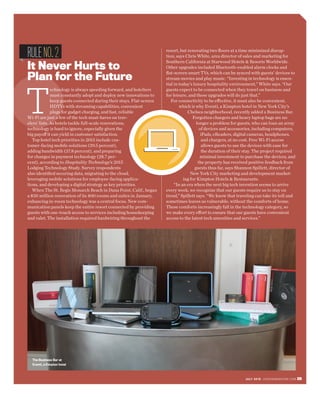
which is why Eventi, a Kimpton hotel in New York City’s
Chelsea neighborhood, recently added a Business Bar.
Forgotten chargers and heavy laptop bags are no
longer a problem for guests, who can loan an array
of devices and accessories, including computers,
iPads, eReaders, digital cameras, headphones,
and chargers, at no cost. Free Wi-Fi access
allows guests to use the devices with ease for
the duration of their stay. The project required
minimal investment to purchase the devices, and
the property has received positive feedback from
guests thus far, says Shannon Spillett, director of
New York City marketing and development market-
ing for Kimpton Hotels & Restaurants.
“In an era when the next big tech invention seems to arrive
every week, we recognize that our guests require us to stay on
trend,” Spillett says. “We know that traveling can take its toll and
sometimes leaves us vulnerable, without the comforts of home.
These comforts increasingly fall in the technology category, so
we make every effort to ensure that our guests have convenient
access to the latest tech amenities and services.”
The Business Bar at
Eventi, a Kimpton hotel
36 LODGINGMAG A ZINE.COM JULY 2015
›››››››››
REFRESHING ADVICE
RULENO.3
A Sustainable
Approach to Design
Will Save You Money
F
rom water-conserving fixtures to efficient LED
lighting, sustainability initiatives not only allow
hotels to be more environmentally responsible
but also have the potential to dramatically cut
costs. That’s why going green is a major focal
point for many of the owners currently tackling renovations.
According to AH&LA’s 2014 Lodging Survey, 16 percent of
respondents planned to incorporate LEED in structural ren-
ovationsoverthenext12months,upfrom13percentin2012.
Taking the first steps toward becoming a sustainable
hotel and cutting costs doesn’t have to entail an enormous
investment or inconvenient downtime. In 2009, Starwood
Hotels & Resorts Worldwide set an aggressive goal of 30
percent reduction in energy consumption and 20 percent
reduction in water consumption by 2020. In 2013, Star-
wood added a goal to reduce carbon emissions by 30
percent in the same timeframe. With more
than 1,200 properties worldwide under
10 brands, Starwood and its franchi-
sees had a lot on their plates. But by
taking a triple-bottom-line approach
to sustainability, the company has
made significant progress toward its
“30/20 by 20” target, says Andrea
Pinabell, vice president of sustain-
ability at Starwood. Using 2008 data
as a baseline, Starwood has cut energy
by 12.1 percent, carbon emissions by 16.07
percent, and water usage by 17.26 percent per
built hotel room thus far through the end of 2014.
“Sustainability is not making one big change—it is a lot
of small efforts put together,” Pinabell explains. “In every-
thing that we do, we look at the environmental impact, the
community impact, as well as the financial impact. We
look for changes that will reduce our energy and water
consumption, decrease our waste production, but also
provide value to our ownership.”
Ongoing foundational initiatives consist of small, no-or
low-cost changes—such as installing LED lighting and
low-flow fixtures—that have a return on investment of
about a year or less. These foundational initiatives are
projected to save $1 billion throughout the system in fewer
than 10 years. Bigger capital investments involve large-
scale renovations, such as mechanical equipment and
irrigation improvements, as well as adopting renewable
energy sources, like solar. To offset some of the costs of
these big-ticket items, Starwood leverages business part-
nerships that will incentivize owners.
The 873-room Westin New York at Times Square is
among the properties in the Starwood system reaping
the benefits of sustainable renovations. In 2011, the
Westin became the first hotel in the state of New York to
receive a silver certification from Green Seal, a nonprofit
environmental standard development and certification
organization. In June, the hotel completed a three-year,
multi-phase, $33 million renovation that tackled all aspects
of the property. Energy conservation enhancements
included installation of two energy efficient chillers, four
heating boilers, and a temperature monitoring system.
Movement-activated lighting and LED lightbulbs have cut
electricity costs, while low-flow toilets and faucet aerators
have reduced water consumption. The 6,000 LED lights
that were installed throughout the course of the project
translate into an overall reduction of energy consumption
by more than 30 percent. Once four more separate LED
lighting projects are complete, it will result in an addition-
al $250,000 in savings in less than a year.
Starwood may be cuttings costs and carbon emissions
with foundational changes, but Berkshire East Mountain
Resort in Charlemont, Mass., is seeing big results in hav-
ing an on-site solar farm and wind turbine. The rotating
solar panels, which track the sun throughout the day, were
installed in 2012, allowing the ski resort to run entirely
off renewable energy. By making this move, the resort was
able to lock in a price for electricity and avoid rising costs.
“Not only is it extremely logical, from a business
standpoint, to have renewable wind and solar, but it
has also helped develop great customer relationships,”
explains Resort Manager Jon Schaefer. “It’s certainly
boosted our business.”
Westin New York
at Times Square
JULY 2015 LODGINGMAG A ZINE.COM 37
Proven Energy Efficient
Laundry Technology
Energy efficient laundry technology that cuts costs while providing a cleaner product
Call us today for further details
800-262-0203 | 805-549-9724
sales@ecotexozone.com | www.ecotexozone.com
Hospitality operations find a treasure trove of cash coming from the laundry room after
switching to EcoTex cold water systems. As soon as you install your EcoTex on-premise laundry
system, the savings begin. The advanced laundry oxidation technology provides superior
disinfection along with major utility cost reductions. Your linens come out cleaner, softer, and
fresher, saving money on linen replacement while reaping huge savings on energy and water.
“We have saved money in water and sewer
expenses, electricity, natural gas, chemical
usage, and the product is coming out softer
and less wear and tear from washing.
Ron Soto, CHA General Manager,
Best Western Plus, Tempe by the Mall, AZ
“Our customers have truly endorsed the
EcoTex Ozone system. They have
significantly reduced operating costs and
experienced their laundry rooms operating
more efficiently with reduced hot water
consumption.”
Dean Anderson, General Manager,
Hyatt Palm Springs, CA
“When our old ozone system failed, I
contacted ClearWater Tech. The best call
I ever made. They simplified the ozone
process so there is minimal maintenance,
and the EcoTex system has brought our
laundry costs down. Our linens, towels,
bed sheets, pillow cases, table cloths,
napkins, and chefs jackets come out
whiter, cleaner, and smell fresher.”
Troy Simao, Facility Maintenance Manager
Vintners Inn, Santa Rosa, CA
EcoTex - The Cold Water Washing System
Call us today for further details
CAPITAL EXPENDITURES (CAPEX) ARE EX-
PECTED TO HIT RECORD LEVELS IN 2015 AND
2016. HOSPITALITY EXPERTS DISCUSSED THE
BENEFITS OF GOOD PLANNING, THE ISSUES
OF BAD BUDGETS, AND MORE DURING A
PANEL AT THE HD EXPO IN LAS VEGAS IN
MAY. HERE ARE A FEW THINGS TO CONSIDER
BEFORE STARTING YOUR NEXT PROJECT.
Align yourself with the right
designers. “The designer can be detrimental
or can create incredible value,” explains Shai
Zelering, managing director of asset manage-
ment and operations for Thayer Lodging. To
make an informed decision and determine the
right fit, Thayer typically approaches two to
three designers per project. “We see how they
balance art and commerce,” he says. “There
are some creative ideas, but if it doesn’t trans-
late in ROI, it doesn’t work for us.”
FOR A
SMOOTH
TRANSITION6TIPS Assemble a well-rounded team.
Make sure all parties involved are team players
who understand the scope and budget of
the project and the desired end result. “If you
select the right designer, the right procurement
team, and the right project manager, they will
get you to the promised land, as long as you as
an owner are ready to make decisions between
what’s nice and necessary,” Zelering says.
Overcommunicate. Comprehensive
project kickoff meetings can help streamline
the design process, especially on a tight
schedule, explains Helen Jorgenson, VP of
design and procurement at Host Hotels and
Resorts. “Get everyone in the room at the
same time, from property to procurement
agent to design firm, and go over the entire
project, the schedule, and get down to the nitty-
gritty to mitigate any risks,” she suggests.
Establish a clear budget. Project
managers should communicate the budget so
designers spend money smartly and identify
areas where they can save. “It’s difficult for
designers to design to the budget if they don’t
know what budget is,” Jorgenson says.
Allocate sufficient time for all
aspects of the project. To avoid throwing
off the schedule, build in time for creating pro-
totypes and mockups or signing shop drawings
and approving finishes. When it comes to
procurement, involve vendors early on, adds
Warren Feldman, CEO of Jonathan Nehmer +
Associates. “We’re trying to go over comments
and shop drawings and get things resolved on
the phone or through video conferencing to
make sure there is better communication of
what the designer wants, what’s on the project
scope, and what the vendor is trying to make.”
Have enough bandwidth. Be
selective about who you partner with or what
projects you take on. “Don’t over-commit,”
Zelering says. “When you’re thinking about
your next job, and you didn’t do a good job on
the current one, things get sideways.”

Renovation Feature

  • 1.
    RENOVATION RULES OF BY LOD G I N G STA F F ›››››››› REFRESHING ADVICE JULY 2015 LODGINGMAG A ZINE.COM 33 PLUS 6TIPS FOR A SMOOTH TRANSITION
  • 2.
    34 LO DG I N G M A G A Z I N E . C O M JULY 2015 ››››››››› REFRESHING ADVICE RULENO.1 Property Improvement Plans Are Never Cost Neutral W hen Cicero’s Development Corp. gets involved in a hotel renovation project, it typically starts with a call from an owner who needs to conduct a property improvement plan (PIP). During the conversation, they discuss the budget and scope of the project and how they can align with the owner’s business plan. “In all cases, we say, ‘Give a range of prices you want us to fall in between,’” says founder Sam Cicero. “It has to be a conscious business decision.” An effective PIP should help a property gain market share, increase guest satis- faction, drive revenue performance, and enhance profitability, according to HVS. When determining where to direct capital investments, owners focus on areas that will drive a considerable return, and whether that means tackling a guestroom re- fresh, an FF&E renovation, or a complete revamp of the public spaces depends on a variety of factors, including a property’s performance in the market, where it is in the life cycle, and whether it is in the process of repositioning or rebranding. PIP projects should always start with design professionals, Cicero stresses. “That’s the part owners skip over—just go to the flag and get whatever they recommend. But, if they go this route, by the time they get to the end, they’re usually over budget. You want to take what the flag wants them to do and make it fit the budget.” The best way for owners to prevent spending excesses is to get a good general contractor involved in the project early, Cicero explains. “Contractors will watch the purse strings and timeline and get whatever professionals involved that they need. You want to maintain the design, watch the budget, and do whatever you can to increase the property’s sustainability.” Last year, Cicero’s completed a multimillion-dollar renovation of more than 25,000 square feet of meeting space in the DoubleTree by Hilton Hotel Chicago–Oak Brook. The refresh included a new look for the grand ballroom, in which the team changed out 469 incandescent downlights with 407 energy efficient LED fixtures and installed a dimming system. They also removed more than 100 fluorescent ceiling fixtures and replaced them with 15 larger hybrid LED chandeliers. “They got savings, and it was better for the en- vironment,” Cicero says. Since the hotel is located near many corporate offices, Cicero’s also made changes that would better accommodate business travelers. These included converting the hotel’s Wine Den bar and restaurant into a meet- ing facility for hosting intimate to midsize events. The gut-job involved installing new ceilings, energy-saving lighting, wall finishes, and trim. They also mounted glass doors to provide easy access to the 1,500-square-foot outdoor deck. To accomplish the owner’s end goal, renovation experts must consider a variety of factors, such as how the project will save owners money or how to meet brand standards without going astray. It’s also smart to leverage the existing asset to emphasize the hotel’s strengths. Owners with one or two hotels can sometimes lose track of the big picture, Cicero says, which is why it’s important to get the right par- ties involved to steer the project in the right direction. “If you are making decisions solely on your budget, you may be making cuts on quality that will inhibit your abil- ity to sell the property down the road,” he says. “If it costs more than you have right now, phase the project so you can do what you want in the confines of your budget.” odging’s current robust performance is creating a competitive environ- ment when it comes to product freshness. The industry fun- damentals have never been better, and these conditions are driving a flurry of construc- tion projects, rebranding and conversion activity, and reno- vations of every scope through- out the United States. In the last three years, an estimated 1.2 million hotel rooms have been renovated, representing more than 20 percent of the existing supply, Lodging Econometrics (LE) data reveals. According to Bruce Ford, LE’s senior vice president and director of global business development, the number of renovations will likely trend downward as strong hotel op- erating profitability discourag- es owners from making rooms unavailable while being reno- vated. However, for those hote- liers willing to take the plunge and make some upgrades, here are some key takeaways for making the best renovation decisions for your bottom line.
  • 3.
    JULY 2015 LODGINGMAGA ZINE.COM 35 RULENO.2 It Never Hurts to Plan for the Future T echnology is always speeding forward, and hoteliers must constantly adopt and deploy new innovations to keep guests connected during their stays. Flat-screen HDTVs with streaming capabilities, convenient plugs for gadget charging, and fast, reliable Wi-Fi are just a few of the tech must-haves on trav- elers’ lists. As hotels tackle full-scale renovations, technology is hard to ignore, especially given the big payoff it can yield in customer satisfaction. Top hotel tech priorities in 2015 include cus- tomer-facing mobile solutions (39.5 percent), adding bandwidth (37.8 percent), and preparing for changes in payment technology (28.7 per- cent), according to Hospitality Technology’s 2015 Lodging Technology Study. Survey respondents also identified securing data, migrating to the cloud, leveraging mobile solutions for employee-facing applica- tions, and developing a digital strategy as key priorities. When The St. Regis Monarch Beach in Dana Point, Calif., began a $30 million renovation of its 400 rooms and suites in January, enhancing in-room technology was a central focus. New com- munication panels keep the entire resort connected by providing guests with one-touch access to services including housekeeping and valet. The installation required hardwiring throughout the resort, but renovating two floors at a time minimized disrup- tion, says Chris White, area director of sales and marketing for Southern California at Starwood Hotels & Resorts Worldwide. Other upgrades included Bluetooth-enabled alarm clocks and flat-screen smart TVs, which can be synced with guests’ devices to stream movies and play music. “Investing in technology is essen- tial in today’s luxury hospitality environment,” White says. “Our guests expect to be connected when they travel on business and for leisure, and these upgrades will do just that.” For connectivity to be effective, it must also be convenient, which is why Eventi, a Kimpton hotel in New York City’s Chelsea neighborhood, recently added a Business Bar. Forgotten chargers and heavy laptop bags are no longer a problem for guests, who can loan an array of devices and accessories, including computers, iPads, eReaders, digital cameras, headphones, and chargers, at no cost. Free Wi-Fi access allows guests to use the devices with ease for the duration of their stay. The project required minimal investment to purchase the devices, and the property has received positive feedback from guests thus far, says Shannon Spillett, director of New York City marketing and development market- ing for Kimpton Hotels & Restaurants. “In an era when the next big tech invention seems to arrive every week, we recognize that our guests require us to stay on trend,” Spillett says. “We know that traveling can take its toll and sometimes leaves us vulnerable, without the comforts of home. These comforts increasingly fall in the technology category, so we make every effort to ensure that our guests have convenient access to the latest tech amenities and services.” The Business Bar at Eventi, a Kimpton hotel
  • 4.
    36 LODGINGMAG AZINE.COM JULY 2015 ››››››››› REFRESHING ADVICE RULENO.3 A Sustainable Approach to Design Will Save You Money F rom water-conserving fixtures to efficient LED lighting, sustainability initiatives not only allow hotels to be more environmentally responsible but also have the potential to dramatically cut costs. That’s why going green is a major focal point for many of the owners currently tackling renovations. According to AH&LA’s 2014 Lodging Survey, 16 percent of respondents planned to incorporate LEED in structural ren- ovationsoverthenext12months,upfrom13percentin2012. Taking the first steps toward becoming a sustainable hotel and cutting costs doesn’t have to entail an enormous investment or inconvenient downtime. In 2009, Starwood Hotels & Resorts Worldwide set an aggressive goal of 30 percent reduction in energy consumption and 20 percent reduction in water consumption by 2020. In 2013, Star- wood added a goal to reduce carbon emissions by 30 percent in the same timeframe. With more than 1,200 properties worldwide under 10 brands, Starwood and its franchi- sees had a lot on their plates. But by taking a triple-bottom-line approach to sustainability, the company has made significant progress toward its “30/20 by 20” target, says Andrea Pinabell, vice president of sustain- ability at Starwood. Using 2008 data as a baseline, Starwood has cut energy by 12.1 percent, carbon emissions by 16.07 percent, and water usage by 17.26 percent per built hotel room thus far through the end of 2014. “Sustainability is not making one big change—it is a lot of small efforts put together,” Pinabell explains. “In every- thing that we do, we look at the environmental impact, the community impact, as well as the financial impact. We look for changes that will reduce our energy and water consumption, decrease our waste production, but also provide value to our ownership.” Ongoing foundational initiatives consist of small, no-or low-cost changes—such as installing LED lighting and low-flow fixtures—that have a return on investment of about a year or less. These foundational initiatives are projected to save $1 billion throughout the system in fewer than 10 years. Bigger capital investments involve large- scale renovations, such as mechanical equipment and irrigation improvements, as well as adopting renewable energy sources, like solar. To offset some of the costs of these big-ticket items, Starwood leverages business part- nerships that will incentivize owners. The 873-room Westin New York at Times Square is among the properties in the Starwood system reaping the benefits of sustainable renovations. In 2011, the Westin became the first hotel in the state of New York to receive a silver certification from Green Seal, a nonprofit environmental standard development and certification organization. In June, the hotel completed a three-year, multi-phase, $33 million renovation that tackled all aspects of the property. Energy conservation enhancements included installation of two energy efficient chillers, four heating boilers, and a temperature monitoring system. Movement-activated lighting and LED lightbulbs have cut electricity costs, while low-flow toilets and faucet aerators have reduced water consumption. The 6,000 LED lights that were installed throughout the course of the project translate into an overall reduction of energy consumption by more than 30 percent. Once four more separate LED lighting projects are complete, it will result in an addition- al $250,000 in savings in less than a year. Starwood may be cuttings costs and carbon emissions with foundational changes, but Berkshire East Mountain Resort in Charlemont, Mass., is seeing big results in hav- ing an on-site solar farm and wind turbine. The rotating solar panels, which track the sun throughout the day, were installed in 2012, allowing the ski resort to run entirely off renewable energy. By making this move, the resort was able to lock in a price for electricity and avoid rising costs. “Not only is it extremely logical, from a business standpoint, to have renewable wind and solar, but it has also helped develop great customer relationships,” explains Resort Manager Jon Schaefer. “It’s certainly boosted our business.” Westin New York at Times Square
  • 5.
    JULY 2015 LODGINGMAGA ZINE.COM 37 Proven Energy Efficient Laundry Technology Energy efficient laundry technology that cuts costs while providing a cleaner product Call us today for further details 800-262-0203 | 805-549-9724 sales@ecotexozone.com | www.ecotexozone.com Hospitality operations find a treasure trove of cash coming from the laundry room after switching to EcoTex cold water systems. As soon as you install your EcoTex on-premise laundry system, the savings begin. The advanced laundry oxidation technology provides superior disinfection along with major utility cost reductions. Your linens come out cleaner, softer, and fresher, saving money on linen replacement while reaping huge savings on energy and water. “We have saved money in water and sewer expenses, electricity, natural gas, chemical usage, and the product is coming out softer and less wear and tear from washing. Ron Soto, CHA General Manager, Best Western Plus, Tempe by the Mall, AZ “Our customers have truly endorsed the EcoTex Ozone system. They have significantly reduced operating costs and experienced their laundry rooms operating more efficiently with reduced hot water consumption.” Dean Anderson, General Manager, Hyatt Palm Springs, CA “When our old ozone system failed, I contacted ClearWater Tech. The best call I ever made. They simplified the ozone process so there is minimal maintenance, and the EcoTex system has brought our laundry costs down. Our linens, towels, bed sheets, pillow cases, table cloths, napkins, and chefs jackets come out whiter, cleaner, and smell fresher.” Troy Simao, Facility Maintenance Manager Vintners Inn, Santa Rosa, CA EcoTex - The Cold Water Washing System Call us today for further details CAPITAL EXPENDITURES (CAPEX) ARE EX- PECTED TO HIT RECORD LEVELS IN 2015 AND 2016. HOSPITALITY EXPERTS DISCUSSED THE BENEFITS OF GOOD PLANNING, THE ISSUES OF BAD BUDGETS, AND MORE DURING A PANEL AT THE HD EXPO IN LAS VEGAS IN MAY. HERE ARE A FEW THINGS TO CONSIDER BEFORE STARTING YOUR NEXT PROJECT. Align yourself with the right designers. “The designer can be detrimental or can create incredible value,” explains Shai Zelering, managing director of asset manage- ment and operations for Thayer Lodging. To make an informed decision and determine the right fit, Thayer typically approaches two to three designers per project. “We see how they balance art and commerce,” he says. “There are some creative ideas, but if it doesn’t trans- late in ROI, it doesn’t work for us.” FOR A SMOOTH TRANSITION6TIPS Assemble a well-rounded team. Make sure all parties involved are team players who understand the scope and budget of the project and the desired end result. “If you select the right designer, the right procurement team, and the right project manager, they will get you to the promised land, as long as you as an owner are ready to make decisions between what’s nice and necessary,” Zelering says. Overcommunicate. Comprehensive project kickoff meetings can help streamline the design process, especially on a tight schedule, explains Helen Jorgenson, VP of design and procurement at Host Hotels and Resorts. “Get everyone in the room at the same time, from property to procurement agent to design firm, and go over the entire project, the schedule, and get down to the nitty- gritty to mitigate any risks,” she suggests. Establish a clear budget. Project managers should communicate the budget so designers spend money smartly and identify areas where they can save. “It’s difficult for designers to design to the budget if they don’t know what budget is,” Jorgenson says. Allocate sufficient time for all aspects of the project. To avoid throwing off the schedule, build in time for creating pro- totypes and mockups or signing shop drawings and approving finishes. When it comes to procurement, involve vendors early on, adds Warren Feldman, CEO of Jonathan Nehmer + Associates. “We’re trying to go over comments and shop drawings and get things resolved on the phone or through video conferencing to make sure there is better communication of what the designer wants, what’s on the project scope, and what the vendor is trying to make.” Have enough bandwidth. Be selective about who you partner with or what projects you take on. “Don’t over-commit,” Zelering says. “When you’re thinking about your next job, and you didn’t do a good job on the current one, things get sideways.”