The Key Design Principles for Hotel Interiors
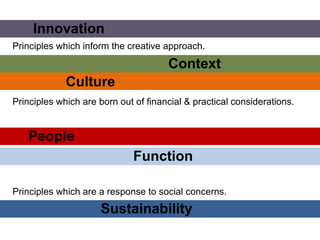
Innovation   -  Yotel  Context   -  Niki Club  Culture  -  Park Hotels  People  -  Boundary   Function   -  Das Triest Sustainability  -  South Place Principles which inform the creative approach. Principles which are born out of financial & practical considerations. Principles which are a response to social concerns.
Innovation  -   Yotel Why: Because clients are looking for fresh, inspired ideas, a point of difference and edge. It is a ‘designer’s duty’ to push the boundaries, to enhance and to create.
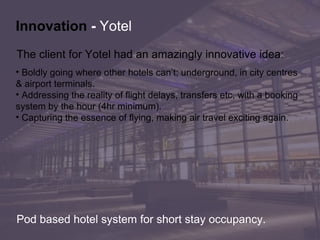
The client for Yotel had an amazingly innovative idea:  Boldly going where other hotels can’t; underground, in city centres  & airport terminals.  Addressing the reality of flight delays, transfers etc, with a booking  system by the hour (4hr minimum). Capturing the essence of flying, making air travel exciting again . Innovation   -  Yotel Pod based hotel system for short stay occupancy.
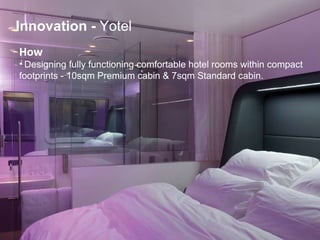
How   Designing fully functioning comfortable hotel rooms within compact  footprints - 10sqm Premium cabin & 7sqm Standard cabin. Innovation   -  Yotel
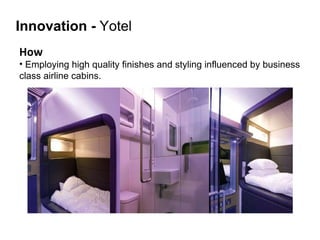
How   Employing high quality finishes and styling influenced by business  class airline cabins.  Innovation   -  Yotel
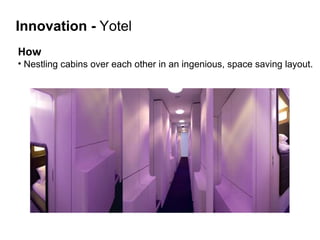
How   Nestling cabins over each other in an ingenious, space saving layout.  Innovation   -  Yotel
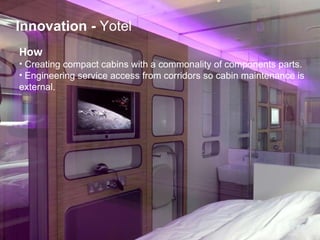
How   Creating compact cabins with a commonality of components parts.  Engineering service access from corridors so cabin maintenance is  external.   Innovation   -  Yotel
Context  -  Niki Club Why: Because being aware of ‘the landscape’ informs design decisions, whether to achieve synergy or contrast.
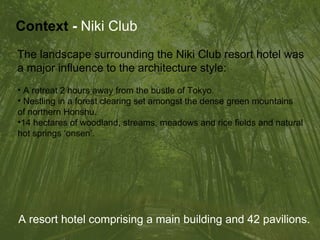
The landscape surrounding the Niki Club resort hotel was  a major influence to the architecture style: A retreat 2 hours away from the bustle of Tokyo. Nestling in a forest clearing set amongst the dense green mountains  of northern Honshu. 14 hectares of woodland, streams, meadows and rice fields and natural  hot springs ‘onsen’. Context   -  Niki Club A resort hotel comprising a main building and 42 pavilions.
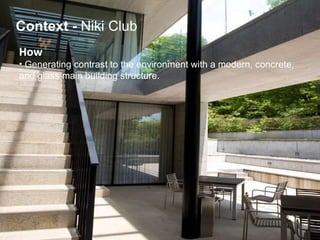
How   Generating contrast to the environment with a modern, concrete,  and glass main building structure. Context   -  Niki Club
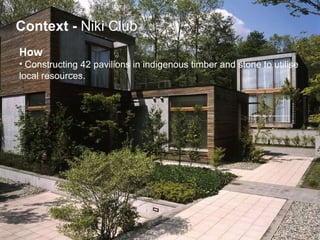
How   Constructing 42 pavilions in indigenous timber and stone to utilise local resources.  Context   -  Niki Club
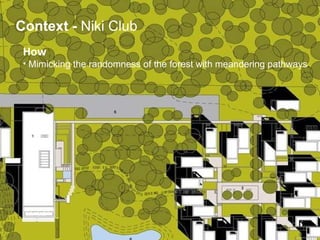
How   Mimicking the randomness of the forest with meandering pathways .  Context   -  Niki Club
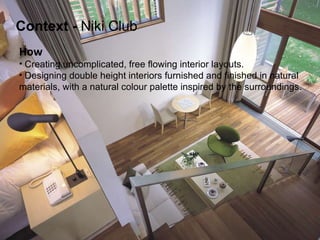
How   Creating uncomplicated, free flowing interior layouts. Designing double height interiors furnished and finished in natural  materials, with a natural colour palette inspired by the surroundings. Context   -  Niki Club
Culture  -  Park Hotels Why: Because being aware of ‘the culture’ of the place informs design decisions, whether to achieve synergy or contrast.
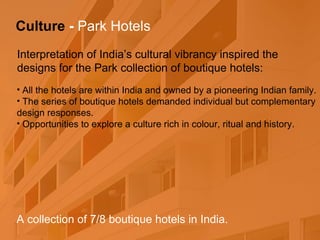
All the hotels are within India and owned by a pioneering Indian family. The series of boutique hotels demanded individual but complementary  design responses. Opportunities to explore a culture rich in colour, ritual and history. Culture   -  Park Hotels Interpretation of India’s cultural vibrancy inspired the  designs for the Park collection of boutique hotels: A collection of 7/8 boutique hotels in India.
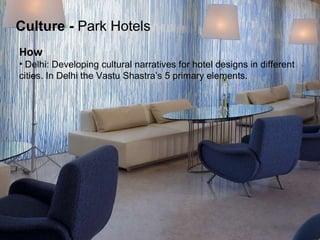
How   Delhi: Developing cultural narratives for hotel designs in different  cities. In Delhi the Vastu Shastra’s 5 primary elements.  Culture   -  Park Hotels
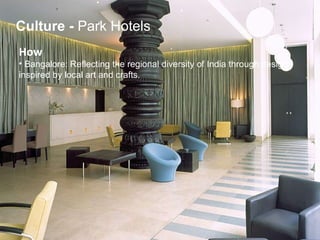
How   Bangalore: Reflecting the regional diversity of India through design  inspired by local art and crafts. Culture   -  Park Hotels
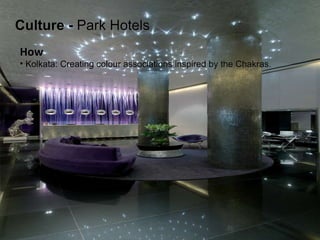
How   Kolkata: Creating colour associations inspired by the Chakras.  Culture   -  Park Hotels How   Kolkata: Creating colour associations inspired by the Chakras.  Culture   -  Park Hotels
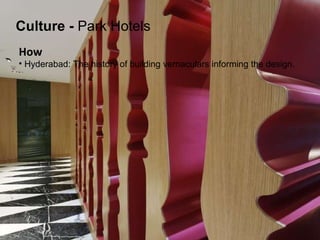
How   Hyderabad: The history of building vernaculars informing the design. Culture   -  Park Hotels
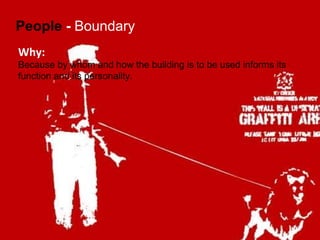
People  -  Boundary Why: Because by whom and how the building is to be used informs its function and its personality.
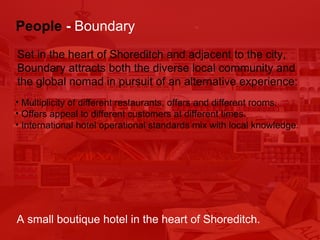
Multiplicity of different restaurants, offers and different rooms. Offers appeal to different customers at different times. International hotel operational standards mix with local knowledge. People   -  Boundary Set in the heart of Shoreditch and adjacent to the city,  Boundary attracts both the diverse local community and  the global nomad in pursuit of an alternative experience: A small boutique hotel in the heart of Shoreditch.
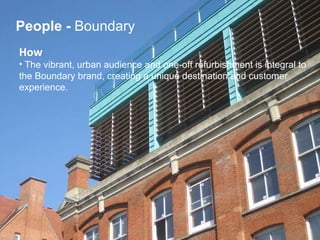
How   The vibrant, urban audience and one-off refurbishment is integral to  the Boundary brand, creating a unique destination and customer  experience. People   -  Boundary
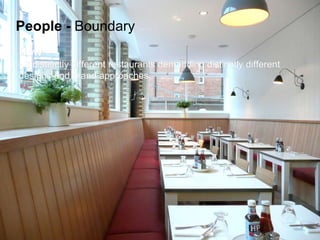
How   3 distinctly different restaurants demanding distinctly different  designs and brand approaches. People   -  Boundary How   3 distinctly different restaurants demanding distinctly different  designs and brand approaches.
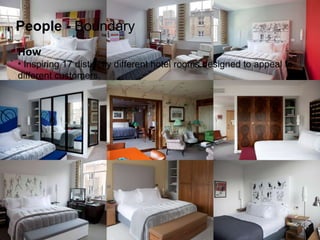
How   Inspiring 17 distinctly different hotel rooms designed to appeal to  different customers. People   -  Boundary
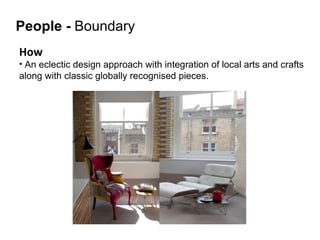
How   An eclectic design approach with integration of local arts and crafts  along with classic globally recognised pieces. People   -  Boundary
Function  -  Das Triest Why: Hotel design and service must fulfil function and embrace budget.
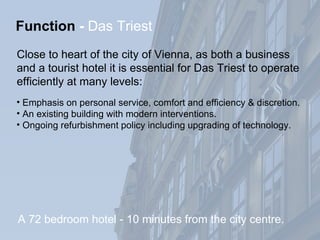
Emphasis on personal service, comfort and efficiency & discretion. An existing building with modern interventions. Ongoing refurbishment policy including upgrading of technology. Function   -  Das Triest Close to heart of the city of Vienna, as both a business  and a tourist hotel it is essential for Das Triest to operate  efficiently at many levels: A 72 bedroom hotel - 10 minutes from the city centre.
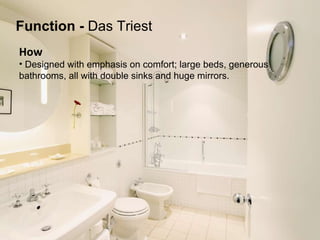
How   Designed with emphasis on comfort; large beds, generous  bathrooms, all with double sinks and huge mirrors.  Function   -  Das Triest
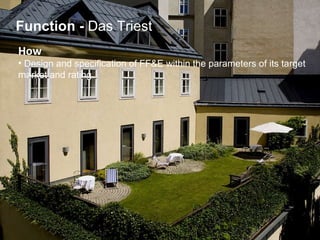
How   Design and specification of FF&E within the parameters of its target  market and rating.  Function   -  Das Triest
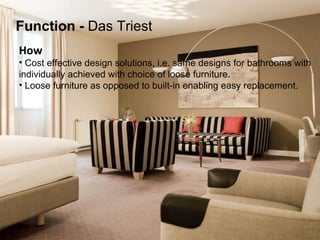
How   Cost effective design solutions, i.e. same designs for bathrooms with individually achieved with choice of loose furniture. Loose furniture as opposed to built-in enabling easy replacement. Function   -  Das Triest
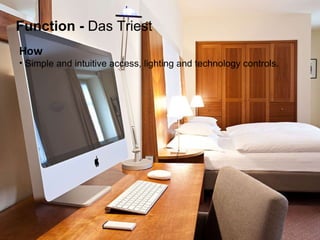
How   Simple and intuitive access, lighting and technology controls. Function   -  Das Triest
Sustainability  -  South Place Why: Because social and environmental responsibility is essential to business and development.  
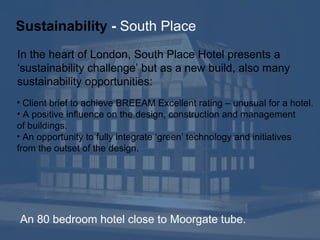
Client brief to achieve BREEAM Excellent rating – unusual for a hotel. A positive influence on the design, construction and management  of buildings. An opportunity to fully integrate ‘green’ technology and initiatives  from the outset of the design.  Sustainability   -  South Place In the heart of London, South Place Hotel presents a  ‘ sustainability challenge’ but as a new build, also many  sustainability opportunities: An 80 bedroom hotel close to Moorgate tube.
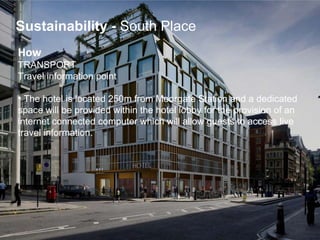
How   TRANSPORT Travel information point   The hotel is located 250m from Moorgate Station and a dedicated  space will be provided within the hotel lobby for the provision of an  internet connected computer which will allow guests to access live  travel information. Sustainability   -  South Place
How   WATER Water consumption   Where evidence provided demonstrates that the specification  includes taps, urinals, WCs and showers that consume less potable  water in use than standard specifications for the same type of fittings. 6/4l dual flush WC. All taps (except cleaners and kitchens) to have minimum flow rate  of 6l/min. Sustainability   -  South Place
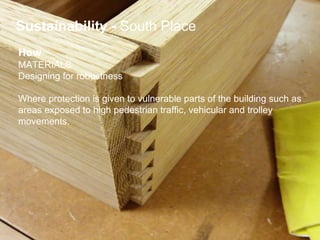
How   MATERIALS Designing for robustness   Where protection is given to vulnerable parts of the building such as  areas exposed to high pedestrian traffic, vehicular and trolley  movements. Sustainability   -  South Place
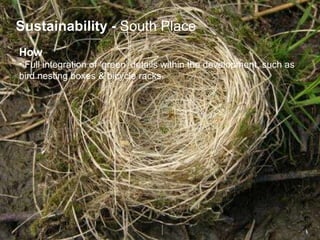
How   Full integration of ‘green’ details within the development, such as  bird nesting boxes & bicycle racks. Sustainability   -  South Place
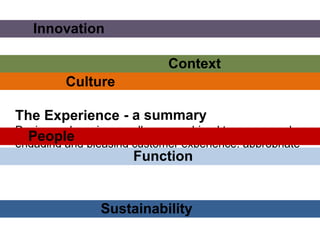
  - a summary Design and service excellence combined to ensure and engaging and pleasing customer experience, appropriate to the target audience and context.   The Experience Innovation   -  Yotel  Context   -  Niki Club  Culture  -  Parks Hotels  People  -  The Boundary   Function   -  Das Triest Sustainability  -  South place
Conran & Partners

  • 1.
    The Key DesignPrinciples for Hotel Interiors
  • 2.
    Innovation - Yotel Context - Niki Club Culture - Park Hotels People - Boundary Function - Das Triest Sustainability - South Place Principles which inform the creative approach. Principles which are born out of financial & practical considerations. Principles which are a response to social concerns.
  • 3.
    Innovation - Yotel Why: Because clients are looking for fresh, inspired ideas, a point of difference and edge. It is a ‘designer’s duty’ to push the boundaries, to enhance and to create.
  • 4.
    The client forYotel had an amazingly innovative idea: Boldly going where other hotels can’t; underground, in city centres & airport terminals. Addressing the reality of flight delays, transfers etc, with a booking system by the hour (4hr minimum). Capturing the essence of flying, making air travel exciting again . Innovation - Yotel Pod based hotel system for short stay occupancy.
  • 5.
    How Designing fully functioning comfortable hotel rooms within compact footprints - 10sqm Premium cabin & 7sqm Standard cabin. Innovation - Yotel
  • 6.
    How Employing high quality finishes and styling influenced by business class airline cabins. Innovation - Yotel
  • 7.
    How Nestling cabins over each other in an ingenious, space saving layout. Innovation - Yotel
  • 8.
    How Creating compact cabins with a commonality of components parts. Engineering service access from corridors so cabin maintenance is external.   Innovation - Yotel
  • 9.
    Context - Niki Club Why: Because being aware of ‘the landscape’ informs design decisions, whether to achieve synergy or contrast.
  • 10.
    The landscape surroundingthe Niki Club resort hotel was a major influence to the architecture style: A retreat 2 hours away from the bustle of Tokyo. Nestling in a forest clearing set amongst the dense green mountains of northern Honshu. 14 hectares of woodland, streams, meadows and rice fields and natural hot springs ‘onsen’. Context - Niki Club A resort hotel comprising a main building and 42 pavilions.
  • 11.
    How Generating contrast to the environment with a modern, concrete, and glass main building structure. Context - Niki Club
  • 12.
    How Constructing 42 pavilions in indigenous timber and stone to utilise local resources. Context - Niki Club
  • 13.
    How Mimicking the randomness of the forest with meandering pathways . Context - Niki Club
  • 14.
    How Creating uncomplicated, free flowing interior layouts. Designing double height interiors furnished and finished in natural materials, with a natural colour palette inspired by the surroundings. Context - Niki Club
  • 15.
    Culture - Park Hotels Why: Because being aware of ‘the culture’ of the place informs design decisions, whether to achieve synergy or contrast.
  • 16.
    All the hotelsare within India and owned by a pioneering Indian family. The series of boutique hotels demanded individual but complementary design responses. Opportunities to explore a culture rich in colour, ritual and history. Culture - Park Hotels Interpretation of India’s cultural vibrancy inspired the designs for the Park collection of boutique hotels: A collection of 7/8 boutique hotels in India.
  • 17.
    How Delhi: Developing cultural narratives for hotel designs in different cities. In Delhi the Vastu Shastra’s 5 primary elements. Culture - Park Hotels
  • 18.
    How Bangalore: Reflecting the regional diversity of India through design inspired by local art and crafts. Culture - Park Hotels
  • 19.
    How Kolkata: Creating colour associations inspired by the Chakras. Culture - Park Hotels How Kolkata: Creating colour associations inspired by the Chakras. Culture - Park Hotels
  • 20.
    How Hyderabad: The history of building vernaculars informing the design. Culture - Park Hotels
  • 21.
    People - Boundary Why: Because by whom and how the building is to be used informs its function and its personality.
  • 22.
    Multiplicity of differentrestaurants, offers and different rooms. Offers appeal to different customers at different times. International hotel operational standards mix with local knowledge. People - Boundary Set in the heart of Shoreditch and adjacent to the city, Boundary attracts both the diverse local community and the global nomad in pursuit of an alternative experience: A small boutique hotel in the heart of Shoreditch.
  • 23.
    How The vibrant, urban audience and one-off refurbishment is integral to the Boundary brand, creating a unique destination and customer experience. People - Boundary
  • 24.
    How 3 distinctly different restaurants demanding distinctly different designs and brand approaches. People - Boundary How 3 distinctly different restaurants demanding distinctly different designs and brand approaches.
  • 25.
    How Inspiring 17 distinctly different hotel rooms designed to appeal to different customers. People - Boundary
  • 26.
    How An eclectic design approach with integration of local arts and crafts along with classic globally recognised pieces. People - Boundary
  • 27.
    Function - Das Triest Why: Hotel design and service must fulfil function and embrace budget.
  • 28.
    Emphasis on personalservice, comfort and efficiency & discretion. An existing building with modern interventions. Ongoing refurbishment policy including upgrading of technology. Function - Das Triest Close to heart of the city of Vienna, as both a business and a tourist hotel it is essential for Das Triest to operate efficiently at many levels: A 72 bedroom hotel - 10 minutes from the city centre.
  • 29.
    How Designed with emphasis on comfort; large beds, generous bathrooms, all with double sinks and huge mirrors. Function - Das Triest
  • 30.
    How Design and specification of FF&E within the parameters of its target market and rating. Function - Das Triest
  • 31.
    How Cost effective design solutions, i.e. same designs for bathrooms with individually achieved with choice of loose furniture. Loose furniture as opposed to built-in enabling easy replacement. Function - Das Triest
  • 32.
    How Simple and intuitive access, lighting and technology controls. Function - Das Triest
  • 33.
    Sustainability - South Place Why: Because social and environmental responsibility is essential to business and development.  
  • 34.
    Client brief toachieve BREEAM Excellent rating – unusual for a hotel. A positive influence on the design, construction and management of buildings. An opportunity to fully integrate ‘green’ technology and initiatives from the outset of the design.  Sustainability - South Place In the heart of London, South Place Hotel presents a ‘ sustainability challenge’ but as a new build, also many sustainability opportunities: An 80 bedroom hotel close to Moorgate tube.
  • 35.
    How TRANSPORT Travel information point   The hotel is located 250m from Moorgate Station and a dedicated space will be provided within the hotel lobby for the provision of an internet connected computer which will allow guests to access live travel information. Sustainability - South Place
  • 36.
    How WATER Water consumption   Where evidence provided demonstrates that the specification includes taps, urinals, WCs and showers that consume less potable water in use than standard specifications for the same type of fittings. 6/4l dual flush WC. All taps (except cleaners and kitchens) to have minimum flow rate of 6l/min. Sustainability - South Place
  • 37.
    How MATERIALS Designing for robustness   Where protection is given to vulnerable parts of the building such as areas exposed to high pedestrian traffic, vehicular and trolley movements. Sustainability - South Place
  • 38.
    How Full integration of ‘green’ details within the development, such as bird nesting boxes & bicycle racks. Sustainability - South Place
  • 39.
    -a summary Design and service excellence combined to ensure and engaging and pleasing customer experience, appropriate to the target audience and context.   The Experience Innovation - Yotel Context - Niki Club Culture - Parks Hotels People - The Boundary Function - Das Triest Sustainability - South place