Entering the Hotel and Leisure Market Dealing with practical issues: The challenge of securing planning permission Ian Blacker Head of Planning Consultancy, John Rowan & Partners
The challenge of securing planning permission The good news Hotel and leisure uses bring investment, employment and activity.  Planning policy supports the principle of new hotel and leisure development (in town centres). Negative “impacts” should tend to be low. The not-to-good news Many councils struggle to see beyond a list of practical concerns.  Complexity of planning process unrelated to size of site. Planning doesn’t recognise the concept of “open for Xmas”.
Latest national planning policy PPS4 (December 2009) Government objectives include to: “build prosperous communities”…”offering a wide range of services to communities in an attractive and safe environment”…[with] competition and enhanced consumer choice through provision of innovative and efficient leisure and tourism services in town centres”. Local Planning Authorities should: “set flexible policies for their centres which are able to respond to changing economic circumstances…and [should] encourage high density development with access by public transport…encourage a diverse range of complementary evening uses…[and] make provision  where appropriate  for leisure, cultural and tourism activities…”
Key tests within the latest planning policy “ Where appropriate” LPAs should “set out the number and scale of leisure developments they wish to encourage taking account of their potential  impact , including cumulative impact, on the character and function of the centre, anti-social behaviour and crime, and the amenities of neighbouring residents”. “ Impact” Planning applications should be assessed against the following impact considerations: a. carbon dioxide emissions/vulnerability to climate change. b. access by a choice of transport. c. high quality and inclusive design. d. impact on economic/physical regeneration. e. impact on local employment.
Effective planning: meeting those challenges Establish planning strategy and objectives at outset of project. Client objectives: What; by when; at what cost? identify risks and know response position and alternatives.  Justify why you’re not doing something as well as why you are. Essential that the planning approach is informed by an understanding of the complexities of the hospitality industry as an operating business as well as a property business. Highlight the physical and economic regeneration benefits these can deliver to individual buildings, neighbourhoods and whole towns.
Do your homework Planning themes and issues Themes Tend to be national/strategic and political Should be readily identifiable Client position needs to be fixed before scheme put together Issues Tend to be local and “neighbourly” May come late into the process Client position needs to react quickly, assess impact and respond
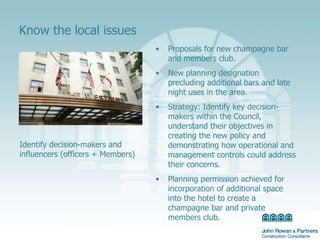
Know the local issues Proposals for new champagne bar and members club. New planning designation precluding additional bars and late night uses in the area.  Strategy: Identify key decision-makers within the Council, understand their objectives in creating the new policy and demonstrating how operational and management controls could address their concerns. Planning permission achieved for incorporation  of additional space into the hotel to create a champagne bar and private members club.  Identify decision-makers and influencers (officers + Members)
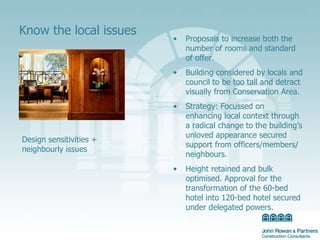
Know the local issues Proposals to increase both the number of rooms and standard of offer. Building  considered by locals and council to be too tall and detract visually from Conservation Area.  Strategy: Focussed on enhancing local context through a radical change to the building’s unloved appearance secured support from officers/members/ neighbours. Height retained and bulk optimised. Approval for the transformation of the 60-bed hotel into 120-bed hotel secured under delegated powers. Design sensitivities + neighbourly issues
Optimising your chances  Dos and don’ts Do: Find allies. Be credible. Accept that it’s going to take longer than you want. Don’t: Under-estimate your neighbours (or their willingness to “do a deal”). Take short-cuts. Ever assume that it’s all sorted.
Hotel & Leisure Projects Effective Project Management Andrew Nycyk Head of Hotels and Leisure, John Rowan & Partners
1. Asset Strategy Owning Structure and Decision Makers Timescales  Investment Plan  Key Investment Drivers
2. Identifying Your Market Current Business Situation   Target Market Position Brand Standards
3. A Robust Brief Set the Brief  The Management Agreement  Seed Budget  Code Requirements Liability?  Outline Programme & Milestones
4. Interior Design Branding What Design Style? Current Trends  Life cycle The Designer
5. Knowing Your Budget Realistic Budget Contingency Control Processes  Reporting Lines  Funder’s Requirements Risk & Procurement
6. Appointing Your Team Prepare Clear Briefs  Detailed Scope of Services  Required Interaction Experience Key Personnel  Realistic Fees Identify Specialists
7. Model Rooms Room Types Review by All Confirm the Design Control Books  Review Programme   & Budget
8. Procurement Procurement Route Risk Profile Vet Contractors/Specialists  Understand the Contract
9. FF&E Translation of the Design Procurement Manager  Manufacturing & Delivery Times Currency & Freight Warehousing and Specialist Logistics Code Compliance
10. Delivery Phase Monitor the Design Programme Open Communication Track Progress and Budget  Stick to the Scope Set the Quality Standard Queries / Issues  Team Work
To Conclude… Take Ownership Share Ideas & Information Check …. & check again Be Open, Honest & Realistic

Ian blacker

  • 1.
    Entering the Hoteland Leisure Market Dealing with practical issues: The challenge of securing planning permission Ian Blacker Head of Planning Consultancy, John Rowan & Partners
  • 2.
    The challenge ofsecuring planning permission The good news Hotel and leisure uses bring investment, employment and activity. Planning policy supports the principle of new hotel and leisure development (in town centres). Negative “impacts” should tend to be low. The not-to-good news Many councils struggle to see beyond a list of practical concerns. Complexity of planning process unrelated to size of site. Planning doesn’t recognise the concept of “open for Xmas”.
  • 3.
    Latest national planningpolicy PPS4 (December 2009) Government objectives include to: “build prosperous communities”…”offering a wide range of services to communities in an attractive and safe environment”…[with] competition and enhanced consumer choice through provision of innovative and efficient leisure and tourism services in town centres”. Local Planning Authorities should: “set flexible policies for their centres which are able to respond to changing economic circumstances…and [should] encourage high density development with access by public transport…encourage a diverse range of complementary evening uses…[and] make provision where appropriate for leisure, cultural and tourism activities…”
  • 4.
    Key tests withinthe latest planning policy “ Where appropriate” LPAs should “set out the number and scale of leisure developments they wish to encourage taking account of their potential impact , including cumulative impact, on the character and function of the centre, anti-social behaviour and crime, and the amenities of neighbouring residents”. “ Impact” Planning applications should be assessed against the following impact considerations: a. carbon dioxide emissions/vulnerability to climate change. b. access by a choice of transport. c. high quality and inclusive design. d. impact on economic/physical regeneration. e. impact on local employment.
  • 5.
    Effective planning: meetingthose challenges Establish planning strategy and objectives at outset of project. Client objectives: What; by when; at what cost? identify risks and know response position and alternatives. Justify why you’re not doing something as well as why you are. Essential that the planning approach is informed by an understanding of the complexities of the hospitality industry as an operating business as well as a property business. Highlight the physical and economic regeneration benefits these can deliver to individual buildings, neighbourhoods and whole towns.
  • 6.
    Do your homeworkPlanning themes and issues Themes Tend to be national/strategic and political Should be readily identifiable Client position needs to be fixed before scheme put together Issues Tend to be local and “neighbourly” May come late into the process Client position needs to react quickly, assess impact and respond
  • 7.
    Know the localissues Proposals for new champagne bar and members club. New planning designation precluding additional bars and late night uses in the area. Strategy: Identify key decision-makers within the Council, understand their objectives in creating the new policy and demonstrating how operational and management controls could address their concerns. Planning permission achieved for incorporation of additional space into the hotel to create a champagne bar and private members club. Identify decision-makers and influencers (officers + Members)
  • 8.
    Know the localissues Proposals to increase both the number of rooms and standard of offer. Building considered by locals and council to be too tall and detract visually from Conservation Area. Strategy: Focussed on enhancing local context through a radical change to the building’s unloved appearance secured support from officers/members/ neighbours. Height retained and bulk optimised. Approval for the transformation of the 60-bed hotel into 120-bed hotel secured under delegated powers. Design sensitivities + neighbourly issues
  • 9.
    Optimising your chances Dos and don’ts Do: Find allies. Be credible. Accept that it’s going to take longer than you want. Don’t: Under-estimate your neighbours (or their willingness to “do a deal”). Take short-cuts. Ever assume that it’s all sorted.
  • 10.
    Hotel & LeisureProjects Effective Project Management Andrew Nycyk Head of Hotels and Leisure, John Rowan & Partners
  • 11.
    1. Asset StrategyOwning Structure and Decision Makers Timescales Investment Plan Key Investment Drivers
  • 12.
    2. Identifying YourMarket Current Business Situation Target Market Position Brand Standards
  • 13.
    3. A RobustBrief Set the Brief The Management Agreement Seed Budget Code Requirements Liability? Outline Programme & Milestones
  • 14.
    4. Interior DesignBranding What Design Style? Current Trends Life cycle The Designer
  • 15.
    5. Knowing YourBudget Realistic Budget Contingency Control Processes Reporting Lines Funder’s Requirements Risk & Procurement
  • 16.
    6. Appointing YourTeam Prepare Clear Briefs Detailed Scope of Services Required Interaction Experience Key Personnel Realistic Fees Identify Specialists
  • 17.
    7. Model RoomsRoom Types Review by All Confirm the Design Control Books Review Programme & Budget
  • 18.
    8. Procurement ProcurementRoute Risk Profile Vet Contractors/Specialists Understand the Contract
  • 19.
    9. FF&E Translationof the Design Procurement Manager Manufacturing & Delivery Times Currency & Freight Warehousing and Specialist Logistics Code Compliance
  • 20.
    10. Delivery PhaseMonitor the Design Programme Open Communication Track Progress and Budget Stick to the Scope Set the Quality Standard Queries / Issues Team Work
  • 21.
    To Conclude… TakeOwnership Share Ideas & Information Check …. & check again Be Open, Honest & Realistic

Editor's Notes

  • #11 Will try and give a heads up on the key factors in setting up and delivering a successful H&L project based on my experience as a consultant and part of an owner operators team. I have based the presentation around a hotel renovation project but the points could equally be applied to new build or a larger leisure project such as a restaurant fitout.
  • #12 Establish owing structure, roles and responsibilities and decision makers