WELCOME
1
• Percentage of urban population is increasing
• Development often made at the expense of green areas
• Increase in area of impermeable spaces
• Numerous consequences
• Ecosystem restoration - need of the hour
2
Introduction
Green roofing – a tool for
ecological engineering
Andrew L Myrthong
2014-12-126
Dept. of Pomology and
Floriculture
3
Outline
1. Green roof definition
2. History of green roof
3. Types of green roof
4. Quality of the roof structure
5. Anatomy of green roof
6. Plants for green roof
7. Installing a green roof
8. Benefits of green roof
9. Summary
10. Conclusion
4
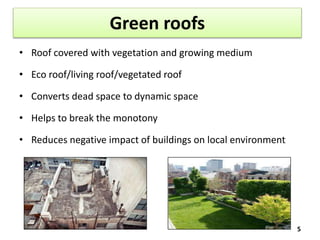
Green roofs
• Roof covered with vegetation and growing medium
• Eco roof/living roof/vegetated roof
• Converts dead space to dynamic space
• Helps to break the monotony
• Reduces negative impact of buildings on local environment
5
History
• Hanging gardens of Babylon
• European houses were covered
with sod and turf
• Germany is the birthplace of
modern day green roof
(Magill et al., 2011)
• Authorities encouraged such green
roofs
6
Types of green roofs
7
Intensive ExtensiveSemi-intensive
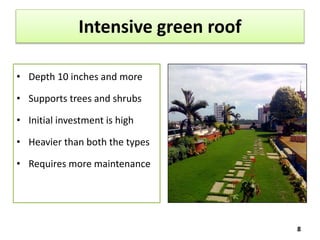
Intensive green roof
• Depth 10 inches and more
• Supports trees and shrubs
• Initial investment is high
• Heavier than both the types
• Requires more maintenance
8
Semi-intensive green roof
• Intermediate type
• Depth ranges from 6 to 10
inches
• Grasses, herbaceous
perennials and shrubs
• Requires more maintenance
• Higher initial cost
9
Extensive green roof
• Depth ranges from 3 to 6
inches
• Succulents, herbs and grasses
• Low establishment cost
• Light in weight
• Not accessible
10
Quality of the roof structure
• Made of wood, steel or
concrete
• Support 25 to 100 pounds per
square foot
• Existing roofs require structural
reinforcing
11
Anatomy of a green roof
12
Waterproofing membrane
• Protects the roof from leakage
• Example:
– Ethylene propylene diene
monomer (EPDM) membrane
– Butyl rubber membrane
13
Root barrier membrane
• Protects the waterproofing
membrane
• Thickness at least 2.5 mm
• Example:
– High density polyethylene
(HDPE)
– High density polypropylene
14
Tough protection mat
• Protects the inner membranes
• Protection mats weigh 500 to 900
g/m2
• Water and nutrient reservoirs
• Recycled non-rotting
polypropylene or polyester
15
Drainage layer
• Stores water in green roofs
• Helps plant survive dry weather
• Example:
– Gravel
– Dimpled plastic sheets
– Ribbed fabric laminates
16
Separation/filter layer
• Resists clogging from fine soil
particles
• Prevents clogging of the
drainage layer
• Made up of geotextile such as
fleece
17
Soil
• Not an ordinary soil
• Optimum water retention capacity
• Light in weight
• pH: 6.5 to 8.0
• Lava, pumice, expanded clay,
Rockwool etc.
18
Vegetation
• Dictated by the depth of substrate
• Thin green roofs: sedum and
herbs
• Thick green roofs: wide range
19
Plants for green roof
• Right plant for the right place
• Succulents are the backbone of green roofs
• Herbaceous perennials used as accents
• Turf, shrubs, trees in intensive green roof
20
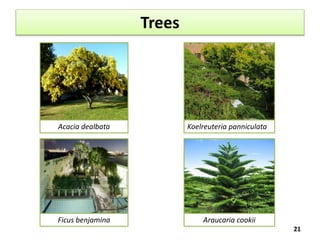
Trees
21
Acacia dealbata Koelreuteria panniculata
Ficus benjamina Araucaria cookii
Conifers
22
Cupressus sp Juniperus sp Pinus sp
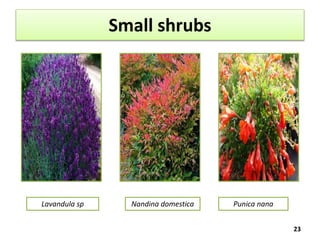
Small shrubs
23
Lavandula sp Nandina domestica Punica nana
Medium large shrubs
24
Callistemon citrinus
Elaeagnu sangustifolia Vitexagnus castus
Abelia grandiflora
Climbers
25
Jasminum officinale Passiflora caerulea Solanum crispum
Herbaceous perennials
26
Tropaeolum majus
Tithonia rotundifoliaPortulaca grandiflora
Verbena
Annuals
27
Eschscholzia californica Amaranthus
Argyranthemum Ipomoea purpurea
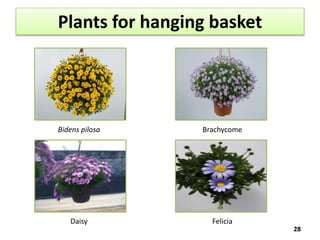
Plants for hanging basket
28
Bidens pilosa Brachycome
Daisy Felicia
Succulents
29
Aeonium sp Aloe vera Sedum sp
Grasses
30
Briza media Panicum virgatum
Pennisetum alopecuroides Pennisetum rubrum
Installing a
green roof
31
Load bearing capacity
• Dictates the type of green roof possible
• Dead loads and live loads
• Intended function, extent of landscaping, anticipated
traffic
• Review by a structural engineer
• Intensive: 200 to 1000 kg/m2
• Extensive: 50 to 200 kg/m2
32
Integrity test
• Checks the integrity of the roof membrane
• Flooding test
• Infrared [IR] moisture survey
• Electric Gradient Leak Location [EGLL]
• Leak Locate Grid System [LLGS]
33
Site considerations
• Inspect drainage locations
• If accessible, incorporate safety measures
• Observe areas with sun/shade exposure
• Check the wind velocity
• Choose appropriate flora
34
35
Installing different layers
Root barrier
Drainage layer and
filter fabric
Soil and plants
Water proofing
membrane
Tough protecting
mat
Drain
boxes and
channels
Benefits of green roof
36
37
Green
roofs
Reduced
energy
use
Urban
heat
island
Air
pollution
Storm
water
mitigation
Noise
reduction
Aesthetic
beauty
Benefits of green roof
Reduced energy use
• Reduces heat flux via evapotranspiration
• Acts as an insulator
• Minimizes the use of air conditioners
• Prevents heat escape in winter
38
39
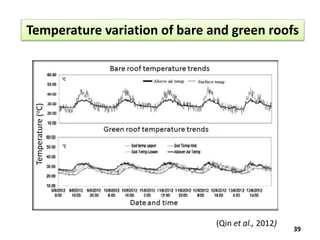
Temperature variation of bare and green roofs
(Qin et al., 2012)
Temperature(oC)
0
5
10
15
20
25
30
35
40
45
Temperature(oC)
Time
Outside air
temperature
Room temperature
with bare RCC slab
Room temperature
with a green roof
Comparison of temperature in rooms with
and without green roofs
40
(Pandey et al., 2013)
Urban heat island effect
41
Lateafternoontemperature
Contd…
• Temperature difference between a city and the countryside
• Buildings absorb solar radiation and reflect back as heat
• Macro scale application could lead to maximum reduction of
2oC
(Smith and Roeber, 2011)
42
Impact of green roof on the urban heat island
effect
43
UrbanHeatisland(oC)
Local time
(Li et al., 2014)
Air pollution
• Plants are influential in reducing air pollution
(Currie and Bass, 2008)
• Green roof substitutes demolished vegetation
• A green roof with an area of 109.0 ha removes 7.87MT air
pollutants per year
(Van Woert et al., 2005)
44
Total pollutant removal by different type of
plants in a green roof
45
3.74
7.4
1.37
5.57
1.67
3.26
0.63
2.69
1.6
3.14
0.61
2.17
0
1
2
3
4
5
6
7
8
Nitrogen dioxide Ozone Sulphur dioxide Particulate
matter
Mgofpollutants
Trees Shrubs Grasses
(Currie and Bass, 2008)
Storm water management
• Impermeable surfaces generate storm water runoff
• Limited infiltration capacity
• Peak flow results in flooding
• Average precipitation retention is 56%
(Gregoire and clausen, 2011)
• Green roof delays peak discharge by 30 minutes to 1 hour
(Wong et al., 2014)
46
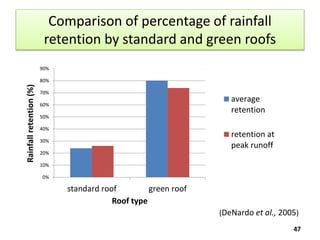
Comparison of percentage of rainfall
retention by standard and green roofs
47
0%
10%
20%
30%
40%
50%
60%
70%
80%
90%
standard roof green roof
Rainfallretention(%)
Roof type
average
retention
retention at
peak runoff
(DeNardo et al., 2005)
Comparison of surface runoff volume for
different rainfall duration
48
0
20
40
60
80
100
120
140
160
180
15 min 30 min 60 min
Surfacerunoffvolume(ml)
Rainfall duration (min.)
long grass
short grass
sedum
(Mickovski et al., 2013)
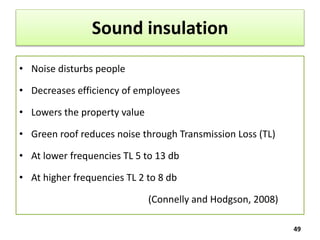
Sound insulation
• Noise disturbs people
• Decreases efficiency of employees
• Lowers the property value
• Green roof reduces noise through Transmission Loss (TL)
• At lower frequencies TL 5 to 13 db
• At higher frequencies TL 2 to 8 db
(Connelly and Hodgson, 2008)
49
Comparison of transmission loss between
conventional and green roofs
50
0
10
20
30
40
50
60
70
50 63 80 100 125 160 200 250 315 400 500 630 800 1000 1250 1600 2000 2500 3150 4000
Transmissionloss(db)
Frequency (Hz)
Green roof Conventional
(Connelly and Hodgson, 2008)
Aesthetic improvement
• Effective for beautifying built
environment
• Enhances good designs
• Disguises bad designs
• Psychological effect
• Provides a visual relief
• Relaxation and restoration
51
Aesthetic improvement in buildings
52
Green buildings in India
53
CII-Sohrabji Godrej Green Business
Centre, Hyderabad
Green Hill, ONGC campus,
Dehradun
Summary
• Roofs covered with vegetation
• Germany- birthplace of modern green roofs
• Intensive, semi-intensive and extensive
• It has eight functional layers
• Helps to fight against the disruption of ecosystem
54
Conclusion
• Ideal architectural combination of aesthetics,
economy and ecology
• Technology for mitigating environmental issues
• Research gaps in Indian context
• Supports sustainable urban planning
• Improves quality of urban life
55
Thank you
56

Green roofs

  • 1.
  • 2.
    • Percentage ofurban population is increasing • Development often made at the expense of green areas • Increase in area of impermeable spaces • Numerous consequences • Ecosystem restoration - need of the hour 2 Introduction
  • 3.
    Green roofing –a tool for ecological engineering Andrew L Myrthong 2014-12-126 Dept. of Pomology and Floriculture 3
  • 4.
    Outline 1. Green roofdefinition 2. History of green roof 3. Types of green roof 4. Quality of the roof structure 5. Anatomy of green roof 6. Plants for green roof 7. Installing a green roof 8. Benefits of green roof 9. Summary 10. Conclusion 4
  • 5.
    Green roofs • Roofcovered with vegetation and growing medium • Eco roof/living roof/vegetated roof • Converts dead space to dynamic space • Helps to break the monotony • Reduces negative impact of buildings on local environment 5
  • 6.
    History • Hanging gardensof Babylon • European houses were covered with sod and turf • Germany is the birthplace of modern day green roof (Magill et al., 2011) • Authorities encouraged such green roofs 6
  • 7.
    Types of greenroofs 7 Intensive ExtensiveSemi-intensive
  • 8.
    Intensive green roof •Depth 10 inches and more • Supports trees and shrubs • Initial investment is high • Heavier than both the types • Requires more maintenance 8
  • 9.
    Semi-intensive green roof •Intermediate type • Depth ranges from 6 to 10 inches • Grasses, herbaceous perennials and shrubs • Requires more maintenance • Higher initial cost 9
  • 10.
    Extensive green roof •Depth ranges from 3 to 6 inches • Succulents, herbs and grasses • Low establishment cost • Light in weight • Not accessible 10
  • 11.
    Quality of theroof structure • Made of wood, steel or concrete • Support 25 to 100 pounds per square foot • Existing roofs require structural reinforcing 11
  • 12.
    Anatomy of agreen roof 12
  • 13.
    Waterproofing membrane • Protectsthe roof from leakage • Example: – Ethylene propylene diene monomer (EPDM) membrane – Butyl rubber membrane 13
  • 14.
    Root barrier membrane •Protects the waterproofing membrane • Thickness at least 2.5 mm • Example: – High density polyethylene (HDPE) – High density polypropylene 14
  • 15.
    Tough protection mat •Protects the inner membranes • Protection mats weigh 500 to 900 g/m2 • Water and nutrient reservoirs • Recycled non-rotting polypropylene or polyester 15
  • 16.
    Drainage layer • Storeswater in green roofs • Helps plant survive dry weather • Example: – Gravel – Dimpled plastic sheets – Ribbed fabric laminates 16
  • 17.
    Separation/filter layer • Resistsclogging from fine soil particles • Prevents clogging of the drainage layer • Made up of geotextile such as fleece 17
  • 18.
    Soil • Not anordinary soil • Optimum water retention capacity • Light in weight • pH: 6.5 to 8.0 • Lava, pumice, expanded clay, Rockwool etc. 18
  • 19.
    Vegetation • Dictated bythe depth of substrate • Thin green roofs: sedum and herbs • Thick green roofs: wide range 19
  • 20.
    Plants for greenroof • Right plant for the right place • Succulents are the backbone of green roofs • Herbaceous perennials used as accents • Turf, shrubs, trees in intensive green roof 20
  • 21.
    Trees 21 Acacia dealbata Koelreuteriapanniculata Ficus benjamina Araucaria cookii
  • 22.
  • 23.
    Small shrubs 23 Lavandula spNandina domestica Punica nana
  • 24.
    Medium large shrubs 24 Callistemoncitrinus Elaeagnu sangustifolia Vitexagnus castus Abelia grandiflora
  • 25.
  • 26.
    Herbaceous perennials 26 Tropaeolum majus TithoniarotundifoliaPortulaca grandiflora Verbena
  • 27.
  • 28.
    Plants for hangingbasket 28 Bidens pilosa Brachycome Daisy Felicia
  • 29.
  • 30.
    Grasses 30 Briza media Panicumvirgatum Pennisetum alopecuroides Pennisetum rubrum
  • 31.
  • 32.
    Load bearing capacity •Dictates the type of green roof possible • Dead loads and live loads • Intended function, extent of landscaping, anticipated traffic • Review by a structural engineer • Intensive: 200 to 1000 kg/m2 • Extensive: 50 to 200 kg/m2 32
  • 33.
    Integrity test • Checksthe integrity of the roof membrane • Flooding test • Infrared [IR] moisture survey • Electric Gradient Leak Location [EGLL] • Leak Locate Grid System [LLGS] 33
  • 34.
    Site considerations • Inspectdrainage locations • If accessible, incorporate safety measures • Observe areas with sun/shade exposure • Check the wind velocity • Choose appropriate flora 34
  • 35.
    35 Installing different layers Rootbarrier Drainage layer and filter fabric Soil and plants Water proofing membrane Tough protecting mat Drain boxes and channels
  • 36.
  • 37.
  • 38.
    Reduced energy use •Reduces heat flux via evapotranspiration • Acts as an insulator • Minimizes the use of air conditioners • Prevents heat escape in winter 38
  • 39.
    39 Temperature variation ofbare and green roofs (Qin et al., 2012) Temperature(oC)
  • 40.
    0 5 10 15 20 25 30 35 40 45 Temperature(oC) Time Outside air temperature Room temperature withbare RCC slab Room temperature with a green roof Comparison of temperature in rooms with and without green roofs 40 (Pandey et al., 2013)
  • 41.
    Urban heat islandeffect 41 Lateafternoontemperature
  • 42.
    Contd… • Temperature differencebetween a city and the countryside • Buildings absorb solar radiation and reflect back as heat • Macro scale application could lead to maximum reduction of 2oC (Smith and Roeber, 2011) 42
  • 43.
    Impact of greenroof on the urban heat island effect 43 UrbanHeatisland(oC) Local time (Li et al., 2014)
  • 44.
    Air pollution • Plantsare influential in reducing air pollution (Currie and Bass, 2008) • Green roof substitutes demolished vegetation • A green roof with an area of 109.0 ha removes 7.87MT air pollutants per year (Van Woert et al., 2005) 44
  • 45.
    Total pollutant removalby different type of plants in a green roof 45 3.74 7.4 1.37 5.57 1.67 3.26 0.63 2.69 1.6 3.14 0.61 2.17 0 1 2 3 4 5 6 7 8 Nitrogen dioxide Ozone Sulphur dioxide Particulate matter Mgofpollutants Trees Shrubs Grasses (Currie and Bass, 2008)
  • 46.
    Storm water management •Impermeable surfaces generate storm water runoff • Limited infiltration capacity • Peak flow results in flooding • Average precipitation retention is 56% (Gregoire and clausen, 2011) • Green roof delays peak discharge by 30 minutes to 1 hour (Wong et al., 2014) 46
  • 47.
    Comparison of percentageof rainfall retention by standard and green roofs 47 0% 10% 20% 30% 40% 50% 60% 70% 80% 90% standard roof green roof Rainfallretention(%) Roof type average retention retention at peak runoff (DeNardo et al., 2005)
  • 48.
    Comparison of surfacerunoff volume for different rainfall duration 48 0 20 40 60 80 100 120 140 160 180 15 min 30 min 60 min Surfacerunoffvolume(ml) Rainfall duration (min.) long grass short grass sedum (Mickovski et al., 2013)
  • 49.
    Sound insulation • Noisedisturbs people • Decreases efficiency of employees • Lowers the property value • Green roof reduces noise through Transmission Loss (TL) • At lower frequencies TL 5 to 13 db • At higher frequencies TL 2 to 8 db (Connelly and Hodgson, 2008) 49
  • 50.
    Comparison of transmissionloss between conventional and green roofs 50 0 10 20 30 40 50 60 70 50 63 80 100 125 160 200 250 315 400 500 630 800 1000 1250 1600 2000 2500 3150 4000 Transmissionloss(db) Frequency (Hz) Green roof Conventional (Connelly and Hodgson, 2008)
  • 51.
    Aesthetic improvement • Effectivefor beautifying built environment • Enhances good designs • Disguises bad designs • Psychological effect • Provides a visual relief • Relaxation and restoration 51
  • 52.
  • 53.
    Green buildings inIndia 53 CII-Sohrabji Godrej Green Business Centre, Hyderabad Green Hill, ONGC campus, Dehradun
  • 54.
    Summary • Roofs coveredwith vegetation • Germany- birthplace of modern green roofs • Intensive, semi-intensive and extensive • It has eight functional layers • Helps to fight against the disruption of ecosystem 54
  • 55.
    Conclusion • Ideal architecturalcombination of aesthetics, economy and ecology • Technology for mitigating environmental issues • Research gaps in Indian context • Supports sustainable urban planning • Improves quality of urban life 55
  • 56.