SOCIAL
DEMOGRAPHY
POPULATION
THEORIES-
BIOLOGICAL THEORY(
THOMAS SADLER)
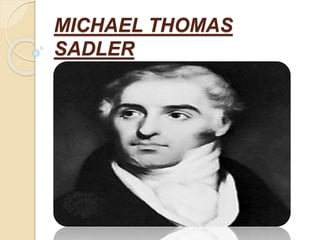
MICHAEL THOMAS
SADLER
MICHAEL THOMAS
SADLER
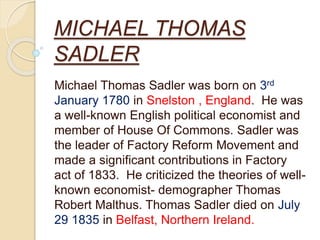
Michael Thomas Sadler was born on 3rd
January 1780 in Snelston , England. He was
a well-known English political economist and
member of House Of Commons. Sadler was
the leader of Factory Reform Movement and
made a significant contributions in Factory
act of 1833. He criticized the theories of well-
known economist- demographer Thomas
Robert Malthus. Thomas Sadler died on July
29 1835 in Belfast, Northern Ireland.
BIOLOGICAL THEORIES
The biological theories argue that the law
regulating fertility among human being is the
same as that which regulates the growth of
plants and other animals .These theories
therefore emphasize on what is common to
all living beings and ignore what is unique or
peculiar to human beings. The biological
theorists believes in the existence of
metaphysical will of nature to perpetuate the
species. In short it is mainly concerned with
human fertility.
MALTHUSIAN
THEORY
Thomas Robert Malthus (1766-1834) was an English
political economist. Malthus’s theory of population
growth was outlined in his Essay on Population. He
argued that human populations tend to grow at a much
faster rate than the rate at which the means of human
subsistence (specially food , but also clothing and other
agriculture based products) can grow. Therefore
humanity is condemned to live in poverty forever
because the growth of agricultural production will
always be over taken by population growth. While
population rises in geometric
progression(2,4,8,16,32,...), and agricultural production
can grow only in arithmetic progression(2,4,6,8,10,..).
DENSITY
PRINCIPLE
The ‘ Density Principle’ was the
theory put forward by Thomas Sadler.
He brought out his ideas in his volume
entitled, ‘The Law Of Population’
which is available in two volumes. The
book runs into about 1300 pages in
addition to many tables. This book is
mainly concerned with the refutation of
the Malthusian theory. In fact 2/3 of the
whole volume is devoted to the criticism
of Malthus and his theory.
Sadler put forward the principle that fertility
varies inversely with the density of population.
The Fecundity of human beings is in the
inverse ratio of the condensation of their
numbers. The variation in fecundity is affected
not by wretchedness and misery but by the
happiness and prosperity of the mankind.
As the density of population increases, the
tendency of increases in number naturally
decreases.
Moreover the fertility rate decreases with the
increase in the density of population.
In agricultural based or pastoral countries
where the density of population is low, the
fertility rate of the population becomes high. In
such countries people have the capacity to work
hard and hardworking people give birth to more
 As the time passed when there is
industrialization, population becomes more
civilized, and literate, the density of population
increases. Here people would limit the size of
family and in such socio-economic condition
they will be happier and there will be prosperity.
 Sadler believe that for maintaining fertility it
was essential to maintain both labour as well
as privacy. With the growth and advancement
of civilization, he opined , desire to put labour
and hard work was decreasing.
 The work which was being done till yesterday
by human beings is today being done by
machine. In other words, labour is becoming
only a mental exercise.
 Due to shortage of accommodation, there is no
privacy and such fertility rate is bound to come
down.
He has therefore come to the conclusion that
nature itself is helping mankind , rather than
behaving in the negative way, which Malthus makes
us believe.
Thomas Sadler was a great critic of Malthus. He
did not accept Malthus’s view that population
increases in geometrical progression and food
supplies in arithmetical progression.
According to Sadler increase of population and
food supply in mathematical terms cannot happen
because when population increases density too will
increase.
When density increases capacity to produce
children goes down. Thus with the increase in
density, the fertility rate declines. He believed that
population adjusts itself with time.
He was of the view that If fertility rate of population
increases , people will be able to produce food
according to their needs and food supply and
Sadler also believed that when density of
population increases, unhealthy atmosphere also
increases which leads to increase of death rate.
Further if death rate is high, it will lead to
increase in birth rate.
This happens to compensate for loss of
population.
And if death rate is low , birth rate also goes
down.
The natural law of population found out by
Sadler, is that ‘the fecundity of human beings
under similar circumstances varies inversely as
their numbers on a given space. Fecundity
means the physiological capacity to conceive or
in short it is the ability to produce an abundance
of offspring or new growth, fertility. His theory
furnished the basis of an easy optimism about
man’s economic future, because with the
Criticism of Thomas Sadler’s
theory
 Sadler failed to distinguish between fertility and
fecundity. According to Thompson and Lewis, “ he
did not distinguish clearly between fecundity and
fertility and he believed that there was no
antagonism between man’s natural capacity to
produce, which he never defined, and his
capacity to produce, adequate subsistence for all
who would be born”. He said that fecundity of
human beings is in inverse ratio to the condensation
of their numbers. But in fact no biological reason is
found to prove the idea that density brings down
fertility, it will bring down fecundity also. This is
because in slums the density is very high and at the
same time fertility is also high among slum dwellers.
 Moreover in many countries including India , Japan
etc the density of population is very high, but the rate
of growth of population is not low. On the other hand
it is high. Therefore Sadler’s theory is not empirically
valid.
 There is a contradiction in Sadler’s theory.
He says that higher density leads to lower
birth rate and higher death rate. But at some
other place, he says that where death rate is
high, the birth rate is also high . This means
with the increase in density , the birth rate
will also increase. But his own statement
contradicts this finding.
 Sadler’s views that with industrialization
population decreases has not been proved
true. In a country like India, industrialization
has not led to the decline in the growth of
population.
 Sadler gives emphasis alone fecundity. For
population growth, fecundity is not so
important as fertility. Fertility implies actual
Reference
1. Asha A. Bhende, Tara Kanitkar-
Principles of Population Studies, 1994,
Bombay, Himalaya Publishing House.
2. Dr. B.N. Ghosh, Population Theories
And Demographic Analysis, Meerut,
Meenakshi Prakashan.
3. Hans Raj, Fundamentals of
Demography-population studies with
special reference to India, New Delhi,
Surjeet Publication.
4. www.yourarticlelibrary.com/population-
geography-3-theories-on-fertility-
biological-cultural-and- economic-
theories/43232

POPULATION THEORIES- Komol Palma.pptx

  • 1.
  • 2.
  • 3.
    MICHAEL THOMAS SADLER Michael ThomasSadler was born on 3rd January 1780 in Snelston , England. He was a well-known English political economist and member of House Of Commons. Sadler was the leader of Factory Reform Movement and made a significant contributions in Factory act of 1833. He criticized the theories of well- known economist- demographer Thomas Robert Malthus. Thomas Sadler died on July 29 1835 in Belfast, Northern Ireland.
  • 4.
    BIOLOGICAL THEORIES The biologicaltheories argue that the law regulating fertility among human being is the same as that which regulates the growth of plants and other animals .These theories therefore emphasize on what is common to all living beings and ignore what is unique or peculiar to human beings. The biological theorists believes in the existence of metaphysical will of nature to perpetuate the species. In short it is mainly concerned with human fertility.
  • 5.
    MALTHUSIAN THEORY Thomas Robert Malthus(1766-1834) was an English political economist. Malthus’s theory of population growth was outlined in his Essay on Population. He argued that human populations tend to grow at a much faster rate than the rate at which the means of human subsistence (specially food , but also clothing and other agriculture based products) can grow. Therefore humanity is condemned to live in poverty forever because the growth of agricultural production will always be over taken by population growth. While population rises in geometric progression(2,4,8,16,32,...), and agricultural production can grow only in arithmetic progression(2,4,6,8,10,..).
  • 6.
    DENSITY PRINCIPLE The ‘ DensityPrinciple’ was the theory put forward by Thomas Sadler. He brought out his ideas in his volume entitled, ‘The Law Of Population’ which is available in two volumes. The book runs into about 1300 pages in addition to many tables. This book is mainly concerned with the refutation of the Malthusian theory. In fact 2/3 of the whole volume is devoted to the criticism of Malthus and his theory.
  • 7.
    Sadler put forwardthe principle that fertility varies inversely with the density of population. The Fecundity of human beings is in the inverse ratio of the condensation of their numbers. The variation in fecundity is affected not by wretchedness and misery but by the happiness and prosperity of the mankind. As the density of population increases, the tendency of increases in number naturally decreases. Moreover the fertility rate decreases with the increase in the density of population. In agricultural based or pastoral countries where the density of population is low, the fertility rate of the population becomes high. In such countries people have the capacity to work hard and hardworking people give birth to more
  • 8.
     As thetime passed when there is industrialization, population becomes more civilized, and literate, the density of population increases. Here people would limit the size of family and in such socio-economic condition they will be happier and there will be prosperity.  Sadler believe that for maintaining fertility it was essential to maintain both labour as well as privacy. With the growth and advancement of civilization, he opined , desire to put labour and hard work was decreasing.  The work which was being done till yesterday by human beings is today being done by machine. In other words, labour is becoming only a mental exercise.  Due to shortage of accommodation, there is no privacy and such fertility rate is bound to come down.
  • 9.
    He has thereforecome to the conclusion that nature itself is helping mankind , rather than behaving in the negative way, which Malthus makes us believe. Thomas Sadler was a great critic of Malthus. He did not accept Malthus’s view that population increases in geometrical progression and food supplies in arithmetical progression. According to Sadler increase of population and food supply in mathematical terms cannot happen because when population increases density too will increase. When density increases capacity to produce children goes down. Thus with the increase in density, the fertility rate declines. He believed that population adjusts itself with time. He was of the view that If fertility rate of population increases , people will be able to produce food according to their needs and food supply and
  • 10.
    Sadler also believedthat when density of population increases, unhealthy atmosphere also increases which leads to increase of death rate. Further if death rate is high, it will lead to increase in birth rate. This happens to compensate for loss of population. And if death rate is low , birth rate also goes down. The natural law of population found out by Sadler, is that ‘the fecundity of human beings under similar circumstances varies inversely as their numbers on a given space. Fecundity means the physiological capacity to conceive or in short it is the ability to produce an abundance of offspring or new growth, fertility. His theory furnished the basis of an easy optimism about man’s economic future, because with the
  • 11.
    Criticism of ThomasSadler’s theory  Sadler failed to distinguish between fertility and fecundity. According to Thompson and Lewis, “ he did not distinguish clearly between fecundity and fertility and he believed that there was no antagonism between man’s natural capacity to produce, which he never defined, and his capacity to produce, adequate subsistence for all who would be born”. He said that fecundity of human beings is in inverse ratio to the condensation of their numbers. But in fact no biological reason is found to prove the idea that density brings down fertility, it will bring down fecundity also. This is because in slums the density is very high and at the same time fertility is also high among slum dwellers.  Moreover in many countries including India , Japan etc the density of population is very high, but the rate of growth of population is not low. On the other hand it is high. Therefore Sadler’s theory is not empirically valid.
  • 12.
     There isa contradiction in Sadler’s theory. He says that higher density leads to lower birth rate and higher death rate. But at some other place, he says that where death rate is high, the birth rate is also high . This means with the increase in density , the birth rate will also increase. But his own statement contradicts this finding.  Sadler’s views that with industrialization population decreases has not been proved true. In a country like India, industrialization has not led to the decline in the growth of population.  Sadler gives emphasis alone fecundity. For population growth, fecundity is not so important as fertility. Fertility implies actual
  • 13.
    Reference 1. Asha A.Bhende, Tara Kanitkar- Principles of Population Studies, 1994, Bombay, Himalaya Publishing House. 2. Dr. B.N. Ghosh, Population Theories And Demographic Analysis, Meerut, Meenakshi Prakashan. 3. Hans Raj, Fundamentals of Demography-population studies with special reference to India, New Delhi, Surjeet Publication. 4. www.yourarticlelibrary.com/population- geography-3-theories-on-fertility- biological-cultural-and- economic- theories/43232