


4/18/13


No Article Review this week

Energy plan due next Friday

Homework: Read 11.4 and 11.5
Reading Quiz

Tomorrow we will have a quiz over tonight’s reading. Be able to
do the following

  Explain soil degradation, slash and burn agriculture, and
  desertification.

  Describe the benefits and drawbacks of sustainable farming
  practices, no-till agriculture, and integrated pest management.

  Discuss organic agriculture.

  Understand CAFOs, impacts of fish harvesting, and aquaculture
Review

Compare and contrast the various forms of
malnutrition.

Discuss factors that contribute to malnutrition.

Relate the concept of energy subsidy to the concept
of ecological footprint.

Describe the Green Revolution.
Objectives


Discuss the benefits and drawbacks of industrial
farming practices.

Debate using genetically modified organisms in
agriculture.
Questions


How has farming changed in the last 75 years?
Do The Math


Before we get into it, work through this math
problem.

Help those at your table.

Don’t give answers, give help
Do The Math

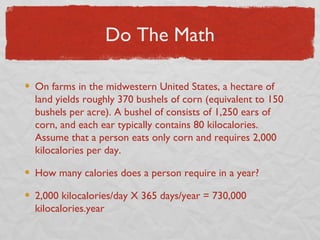
On farms in the midwestern United States, a hectare of
land yields roughly 370 bushels of corn (equivalent to 150
bushels per acre). A bushel of consists of 1,250 ears of
corn, and each ear typically contains 80 kilocalories.
Assume that a person eats only corn and requires 2,000
kilocalories per day.

How many calories does a person require in a year?

2,000 kilocalories/day X 365 days/year = 730,000
kilocalories.year
Do The Math

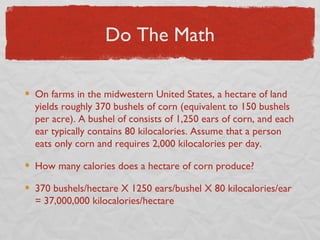
On farms in the midwestern United States, a hectare of land
yields roughly 370 bushels of corn (equivalent to 150 bushels
per acre). A bushel of consists of 1,250 ears of corn, and each
ear typically contains 80 kilocalories. Assume that a person
eats only corn and requires 2,000 kilocalories per day.

How many calories does a hectare of corn produce?

370 bushels/hectare X 1250 ears/bushel X 80 kilocalories/ear
= 37,000,000 kilocalories/hectare
Do The Math


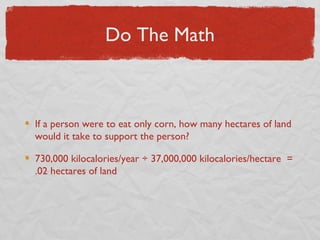
If a person were to eat only corn, how many hectares of land
would it take to support the person?

730,000 kilocalories/year ÷ 37,000,000 kilocalories/hectare =
.02 hectares of land
Do The Math


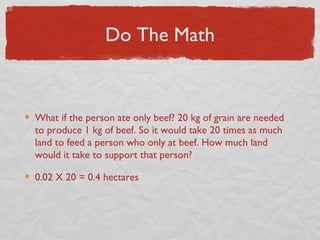
What if the person ate only beef? 20 kg of grain are needed
to produce 1 kg of beef. So it would take 20 times as much
land to feed a person who only at beef. How much land
would it take to support that person?

0.02 X 20 = 0.4 hectares
Do The Math


If the Earth has about 1.5 billion hectares of land suitable for
growing food, is there sufficient land on Earth to feed all the
inhabitants of the planet if they only ate beef?

7 billion people X 0.4 ha/person = 2.8 billion ha needed
Do The Math


How many people eating a beef-only diet could Earth
support?

1.5 billion ha land X (1 person/0.4 ha) = 3.75 billion people
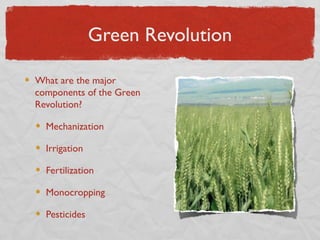
Green Revolution

What are the major
components of the Green
Revolution?

  Mechanization

  Irrigation

  Fertilization

  Monocropping

  Pesticides
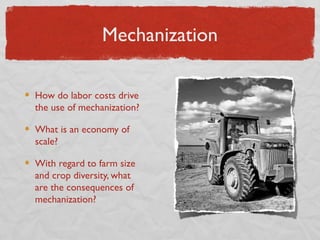
Mechanization

How do labor costs drive
the use of mechanization?

What is an economy of
scale?

With regard to farm size
and crop diversity, what
are the consequences of
mechanization?
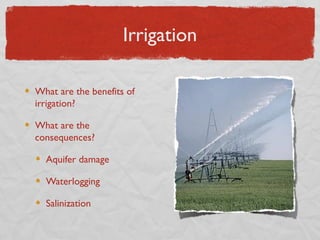
Irrigation

What are the benefits of
irrigation?

What are the
consequences?

  Aquifer damage

  Waterlogging

  Salinization
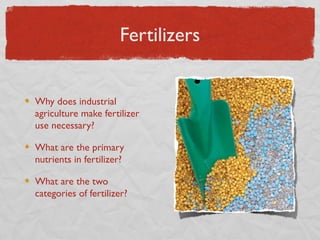
Fertilizers


Why does industrial
agriculture make fertilizer
use necessary?

What are the primary
nutrients in fertilizer?

What are the two
categories of fertilizer?
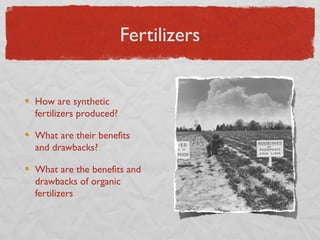
Fertilizers


How are synthetic
fertilizers produced?

What are their benefits
and drawbacks?

What are the benefits and
drawbacks of organic
fertilizers
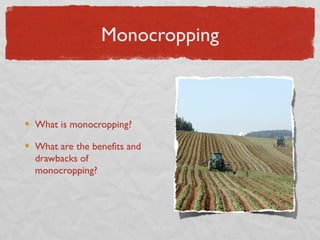
Monocropping


What is monocropping?

What are the benefits and
drawbacks of
monocropping?
Pesticides

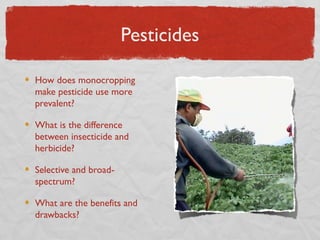
How does monocropping
make pesticide use more
prevalent?

What is the difference
between insecticide and
herbicide?

Selective and broad-
spectrum?

What are the benefits and
drawbacks?
Pesticides

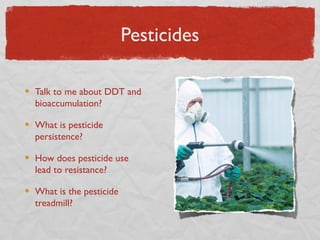
Talk to me about DDT and
bioaccumulation?

What is pesticide
persistence?

How does pesticide use
lead to resistance?

What is the pesticide
treadmill?
GMO

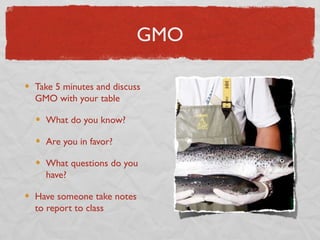
Take 5 minutes and discuss
GMO with your table

  What do you know?

  Are you in favor?

  What questions do you
  have?

Have someone take notes
to report to class
GMO

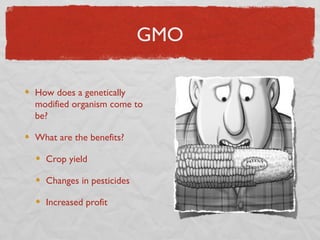
How does a genetically
modified organism come to
be?

What are the benefits?

  Crop yield

  Changes in pesticides

  Increased profit
GMO


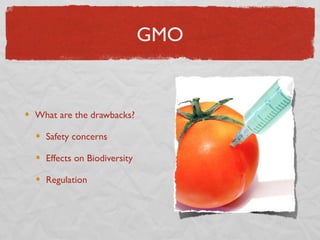
What are the drawbacks?

  Safety concerns

  Effects on Biodiversity

  Regulation
AP Practice

Which of the following describes a fundamental characteristic of the Green
Revolution in food resources?

   A. The application of higher levels of organic fertilizers to increase rice
   production

   B. Deforestation to provide field crops with increased sunlight for photosynthesis

   C. The addition of calorie, fat, and fiber percentages to the information provided
   on food package labels

   D. The development of new strains of crops with higher yields

   E. The discovery that chlorophyll adds nutritional value to wheat, rice, and
   sorghum

Green Revolution

  • 1.
    4/18/13 No Article Reviewthis week Energy plan due next Friday Homework: Read 11.4 and 11.5
  • 2.
    Reading Quiz Tomorrow wewill have a quiz over tonight’s reading. Be able to do the following Explain soil degradation, slash and burn agriculture, and desertification. Describe the benefits and drawbacks of sustainable farming practices, no-till agriculture, and integrated pest management. Discuss organic agriculture. Understand CAFOs, impacts of fish harvesting, and aquaculture
  • 3.
    Review Compare and contrastthe various forms of malnutrition. Discuss factors that contribute to malnutrition. Relate the concept of energy subsidy to the concept of ecological footprint. Describe the Green Revolution.
  • 4.
    Objectives Discuss the benefitsand drawbacks of industrial farming practices. Debate using genetically modified organisms in agriculture.
  • 5.
    Questions How has farmingchanged in the last 75 years?
  • 6.
    Do The Math Beforewe get into it, work through this math problem. Help those at your table. Don’t give answers, give help
  • 7.
    Do The Math Onfarms in the midwestern United States, a hectare of land yields roughly 370 bushels of corn (equivalent to 150 bushels per acre). A bushel of consists of 1,250 ears of corn, and each ear typically contains 80 kilocalories. Assume that a person eats only corn and requires 2,000 kilocalories per day. How many calories does a person require in a year? 2,000 kilocalories/day X 365 days/year = 730,000 kilocalories.year
  • 8.
    Do The Math Onfarms in the midwestern United States, a hectare of land yields roughly 370 bushels of corn (equivalent to 150 bushels per acre). A bushel of consists of 1,250 ears of corn, and each ear typically contains 80 kilocalories. Assume that a person eats only corn and requires 2,000 kilocalories per day. How many calories does a hectare of corn produce? 370 bushels/hectare X 1250 ears/bushel X 80 kilocalories/ear = 37,000,000 kilocalories/hectare
  • 9.
    Do The Math Ifa person were to eat only corn, how many hectares of land would it take to support the person? 730,000 kilocalories/year ÷ 37,000,000 kilocalories/hectare = .02 hectares of land
  • 10.
    Do The Math Whatif the person ate only beef? 20 kg of grain are needed to produce 1 kg of beef. So it would take 20 times as much land to feed a person who only at beef. How much land would it take to support that person? 0.02 X 20 = 0.4 hectares
  • 11.
    Do The Math Ifthe Earth has about 1.5 billion hectares of land suitable for growing food, is there sufficient land on Earth to feed all the inhabitants of the planet if they only ate beef? 7 billion people X 0.4 ha/person = 2.8 billion ha needed
  • 12.
    Do The Math Howmany people eating a beef-only diet could Earth support? 1.5 billion ha land X (1 person/0.4 ha) = 3.75 billion people
  • 13.
    Green Revolution What arethe major components of the Green Revolution? Mechanization Irrigation Fertilization Monocropping Pesticides
  • 14.
    Mechanization How do laborcosts drive the use of mechanization? What is an economy of scale? With regard to farm size and crop diversity, what are the consequences of mechanization?
  • 15.
    Irrigation What are thebenefits of irrigation? What are the consequences? Aquifer damage Waterlogging Salinization
  • 16.
    Fertilizers Why does industrial agriculturemake fertilizer use necessary? What are the primary nutrients in fertilizer? What are the two categories of fertilizer?
  • 17.
    Fertilizers How are synthetic fertilizersproduced? What are their benefits and drawbacks? What are the benefits and drawbacks of organic fertilizers
  • 18.
    Monocropping What is monocropping? Whatare the benefits and drawbacks of monocropping?
  • 19.
    Pesticides How does monocropping makepesticide use more prevalent? What is the difference between insecticide and herbicide? Selective and broad- spectrum? What are the benefits and drawbacks?
  • 20.
    Pesticides Talk to meabout DDT and bioaccumulation? What is pesticide persistence? How does pesticide use lead to resistance? What is the pesticide treadmill?
  • 21.
    GMO Take 5 minutesand discuss GMO with your table What do you know? Are you in favor? What questions do you have? Have someone take notes to report to class
  • 22.
    GMO How does agenetically modified organism come to be? What are the benefits? Crop yield Changes in pesticides Increased profit
  • 23.
    GMO What are thedrawbacks? Safety concerns Effects on Biodiversity Regulation
  • 24.
    AP Practice Which ofthe following describes a fundamental characteristic of the Green Revolution in food resources? A. The application of higher levels of organic fertilizers to increase rice production B. Deforestation to provide field crops with increased sunlight for photosynthesis C. The addition of calorie, fat, and fiber percentages to the information provided on food package labels D. The development of new strains of crops with higher yields E. The discovery that chlorophyll adds nutritional value to wheat, rice, and sorghum