
INFLUENCE OF MINERALADDITIONS ON
THE PERFORMANCE OF GREEN
RECYCLED AGGREGATE CONCRETE
DAYAL KURIAN VARGHESE
1
24-Dec-16
OVERVIEW
Introduction
Green recycled aggregate concrete (GRAC)
Recycled concrete aggregate (RCA)
Case study-1
Case study-2
Conclusion
References
24-Dec-16
2
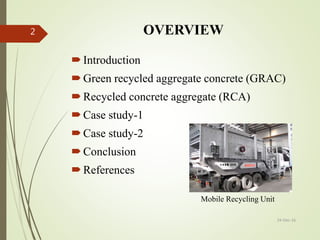
Mobile Recycling Unit
INTRODUCTION
 By the end of the 20th century, sustainable
development and environmental protection became
key goals of modern society
 Main problems that industry of construction
materials faces were:
 natural aggregate depletion
high consumption of Portland cement and
associated high emission of carbon dioxide
large amount of generated construction and
demolition (C&D) waste
3
24-Dec-16
GREEN RECYCLED AGGREGATE
CONCRETE (GRAC)
 GRAC made with recycled concrete aggregate, low
cement content and high content of different mineral
supplements
 Such concretes belong to ‘‘green’’ or ‘‘eco’’ concretes
 Here GRAC produced with
fine river aggregate
coarse recycled aggregate
Portland Cement
Silica fume (SF), fly ash (FA), Metakaolin (MK),
GGBS
24-Dec-16
4
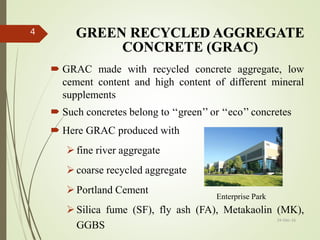
Enterprise Park
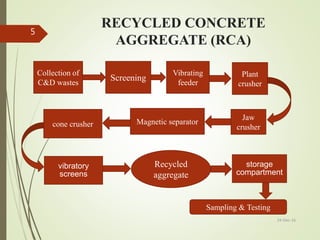
RECYCLED CONCRETE
AGGREGATE (RCA)
24-Dec-16
5
Collection of
C&D wastes
Screening
Vibrating
feeder
Plant
crusher
Jaw
crusher
Magnetic separatorcone crusher
vibratory
screens
storage
compartment
Recycled
aggregate
Sampling & Testing
CASE STUDY-1
“Comparisons of natural and recycled aggregates
concretes prepared with the addition of different
mineral admixtures”
 Kou et al. (2011) conducted studies on GRAC
prepared with different mineral admixtures such
as SF (10%),MK (15%),FA (35%), GGBS (55%)
 The coarse aggregates were replaced with 50%
and 100% of RCA
24-Dec-16
6
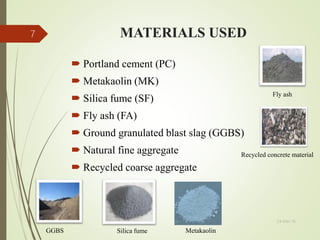
MATERIALS USED
 Portland cement (PC)
 Metakaolin (MK)
 Silica fume (SF)
 Fly ash (FA)
 Ground granulated blast slag (GGBS)
 Natural fine aggregate
 Recycled coarse aggregate
24-Dec-16
7
GGBS
Fly ash
Recycled concrete material
Silica fume Metakaolin
24-Dec-16
8
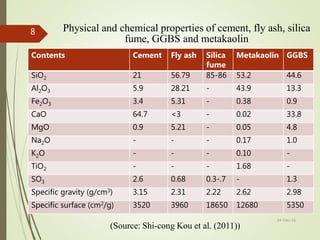
Contents Cement Fly ash Silica
fume
Metakaolin GGBS
SiO2 21 56.79 85-86 53.2 44.6
Al2O3 5.9 28.21 - 43.9 13.3
Fe2O3 3.4 5.31 - 0.38 0.9
CaO 64.7 <3 - 0.02 33.8
MgO 0.9 5.21 - 0.05 4.8
Na2O - - - 0.17 1.0
K2O - - - 0.10 -
TiO2 - - - 1.68 -
SO3 2.6 0.68 0.3-.7 - 1.3
Specific gravity (g/cm3) 3.15 2.31 2.22 2.62 2.98
Specific surface (cm2/g) 3520 3960 18650 12680 5350
Physical and chemical properties of cement, fly ash, silica
fume, GGBS and metakaolin
(Source: Shi-cong Kou et al. (2011))
SPECIMEN PREPARATION AND CURING
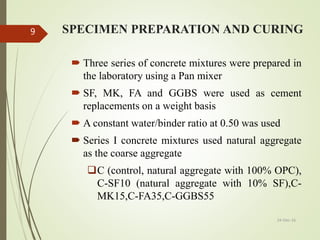
 Three series of concrete mixtures were prepared in
the laboratory using a Pan mixer
 SF, MK, FA and GGBS were used as cement
replacements on a weight basis
 A constant water/binder ratio at 0.50 was used
 Series I concrete mixtures used natural aggregate
as the coarse aggregate
C (control, natural aggregate with 100% OPC),
C-SF10 (natural aggregate with 10% SF),C-
MK15,C-FA35,C-GGBS55
24-Dec-16
9
Contd…….
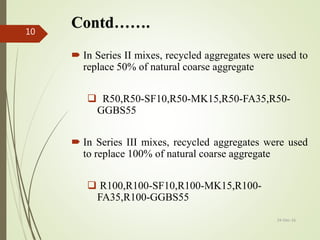
 In Series II mixes, recycled aggregates were used to
replace 50% of natural coarse aggregate
 R50,R50-SF10,R50-MK15,R50-FA35,R50-
GGBS55
 In Series III mixes, recycled aggregates were used
to replace 100% of natural coarse aggregate
 R100,R100-SF10,R100-MK15,R100-
FA35,R100-GGBS55
24-Dec-16
10
24-Dec-16
11
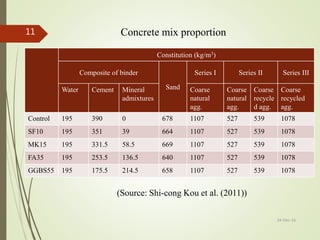
Constitution (kg/m3)
Composite of binder
Sand
Series I Series II Series III
Water Cement Mineral
admixtures
Coarse
natural
agg.
Coarse
natural
agg.
Coarse
recycle
d agg.
Coarse
recycled
agg.
Control 195 390 0 678 1107 527 539 1078
SF10 195 351 39 664 1107 527 539 1078
MK15 195 331.5 58.5 669 1107 527 539 1078
FA35 195 253.5 136.5 640 1107 527 539 1078
GGBS55 195 175.5 214.5 658 1107 527 539 1078
Concrete mix proportion
(Source: Shi-cong Kou et al. (2011))
Contd…….
 Workability measured using the slump cone test
 Concrete cubes of size 100 mm casted for
determining compressive strength
 100mm x 200mm concrete cylinders casted to
determine the tensile splitting strength
 100mm x 50mm concrete cylinders casted to
determine the chloride ion penetration
 75mm x 75mm x 285mm prisms were casted for
determining drying shrinkage
12
24-Dec-16
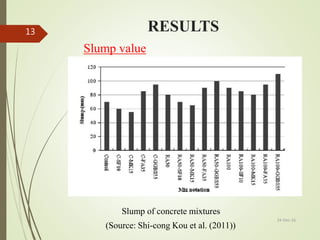
RESULTS13
24-Dec-16
Slump of concrete mixtures
Slump value
(Source: Shi-cong Kou et al. (2011))
Compressive strength14
24-Dec-16
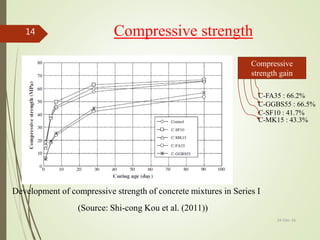
Development of compressive strength of concrete mixtures in Series I
C-FA35 : 66.2%
C-GGBS55 : 66.5%
C-SF10 : 41.7%
C-MK15 : 43.3%
Compressive
strength gain
(Source: Shi-cong Kou et al. (2011))
Compressive strength
24-Dec-16
15
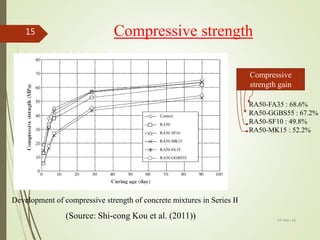
Development of compressive strength of concrete mixtures in Series II
RA50-FA35 : 68.6%
RA50-GGBS55 : 67.2%
RA50-SF10 : 49.8%
RA50-MK15 : 52.2%
Compressive
strength gain
(Source: Shi-cong Kou et al. (2011))
Compressive strength
24-Dec-16
16
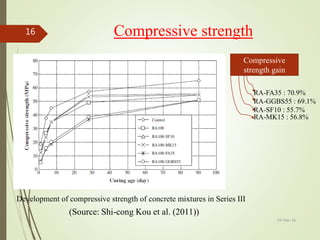
Development of compressive strength of concrete mixtures in Series III
RA-FA35 : 70.9%
RA-GGBS55 : 69.1%
RA-SF10 : 55.7%
RA-MK15 : 56.8%
Compressive
strength gain
(Source: Shi-cong Kou et al. (2011))
Tensile strength
24-Dec-16
17
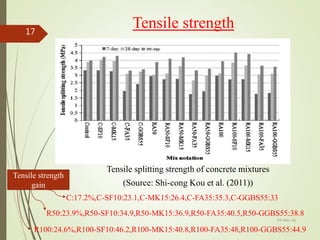
Tensile splitting strength of concrete mixtures
Tensile strength
gain
C:17.2%,C-SF10:23.1,C-MK15:26.4,C-FA35:35.3,C-GGBS55:33
R50:23.9%,R50-SF10:34.9,R50-MK15:36.9,R50-FA35:40.5,R50-GGBS55:38.8
R100:24.6%,R100-SF10:46.2,R100-MK15:40.8,R100-FA35:48,R100-GGBS55:44.9
(Source: Shi-cong Kou et al. (2011))
Drying shrinkage
24-Dec-16
18
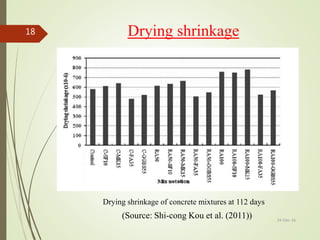
Drying shrinkage of concrete mixtures at 112 days
(Source: Shi-cong Kou et al. (2011))
Chloride ion penetration
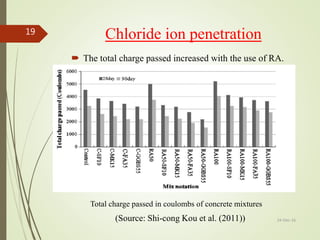
 The total charge passed increased with the use of RA.
24-Dec-16
19
Total charge passed in coulombs of concrete mixtures
(Source: Shi-cong Kou et al. (2011))
DISCUSSION
 The compressive strength of RAC was lower than
that of the control specimen, but could be
compensated by the use of 10% SF or 15% MK
 However 35% FA or 55% GGBS lowered the
compressive strength
 The tensile strength of natural and RAC made
with SF and MK was higher than that of the
corresponding control concrete at all test ages
 FA and GGBS decreased the tensile strength
24-Dec-16
20
Contd…….
 The drying shrinkage values of the natural and RAC
made with SF and MK was higher than that of control
 The chloride ion penetration test indicated that the
concrete containing recycled aggregate had a more
open pore structure, compared to the control concrete
 The test results show that SF and MK can improve
both strength and durability properties of RAC
 FA and GGBS significantly improved the durability
performance of the recycled aggregate concrete
24-Dec-16
21
CASE STUDY-2
“Experimental analysis of properties of recycled coarse
aggregate (RCA) concrete with mineral additives”
 Ö. Çakır (2014) observed compressive strength and
splitting tensile strength of GRAC prepared with
incorporation of SF and GGBFS
 The RAC was prepared by using 5%, 10% of SF and
30% ,60% of GGBFS whereas coarse aggregates
were replaced with 50% and 100% of RCA
24-Dec-16
22
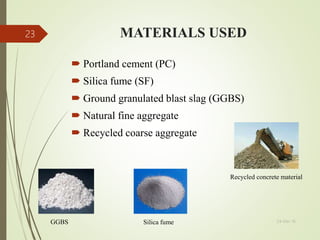
MATERIALS USED
 Portland cement (PC)
 Silica fume (SF)
 Ground granulated blast slag (GGBS)
 Natural fine aggregate
 Recycled coarse aggregate
24-Dec-16
23
GGBS
Recycled concrete material
Silica fume
SPECIMEN PREPARATION AND CURING
 Three series of concrete mixtures were prepared
in the laboratory using a Pan mixer
 SF, GGBFS were used as cement replacements
on a weight basis
 A constant water/binder ratio at 0.50 was used
 Series I concrete mixtures used natural aggregate
as the coarse aggregate
NA (control, natural aggregate with 100%
OPC), NA-SF5 (natural aggregate with 5%
SF),NA-SF10,NA-GGBS30,NA-GGBS60
24-Dec-16
24
Contd…….
 In Series II mixes, recycled aggregates were used to replace
50% of natural coarse aggregate
 RA50,RA50-SF5,R50-SF10,RA50-GGBS30,RA50
GGBS60
 In Series III mixes, recycled aggregates were used to
replace 100% of natural coarse aggregate
 RA100,RA100-SF5,RA100-SF10,RA100
GGBS30,RA100-GGBS60
 100mm x 200mm concrete cylinders casted to determine
the tensile splitting strength
 150 mm concrete cubes casted for the determination of the
compressive strength
24-Dec-16
25
RESULTS
24-Dec-16
26
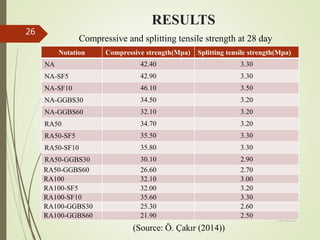
Notation Compressive strength(Mpa) Splitting tensile strength(Mpa)
NA 42.40 3.30
NA-SF5 42.90 3.30
NA-SF10 46.10 3.50
NA-GGBS30 34.50 3.20
NA-GGBS60 32.10 3.20
RA50 34.70 3.20
RA50-SF5 35.50 3.30
RA50-SF10 35.80 3.30
RA50-GGBS30 30.10 2.90
RA50-GGBS60 26.60 2.70
RA100 32.10 3.00
RA100-SF5 32.00 3.20
RA100-SF10 35.60 3.30
RA100-GGBS30 25.30 2.60
RA100-GGBS60 21.90 2.50
Compressive and splitting tensile strength at 28 day
(Source: Ö. Çakır (2014))
DISCUSSION
 The compressive strength of the GRAC gradually decreases
as the amount of RCA increases.
 At 100% of the replacement level, the compressive strength
decreases about 24% at 28 days. At over 50% of the
replacement level, the strength reduction is more significant.
 GRAC containing 5% and 10% SF increases the
compressive strength. However, the use of 30% and 60%
GGBFS lowered the compressive strength.
 GRAC containing 5% and 10% SF increases the tensile
strength. However, the use of 30% and 60% GGBFS
lowered the tensile strength.
24-Dec-16
27
24-Dec-16
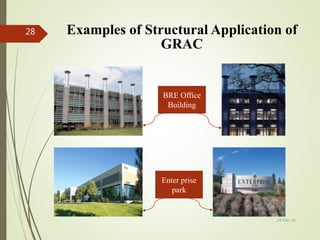
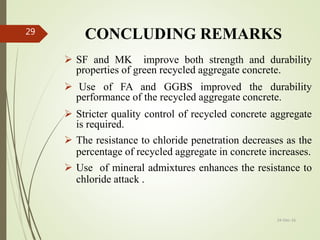
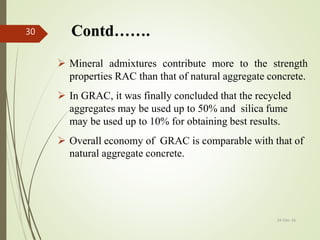
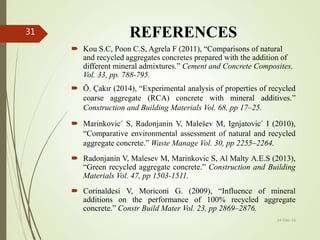
28 Examples of Structural Application of
GRAC
BRE Office
Building
Enter prise
park
CONCLUDING REMARKS
 SF and MK improve both strength and durability
properties of green recycled aggregate concrete.
 Use of FA and GGBS improved the durability
performance of the recycled aggregate concrete.
 Stricter quality control of recycled concrete aggregate
is required.
 The resistance to chloride penetration decreases as the
percentage of recycled aggregate in concrete increases.
 Use of mineral admixtures enhances the resistance to
chloride attack .
24-Dec-16
29
Contd…….
 Mineral admixtures contribute more to the strength
properties RAC than that of natural aggregate concrete.
 In GRAC, it was finally concluded that the recycled
aggregates may be used up to 50% and silica fume
may be used up to 10% for obtaining best results.
 Overall economy of GRAC is comparable with that of
natural aggregate concrete.
24-Dec-16
30
REFERENCES
 Kou S.C, Poon C.S, Agrela F (2011), “Comparisons of natural
and recycled aggregates concretes prepared with the addition of
different mineral admixtures.” Cement and Concrete Composites,
Vol. 33, pp. 788-795.
 Ö. Çakır (2014), “Experimental analysis of properties of recycled
coarse aggregate (RCA) concrete with mineral additives.”
Construction and Building Materials Vol. 68, pp 17–25.
 Marinkovic´ S, Radonjanin V, Malešev M, Ignjatovic´ I (2010),
“Comparative environmental assessment of natural and recycled
aggregate concrete.” Waste Manage Vol. 30, pp 2255–2264.
 Radonjanin V, Malesev M, Marinkovic S, Al Malty A.E.S (2013),
“Green recycled aggregate concrete.” Construction and Building
Materials Vol. 47, pp 1503-1511.
 Corinaldesi V, Moriconi G. (2009), “Influence of mineral
additions on the performance of 100% recycled aggregate
concrete.” Constr Build Mater Vol. 23, pp 2869–2876.
24-Dec-16
31
32
24-Dec-16
THANK YOU FOR YOUR KIND ATTENTION!!!
Any Questions???

GREEN RECYCLED AGGREGATE CONCRETE (GRAC)

  • 1.
    INFLUENCE OF MINERALADDITIONSON THE PERFORMANCE OF GREEN RECYCLED AGGREGATE CONCRETE DAYAL KURIAN VARGHESE 1 24-Dec-16
  • 2.
    OVERVIEW Introduction Green recycled aggregateconcrete (GRAC) Recycled concrete aggregate (RCA) Case study-1 Case study-2 Conclusion References 24-Dec-16 2 Mobile Recycling Unit
  • 3.
    INTRODUCTION  By theend of the 20th century, sustainable development and environmental protection became key goals of modern society  Main problems that industry of construction materials faces were:  natural aggregate depletion high consumption of Portland cement and associated high emission of carbon dioxide large amount of generated construction and demolition (C&D) waste 3 24-Dec-16
  • 4.
    GREEN RECYCLED AGGREGATE CONCRETE(GRAC)  GRAC made with recycled concrete aggregate, low cement content and high content of different mineral supplements  Such concretes belong to ‘‘green’’ or ‘‘eco’’ concretes  Here GRAC produced with fine river aggregate coarse recycled aggregate Portland Cement Silica fume (SF), fly ash (FA), Metakaolin (MK), GGBS 24-Dec-16 4 Enterprise Park
  • 5.
    RECYCLED CONCRETE AGGREGATE (RCA) 24-Dec-16 5 Collectionof C&D wastes Screening Vibrating feeder Plant crusher Jaw crusher Magnetic separatorcone crusher vibratory screens storage compartment Recycled aggregate Sampling & Testing
  • 6.
    CASE STUDY-1 “Comparisons ofnatural and recycled aggregates concretes prepared with the addition of different mineral admixtures”  Kou et al. (2011) conducted studies on GRAC prepared with different mineral admixtures such as SF (10%),MK (15%),FA (35%), GGBS (55%)  The coarse aggregates were replaced with 50% and 100% of RCA 24-Dec-16 6
  • 7.
    MATERIALS USED  Portlandcement (PC)  Metakaolin (MK)  Silica fume (SF)  Fly ash (FA)  Ground granulated blast slag (GGBS)  Natural fine aggregate  Recycled coarse aggregate 24-Dec-16 7 GGBS Fly ash Recycled concrete material Silica fume Metakaolin
  • 8.
    24-Dec-16 8 Contents Cement Flyash Silica fume Metakaolin GGBS SiO2 21 56.79 85-86 53.2 44.6 Al2O3 5.9 28.21 - 43.9 13.3 Fe2O3 3.4 5.31 - 0.38 0.9 CaO 64.7 <3 - 0.02 33.8 MgO 0.9 5.21 - 0.05 4.8 Na2O - - - 0.17 1.0 K2O - - - 0.10 - TiO2 - - - 1.68 - SO3 2.6 0.68 0.3-.7 - 1.3 Specific gravity (g/cm3) 3.15 2.31 2.22 2.62 2.98 Specific surface (cm2/g) 3520 3960 18650 12680 5350 Physical and chemical properties of cement, fly ash, silica fume, GGBS and metakaolin (Source: Shi-cong Kou et al. (2011))
  • 9.
    SPECIMEN PREPARATION ANDCURING  Three series of concrete mixtures were prepared in the laboratory using a Pan mixer  SF, MK, FA and GGBS were used as cement replacements on a weight basis  A constant water/binder ratio at 0.50 was used  Series I concrete mixtures used natural aggregate as the coarse aggregate C (control, natural aggregate with 100% OPC), C-SF10 (natural aggregate with 10% SF),C- MK15,C-FA35,C-GGBS55 24-Dec-16 9
  • 10.
    Contd…….  In SeriesII mixes, recycled aggregates were used to replace 50% of natural coarse aggregate  R50,R50-SF10,R50-MK15,R50-FA35,R50- GGBS55  In Series III mixes, recycled aggregates were used to replace 100% of natural coarse aggregate  R100,R100-SF10,R100-MK15,R100- FA35,R100-GGBS55 24-Dec-16 10
  • 11.
    24-Dec-16 11 Constitution (kg/m3) Composite ofbinder Sand Series I Series II Series III Water Cement Mineral admixtures Coarse natural agg. Coarse natural agg. Coarse recycle d agg. Coarse recycled agg. Control 195 390 0 678 1107 527 539 1078 SF10 195 351 39 664 1107 527 539 1078 MK15 195 331.5 58.5 669 1107 527 539 1078 FA35 195 253.5 136.5 640 1107 527 539 1078 GGBS55 195 175.5 214.5 658 1107 527 539 1078 Concrete mix proportion (Source: Shi-cong Kou et al. (2011))
  • 12.
    Contd…….  Workability measuredusing the slump cone test  Concrete cubes of size 100 mm casted for determining compressive strength  100mm x 200mm concrete cylinders casted to determine the tensile splitting strength  100mm x 50mm concrete cylinders casted to determine the chloride ion penetration  75mm x 75mm x 285mm prisms were casted for determining drying shrinkage 12 24-Dec-16
  • 13.
    RESULTS13 24-Dec-16 Slump of concretemixtures Slump value (Source: Shi-cong Kou et al. (2011))
  • 14.
    Compressive strength14 24-Dec-16 Development ofcompressive strength of concrete mixtures in Series I C-FA35 : 66.2% C-GGBS55 : 66.5% C-SF10 : 41.7% C-MK15 : 43.3% Compressive strength gain (Source: Shi-cong Kou et al. (2011))
  • 15.
    Compressive strength 24-Dec-16 15 Development ofcompressive strength of concrete mixtures in Series II RA50-FA35 : 68.6% RA50-GGBS55 : 67.2% RA50-SF10 : 49.8% RA50-MK15 : 52.2% Compressive strength gain (Source: Shi-cong Kou et al. (2011))
  • 16.
    Compressive strength 24-Dec-16 16 Development ofcompressive strength of concrete mixtures in Series III RA-FA35 : 70.9% RA-GGBS55 : 69.1% RA-SF10 : 55.7% RA-MK15 : 56.8% Compressive strength gain (Source: Shi-cong Kou et al. (2011))
  • 17.
    Tensile strength 24-Dec-16 17 Tensile splittingstrength of concrete mixtures Tensile strength gain C:17.2%,C-SF10:23.1,C-MK15:26.4,C-FA35:35.3,C-GGBS55:33 R50:23.9%,R50-SF10:34.9,R50-MK15:36.9,R50-FA35:40.5,R50-GGBS55:38.8 R100:24.6%,R100-SF10:46.2,R100-MK15:40.8,R100-FA35:48,R100-GGBS55:44.9 (Source: Shi-cong Kou et al. (2011))
  • 18.
    Drying shrinkage 24-Dec-16 18 Drying shrinkageof concrete mixtures at 112 days (Source: Shi-cong Kou et al. (2011))
  • 19.
    Chloride ion penetration The total charge passed increased with the use of RA. 24-Dec-16 19 Total charge passed in coulombs of concrete mixtures (Source: Shi-cong Kou et al. (2011))
  • 20.
    DISCUSSION  The compressivestrength of RAC was lower than that of the control specimen, but could be compensated by the use of 10% SF or 15% MK  However 35% FA or 55% GGBS lowered the compressive strength  The tensile strength of natural and RAC made with SF and MK was higher than that of the corresponding control concrete at all test ages  FA and GGBS decreased the tensile strength 24-Dec-16 20
  • 21.
    Contd…….  The dryingshrinkage values of the natural and RAC made with SF and MK was higher than that of control  The chloride ion penetration test indicated that the concrete containing recycled aggregate had a more open pore structure, compared to the control concrete  The test results show that SF and MK can improve both strength and durability properties of RAC  FA and GGBS significantly improved the durability performance of the recycled aggregate concrete 24-Dec-16 21
  • 22.
    CASE STUDY-2 “Experimental analysisof properties of recycled coarse aggregate (RCA) concrete with mineral additives”  Ö. Çakır (2014) observed compressive strength and splitting tensile strength of GRAC prepared with incorporation of SF and GGBFS  The RAC was prepared by using 5%, 10% of SF and 30% ,60% of GGBFS whereas coarse aggregates were replaced with 50% and 100% of RCA 24-Dec-16 22
  • 23.
    MATERIALS USED  Portlandcement (PC)  Silica fume (SF)  Ground granulated blast slag (GGBS)  Natural fine aggregate  Recycled coarse aggregate 24-Dec-16 23 GGBS Recycled concrete material Silica fume
  • 24.
    SPECIMEN PREPARATION ANDCURING  Three series of concrete mixtures were prepared in the laboratory using a Pan mixer  SF, GGBFS were used as cement replacements on a weight basis  A constant water/binder ratio at 0.50 was used  Series I concrete mixtures used natural aggregate as the coarse aggregate NA (control, natural aggregate with 100% OPC), NA-SF5 (natural aggregate with 5% SF),NA-SF10,NA-GGBS30,NA-GGBS60 24-Dec-16 24
  • 25.
    Contd…….  In SeriesII mixes, recycled aggregates were used to replace 50% of natural coarse aggregate  RA50,RA50-SF5,R50-SF10,RA50-GGBS30,RA50 GGBS60  In Series III mixes, recycled aggregates were used to replace 100% of natural coarse aggregate  RA100,RA100-SF5,RA100-SF10,RA100 GGBS30,RA100-GGBS60  100mm x 200mm concrete cylinders casted to determine the tensile splitting strength  150 mm concrete cubes casted for the determination of the compressive strength 24-Dec-16 25
  • 26.
    RESULTS 24-Dec-16 26 Notation Compressive strength(Mpa)Splitting tensile strength(Mpa) NA 42.40 3.30 NA-SF5 42.90 3.30 NA-SF10 46.10 3.50 NA-GGBS30 34.50 3.20 NA-GGBS60 32.10 3.20 RA50 34.70 3.20 RA50-SF5 35.50 3.30 RA50-SF10 35.80 3.30 RA50-GGBS30 30.10 2.90 RA50-GGBS60 26.60 2.70 RA100 32.10 3.00 RA100-SF5 32.00 3.20 RA100-SF10 35.60 3.30 RA100-GGBS30 25.30 2.60 RA100-GGBS60 21.90 2.50 Compressive and splitting tensile strength at 28 day (Source: Ö. Çakır (2014))
  • 27.
    DISCUSSION  The compressivestrength of the GRAC gradually decreases as the amount of RCA increases.  At 100% of the replacement level, the compressive strength decreases about 24% at 28 days. At over 50% of the replacement level, the strength reduction is more significant.  GRAC containing 5% and 10% SF increases the compressive strength. However, the use of 30% and 60% GGBFS lowered the compressive strength.  GRAC containing 5% and 10% SF increases the tensile strength. However, the use of 30% and 60% GGBFS lowered the tensile strength. 24-Dec-16 27
  • 28.
    24-Dec-16 28 Examples ofStructural Application of GRAC BRE Office Building Enter prise park
  • 29.
    CONCLUDING REMARKS  SFand MK improve both strength and durability properties of green recycled aggregate concrete.  Use of FA and GGBS improved the durability performance of the recycled aggregate concrete.  Stricter quality control of recycled concrete aggregate is required.  The resistance to chloride penetration decreases as the percentage of recycled aggregate in concrete increases.  Use of mineral admixtures enhances the resistance to chloride attack . 24-Dec-16 29
  • 30.
    Contd…….  Mineral admixturescontribute more to the strength properties RAC than that of natural aggregate concrete.  In GRAC, it was finally concluded that the recycled aggregates may be used up to 50% and silica fume may be used up to 10% for obtaining best results.  Overall economy of GRAC is comparable with that of natural aggregate concrete. 24-Dec-16 30
  • 31.
    REFERENCES  Kou S.C,Poon C.S, Agrela F (2011), “Comparisons of natural and recycled aggregates concretes prepared with the addition of different mineral admixtures.” Cement and Concrete Composites, Vol. 33, pp. 788-795.  Ö. Çakır (2014), “Experimental analysis of properties of recycled coarse aggregate (RCA) concrete with mineral additives.” Construction and Building Materials Vol. 68, pp 17–25.  Marinkovic´ S, Radonjanin V, Malešev M, Ignjatovic´ I (2010), “Comparative environmental assessment of natural and recycled aggregate concrete.” Waste Manage Vol. 30, pp 2255–2264.  Radonjanin V, Malesev M, Marinkovic S, Al Malty A.E.S (2013), “Green recycled aggregate concrete.” Construction and Building Materials Vol. 47, pp 1503-1511.  Corinaldesi V, Moriconi G. (2009), “Influence of mineral additions on the performance of 100% recycled aggregate concrete.” Constr Build Mater Vol. 23, pp 2869–2876. 24-Dec-16 31
  • 32.
    32 24-Dec-16 THANK YOU FORYOUR KIND ATTENTION!!! Any Questions???

Editor's Notes

  • #4 over the last five years, India’s first and only recycling plant for construction and demolition (C&D) waste has saved the already-polluted Yamuna and the overflowing landfills of Delhi from 15.4 lakh tonnes of debris. A Ministry of Urban Development circular on June 28, 2012, directed States to set-up such facilities in all cities with a population of over 10 lakh. But, till now the existing facility at Burari is the only one. #concrete paving blocks & tiles
  • #5 Enter price park in Denver ,US In US construction Demolition recycling Assosiation
  • #6 Jaw compresses concrete in between stationary and movable plate Cone crusher –concrete is crushed b/w 2 cone shaped plates.. #vibrating feeder/grizzly for sorting the hard portions from the inert C&D materials #vibratory screens for separating the crushed recycled aggregates into different sizes;
  • #7 efgrgrttwefdwedere
  • #12 1: 1.73 : 2.83
  • #15 58 Mpa
  • #20 The resistance to chloride ion penetration of the natural and recycled aggregate concrete improved with the use of the mineral admixtures. The improvement order (from the lowest to highest) is SF10 concrete, MK15 concrete, FA35 concrete, and GGBS55 concrete. Since recycled aggregates are highly porous and causes weak interfacial transition zone, it causes high amount of charge to pass causing low resistance. The addition of silica fume increased the resistance to chloride ion penetration of both natural and recycled aggregate. This is due to reduction in average pore size of the paste and the improvement of interfacial transition zone.
  • #21 The compressive strength of concrete containing recycled aggregate at 1, 4, 7, 28 and 90 days was lower than that of the control specimen, but could be compensated by the use of 10% SF or 15% MK. However, the use of 30% FA or 55% GGBS lowered the strength. The tensile splitting strength of natural and recycled aggregate concrete made with SF and MK was higher than that of the corresponding control concrete at all test ages, whereas FA and GGBS decreased the tensile splitting strength of the concretes.
  • #22 The use of mineral admixture resulted in a decrease in the charge passed through the concrete specimens
  • #23 1 : 2.5 : 3.34
  • #29 GRAC may be used for all construction application (including general purpose construction, and minor and major structural applications), which shows that in the near future GRAC can be a competitive to normal aggregate concrete.. Building Research Establishment (BRE) Office Building in UK IN 1996 -BRE’s is an establishment whose job is to enhance or promote the sustainable or eco-friendly con: works. So they used this building as an opportunity to demonstrate all the features of green building…GRAC supplied for foundations, floor slabs, structural columns and waffle floors. 2. Enter price park in Denver ,US In US construction Demolition recycling Assosiation
  • #30 I.The given studies showed that if we adopt GRAC it reduces 1.natu .agg. Depl 2. Construction and Demolition Waste Management III. limited applications of recycled construction materials are attributable to their inferior quality. To enhance confidence for their use, existing techniques need to be further developed to improve its quality. Some of RA can be used for all construction application (including general purpose concrete, and minor and major structural applications), which shows that they can be as competitive as normal aggregate.
  • #31 In GRAC, For obtaining good result, RCA may be used up to 50% and at the same time SF may be used up to 10% GRAC address a lot of environmental issue.. At the same time if we provide a good recycling facility….it will be economical than natural aggregate concrete.