THE CHALLENGES OF MULTI-
CLOUD MANAGEMENT AND
HOW TO OVERCOME ITS
CHALLENGES IN IT TEAMS
T
he future of cloud computing has been in a great dimension ever since the beginning of its
lineage and existence. As the cloud develops, many businesses of different kinds continue
to corporate and derive pleasure in its solution through the data stored. Being in an agile
environment where it is superficially managed by all organizations, especially in a remote and
hybrid work setting. It creates flexibility in reaching employees anytime, regardless of the loca-
tion or region.For this reason, many organizations have deployed solutions to serve diversely
as network providers for their internal and external regions, creating flexibility and a dramatic
rise in every organization, which is said to be a more proactive strategy in the multi-cloud solu-
tion.
However, without user or administrative intervention, exploring multi-cloud can be difficult.
Yet, with the presence of an expert, operating on a multi-cloud structure can still provide and
help businesses avoid redundancy, resilience, low cost, and vendor lock-in. However, regard-
less of the functions, the challenges are considered a defect and have to be potentially treated
with care. This article explores the fundamentals of a multi-cloud system and how to overcome
its challenges in IT teams.
What Is Multi-cloud Management?:
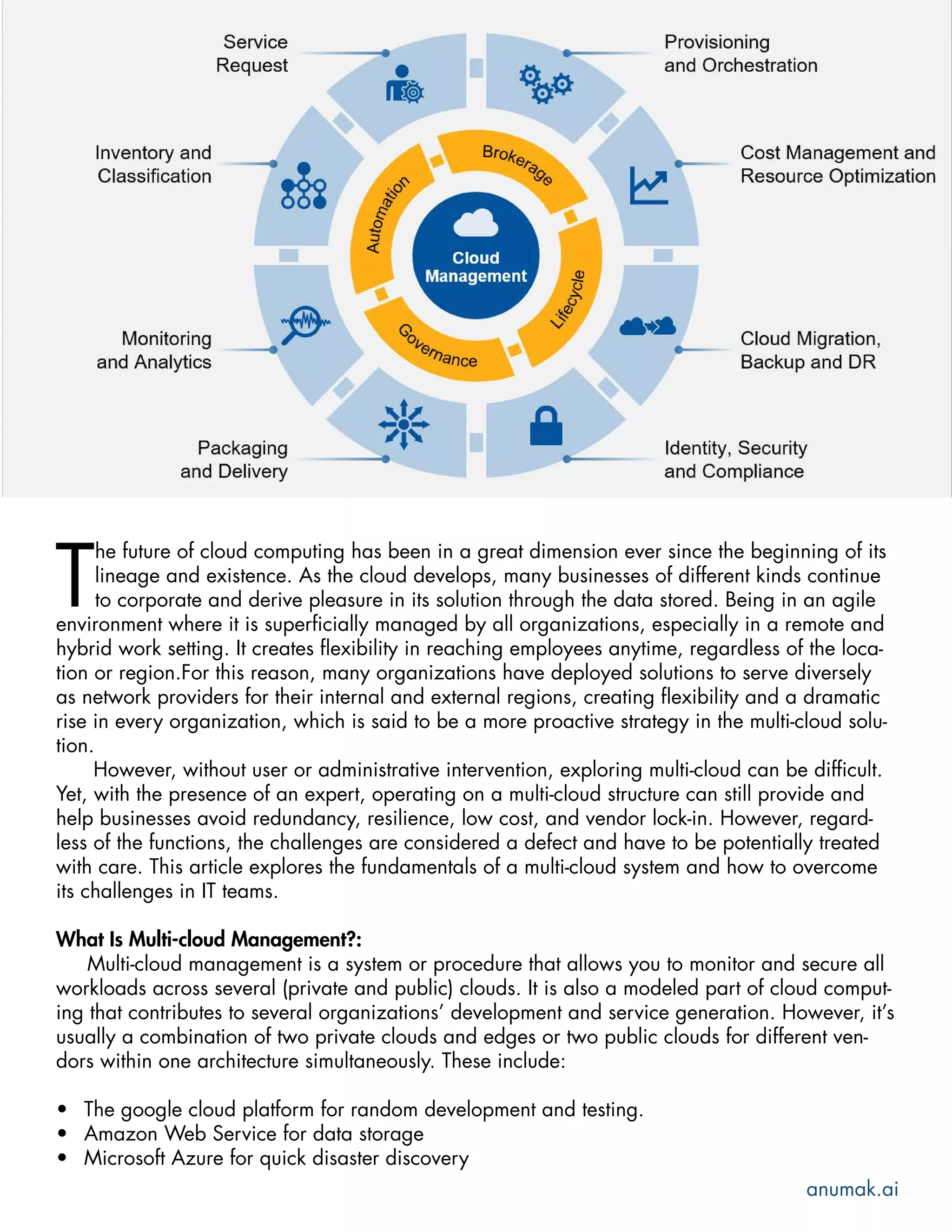
Multi-cloud management is a system or procedure that allows you to monitor and secure all
workloads across several (private and public) clouds. It is also a modeled part of cloud comput-
ing that contributes to several organizations’ development and service generation. However, it’s
usually a combination of two private clouds and edges or two public clouds for different ven-
dors within one architecture simultaneously. These include:
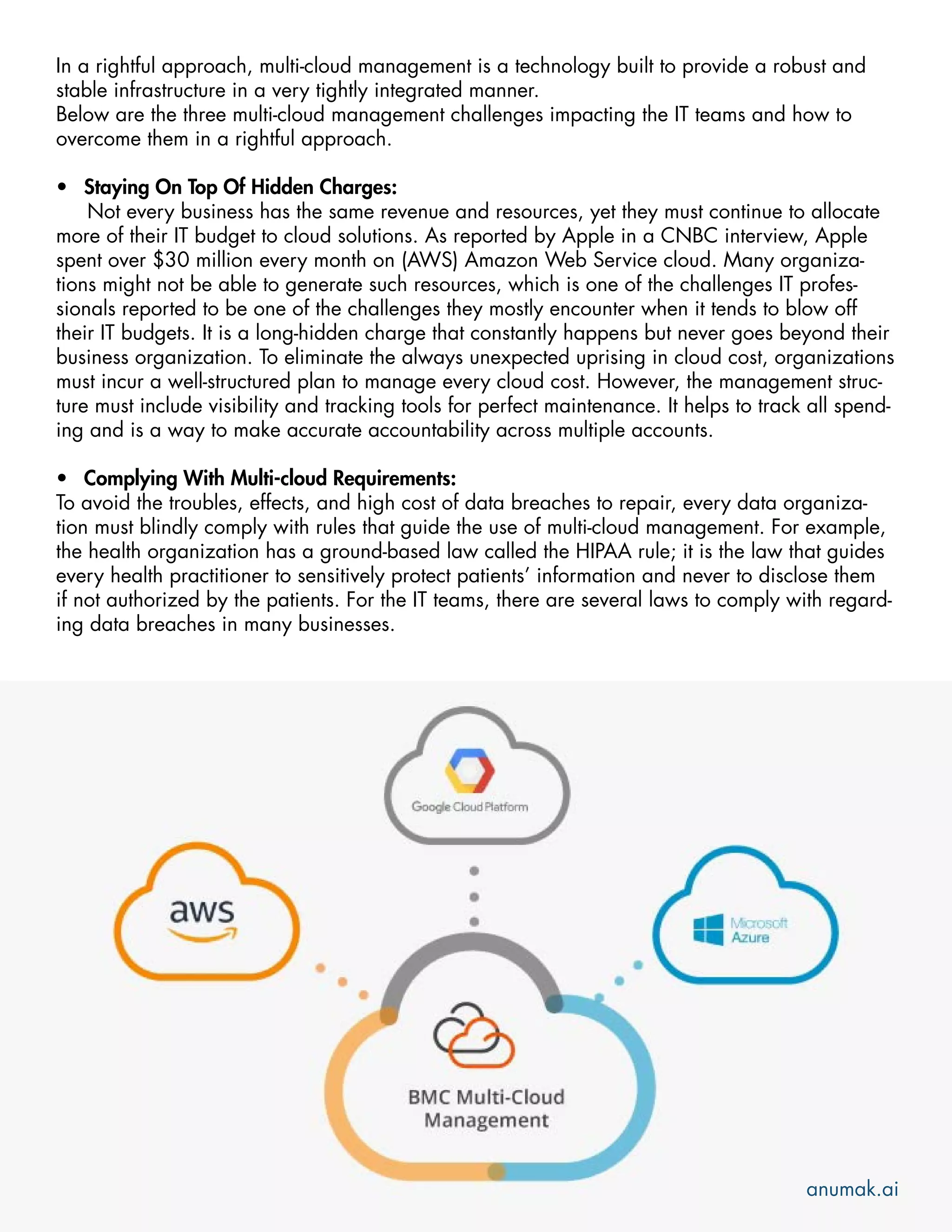
• The google cloud platform for random development and testing.
• Amazon Web Service for data storage
• Microsoft Azure for quick disaster discovery
anumak.ai
In a rightful approach, multi-cloud management is a technology built to provide a robust and
stable infrastructure in a very tightly integrated manner.
Below are the three multi-cloud management challenges impacting the IT teams and how to
overcome them in a rightful approach.
• Staying On Top Of Hidden Charges:
Not every business has the same revenue and resources, yet they must continue to allocate
more of their IT budget to cloud solutions. As reported by Apple in a CNBC interview, Apple
spent over $30 million every month on (AWS) Amazon Web Service cloud. Many organiza-
tions might not be able to generate such resources, which is one of the challenges IT profes-
sionals reported to be one of the challenges they mostly encounter when it tends to blow off
their IT budgets. It is a long-hidden charge that constantly happens but never goes beyond their
business organization. To eliminate the always unexpected uprising in cloud cost, organizations
must incur a well-structured plan to manage every cloud cost. However, the management struc-
ture must include visibility and tracking tools for perfect maintenance. It helps to track all spend-
ing and is a way to make accurate accountability across multiple accounts.
• Complying With Multi-cloud Requirements:
To avoid the troubles, effects, and high cost of data breaches to repair, every data organiza-
tion must blindly comply with rules that guide the use of multi-cloud management. For example,
the health organization has a ground-based law called the HIPAA rule; it is the law that guides
every health practitioner to sensitively protect patients’ information and never to disclose them
if not authorized by the patients. For the IT teams, there are several laws to comply with regard-
ing data breaches in many businesses.
anumak.ai
In case of any unexpected disaster, IT professionals must heavily invest in cloud solutions to help
them set up agile compliance policies against their cloud infrastructure.
• The Rising Security Challenges:
Many businesses have experienced data loss due to several cyberattacks that filtrated many
organizations during the covid-19 period, primarily in the IT sectors, causing loss of visibility,
configuration, and cyberattack, taking advantage of their weakness.
If not carefully maximized, the complexity of the multi-cloud system can lead to its delay in
operation. The security platforms are meant to be set up to access and respond to immediate
treat pieces of information; else, the operating system can become very slow if not damaged.
Conclusion
With businesses now accelerating their goal to becoming a whole cloud-native interface in the
coming years, with a ground cloud-based disaster recovery strategy, they must also be embed-
ded within their management plans. Otherwise, every business risks losing vital data and hav-
ing its systems, operations, and services shut down by natural and artificial disasters, hardware
failures, power outages, and security risks.
anumak.ai
ANUMAK & COMPANY
aNumak & Company is a global management consulting firm, an India private company
limited by warranty. It is a company with expertise in creating scalable business models for
different industry verticals. The Company strives to provide solutions through consulting, digital
transformation, and innovative products that solve modern business problems. Offering on–
site and offshore support and unique strategies, aNumak & Company transforms traditional
business models into high–performance, dynamic, and distinctive business enterprises. It brings
insights from core domain experts to deliver the best possible solutions to drive growth. aNumak
& Company and each of its member firms are legally separate and independent entities. For
more detailed information about aNumak & Company and its member companies, please visit
https://www.anumak.com
This material was prepared by aNumak & Company. This material (including any information it
contains) is intended to provide general information on a particular topic(s). This material may
contain information obtained from publicly available information or other third–party sources.
aNumak & Company does not independently verify such sources and is not responsible for any
loss resulting from reliance on information obtained from such sources. aNumak & Company
does not provide any investment, legal, or other professional advice or services through this
material. You should seek specific advice from the relevant specialist(s) for such services.
This material or information is not intended to be considered the sole basis for any decision
that could affect you, your business, or the operations of the company. Before making any
decision or taking any action that could affect your finances or business, you should consult a
professional.
No institution at aNumak & Company can be held responsible for any loss suffered by any
person or institution due to access to, use, or reliance on this material. By using this material or
any information it contains, the user accepts he entirety of this notice and the terms of use.
©2022 aNumak & Company
anumak.ai

The Challenges Of Multi-cloud Management.pdf

  • 1.
    THE CHALLENGES OFMULTI- CLOUD MANAGEMENT AND HOW TO OVERCOME ITS CHALLENGES IN IT TEAMS
  • 2.
    T he future ofcloud computing has been in a great dimension ever since the beginning of its lineage and existence. As the cloud develops, many businesses of different kinds continue to corporate and derive pleasure in its solution through the data stored. Being in an agile environment where it is superficially managed by all organizations, especially in a remote and hybrid work setting. It creates flexibility in reaching employees anytime, regardless of the loca- tion or region.For this reason, many organizations have deployed solutions to serve diversely as network providers for their internal and external regions, creating flexibility and a dramatic rise in every organization, which is said to be a more proactive strategy in the multi-cloud solu- tion. However, without user or administrative intervention, exploring multi-cloud can be difficult. Yet, with the presence of an expert, operating on a multi-cloud structure can still provide and help businesses avoid redundancy, resilience, low cost, and vendor lock-in. However, regard- less of the functions, the challenges are considered a defect and have to be potentially treated with care. This article explores the fundamentals of a multi-cloud system and how to overcome its challenges in IT teams. What Is Multi-cloud Management?: Multi-cloud management is a system or procedure that allows you to monitor and secure all workloads across several (private and public) clouds. It is also a modeled part of cloud comput- ing that contributes to several organizations’ development and service generation. However, it’s usually a combination of two private clouds and edges or two public clouds for different ven- dors within one architecture simultaneously. These include: • The google cloud platform for random development and testing. • Amazon Web Service for data storage • Microsoft Azure for quick disaster discovery anumak.ai
  • 3.
    In a rightfulapproach, multi-cloud management is a technology built to provide a robust and stable infrastructure in a very tightly integrated manner. Below are the three multi-cloud management challenges impacting the IT teams and how to overcome them in a rightful approach. • Staying On Top Of Hidden Charges: Not every business has the same revenue and resources, yet they must continue to allocate more of their IT budget to cloud solutions. As reported by Apple in a CNBC interview, Apple spent over $30 million every month on (AWS) Amazon Web Service cloud. Many organiza- tions might not be able to generate such resources, which is one of the challenges IT profes- sionals reported to be one of the challenges they mostly encounter when it tends to blow off their IT budgets. It is a long-hidden charge that constantly happens but never goes beyond their business organization. To eliminate the always unexpected uprising in cloud cost, organizations must incur a well-structured plan to manage every cloud cost. However, the management struc- ture must include visibility and tracking tools for perfect maintenance. It helps to track all spend- ing and is a way to make accurate accountability across multiple accounts. • Complying With Multi-cloud Requirements: To avoid the troubles, effects, and high cost of data breaches to repair, every data organiza- tion must blindly comply with rules that guide the use of multi-cloud management. For example, the health organization has a ground-based law called the HIPAA rule; it is the law that guides every health practitioner to sensitively protect patients’ information and never to disclose them if not authorized by the patients. For the IT teams, there are several laws to comply with regard- ing data breaches in many businesses. anumak.ai
  • 4.
    In case ofany unexpected disaster, IT professionals must heavily invest in cloud solutions to help them set up agile compliance policies against their cloud infrastructure. • The Rising Security Challenges: Many businesses have experienced data loss due to several cyberattacks that filtrated many organizations during the covid-19 period, primarily in the IT sectors, causing loss of visibility, configuration, and cyberattack, taking advantage of their weakness. If not carefully maximized, the complexity of the multi-cloud system can lead to its delay in operation. The security platforms are meant to be set up to access and respond to immediate treat pieces of information; else, the operating system can become very slow if not damaged. Conclusion With businesses now accelerating their goal to becoming a whole cloud-native interface in the coming years, with a ground cloud-based disaster recovery strategy, they must also be embed- ded within their management plans. Otherwise, every business risks losing vital data and hav- ing its systems, operations, and services shut down by natural and artificial disasters, hardware failures, power outages, and security risks. anumak.ai
  • 5.
    ANUMAK & COMPANY aNumak& Company is a global management consulting firm, an India private company limited by warranty. It is a company with expertise in creating scalable business models for different industry verticals. The Company strives to provide solutions through consulting, digital transformation, and innovative products that solve modern business problems. Offering on– site and offshore support and unique strategies, aNumak & Company transforms traditional business models into high–performance, dynamic, and distinctive business enterprises. It brings insights from core domain experts to deliver the best possible solutions to drive growth. aNumak & Company and each of its member firms are legally separate and independent entities. For more detailed information about aNumak & Company and its member companies, please visit https://www.anumak.com This material was prepared by aNumak & Company. This material (including any information it contains) is intended to provide general information on a particular topic(s). This material may contain information obtained from publicly available information or other third–party sources. aNumak & Company does not independently verify such sources and is not responsible for any loss resulting from reliance on information obtained from such sources. aNumak & Company does not provide any investment, legal, or other professional advice or services through this material. You should seek specific advice from the relevant specialist(s) for such services. This material or information is not intended to be considered the sole basis for any decision that could affect you, your business, or the operations of the company. Before making any decision or taking any action that could affect your finances or business, you should consult a professional. No institution at aNumak & Company can be held responsible for any loss suffered by any person or institution due to access to, use, or reliance on this material. By using this material or any information it contains, the user accepts he entirety of this notice and the terms of use. ©2022 aNumak & Company anumak.ai