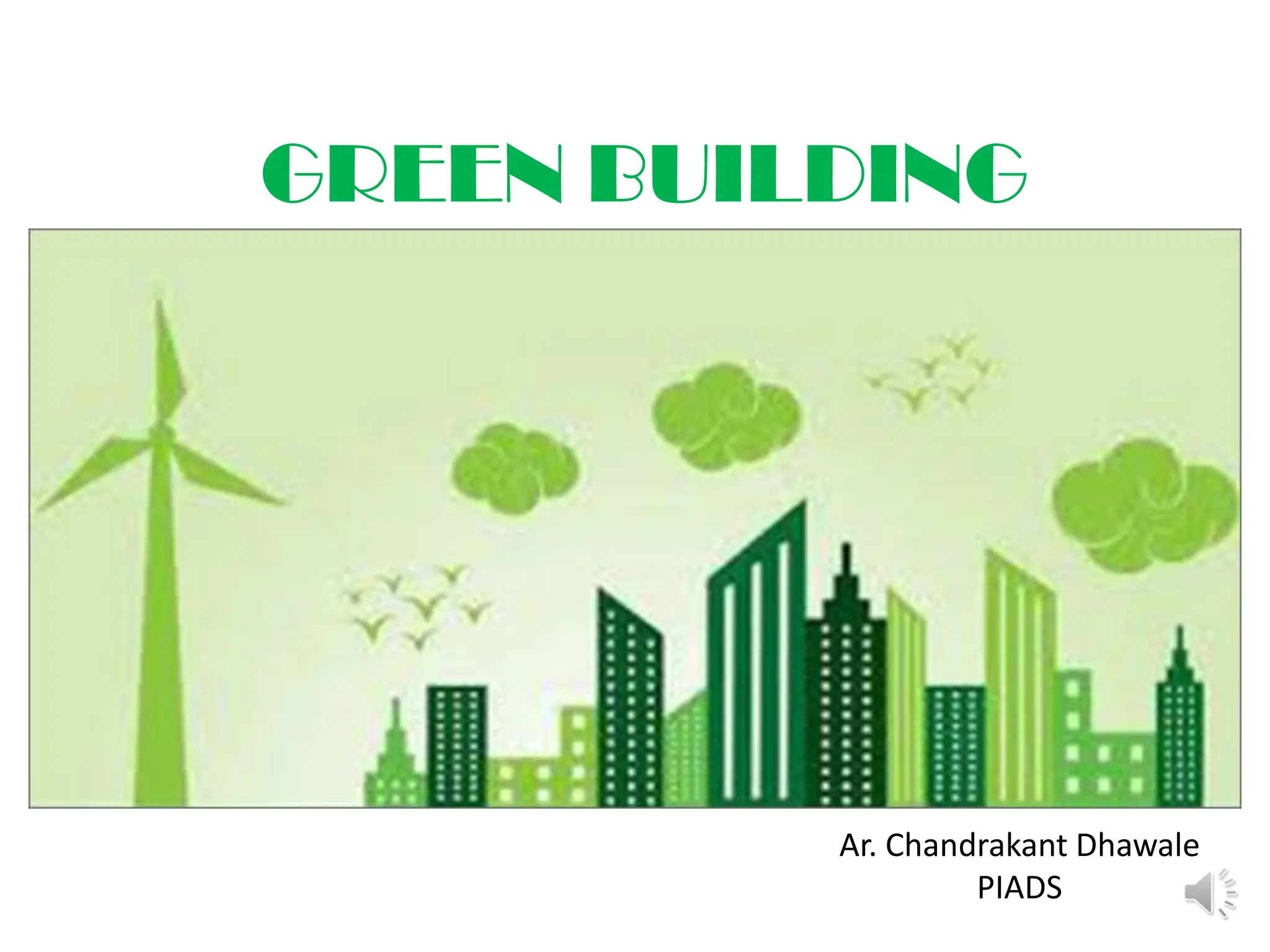
GREEN BUILDING
Ar. Chandrakant Dhawale
PIADS
PIADS GREEN BUILDING
This day and age, you hear everyone talking about going green. Whether you want to
admit it or not, at some point, everyone will have to follow with the green movement.
This is because at the rate we are going, the earth is simply not sustainable. That means
that over the years, we will begin to run out of certain natural resources that are needed
for us to survive.
Indeed, that is alarming to some people, which is why there are so many people that focus
on the green building today. But what exactly is green building?
PIADS GREEN BUILDING
Defining a Green Building
Concept of green building
• Buildings that are LEED-certified make better places for people to live and also use less
energy and water, reduce air pollution, produce clean air and save money for businesses
and families.
• The Indian Green Building Council (IGBC) defines a green building as one which uses less
water, is energy efficient, conserves natural resources, generates less waste, and
provides healthier space for occupants as compared to a conventional building.
Suzlon One Earth, Pune. .
PIADS GREEN BUILDING
• First, we will take a look at what a green building , Some people may think of a green or
sustainable building as just a building that doesn’t really have as bad of an impact on
the environment as another ‘average’ building.
• Other people may find it to be the type of building and the actual surroundings of the
building.
• The ideal green building would be a building project that would allow you to preserve
most of the natural environment around the project site, while still being able to
produce a building that is going to serve a purpose.
• The construction and operation will promote a healthy environment for all involved,
and it will not disrupt the land, water, resources and energy in and around the building.
This is the actual definition of a green building.
The U.S. EPA says
“Green building is the practice of creating structures and using processes that are
environmentally responsible and resource-efficient throughout a building’s life-cycle from
siting to design, construction, operation, maintenance, renovation and deconstruction.
This practice expands and complements the classical building design concerns of economy,
utility, durability, and comfort. Green building is also known as a sustainable or high-
performance building.”
PIADS GREEN BUILDING
Why Go Green?
Why it is so important to go green. Most people will find when going green that they are
able to reduce their carbon footprint and actually lend a helping hand to the environment.
You can go green in a variety of different ways, but builders and construction workers must
do their part as well.
If you haven’t begun going green, then you will find that there are a variety of different
things that you can do to help you get started. You don’t have to jump in headfirst, and you
can actually take some baby steps along the way. Green buildings are designed in such a way
to reduce the overall impact on the environment and human health by:
i. Reducing trash, pollution and degradation of the environment.
ii. Efficiently using energy, water and other resources.
iii. Protecting occupant health and improving productivity.
PIADS GREEN BUILDING
Does Going Green Really Cost You More?
Some people feel that they just can’t go green because it will cost them more money, but
that is really a common misconception. While it may cost you a bit more to get started
when you are going green, because green materials and products can be more costly, you
really have to consider the type of savings that you will be able to reap.
You will be able to save on energy costs because going green also means conserving
energy. You should really look at the green building as more of an investment than
anything else. An investment that will be able to save you money, as well as an investment
that will be able to help the environment! It is a win-win situation for everyone!
PIADS GREEN BUILDING
Benefits of Green Building
• With new technologies constantly being developed to complement current practices in
creating greener structures, the benefits of green building can range from
environmental to economic to social.
• By adopting greener practices, we can take the maximum advantage of environmental
and economic performance.
• Green construction methods, when integrated with eco-friendly design and
construction, provide the most significant benefits. Benefits of green building include:
1. Reduces Wastage of Water and Energy.
• Green buildings certified by the Indian Green Building Council (IGBC) results in water
savings of 20 – 30% and energy savings of 40 – 50% compared to conventional
buildings in India.
• Green buildings achieving the Green Star certification in Australia have been shown to
save 51% less potable water and produce 62% fewer greenhouse gas emissions than if
they had been built to meet minimum industry requirements.
• Green buildings achieving the Green Star certification in South Africa have been shown
to save between 20 – 30% potable water every year, and to save on average between
30 – 40% energy and carbon emissions every year, when compared to the industry
norm.
PIADS GREEN BUILDING
Green buildings achieving the LEED certification in the US and other countries have been
shown to consume 11 percent less water and consume 25 percent less energy than non-
green buildings.
2. Conserves Natural Resources
• The building sector has the largest potential for reducing greenhouse gas emissions
significantly compared to other major emitting sectors.
• This emissions savings potential is said to be as much as 84 gigatons (84 BILLION TON)
of CO2 (GtCO2) by 2050, through direct measures in buildings such as energy
efficiency, fuel switching and the use of renewable energy.
• The building sector has the potential to make energy savings of 50% or more in 2050,
in support of limiting global temperature rises to 2°C (above pre-industrial levels) –
UNEP, 2016.
3. Improves Air and Water Quality
Research suggests that better indoor air quality that is low concentrations of CO2 and
pollutants, and high ventilation rates can lead to improvements in the performance of up
to 8 percent.
PIADS GREEN BUILDING
4. Protects Biodiversity and Ecosystems
Green building supports ecosystems by promoting the efficient use of energy, water and
other resources. It also uses renewable energy, such as solar energy. Measures are usually
taken for reducing pollution and waste and also enabling re-use and recycling of the
materials. Materials that are used are non-toxic, ethical and sustainable
The environment is considered in design, construction and operation and enables
adaptation to a changing environment.
PIADS GREEN BUILDING
Economic Benefits
5. Reduces Costs and Increase Value
These buildings lower construction costs and higher property value for building developers;
global energy efficiency measures could save an estimated €280 to €410 billion in savings on
energy spending. Green buildings, whether new or renovated – command a 7 percent
increase in asset value over traditional buildings – Dodge Data & Analytics, 2016.
(Asset valuation is the process of determining the fair market value of an asset
a figure showing the total value of the assets of a company or organization)
6. Improves Occupant Productivity
Green Building focuses on creating buildings that are not only good for the environment but
also support healthier, happier and more productive lives. These include cost savings on
utility bills for tenants or households through energy and water efficiency.
7. Creates a Market For Green Product and Services
Different countries and regions have a variety of characteristics such as distinctive climatic
conditions, unique cultures and traditions, diverse building types and ages, or wide-ranging
environmental, economic and social priorities, all of these shapes up the green building and
make green buildings best suited to their own markets.
PIADS GREEN BUILDING
Social Benefits
8. Improves the Quality of Life
In green buildings, the quality of life of occupants is considered in design, construction and
operation. It Improves occupant health and comfort. Research suggests that better indoor
air quality (low concentrations of CO2 and pollutants and high ventilation rates) can lead to
improvements in the performance of up to 8 percent.
Workers in green, well-ventilated offices record a 101 percent increase in cognitive scores
(brain function). Employees in offices with windows slept an average of 46 minutes more
per night – American Academy of Sleep Medicine.
9. Minimizes Strain on Local Infrastructure
Green buildings work with local governments and utilities to provide training and incentives
for green building and energy efficiency.
They also offer free classes, public forums and technical training that can minimize strain on
local infrastructure.
These provide opportunities for existing homes to easily and affordably go green, becoming
truly sustainable, non-toxic, zero water and zero energy buildings.
PIADS GREEN BUILDING
The Goals of Green Building
Now, we should consider the goals of green building. Of course, one of the main goals is to
make the earth more sustainable, but it really does go deeper than that. When you decide
to go green, your goal will be to actually help to sustain the environment without
disrupting the natural habitats around it.
When you start a building project and you disrupt the natural habitats around it, you can
actually make an impact on the wildlife and environment that will be much like a butterfly
effect.
Even the smallest changes that you can make will help to promote better planet earth, and
a better place for us all to live- not just us humans, but also the plants and wildlife that take
up their residence here on earth as well.
As you can see, green building is something that everyone should really jump on to. If you
don’t plan to rebuild your home, then you may just want to make a few green changes
within your home to ensure that you are able to get the goals that you want out of it.
PIADS GREEN BUILDING
 Buildings contribute towards major environmental impacts during their life cycle.
Various resources such as soil, trees, water, and various formats of energy are used
by the buildings.
 For instance Water, most vital resource, is consumed continuously during building
construction as well as operation.
 Similarly several buildings along with usage of resources generate large amounts of
waste, which can be recycled and can be reused.
 Thus, the challenge of a green building is to make optimum usage of resources and
proper waste disposal at an affordable cost.
 Recognizing the importance of sustainable building practices, ―going green‖ and
―environment sustainability‖ has been introduced for many years.
 The Indian construction industry registered an annual growth of 15.9% in real terms in
2021, following a decline of 12.3% in 2020.
 In the entire lifespan of a building, energy, construction materials, manpower,
construction and demolition (C&D) waste, water, transportation, and GHG emission
are considered to be the major factors that have an ecological impact.
 Many studies on life cycle energy, emissions, C&D waste , transportation , and water
consumption in buildings have been reported. estimated material use in India is
projected to be nearly 15 billion tonnes by 2030, and it will further increase up to 25
billion tonnes by 2050, while total C&D waste generated in the country in 2015 was
about 716 million tonnes.
Green Building rating system
PIADS GREEN BUILDING
 The construction sector is the major emitters of greenhouse gases, Globally 25% of wood,
40% of raw stone, gravel and sand are estimated to be consumed by the construction
sector annually.
 The construction cost shared by material alone is 50%–60% and 9% of the total purchased
material end up as waste, Coupled with the benefits of the urbanization, extensive
infrastructure and reconstruction, building projects led to an alarmed rise of construction
and demolition (C & D) waste generation in last few years.
 However, construction is still a major energy consumer based on official statistics.
 This could be due to the passive attitude of construction practitioners towards adopting
sustainable solutions.
 Facing the rising energy costs and growing environmental concerns, the demand for
sustainable building facilities with minimal environmental impact has been pushed
recently.
 Authorities and organizations initiated the rating systems for green buildings to
minimize/optimize consumption of natural resources and control pollution.
PIADS GREEN BUILDING
 Buildings certified by various rating systems are considered as consuming less energy,
providing a better living environment and contributing to the overall reputation of the
property.
 It is estimated that there are approximately 600 green rating systems globally .
 BREEAM (Building Research Establishment Assessment Method) is known as the first
rating tool to assess building performance based on certain target values for different
criteria.
 Based on the magnitude of green measures adopted, Points are Awarded to a building
and, after appropriate weighting; a total score is described to determine the rating of the
building.
 This helps to convey the range of application of green measures in building
construction. Worldwide various rating systems have been developed.
 The first environmental certification system was created in year 1996 the Building
Research Establishment‘s Environmental Assessment Method (BREEAM) in UK.
 In year 1998 the Leadership in Energy and Environmental Design (LEED) green
building rating system was introduced in US.
 In year 2007 the Green Rating Integrated Habitat Assessment (GRIHA) green
building rating system was introduced in INDIA.
 Although green building rating certifications have been the focus of various researchers
during the past 20 years, there is still no systematic review of the detailed criteria and
the updated process of each rating system.
PIADS GREEN BUILDING
LEED
 Leadership in Energy and Environmental Design (LEED) was developed in the US
in 1998.
 This is the most widely used green Building rating system in the world.
 The rating system is based on several environmental and building related criterions
based on which the buildings are rated.
 The Indian Green Building Council adapted LEED system and launched LEED
India version on 1st January 2007.
 There are more than 650 LEED certified green buildings in India such as CII-Godrej
ITC Green Centre Gurugram, Wipro Gurugram etc.
PIADS GREEN BUILDING
Credit Points under Different Categories
 100 possible points under the five core categories – SS, WE, EA, MR & IEQ
 6 possible points under ‗Innovation in Design‘
 4 possible points under ‗Regional Priority‘ (local environment,social equity and public health)
 Total possible points achieved are 110.
PIADS GREEN BUILDING
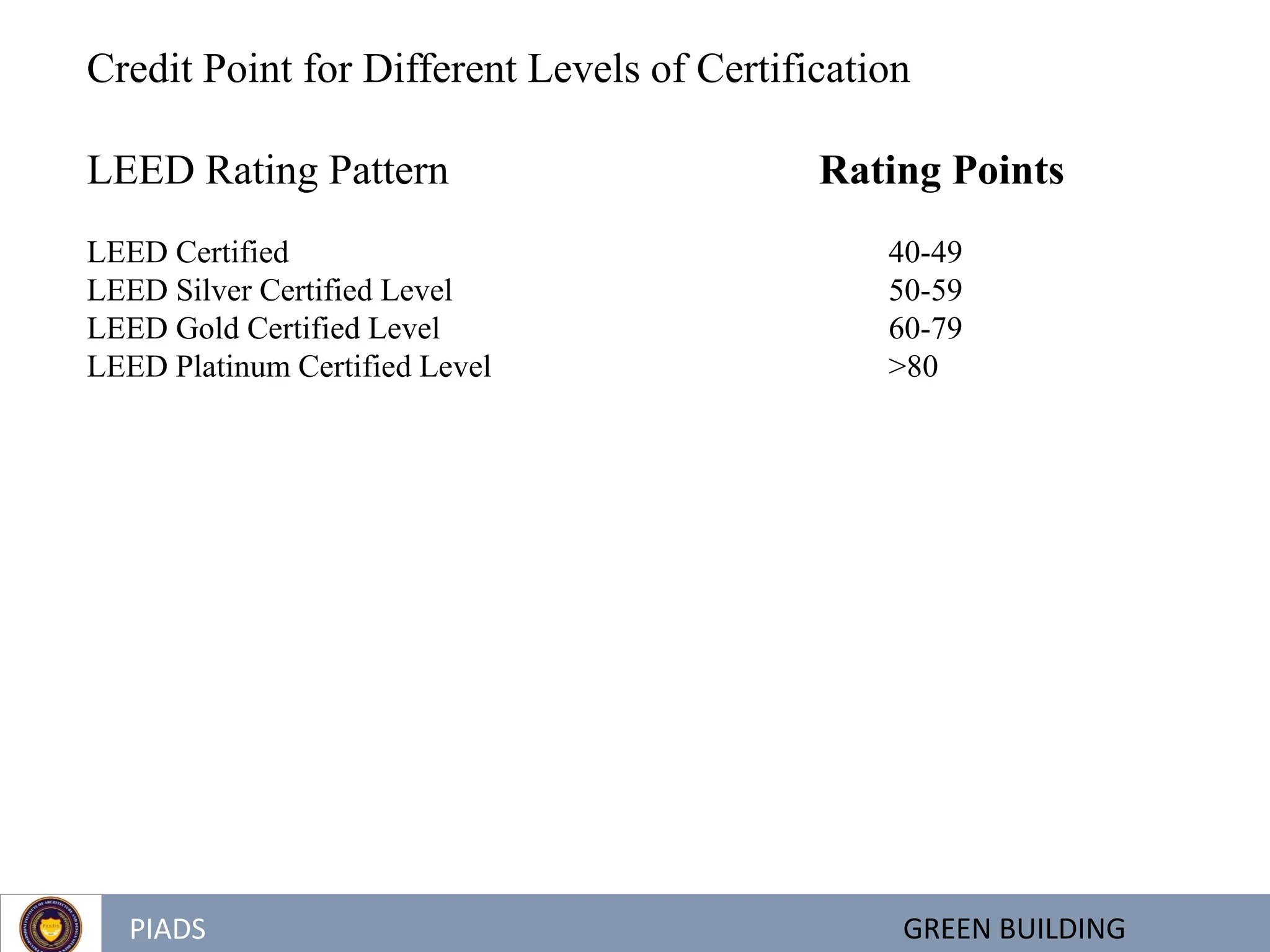
Credit Point for Different Levels of Certification
LEED Rating Pattern Rating Points
LEED Certified 40-49
LEED Silver Certified Level 50-59
LEED Gold Certified Level 60-79
LEED Platinum Certified Level >80
PIADS GREEN BUILDING
BREEAM
 Building Research Establishment‘s Environmental Assessment Method (BREEAM) was
developed in the United Kingdom in 1990 and is one of the earliest building
environmental assessment methods.
 BREEAM covers a range of building types including—offices, homes, industrial units,
retail units, and schools.
 When a building is assessed, points are awarded for each criterion and the points are
added for a total score.
 The overall building performance is awarded a ‗Pass‘, ‗Good‘, ‗Very Good‘ or
‗Excellent‘ rating based on the score.
 BREEAM has separate criteria/checklist for evaluation of Design and Procurement and
for Management and Operation of buildings.
PIADS GREEN BUILDING
 Credit Points under Different Categories • 100 possible points under the five core
categories – M, HW, E, T, W, M & W
 An additional 1% can be added to the final score of the relevant category for each
‗innovation credit‘ achieved (up to a maximum of 7%)
PIADS GREEN BUILDING
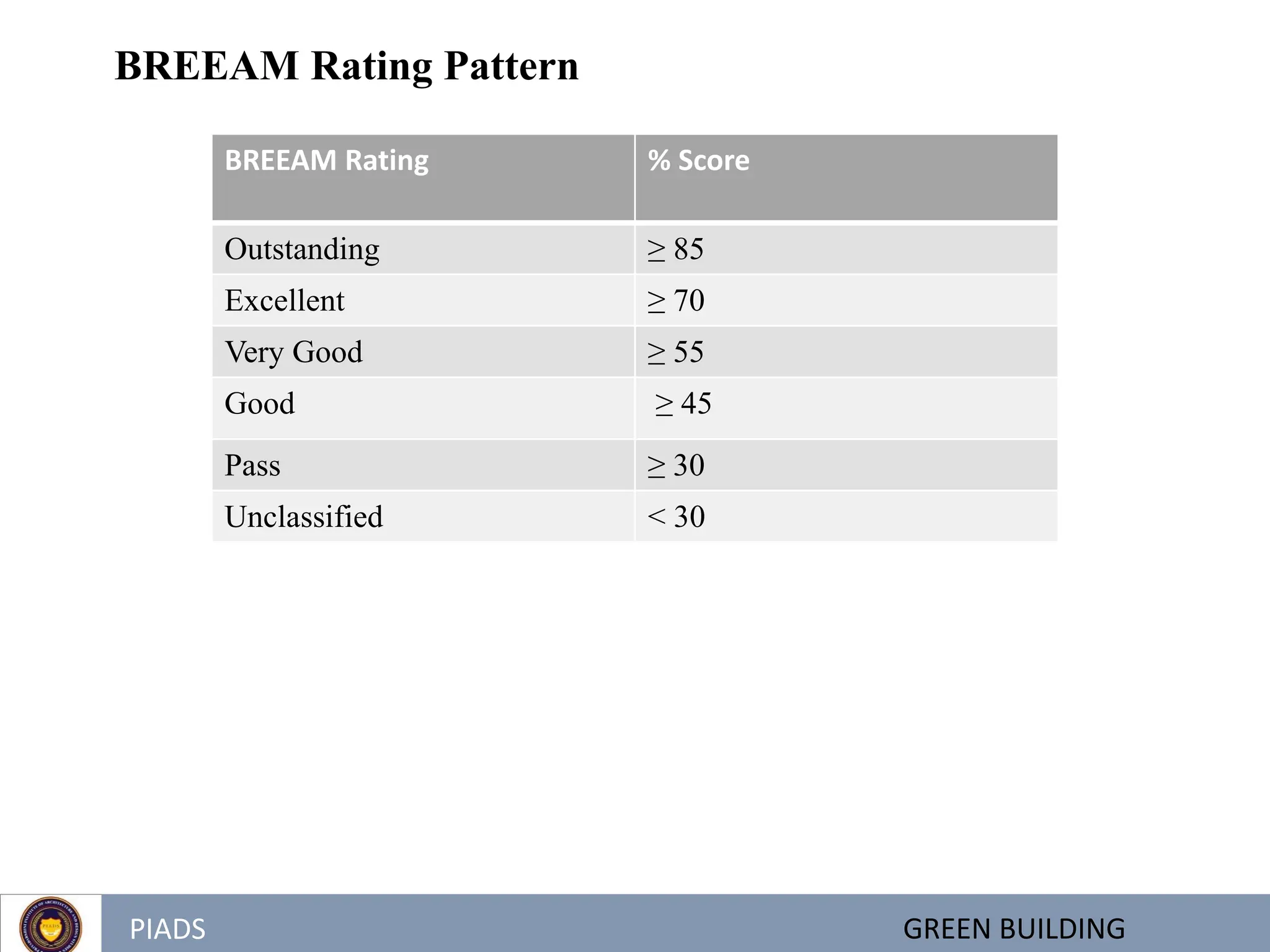
BREEAM Rating % Score
Outstanding ≥ 85
Excellent ≥ 70
Very Good ≥ 55
Good ≥ 45
Pass ≥ 30
Unclassified < 30
BREEAM Rating Pattern
PIADS GREEN BUILDING
 Construction sector in India is considered to be fastest growing construction sector in
world.
 Built floor area is almost doubled in last ten years.
 This is driven by rapid urbanization. About 30% of India’s 221.1 million households are
now in urban areas with the urban population projected to more than double by 2050
 Green house Gas emissions associated with Building Material manufacturing is also likely
to impact on energy use patterns of occupants, increasing the need to consider lower
embodied energy approaches to construction.
 Along with this attempts have been made to rate the type of construction based on its
direct and indirect impact on environment by green building rating systems around the
globe and by their Indian versions.
 There are prominently two rating systems working in India.
 Indian green Building Council (IGBC) and The Energy Resource Institute (TERI) are
executing number of rating programs throughout India since 2001. GRIHA
 The successful delivery of green buildings requires balancing energy and resource
efficiency while providing a comfortable, healthy and productive environment.
 This requires careful selection of criteria to rate the performance of green building
assessment mechanism.
 IGBC has initiated and continuously upgraded its own rating program since its inception.
 While GRIHA have achieved considerable footprint based on incentive programs released
by government of India.
PIADS GREEN BUILDING
GRIHA
 Most of the internationally adopted rating systems have been framed to suit the building
industry of that particular country.
 The Energy Resource Institute (TERI) New Delhi, with an objective of sustainable
development, took the responsibility of developing a rating system to measure
building‘s environmental performance in the context of India‘s varied climate and
building practices and to encourage the construction of Green Buildings in India.
 The rating system will evaluate the performance of the building for its entire life cycle
based on the Green Building techniques adopted during construction, operation and
maintenance of the building.
 This rating system developed by TERI is called as Green Rating for Integrated Habitat
Assessment (GRIHA).
 GRIHA is India‘s official Green Building rating program.
 It is a 5 star rating system purely based on the environmental performance of the
building. GRIHA is formed by The Energy Resource Institute New Delhi (TERI) under
the Ministry of New and Renewable Energy (MNRE).
 The process of rating is limited to new buildings only.
 May it be commercial, educational and residential or any building built to serve any
purpose.
PIADS GREEN BUILDING
The basic features of GRIHA
 The system has been developed to help 'design and evaluate' new buildings
(buildings that are still at the inception stages). A building is assessed based on its
predicted performance over its entire life cycle – inception through operation. The
stages of the life cycle that have been identified for evaluation are:
 Pre-construction stage: intra- and inter-site issues like proximity to public
transport, type of soil, kind of land, where the property is located, the flora and fauna
on the land before construction activity starts, the natural landscape and land
features.
 Building planning and construction stages: issues of resource conservation and
reduction in resource demand, resource utilization efficiency, resource recovery and
reuse, and provisions for occupant health and well-being. The prime resources that
are considered in this section are land, water, energy, air, and green cover.
 Building operation and maintenance stage: issues of operation and maintenance of
building systems and processes, monitoring and recording of energy consumption,
and occupant health and well-being, and also issues that affect the global and local
environment.
PIADS GREEN BUILDING
The benefits
 On a broader scale, this system, along with the activities and processes that lead up
to it, will benefit the community at large with the improvement in the environment
by reducing GHG (greenhouse gas) emissions, reducing energy consumption and the
stress on natural resources.
• Some of the benefits of a green design to a building owner, user, and the society as a
whole are as follows:
 Reduced energy consumption without sacrificing the comfort levels
 Reduced destruction of natural areas, habitats, and biodiversity, and reduced soil loss
from erosion etc.
 Reduced air and water pollution (with direct health benefits)
 Reduced water consumption
 Limited waste generation due to recycling and reuse
 Reduced pollution loads
 Increased user productivity
 Enhanced image and marketability
PIADS GREEN BUILDING
The certification is based on 34 criterions for which marks are awarded out of 100 for
buildings with more than 2500 sq. meter. Built-up area.
The rating pattern according to the marks scored by the building is as shown in the table.
Credit Points under Different Categories
 100 possible points under the Eight categories
 4 possible points under ‗Innovation in Design‘
 Total possible points achieved are 104
PIADS GREEN BUILDING
GRIHA Rating Points
One star 50-60
Two star 61-70
Three star 71-80
Four star 81-90
Five star >91
GREEHA Rating Pattern
PIADS GREEN BUILDING
Comparision between
LEED, LEED IN INDIA,TERI GRIHA. BREAM
PIADS GREEN BUILDING
Comparision between
LEED, GRIHA. BREAM

green building notes and their criteria rating

  • 1.
  • 2.
    PIADS GREEN BUILDING Thisday and age, you hear everyone talking about going green. Whether you want to admit it or not, at some point, everyone will have to follow with the green movement. This is because at the rate we are going, the earth is simply not sustainable. That means that over the years, we will begin to run out of certain natural resources that are needed for us to survive. Indeed, that is alarming to some people, which is why there are so many people that focus on the green building today. But what exactly is green building?
  • 3.
    PIADS GREEN BUILDING Defininga Green Building Concept of green building • Buildings that are LEED-certified make better places for people to live and also use less energy and water, reduce air pollution, produce clean air and save money for businesses and families. • The Indian Green Building Council (IGBC) defines a green building as one which uses less water, is energy efficient, conserves natural resources, generates less waste, and provides healthier space for occupants as compared to a conventional building. Suzlon One Earth, Pune. .
  • 4.
    PIADS GREEN BUILDING •First, we will take a look at what a green building , Some people may think of a green or sustainable building as just a building that doesn’t really have as bad of an impact on the environment as another ‘average’ building. • Other people may find it to be the type of building and the actual surroundings of the building. • The ideal green building would be a building project that would allow you to preserve most of the natural environment around the project site, while still being able to produce a building that is going to serve a purpose. • The construction and operation will promote a healthy environment for all involved, and it will not disrupt the land, water, resources and energy in and around the building. This is the actual definition of a green building. The U.S. EPA says “Green building is the practice of creating structures and using processes that are environmentally responsible and resource-efficient throughout a building’s life-cycle from siting to design, construction, operation, maintenance, renovation and deconstruction. This practice expands and complements the classical building design concerns of economy, utility, durability, and comfort. Green building is also known as a sustainable or high- performance building.”
  • 5.
    PIADS GREEN BUILDING WhyGo Green? Why it is so important to go green. Most people will find when going green that they are able to reduce their carbon footprint and actually lend a helping hand to the environment. You can go green in a variety of different ways, but builders and construction workers must do their part as well. If you haven’t begun going green, then you will find that there are a variety of different things that you can do to help you get started. You don’t have to jump in headfirst, and you can actually take some baby steps along the way. Green buildings are designed in such a way to reduce the overall impact on the environment and human health by: i. Reducing trash, pollution and degradation of the environment. ii. Efficiently using energy, water and other resources. iii. Protecting occupant health and improving productivity.
  • 6.
    PIADS GREEN BUILDING DoesGoing Green Really Cost You More? Some people feel that they just can’t go green because it will cost them more money, but that is really a common misconception. While it may cost you a bit more to get started when you are going green, because green materials and products can be more costly, you really have to consider the type of savings that you will be able to reap. You will be able to save on energy costs because going green also means conserving energy. You should really look at the green building as more of an investment than anything else. An investment that will be able to save you money, as well as an investment that will be able to help the environment! It is a win-win situation for everyone!
  • 7.
    PIADS GREEN BUILDING Benefitsof Green Building • With new technologies constantly being developed to complement current practices in creating greener structures, the benefits of green building can range from environmental to economic to social. • By adopting greener practices, we can take the maximum advantage of environmental and economic performance. • Green construction methods, when integrated with eco-friendly design and construction, provide the most significant benefits. Benefits of green building include: 1. Reduces Wastage of Water and Energy. • Green buildings certified by the Indian Green Building Council (IGBC) results in water savings of 20 – 30% and energy savings of 40 – 50% compared to conventional buildings in India. • Green buildings achieving the Green Star certification in Australia have been shown to save 51% less potable water and produce 62% fewer greenhouse gas emissions than if they had been built to meet minimum industry requirements. • Green buildings achieving the Green Star certification in South Africa have been shown to save between 20 – 30% potable water every year, and to save on average between 30 – 40% energy and carbon emissions every year, when compared to the industry norm.
  • 8.
    PIADS GREEN BUILDING Greenbuildings achieving the LEED certification in the US and other countries have been shown to consume 11 percent less water and consume 25 percent less energy than non- green buildings. 2. Conserves Natural Resources • The building sector has the largest potential for reducing greenhouse gas emissions significantly compared to other major emitting sectors. • This emissions savings potential is said to be as much as 84 gigatons (84 BILLION TON) of CO2 (GtCO2) by 2050, through direct measures in buildings such as energy efficiency, fuel switching and the use of renewable energy. • The building sector has the potential to make energy savings of 50% or more in 2050, in support of limiting global temperature rises to 2°C (above pre-industrial levels) – UNEP, 2016. 3. Improves Air and Water Quality Research suggests that better indoor air quality that is low concentrations of CO2 and pollutants, and high ventilation rates can lead to improvements in the performance of up to 8 percent.
  • 9.
    PIADS GREEN BUILDING 4.Protects Biodiversity and Ecosystems Green building supports ecosystems by promoting the efficient use of energy, water and other resources. It also uses renewable energy, such as solar energy. Measures are usually taken for reducing pollution and waste and also enabling re-use and recycling of the materials. Materials that are used are non-toxic, ethical and sustainable The environment is considered in design, construction and operation and enables adaptation to a changing environment.
  • 10.
    PIADS GREEN BUILDING EconomicBenefits 5. Reduces Costs and Increase Value These buildings lower construction costs and higher property value for building developers; global energy efficiency measures could save an estimated €280 to €410 billion in savings on energy spending. Green buildings, whether new or renovated – command a 7 percent increase in asset value over traditional buildings – Dodge Data & Analytics, 2016. (Asset valuation is the process of determining the fair market value of an asset a figure showing the total value of the assets of a company or organization) 6. Improves Occupant Productivity Green Building focuses on creating buildings that are not only good for the environment but also support healthier, happier and more productive lives. These include cost savings on utility bills for tenants or households through energy and water efficiency. 7. Creates a Market For Green Product and Services Different countries and regions have a variety of characteristics such as distinctive climatic conditions, unique cultures and traditions, diverse building types and ages, or wide-ranging environmental, economic and social priorities, all of these shapes up the green building and make green buildings best suited to their own markets.
  • 11.
    PIADS GREEN BUILDING SocialBenefits 8. Improves the Quality of Life In green buildings, the quality of life of occupants is considered in design, construction and operation. It Improves occupant health and comfort. Research suggests that better indoor air quality (low concentrations of CO2 and pollutants and high ventilation rates) can lead to improvements in the performance of up to 8 percent. Workers in green, well-ventilated offices record a 101 percent increase in cognitive scores (brain function). Employees in offices with windows slept an average of 46 minutes more per night – American Academy of Sleep Medicine. 9. Minimizes Strain on Local Infrastructure Green buildings work with local governments and utilities to provide training and incentives for green building and energy efficiency. They also offer free classes, public forums and technical training that can minimize strain on local infrastructure. These provide opportunities for existing homes to easily and affordably go green, becoming truly sustainable, non-toxic, zero water and zero energy buildings.
  • 12.
    PIADS GREEN BUILDING TheGoals of Green Building Now, we should consider the goals of green building. Of course, one of the main goals is to make the earth more sustainable, but it really does go deeper than that. When you decide to go green, your goal will be to actually help to sustain the environment without disrupting the natural habitats around it. When you start a building project and you disrupt the natural habitats around it, you can actually make an impact on the wildlife and environment that will be much like a butterfly effect. Even the smallest changes that you can make will help to promote better planet earth, and a better place for us all to live- not just us humans, but also the plants and wildlife that take up their residence here on earth as well. As you can see, green building is something that everyone should really jump on to. If you don’t plan to rebuild your home, then you may just want to make a few green changes within your home to ensure that you are able to get the goals that you want out of it.
  • 13.
    PIADS GREEN BUILDING Buildings contribute towards major environmental impacts during their life cycle. Various resources such as soil, trees, water, and various formats of energy are used by the buildings.  For instance Water, most vital resource, is consumed continuously during building construction as well as operation.  Similarly several buildings along with usage of resources generate large amounts of waste, which can be recycled and can be reused.  Thus, the challenge of a green building is to make optimum usage of resources and proper waste disposal at an affordable cost.  Recognizing the importance of sustainable building practices, ―going green‖ and ―environment sustainability‖ has been introduced for many years.  The Indian construction industry registered an annual growth of 15.9% in real terms in 2021, following a decline of 12.3% in 2020.  In the entire lifespan of a building, energy, construction materials, manpower, construction and demolition (C&D) waste, water, transportation, and GHG emission are considered to be the major factors that have an ecological impact.  Many studies on life cycle energy, emissions, C&D waste , transportation , and water consumption in buildings have been reported. estimated material use in India is projected to be nearly 15 billion tonnes by 2030, and it will further increase up to 25 billion tonnes by 2050, while total C&D waste generated in the country in 2015 was about 716 million tonnes. Green Building rating system
  • 14.
    PIADS GREEN BUILDING The construction sector is the major emitters of greenhouse gases, Globally 25% of wood, 40% of raw stone, gravel and sand are estimated to be consumed by the construction sector annually.  The construction cost shared by material alone is 50%–60% and 9% of the total purchased material end up as waste, Coupled with the benefits of the urbanization, extensive infrastructure and reconstruction, building projects led to an alarmed rise of construction and demolition (C & D) waste generation in last few years.  However, construction is still a major energy consumer based on official statistics.  This could be due to the passive attitude of construction practitioners towards adopting sustainable solutions.  Facing the rising energy costs and growing environmental concerns, the demand for sustainable building facilities with minimal environmental impact has been pushed recently.  Authorities and organizations initiated the rating systems for green buildings to minimize/optimize consumption of natural resources and control pollution.
  • 15.
  • 16.
    PIADS GREEN BUILDING Buildings certified by various rating systems are considered as consuming less energy, providing a better living environment and contributing to the overall reputation of the property.  It is estimated that there are approximately 600 green rating systems globally .  BREEAM (Building Research Establishment Assessment Method) is known as the first rating tool to assess building performance based on certain target values for different criteria.  Based on the magnitude of green measures adopted, Points are Awarded to a building and, after appropriate weighting; a total score is described to determine the rating of the building.  This helps to convey the range of application of green measures in building construction. Worldwide various rating systems have been developed.  The first environmental certification system was created in year 1996 the Building Research Establishment‘s Environmental Assessment Method (BREEAM) in UK.  In year 1998 the Leadership in Energy and Environmental Design (LEED) green building rating system was introduced in US.  In year 2007 the Green Rating Integrated Habitat Assessment (GRIHA) green building rating system was introduced in INDIA.  Although green building rating certifications have been the focus of various researchers during the past 20 years, there is still no systematic review of the detailed criteria and the updated process of each rating system.
  • 17.
    PIADS GREEN BUILDING LEED Leadership in Energy and Environmental Design (LEED) was developed in the US in 1998.  This is the most widely used green Building rating system in the world.  The rating system is based on several environmental and building related criterions based on which the buildings are rated.  The Indian Green Building Council adapted LEED system and launched LEED India version on 1st January 2007.  There are more than 650 LEED certified green buildings in India such as CII-Godrej ITC Green Centre Gurugram, Wipro Gurugram etc.
  • 18.
    PIADS GREEN BUILDING CreditPoints under Different Categories  100 possible points under the five core categories – SS, WE, EA, MR & IEQ  6 possible points under ‗Innovation in Design‘  4 possible points under ‗Regional Priority‘ (local environment,social equity and public health)  Total possible points achieved are 110.
  • 19.
    PIADS GREEN BUILDING CreditPoint for Different Levels of Certification LEED Rating Pattern Rating Points LEED Certified 40-49 LEED Silver Certified Level 50-59 LEED Gold Certified Level 60-79 LEED Platinum Certified Level >80
  • 20.
    PIADS GREEN BUILDING BREEAM Building Research Establishment‘s Environmental Assessment Method (BREEAM) was developed in the United Kingdom in 1990 and is one of the earliest building environmental assessment methods.  BREEAM covers a range of building types including—offices, homes, industrial units, retail units, and schools.  When a building is assessed, points are awarded for each criterion and the points are added for a total score.  The overall building performance is awarded a ‗Pass‘, ‗Good‘, ‗Very Good‘ or ‗Excellent‘ rating based on the score.  BREEAM has separate criteria/checklist for evaluation of Design and Procurement and for Management and Operation of buildings.
  • 21.
    PIADS GREEN BUILDING Credit Points under Different Categories • 100 possible points under the five core categories – M, HW, E, T, W, M & W  An additional 1% can be added to the final score of the relevant category for each ‗innovation credit‘ achieved (up to a maximum of 7%)
  • 22.
    PIADS GREEN BUILDING BREEAMRating % Score Outstanding ≥ 85 Excellent ≥ 70 Very Good ≥ 55 Good ≥ 45 Pass ≥ 30 Unclassified < 30 BREEAM Rating Pattern
  • 23.
    PIADS GREEN BUILDING Construction sector in India is considered to be fastest growing construction sector in world.  Built floor area is almost doubled in last ten years.  This is driven by rapid urbanization. About 30% of India’s 221.1 million households are now in urban areas with the urban population projected to more than double by 2050  Green house Gas emissions associated with Building Material manufacturing is also likely to impact on energy use patterns of occupants, increasing the need to consider lower embodied energy approaches to construction.  Along with this attempts have been made to rate the type of construction based on its direct and indirect impact on environment by green building rating systems around the globe and by their Indian versions.  There are prominently two rating systems working in India.  Indian green Building Council (IGBC) and The Energy Resource Institute (TERI) are executing number of rating programs throughout India since 2001. GRIHA  The successful delivery of green buildings requires balancing energy and resource efficiency while providing a comfortable, healthy and productive environment.  This requires careful selection of criteria to rate the performance of green building assessment mechanism.  IGBC has initiated and continuously upgraded its own rating program since its inception.  While GRIHA have achieved considerable footprint based on incentive programs released by government of India.
  • 24.
    PIADS GREEN BUILDING GRIHA Most of the internationally adopted rating systems have been framed to suit the building industry of that particular country.  The Energy Resource Institute (TERI) New Delhi, with an objective of sustainable development, took the responsibility of developing a rating system to measure building‘s environmental performance in the context of India‘s varied climate and building practices and to encourage the construction of Green Buildings in India.  The rating system will evaluate the performance of the building for its entire life cycle based on the Green Building techniques adopted during construction, operation and maintenance of the building.  This rating system developed by TERI is called as Green Rating for Integrated Habitat Assessment (GRIHA).  GRIHA is India‘s official Green Building rating program.  It is a 5 star rating system purely based on the environmental performance of the building. GRIHA is formed by The Energy Resource Institute New Delhi (TERI) under the Ministry of New and Renewable Energy (MNRE).  The process of rating is limited to new buildings only.  May it be commercial, educational and residential or any building built to serve any purpose.
  • 25.
    PIADS GREEN BUILDING Thebasic features of GRIHA  The system has been developed to help 'design and evaluate' new buildings (buildings that are still at the inception stages). A building is assessed based on its predicted performance over its entire life cycle – inception through operation. The stages of the life cycle that have been identified for evaluation are:  Pre-construction stage: intra- and inter-site issues like proximity to public transport, type of soil, kind of land, where the property is located, the flora and fauna on the land before construction activity starts, the natural landscape and land features.  Building planning and construction stages: issues of resource conservation and reduction in resource demand, resource utilization efficiency, resource recovery and reuse, and provisions for occupant health and well-being. The prime resources that are considered in this section are land, water, energy, air, and green cover.  Building operation and maintenance stage: issues of operation and maintenance of building systems and processes, monitoring and recording of energy consumption, and occupant health and well-being, and also issues that affect the global and local environment.
  • 26.
    PIADS GREEN BUILDING Thebenefits  On a broader scale, this system, along with the activities and processes that lead up to it, will benefit the community at large with the improvement in the environment by reducing GHG (greenhouse gas) emissions, reducing energy consumption and the stress on natural resources. • Some of the benefits of a green design to a building owner, user, and the society as a whole are as follows:  Reduced energy consumption without sacrificing the comfort levels  Reduced destruction of natural areas, habitats, and biodiversity, and reduced soil loss from erosion etc.  Reduced air and water pollution (with direct health benefits)  Reduced water consumption  Limited waste generation due to recycling and reuse  Reduced pollution loads  Increased user productivity  Enhanced image and marketability
  • 27.
    PIADS GREEN BUILDING Thecertification is based on 34 criterions for which marks are awarded out of 100 for buildings with more than 2500 sq. meter. Built-up area. The rating pattern according to the marks scored by the building is as shown in the table. Credit Points under Different Categories  100 possible points under the Eight categories  4 possible points under ‗Innovation in Design‘  Total possible points achieved are 104
  • 28.
    PIADS GREEN BUILDING GRIHARating Points One star 50-60 Two star 61-70 Three star 71-80 Four star 81-90 Five star >91 GREEHA Rating Pattern
  • 29.
    PIADS GREEN BUILDING Comparisionbetween LEED, LEED IN INDIA,TERI GRIHA. BREAM
  • 30.
    PIADS GREEN BUILDING Comparisionbetween LEED, GRIHA. BREAM