Submitted by:
Sowjanya
Spandana
A. sravya
Sravani
BREEAM
WHAT IS BREEAM?
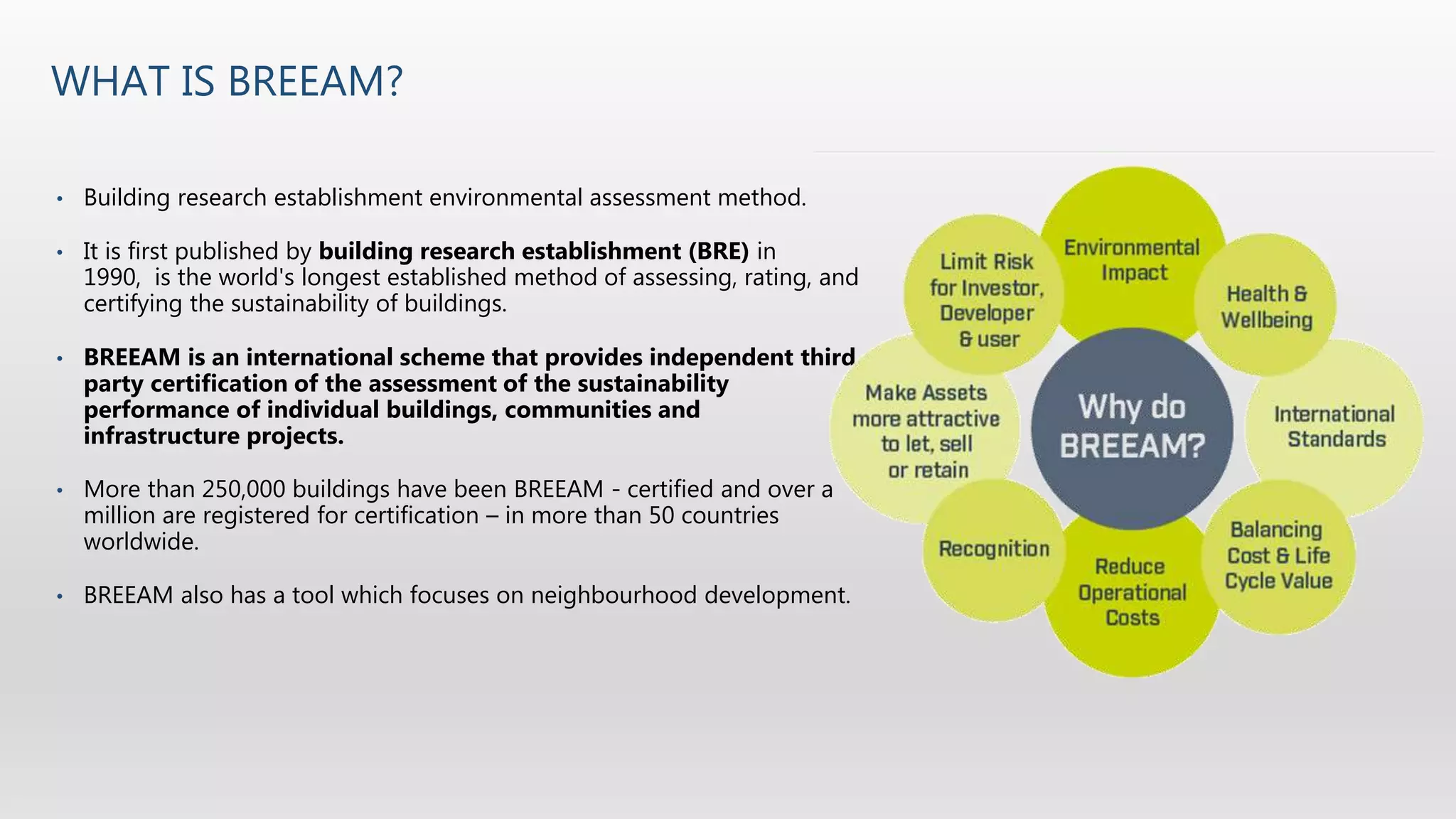
• Building research establishment environmental assessment method.
• It is first published by building research establishment (BRE) in
1990, is the world's longest established method of assessing, rating, and
certifying the sustainability of buildings.
• BREEAM is an international scheme that provides independent third
party certification of the assessment of the sustainability
performance of individual buildings, communities and
infrastructure projects.
• More than 250,000 buildings have been BREEAM - certified and over a
million are registered for certification – in more than 50 countries
worldwide.
• BREEAM also has a tool which focuses on neighbourhood development.
BREEAM'S PERFORMANCE RATING AND STARS:
• The main output from a certified BREEAM
assessment is the rating.
• A certified rating reflects the performance achieved
by a project and its stakeholders, as measured
against the standard and its benchmarks.
• The rating enables comparability between projects
and provides reassurance to customers and users,
in turn underpinning the quality and value of the
asset.
• The BREEAM ratings range from Acceptable (In-Use
scheme only) to Pass, Good, Very Good, Excellent
to Outstanding and it is reflected in a series of stars
on the BREEAM certificate.
BREEAM CATEGORY ISSUES AND AIM:
• BREEAM measures sustainable value in a series of categories, ranging from energy to ecology.
• Each of these categories addresses the most influential factors, including
1. Low impact design and carbon emissions reduction.
2. Design durability and resilience; adaption to climate change.
3. Ecological value and biodiversity protection.
energy Health and
well being
innovation Land use materials management
pollution transport waste water
SCOPE:
• Describe some of the native animals and plants that can be seen in your country.
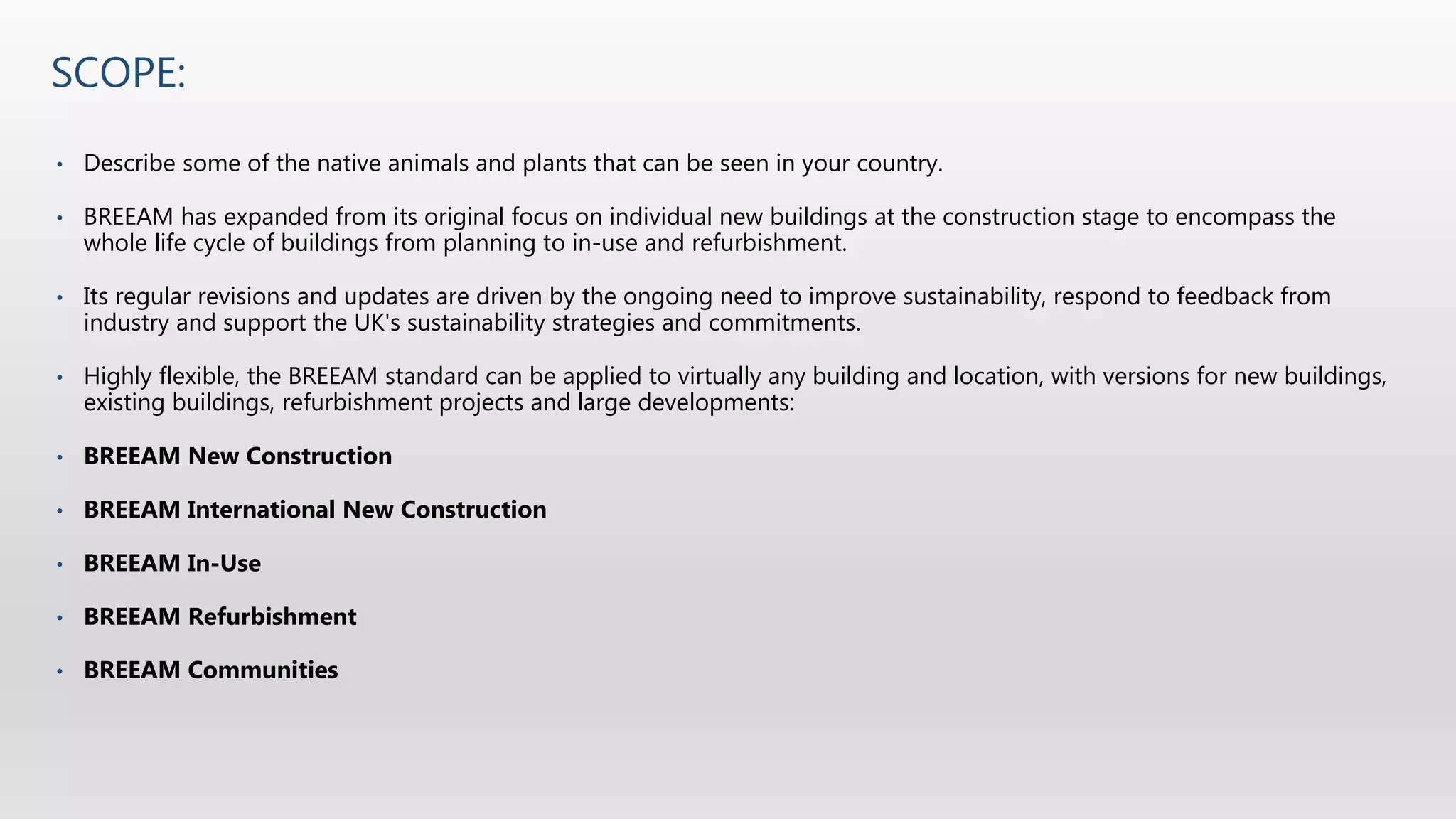
• BREEAM has expanded from its original focus on individual new buildings at the construction stage to encompass the
whole life cycle of buildings from planning to in-use and refurbishment.
• Its regular revisions and updates are driven by the ongoing need to improve sustainability, respond to feedback from
industry and support the UK's sustainability strategies and commitments.
• Highly flexible, the BREEAM standard can be applied to virtually any building and location, with versions for new buildings,
existing buildings, refurbishment projects and large developments:
• BREEAM New Construction
• BREEAM International New Construction
• BREEAM In-Use
• BREEAM Refurbishment
• BREEAM Communities
NATIONAL OPERATORS:
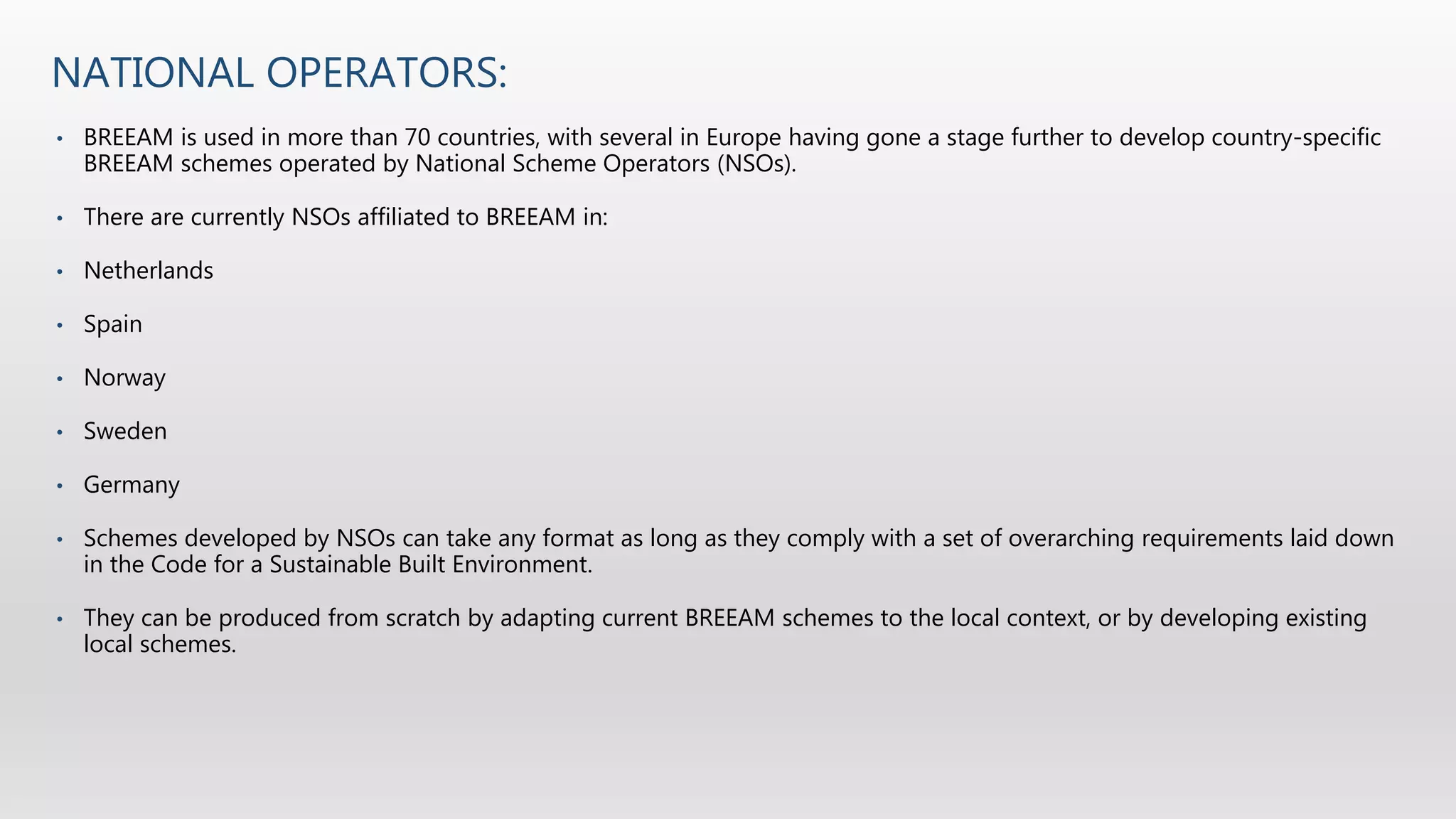
• BREEAM is used in more than 70 countries, with several in Europe having gone a stage further to develop country-specific
BREEAM schemes operated by National Scheme Operators (NSOs).
• There are currently NSOs affiliated to BREEAM in:
• Netherlands
• Spain
• Norway
• Sweden
• Germany
• Schemes developed by NSOs can take any format as long as they comply with a set of overarching requirements laid down
in the Code for a Sustainable Built Environment.
• They can be produced from scratch by adapting current BREEAM schemes to the local context, or by developing existing
local schemes.

Breeam

  • 1.
  • 2.
    WHAT IS BREEAM? •Building research establishment environmental assessment method. • It is first published by building research establishment (BRE) in 1990, is the world's longest established method of assessing, rating, and certifying the sustainability of buildings. • BREEAM is an international scheme that provides independent third party certification of the assessment of the sustainability performance of individual buildings, communities and infrastructure projects. • More than 250,000 buildings have been BREEAM - certified and over a million are registered for certification – in more than 50 countries worldwide. • BREEAM also has a tool which focuses on neighbourhood development.
  • 3.
    BREEAM'S PERFORMANCE RATINGAND STARS: • The main output from a certified BREEAM assessment is the rating. • A certified rating reflects the performance achieved by a project and its stakeholders, as measured against the standard and its benchmarks. • The rating enables comparability between projects and provides reassurance to customers and users, in turn underpinning the quality and value of the asset. • The BREEAM ratings range from Acceptable (In-Use scheme only) to Pass, Good, Very Good, Excellent to Outstanding and it is reflected in a series of stars on the BREEAM certificate.
  • 4.
    BREEAM CATEGORY ISSUESAND AIM: • BREEAM measures sustainable value in a series of categories, ranging from energy to ecology. • Each of these categories addresses the most influential factors, including 1. Low impact design and carbon emissions reduction. 2. Design durability and resilience; adaption to climate change. 3. Ecological value and biodiversity protection. energy Health and well being innovation Land use materials management pollution transport waste water
  • 5.
    SCOPE: • Describe someof the native animals and plants that can be seen in your country. • BREEAM has expanded from its original focus on individual new buildings at the construction stage to encompass the whole life cycle of buildings from planning to in-use and refurbishment. • Its regular revisions and updates are driven by the ongoing need to improve sustainability, respond to feedback from industry and support the UK's sustainability strategies and commitments. • Highly flexible, the BREEAM standard can be applied to virtually any building and location, with versions for new buildings, existing buildings, refurbishment projects and large developments: • BREEAM New Construction • BREEAM International New Construction • BREEAM In-Use • BREEAM Refurbishment • BREEAM Communities
  • 6.
    NATIONAL OPERATORS: • BREEAMis used in more than 70 countries, with several in Europe having gone a stage further to develop country-specific BREEAM schemes operated by National Scheme Operators (NSOs). • There are currently NSOs affiliated to BREEAM in: • Netherlands • Spain • Norway • Sweden • Germany • Schemes developed by NSOs can take any format as long as they comply with a set of overarching requirements laid down in the Code for a Sustainable Built Environment. • They can be produced from scratch by adapting current BREEAM schemes to the local context, or by developing existing local schemes.

Editor's Notes

  • #3 Insert a map of your country.
  • #4 Insert a picture of one of the geographic features of your country.
  • #5 Insert a picture illustrating a season in your country.
  • #6 Insert a picture of an animal and or plant found in your country.