THE
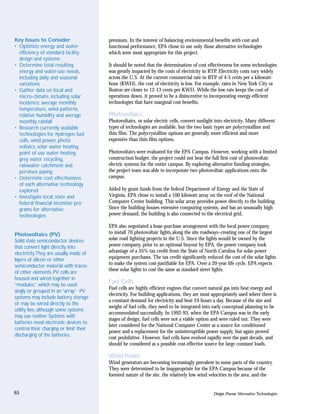
GREENING
   CURVE
 Lessons Learned in the Design of the
 New EPA Campus in North Carolina


 U.S. Environmental Protection Agency
                    EPA 220/K-02-001
THE
                               GREENING
                                  CURVE
                                       Lessons Learned in the Design of the
                                       New EPA Campus in North Carolina

                                                            November 2001


                                      ACKNOWLEDGMENTS

             Sandra Mendler, of Hellmuth, Obata and Kassabaum, was the
    principal author of the Greening Curve. Contributors and reviewers
          included Wanda Allen,Tom Ashmore, Allen Atkins, Bob Barr, Jim
Doussard, Bill Gaines, Jamie Gagliarducci, Sandy Germann, Bucky Green,
 Judy Kincaid, Bill Laxton, Sandra Leibowitz, Fred Livingston, Chris Long,
 Gail Lindsey, Nadav Malin, Lisa McCabe, Billy Morris, Michael Overcash,
      Robert Payne, Suzanne Roberts, Peter Schubert, Rhonda Sherman,
Donna Stankus, James White, Gail Whitfield, Joyce Yin and many others.
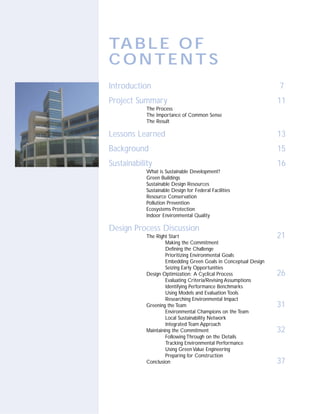
TA B L E O F
CONTENTS
Introduction                                                      7
Project Summary                                                   11
            The Process
            The Importance of Common Sense
            The Result

Lessons Learned                                                   13
Background                                                        15
Sustainability                                                    16
            What is Sustainable Development?
            Green Buildings
            Sustainable Design Resources
            Sustainable Design for Federal Facilities
            Resource Conservation
            Pollution Prevention
            Ecosystems Protection
            Indoor Environmental Quality

Design Process Discussion
            The Right Start                                       21
                     Making the Commitment
                     Defining the Challenge
                     Prioritizing Environmental Goals
                     Embedding Green Goals in Conceptual Design
                     Seizing Early Opportunities
            Design Optimization: A Cyclical Process               26
                     Evaluating Criteria/Revising Assumptions
                     Identifying Performance Benchmarks
                     Using Models and Evaluation Tools
                     Researching Environmental Impact
            Greening the Team                                     31
                     Environmental Champions on the Team
                     Local Sustainability Network
                     Integrated Team Approach
            Maintaining the Commitment                            32
                     Following Through on the Details
                     Tracking Environmental Performance
                     Using Green Value Engineering
                     Preparing for Construction
            Conclusion                                            37
Design Issues Discussion
     Site Design                                              38
              Minimize Site Disruption
              Structured Parking
              Fire Lanes
              Erosion Control
              Loop Road
              Preservation and Enhancement of Wetland Areas
              Specimen Tree Study
     Water Quality                                            41
              Pollution Prevention Strategies
              Erosion Control
              Water Pretreatment Options
     Landscaping                                              43
              Low-Maintenance Landscaping
              Grasses and Wildflowers
              Wetland Plantings
              Composting
     Building Envelope                                        45
              Evaluation of Building Loads
              Sun Control
              Glass Selection
              Thermally Broken Windows
              Light Shelves
              Insulation
              Infiltration
              Albedo Control
              Operable Windows
     Space Planning                                           49
              Modular Office Design
              Modular Lab Design
     Building Atrium                                          51
              Building Massing
              Energy and Daylighting Analysis
              Atrium Skylight Options
     Lighting Systems                                         53
              Green Lights
              Daylighting
              Task Lighting
              Laboratory Lighting
              Office Lighting
              Special Spaces
              Lighting Controls
              Exit Signs
Building Mechanical Systems                                     55
         Energy Modeling
         Central Utility Plant
         High Efficiency Chillers and Boilers
         Variable Air Volume
         Outside Air Economizer Cycle
         Variable Frequency Drives
         High Efficiency Motors and Fans
         Heat Reclamation for Hot Water Generation
         Laboratory Fume Hoods
         Heat Recovery for Laboratory Exhaust
         CFC Free Refrigeration Equipment
         Building Humidification
         Central Direct Digital Control (DDC) System
         Building Commissioning
         Building Acceptance Test Manual
         Summary of HVAC Systems
Water Conservation                                              63
         Water Conserving Fixtures
         Water Efficient Cooling Towers
         Ozone Treatment for Cooling Towers
 Alternative Technologies                                       64
         Photovoltaics
         Fuel Cells
         Wind Power
         Solar Hot Water
         Central Hot Water vs. Point-of-Use Hot Water
         Grey Water Reuse
         Rain Water Catchment
 Building Materials                                             67
         Life Cycle of Materials and Products
         Durable Materials
         Recycled Content
         Local Materials
         Low Toxic and Low VOC Materials
         Sustainably Harvested Wood
         Resource Recovery
         Site Materials
         Government Procurement Requirements
Indoor Air Quality                                              72
         Source Control, Source Isolation and Source Dilution
         Designing for Indoor Air Quality
         IAQ Facilities Operation Manual
         Indoor Air Quality vs. Energy Efficiency
         Low-Emission Materials
         IAQ Testing of Materials
         Construction Procedures
Risk Prevention                                                 78
         Electromagnetic Fields
         Radon Gas
Waste Management                                                79
         Efficient Building Design
         Waste Reduction
Increased Building Longevity
                  Building Adaptability
                  Collection and Handling of Recyclables
                  Recycling Chutes
                  Reuse of On-Site Materials
                  Construction Waste Recycling
                  Gypsum Grinding
          Construction                                                              82
                  Partnering for Construction
                  Plant Rescue
                  Reuse of Land Clearing Debris
                  Rock Crushing
                  On-Site Concrete Batch Plant
                  RotoReclaimer
                  Salvage of Demolition Materials for Reuse
                  Construction Waste Recycling
                  Use of Recycled Content Building Materials
                  Submittals Review During Construction
                  Constant Vigilance

Endnotes


The Greening Curve: Lessons Learned in the Design of the New EPA Campus in North Carolina
INTRODUCTION
    The Greening Curve
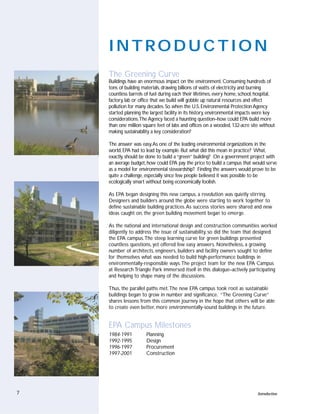
    Buildings have an enormous impact on the environment. Consuming hundreds of
    tons of building materials, drawing billions of watts of electricity and burning
    countless barrels of fuel during each their lifetimes, every home, school, hospital,
    factory, lab or office that we build will gobble up natural resources and effect
    pollution for many decades. So when the U.S. Environmental Protection Agency
    started planning the largest facility in its history, environmental impacts were key
    considerations.The Agency faced a haunting question–how could EPA build more
    than one million square feet of labs and offices on a wooded, 132-acre site without
    making sustainability a key consideration?

    The answer was easy.As one of the leading environmental organizations in the
    world, EPA had to lead by example. But what did this mean in practice? What,
    exactly, should be done to build a “green” building? On a government project with
    an average budget, how could EPA pay the price to build a campus that would serve
    as a model for environmental stewardship? Finding the answers would prove to be
    quite a challenge, especially since few people believed it was possible to be
    ecologically smart without being economically foolish.

    As EPA began designing this new campus, a revolution was quietly stirring.
    Designers and builders around the globe were starting to work together to
    define sustainable building practices. As success stories were shared and new
    ideas caught on, the green building movement began to emerge.

    As the national and international design and construction communities worked
    diligently to address the issue of sustainability, so did the team that designed
    the EPA campus.The steep learning curve for green buildings presented
    countless questions, yet offered few easy answers. Nonetheless, a growing
    number of architects, engineers, builders and facility owners sought to define
    for themselves what was needed to build high-performance buildings in
    environmentally-responsible ways.The project team for the new EPA Campus
    at Research Triangle Park immersed itself in this dialogue–actively participating
    and helping to shape many of the discussions.

    Thus, the parallel paths met.The new EPA campus took root as sustainable
    buildings began to grow in number and significance. “The Greening Curve”
    shares lessons from this common journey in the hope that others will be able
    to create even better, more environmentally-sound buildings in the future.


    EPA Campus Milestones
    1984-1991          Planning
    1992-1995          Design
    1996-1997          Procurement
    1997-2001          Construction


7                                                                              Introduction
Sustainable Building Milestones
1987                 “Sustainability” defined by the World Commission on
                     Environment and Development.

1990                 American Institute of Architects (AIA) Committee on the
                     Environment established.

1992                 Green Building Case Studies start to emerge–Audubon
                     House (New York City), Natural Resources Building
                     (Olympia,Washington) and others.

                     Environmental Resources Guide funded by EPA and
                     published by AIA.

                     Energy Policy Act passed in the United States

1993                 U.S. Green Building Council (USGBC) established.

                     Early Green Building Assessment Tools unveiled in Canada
                     (BEPAC) and Great Britain (BREEAM).

                     Federal Executive Orders issued on acquisition, recycling,
                     waste prevention and ozone-depleting substances. Other
                     Executive Orders followed through the year 2000, covering
                     energy and water conservation and environmental
                     management.

1995                 Federal Guidelines for Buying Recycled issued by EPA
                     (Recovered Materials Advisory Notice).

1996                 Sustainable Building Technical Manual published by EPA, U.S.
                     Department of Energy, USGBC and Public Technology, Inc.

1997                 Green Developments case studies published by Rocky
                     Mountain Institute.

1998                 First U.S. Green Building Assessment Tool released by
                     USGBC as Leadership in Energy and Environmental Design
                     (LEED).

                     First International Green Building Assessment Tool created
                     and tested through the Green Building Challenge (GBC)
                     conference in Canada.

                     Green Building Advisor guidelines and case studies issued by
                     the Center for Renewable Energy and Sustainable
                     Technology.

                     BEES Life Cycle Materials Database first released by the
                     National Institute of Standards and Technology (Building for
                     Environmental and Economic Sustainability–BEES).


The Greening Curve: Lessons Learned in the Design of the New EPA Campus in North Carolina   8
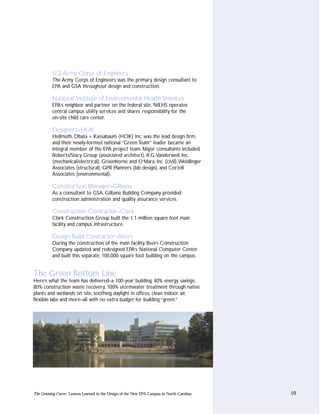
Learning Together
    The team that created the new EPA campus involved itself in the development of
    several of these nationally recognized sustainable building tools–such as LEED, the
    Green Building Challenge, the Environmental Resource Guide, BEES and the Green
    Building Advisor. Locally, the team also helped craft the Triangle J Regional High
    Performance Building Guidelines, as well as the “WasteSpec” construction recycling
    specification which has now become a national reference.

    By joining forces with others who were eager to make better buildings, and by
    tapping EPA’s own in-house environmental experts, the design team was able
    to enhance the quality of the new campus while advancing the broader
    dialogue on sustainability.


    The Team
    EPA proved that a state-of-the-art laboratory and office complex can be a
    model for environmental stewardship without costing extra.The key to this
    success was a dynamic, creative team approach that involved a radical shift in
    culture. From day one, the environment was placed on equal footing with cost
    and performance–a new mindset that helped guide every major decision and
    ultimately created a model for sustainable facilities.

    Key members of the project team are as follows:

             U.S. Environmental Protection Agency
             As the owner, EPA was a hands-on, active participant in the project. In
             addition to full-time project managers and engineers, EPA brought
             researchers and regulatory program experts in as advisors on
             environmental issues.

             U.S. General Services Administration
             GSA served as a technical consultant during design and managed the
             construction phase of the new EPA campus.


9                                                                             Introduction
U.S. Army Corps of Engineers
          The Army Corps of Engineers was the primary design consultant to
          EPA and GSA throughout design and construction.

          National Institute of Environmental Health Sciences
          EPA’s neighbor and partner on the federal site, NIEHS operates
          central campus utility services and shares responsibility for the
          on-site child care center.

          Designers–HOK
          Hellmuth, Obata + Kassabaum (HOK) Inc. was the lead design firm,
          and their newly-formed national “Green Team” leader became an
          integral member of the EPA project team. Major consultants included
          Roberts/Stacy Group (associated architect), R.G.Vanderweil, Inc.
          (mechanical/electrical), Greenhorne and O’Mara, Inc. (civil),Weidlinger
          Associates (structural), GPR Planners (lab design), and Cortell
          Associates (environmental).

          Construction Manager–Gilbane
          As a consultant to GSA, Gilbane Building Company provided
          construction administration and quality assurance services.

          Construction Contractor–Clark
          Clark Construction Group built the 1.1 million square foot main
          facility and campus infrastructure.

          Design-Build Contractor–Beers
          During the construction of the main facility, Beers Construction
          Company updated and redesigned EPA’s National Computer Center
          and built this separate, 100,000 square foot building on the campus.


The Green Bottom Line
Here’s what the team has delivered–a 100-year building, 40% energy savings,
80% construction waste recovery, 100% stormwater treatment through native
plants and wetlands on site, soothing daylight in offices, clean indoor air,
flexible labs and more–all with no extra budget for building “green.”


The Greening Curve: Lessons Learned in the Design of the New EPA Campus in North Carolina   10
PROJECT
Project Name
                                       S U M M A RY
US EPA Campus

Location                               The new EPA Campus at Research Triangle Park, North Carolina is home to
Research Triangle Park,                one of the world’s largest groups of scientists, engineers, policy makers and
North Carolina                         administrators dedicated to understanding and solving environmental problems.
                                       With hundreds of environmentally-friendly features, it’s also a model “green
Completion Date                        building” and proof that environmental protection can be accomplished
Year 2001                              without raising costs.

Square Footage                         The new campus is the largest construction project in EPA’s history, and from the
Total gross area: 1,160,000            start, EPA recognized it had a once-in-a-lifetime opportunity to lead by example.
Net program area: 625,000              EPA chose to build a home that strongly reflected the missions to be carried out
• Laboratory space: 270,000            within its walls. While providing the Agency with flexible, state-of-the-art
• Office space: 220,000                laboratories and offices, the new campus also embodies a solid environmental
• Computer center: 70,000              ethic in every aspect of design, construction and operation.
• Building common: 50,000
• Child care center: 15,000            The 1.2 million square foot facility is located on a 133-acre site, part of a 511-acre
                                       federal campus dedicated to environmental and public health research. It
Examples of Materials Used             accommodates more than 2,000 people and contains 600 laboratory modules in five
• 4 acres of concrete block walls      laboratory wings, three office wings and a six-story office tower with a cafeteria and
• 35 acres of drywall                  conference center. The buildings are organized along a series of atria that act together
• 7 acres of carpet                    as a “main street” to enhance communication among professional staff. Laboratory
• 12 acres of ceiling tile             types include chemistry and biology labs, materials testing labs, electronics labs,
• 2,861 interior doors                 automobile testing facilities, and large-scale combustion research labs.
• 19.6 miles of telcom conduit
                                       The Process
                                       From the beginning, the core design group focused on defining environmental
                                       objectives and tracking progress toward meeting them. Work sessions included
Accomplishments                        participation by green advocates, architects, engineers and building users including
                                       researchers and administrative officers. One of the most valuable benefits of the
Site Design                            process was the discussion between technical and non-technical people. Innovative
Building fits within contours of
site, reducing need to regrade
and limiting disruption to habitats
and wetlands. Natural woodlands
and wildflower plantings minimize
water, fertilizer and pesticide use,
and reduce associated
maintenance costs.

Water Quality
Stormwater runoff is treated
naturally using bio-retention, an
innovative system that uses soil
and plants to remove
contaminants from stormwater.
Reductions in impervious surface
for roadways and parking.
increase green space.


11
solutions emerged from systematically                                                       Energy Conservation
reviewing multiple options, and making                                                      Compared with standard new
comparisons with a variety of functional                                                    lab/office construction, the EPA
and environmental benchmarks. The                                                           Campus uses 40% less energy
environmental soundness of decisions                                                        for a projected savings of more
was tested in every phase of design.                                                        than one million dollars per
                                                                                            year–conserving non-renewable
The Importance of                                                                           fossil fuels and reducing air
                                                                                            emissions.
Common Sense
Raising questions every step of the way,                                                    Lighting
design team members maintained a                                                            Daylighting, high-efficiency lamps
focus on their specialties while                                                            and ballasts, task lighting, and
collaborating across disciplines to                                                         smart controls yield savings in
identify creative, practical solutions. By                                                  electrical energy use and
stepping back and viewing the whole                                                         improve lighting quality.
through the lens of environmental
stewardship, large, seemingly obvious                                                       Building Materials
issues were uncovered that might                                                            Building materials selected to be
otherwise have been overlooked.                                                             durable and low maintenance,
For example:                                                                                and to minimize life-cycle
                                                                                            environmental impact.
Why install non-native turf grass that                                                      Specifications ensure
requires ongoing maintenance and will use 250,000 gallons of water per month in the         compliance with environmental
summer, when we can use wildflowers, native grasses and native woodland plantings           requirements, such as recycled
that will be more appropriate to the natural site environment and require little care?      content, sustainably-harvested
                                                                                            wood and chemical content
Why would water quality ponds that were intended to serve as a passive “natural”            limits.
technology require the destruction of acres of forestland? Wasn’t there a solution that
would be less disruptive to the site?                                                       Indoor Air Quality (IAQ)
                                                                                            Improved ventilation criteria,
How can we install over seven acres of carpeting into a facility without understanding      special construction
how the choice of carpeting affects the longevity of the carpet, how maintenance            requirements and careful
impacts indoor air quality and what the recyclability is at the end of its useful life?     selection of materials and
                                                                                            finishes promote superior IAQ.
                                                                                            A comprehensive IAQ Facility
The Result                                                                                  Operations Manual was
The facility limits environmental                                                           produced to guide future
impact throughout all aspects of its                                                        operations and maintenance.
design, construction and operation.
Within a fixed budget, the project                                                          Waste Recycling
team was able to meet all functional                                                        Design accommodates recycling
requirements, reduce long-term                                                              during occupancy. 80% of all
operating costs and improve                                                                 construction waste recycled for
environmental performance. The                                                              a diversion of about 10,000 tons
result is a campus that reflects the values                                                 of material from local landfills.
of EPA through its stewardship of                                                           Design flexibility conserves
natural resources while simultaneously                                                      resources by minimizing impact
demonstrating the added value that can                                                      of future changes.
be realized from a sustainable approach
to design and construction.


The Greening Curve: Lessons Learned in the Design of the New EPA Campus in North Carolina                                12
LESSONS
     LEARNED
     Green Design Is Better Design
     In addition to being environmentally responsible, the green design strategies
     employed for the EPA Campus project provided equal or better performance in
     terms of comfort, durability and ease of maintenance. Benefits for occupants
     include greater access to daylight, more fresh air, protected forest and wetland
     areas and a design that feels more connected to nature.

     Green Design Is Affordable
     Energy and water conservation, low-impact site design, materials minimization
     and other choices have clear economic benefits. Green design features with little
     financial payback can be afforded by making trade-offs in other areas of a project.
     Balance tough choices with easy wins.

     Make the Commitment
     Project leaders must make clear, consistent, and unambiguous statements about
     their commitment to design and build a green building. An owner can underscore
     their commitment to green design by including environmental design requirements
     in the design contract.

     Focus on the Process
     The state-of-the-art for green design is evolving rapidly, and the best green design
     solutions are highly responsive to their site and the unique requirements of their
     building type. Focus on the design process to achieve your goals.

     Seek out Green Partners
     There is a growing community of architects, engineers and builders that are
     dedicated to developing green buildings. Begin with committed partners that share
     your vision and enjoy the challenge of green design.

     Recruit Environmental Champions
     To maintain a focus on green design goals, owners, designers and builders need to
     identify green champions to lead within their ranks. Green advocates on the team
     can perform ongoing design reviews and promote multi-disciplinary collaboration
     to achieve the best solutions.

     Identify Performance Benchmarks
     Benchmarks put performance data in perspective. Seek out benchmark
     information that will allow the team to understand “typical” performance as well
     as the potential for “improved” green building performance.

     Tap Into the Sustainability Network
     Awareness and knowledge of green design is growing rapidly, and many are eager
     to share their knowledge in the interest of protecting the environment. Discover
     extensive resources on the internet and in print, and place a priority on local
     resources. Talk to others who have been through a green building process, and visit
     their facilities.

13                                                                           Lessons Learned
Reconsider Assumptions
Design criteria drive performance. Great savings can come from challenging
criteria that may no longer be valid. Encourage the team to raise questions and
re-evaluate assumptions.

Make Time for Research
Even though more and more resources are being created to help design teams
understand environmental impacts, innovative design solutions will require
research to identify the best solutions. Don’t rush the process unnecessarily.

Use Models and Evaluation Tools
Energy and daylighting models can help the team make choices that reduce first costs
and save energy throughout the life of the project. Green building evaluation tools
can bring a comprehensive sustainability focus to the design process, and can help
assess actual results for whole buildings and sites. Make a commitment to use energy
and daylight modeling and evaluation tools creatively to improve design performance.

Seize Early Opportunities
Make an effort to integrate green design strategies in the early phases of design.
While it is never too late to make a better choice, the cost of shifting to greener
design alternatives will increase over time.

Use Green Value Engineering
Often seen as a threat to green design because of its focus on immediate savings,
value engineering (VE) can be used as a tool for improving environmental
performance. To ensure a balanced focus on cost, function and the environment,
assign green advocates as full-time participants in the VE process.

Prepare for Construction
Take time to explain green design goals to the construction team. Because green
design strategies are still new to many contractors, sessions to educate both
management and the workers can be extremely valuable. Establish the
environment as a project goal on equal footing with traditional construction goals
of safety, quality, budget and schedule.

Follow Through During Construction
Pay close attention throughout the construction process, with a keen eye toward
specification compliance and substitutions.

Keep Talking
Make sure that environmental considerations are part of key conversations. It takes
constant reinforcement to maintain the focus.


The Greening Curve: Lessons Learned in the Design of the New EPA Campus in North Carolina   14
B AC K G R O U N D
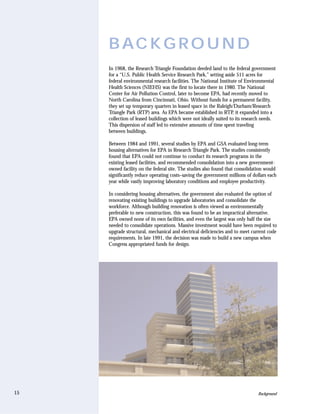
     In 1968, the Research Triangle Foundation deeded land to the federal government
     for a “U.S. Public Health Service Research Park,” setting aside 511 acres for
     federal environmental research facilities. The National Institute of Environmental
     Health Sciences (NIEHS) was the first to locate there in 1980. The National
     Center for Air Pollution Control, later to become EPA, had recently moved to
     North Carolina from Cincinnati, Ohio. Without funds for a permanent facility,
     they set up temporary quarters in leased space in the Raleigh/Durham/Research
     Triangle Park (RTP) area. As EPA became established in RTP, it expanded into a
     collection of leased buildings which were not ideally suited to its research needs.
     This dispersion of staff led to extensive amounts of time spent traveling
     between buildings.

     Between 1984 and 1991, several studies by EPA and GSA evaluated long-term
     housing alternatives for EPA in Research Triangle Park. The studies consistently
     found that EPA could not continue to conduct its research programs in the
     existing leased facilities, and recommended consolidation into a new government-
     owned facility on the federal site. The studies also found that consolidation would
     significantly reduce operating costs–saving the government millions of dollars each
     year while vastly improving laboratory conditions and employee productivity.

     In considering housing alternatives, the government also evaluated the option of
     renovating existing buildings to upgrade laboratories and consolidate the
     workforce. Although building renovation is often viewed as environmentally
     preferable to new construction, this was found to be an impractical alternative.
     EPA owned none of its own facilities, and even the largest was only half the size
     needed to consolidate operations. Massive investment would have been required to
     upgrade structural, mechanical and electrical deficiencies and to meet current code
     requirements. In late 1991, the decision was made to build a new campus when
     Congress appropriated funds for design.


15                                                                             Background
S U S TA I N A B I L I T Y
What is Sustainable Development?
Sustainable development was defined by the United Nations World Commission                         Sustainability means
on Environment and Development in the 1987 Brundtland Report, as “those paths                      meeting our needs today
of social economic and political progress that meet the needs of the present without               without compromising the
compromising the ability of future generations to meet their own needs.”1 In 1993,                 ability of future generations
a year after the Earth Summit in Rio de Janeiro, the World Congress of Architects                  to meet their own needs.
similarly defined “sustainability” for the architectural community.
                                                                                                   —UIA/AIA World Congress of
There is general agreement that environmental degradation is accelerating                           Architects, June 1993
worldwide, and that projected increases in rates of consumption and population
growth cannot be sustained. Solutions will require widespread efforts to increase
efficiency, reduce pollution and restore ecosystems. With a goal of building in
harmony with the natural environment, sustainable development involves a more
sophisticated understanding of natural systems than is required by conventional
development. Sustainable design solutions also require designers to expand their
awareness of the environmental impact related to industrial processes,
transportation and construction. Because the impact of buildings and construction
on the environment is significant, there is great potential for improving the
environment through better design of buildings. This requires a responsibility to act
differently than we have in the past to reduce traditional environmental impact.

Green Buildings
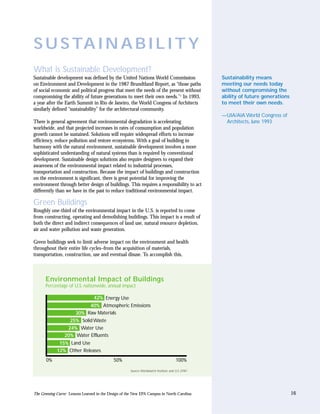
Roughly one-third of the environmental impact in the U.S. is reported to come
from constructing, operating and demolishing buildings. This impact is a result of
both the direct and indirect consequences of land use, natural resource depletion,
air and water pollution and waste generation.

Green buildings seek to limit adverse impact on the environment and health
throughout their entire life cycles–from the acquisition of materials,
transportation, construction, use and eventual disuse. To accomplish this,


      Environmental Impact of Buildings
      Percentage of U.S. nationwide, annual impact

                             42% Energy Use
                           40% Atmospheric Emissions
                     30% Raw Materials
                   25% Solid Waste
                  24% Water Use
                 20% Water Effluents
              15% Land Use
             12% Other Releases
       0%                                    50%                                       100%

                                                      Source: Worldwatch Institute and U.S. EPA2


The Greening Curve: Lessons Learned in the Design of the New EPA Campus in North Carolina                                          16
A Sampling of                                designers must view the building holistically and consider environmental impact
Environmental Requirements                   related to site development, transportation and infrastructure, as well as the
Mandated by Executive Orders                 impact related to the full life-cycle of all building materials and products that
                                             comprise the building.
EO #12843:Procurement
Requirements and Policies for                Green buildings represent important steps in the evolution of buildings and
Federal Agencies for Ozone-
                                             communities toward sustainability. As such, they consider all opportunities to:
Depleting Substances,4/93
                                                     • Conserve Resources
Requires minimizing procurement of
ozone-depleting substances per                       • Prevent Pollution
phaseout schedules outlined in the                   • Protect Ecosystems
Clean Air Act.                                       • Enhance Indoor Environmental Quality

EO #12873:Federal Acquisition,               Sustainable Design Resources
Recycling,and Waste Prevention,              When EPA began planning for its new facility, the concept of “sustainable design”
10/93                                        was just beginning to gain momentum in the U.S. Only a handful of green case
Requires EPA to publish federal              study buildings had been completed, and the information on what to do and how
procurement guidelines for                   to do it was scarce. In 1990, shortly after the 20th anniversary of Earth Day, the
recommended recovered content                American Institute of Architects (AIA) established the Committee on the
in certain materials.
                                             Environment (COTE) to begin the process of filling the information void for the
EO #12902:Energy Efficiency and              architectural profession. In 1991, EPA entered into an agreement with the AIA to
Water Conservation at Federal                work together to create a comprehensive environmental design resource guide
Facilities,3/94                              entitled the Environmental Resource Guide (ERG). The ERG was first published
Requires federal agencies to implement       in 1992 as an AIA publication, and was subsequently republished by John Wiley &
conservation strategies in their buildings   Sons in an updated format in 1996, followed by annual updates in 1997 and 1998.
as stated in EPACT.
                                             Throughout the 1990s, the “green building” movement continued to evolve. In
EO #13101:Greening the                       1993, the U.S. Green Building Council was formed and began work on a green
Government Through Waste                     building rating system for the U.S. In 1996, a comprehensive sustainable design
Prevention,Recycling,and Federal             resource guide entitled the Sustainable Building Technical Manual was published
Acquisition,9/98                             by Public Technology Inc. with the support of EPA, the Department of Energy
Requires GSA and Department of               and the U.S. Green Building Council. In 1997, John Wiley & Sons published
Defense to develop sustainable design        Green Developments, a compendium of 100 recently completed green building
and development principals for the siting,
                                             case studies written by the Rocky Mountain Institute. Since this time, additional
design and construction of new facilities;
requires agencies to design new facilities   green design resources have emerged.
based on lowest life-cycle cost.
                                             Sustainable Design for Federal Facilities
EO #13123:Greening the                       The Energy Policy Act (EPACT) of 1992 was an important milestone in the
Government Through Efficient                 sustainable design movement because it signaled the federal government’s
Energy Management,6/99                       recognition of its own leverage, applied through example and through unparalleled
Requires government to promote               purchasing power. EPACT was signed into law in October 1992, shortly after
sustainable building concepts and help       design work had begun on the new EPA Campus. It provided guidance to federal
foster markets for emerging sustainable      facility planners on how to improve the energy performance of their agencies, and
technologies.                                it set a goal of a 30% reduction in commercial building energy usage by 2005,
                                             based on a 1985 baseline. EPACT required that all government buildings “install
EO #13148:Greening the
                                             in Federal Buildings owned by the United States all energy and water conservation
Government Through Leadership
in Environmental Management,                 measures with payback periods of less than 10 years,” and that these conservation
4/00                                         measures be evaluated using a life-cycle costing methodology.
Requires federal agencies to integrate
environmental accountability into daily      EPACT also mandated that each federal agency that constructs at least five buildings
decision making and long-term planning       a year “designate at least one building, at the earliest stage of development, to be a
processes across all agency missions,        showcase highlighting advanced technologies and practices for energy efficiency, or
activities and functions.                    use of solar and other renewable energy.” Even though EPACT and the subsequent
                                             Executive Orders (EOs) were enacted after design had already begun on the new


17                                                                                                                       Sustainability
Campus, it provided additional support and validation to project team members
committed to developing the EPA Campus as a showcase facility. In June 1999, the
federal commitment to green buildings remained strong as EO #13123 was issued,
further advancing the government’s pledge to green its facilities.

Resource Conservation
Resource use, which includes energy, water and materials, is fundamental to the              Opportunities to
impact buildings have on the environment. Non-renewable resources are being                  Conserve Resources
depleted and many renewable resources, such as timber and water, are being
extracted at rates that exceed their ability to be replenished. According to the             Energy Use
Worldwatch Institute, three billion tons of raw materials, approximately 40% of              • Heating and cooling
all materials entering the global economy, are turned into foundations, walls, pipes         • Air circulation
and panels for building construction each year.3                                             • Lighting
                                                                                             • Water heating
Green buildings seek to use environmentally-preferable building materials. This              • Special equipment
refers to all of the products and materials that have reduced the environmental              • Plug loads
impact over the full life-cycle of the material, as compared to other available
options. Conservation of material resources also depends on efficient use of                 Water Use
materials, enhanced durability and strategies to encourage re-use and recycling of           • Landscape irrigation
resources. Green buildings accommodate re-use and recycling so that waste                    • Plumbing fixtures
generated by building occupants can be handled properly. Construction waste,                 • Mechanical equipment
which constitutes approximately 25% of municipal landfill content, can also be               • Appliances
reduced, re-used and recycled.
                                                                                             Building & Site Materials
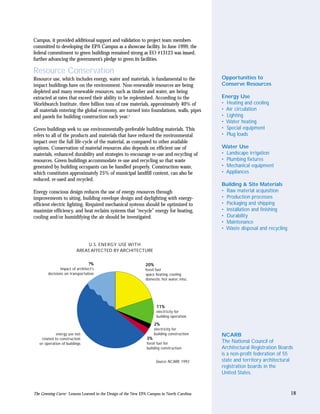
Energy conscious design reduces the use of energy resources through                          • Raw material acquisition
improvements to siting, building envelope design and daylighting with energy-                • Production processes
efficient electric lighting. Required mechanical systems should be optimized to              • Packaging and shipping
maximize efficiency, and heat reclaim systems that “recycle” energy for heating,             • Installation and finishing
cooling and/or humidifying the air should be investigated.                                   • Durability
                                                                                             • Maintenance
                                                                                             • Waste disposal and recycling


                              U.S. ENERGY USE WITH
                         AREAS AFFECTED BY ARCHITECTURE


                                ?%                             20%
               impact of architect's                           fossil fuel
        decisions on transportation                            space heating, cooling
                                                               domestic hot water, misc.


                                                                      11%
                                                                      electricity for
                                                                      building operation

                                                                     2%
                                                                     electricity for
             energy use not                                          building construction   NCARB
    related to construction                                    3%
   or operation of buildings                                   fossil fuel for               The National Council of
                                                               building construction         Architectural Registration Boards
                                                                                             is a non-profit federation of 55
                                                                      Source: NCARB, 1993    state and territory architectural
                                                                                             registration boards in the
                                                                                             United States.


The Greening Curve: Lessons Learned in the Design of the New EPA Campus in North Carolina                                     18
Sources of Pollution                  Finally, conservation of water resources in green buildings involves strategies to use
                                      less water for HVAC equipment and appliances, flushing fixtures, potable water
Energy Use                            uses and irrigation. Water harvesting and water re-use strategies can reduce
• Petroleum extraction and            demand for potable water supplies.
  refinement
• Oil spills                          Pollution Prevention
• Air emissions and nuclear waste     Buildings and their sites contribute to the creation of waste and pollution as a
  from energy usage                   result of their use of energy, water and materials. In nature there is no waste
• Air pollution from automobiles      because all by-products of natural processes serve as “food” for other processes.
  and other transportation            Many of the industrial processes employed in the creation of buildings, however,
• Thermal waste                       release solid, liquid or gaseous by-products into the environment that serve no
• Ozone-depleting substances          useful purpose and are potentially harmful.

Water Use                             Green building design searches for solutions that prevent the creation of pollution
• Contaminated runoff                 at the source. By limiting energy and water use, and making efficient use of
• Waste water                         environmentally-preferable materials, pollution can be reduced. Integrating
• Water treatment by-products         environmentally-sound recycling into design solutions can further reduce pollution.
                                      Waste treatment followed by safe disposal is required for pollution that cannot be
Materials Use                         prevented or recycled. On-site, natural treatment options should be considered to
• By-products from material           treat waste including bioretention, constructed wetlands and composting.
  manufacture
• Wasteful packaging                  Ecosystems Protection
• Solid and liquid waste              The impact of buildings on natural ecosystems occurs on multiple levels, including
• Hazardous waste                     loss of open space and habitat, intrusion on fragile ecosystems, alteration of
                                      stormwater flows, erosion and loss of soil resources, contamination of water
Environmental Impact on               resources and use of non-native and invasive species or monocultures of vegetation.
Ecosystems                            Green buildings seek to develop “low impact” solutions which work in harmony
• Displacement of habitat for         with natural systems, and minimize disruption to plant and animal habitats.
  buildings, roadways and parking     Redevelopment of previously built sites and compact development can limit
• Increase in impervious surface      disruption. Native, low maintenance landscapes, reductions in impervious materials
• Reduction in groundwater            and natural filtration of stormwater can reduce the need for treatment strategies.
  recharge
• Soil erosion                        Indoor Environmental Quality
• Contamination of water bodies
                                      In the United States, it has been estimated that people spend more than 90% of
• Contamination of groundwater
                                      their time indoors.4 This makes the quality of the indoor environment critical.
• Use of invasive exotic plants
                                      Indoor environmental quality refers to comfort and building-related health and
• Use of fertilizers and pesticides
                                      productivity issues that result from the quality of interior lighting, acoustics,
• Urban heat island effect
                                      thermal control and indoor air quality (IAQ).

                                      Indoor air quality depends upon a variety of factors, including the levels of
                                      particulates, volatile organic compounds (VOCs) and molds, bacteria or other
                                      biological contaminants in the air stream. Indoor air contaminants can come from
                                      building and finish materials, cleaning and maintenance products, mechanical
                                      equipment, microbial growth in wet areas, tobacco smoke, radon gas, office
                                      machines, exterior pollution and a variety of other sources.

                                      EPA rates indoor air pollution among the top five environmental risks to public
                                      health. It has been estimated that unhealthy indoor air is found in up to 30% of
                                      new and renovated buildings. Both the long- and short-term health effects of poor
                                      indoor air are revealing themselves at an increasing rate due to occupant
                                      complaints, while specific IAQ problems are being discovered through testing
                                      and monitoring.


19                                                                                                               Sustainability
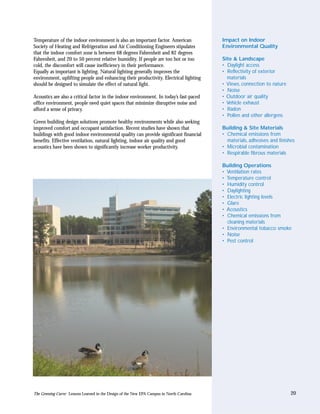
Temperature of the indoor environment is also an important factor. American                 Impact on Indoor
Society of Heating and Refrigeration and Air Conditioning Engineers stipulates              Environmental Quality
that the indoor comfort zone is between 68 degrees Fahrenheit and 82 degrees
Fahrenheit, and 20 to 50 percent relative humidity. If people are too hot or too            Site & Landscape
cold, the discomfort will cause inefficiency in their performance.                          • Daylight access
Equally as important is lighting. Natural lighting generally improves the                   • Reflectivity of exterior
environment, uplifting people and enhancing their productivity. Electrical lighting           materials
should be designed to simulate the effect of natural light.                                 • Views, connection to nature
                                                                                            • Noise
Acoustics are also a critical factor in the indoor environment. In today’s fast-paced       • Outdoor air quality
office environment, people need quiet spaces that minimize disruptive noise and             • Vehicle exhaust
afford a sense of privacy.                                                                  • Radon
                                                                                            • Pollen and other allergens
Green building design solutions promote healthy environments while also seeking
improved comfort and occupant satisfaction. Recent studies have shown that                  Building & Site Materials
buildings with good indoor environmental quality can provide significant financial          • Chemical emissions from
benefits. Effective ventilation, natural lighting, indoor air quality and good                materials, adhesives and finishes
acoustics have been shown to significantly increase worker productivity.                    • Microbial contamination
                                                                                            • Respirable fibrous materials

                                                                                            Building Operations
                                                                                            • Ventilation rates
                                                                                            • Temperature control
                                                                                            • Humidity control
                                                                                            • Daylighting
                                                                                            • Electric lighting levels
                                                                                            • Glare
                                                                                            • Acoustics
                                                                                            • Chemical emissions from
                                                                                              cleaning materials
                                                                                            • Environmental tobacco smoke
                                                                                            • Noise
                                                                                            • Pest control


The Greening Curve: Lessons Learned in the Design of the New EPA Campus in North Carolina                                    20
DESIGN
     COST                       PROCESS
                                DISCUSSION
                    FUNCTION
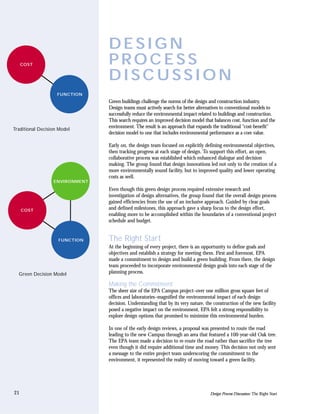
                                Green buildings challenge the norms of the design and construction industry.
                                Design teams must actively search for better alternatives to conventional models to
                                successfully reduce the environmental impact related to buildings and construction.
                                This search requires an improved decision model that balances cost, function and the
                                environment. The result is an approach that expands the traditional “cost-benefit”
Traditional Decision Model
                                decision model to one that includes environmental performance as a core value.

                                Early on, the design team focused on explicitly defining environmental objectives,
                                then tracking progress at each stage of design. To support this effort, an open,
                                collaborative process was established which enhanced dialogue and decision
                                making. The group found that design innovations led not only to the creation of a
                                more environmentally sound facility, but to improved quality and lower operating
                                costs as well.
                  ENVIRONMENT
                                Even though this green design process required extensive research and
                                investigation of design alternatives, the group found that the overall design process
                                gained efficiencies from the use of an inclusive approach. Guided by clear goals
     COST                       and defined milestones, this approach gave a sharp focus to the design effort,
                                enabling more to be accomplished within the boundaries of a conventional project
                                schedule and budget.


                    FUNCTION    The Right Start
                                At the beginning of every project, there is an opportunity to define goals and
                                objectives and establish a strategy for meeting them. First and foremost, EPA
                                made a commitment to design and build a green building. From there, the design
                                team proceeded to incorporate environmental design goals into each stage of the
  Green Decision Model          planning process.

                                Making the Commitment
                                The sheer size of the EPA Campus project–over one million gross square feet of
                                offices and laboratories–magnified the environmental impact of each design
                                decision. Understanding that by its very nature, the construction of the new facility
                                posed a negative impact on the environment, EPA felt a strong responsibility to
                                explore design options that promised to minimize this environmental burden.

                                In one of the early design reviews, a proposal was presented to route the road
                                leading to the new Campus through an area that featured a 100-year-old Oak tree.
                                The EPA team made a decision to re-route the road rather than sacrifice the tree
                                even though it did require additional time and money. This decision not only sent
                                a message to the entire project team underscoring the commitment to the
                                environment, it represented the reality of moving toward a green facility.


21                                                                                 Design Process Discussion: The Right Start
When placed in the context of EPA’s organizational mission, this sense of                   Make environmental goals for the
obligation was further magnified. EPA felt that the design and construction of its          facility explicit in the Request for
new facility presented not just an opportunity, but also an obligation to lead by           Proposals and the Program of
example. As the building owner, EPA would control nearly all design decisions. If           Requirements.
done correctly, the Agency believed that its facility could become a functional
model for the greening of other public and private sector facilities, and help
advance sustainable design and construction as an industry-wide practice.
                                                                                            Require that the Architect
Defining the Challenge                                                                      and Engineer demonstrate both
Before the formal design of the new facility began, EPA set the course for the              knowledge about and commitment
project by describing the environmental challenge both for itself and for the               to sustainable design.
professional design team it would solicit. Green design criteria were written into
the key project documents, including the solicitation for Architect/Engineer (A/E)
services, the Program of Requirements (POR), and the contract with the chosen
A/E. By clearly and consistently presenting its environmental goals and explicitly          “The facility shall be designed to
integrating them into the project requirements, EPA set a direction for the design          reflect its mission.This translates
firms and established a set of procedures for tracking environmental performance            into a facility that conserves
during the design process.                                                                  energy, efficiently utilizes water,
                                                                                            promotes effective recycling, is
The solicitation for A/E services was EPA’s first opportunity to present its vision for     radon free and provides excellent
the new facility to potential A/E contractors. Recognizing the importance of                indoor air quality to its occupants.
choosing a partner that would share EPA’s vision, the contract solicitation required a      The architectural and engineering
“demonstrated corporate ability to design environmentally sound facilities.” Because        design shall implement proven
knowledge about green buildings was not widespread in the U.S. at the time, the             methods, strategies and
responses from A/E contractors enabled EPA to gauge the level of experience,                technologies which respect and
interest and enthusiasm for the challenge of designing a green building.                    protect the environment.”

                                                                                            –EPA Program
                                                                                             of Requirements
     Environmental Requirements in the Design Contract

     General
     • Energy conscious design
     • Highly durable facility design–anticipate a 100-year lifespan
     • Environmentally-sensitive construction materials and products
     • Materials and equipment with no ozone-depleting potential
     • Construction materials with no recycled content
     • Aggressive recycling plan
     • Radon free
     • Water conserving design

     Energy Conservation
     • Daylighting and the optimum use of energy efficient lighting
     • Life-cycle cost analysis of HVAC systems over a 30-year period
     • Building Automated System (BAS) for monitoring and control

     Indoor Air Quality
      • Controls for outdoor and indoor sources of indoor air pollution
      • Detailed site evaluation to determine impact of the site on IAQ
      • Plan for operation and maintenance of HVAC equipment
      • Innovative approaches to maximize ventilation efficiency
      • Evaluation of building materials for potential impact on IAQ
      • HVAC system that minimize impact on IAQ
      • Evaluation for air cleaning devices


The Greening Curve: Lessons Learned in the Design of the New EPA Campus in North Carolina                                     22
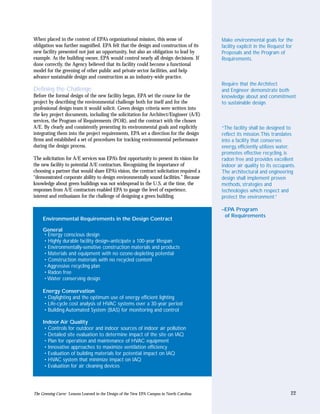
Identify specific environmental      Development of the POR for the new facility presented another important
design requirements in the           opportunity to steer the project toward its environmental goals. A typical POR
Architect/Engineer contract.         itemizes square footage requirements by space type and sets standards for the
                                     performance and quality of the facility. EPA expanded this approach through the
                                     inclusion of broad-based environmental design considerations, supported by
Engage all team members in           detailed descriptions of features to be considered during the design process.
setting project goals including      Ultimately the entire POR, including the environmental design requirements,
environmental goals.                 became part of the statement of work for the A/E contract.

                                     In addition to the environmental design requirements captured in the POR, the
Encourage development of             A/E contract contained specific deliverables for each stage of the project that
environmental design goals that      supported the development of environmentally-preferable design options. For
are overarching in nature, as well   example, there were stand-alone requirements for indoor air quality submittals,
those that are specific and          energy analysis and reports, life-cycle cost studies, site surveys, specimen tree studies,
measurable.                          an environmental assessment and documentation of related environmental permits.

                                     Prioritizing Environmental Goals
                                     While EPA set forth a comprehensive list of environmental design requirements
EPA Campus Project Goals             for the A/E team to meet, it also recognized that the entire design team would
                                     need to balance many competing considerations. Consequently, it was necessary to
Top-Tier Goals                       integrate environmental goals into the larger matrix of goals for the facility as a
• Functionality                      whole. The process of prioritizing would also provide an opportunity to build
• Environmental design               consensus within the group on the relative importance of the environmental goals
• Low life-cycle cost                for the project.

Specific Goals                       As a first step, EPA held a two-day design kickoff session for all design team
• Maintainability                    members for the purpose of goal setting and team building. During this session,
• Natural light                      the group brainstormed a list of primary design goals for the facility. This list was
• Communication                      then discussed extensively to develop consensus within the group and to prioritize
• Flexibility                        goals. The process of developing goals as a group helped each of the members
• Close proximity/walkability        develop a sense of ownership of and commitment to these goals.
• Security
                                     Among these overarching design goals, functionality and environmental design
                                     were identified as the most important. Cost control was not listed as a priority to
                                     be debated because it was accepted as a given. There was a fixed budget for the
                                     project and that budget could not be exceeded. In terms of functionality, the
                                     facility was being built to support the activities of a diverse group of EPA
                                     programs, and meeting the operational requirements of this work was paramount.
                                     The focus on environmental design goals for the facility was underscored when the
                                     entire team agreed that environmental design was also of primary importance.
                                     With this decision, environmental performance expectations expanded, beyond
                                     what was a collection of contract requirements for specific studies and reports
                                     documenting environmental performance, to become a core issue.

                                     Embedding Green Goals in Conceptual Design
                                     Concept design marks the beginning of the design process. It was during this
                                     phase that the design team began to identify and develop the ideas that organized
                                     the design. There are many issues at the core of green design that need to be
                                     addressed up front, while there is an opportunity to influence the building form
                                     and its placement and orientation on the site. These issues included:

                                               • limit disruption to site
                                               • protect wetland areas and existing trees
                                               • develop orientation and massing to maximize daylight access
                                               • develop orientation and massing to maximize energy efficiency
                                               • develop orientation to benefit fresh air flows

23                                                                                         Design Process Discussion: The Right Start
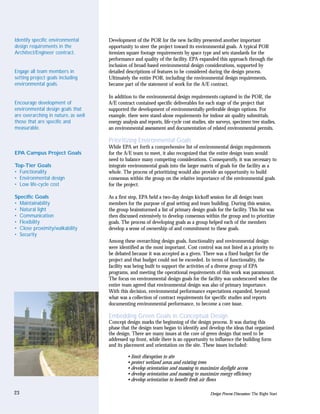
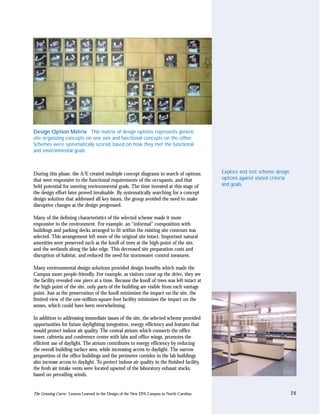
Design Option Matrix This matrix of design options represents generic
site organizing concepts on one axis and functional concepts on the other.
Schemes were systematically scored, based on how they met the functional
and environmental goals.


During this phase, the A/E created multiple concept diagrams in search of options           Explore and test scheme design
that were responsive to the functional requirements of the occupants, and that              options against stated criteria
held potential for meeting environmental goals. The time invested at this stage of          and goals.
the design effort later proved invaluable. By systematically searching for a concept
design solution that addressed all key issues, the group avoided the need to make
disruptive changes as the design progressed.

Many of the defining characteristics of the selected scheme made it more
responsive to the environment. For example, an “informal” composition with
buildings and parking decks arranged to fit within the existing site contours was
selected. This arrangement left more of the original site intact. Important natural
amenities were preserved such as the knoll of trees at the high-point of the site,
and the wetlands along the lake edge. This decreased site preparation costs and
disruption of habitat, and reduced the need for stormwater control measures.

Many environmental design solutions provided design benefits which made the
Campus more people-friendly. For example, as visitors come up the drive, they see
the facility revealed one piece at a time. Because the knoll of trees was left intact at
the high-point of the site, only parts of the building are visible from each vantage
point. Just as the preservation of the knoll minimizes the impact on the site, the
limited view of the one-million-square-foot facility minimizes the impact on the
senses, which could have been overwhelming.

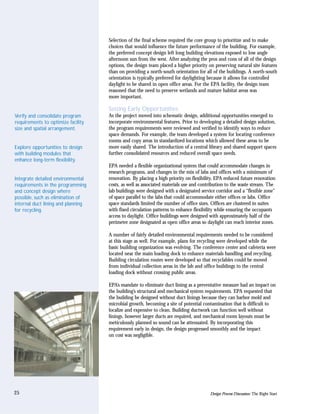
In addition to addressing immediate issues of the site, the selected scheme provided
opportunities for future daylighting integration, energy efficiency and features that
would protect indoor air quality. The central atrium which connects the office
tower, cafeteria and conference center with labs and office wings, promotes the
efficient use of daylight. The atrium contributes to energy efficiency by reducing
the overall building surface area, while increasing access to daylight. The narrow
proportion of the office buildings and the perimeter corridor in the lab buildings
also increase access to daylight. To protect indoor air quality in the finished facility,
the fresh air intake vents were located upwind of the laboratory exhaust stacks,
based on prevailing winds.


The Greening Curve: Lessons Learned in the Design of the New EPA Campus in North Carolina                                     24
Selection of the final scheme required the core group to prioritize and to make
                                    choices that would influence the future performance of the building. For example,
                                    the preferred concept design left long building elevations exposed to low angle
                                    afternoon sun from the west. After analyzing the pros and cons of all of the design
                                    options, the design team placed a higher priority on preserving natural site features
                                    than on providing a north-south orientation for all of the buildings. A north-south
                                    orientation is typically preferred for daylighting because it allows for controlled
                                    daylight to be shared in open office areas. For the EPA facility, the design team
                                    reasoned that the need to preserve wetlands and mature habitat areas was
                                    more important.

                                    Seizing Early Opportunities
Verify and consolidate program      As the project moved into schematic design, additional opportunities emerged to
requirements to optimize facility   incorporate environmental features. Prior to developing a detailed design solution,
size and spatial arrangement.       the program requirements were reviewed and verified to identify ways to reduce
                                    space demands. For example, the team developed a system for locating conference
                                    rooms and copy areas in standardized locations which allowed these areas to be
Explore opportunities to design     more easily shared. The introduction of a central library and shared support spaces
with building modules that          further consolidated resources and reduced overall space needs.
enhance long-term flexibility.
                                    EPA needed a flexible organizational system that could accommodate changes in
                                    research programs, and changes in the mix of labs and offices with a minimum of
Integrate detailed environmental    renovation. By placing a high priority on flexibility, EPA reduced future renovation
requirements in the programming     costs, as well as associated materials use and contribution to the waste stream. The
and concept design where            lab buildings were designed with a designated service corridor and a “flexible zone”
possible, such as elimination of    of space parallel to the labs that could accommodate either offices or labs. Office
internal duct lining and planning   space standards limited the number of office sizes. Offices are clustered in suites
for recycling.                      with fixed circulation patterns to enhance flexibility while ensuring the occupants
                                    access to daylight. Office buildings were designed with approximately half of the
                                    perimeter zone designated as open office areas so daylight can reach interior zones.

                                    A number of fairly detailed environmental requirements needed to be considered
                                    at this stage as well. For example, plans for recycling were developed while the
                                    basic building organization was evolving. The conference center and cafeteria were
                                    located near the main loading dock to enhance materials handling and recycling.
                                    Building circulation routes were developed so that recyclables could be moved
                                    from individual collection areas in the lab and office buildings to the central
                                    loading dock without crossing public areas.

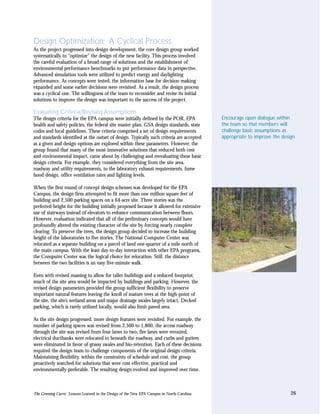
                                    EPA’s mandate to eliminate duct lining as a preventative measure had an impact on
                                    the building’s structural and mechanical system requirements. EPA requested that
                                    the building be designed without duct linings because they can harbor mold and
                                    microbial growth, becoming a site of potential contamination that is difficult to
                                    localize and expensive to clean. Building ductwork can function well without
                                    linings, however larger ducts are required, and mechanical room layouts must be
                                    meticulously planned so sound can be attenuated. By incorporating this
                                    requirement early in design, the design progressed smoothly and the impact
                                    on cost was negligible.


25                                                                                     Design Process Discussion: The Right Start
Design Optimization: A Cyclical Process
As the project progressed into design development, the core design group worked
systematically to “optimize” the design of the new facility. This process involved
the careful evaluation of a broad range of solutions and the establishment of
environmental performance benchmarks to put performance data in perspective.
Advanced simulation tools were utilized to predict energy and daylighting
performance. As concepts were tested, the information base for decision making
expanded and some earlier decisions were revisited. As a result, the design process
was a cyclical one. The willingness of the team to reconsider and revise its initial
solutions to improve the design was important to the success of the project.

Evaluating Criteria/Revising Assumptions
The design criteria for the EPA campus were initially defined by the POR, EPA               Encourage open dialogue within
health and safety policies, the federal site master plan, GSA design standards, state       the team so that members will
codes and local guidelines. These criteria comprised a set of design requirements           challenge basic assumptions as
and standards identified at the outset of design. Typically such criteria are accepted      appropriate to improve the design.
as a given and design options are explored within these parameters. However, the
group found that many of the most innovative solutions that reduced both cost
and environmental impact, came about by challenging and reevaluating these basic
design criteria. For example, they considered everything from the site area,
roadway and utility requirements, to the laboratory exhaust requirements, fume
hood design, office ventilation rates and lighting levels.

When the first round of concept design schemes was developed for the EPA
Campus, the design firm attempted to fit more than one million square feet of
building and 2,500 parking spaces on a 64-acre site. Three stories was the
preferred height for the building initially proposed because it allowed for extensive
use of stairways instead of elevators to enhance communication between floors.
However, evaluation indicated that all of the preliminary concepts would have
profoundly altered the existing character of the site by forcing nearly complete
clearing. To preserve the trees, the design group decided to increase the building
height of the laboratories to five stories. The National Computer Center was
relocated as a separate building on a parcel of land one-quarter of a mile north of
the main campus. With the least day-to-day interaction with other EPA programs,
the Computer Center was the logical choice for relocation. Still, the distance
between the two facilities is an easy five-minute walk.

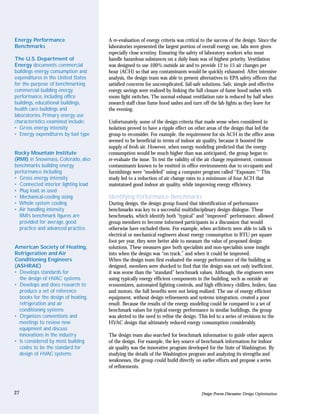
Even with revised massing to allow for taller buildings and a reduced footprint,
much of the site area would be impacted by buildings and parking. However, the
revised design parameters provided the group sufficient flexibility to preserve
important natural features leaving the knoll of mature trees at the high-point of
the site, the site’s wetland areas and major drainage swales largely intact. Decked
parking, which is rarely utilized locally, would also limit paved area.

As the site design progressed, more design features were revisited. For example, the
number of parking spaces was revised from 2,500 to 1,800, the access roadway
through the site was revised from four lanes to two, fire lanes were rerouted,
electrical ductbanks were relocated to beneath the roadway, and curbs and gutters
were eliminated in favor of grassy swales and bio-retention. Each of these decisions
required the design team to challenge components of the original design criteria.
Maintaining flexibility, within the constraints of schedule and cost, the group
proactively searched for solutions that were cost-effective, practical and
environmentally-preferable. The resulting design evolved and improved over time.


The Greening Curve: Lessons Learned in the Design of the New EPA Campus in North Carolina                                  26
Energy Performance                   A re-evaluation of energy criteria was critical to the success of the design. Since the
Benchmarks                           laboratories represented the largest portion of overall energy use, labs were given
                                     especially close scrutiny. Ensuring the safety of laboratory workers who must
The U.S. Department of               handle hazardous substances on a daily basis was of highest priority. Ventilation
Energy documents commercial          was designed to use 100% outside air and to provide 12 to 15 air changes per
buildings energy consumption and     hour (ACH) so that any contaminants would be quickly exhausted. After intensive
expenditures in the United States    analysis, the design team was able to present alternatives to EPA safety officers that
for the purpose of benchmarking      satisfied concerns for uncomplicated, fail-safe solutions. Safe, simple and effective
commercial building energy           energy savings were realized by linking the full closure of fume hood sashes with
performance, including office        room light switches. The normal exhaust ventilation rate is reduced by half when
buildings, educational buildings,    research staff close fume hood sashes and turn off the lab lights as they leave for
health care buildings and            the evening.
laboratories. Primary energy use
characteristics examined include:    Unfortunately, some of the design criteria that made sense when considered in
• Gross energy intensity             isolation proved to have a ripple effect on other areas of the design that led the
• Energy expenditures by fuel type   group to reconsider. For example, the requirement for six ACH in the office areas
                                     seemed to be beneficial in terms of indoor air quality, because it boosted the
                                     supply of fresh air. However, when energy modeling predicted that the energy
Rocky Mountain Institute             consumption would be much higher than was anticipated, the group began to
(RMI) in Snowmass, Colorado, also    re-evaluate the issue. To test the validity of the air change requirement, common
benchmarks building energy           contaminants known to be emitted in office environments due to occupants and
performance including                furnishings were “modeled” using a computer program called “Exposure.”7 This
• Gross energy intensity             study led to a reduction of air change rates to a minimum of four ACH that
• Connected interior lighting load   maintained good indoor air quality, while improving energy efficiency.
• Plug load, as used
• Mechanical-cooling sizing          Identifying Performance Benchmarks
• Whole system cooling               During design, the design group found that identification of performance
• Air handling intensity             benchmarks was key to a successful multidisciplinary design dialogue. These
  RMI’s benchmark figures are        benchmarks, which identify both “typical” and “improved” performance, allowed
  provided for average, good         group members to become informed participants in a discussion that would
  practice and advanced practice.    otherwise have excluded them. For example, when architects were able to talk to
                                     electrical or mechanical engineers about energy consumption in BTU per square
                                     foot per year, they were better able to measure the value of proposed design
American Society of Heating,         solutions. These measures gave both specialists and non-specialists some insight
Refrigeration and Air                into when the design was “on track,” and when it could be improved.
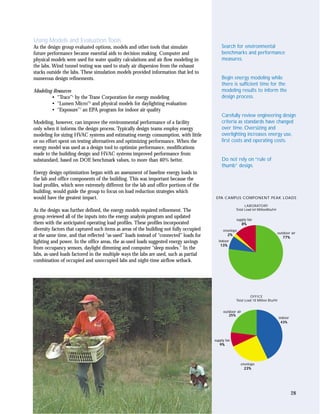
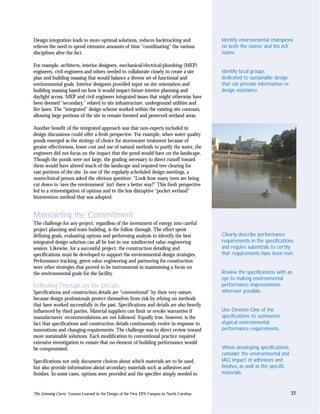
Conditioning Engineers               When the design team first evaluated the energy performance of the building as
(ASHRAE)                             designed, members were shocked to find that the design was not only inefficient,
• Develops standards for             it was worse than the “standard” benchmark values. Although, the engineers were
  the design of HVAC systems         using typically energy efficient components in the building, such as outside air
• Develops and does research to      economizers, automated lighting controls, and high efficiency chillers, boilers, fans
  produce a set of reference         and motors, the full benefits were not being realized. The use of energy efficient
  books for the design of heating,   equipment, without design refinements and systems integration, created a poor
  refrigeration and air              result. Because the results of the energy modeling could be compared to a set of
  conditioning systems               benchmark values for typical energy performance in similar buildings, the group
• Organizes conventions and          was alerted to the need to refine the design. This led to a series of revisions to the
  meetings to review new             HVAC design that ultimately reduced energy consumption considerably.
  equipment and discuss
  innovations in the industry        The design team also searched for benchmark information to guide other aspects
• Is considered by most building     of the design. For example, the key source of benchmark information for indoor
  codes to be the standard for       air quality was the innovative program developed for the State of Washington. By
  design of HVAC systems             studying the details of the Washington program and analyzing its strengths and
                                     weaknesses, the group could build directly on earlier efforts and propose a series
                                     of refinements.


27                                                                                  Design Process Discussion: Design Optimization
Using Models and Evaluation Tools
As the design group evaluated options, models and other tools that simulate                  Search for environmental
future performance became essential aids to decision making. Computer and                    benchmarks and performance
physical models were used for water quality calculations and air flow modeling in            measures.
the labs. Wind tunnel testing was used to study air dispersion from the exhaust
stacks outside the labs. These simulation models provided information that led to
numerous design refinements.                                                                 Begin energy modeling while
                                                                                             there is sufficient time for the
Modeling Resources                                                                           modeling results to inform the
        • “Trace”5 by the Trane Corporation for energy modeling                              design process.
        • “Lumen Micro”6 and physical models for daylighting evaluation
        • “Exposure”7 an EPA program for indoor air quality
                                                                                             Carefully review engineering design
Modeling, however, can improve the environmental performance of a facility                   criteria as standards have changed
only when it informs the design process. Typically design teams employ energy                over time. Oversizing and
modeling for sizing HVAC systems and estimating energy consumption, with little              overlighting increases energy use,
or no effort spent on testing alternatives and optimizing performance. When the              first costs and operating costs.
energy model was used as a design tool to optimize performance, modifications
made to the building design and HVAC systems improved performance from
substandard, based on DOE benchmark values, to more than 40% better.                         Do not rely on “rule of
                                                                                             thumb” design.
Energy design optimization began with an assessment of baseline energy loads in
the lab and office components of the building. This was important because the
load profiles, which were extremely different for the lab and office portions of the
building, would guide the group to focus on load reduction strategies which
would have the greatest impact.                                                           EPA C AMPUS COMPONENT PEAK LOADS

                                                                                                             LABORATORY
As the design was further defined, the energy models required refinement. The                          Total Load 64 MillionBtu/Hr

group reviewed all of the inputs into the energy analysis program and updated
                                                                                                       supply fan
them with the anticipated operating load profiles. These profiles incorporated                              8%
diversity factors that captured such items as areas of the building not fully occupied        envelope
                                                                                                                                     outdoor air
at the same time, and that reflected “as-used” loads instead of “connected” loads for             2%
                                                                                                                                        77%
lighting and power. In the office areas, the as-used loads suggested energy savings        indoor
                                                                                            13%
from occupancy sensors, daylight dimming and computer “sleep modes.” In the
labs, as-used loads factored in the multiple ways the labs are used, such as partial
combination of occupied and unoccupied labs and night-time airflow setback.


                                                                                                                OFFICE
                                                                                                       Total Load 18 Million Btu/Hr


                                                                                              outdoor air
                                                                                                 25%
                                                                                                                                      indoor
                                                                                                                                       43%


                                                                                         supply fan
                                                                                            9%


                                                                                                          envelope
                                                                                                            23%


                                                                                                                                               28
Computer modeling also was used to create a quality assurance mechanism for
                                     indoor air quality requirements. A set of emissions thresholds was established based
                                     on what would be both acceptable and achievable, and predictive modeling was
                                     performed to confirm that emissions thresholds could be met. Based on that
                                     predictive modeling, EPA was able to assure prospective contractors that if building
                                     materials passed the emissions testing requirements, the building would also pass
                                     baseline indoor air quality testing requirements after construction was complete.
                                     During the evolution of the new EPA Campus project, several rating systems for
                                     sustainable buildings emerged. Canada and Great Britain unveiled two of the
                                     earliest whole-building assessment tools in 1993. Along with fledgling initiatives in
                                     the U.S., the Netherlands and a handful of other countries, these early rating
                                     systems helped spark an international effort in 1998 that created the Green
                                     Building Challenge (GBC). Led by the Canadians, GBC aimed to establish
                                     international comprehensive benchmarks for environmentally-responsible building
                                     and site design from an environmental perspective. The new EPA campus was one
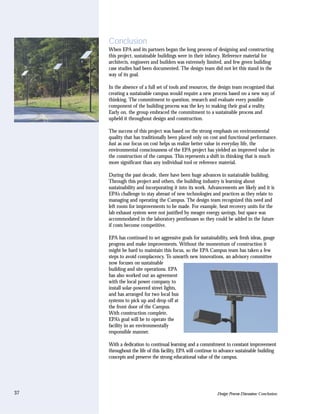
                                     of 30 case studies evaluated by the 14 participating countries in the prototype
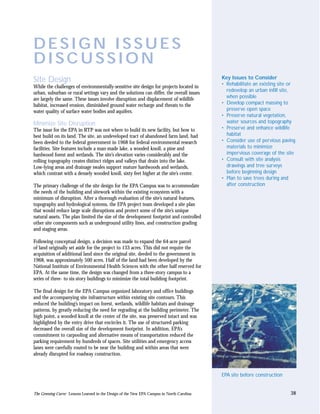
                                     round of GBC.

                                     In the United States, the U.S. Green Building Council first established its
                                     Leadership in Energy and Environmental Design (LEED) rating system in 1999.
                                     LEED evaluates the total environmental performance of a building during all
                                     phases of its useful life, from construction through demolition. Although LEED
                                     emerged too late to be of use in designing the main facility on the EPA campus, it
                                     was applied to the redesign of the National Computer Center–a separate 100,000
                                     square foot facility on the campus. The computer center has been designed to meet
                                     the “gold” rating criteria under LEED.

                                     Although the international and national green building standards offer the
                                     advantage of benchmarking performance based on broad consensus, they do face
                                     some challenges. For example, it has been difficult to adjust for the local effects of
                                     climate, markets, transportation infrastructure and other locale-specific factors.
                                     Recognizing this, a number of communities and regions have brought forward their
                                     own systems. In the Research Triangle area, the Triangle J Council of Governments
                                     performed a detailed adaptation of LEED to create their own “High Performance
In 1999, the U.S. Green Building     Guidelines: Triangle Region Public Facilities” (HPG). EPA’s new campus design
Council established the Leadership   team helped create the HPG guidelines, which were issued in 2001. The Agency
in Energy and Environmental          will incorporate them, along with LEED, into the EPA/NIEHS child care center
Design (LEED) rating system.         design-build contract.
LEED evaluates environmental
performance from a “whole            Researching Environmental Impact
building” perspective over a         The search for physical solutions to established goals and design criteria led to
building’s life-cycle.               supplemental research to understand the environmental impact and identify
                                     preferred approaches. In some areas, such as energy and water use, the research
                                     required proved to be minimal. However in other areas, such as building materials
When researching environmentally     selection and specification, extensive research was necessary to develop resources
preferable building materials,       that did not yet exist.
gather specific information about
products by manufacturer, rather     Civil engineers performed feasibility studies to explore cost-effective stormwater
than generalized information         management options to effectively cleanse runoff, while minimizing site impact.
about product types, whenever        The bioretention strategy that was ultimately selected was a relatively new
possible.                            approach relying on “pocket wetlands” filled with permeable planting soil and
                                     plantings to accelerate the natural processing of contaminants suspended in the
                                     stormwater runoff. Since this technology had never been used in North Carolina


29                                                                                  Design Process Discussion: Design Optimization
at the time, the civil engineer had to educate regulators in North Carolina about
successful bioretention systems in Maryland in order to use it on this project. This
effort helped lead North Carolina officials to adopt bioretention as a Best
Management Practice for stormwater treatment across the state.

Other site issues requiring research included native plantings such as wetland and
wildflower species, alternatives for erosion control, permeable pavement options,
performance of recycled content roadway materials and re-use of on-site materials.
Specialty consultants joined the project team to develop the wetland plantings and
wildflower specifications. Topics were investigated by the civil engineers, who
applied skepticism, logic and common sense to test the performance of each
proposed alternative material.

Environmentally preferable materials selection was a major issue requiring
extensive research. Early in schematic design, the design team determined that
although some sources of information were available to guide decision making
about environmentally preferable products, such as the AIA’s Environmental
Resource Guide (ERG), manufacturer specific information regarding the
environmental performance of individual products did not yet exist in any
published form.

In response to this information void, the A/E voluntarily initiated an effort to
gather life-cycle environmental impact information about products. With input
from experts in the green building field, the A/E developed a product
questionnaire that was sent to every manufacturer considered for use in the
project. Response to the questionnaire was good, and the data proved useful in
defining which products would be the best choices for the EPA project.

The concept of “materials benchmarking” also added an important dimension to
the research effort on environmentally preferable building materials. It led the group
to explore the range of materials and products on the market, and to compare them,
by developing benchmarks for materials. The research effort eventually extended
beyond the products and materials to considerations of how the materials were
installed, when they would be installed and, due to their potential impact on indoor
air quality, how they would be maintained. This focus on IAQ led to requirements
for emission testing of selected materials, so the potential impact on indoor air
quality could be evaluated before materials were installed, rather than later, when
the cost of removing them or mitigating their effects could be prohibitive.

In addition to requiring emissions data, the group collected IAQ specifications
and related information from other projects with an indoor air focus, and                   Environmentally-preferable
prudently reviewed them to develop uncomplicated procedures to safeguard IAQ                building materials
during construction. For example, instead of a 90-day “flush out” period which
would have required the building to remain empty while it was ventilated prior to
occupancy, the group opted for ventilation during construction. This requirement
was coupled with IAQ testing to document air quality prior to occupancy, thereby
ensuring that chemical vapors emitted during construction had been removed and
air quality in the building met the established indoor air quality standards.

Other issues, such as the potential impact of electromagnetic fields on the health
of building occupants, represented entirely new territory that required extensive
research. Local issues, such as the details of the recycling infrastructure available in
North Carolina, required research as this information is regionally specific and
changes over time.


The Greening Curve: Lessons Learned in the Design of the New EPA Campus in North Carolina                                30
Green Team Core Members                Greening the Team
Although the entire team was
                                       Even though the design team understood the need to improve the environmental
committed to producing an
                                       performance of the facility, the design process itself involved dozens of people
environmentally sound design,
                                       working simultaneously on an assortment of tasks. Because of the complexity of the
certain team members had
                                       design and the variety of demands on all team members, the project leaders worked
especially critical roles in keeping
                                       on greening the design team itself, to ensure that the project’s environmental goals
the green building effort focused
                                       would not get lost in the process.
and on track.
                                       Unlike most organizations, EPA is fortunate to have its own in-house experts
EPA Project Manager
                                       on pollution prevention, indoor air quality, energy conservation, recycling and
Responsible for balancing
                                       a variety of other environmental issues. EPA invited input from these in-house
environmental goals against the
                                       experts in planning for the new facility, and the project benefited from their
pressures of meeting cost,
                                       insights. The ultimate success of the project, however, would be determined by
performance and schedule
                                       the extent to which EPA could engage all project team members in integrating
requirements.
                                       environmental design issues into the creative decision making process.
EPA Environmental Advocate
As a member of the EPA project
                                       Environmental Champions on the Team
                                       While many design team members contributed their expertise and insight
management team, had the special
                                       to the development of environmentally preferable solutions, EPA and the A/E
role of questioning all design
                                       each recognized that it was extremely important to have an individual with an
decisions for their environmental
                                       understanding of the whole “champion” the environmental goals for the project.
merits.
                                       EPA and the A/E each designated an “environmental advocate” to guide the design
                                       internally, while also reaching out to the local sustainability network for additional
Environmental Scientist
                                       support. Environmental advocates were tasked with monitoring and supporting
As a member of the EPA research
                                       environmental initiatives incorporated in the design. These advocates searched for
community and the original
                                       information that enabled the design team to assess environmental impact, raise
project officer for the
                                       issues and identify strategies to consider, and facilitate the development of design
Environmental Resources Guide,
                                       solutions requiring multidisciplinary collaboration.
provided expert advice to the
core design group on a range of
pollution prevention and
                                       Local Sustainability Network
                                       In addition to the project team that had been assembled to design the new EPA
sustainability issues.
                                       Campus, many others contributed throughout the process. A community of
                                       people involved with issues relating to sustainable design and green buildings
Indoor Air
                                       provided crucial voluntary assistance. These independent resources in the design,
Quality Coordinator
                                       academic and nonprofit communities provided valuable input. For example,
A mechanical engineer and indoor
                                       volunteers linked the group with local recycling resources, identified successful
air quality researcher for the EPA;
                                       demonstration projects that could serve as models, and assisted the A/E with
oversaw the development of the
                                       technical information relating to emerging issues such as design for good indoor
IAQ manual and reviewed the
                                       air quality and environmentally preferable materials selection.
design for indoor health impact.
                                       EPA also organized a voluntary committee from within its own ranks called the
Project Engineers
                                       Pollution Prevention Committee, to support the design effort. Meetings were held
The EPA’s lead technical staff;
                                       early during schematic design, which led to the creation of an extensive list of
directed the actual
                                       green design strategies to be considered. Some of the members of this group
implementation of green design
                                       remained involved as advisors to EPA to assist during design reviews. The
decisions.
                                       Pollution Prevention Committee was a great mechanism for broadening
                                       involvement and generating ideas that spanned many disciplines.
A/E “Green Team” Leader
As part of the lead architectural
firm, had the task of assuring the
                                       Integrated Team Approach
                                       Recognizing that optimal sustainable design strategies rely on synergy achieved
environmental soundness of the
                                       when one solution addresses multiple objectives, the design team collaborated by
complete range of architectural
                                       physically working together. Work sessions and design reviews included EPA, the
and engineering choices made on
                                       A/E and its consultants. Though this collaboration required the group to spend
the project.
                                       more time in meetings, the design process as a whole became more efficient.


31                                                                                      Design Process Discussion: Greening the Team
Design integration leads to more optimal solutions, reduces backtracking and                Identify environmental champions
relieves the need to spend extensive amounts of time “coordinating” the various             on both the owner and the A/E
disciplines after the fact.                                                                 teams.

For example, architects, interior designers, mechanical/electrical/plumbing (MEP)
engineers, civil engineers and others needed to collaborate closely to create a site        Identify local groups
plan and building massing that would balance a diverse set of functional and                dedicated to sustainable design
environmental goals. Interior designers provided input on site orientation and              that can provide information or
building massing based on how it would impact future interior planning and                  design assistance.
daylight access. MEP and civil engineers integrated issues that might otherwise have
been deemed “secondary,” related to site infrastructure, underground utilities and
fire lanes. The “integrated” design scheme worked within the existing site contours,
allowing large portions of the site to remain forested and preserved wetland areas.

Another benefit of the integrated approach was that non-experts included in
design discussions could offer a fresh perspective. For example, when water quality
ponds emerged as the strategy of choice for stormwater treatment because of
greater effectiveness, lower cost and use of natural methods to purify the water, the
engineers did not focus on the impact that the pond would have on the landscape.
Though the ponds were not large, the grading necessary to direct runoff toward
them would have altered much of the landscape and required tree clearing for
vast portions of the site. In one of the regularly scheduled design meetings, a
nontechnical person asked the obvious question: “Look how many trees are being
cut down to ‘save the environment’ isn’t there a better way?” This fresh perspective
led to a reinvestigation of options and to the less disruptive “pocket wetland”
bioretention method that was adopted.


Maintaining the Commitment
The challenge for any project, regardless of the investment of energy into careful
project planning and team building, is the follow through. The effort spent
defining goals, evaluating options and performing analysis to identify the best             Clearly describe performance
integrated design solution can all be lost in one misdirected value engineering             requirements in the specifications,
session. Likewise, for a successful project, the construction detailing and                 and require submittals to certify
specifications must be developed to support the environmental design strategies.            that requirements have been met.
Performance tracking, green value engineering and partnering for construction
were other strategies that proved to be instrumental in maintaining a focus on
the environmental goals for the facility.                                                   Review the specifications with an
                                                                                            eye to making environmental
Following Through on the Details                                                            performance improvements
Specifications and construction details are “conventional” by their very nature,            wherever possible.
because design professionals protect themselves from risk by relying on methods
that have worked successfully in the past. Specifications and details are also heavily
influenced by third parties. Material suppliers can limit or revoke warranties if           Use Division One of the
manufacturers’ recommendations are not followed. Equally true, however, is the              specifications to summarize
fact that specifications and construction details continuously evolve in response to        atypical environmental
innovations and changing requirements. The challenge was to direct review toward            performance requirements.
more sustainable solutions. Each modification to conventional practice required
extensive investigation to ensure that no element of building performance would
be compromised.                                                                             When developing specifications,
                                                                                            consider the environmental and
Specifications not only document choices about which materials are to be used,              IAQ impact of adhesives and
but also provide information about secondary materials such as adhesives and                finishes, as well as the specific
finishes. In some cases, options were provided and the specifier simply needed to           materials.


The Greening Curve: Lessons Learned in the Design of the New EPA Campus in North Carolina                                       32
choose the option that was environmentally-preferable. For example, nearly every
                                    flooring manufacturer either makes a zero-VOC adhesive, or has approved one,
                                    though they may still carry the old higher-solvent formulations. In other cases,
                                    such as the high performance finishes required in the laboratory environment,
                                    research was needed to identify alternatives to finishes that are standard in the
                                    industry, but factory applied.

                                    The team also anticipated challenges that might occur during construction.
                                    By painstakingly defining environmental performance requirements and the
                                    submittals required, alternate products proposed for substitution were screened
                                    for environmental performance.

                                    Division One of the contract specifications was developed specifically to highlight
                                    unusual environmental requirements. Division One of the specifications contains
                                    the project General Conditions, key non-technical requirements for the prime and
                                    all subcontractors. By summarizing environmental requirements in this initial
                                    section as well as in the technical provisions that follow, EPA was assured that the
                                    contractor understood the environmental requirements from a “big picture”
                                    perspective. A new section, Environmental Impact of Materials, was created to
                                    diminish the possibility that either contractors or subcontractors could
                                    misunderstand environmental requirements. Cross-referencing between this
                                    section and the individual specification sections provided clear and consistent
                                    documentation of environmental requirements.

                                    Unique specification sections were developed for Division One to clarify atypical
                                    construction procedures. At the beginning of the project manual, a section entitled
                                    Environmental Requirements, simply describes EPA’s environmental goals for the
                                    project. The section begins with the following statement: “It is the goal of the EPA
                                    to integrate the Agency’s mission into this project as much as feasible and practical;
                                    i.e., to construct a green building.” Other Division One sections include Testing for
                                    Indoor Air Quality, Baseline IAQ and Materials; Sequence of Installation Finishes; and
                                    Waste Material Management and Recycling. Detailed commissioning requirements
                                    are located in the mechanical and electrical sections to ensure that the building will
                                    operate properly, and that energy savings will be realized.

Track the development of            Tracking Environmental Performance
contract documents thoroughly       The core design group found that mechanisms to track environmental
to ensure successful inclusion of   performance were especially essential in the later phases of the project. The
environmental design features.      number of decisions made on a daily basis would multiply as the project moved
                                    into the final stages of design. Tracking environmental design strategies helped
                                    highlight the “non-standard” features requiring special attention.

                                    The tracking process involved ongoing design review as well as periodic
                                    reporting. A detailed report issued at the end of Design Development itemized all
                                    environmental features incorporated into the design. The report was organized by
                                    design topics: Site Design, Energy Conservation, Water Conservation, Building
                                    Materials, Indoor Air Quality and Waste Management. The design strategies
                                    suggested by EPA’s Pollution Prevention Committee were tracked in the report as
                                    well as additional issues identified along the way. The report contained an energy
                                    budget, which predicted future energy costs through computer modeling, and a
                                    description of all of the energy conserving features of the design. This report,
                                    updated and reissued at key milestones, led to a series of itemized checklists that
                                    were distributed to project team members from each discipline.


33                                                                         Design Process Discussion: Maintaining the Commitment
Summary of VE cost savings during the Design Development phase

ITEM               STRATEGY                                                      ENVIRONMENTAL                            CONSTRUCTION               LIFE CYCLE
                                                                                 BENEFIT                                  COST SAVINGS               COST IMPACT
Roadways and       Depart from federal site master plan requirements for        Greatly decreased road and                $2 million                 Less maintenance
Utility Lines      4–lane roads plus utility easements; design 2–lane roads and utility footprint – preserving site                                  and repair cost
                   bury electrical and communication lines under the road       woodlands and wetlands

Stormwater         Replace curb and gutter and oil–grit separators with           Improved on–site treatment              $500,000                   No increase or decrease
                   grassy swales, water quality ponds and bioretention            of stormwater


Atrium Skylight    Revise from all glass to one third glass, one third           Improved energy performance and indoor   $500,000                   Lower energy cost
                   insulated translucent panels and one third solid              environment–thermal comfort                                         ($50,000 / year)
                                                                                 and light quality
Laboratory         Install 250 specialized fume hoods and exhaust systems         Prevents consumption of large           $1.5 million               Lower energy cost
Exhaust Hoods      that reduce total air flow demand by 50% and eliminate         qualities of conditioned air                                       ($1 million / year)
                   dozens of fans


While the checklists served as a reminder of the decisions that had been agreed
upon, design reviews were also necessary to correct misunderstandings that would
emerge. For example, at one point late in the construction documentation phase,
it was discovered that a lighting designer had introduced a large quantity of
inefficient incandescent light sources in the entry lobby of the main facility to
make the space feel “warmer.” The design team had worked hard to develop a
pleasing, energy efficient, lighting scheme. When it was brought to the group’s
attention, the interior designers clarified that although fluorescent lighting may
have seemed unconventional in a lobby space in the past, color rendition of
compact fluorescent lamps had improved tremendously. If necessary, the
coloration of the space would be fine-tuned by adjusting the stain on the wood
panels and the paint on the walls. As a result, the construction documents were
changed and the fluorescent lighting was maintained.

Using Green Value Engineering
Throughout the design process, the issue of cost, and particularly the cost of                                                 Encourage the VE process to
green design strategies, was scrutinized judiciously. In addition to ongoing analysis                                          balance cost, function and
of options by the cost consultant and a member of the core design group, EPA                                                   environmental performance.
chose to engage in focused Value Engineering (VE) reviews. VE is often seen as
the enemy of good design in general and green design in particular. At its best
however, VE is not merely a cost-cutting exercise, but a review process to enhance                                             Include designers and
“value.” EPA used the VE process to balance cost, function and environmental                                                   environmental advocates on
performance when considering options.                                                                                          the VE review team.

The VE process became especially important when extraordinary challenges
were introduced by the political process that is unique to the design of a large
government facility. When the U.S. Senate was considering appropriations for the
new facility, they asked EPA to review the project again to see if the total cost
could be significantly reduced. This challenged VE participants to produce creative
cost reductions without compromising functionality, reducing program area or
compromising environmental goals. The core design group not only reduced the
total project cost by approximately $30 million, but the VE cost-reduction exercise
produced a greener building.


The Greening Curve: Lessons Learned in the Design of the New EPA Campus in North Carolina                                                                        34
Encourage the development              One reason the VE sessions were so successful was that the inclusive process
of VE proposals by interdisciplinary   allowed for informed, interdisciplinary brainstorming to occur. Led by a special
teams to promote integrated design     VE group of the Army Corps of Engineers, the design team, participated in the
solutions.                             brainstorming of VE proposals, ensuring that the finer points of the design were
                                       not overlooked. Together, we worked to save money retain the functional needs
                                       and keep the project green all at once.

                                       Given the tremendous pressure to reduce the first costs of the design, it is
                                       surprising that many of the environmental features that required a first-cost
                                       investment remained. Fortunately, the team recognized the importance of looking
                                       at the project and the budget as a whole, not simply line by line. While energy
                                       and water conservation, and materials minimization would be economically
                                       justifiable, either in terms of first costs or life-cycle costs, other environmentally
                                       beneficial strategies would not provide an immediate dollar payback. By
                                       considering value broadly and making design trade-offs in other areas, EPA
                                       justified design decisions that might never have survived purely economic scrutiny,
                                       such as the use of certified sustainably-harvested wood.

                                       The VE modifications are interesting to study both for what they contain as well
                                       as for what they do not contain. Difficult choices were made, and the trade-offs
                                       reflect the values of EPA. For example, EPA replaced the slate flooring in the
                                       public areas with ceramic tile, but chose not to delete humidification from the
                                       office buildings, because it would contribute to occupant comfort over the long
                                       term. Rather than delete occupancy sensors, which save energy by turning off lights
                                       when people leave their offices, EPA decided to omit doors on suite entryways.
                                       Rather than use wood paneling that was not from independently-certified
                                       sustainable sources, the group chose to reduce the amount of wood paneling,
                                       using it in small quantities in public areas. Sidelights, which bring daylight into
                                       the interior closed offices, were also maintained by making similar tradeoffs.

                                       One of the most important VE issues involved the decision to keep structured
                                       parking rather than all surface parking. This decision alone represented several
                                       million dollars that might have been spent on the facility, however, it emphasized
                                       the undeterred commitment to value the site environment. EPA felt strongly that
                                       use of all deck parking, which would have required the clearing of an additional
                                       15 acres of land, disrupted wetland areas and existing drainage patterns, and
                                       eliminated nearly all tree coverage on the site, was not acceptable. To compensate
                                       for the cost impact of the decision, the quantity of on-site parking was reduced by
                                       25%, and EPA made a strong commitment to create incentives for
Educate all members of the             employees to use alternative transportation.
construction team about the
project environmental goals.           Preparing for Construction
                                       Recognizing the size and complexity of the new campus, EPA selected the
                                       GSA as construction manager for the project, due to their expertise with
Encourage contractor to join the       large-scale construction.
project as a partner, and contribute
to development of creative,            Unfortunately, when the construction procurement was initially advertised and
environmental design solutions         competitively bid, the bid prices exceeded the project budget. This raised the
during the construction phase.         question, “Did the bids come in higher because of the environmental
                                       requirements?”

                                       EPA and GSA invited the bidders to comment on what could be done to
                                       reduce the cost of the project. It is interesting to note that only two of the many
                                       comments received were related to environmental features of the design. One
                                       contractor commented that the “wet sponge method” for finishing drywall, which

35                                                                            Design Process Discussion: Maintaining the Commitment
was specified to protect construction workers and the building from silica dust
released into the air with dry sanding, added 50% to the cost of the gypsum board
installation. In the end, a conventional gypsum finishing method was permitted,
since a requirement by the contractor to seal off ductwork during gypsum
finishing, and to clean the ductwork prior to building acceptance would already
ensure dust-free ventilation systems. A phased installation sequence would also
keep carpet out of work areas until dusty wallboard work was complete.

The other comment that EPA received from the contractors related to the detailed
emissions testing of material assemblies. Originally all materials that would have a
potential impact on IAQ were to be tested. It was expected that the cost of testing,
an extremely small portion of overall cost, would be borne by manufacturers eager
to participate in the project. Faced with budget concerns, and the fear expressed
by contractors that the procedure could get lengthy and complicated, the
specification was revised on the basis of relative contribution to the office air
zones. Four assemblies which presented the greatest exposed surface areas were
tested for emission potential–wall paint, acoustical ceiling tile, spray-on
fireproofing and carpet. This change reduced the paperwork burden and much of
the perceived risk for contractors while allowing EPA to retain stringent
environmental constraints on the materials used in the project.

Though the economic analysis and information from contractors indicated
otherwise, there was tremendous temptation to remove many of the green
specifications from the project because of the concern that they were related to the
cost overrun. Fortunately the group had addressed cost issues throughout the design
process, and the research on the cost and availability of environmentally-preferable
materials was well documented. Except for the two issues previously noted, the green
specification was maintained in the next set of construction documents.

The project’s actual bid price compares favorably with government industry and
academic facilities of similar scope. The design team’s research efforts and practical
approach had kept the cost of the green design well within industry standards.

When GSA selected a general contractor, a new member and potential collaborator
joined the team. At this time, the A/E introduced a construction administration
team that contained some new players, though the environmental advocate roles
were maintained.

The final preparatory phase prior to construction involved a partnering session to
focus the newly formed construction team on working together to enhance safety,
quality and environmental performance. The session included a presentation of
the environmental goals for the facility and a viewing of a training video on
environmentally friendly construction practices created especially for this project.
The video was required viewing for every construction worker on the site to teach
the construction team about environmentally-sensitive practices during construction
and to explain its importance. The expectation was that construction workers and
managers, inspired by the goals of the project, would be motivated to become
willing partners in the creation of an environmentally-friendly construction site.
The signed partnering charter included a commitment by all parties to
environmental, safety and quality goals.


The Greening Curve: Lessons Learned in the Design of the New EPA Campus in North Carolina   36
Conclusion
     When EPA and its partners began the long process of designing and constructing
     this project, sustainable buildings were in their infancy. Reference material for
     architects, engineers and builders was extremely limited, and few green building
     case studies had been documented. The design team did not let this stand in the
     way of its goal.

     In the absence of a full set of tools and resources, the design team recognized that
     creating a sustainable campus would require a new process based on a new way of
     thinking. The commitment to question, research and evaluate every possible
     component of the building process was the key to making their goal a reality.
     Early on, the group embraced the commitment to a sustainable process and
     upheld it throughout design and construction.

     The success of this project was based on the strong emphasis on environmental
     quality that has traditionally been placed only on cost and functional performance.
     Just as our focus on cost helps us realize better value in everyday life, the
     environmental consciousness of the EPA project has yielded an improved value in
     the construction of the campus. This represents a shift in thinking that is much
     more significant than any individual tool or reference material.

     During the past decade, there have been huge advances in sustainable building.
     Through this project and others, the building industry is learning about
     sustainability and incorporating it into its work. Advancements are likely and it is
     EPA’s challenge to stay abreast of new technologies and practices as they relate to
     managing and operating the Campus. The design team recognized this need and
     left room for improvements to be made. For example, heat recovery units for the
     lab exhaust system were not justified by meager energy savings, but space was
     accommodated in the laboratory penthouses so they could be added in the future
     if costs become competitive.

     EPA has continued to set aggressive goals for sustainability, seek fresh ideas, gauge
     progress and make improvements. Without the momentum of construction it
     might be hard to maintain this focus, so the EPA Campus team has taken a few
     steps to avoid complacency. To unearth new innovations, an advisory committee
     now focuses on sustainable
     building and site operations. EPA
     has also worked out an agreement
     with the local power company to
     install solar-powered street lights,
     and has arranged for two local bus
     systems to pick up and drop off at
     the front door of the Campus.
     With construction complete,
     EPA’s goal will be to operate the
     facility in an environmentally
     responsible manner.

     With a dedication to continual learning and a commitment to constant improvement
     throughout the life of this facility, EPA will continue to advance sustainable building
     concepts and preserve the strong educational value of the campus.


37                                                           Design Process Discussion: Conclusion
DESIGN ISSUES
DISCUSSION
                                                                                            Key Issues to Consider
Site Design                                                                                 • Rehabilitate an existing site or
While the challenges of environmentally-sensitive site design for projects located in
urban, suburban or rural settings vary and the solutions can differ, the overall issues       redevelop an urban infill site,
are largely the same. These issues involve disruption and displacement of wildlife            when possible
habitat, increased erosion, diminished ground water recharge and threats to the             • Develop compact massing to
water quality of surface water bodies and aquifers.                                           preserve open space
                                                                                            • Preserve natural vegetation,
Minimize Site Disruption                                                                      water sources and topography
The issue for the EPA in RTP was not where to build its new facility, but how to            • Preserve and enhance wildlife
best build on its land. The site, an undeveloped tract of abandoned farm land, had            habitat
been deeded to the federal government in 1968 for federal environmental research            • Consider use of pervious paving
facilities. Site features include a man-made lake, a wooded knoll, a pine and                 materials to minimize
hardwood forest and wetlands. The site’s elevation varies considerably and the                impervious coverage of the site
rolling topography creates distinct ridges and valleys that drain into the lake.            • Consult with site analysis
Low-lying areas and drainage swales support mature hardwoods and wetlands,                    drawings and tree surveys
which contrast with a densely wooded knoll, sixty feet higher at the site’s center.           before beginning design
                                                                                            • Plan to save trees during and
The primary challenge of the site design for the EPA Campus was to accommodate                after construction
the needs of the building and sitework within the existing ecosystem with a
minimum of disruption. After a thorough evaluation of the site’s natural features,
topography and hydrological systems, the EPA project team developed a site plan
that would reduce large scale disruptions and protect some of the site’s unique
natural assets. The plan limited the size of the development footprint and controlled
other site components such as underground utility lines, and construction grading
and staging areas.

Following conceptual design, a decision was made to expand the 64-acre parcel
of land originally set aside for the project to 133 acres. This did not require the
acquisition of additional land since the original site, deeded to the government in
1968, was approximately 500 acres. Half of the land had been developed by the
National Institute of Environmental Health Sciences with the other half reserved for
EPA. At the same time, the design was changed from a three-story campus to a
series of three- to six-story buildings to minimize the total building footprint.

The final design for the EPA Campus organized laboratory and office buildings
and the accompanying site infrastructure within existing site contours. This
reduced the building’s impact on forest, wetlands, wildlife habitats and drainage
patterns, by greatly reducing the need for regrading at the building perimeter. The
high point, a wooded knoll at the center of the site, was preserved intact and was
highlighted by the entry drive that encircles it. The use of structured parking
decreased the overall size of the development footprint. In addition, EPA’s
commitment to carpooling and alternative means of transportation reduced the
parking requirement by hundreds of spaces. Site utilities and emergency access
lanes were carefully routed to be near the building and within areas that were
already disrupted for roadway construction.


                                                                                            EPA site before construction


The Greening Curve: Lessons Learned in the Design of the New EPA Campus in North Carolina                                  38
Statistics
Site: 133 acres
Building: 10.05 acres
Paved Areas: 16.9 acres


                                    Structured Parking
                                    Parking decks and public transportation are two approaches for preserving green
                                    space and limiting dependence on the automobile. Two factors typically drive the
                                    selection of structured parking: construction costs and space limitations. The unit
100% surface parking study          cost for structured parking is typically about four times the unit cost for surface
                                    parking. In addition, land is readily available in RTP and the zoning codes permit
                                    nearly unrestricted use for parking. Consequently, the project team’s specification of
                                    structured parking represented a departure from standard practice in the RTP area.

                                    However, a study of an “all-surface” parking alternative revealed that the cost of
                                    surface parking on the site would be a little higher than average because of the need
                                    for additional grading, retaining walls and stormwater management. The all-surface
                                    parking scheme would have covered an additional eight acres, requiring greater
                                    forest clearing and disrupting drainage patterns and wetlands. Though the all-
                                    surface parking scheme would save several million dollars, EPA opted for the more
                                    compact design, which would use a mix of surface and structured parking.

                                    To offset some of these costs, EPA reduced the overall parking requirements by
                                    about 25 percent. To minimize the impact of reduced parking on employees,
                                    EPA is creating incentives for carpooling and is exploring alternative means of
                                    transportation. Easy access to public transit systems has also been provided. The
                                    decked parking actually provided better service to employees and visitors by
                                    bringing more parking closer to the buildings.

                                    Fire Lanes
                                    Fire lanes are required by code to provide fire truck access to all parts of the
                                    Campus’ buildings. While essential for safety, fire lanes have the potential to wreak
                                    havoc on tree-preservation strategies. These access lanes generally require a clear,
                                    level and permanently unobstructed zone that is a minimum of 36 feet wide and 10
                                    feet away from the building. If the fire lane is not a continuous loop, turnaround
Site plan of final parking design   areas that are at least 100 feet in diameter must be provided.
with both structured and surface    To reduce the impact, the EPA project team worked closely with the local fire
parking                             marshal to develop a plan to meet all requirements and minimize site disruption.


39                                                                                            Design Issue Discussion: Site Design
The plan calls for the development of roadways on the entry side of the site for fire
truck access and a grass paving system for most of the fire lanes to the west, so that
total impervious surface on site could be minimized.

Erosion Control
Reducing the loss of valuable topsoil was particularly important on the EPA site,
not only to protect on-site streams but also the man-made lake from sedimentation.
Developed in accordance with North Carolina Sedimentation Pollution Control
requirements, EPA’s erosion control plan included specifications to guide construction
and maintenance of the erosion control features. Plan measures included tree protection
devices, temporary perimeter diversions and sediment traps or basins, and silt curtains
across lake inlets. The plan also specified dust control measures and required the
stabilization of disturbed areas with temporary seeding. Topsoil removed from the site
and stockpiled for reuse was temporarily seeded.

Site planners and civil engineers worked closely with the rest of the project team to
develop an erosion control plan that is integrated with the design, and meets the
overall environmental goals for the project. When details of EPA’s erosion control
plan were reviewed, it was determined that the standard list of materials approved
by the state for stabilization of temporary coverage included some materials, such
as asphaltic tackifier, that were undesirable from an environmental perspective.
The specification was revised to allow only biodegradable, nontoxic substances to
be used for soil stabilization, and to require the use of 100% recycled content
hydromulch in the seeding around all Campus buildings.

Loop Road
The 1970 U.S. Public Health Service Research Park Master Plan, that addressed the
entire 511-acre campus in RTP, specified a four-lane loop road to provide access to
all buildings. The plan also identified an underground utility loop fully accessible
for maintenance and repairs, built outside the roadways on both sides. To
implement the master plan’s design would have required clearing a 235-foot wide
swath of trees about one mile long.


View of existing lake on the EPA /NIEHS site prior to construction


The Greening Curve: Lessons Learned in the Design of the New EPA Campus in North Carolina   40
The project team questioned the master plan requirements for the four-lane loop
                                          road as being both extremely costly and disruptive to the natural environment.
                                          Detailed traffic studies demonstrated that a two-lane road would be more than
                                          adequate to handle traffic flows. Based on both the cost and negative environmental
                                          impact of the four-lane road, the design was changed to include a two-lane road.
                                          Electrical and communication lines were moved under the roadway, further
                                          reducing the required clearing. Combined with land-conserving parking decks and
                                          tight construction clearing limits, the roadway redesign required less than half the
                                          amount of clearing, saving 25 acres of forest. The narrowed roads cost $1.6 million
                                          less–which offset much of the cost premium for decked parking.

                                          Preservation and Enhancement of Wetland Areas
                                          The existing site drains into a man-made lake, with more than nine acres of wetland
                                          areas occurring in the zone where the drainage swales meet the lake. To protect these
                                          wetlands, a buffer zone approximately 100 feet wide was established along the lake
                                          edge. No development was allowed in this buffer zone except for a network of
                                          walking and jogging trails.

                                          One exception was necessary at the site’s northern edge, where the site narrows. Here,
Site plan with four-lane road             the new loop road disturbed 0.13-acre of wetland area. To compensate for the lost
                                          wetlands, the project team chose to enlarge a 0.024-acre wetland to almost an acre in
                                          size. The enlargement created almost seven times more wetlands than were lost. It also
                                          provides a “naturalist garden” for the Campus.

                                          Specimen Tree Study
                                          A tree survey is an important first step when designing and building on a wooded
                                          site, however a survey alone is not sufficient. An integrated, “green” approach to
                                          siting requires the entire project team, civil engineers as well as architects, to
                                          consider specimen trees during the formative stages of scheme design. In this case,
                                          the schematic design for the roadway to the EPA Campus was completed before the
                                          tree survey was consulted, and the result was a design in which the main entry drive
                                          for the facility would have destroyed many of the most mature trees on the site.

                                          In the end, however, the roads were redesigned to save several large oak trees.
                                          The preserved area now forms a natural gateway to the site and serves as a living
                                          reminder of the homesteads that stood there in the early part of the 20th century.
                                          The “near miss” with the oak trees had a surprising side effect, making these historic
                                          trees a symbol to the EPA project team of the importance of designing with nature.
Site plan with two-lane road

                                          Water Quality
                                          All construction sites impact their watersheds, affecting both surface and subsurface
                                          water quality. Water contaminants from a typical building site include nutrients
                                          from fertilizers and toxic chemicals, pesticides used on landscaped areas,
                                          hydrocarbons from roadways and parking lots and sediment from soil erosion.

                                          The EPA Campus has been developed to protect water quality. The man-made lake
                                          and wetland areas on the site act as pre-existing water quality features to control
                                          runoff and filter contaminants. These have been supplemented by a new water
                                          quality pond and ten biofiltration sites to provide stormwater retention, sediment
                                          collection and filtration before water is released downstream to Burden’s Creek.
                                          Even though the EPA Campus only affects a small portion of the 511-acre
                                          watershed, the use of highly effective stormwater runoff control measures reduces
The largest oak tree on site is 12 feet   downstream impacts within the basin.
in circumference.


41                                                                                                      Design Process: Water Quality
Pollution Prevention Strategies                                                              Key Issues to Consider
Many of the design decisions for the new EPA Campus, contribute to improved
water quality through pollution prevention. These pollution prevention strategies            • Work with natural drainage
include the use of low maintenance landscaping that relies on native and adapted               systems
species and reduces the need for fertilizers and pesticides. Incentives for carpooling       • Minimize the use of impervious
                                                                                               paved surfaces
and mass transit coupled with reductions in parking will lower traffic density,
                                                                                             • Plan on-site stormwater
thereby reducing airborne hydrocarbon and particulate contaminants. Parking                    retention where natural
decks, grass paving for emergency access roads, and mulch pathways for nature trails           filtration is insufficient
further reduce the total amount of impervious surface and help reduce runoff. The            • Protect existing water
facility also meets all National Pollutant Discharge Elimination System (NPDES)                sources from soil erosion or
permitting requirements.                                                                       other sources of contamination
                                                                                             • Maximize use of passive and
Erosion Control                                                                                natural methods for treating
Erosion control for the EPA Campus was designed according to North Carolina                    stormwater, such as sheet
requirements, which require measures including sediment traps and silt fences to               flow across vegetated areas
retain coarse sediment during construction, operations and maintenance. These                  and bioretention
measures are essential to protect the on-site lake from sedimentation. As
enhancements to the State’s mandates, additional filtration measures were added to
trap fine clay particles. During construction, an experimental gypsum treatment
                                                                                             What is an NPDES Permit?
process was used periodically to accelerate settling of the clay, improving the
                                                                                             Because sediment is recognized as
effectiveness of the sediment ponds.
                                                                                             a significant pollutant that results
Water Pretreatment Options                                                                   from construction activity, NPDES
Runoff from roadway and parking areas contains hydrocarbon and particulate                   permits are required for all
contaminants as well as heavy metals such as mercury. A common stormwater                    construction sites larger than
treatment method is to capture these contaminants in a physical device such as an            five acres in size.To comply with
oil-grit separator to “pre-treat” the water before it leaves the site. Oil-grit separators   permitting requirements, erosion
were considered for the EPA Campus but ultimately not selected because other                 controls are required prior to and
strategies were discovered with higher contaminant removal efficiency, lower cost            during construction, and
and lower maintenance requirements.                                                          stormwater management practices
                                                                                             are required after construction.
The strategy preferred by the project team was one in which concentrated flows are
collected and treated in small bioretention areas. These areas are distributed around
the site in ten different locations. In the collection step, grassy swales at the edges of
paved areas are used instead of curbs and gutters to channel the water to the                What is Non-Point Source
bioretention areas. These swales encourage runoff to “sheet flow” over vegetated             Water Pollution?
areas, naturally filtering contaminants suspended in the runoff as the water passes          Any source of water pollution or
through the vegetation and percolates through the soil. Larger water quality ponds           pollutants not associated with a
at the northern and southern ends of the site serve as additional cleansing devices          discrete conveyance, including
for areas not served by bioretention ponds. These bioretention facilities and water          runoff from fields, forest lands,
quality ponds were also designed as aesthetic enhancements to the site.                      mining, construction activity and
                                                                                             saltwater intrusion.
The realities of the site, however, required that the use of swales be balanced with
other priorities. Curbs and gutters were still used in small areas where absolutely
necessary to prevent extensive tree clearing or to control traffic.

 The bioretention areas use subsurface compost and plantings to accelerate the
filtering of contaminants, while water quality ponds retain stormwater in
constructed ponds filled with wetland plantings that cleanse the water. Water quality
ponds were not selected as the primary solution because they require a larger
amount of tree clearing than the smaller bioretention areas, which can be tucked
into areas already being cleared for roadway construction. The water quality pond,
however, can accommodate a larger quantity of runoff. The pond at the south end
of the site has a storage capacity of one-half acre-feet of water (160,000 gallons).

                                                                                                                              42
The Greening Curve: Lessons Learned in the Design of the New EPA Campus in North Carolina
Oil-Grit Separator                                                                            YARD                            GROUND COVER
                                                                                                                              OR MULCH LAYER
                                                                                              INLET
A three–chamber underground                                                       MAXIMUM
                                                                                  PONDED
structure which uses gravity to                                                   WATER DEPTH
separate the grit and oils from the                                               (6 INCHES)

water.The grit and sediment in the                                 SHEET FLOW

runoff settle to the bottom of the
                                                                    PAVEMENT
first chamber of an oil-grit                                                       GRASS
                                                                                   BUFFER                       PLANTING
separator. In the second chamber,                                                                               SOIL
                                                                                                                                  4'-0" MIN.
the oils rise to the top and are                                                     1'-0"                  STORM DRAIN
                                                                                     MIN.                   OUTFALL PIPE
trapped in the chamber by an
inverted pipe, which draws water
                                                                                                                                 IN-SITU
from the bottom of the chamber.                                                      SAND
                                                                                     BED
                                                                                                                                 MATERIAL
The third chamber then
                                                                                                       BIORETENTION AREA
discharges the “cleaned” runoff.
                                                                  Bioretention diagram
          MANHOLE
          (TYPICAL)


 INFLOW
 PIPE
                        OILS
                                                        DRAIN
                                                        DOWN
                                                                  Landscaping
                                                        PIPE
                                                                  Low maintenance landscaping provides one of the most cost-effective opportunities
 WATER
 SURFACE                                                OUTFLOW
                                                                  for sustainable design. By choosing plants tolerant of native soils, climate and water
SEDIMENT
                                                        PIPE
                                                                  availability, irrigation systems are simplified or eliminated and the associated
                                                                  maintenance and irrigation costs are reduced.
                      TRASH         ORIFICES
                      RACK

                                                                  The landscape plantings selected for the EPA Campus represent a cross section of
Bioretention                                                      plants that are either native or adapted to the region, and drought tolerant. Plant health
A depressed, heavily vegetated                                    will be maintained through the use of compost and organic mulches prepared on site.
area using plants and soils to
remove pollutants from                                            Low-Maintenance Landscaping
stormwater runoff.Various                                         The new plantings for the EPA Campus are either native species or species that can
                                                                  survive the local climate, soils and water availability. This minimizes the need for
physical and biological processes
                                                                  fertilizers, pesticides and irrigation. Because of this reliance on native and adapted
including absorption, transpiration,
                                                                  plantings, a “quick coupler” irrigation system has been provided as a low-cost and
filtration and decomposition occur
                                                                  appropriate alternative to a fully automatic irrigation system. The quick coupler can
in the root zone to improve water
                                                                  be connected to hose bibs at intervals throughout the site to irrigate new plants
quality (see Bioretention diagram).
                                                                  during their period of establishment and to assist during periods of extreme drought.

                                                                  An exception to this approach was made in the main building entry plaza for
Water Quality Pond
                                                                  plantings in the raised planter beds. These planters provide a non-permanent
A permanent pool of water used
                                                                  landscape that may include some “exotics.” Accent plantings on the main entry
for treating stormwater runoff.
                                                                  plaza will be irrigated with an automated drip irrigation system. The drip irrigation
Water quality is achieved by
                                                                  system provides a highly water-efficient solution for these small, localized areas
gravitational settling, algal settling,
                                                                  which will require irrigation.
wetland plant uptake and bacterial
decomposition.                                                    Grasses and Wildflowers
                                                                  Instead of using traditional turf grass, the 15 acres of land along the road will be
             DAM
             EMBANKMENT
                                                                  planted with wildflowers and native warm season grasses. These wildflowers and
                               RISER
                                                                  grasses are available in five palettes of color and species. A detailed wildflower
                               OUTLET
                                        FLOATING
                                                         STORM
                                                         DRAIN    specification identifies species and quantities of seed for each palette, with a
                                        DEBRIS AND       OUTLET
                                        OILS                      schedule that will establish a permanent colony over a three-year period. The
                                INVERTED
                                OUTLET                            specification includes seeding directions for spring and fall plantings,
                                PIPE
                                                                  environmentally acceptable herbicides and biodegradable soil retention blankets.
             POND
             OUTLET
             PIPE                              NORMAL
                                  SEDIMENT
                                               POOL               This low-maintenance alternative will add diversity and attract wildlife while
                                                                  requiring mowing with a “bush hog” only once a year to control woody vegetation.


43                                                                                                                                  Design Process: Landscaping
Key Issues to Consider
                                                                                             • Select plantings with minimal
                                                                                               irrigation, fertilization and
                                                                                               pesticide needs
                                                                                             • Plant native species
                                                                                             • Protect and enhance wildlife
                                                                                               habitat
                                                                                             • Compost food waste and
                                                                                               landscaping debris on site
                                                                                             • Consider alternatives to turf
                                                                                               grass where appropriate


                                                                                             Representative Plant Mix

                                                                                             Wildflowers
                                                                                             Black-eyed Susan, Purple
                                                                                             Coneflower, California Ox-eye
                                                                                             Daisy,Yellow Cosmos,Toadflax,
                                                                                             Cosmos, California Poppy,
Wetland Plantings                                                                            Tickseed, Moss Verbena,
A total of 0.154 acres of wetland area will be disturbed by construction: 0.13 acres         Perennial Lupine
from an unavoidable road cut and 0.024 acres when wetland area is converted into a
larger wetland pond. When complete, the new pond plus the remediated wetland                 Tall Grasses
areas will comprise almost an acre of new wetlands. Once the wetland pond has been           Indian Grass, Little Bluestem
established, an underground transfer pipe will allow water to flow to the lake and           Purpletop, Sideoats Grama,
back, controlling water levels in the pond. It is anticipated that the pond will need        Blue Grama
minimal annual maintenance to control forest succession and weedy overgrowth.
                                                                                             Wetland Plantings
Just as the undisturbed forested knoll at the center of the entry drive creates a public     Arrow Arum, Lizard Tail,Tussock
identity for the facility, the wetland pond on the lake side of the site will form a         Sedge, Sweetflag, Blue Flag Iris
human-scaled, private sanctuary. The small pond with a naturalist garden of wetland
plantings will underscore the value of wetland environments.                                 Wetland Meadow Plantings
                                                                                             Broomsedge, New York Aster,
Composting                                                                                   Switch Grass, Little Blue Stem
Plant health can be greatly improved by the use of compost and organic mulches.
The project team made plans to incorporate these resources throughout the life of
the facility.

                                                  The specifications stipulated that
                                                  during construction, land that required
                                                  clearing would first be logged for
                                                  valuable timber, and then the
                                                  remaining debris would be shredded
                                                  in a tub grinder to create mulch for
                                                  future use on the site. This is in
                                                  contrast to the prevailing practices in
                                                  this region, where it is typical for
                                                  landscape scrap to be piled high and
                                                  burned. Mulch stockpiled on site has
                                                  been aged for use in finish landscaping.
                                                  Some of the mulch has been mixed
Wildflowers attract wildlife
                                                                                             Wetland plants


The Greening Curve: Lessons Learned in the Design of the New EPA Campus in North Carolina                                       44
Benefits of Composting              directly into the topsoil, where the decomposed material will aerate and amend
• Transportation of organic         the soil for more productive plant growth. Cafeteria waste at the Campus is also
  waste from landscaping and        composted and used for landscaping on site.
  food preparation of the site is
  eliminated or minimized
• Biodegradable waste is not        Building Envelope
  stored in landfills, where it     Improvements to the building envelope typically provide the first line of defense in
  would be mixed with               energy-efficient design strategies. Sunshading, insulation, a tight building envelope
  inorganic and often toxic         that limits infiltration and thermal bridging, and high performance glass all reduce
  wastes and prevented from         unwanted heat gain or loss. “Optimizing” the design of the building envelope refers
  biodegrading                      to a process that systematically evaluates options to find the best combination of
• A renewable source of             strategies that will cost-effectively improve performance.
  organic fertilizer for
  landscaping is created on site    Evaluation of Building Loads
• Plant fertilizers need not be     Before energy design strategies can be explored, an understanding of the building’s
  transported to the site           most significant energy requirements should be developed. Major components of
                                    the EPA facility energy load were ranked by building type (see accompanying pie
                                    charts). These components included outside air for ventilation, internal loads
                                    generated by occupants, lights and equipment; energy for supply air fans; and
Key Issues to Consider              heat loss and gain through the building envelope.
• Optimize building insulation
• Optimize building glazing         These initial load profiles guided the
• Incorporate exterior shading      project team as they sought design
  and sun control                   strategies with the greatest benefit. For the    EPA C AMPUS COMPONENT PEAK LOADS
• Evaluate impact of interior       new EPA Campus, high ventilation
                                                                                                        LABORATORY
  sunshading                        requirements in the laboratories, and high                    Total Load 64 MillionBtu/Hr

• Minimize air infiltration         internal loads in the offices lessen the
                                    relative impact of the building envelope on                   supply fan
• Provide adequate air barrier                                                                         8%
  and vapor retarder                overall energy use. The relative importance
                                                                                         envelope
• Minimize unintentional or         of the building envelope in terms of overall             2%                                 outdoor air
                                                                                                                                   77%
  uncontrolled thermal bridges      energy use is also much greater for the           indoor
• Use light-colored roofing         office buildings than for the laboratory           13%
                                    buildings. For example, office buildings
                                    attribute 23 percent of peak energy load to
                                    the building envelope and the labs only
                                    attribute 2 percent. This indicates that
                                    improvements in the building envelope of
                                    the office building will be more cost-
                                    effective than improvements in the
                                    building envelope of the lab buildings.                                OFFICE
                                                                                                  Total Load 18 Million Btu/Hr

                                    Sun Control
                                                                                         outdoor air
                                    A key goal of sun control is to provide                 25%
                                                                                                                                 indoor
                                    beneficial daylighting for building                                                           43%
                                    occupants while blocking unwanted glare
                                    and heat gain. The facility’s facades
                                    incorporate some architectural sunshading       supply fan
                                    through the deep profile of the precast            9%
                                    concrete cladding. Clusters of tall trees,
                                    some as high as 80 feet, which were
                                    preserved during site design, also provide                       envelope
                                    valuable shading for the west side of the                          23%
                                    low three-story office buildings. Low-E
                                    glazing and interior mini-blinds complete
                                    the sun control strategy in office areas.


45                                                                                                Design Process: Building Envelope
Motorized shadecloth blinds are used in public areas in the central office tower.
However, the lab buildings do not require interior blinds because all of the occupied                         Comparative Performance
spaces are inboard and the deep articulation of the precast concrete outer walls help                                 of Glazing Types
                                                                                                          Heat Flow
shade strong midday sun. The cafeteria and training area facades, with 12-foot-high                    U–value = 1.11
floor-to-ceiling glass overlooking the lake, incorporate a deep architectural trellis                     This is the
                                                                                                       comparison for
planted with deciduous vines that provide maximum sunshading in summer and                              other glazings
partial sunshading in winter.
                                                                                                         Solar Heat
                                                                                                        SHGC = 0.86
Glass Selection                                                                                         14% of solar                86% of
                                                                                                          radiation is              solar
The performance of types of glazing varies tremendously. Compared to most tinted                                                    radiation is
                                                                                                             rejected
and reflective glazings, spectrally selective Low-E coatings provide a higher level of                                              transmitted
                                                                                                                Daylight
daylight for a given amount of solar heat reduction. This feature is especially                                VT = 0.90            90% of
important in cooling-dominated climates. The Comparison of Glazing Performance                             10% of visible           visible light is
                                                                                                        light is reflected          transmitted
(below) indicates that the improved Low-E double glazed insulating unit with                                or absorbed
spectrally selective glass has the highest Coolness Index (CI) of all. This ability to
transmit light without heat is a major technological achievement. For the EPA                             Heat Flow
facility, the improved Low-E is used on southern and western exposures and the                         U–value = 0.24
                                                                                                         88% less heat
atrium roof. Standard Low-E is a lower cost option and provides sufficient                            than single–pane
performance for the northern and eastern exposures.                                                       clear glazing
                                                                                                        Solar Heat
                                                                                                       SHGC = 0.41
                                                                                                       59% of solar                 41% of
                                                                                                         radiation is               solar
                                                                                                            rejected                radiation is
                                                                                                                Daylight            transmitted
                                                                                                               VT = 0.72            72% of
                                                                                                           28% of visible           visible light is
                                                                                                        light is reflected          transmitted
                                                                                                            or absorbed
 Comparison of Glazing Performance                                        Glazing types used at EPA
 Glazing Type                       U-Value           Shading          Visible Light Coolness
                                    (Winter/Summer)
                                                      Coefficient      Transmittance Index (CI)             Single pane clear glass (top) and
 Single pane clear glazing          1.09/1.03         0.94             89%                .94
                                                                                                            double pane glass with spectrally
                                                                                                            selective low–E coating (bottom)
 Double pane clear glazing          0.48/0.55         0.81             79%                .97


 Bronze tint on clear double        0.44/0.52         0.29             18%                .62
 pane glazing

 Low-E coating on clear             0.31/0.32         .59              73%                1.24
 double pane glazing

 Low-E coating on green spectrally 0.31/0.33          0.47             63%                1.34
 selective double pane glazing 1
 Improved Low-E coating on         0.29/0.30          0.35             60%                1.71
 green spectrally selective double
 pane glazing
 Heat Mirror™ 88 1" insulating      0.32/0.37         0.44             61%                1.38
 unit with green glazing 2, 3

 Heat Mirror™ 44 1" insulating      0.31/0.35         0.24             32%                1.33
 unit with green glazing 2, 3

 Super Windows                      0.13              0.36             54%                1.5


 1
   Spectrally selective glass has different performance depending on the color.
 2
   Performance will vary depending on the film used, heavier films reduce light transmittance
 and lower shading coefficient, but U-value remains about the same, HM88 and HM 44 are
 shown to demonstrate some of the range.
 3
   Assumes 1" insulating unit, 1 1/2" insulating unit will have a U-value of 0.23/0.27 for HM88
 and 0.21/0.24 for HM44.


The Greening Curve: Lessons Learned in the Design of the New EPA Campus in North Carolina                                                       46
Building Envelope                          Thermally Broken Windows
Refers to a building’s exterior skin.      The largest disadvantage of aluminum as a window frame material is in its high thermal
Particularly important is the              conductance. Unless “thermally broken,” the frame readily conducts heat, greatly
extent to which it allows or               raising the overall U-factor of a window unit. Moisture accumulation in the building
resists the passage of air, light,         can also become a problem if it becomes cold enough outside to condense moisture or
heat, moisture, sound and pests            frost on the inside surfaces of window frames. Consequently, all aluminum window
into and out of the building.              frames for the EPA Campus are fully thermally broken. This feature will not only
                                           improve comfort, but it will also eliminate condensation that could lead to the growth
                                           of molds and mildew, thus preserving good indoor air quality.
Coolness Index (CI)
Sometimes referred to as efficacy
(ke), this is the ratio of visible light
transmittance to shading
coefficient; a higher number
indicates better admission of
daylight with less accompanying
heat gain.


Low-E
Low-emissivity, a term used by the
glass industry for microscopically
thin metal or metallic oxide layers
deposited on a window or skylight
glazing surface primarily to reduce
the U-factor by suppressing                Light shelves at National Computer Center
radiative heat flow. A typical type
of low-E coating is transparent to
the solar spectrum (visible light          Light Shelves
and short-wave infrared radiation)         Metal light shelves that would also act as a sun screening element were explored during
and reflective of long-wave                design. While light shelves can enhance the use of daylight in office areas, the potential
infrared radiation.                        benefits for the EPA offices were limited because of the high proportion of interior
                                           closed offices. In addition, deep window ledges and the tall existing trees adjacent to
                                           the building already provide some sunshading. Consequently, at a cost of approximately
R-Value                                    $500,000, light shelves were determined not to be the most cost-effective way to
A measurement of the resistance            improve performance. Instead, improved low-E glazing was used on the west and south
of a material to the transfer of           facades for a premium of $10,000. The result was almost as good as the $500,000
heat. Insulation having high R-value       solution and was much more cost-effective.
is important for walls, roofing and
foundations.Windows and doors              Insulation
may have improved R-values                 Due to North Carolina’s mild climate and the relatively small contribution of the
depending upon their design.               building envelope to overall thermal loads, super-insulation is not a cost-justifiable
                                           strategy in the new facility. Even in the winter, the office buildings will be in cooling
                                           mode most of the time, and the lab buildings will be minimally affected by their
                                           insulative value. Due to the internal loads generated by people, lights and computer
Shading Coefficient
                                           equipment, offices on the interior are cooled virtually year round. In a typical office
measures the total solar heat gain
                                           building, the envelope is 15-20 percent of the load, whereas the lights, equipment,
through the glazing compared to            people and outdoor air constitute the remainder of the load. In summer, light-colored
1/8” clear glass under the same            roofing and cladding will contribute to heat gain reduction, putting less of a burden
design conditions; the lower the           on the insulation to slow heat transmission. Therefore, insulation for the facility is
shading coefficient, the lower the         provided in moderate quantities: U-values of 0.05 for the roof and 0.07 for the walls.
solar heat gain.


47                                                                                                      Design Process: Building Envelope
Infiltration                                                                                Thermal Break
The infiltration of outdoor air can be a major source of heat transfer through a            To solve the heat conduction
building’s envelope. It can also introduce unwanted moisture into the building’s            problem of aluminum frames, the
interior. The EPA Campus used low-toxicity, high performance caulks and sealants            frame is split into interior and
to minimize unwanted heat loss and heat gain, to maintain required pressurization           exterior pieces and a less
relationships between office and lab, and to prevent infiltration of exhaust air or         conductive material such as plastic
ground contaminants. Air locks are provided at all public entries.                          is used to join them. Current
                                                                                            technology with standard thermal
Albedo Control                                                                              breaks has improved aluminum
Roof and exterior wall surfaces that reflect rather than absorb light limit heat            frame U-factors from roughly 2.0
absorption through the building envelope. The measure of light reflectivity is called       to about 1.0.
“albedo.” Generally, materials with high albedo are light in color. Consequently, the
project team chose white single-ply roofing (albedo of 0.78) throughout the facility
to limit heat gain, and reduce air conditioning requirements. With an “emissivity”
of 0.90, this roofing will also shed it’s absorbed heat relatively quickly. Even though     U-Value
studies show that similar white roofs lose up to 25 percent of their albedo within          A measure of heat flow is the
the first three years following installation due to dirt accumulation, the performance      inverse of R-value (R=1/U).
stabilizes at a level of about 0.60 albedo, which is still significantly better than
typical black-roof surfaces.

The building cladding is a light beige precast concrete, with beige concrete masonry        Albedo
units at the building base and cores. These light-colored surfaces will also contribute     A measure of the light reflectance
to reduced cooling requirements for the facility.                                           of a material, whether a building
                                                                                            material, paving, ground cover, etc.
 Albedo and Emissivity of Materials
                                                                                            Building materials with high
                                                                                            albedo (lighter colors) reflect
 Material                                            Albedo                 Emissivity
                                                                                            more light off their surface and
                                                                                            reduce the overall heat gain
                                                                                            through the building’s envelope.
 Concrete                                            0.3                    0.94

 Tar paper                                           0.05                   0.93
                                                                                            Emissivity
 Bright galvanized iron                              0.35                   0.13            The rate at which absorbed
                                                                                            energy is radiated away from an
 Bright aluminum                                     0.85                   0.04            object; a desirable roofing
                                                                                            membrane will easily release its
 Aluminum Paint                                      0.80                   0.27 - 0.67     absorbed heat energy and keep
                                                                                            the roof cooler.
 White single ply roofing                            0.78                   0.90
 Black EPDM roofing                                  0.045                  0.88

 Gravel                                              0.72                   0.28

 Source: The Protocols of White Roofing by James I. Seeley,
 published in The Concrete Specifier, November 1997

Operable Windows
Air pressure relationships within the facility control the flow of air between the lab
and the office portions of the building. These pressure relationships enhance safety
within the building by ensuring that air in laboratory areas cannot migrate into
office areas, which are under positive pressure. The pressure relationships also keep
odors and fumes from spaces such as loading areas, trash docks and print rooms out


The Greening Curve: Lessons Learned in the Design of the New EPA Campus in North Carolina                                      48
of the airstream. Operable windows would compromise the EPA’s facility’s pressure
                                   balance, and could create indoor air quality problems due to the region’s high
                                   humidity and heavy mold and pollen loads.

                                   However, to help bring fresh air inside during good weather, an outside air
                                   economizer system has been integrated into the design. When outside temperatures
                                   permit, and humidity is not too high, the outside air economizer system provides
                                   cooling with up to 100% outside air, filtered to remove dust, pollen and mold spores.


                                   Space Planning
Key Issues to Consider             Space planning has a significant impact on the overall environmental performance
• Develop flexible space plans     of most facilities. Depending on how the space is designed, it will either become
  using modular design that        obsolete after a short period of time and require complete renovation, or it will be
  anticipates future needs         flexible enough to meet future needs with a minimum of effort. Consequently,
• Develop mechanical, electrical   increased flexibility enhances building longevity, thereby conserving material
  and plumbing infrastructure      resources and reducing waste streams.
  that anticipates future needs
  and can accommodate change       The new facility has been developed with a flexible organizational system to
• Improve efficiency of the        accommodate movement of personnel, changes in research programs and changes
  building through the use of      in the mix of labs and offices.
  shared spaces
                                   Modular Office Design
                                   To minimize the demand for office alterations, the design accommodates a limited
                                   number of office sizes. Two basic sizes are provided for closed offices, and two sizes
                                   for open workstations. The fundamental building block for office planning is a 36-
                                   by-50-foot “pod” with fixed demising walls that separate one pod, or suite, from the
                                   next. While this pod can accommodate open and closed offices in several different
                                   ways, a 20-foot-wide zone along the windows is always dedicated for open
                                   workstations so that people in the interior zone of the office floors will have access
                                   to natural light.

                                   When reconfiguration is necessary, the perimeter suite walls, lights, sprinklers,
                                   ceiling grid and electronic sensors can usually remain in place. Construction is
                                   mostly limited to those partition walls within the pod that must be changed to
                                   accommodate a different proportion of closed to open, or large to small offices.
                                   Demountable partitions were considered but not chosen because the need for
                                   reconfiguration within the office areas will not be frequent enough to justify the
                                   additional investment.


                                                                                            Standard office suite configuration


49                                                                                              Design Process: Space Planning
Modular Lab Design                                                                                        Hallway
The laboratory space is designed to provide safe and efficient layouts with easy
access to utility services and investigator offices. A service corridor provides access         Lab             Scientist         Technician
to essential plumbing, exhaust risers, electrical panels and bottled gases. The                 Support         Office            Office

telecommunications backbone bisects each floor plate. Modular lab “building
blocks” measuring 11 feet by 23 feet are arrayed to each side of the service corridor,
and an adjacent 11-foot by 12-foot support/office block provides added flexibility                                          Casework

to house science or scientists. A service ledge containing all lab support utilities
provides the core element for multi-module peninsula benches or the base structure
for utility free dividing walls. Modules can be easily combined by leaving out these
wall segments (up to eight modules in width), or by extending the base module to
33 feet by using the lab support module. Conversely, adding a wall atop a peninsula
bench allows easy division of larger labs into smaller labs without disrupting                                                         Fume
electrical or piped utilities.                                                                                                         Hood

                                                                                            Service Corridor

                                                  Bracing                                   Typical Laboratory Plan


                                                   Wall or strut/shelves


                               Electrical
                                                         Air/Vacuum, Gases


              Plumbing
                                                                      Bolt–on
                                                                      Casework


         Service Ledge
         with Utilities


Utility distribution to lab benches is provided through the fixed service ledge
which supports and protects all utility piping. Services include gas, compressed
air, vacuum, water and electricity for various kinds of specialty equipment and
instrumentation. Since utility lines do not normally need to be moved when labs
are reconfigured, there is less disruption, costs are minimized and demolition waste
is drastically reduced.

Lab casework and counter tops are designed in three- or four-foot units, each with
pullout writing boards and either high or low bench heights. Kneehole spaces
feature lockable computer keyboard drawers, and wall cabinets and open-wire shelf
units are fully adjustable. This allows ready reuse of laboratory casework over the
years of occupancy. The EPA labs have been developed so that all changes, except
those that affect the size of the lab, can be made without construction. When
construction is required it is limited to gypsum partitions between labs, while the
floor, ceiling, lighting, sprinklers, diffusers and lab services all remain intact.

These conserving strategies greatly extend the service life of labs and equipment,
and reduce the quantity of lab furnishings and building materials typically hauled to
landfills. Waste from future renovations is limited to gypsum wall board and steel
framing, both of which are fully recyclable. Finally, very little research time will be
lost waiting for renovations to be completed.

The Greening Curve: Lessons Learned in the Design of the New EPA Campus in North Carolina                                                      50
Building Atrium
                                  Building atria can enhance the functionality of a building by providing large enclosed
Key Issues to Consider            spaces that contribute to the sense of community within a facility. The atrium for
• Minimize the building’s         the new EPA facility was seen as an important strategy to encourage interaction
  exterior perimeter by           between EPA employees, not just within work groups but across disciplines. When
  connecting otherwise            properly designed, atria can also serve as energy conservation features that reduce
  separate buildings              heat gain and loss while bringing natural light into a building. However, careful
• Draw natural light into the     skylight design is necessary if the potential energy benefit is going to be realized. If
  building interior, but avoid    designed without proper care, an atrium can trap solar heat in the summer and lose
  over-lighting                   heat through the skylight in the winter, greatly increasing energy usage.
• Minimize heat gain and heat
  loss through the atrium roof/   Building Massing
  skylight                        The building massing of the EPA Campus has been developed to reduce exterior
                                  surface area while addressing the desire for a predominantly low-rise facility. A series
                                  of building atria connect laboratory and office buildings, to bring daylight into the
                                  facility while providing a main street of circulation for the complex of buildings.
                                  From a design perspective, the atria connect two otherwise separate buildings,
                                  reducing the exterior perimeter by exchanging skylight area for what would
                                  otherwise be exterior vertical walls. The connection provides savings, both in
                                  capital costs and energy costs.

                                  Energy and Daylighting Analysis
                                  The goal for atrium skylighting is to meet required functional and aesthetic
                                  requirements while balancing daylighting and energy goals. To optimize the design
                                  of the atrium skylight, the project team used energy and daylighting analysis to
                                  assess heat gain and loss through the atrium skylight, illumination requirements that
                                  could be met with daylighting, and heat gain associated with electric lighting.

                                  The original atrium design called for a top-of-the-line, all-glass skylight, with high-
                                  performance low-E glazing. However, the project team quickly realized that this
                                  approach was problematic. The atrium skylight would have provided too much
                                  light. The light converts to heat energy inside the building, which impacts the
                                  overall building cooling load. Excessive lighting also causes visual discomfort from
                                  harsh levels of contrast. However, simply lowering the visible light transmittance of
                                  the glass would have resulted in a gloomy, gray sky appearance, with high levels of
                                  interior reflectance on the glass.

                                  After adjusting model parameters for six different atrium roof options, the optimum
                                  skylight design was selected. Using the same high performance glass for
                                  approximately 26 percent of the surface, the remainder of the atrium surface was
                                  comprised of translucent panels with improved insulative value, and opaque panels
                                  filled with insulation. The revised design reduces the atrium’s peak energy usage by
                                  two-thirds compared to the all-glass skylight. The solution still provides plenty of
                                  light, so that the perimeter of offices facing the atrium will require very little
                                  artificial lighting.

                                  It is difficult to calculate the net benefit of the new facility’s atrium without a
                                  detailed energy analysis of a similar scheme with no atrium. For comparison
                                  purposes, the office portions of the adjacent central office tower next to the entry
                                  plaza were determined to operate on the same schedules and at the same density as
                                  the office buildings connected by the atrium. Energy calculations indicate the office
                                  buildings fronting the atrium use 37,400 Btu/SF/Yr versus 41,000 Btu/SF/Yr for
                                  the freestanding tower, a 10% reduction in energy consumption. This reduction is
Section through the               primarily related to decreased exterior surface.
central atrium


51                                                                                             Design Process: Building Atrium
Atrium Skylight Options
                                                          Multiple skylight options for the
                                                          EPA project were considered
                                                          (see diagram). A comparison of       Base Case
                                                          the first cost and the energy cost
                                                          over a 20-year life cycle was
                                                          provided for each. Schemes one
                                                          and two were eliminated due to
                                                                                               Scheme 1
                                                          their relatively high cost and
                                                          comparatively low energy
                                                          performance. Schemes three,
                                                          four and five had remarkably
                                                          similar cost and energy              Scheme 2
                                                          performance.

                                                     Scheme three is a modified
                                                     version of the original skylight          Scheme 3
                                                     that faces west. In contrast,
                                                     schemes four and five introduce
                                                     a series of clerestory windows
                                                     that face north and south, a              Scheme 4
                                                     traditionally-preferred approach
                                                     for passive solar design that
                                                     eliminates the western exposure.
Central atrium                                       The energy analysis showed a
                                                                                               Scheme 5
                                                     surprisingly small added energy
benefit for schemes four and five. Scheme three was ultimately chosen because it
would be easier to maintain, due to its single, continuous slope as opposed to
multiple peaks and valleys. Scheme three also allowed a clear view of the sky from              Atrium skylight options
the interior.


     COST
 $1,000,000
                                                                              Total Cost
   $900,000                                                                   First Cost
   $800,000                                                                   Energy Cost

   $700,000
   $600,000
   $500,000
   $400,000
   $300,000
   $200,000
   $100,000
           $0
                 Base        Scheme        Scheme        Scheme       Scheme        Scheme
                 Case           1             2             3            4             5


The Greening Curve: Lessons Learned in the Design of the New EPA Campus in North Carolina                                 52
Key Issues to Consider                  The outcome of this rigorous analysis was the selection of an atrium skylight design
• Maximize the benefits of              with reduced construction cost, combined with excellent daylighting and thermal
  natural daylight                      performance. In addition to the energy and cost benefits, the atrium design
• Select high-efficiency, long-         contributes to the aesthetic quality, with a forest-like mix of brightness and shade,
  lasting light sources and high-       intermingled with views of the sky.
  efficiency fixtures
• Make use of task lighting
• Balance lighting efficiency with      Lighting Systems
  visual comfort                        When electricity use and the increased cooling load due to electrical lighting are
• Control the balance between           considered together, electric lighting generally represents approximately 15 percent
  natural and artificial lighting       of the overall energy consumption in typical office buildings. Efficient lighting
  with sensors and dimmers              requires appropriate use of daylight, an accurate assessment of required lighting
  where appropriate                     quantities, use of efficient lamps, ballasts and fixtures, and measures to reduce
                                        unnecessary lighting during unoccupied hours. For the EPA Campus, the
Ambient Light                           combination of sensor controls and high-efficiency fixtures produced lighting that
The overall lighting level of a         is approximately 70% more efficient than a standard code-compliant building.
space, including primarily daylight
and overhead lighting.                  Besides the energy issues associated with electric lighting, there are quality of life
                                        and productivity issues to consider. Excessive illumination can create visual
Ballast                                 discomfort, glare, headaches and fatigue while increasing energy consumption and
A device used to operate                associated pollutant emissions. Greater use of daylighting, reduced glare, good color
fluorescent and HID lamps. It           rendition, elimination of lamp flicker and correct lighting levels can contribute to
provides the necessary starting         the productivity and well being of a building’s occupants.
voltage, while limiting and
regulating the lamp current during      Green Lights
operation.                              EPA’s voluntary Green Lights program encourages companies to upgrade their
                                        lighting. While the efficient lighting technologies have a higher first cost, their
Color Rendering Index (CRI)             payback periods are quick. Participants in the Green Lights program have found
A scale of the effect of a light        that, on average, their lighting improvements have generated a 30 percent rate of
source on the color appearance of       return. Although originally intended for existing buildings, the Green Light
an object compared to its color         principles are equally valid for new construction. Consequently, the project team for
appearance under a reference light      the EPA Campus implemented the full range of measures described in the Green
source (low numbers indicate            Lights program, including high-efficiency lamps and ballasts, task lighting,
unnatural appearance; 100               photoelectric dimming controls, occupancy sensors, a central lighting control system
indicates no color shift).              and bulb maintenance. The combination of sensor controls and high-efficiency
                                        fixtures produced lighting for the new Campus that is about 70% more efficient
Compact Fluorescent Lamps               than standard code-compliant buildings.
(CFLs)
Fluorescent lamps that are              Daylighting
configured to fit into a standard       The EPA Campus design promotes the use of daylighting in a number of ways. The
incandescent socket. Many models        building atria that connect lab and office buildings bring daylight into the building
contain an integral ballast.            interior. All exterior glazing has high visible light transmittance and a low shading
                                        coefficient to provide “cool light.” Interior space planning supports daylighting
                                        through the use of light color finishes, low partition heights and a planning concept
Dimming Systems
                                        that designates almost 50 percent of the perimeter space planning zone to be
Controls that automatically turn
                                        dedicated to open office workstations. This zone keeps exterior windows
down the artificial lighting in areas
                                        unobstructed so that light can penetrate interior office zones.
that receive sunlight during the
daylight hours to save electricity
and reduce the building’s
                                        Task Lighting
                                        Task lighting directs light onto a work surface or object that requires illumination.
cooling load.
                                        This allows the general or “ambient” lighting levels to be reduced to a more
                                        comfortable level. Ambient lighting levels for the EPA Campus were reduced in
                                        anticipation of task lighting which will be used in all office and lab areas. The office
                                        areas are designed to 30-40 Foot Candles (FC) ambient and 50 FC task, and the
                                        labs are designed to 70-80 FC ambient and 100 FC task.


53                                                                                                   Design Process: Lighting Systems
Laboratory Lighting                                                                         Direct lighting
The laboratories for the EPA Campus are lit with direct and indirect lighting that          Illuminates a surface or space
is complemented by task lighting on the work surface. Numerous options were                 directly from the light source,
evaluated. The direct/indirect lighting scheme proved to be considerably more               whereas indirect lighting reflects
efficient than a traditional scheme using down lighting alone. It also provides better      the light off other surfaces.
quality lighting. The indirect component enhances the spread of light while the
direct component improves overall efficiency as well as depth perception.                   Downlight
                                                                                            A type of ceiling luminaire, usually
The direct/indirect scheme also reduces the connected watts per square foot (SF)            fully recessed, where most of the
from 1.85 to 1.38 when compared to the direct lighting scheme alone. This is                light is directed downward.
because only one row of three-lamp fixtures is required instead of two rows of two-
lamp fixtures. This scheme also generates first cost savings. Light distribution studies    Fluorescent
developed for the selected indirect/direct scheme demonstrate that the spread of            A lamp that produces visible light
light in the labs will provide the desired quality.                                         by emitting electromagnetic
                                                                                            radiation and is much more
                                                                                            efficient than incandescent,
                                                                                            requiring only 15-30% of the
                                                                                            energy to produce an equivalent
                                                                                            amount of light.


Computer-generated radiosity study of typical laboratory                                    Typical laboratory section with
                                                                                            direct / indirect lighting
                                                                                            supplemented by task lighting
Office Lighting
 In the office areas, indirect lighting proved to be less efficient and more expensive
than direct lighting. This was due to the high proportion of closed offices required
in these areas. Consequently, office areas for the EPA Campus are lit with two-foot
by four-foot recessed fluorescent downlights with compact fluorescent downlights in
the circulation zones. Even so, this scheme requires less than one connected watt per
SF. Daylight dimming and occupancy sensors in the office areas further reduce
lighting requirements, so that the anticipated energy use for lighting is only about
0.6 watts per SF.

Special Spaces
The lobby, cafeteria, conference center and breakout spaces in the atria are areas that
traditionally would receive some incandescent lighting. However, with the advent of
improved fluorescent lamps with high color rendering indexes (CRI) and no flicker,
this preference is no longer valid. The EPA Campus uses compact fluorescent
fixtures supplemented with metal halide fixtures in public areas where a stronger,          Typical laboratory section with
more intense source is desired.                                                             direct lighting supplemented by
                                                                                            task lighting


The Greening Curve: Lessons Learned in the Design of the New EPA Campus in North Carolina                                        54
Occupancy Sensor
A control device that turns lights
off after the space has become
unoccupied.


Photocell
A light sensing device used to
control luminaires and dimmers in
response to detected light levels,
saving electricity when daylight is
sufficient.


Task Lighting
Any form of light that is focused
on a specific surface or object. It
is intended to provide high-quality,
                                       Central atrium
flexible, lighting for a
predetermined activity.

Exit Signs
                                       Lighting Controls
                                       Many types of automated control systems have been developed to reduce the
• There are more than 100
                                       use of electric lighting when it is not needed. These systems include a variety of
   million exit signs in buildings
                                       photoelectric sensors for dimming in response to daylight, occupancy sensors that
   throughout the United States,
                                       shut lights off when occupants leave the room, and time clock controls that shut
   operating 24 hours a day, 365
                                       lights off based on occupancy schedules. Lumen maintenance controls use dimming
   days a year
                                       to undo the overlighting that is typically employed to compensate for degradation
• Cumulatively, we spend about
                                       of lamp output over time.
   $1 billion per year just to
   operate all the exit signs in       The EPA Campus uses several of these systems in its lighting strategy. Photoelectric
   buildings in the U.S.               sensors for daylight dimming control are used in the building atria, the cafeteria and
• Beginning in the year 2000,          conferencing center, and in office building perimeter zones, including office areas
   companies could save 800            that face the atria. Photoelectric sensors are also used to control lighting in the
   million kilowatts of electricity    parking garages. Occupancy sensors are used to control lighting in open and closed
   per year through the use of         office areas, as well as support areas such as storage rooms, copy rooms and small
   EPA Energy Star compliant           conference rooms. However, occupancy sensors will not be used in labs for safety
   exit signs, a total of almost       reasons. The Building Automated Control System also has a timeclock feature that
   $70 million each year               will switch off lights inadvertently left on during off hours.
• A typical long-life incandescent
   exit sign consumes 40 watts         Exit Signs
   and must have the lamps             Although exit signs are a seemingly minor concern, they are plentiful in buildings
  replaced every eight months          and are illuminated 24 hours a day, seven days a week. When relamping is
• A typical compact fluorescent        considered, the differences between available options are magnified. For example, a
   exit sign consumes 10 watts         typical long-life incandescent lamp in an exit sign must be replaced every eight
   and must have the lamps             months versus 1.7 years for a compact fluorescent, and 80 years for a Light
   replaced every 1.7 years            Emitting Diode (LED) exit sign. To take advantage of the installation, operations
• A typical Light Emitting Diode       and maintenance dividends, the EPA Campus uses LED exit signs throughout.
   (LED) exit sign consumes less
   than 5 watts and has a life
   expectancy of more than 80          Building Mechanical Systems
   years. (An LED is a solid state     Building mechanical systems that provide heating, cooling and ventilation generally
   light source with no filament)      account for as much as 50 percent of a typical building’s total energy consumption.
                                       The efficiency of systems, however, varies considerably–as does the potential
Source: Energy Efficient Lighting      environmental impact. This impact can include resource depletion and habitat
Association, 1998

55                                                                                       Design Process: Building Mechanical Systems
destruction from the extraction of fuel, air emissions from combustion that create          Key Issues to Consider
pollution and contribute to global warming, and ozone depletion from the release of         • Consider the primary fuel or
chlorofluorocarbon (CFC) and hydrochlorofluorocarbon (HCFC) refrigerants in                   energy source to be used
cooling equipment.                                                                          • Look for equipment that does
                                                                                              not use CFCs or HCFCs
From both a cost and a pollution prevention perspective, investments in energy-             • Choose high-efficiency heating
efficient systems should be considered after all efforts have been made to eliminate          and cooling equipment, pumps
unnecessary thermal loads. Energy conservation and energy efficiency strategies for           and motors
the EPA Campus netted more than a 40 percent reduction in energy consumption                • Minimize reheating of
for the overall facility, compared to average building energy performance statistics          conditioned air
developed by the U.S. Department of Energy.                                                 • Use variable frequency drives
                                                                                              for fans and pumps, and
Energy Modeling                                                                               variable air volume boxes for
Energy modeling is an effective tool that allowed the project team to evaluate                air handling
options and find cost-effective solutions. An energy budget was developed for the           • Explore heat reclamation.
EPA Campus, providing modeling information on peak loading and operational                  • Optimize distribution of
energy use. While reductions in peak loading can lead to first-cost savings as systems        mechanical equipment to
are downsized, operational energy use must also be evaluated as an indicator of               minimize transport losses
ultimate energy consumption. Producing an energy budget during the detailed                 • Consider setting goals that
design phase allows for an accurate simulation because systems have already been              exceed federal benchmarks
selected. However, it limits the ability of designers to make use of energy studies to        for efficiency
inform system selection and architectural scheme design. Ideally, a preliminary
energy budget should be developed in schematic design and used as a design tool,
then updated during design development and final design phases.

Central Utility Plant
The EPA Campus shares a central utility plant with the National Institute of
Environmental Health Sciences (NIEHS) facility across the lake. A separate utility
plant for the EPA facility was originally considered because the elimination of the
36" chilled water (CW) and 14" high temperature hot water (HTHW) campus loop
would have considerable first- cost savings and limit thermal transport losses.
However, the use of a central plant has the advantage of scale that favors the use of
high-efficiency equipment, shared operations, staff and equipment, redundancy and
load balancing. The shared plant was ultimately endorsed and, in the current design,
cross-connected underground pipes supply HTHW and CW to both the EPA facility
and NIEHS.

In addition to shared equipment redundancy with NIEHS that offset some of the first-
cost premium, the EPA Campus gained operational benefits associated with shared
plant personnel. This shared redundancy proved to be a major cost and environmental
savings to both EPA and NIEHS. One 3,500-ton chiller and one 40-million Btu/hour
boiler were cut from the project, which eliminated the purchase, production and
transport of enormous pieces of equipment. With less room needed for equipment, the
central plant building expansion was reduced by 5,000 square feet.

High Efficiency Chillers and Boilers
The efficiency of chillers and boilers can vary considerably. However, even with
high-efficiency equipment, chiller and boiler efficiencies are not fixed. Efficiencies
can vary according to loading with some machines reaching peak efficiency at full
load and others at partial load. Consequently, a good understanding of anticipated
actual loadings, not just peak loading, is important for design so that the full load
and the partial-load efficiencies of equipment can be evaluated and optimized
relative to demand.


The Greening Curve: Lessons Learned in the Design of the New EPA Campus in North Carolina                                  56
Heat Recovery System                  The chillers and the boilers specified for the NIEHS/EPA Central Utility Plant
Any system that recovers waste        (CUP) are highly efficient units designed to operate at multiple settings. This allows
heat generated by building            their output efficiency to be optimized. For example, the CUP chillers consume
operation to satisfy part of the      0.54 KW/ton at 50 to 75% loads. At 100% load, consumption increases to 0.63
building’s energy needs. Sources of   KW/ton, and at only 25% load, the energy consumption is an even higher 0.77
heat include exhaust air, machines,   KW/ton. In other words, extremely high or low loads are the least efficient
lights, process energy and people.    operating modes. Because the design is based on multiple chillers in operation with
                                      a redundant chiller provided, 100 percent output will never be required and 25
                                      percent loading will be minimized.
Variable Air Volume (VAV)
A feature in a mechanical space       Variable Air Volume
heating/cooling system that uses      Variable air volume (VAV) systems control temperature by varying the quantity
an automatic control to adjust the    of supply air based on the actual cooling required. VAV boxes can be set so that
air volume flow rate rather than      minimum outdoor air requirements are met while varying the supply air to suit the
adjusting the air temperature.        heating or cooling load in the space. In this situation, a variable speed drive on the
                                      air handler will slow down the fan, maintaining minimum system pressure and saving
                                      fan energy. In addition, the lower airflow passing across the cooling coil reduces the
Variable Speed Drive                  required heat transfer in the coil as well as the amount of chilled water used.
A device used to control the
speed of an alternating current-      The EPA facility uses a non-powered VAV system in the office buildings and a dual-
driven motor by electronically        setting constant volume system in the laboratories. The straight system was used
varying the input voltage and         instead of a fan-powered VAV even though a fan-powered VAV can contribute to
motor frequency.                      better air movement and air mixing within the office space. The straight system was
                                      selected because the fan-powered VAV is a high maintenance piece of equipment
                                      that consumes fan energy. The simpler “straight” system is a low energy alternative,
                                      and it also allowed EPA to specify an increased minimum airflow. The EPA facility
                                      provides a minimum of 2.25 air changes per hour (ACH) of outdoor air, which
                                      exceeds the one ACH minimum recommended by the American Society of Heating
                                      and Refrigeration Engineers (ASHRAE) 62-89.

                                      Outside Air Economizer Cycle
                                      Each of the air handling units for the offices and the labs at the EPA Campus is
                                      equipped with an outside air economizer cycle with enthalpy controllers to sense
                                      relative humidity and protect the building from overly humid air. Outside air
                                      economizer cycle operation (also known as “free cooling”) allows the air handling unit
                                      to operate at up to a 100 percent outdoor air mode when the outdoor temperature
                                      and humidity allows. It is the mechanical equivalent of the open window.

                                      Economizers become active when outdoor air temperature is at or below 55 degrees.
                                      If the outdoor temperature continues to drop below the supply air temperature (55
                                      degrees), the system mixes outdoor air and return air to maintain temperature.
                                      Economizer cycles create tremendous savings in climates that are mild much of the
                                      year and where humidity is not too high. Outdoor air economizers need to be
                                      addressed in the early stages of design because space for larger ductwork and
                                      shaftways is required.

                                      Variable Frequency Drives
                                      A variable frequency drive is a solid-state device hooked to the starter of a motor,
                                      fan or pump to allow for the motor speed to be varied according to the demand.
                                      This allows the system to take advantage of the slower speeds and to reduce
                                      energy consumption.

                                       The EPA Campus uses variable speed drives on all water pumps and air handling
                                      units. Sensors in the piping system and the duct system monitor fluctuations in the
                                      static pressure or the water pressure, transmitting a signal to the variable speed drives
                                      to slow down or increase the speed of the motor depending on the conditions.

57                                                                                        Design Process: Building Mechanical Systems
High Efficiency Motors and Fans                                                                   Economizer Cycle
The heart of the HVAC system is the fan that pushes the air; the fan is required                  (aka “outside air economizer”) A
whether the process requires cooling, heating, ventilation or exhaust. Consequently,              system whereby cool outdoor air
the specification of the highest efficiency fans and motors for use in the HVAC is an             is used, as available, to ease the
important step toward the development of efficient systems. The EPA specifications                burden on a refrigeration cycle as
call for 90-95 percent efficient motors, a 10-15 percent savings over the customary               it cools recirculated indoor air.
80-85 percent efficient motors. The specifications also call for high efficiency
centrifugal and axial fans with variable frequency drives. By combining the highest
efficiency fan design with variable speed demand high efficiency motors, a 15-20
percent overall savings in fan energy can be realized.                                                     Cooling (or heating)
                                                                                                                    coils as needed

Heat Reclamation for Hot Water Generation                                                   25 deg.
                                                                                                                                      Recirculated
                                                                                                                                      high percentage
In the EPA facility, the high temperature hot water that has been circulated through                                                  of total
heat exchangers to generate steam for the main building maintains sufficient heat to
make domestic hot water. Consequently, circulating the water through an additional                                                    Return
                                                                                                                                      from
heat exchanger to make domestic hot water is an efficient use of the “surplus” heat.             95 deg.
                                                                                                                                      building
By maximizing the overall change in temperature, heat losses are reduced in site
utility piping. This means that more of the energy per gallon of water is used and                                    No cooling or heating
                                                                                                                                   coils needed
not wasted as system losses from site distribution.                                           40 deg.


Laboratory Fume Hoods
                                                                                                                                      Recirculated
Laboratory fume hoods are vented enclosures provided for the safe handling of                                                         about 50º
hazardous substances. They prevent the escape of contaminants to laboratory air,
thereby providing containment. In addition, they typically provide most or all of the
                                                                                                                      No cooling or heating
exhaust for the entire laboratory.                                                                                                 coils needed
                                                                                              55 deg.
During the design of the laboratories, it was determined that there were limited options
for conserving energy conservation in the fume hood systems while still meeting                                                       No
current EPA safety performance standards. The air change requirement in the standard                                                  recirculated
                                                                                                                                      air
chemical lab is 12 air changes per hour (ACH); other specialty labs can require up to
15 ACH. The design parameters at the outset of design were for a 1,400 cubic feet per
minute (CFM) conventional fume hood, with no provision for nighttime setback. This
EPA standard was based on the need for a minimum face velocity of 100 feet per
minute (fpm) with the sash fully open.                                                            Economizer cycle controls
                                                                                                  the relationships between
The EPA’s new standard hoods were modified to provide for an 80 percent sash stop on              supply and return air:
all of the hoods. The sash height reduction to 80 percent provides energy savings of 20
percent without compromising safety. This requires the researcher to manually override            • When outside air is hot (or
the sash stop for setups within the hood, placing the hood in “alarm” mode, and then                very cold) the economizer
to lower the sash back to the 80 percent stop or lower while chemicals are handled                  cycle is inactive
within the hood. The sash height reduction requires that operators understand the
system and not attempt to work with the hood 100 percent open.                                    • As very cold outside air gets
                                                                                                    warmer, it can be blended with
The design of the laboratories evolved to accommodate two-position variable air                     recirculated air, and neither
volume control for each lab module. Called a “nighttime setback,” this feature allows               heating nor cooling coils are
for energy savings in the lab module during unoccupied hours. A two-position supply                 needed
volume box is provided in each lab module. Each fume hood is connected to a riser
with a two-position exhaust volume box in the penthouse. The system has been devised              • When outside air is cool, it can
so that when the fume hood is at maximum flow, the volume boxes are positioned to                   completely replace recirculated
provide for a flow of 1120 CFM through the fume hood. If the lights are off and the                 air, making mechanical cooling
sash is closed on the fume hood, the volume boxes will reduce the airflow through the               inactive
lab module by approximately 50 percent. This saves energy by reducing the air
handling unit flow rate and slowing down the motor on the fans. The reduced airflow               Source: Stein and Reynolds,
eases cooling and reheat requirements. Fan energy is also saved when the exhaust                  Mechanical and Electrical
requirements are reduced by using variable frequency drives on the exhaust fans.                  Equipment for Buildings, 1992


The Greening Curve: Lessons Learned in the Design of the New EPA Campus in North Carolina                                                            58
Conventional Fume Hood                  Other energy conserving options, such as full VAV and combination
One of the oldest forms of              vertical/horizontal sash fume hoods, were considered and rejected by the EPA team.
laboratory fume hood, it is             EPA placed a high priority on low maintenance solutions that do not require
designed so that all exhaust air is     expensive operator training. Some of the newer energy conserving strategies had too
drawn in through the front face         few successful installations to validate them when the design decisions were being
opening.This type of hood can           made for the EPA Campus.
suffer from excessive face velocities
and poor containment because the               Industry Standard 6-Foot Hood                   EPA Hood: Operational Mode
air velocity at the face increases
proportionately as the sash is
lowered.                                Sash                                          Sash
                                        100%                                          80%
                                        open                                          open


                                                              1,400 CFM                                     1,120 CFM
                                                              All the time                         20% minimum savings all the time
Fume Hood Energy
Conservation Strategies

                                               EPA Hood: Set-Up Mode                           EPA Hood: Night Setback (Unoccupied) Mode
Sash Height Reduction
Because fume hood exhaust air
quantities are determined by the
                                                                                      Lights
area of the face opening and the        Sash                                          off
                                        100%                   ALARM
need to maintain a minimum face         open
velocity, a reduction in the sash                                                     Sash
height reduces the total required                           1,120 CFM
                                                                                      closed
                                                                                                             660 CFM
air flow.                                          20% minimum savings all the time                       53% total savings


Night Set Back
A sliding sash closes the fume
hood and slows air flow during
evening or unoccupied hours.            Heat Recovery for Laboratory Exhaust
                                        Heat exchangers operate in a number of different ways depending on the medium that
Variable Air Volume Fume Hood           is being used, and the proximity of the intake and exhaust streams. Their function is to
Provides a constant velocity across     use waste heat and waste cooling to accomplish preheating and precooling. The
the hood face opening by varying        potential for energy savings can be quite high, particularly for building types like
the supply and exhaust air volume       laboratories that require large volumes of conditioned air to be exhausted.
when the sash is opened or closed.
                                        A value engineering study prepared during concept design for the EPA facility
Requires sophisticated controls
                                        evaluated the cost-effectiveness of installing a glycol runaround system in the
and a response time of not more
                                        laboratory air handling equipment. The glycol system was proposed because it
than five seconds to safeguard
                                        avoids possible contamination between air streams, and won’t freeze in the outside
against backdrafts.
                                        air stream. In the winter, warm exhaust air transfers heat to a glycol solution, which
                                        is then pumped to the coil in the air handling unit to preheat outdoor air. Incoming
Horizontally Sliding Sash
                                        air is warmed as it passes over the glycol loop before passing through the heating
Horizontal panels reduce the face
                                        coil, thus reducing the energy required to heat the outdoor air. This is also true in
opening decreasing the total
                                        the cooling season where cooler exhaust air cools the glycol solution, which then
required air flow.
                                        precools the outdoor air.
Combination Sash Fume Hood
                                        Much to everyone’s surprise, the study indicated that the glycol heat recovery system
Horizontal sashes are used in
                                        would cost $915,000 to install and approximately $8,900 more per year to run than
combination with vertical sashes,       the system without the runaround cycle. This cost differential was attributed to the
providing the opportunity to save       extremely low electric rates of the local electric power provider and the absence of
air flow by restricting the sash        profound, long-duration extremes in North Carolina weather. The glycol system had
opening either vertically or            increased fan static pressure caused by the heat recovery coils, and additional energy
horizontally.


59                                                                                              Design Process: Building Mechanical Systems
requirements for the glycol loop pumps. The energy to run the reheat system was
enough of an additional load to actually make heat recovery a more expensive
system to operate. As a result, EPA did not install a heat recovery system, but
provided space in the mechanical penthouse to allow installation of a system should
technology and economics make heat recovery a prudent choice in the future.

CFC Free Refrigeration Equipment
Because of the impact CFCs have on the ozone layer, CFC refrigerants have been              Global Warming Potential
largely replaced by HCFC substitutes. Federal legislation has mandated strict               The ratio of the warming caused
phaseout dates that further impact decision making. Among the common                        by a substance to the warming
substitutes for CFCs are HCFC-22, which has one-twentieth the ozone depleting               caused by a similar mass of
potential of CFC-11 and will be phased out in 2020; HCFC-123 which has less                 carbon dioxide.
than half the ozone depleting potential of HCFC-22 and will not be phased out
until 2030; and HFC 134a, which has no measured ozone depleting potential and
does not have a phase out date scheduled at this time. There are pros and cons to           Ozone-Depletion Potential
HCFC-123 and HFC-134a, the two most viable substitute refrigerants. While                   The ratio of the impact on ozone
HCFC-123 is more efficient, it is scheduled to be phased out of production due to           of a chemical compared to the
its ozone depletion potential. HFC 134a is a safer alternative that has less ozone          impact of a similar mass of
depleting potential, but is a higher pressure refrigerant that is slightly less efficient   CFC-11.
and requires slightly larger equipment and more floor area.

In the end, EPA selected HFC-134a because it is a 0-rated refrigerant for ozone             Ozone-Depleting Substances
depleting potential. Gas absorption chillers were rejected as an option because the         Those chemicals that contribute
cost was prohibitive given the extremely low electricity rates at RTP.                      to stratospheric ozone depletion,
                                                                                            including chlorofluorocarbons
Building Humidification                                                                     (CFCs), hydrochlorofluorocarbons
Humidification is recommended in regions where winter conditions are particularly           (HCFCs), halons, methyl bromide,
dry and may adversely impact the health and well-being of occupants in office               carbon tetrachloride and methyl
environments. In laboratories, humidification can be essential to the success of            chloroform.
research projects. To provide the necessary humidification, the EPA facility uses a
water atomizing system that employs compressed air and softened water to provide a
minimum relative humidity (RH) of 35 percent in the laboratories and offices. A             Central DDC System
value engineering study verified that energy savings made this type of system cost          • Schedules start/stop
effective even with its higher first cost. Steam systems require high temperature hot       • Optimum start/stop
water to be converted to steam with special re-boiler generators that have inherent         • Duty cycling
inefficiencies, as well as heat loss from piping. With the water atomizing system,          • Load shedding
cooling requirements are reduced because cool vapor from the humidifier acts as an
                                                                                            • Demand limiting
evaporative cooling medium, giving the system a certain amount of free cooling in
                                                                                            • Enthalpy economizer
the air stream. Because of these savings, the cost of the system was acceptable.
                                                                                            • Temperature set back
                                                                                            • Supply air settings
Central Direct Digital Control (DDC) System                                                 • Water temperature settings
Central control systems allow building operators to have close control of their
                                                                                            • Chiller optimization
equipment and save energy by allowing systems to be turned down or off when they
                                                                                            • Chiller demand limiting
are not needed. The typical direct digital control (DDC) system uses a central
                                                                                            • Lighting systems control
computer and remote control panels into which the various pieces of equipment are
                                                                                            • Security systems control
wired for control. The system has an electronic base and is far more accurate than
                                                                                            • Critical and maintenance alarms
the pneumatic (compressed air control) systems of the past. Even if the main
computer console goes down, the remote panels can stand alone and continue to
control the equipment.

A central DDC system has been specified to control all of the HVAC systems and
many of the electrical components as well. The building operator will be able to
monitor multiple control parameters including temperatures, pressures, whether
lights and fans are on or off, whether filters are clogged and other aspects of air
handling units as well as pumps and cooling tower operation.


The Greening Curve: Lessons Learned in the Design of the New EPA Campus in North Carolina                                  60
These systems can be started, stopped and otherwise controlled for maximum
                                efficiency. Alarms will feed back to a central console so that the condition of all
                                equipment can be assessed at all times. As the actual building operating characteristics
                                are established, the system operators will be able to make adjustments to operating set
                                points to optimize system performance and reduce energy usage. A telephone interface
                                module (TIM) allows for modem interface and touch tone overrides from any touch
                                tone telephone. Wall thermostats provide office and lab occupants with digital readings
                                of temperatures within the office suites. Occupants can request adjustments with a
                                phone call to the building automation system operator.

                                Building Commissioning
Systems to be                   In the past, commissioning has been used primarily as a procedure to verify the
Commissioned                    performance of HVAC equipment. It ensures that equipment is installed and
• Each HVAC supply air system   operating properly before the building is occupied. Studies have shown that
• Each HVAC exhaust air         buildings that are not properly commissioned can lose as much as 20 percent of
  system                        their operational energy efficiency due to improperly operating systems.
• HVAC hot water system
• HVAC chilled water system     “Full systems” commissioning is becoming increasingly common. At the EPA
• HVAC HTHW system              facility, operators and maintenance personnel have been included in the
• HVAC steam system             commissioning process to enhance their understanding of the building’s systems and
• Fuel oil system               their intended performance. Participants have included EPA personnel such as the
• Animal watering system        building engineers, HVAC operation and maintenance personnel and building
• Water heaters                 security personnel. A separate testing and start-up procedure was required for the
• Fire pumps                    DDC system to ensure that it is working properly and building engineers know how
• Raceway system                to operate it.
• Conductor system and
  wiring devices                Building Acceptance Test Manual
• Grounding system              A Building Acceptance Test Manual was developed by the project team to provide
• Lighting control system       an operations manual for the building owner to use during commissioning and
• Fire and voice alarm system   occupancy. All building systems–HVAC, electrical, fire safety, security,
• Security system               communications and architectural–were itemized and appropriate testing protocols
• Emergency stand-by power      were identified. This document serves as an important guide for ongoing
  system                        maintenance and recommissioning over time.


61                                                                                 Design Process: Building Mechanical Systems
Summary of major heating, ventilation and air conditioning systems.

Item                            Impact on Energy Efficiency

Variable Speed Drives           Variable speed drives have been provided for all water pumps
                                and air handling units. Sensors in the piping or duct system
                                record fluctuations in static pressure or water pressure and
                                transmit a signal back to the variable speed drives, which then
                                slow down or increase the motor speed.
VAV Boxes in Office Areas       A standard Variable Air Volume (VAV) System is provided for
                                the office spaces. A variable speed drive on the air handler will
                                slow down the fan, thereby maintaining minimum system
                                pressure and saving fan energy.

Air Economizer Cycle            Each air handling unit for the office space is equipped with a free
                                cooling economizer cycle. The air handling unit will operate at
                                100% outdoor air mode when the outdoor air temperature is
                                below the space return air temperature. When the temperature
                                drops, the system would then mix outdoor air and return air
                                in order to maintain temperature.

Lab Air Handling Units -        Each of the main lab buildings contains five air handling units.
Optimum Operating               As the building load increases, the control sequences will have
Efficiency                      the units operate at 60%, 80% and then 100% to optimize
                                efficiency.

Pipe Sizing                     Piping has been sized so that the pressure drop is below the
                                recommended values in Standard 90.1 Section 9.5.5.1, creating
                                greater energy savings than required by ASHRAE or the
                                applicable building codes.

Two Position VAV for            Two-position air flow control for the laboratories: when the fume
Laboratories                    hood is at maximum flow, the box is fully open to provide 1120 CFM
                                exhaust. If the lab is unoccupied and the hood sash is closed,
                                the boxes will go to a 50% position, saving energy by reducing the
                                air handling unit flow rate.
Building Infiltration           By ensuring that pressurization exists, outside air infiltration is
Controls                        minimized to reduce loading on the heating system.

HVAC Control System             A direct digital control (DDC) central building automation
                                system will monitor and control all equipment set points to
                                maximize efficiency and monitor performance.

Air Filter Pressure             Static pressure sensors for each filter bank in all air handling
                                units monitor pressure drop across filters and alert maintenance
                                staff as when they need to be changed, thereby improving
                                energy efficiency of fans.

Ductwork and Pipe               Meets the ASHRAE Energy Conservation Standard 90.1
Insulation                      requirements.

High Temperature Hot            High temperature hot water is circulated through heat
Water/Domestic Water            exchangers to generate steam and also to make domestic hot
Generation                      water. This means that more of the energy per gallon of water
                                is utilized and not wasted as system losses in the
                                site distribution.
Water Atomizing                 A water atomizing system for humidification has been
Humidification                  incorporated into the laboratories and office spaces. Also serves
                                as an evaporative cooling medium.


The Greening Curve: Lessons Learned in the Design of the New EPA Campus in North Carolina             62
United States Projected                  Water Conservation
Water Savings from                       Building operations consume an estimated 16 percent of the fresh water in the
Efficiency Standards                     United States.8 The portion used for landscape irrigation can be controlled through
                                         the use of native plantings and water reuse strategies. The water usage for
Water Fixture Use                        equipment will vary based on the types of systems used, with one-pass cooling and
(Billions m3/year)                       evaporative strategies using the largest quantities of water. While water usage for
25
                                         plumbing fixtures has been reduced considerably due to the mandatory water
                                         efficiency requirements in the Energy Policy Act of 1992 (EPACT), more can be
20                                       done to promote water conservation.
15
                                         Water Conserving Fixtures
10                                       The EPA Campus uses EPACT standard low flush toilets and urinals. Lavatories
 5                                       used for hand washing have been demonstrated to perform quite well at 0.5 gallons
                                         per minute, instead of the 2.5 allowed by the EPACT. Consequently, aerators and
 0                                       flow restricting nozzles for faucets and showers were used to make the facility more
     1995 2000 2010 2015 2020

     Without EPACT standards
     With EPACT standards             1992 Energy Policy Act (EPACT) Requirements
 Source: Worldwatch Institute, 1996   for Water Conserving Fixtures, effective 1/1/94

                                      Shower Heads and Faucets                                     Maximum
                                      Fixture Type                                                 Water Use

                                      Showerheads, any type (excluding safety showers)             2.5 gallons per minute
Key Issues to Consider
• Meet or exceed the EPACT
                                      Lavatory faucets                                             2.5 gallons per minute
  fixture requirements for
  water conservation
• Consider automatic shut-off         Lavatory replacement aerators                                2.5 gallons per minute
  faucets in high-use areas
• Consider alternative toilets        Kitchen faucets                                              2.5 gallons per minute
  and urinals
• Eliminate the use of chillers       Kitchen replacement aerators                                 2.5 gallons per minute
  that use “one pass” water
• Explore water-efficient             Metering faucets                                             .25 gallon per cycle
  cooling tower options, such as
  drift eliminators and
  automated blow down                 Water Closets and Urinals                                    Maximum
                                      Fixture Type                                                 Water Use

                                      Gravity tank-type toilets (non commercial)                   1.6 gallons per flush

                                      Gravity tank-type toilets (commercial)                       1.6 gallons per flush

                                      Flushometer tank toilets                                     1.6 gallons per flush

                                      Electromechanical hydraulic toilets                          1.6 gallons per flush

                                      Blowout toilets                                              3.5 gallons per flush

                                      Urinals (any type)                                           1.0 gallons per flush


63                                                                                               Design Process: Water Conservation
water efficient than the EPACT standard. For the EPA Campus, manual flush                              HOT                                HOT
valves were used, and touchless “sensor-operated” lavatories provide for improved                     WATER
                                                                                                        IN              WARM
                                                                                                                                         WATER
                                                                                                                                           IN

sanitation and heightened water conservation. Availability of hot and cold water has                                   AIR OUT


been improved by a recirculating system with automatic temperature controls.                                                                     NOZZLES


                                                                                                                  M


                                                                                                                                 W
                                                                                                               AR


                                                                                                                                  AR
                                                                                                              W


                                                                                                                                     M
                                                                                               AIR                                               AIR
Water Efficient Cooling Towers                                                                 IN                                                IN

Cooling towers provide an efficient complement to chilled water cooling systems,
                                                                                                                                                 AIR INLET
by rejecting the waste heat from the recirculating chilled water system. These towers         WET DECK                 COOLED
                                                                                                                                                 LOUVERS

maximize the surface area contact between outdoor air and the warm waste water,               SURFACE                 WATER OUT


creating cooling action through evaporation. They have been made more water                          Cooling tower
efficient by limiting “drift,” or excessive water content, in the hot air that is rejected,
and by recirculating the condensate water. Most, but not all, cooling tower
manufacturers have incorporated drift eliminators as standard features that
decrease water consumption.

Cooling towers, however, must be protected from corrosion and contamination.
Typically, this is done with chemical additives. The type and the quantity of additive
used to treat the water varies regionally due to natural variations in the water                     Cooling Towers Save Water
chemistry. Generally, these additives include corrosion inhibitors, dispersants, algae               The EPA campus uses innovative
and bacteria control agents, alkaline additives and oxygen scavengers. To determine                  features that will save about 4
the correct amount of a given additive for a specific cooling tower, periodic water                  million gallons of water per year.
tests are performed. The tests enable the development and regulation of a
maintenance program with an automated system that controls dosage and
“blowdown.” Blowdown is the term for water that is discharged from the
condensate water system to control the concentration of chemicals, salts and
other impurities in the circulating water.

The EPA Campus has incorporated some innovative features to improve the water
efficiency of cooling towers, generating an estimated savings of approximately four
million gallons a year. These features include a dynamic water analysis system that allows
the quantity of blowdown to be reduced to a minimum. The system regularly monitors
water quality, allowing better control of the additive dosage and thereby reducing the
need to apply a “safety factor” in anticipation of days when the water quality may be
atypical. The dynamic sampling system increases the cycles of concentration from 6-8,
which is the industry standard, to 12-14. While the system conserves water, it also
reduces reliance on chemicals and has a two- to three-year payback.

Ozone Treatment for Cooling Towers
An ozone system was considered early on by the project team as a nearly chemical-free
option for treating condensate water in the cooling towers. The ozone system offered
an attractive option because it not only conserved water, but it also greatly reduced
reliance on chemicals for water treatment. Unfortunately, the system could not be cost
justified for this application. The first cost premium for the system was estimated at
$300,000–350,000, and the system also had higher maintenance costs.

Alternative Technologies
Alternative technologies were defined by the EPA project team as those that are not
yet common in the marketplace. Some technologies were included in this category
because they are new. Others were included even though they had not yet gained
widespread acceptance because they only proved cost effective where rates for
electricity, water or sewage treatment have become especially high. This was a
subjective judgment that is not based on the merit of the individual technologies.
Though all of the alternative technologies considered for the EPA Campus had
positive environmental characteristics, most would have come at a significant cost


The Greening Curve: Lessons Learned in the Design of the New EPA Campus in North Carolina                                                              64
Key Issues to Consider                  premium. In the interest of balancing environmental benefits with cost and
• Optimize energy and water-            functional performance, EPA chose to use only those alternative technologies
  efficiency of standard facility       which were most appropriate for this project.
  design and systems
• Determine total resulting             It should be noted that the determination of cost effectiveness for some technologies
  energy and water-use needs,           was greatly impacted by the costs of electricity in RTP. Electricity costs vary widely
  including daily and seasonal          across the U.S. At the current commercial rate in RTP of 4-5 cents per a kilowatt-
  variations                            hour (KWH), the cost of electricity is low. For example, rates in New York City or
• Gather data on local and              Boston are closer to 12-13 cents per KWH. While the low rate keeps the cost of
  micro-climate, including solar        operations down, it proved to be a disincentive to incorporating energy-efficient
  incidence, average monthly            technologies that have marginal cost benefits.
  temperature, wind patterns,
  relative humidity and average         Photovoltaics
  monthly rainfall                      Photovoltaics, or solar electric cells, convert sunlight into electricity. Many different
• Research currently available          types of technologies are available, but the two basic types are polycrystalline and
  technologies for hydrogen fuel        thin film. The polycrystalline options are generally more efficient and more
  cells, wind power, photo              expensive than thin film options.
  voltaics, solar water heating,
  point of use water heating,           Photovoltaics were evaluated for the EPA Campus. However, working with a limited
  grey water recycling,                 construction budget, the project could not bear the full first cost of photovoltaic
  rainwater catchment and               electric systems for the entire campus. By exploring alternative funding strategies,
  pervious paving                       the project team was able to incorporate two photovoltaic applications onto the
• Determine cost effectiveness          campus.
  of each alternative technology
  explored                              Aided by grant funds from the federal Department of Energy and the State of
• Investigate local, state and          Virginia, EPA chose to install a 100 kilowatt array on the roof of the National
  federal financial incentive pro       Computer Center building. This solar array provides power directly to the building.
  grams for alternative                 Since the building houses extensive computing systems, and has an unusually high
  technologies                          power demand, the building is also connected to the electrical grid.

                                        EPA also negotiated a lease-purchase arrangement with the local power company
Photovoltaics (PV)                      to install 70 photovoltaic lights along the site roadways–creating one of the largest
Solid state semiconductor devices       solar road lighting projects in the U.S. Since the lights would be owned by the
that convert light directly into        power company, prior to an optional buyout by EPA, the power company took
electricity.They are usually made of    advantage of a 35% tax credit from the State of North Carolina for solar power
layers of silicon or other              equipment purchases. The tax credit significantly reduced the cost of the solar lights
                                        to make the system cost-justifiable for EPA. Over a 20-year life cycle, EPA expects
semiconductor material with traces
                                        these solar lights to cost the same as standard street lights.
of other elements. PV cells are
housed and wired together in
“modules,” which may be used
                                        Fuel Cells
                                        Fuel cells are highly efficient engines that convert natural gas into heat energy and
singly or grouped in an “array.” PV
                                        electricity. For building applications, they are most appropriately used where there is
systems may include battery storage
                                        a constant demand for electricity and heat 24 hours a day. Because of the size and
or may be wired directly to the
                                        weight of fuel cells, they need to be integrated into early conceptual planning to be
utility line, although some systems
                                        accommodated successfully. In 1992-93, when the EPA Campus was in the early
may use neither. Systems with
                                        stages of design, fuel cells were not a viable option and were ruled out. They were
batteries need electronic devices to
                                        later considered for the National Computer Center as a source for conditioned
control their charging or limit their
                                        power and a replacement for the uninterruptible power supply, but again proved
discharging of the batteries.
                                        cost prohibitive. However, fuel cells have evolved rapidly over the past decade, and
                                        should be considered as a possible cost-effective source for large constant loads.

                                        Wind Power
                                        Wind generators are becoming increasingly prevalent in some parts of the country.
                                        They were determined to be inappropriate for the EPA Campus because of the
                                        forested nature of the site, the relatively low wind velocities in the area, and the


65                                                                                              Design Process: Alternative Technologies
abundant low-cost electricity available on the site. Trees would have to be cleared to
make room for wind generators on the site and this would have defeated the effort
to minimize habitat disruption.
                                                                                                      Array
Solar Hot Water
Solar hot water technology provides an efficient application of the sun’s energy to                            Controller
                                                                                                                              Inverter
directly heat water for use. Given the low local cost of electricity, solar hot water heating
offered the most likely cost-effective solar alternative. However, the central water system
                                                                                                                                         Load
proposed for use on the EPA Campus was also very efficient and made use of heat
recovery. Consequently, solar hot water generation was never formally evaluated.
                                                                                                                            Battery
Central Hot Water vs. Point-of-Use Hot Water
Point-of-use heaters for water can be an attractive option because heat is only                     Typical PV system including
generated when it is needed and heat energy is not lost in transmission as hot water                battery and controller, Solarex
is pumped and recirculated through the building. A study completed for the EPA
facility to evaluate the potential benefit of using a point-of-use system for water
heating made a clear case for the use of the central system. While the first cost of                Fuel Cell
the point-of-use system is slightly lower, the life cycle costs are dramatically higher,            A fuel cell converts chemical
since these systems are less efficient than a central hot water system. Heat recovery is            energy directly into electricity via a
more easily accommodated into a central system and maintenance is simpler when                      modified oxidation process; that is,
fewer pieces of equipment require servicing.                                                        by reversing electrolysis. By
                                                                                                    combining hydrogen and oxygen
                                                                                                    from an outside source, the fuel cell
Point-of-Use versus Central Hot Water Heating                                                       makes electricity like a battery that
                                                                                                    does not need to be recharged
                                   Central Hot            Point of Use           Point of Use       because the fuel comes from
                                   Water Plan              10 Year Warranty      20 Year Warranty   outside.The process also produces
                                                                                                    heat, water and carbon dioxide
 Hot water piping system             $140,694.90              $20,744.00             $20,744.00     depending upon the fuel used.

 Water heaters                        $65,400.00             $109,156.00           $148,900.00      Solar Water Heater
                                                                                                    A system in which direct heat
 Miscellaneous installation             $1,600.00             $20,250.00             $20,250.00     from the sun is absorbed by
                                                                                                    collectors and transferred by
 Annual energy cost                   $13,172.78              $46,147.76             $34,802.94     pumps to a storage unit.Typically,
                                                                                                    the heated fluid in the storage unit
 Annual maintenance cost                $6,700.00             $19,996.52             $16,330.00
                                                                                                    conveys its heat to the building’s
 Total 20-year cost                $799,468.13           $2,151,799.00         $1,744,534,74        hot water via a heat exchanger.
                                                                                                    Controls are needed to regulate
                                                                                                    the operation.
Grey Water Reuse
Grey water is defined as all wastewater not originating from toilets or urinals. It includes        Point-of-Use Water Heater
water from lavatories, coffee sinks, showers and drinking fountains. The grey water study           A small water heater that services
for the EPA Campus considered reuse of various sources of grey water ranging from the               only the water to be used at one
highly purified reverse osmosis (RO) water used in laboratories through the condensate              location, such as a single lavatory
from air handlers, and eventually to all the possible grey water sources combined. North            faucet, rather than storing hot
Carolina codes restrict grey water use within the building, and the EPA’s outdoor                   water in a central tank and
irrigation requirements were minimal. An option that treated black water (water from                distributing it throughout the
flushing fixtures) was also considered.                                                             building via pipes, from which
                                                                                                    much of the heat will escape.
One interesting discovery from this study, however, was that there were nearly                      Some point-of-use water heaters
enough relatively clean water sources to provide the entire water requirement for                   are “tankless,” while others use
flushing and irrigation without any need to introduce expensive filtration systems                  very small storage tanks at each
for water reuse of wastewater streams that would contains soaps and other                           location.
contaminants. The water generated from condensate alone is 500-3,100 gallons per
hour during the cooling season.

The Greening Curve: Lessons Learned in the Design of the New EPA Campus in North Carolina                                                   66
Grey Water Recycling                  Grey Water Reuse Study
Any system of reusing wastewater
not originating from toilets or                                     Option 1      Option 2     Option 3         Option 4       Option 5
urinals. In commercial buildings                                    Reuse RO      Reuse all    Option 2         Option 2       Option 4
                                                                    reject only   pure water   plus clear       plus grey      plus black
this includes waste water from                                                    waste        condensate       water          water
lavatories, showers, drinking                                                     streams      from air                        reuse
                                                                                               handlers
fountains and janitor’s sinks.
Sometimes it includes stormwater.     First Cost Premium            $70,940       $147,700     $409,500         $744,400       $1,480,000
Grey water may be reused once         Annual Costs 1                $6,500/yr     $7,400/yr    $11,600/yr       $26,800/yr     $68,800/yr
to flush a toilet before being sent
to sewage treatment or may be         Annual Water Savings          $6,380/yr     $15,000/yr   $23,000/yr       $27,200/yr     $29,100/yr
diverted to an irrigation system,     Payback                       N/A           19.4 years 35.9 years 1860 years N/A
depending upon its contaminants.
                                      1 Annual   costs refers to annual energy and maintenance costs


Rainwater Catchment                   With minimal need for irrigation and restrictive codes for indoor use, along with
A system that gathers rain that       a very high cost for dual plumbing systems, EPA opted not to include grey water
falls on a roof or yard and           reuse in the project.
channels it to a storage tank
(cistern).The first wash of water     Rain Water Catchment
on a roof is usually discarded and    Rain water catchment refers to systems that collect rain water in storage tanks or
the subsequent rainfall is captured   cisterns for reuse in the building or for irrigation. This was viewed as a landscape
for use if the system is being used   irrigation feature, and because nearly all irrigation requirements had been eliminated
for potable water. Alternatively, a   from the design, this option did not receive a formal investigation. Rain cisterns
sand filter may be used.              were considered as a possibility but were quickly eliminated due to code constraints
                                      for indoor use and little need for outdoor watering.


Key Issues to Consider                Building Materials
• Gather data to evaluate life-       Through their design decisions and specifications, architects and engineers directly
  cycle impact of materials and       influence the purchase of millions of tons of materials each year. These design
  systems                             decisions impact the marketplace and influence the kinds of products that industry
• Balance environmental               produces. In turn, these market decisions affect the selection of raw materials, the
  performance with cost and           use of energy and water, the depletion of non-renewable resources and the creation
  durability                          of waste and pollution.
• Dimension materials carefully
  to minimize waste                   The project team for the EPA Campus considered the environmental impact of
• Avoid the unnecessary use of        building materials over their entire life cycle in selecting materials for the new
  finish materials                    facility. Then, as the specifications were developed, specific performance criteria
• Design for disassembly and          were documented to the greatest extent possible.
  reuse of materials
• Establish maximum volatile          Life-Cycle Impacts of Materials and Products
  organic compound (VOC)              Most standard building materials and products have a fairly wide field of manufacturers
  content levels                      and, consequently, products vary. Therefore, selecting environmentally preferable
• Establish minimum recycled          building materials and products requires a proactive approach that examines the
  content levels                      environmental and health impact of a product at each stage of its life cycle.


                                      Raw Material           Production           Packaging            Installation             Resource
                                      Composition             Process             & Shipping              & Use                 Recovery


67                                                                                                          Design Process: Building Materials
• Raw Material Composition
  Are the materials nontoxic? Renewable? Salvaged? From a sustainable source?
  Do they contain recycled content?
• Production Process
  How much energy and water is used in the manufacturing process? How much
  solid, aqueous and gaseous waste is emitted? Is manufacturing waste reused? Is
  the manufacturing plant energy efficient? Does the manufacturing plant
  conserve or reuse water?
• Packing and Shipping
  Is the product locally manufactured? Is minimal, reusable or recycled packaging
  used? Are efficient shipping methods used?
• Installation and Use
  How durable is the product? Can it be repaired? Is the installation method
  hazardous? Does the product, or related adhesives or finishes, produce chemical
  emissions? Is the product low maintenance? Do maintenance procedures produce
  chemical emissions?                                                                       Palette of finish materials used in
• Resource Recovery                                                                         the main facility
  Is the product salvageable, recyclable or biodegradable? Does the manufacturer
  have a take-back program?
                                                                                            Sample of EPA
Durable Materials                                                                           Campus Materials
EPA’s long-term commitment to its new facility and its location in RTP is reflected         • 4 acres of concrete block walls
in the stated design goal to create a “100-year-building.” This view is intended to         • 2 acres of Low-E glass
reduce long-term operating and maintenance costs. Highly durable materials have             • 35 acres of drywall
an environmental advantage because fewer materials are used over time and less              • 7 acres of carpet
material is disposed of. Examples of durable materials selected for the facility            • 12 acres of ceiling tile
include cementitious terrazzo, mud-set ceramic tiles and the precast concrete
                                                                                            • 2,861 interior doors
exterior wall system. The ceramic tile will last almost forever when properly
                                                                                            • 19 miles of telcom conduit
installed, and the cladding is anchored to masonry backup walls, detailed with
stainless steel flashing, and sealed to enhance longevity and maintainability.
                                                                                            What is RMAN?
                                                                                            RMAN stands for Recovered
Recycled Content                                                                            Materials Advisory Notice. It
Specification of materials with recycled content helps to conserve virgin resources
                                                                                            provides guidance on recycled
and drives the market for recycling. Therefore, the specification for the EPA facility
                                                                                            content materials and was issued
included detailed requirements for minimum recycled content by material type. The
                                                                                            by the EPA in May 1995.
EPA’s Recovered Materials Advisory Notices (RMAN) provided preliminary
                                                                                            Construction materials include:
guidance. Then, research into market availability was performed using a detailed
                                                                                            • Cement and concrete
questionnaire. The goal was to evaluate the cross-section of products available so a
                                                                                               containing fly ash (previously
competitive range of manufacturers could be selected.
                                                                                               issued January 28,1993 as 48
Products specified with recycled content include rubber flooring, ceramic tiles,               FR 4230)
asphalt paving, cast-in-place concrete, insulation, wood fiberboard, gypsum                 • Building Insulation (previously
wallboard and more. The following figure presents all of the recycled content                  issued February 17, 1989 as
provisions in the final specification. The list represents minimums and many                   54 FR 7327)
materials have been procured that contain more than the minimum required. The               • Structural fiberboard
following chart summarizes the improvement that the specification represents                • Laminate paperboard
compared to standard practice for many of the material types.                               • Plastic pipe and fittings
                                                                                            • Geotextiles
During construction, EPA was unable to find local asphalt plants that could                 • Cement/concrete using
produce 25% recycled content asphalt as designed. The quality of the specified                  ground granulated blast
asphalt from plants unfamiliar with this production became a concern. As an                     furnace slag
alternative, EPA accepted asphalt with slightly lower recycled content which                • Carpet
incorporated roofing shingle scrap–a waste that is typically difficult to recycle.          • Floor tiles
                                                                                            • Patio blocks
                                                                                            • Hydromulch


The Greening Curve: Lessons Learned in the Design of the New EPA Campus in North Carolina                                     68
RMAN Update                             Recycled          100
An update was issued in                 Content
November 1997, that added the                              90

following construction materials                           80
categories:
• Latex paint                                              70

• Shower and toilet partitions                             60
• Parking stops
                                                           50

                                                           40
How is RMAN Enforced?
Once the EPA designates items                              30
that are or can be made with
                                                           20
recycled content, RCRA section
6002 requires any procuring                                10
agency when using appropriated
                                                              0
federal funds to use the highest                                   Fiberglass Mineral wool    Acoustic      Rubber       Structural   Material
percentage of recovered material                                   batt/board  insulation/     panel         floor       fiberboard
                                                                   insulation   fire safing   ceilings        tiles
practical.

                                                                          Specified             Conventional
Pre-Consumer Waste
                                     Comparison of Recycled Content Levels Specified with Conventional Materials
(aka in-plant-scrap)
Comes from material off-cutting,
damaged material or other
                                        Minimum Required Recycled Content
manufacturing waste.
                                         Material or Product                            Recommended Recycled Content

                                         Asphaltic concrete paving                      25% by weight 1
Post-Consumer Waste
Comes from products discarded            Reinforcing steel in concrete                  60% recycled scrap steel 2

by end users (consumers).                Reinforcing bars in precast concrete           60% recycled steel 2
Examples include newspapers,             Concrete masonry unit                          50% recycled content
magazines, beverage containers,          Reinforcing bars in concrete unit masonry      60% recycled steel 2
building materials, etc.
                                         Framing steel                                  30% recycled steel 2

                                         Fiberglass batt insulation                     20% recycled glass cullet 3

Renewable Materials                      Fiberglass board insulation                    20% recycled glass cullet 3
Are replenished at a rate equal to       Mineral wool insulation                        75% recycled material (slag) 3
or greater than their rate of            Mineral wool fire safing insulation            75% recycled material by weight (slag) 3
depletion.
                                         Gypsum board                                   10% recycled or synthetic gypsum
                                         Facing paper of gypsum board                   100% recycled newsprint including post consumer waste 3

Heavy Metals                             Mineral fiber sound attenuation blankets       75% recovered material by weight (slag) 3
Includes mercury, lead, cadmium,         Steel studs, runners, channels                 60% recycled steel 2
thallium, cobalt, nickel and             Acoustic panel ceilings                        60% recycled material by weight
aluminum. Most are very toxic and
                                         Ceiling suspension systems                     60% recycled material
persistent in the environment.
                                         Rubber floor tiles                             90-100% recycled materials 3
                                         Hydromulch                                     100% recovered materials 3
                                         Structural fiberboard                          80-100% recycled content 3

                                         1
                                           As per North Carolina Department of Transportation (NCDOT) recommendation.
                                         2
                                           60% represents the average recycled content for the U.S. steel industry. Use of U.S. manufactured
                                         steel will meet this requirement.
                                         3
                                           As per EPA Comprehensive Guideline for Procurement of Products Containing Recovered
                                         Materials (60 FR 21370, effective 5/1/95) and its corresponding Recovered Materials Advisory
                                         Notice (RMAN), 5/1/95.


69                                                                                                              Design Process: Building Materials
Local Materials
Many materials selected for the EPA Campus were locally manufactured including
concrete, brick pavers, concrete masonry block and precast wall panels. The
specification of local materials was a good environmental choice because, all other
things being equal, it minimized energy use and the pollutants generated during
transportation. Local materials also are generally less costly and have shorter lead
times than alternatives that need to be shipped long distances.

Consideration of local markets also affected the development of the specifications in
a more general way. As environmental specification requirements such as minimum
recycled content were being developed, the project team researched the potential for
local manufacturers to meet those requirements. The team did not want products,
especially bulky materials such as drywall, to be shipped from remote locations just to
satisfy an extreme environmental requirement. Consequently, trade-offs were made
and the final design specifications reflected those products in the local market with
better-than-average environmental performance.

Low Toxic and Low VOC Materials                                                             VOCs
Volatile organic compounds (VOCs) are carbon-based chemicals which are in a                 (Volatile Organic Compounds)
gaseous phase at ambient temperatures. VOCs can include irritants and some                  Chemicals that are carbon-based
carcinogens that are commonly found in building materials. VOCs are emitted from            and evaporate from material
these materials as a result of the selection of raw materials and intermediate              surfaces into indoor air at normal
chemicals used in manufacturing processes.                                                  room temperatures (referred to
                                                                                            as off-gassing).
EPA specifications require low-VOC adhesives, finishes, sealants, joint compounds
and paints. See the following figure for a complete listing of requirements.
Certifications were also required to document that no heavy metals were present
in paints, adhesives and sealants.

For the building occupant, the concern over VOCs involves the extent to which
they are “off-gassed” into the indoor air from a specific material. VOCs for liquid-
based products can be measured in grams per liter (g/L). Grams per liter represents
the total quantity of VOCs in the material; the volatility of the material determines
how quickly they will evaporate from the material surface.

Material selection to reduce VOCs in the building interior is an excellent way to
practice pollution prevention. Many commonly used products have been
reformulated to be water-based instead of solvent-based. Simply reducing the
quantity of solvents can lead to performance problems, as was the case when the
first generation of low-VOC paints and adhesives was developed. However, many of
the reformulated products today are equal to or superior to their conventional
solvent-based counterparts. For example, a good quality, high-performance acrylic
latex paint can outperform the conventional alkyd enamel that has typically been
used for high-wear applications in all categories of performance: hardness, abrasion
resistance and washability. With the myriad of options that exist for paints and
coatings (which are constantly changing), it is extremely important to research the
available options and reference performance standards when specifying.


The Greening Curve: Lessons Learned in the Design of the New EPA Campus in North Carolina                                  70
Performance                                 Low-VOC Content Requirements
Standards for Paint
The durability of paints and             Material or Product                                         VOC Content
coatings is a critical factor of their                                                               (Grams/Liter)
total life-cycle impact: low-toxic
paints that require additional coats     Form Release Agents                                         350
to cover or that must be
re-coated more often than                Plastic Laminate Adhesive                                   20
conventional products have lesser
overall environmental advantages.        Casework and Millwork Adhesives                             20

Applicable Testing Standards             Transparent Wood Finish Systems                             350
for Interior Paint
Performance                              Cast Resin Countertop Silicone Sealant                      20
• ASTM D2486-89 for
                                         Garage Deck Sealer                                          600
  scrubbability (abrasion
  resistance)                            Water Based Joint Sealants                                  50
• ASTM D2805-88 for hiding
  power (opacity)                        Non-Water Based Joint Sealants                              350
• ASTM D3359-90 Method B for
  washability (stain resistance)         Portland Cement Plaster                                     20

                                         Gypsum Drywall Joint Compound                               20

                                         Terrazzo Sealer                                             250

                                         Acoustic Panel Ceiling Finish                               50

                                         Resilient Tile Flooring Adhesive                            100

                                         Vinyl Flooring Adhesives                                    100

                                         Carpet Adhesive                                             50

                                         Carpet Seam Sealer                                          50

                                         Water Based Paint & Multicolor Finish Coatings              150

                                         Solvent Based Paint                                         380

                                         Performance Water Based Acrylic Coatings                    250

                                         Pigmented Acrylic Sealers                                   250

                                         Catalyzed Epoxy Coatings                                    250

                                         High Performance Silicone                                   250

                                         Casement Sealant                                            50

                                         Liquid Membrane-forming Curing & Sealing Compound           350


71                                                                                           Design Process: Building Materials
Sustainably Harvested Wood                                                                  Certifying Sustainably
Wood was used in very limited quantities as an accent material in the new facility.         Harvested Wood
In addition, all finished wood millwork and paneling was specified to come from a           The Forest Stewardship Council
certified sustainable source. All of the species specified are domestic hardwoods.          accredits agencies to certify
Wood that was used has been mounted with clips that allow for future removal and            forestry operations and chain-of-
reuse as needed. When wood paneling was reviewed in value engineering, the team             custody wood products
chose to maintain the aesthetic qualities of wood in the design, but opted to use           distributors.Two major FSC-
half as much as originally intended.                                                        accredited agencies include
                                                                                            Scientific Certification Systems
Resource Recovery                                                                           and the Rainforest Alliance’s
The impact of resource recovery was addressed throughout the material selection             Smartwood Program, which has
and detailing process. The objective was to enhance the potential for future                a growing number of regional
recyclability, reuse or salvage. If these options proved impractical, then the potential    affiliates across the United States.
for enhanced biodegradability was considered. Use of metals without alloys,
mechanical fastening of wood panels and specification of certified recyclable
carpeting are examples of ways that recycling was encouraged. With a facility that
will use more than seven acres of carpet, the team believed it was very important to
be certain that the material could be returned for recycling at the end of its life.

Site Materials
When working on a 133-acre site with a building footprint of more than 10 acres,
the quantities of material generated during site clearing, excavation, roadwork and
landscaping can become significant. Consequently, every effort was made to consider
the site when thinking about environmentally preferable materials. Reuse of on-site
material proved to be an especially sound environmental initiative because it
conserved resources and eliminated waste at the same time. All land-clearing debris
was shredded for use as landscaping mulch or as a soil amendment. Excavated rock
was crushed for use as fill material. The project team also found opportunities to use
large quantities of recycled materials. For example, concrete aggregate and recycled
asphalt are used in the roadwork, and the hydromulch is a 100 percent recycled
cellulosic or wood product.

Government Procurement Requirements                                                         Key Issues to Consider
Government procurement rules require that a minimum of three products be                    • Designate building a non-
capable of meeting the specification to ensure a competitive bid. While it is good            smoking facility
practice to ensure competitive bidding on all projects–not just for government              • Test for radon
contracts–it can limit the use of some emerging new “green” products. Although              • Require full-systems
this proved to be a challenge for the EPA Campus project, designers were able to              commissioning
identify competitive sources for all materials specified.                                   • Adopt ASHRAE 55-1992
                                                                                            • Adopt ASHRAE 62-1989
                                                                                            • Locate intakes and
Indoor Air Quality                                                                            exhaust to avoid
The quality of indoor air delivered to the breathing zone can influence the health,           re-entrainment
comfort and workplace productivity of a building’s occupants and visitors. To
                                                                                            • Limit use of fibrous material
ensure that indoor air quality (IAQ) concerns were integrated throughout the design
                                                                                              exposed to the airstream,
process, EPA made design for good IAQ a prominent issue in its request for
                                                                                              including duct liner
proposals and in its design contract with the A/E. All significant program
                                                                                            • Select “low-emission” materials
requirements, design criteria and design features were documented in an Indoor Air
                                                                                            • Develop IAQ management plan
Quality Facility Operations Manual developed by the A/E team, which will provide
                                                                                              for construction
guidance for the IAQ program in the occupied facility.
                                                                                            • Designate an IAQ manager.
                                                                                            • Ventilate, but don’t “bake out”
Source Control, Source Isolation and Source Dilution
Traditional methods of ensuring good indoor air quality rely almost exclusively on
ventilation strategies. In these instances, fresh air is introduced into the space to


The Greening Curve: Lessons Learned in the Design of the New EPA Campus in North Carolina                                     72
What is a VOC?                           dilute contaminants that accumulate over time. A more proactive and cost-effective
Volatile Organic Compounds               strategy involves a life cycle approach to indoor air quality. The EPA campus
(VOCs) are carbon-based                  approach employs source control, source isolation, and source dilution for design
chemicals that contain carbon            and construction, together with an integrated IAQ management plan for the
molecules are volatile enough to         operations and maintenance phase.
evaporate or “off-gas” from
materials surfaces into indoor air       Source control strategies eliminate possible sources of contamination before they are
at normal room temperatures.             introduced into the building. Examples include designating a building as non-
VOCs include Methane, Ethane,            smoking, limiting the use of exposed friable fibrous materials which can become
Methylene Chloride,                      airborne, and avoiding possible sites of microbial growth. The judicious selection of
1,1,1-Trichloroethane, CFCs,             building materials can minimize emissions of VOCs, toxic chemicals and other
HCFCs, HFCs, Formaldehyde and            irritating substances.
other chemical compounds.
                                         Source isolation strategies control sources of contamination that cannot be
                                         completely eliminated. Office buildings, for example, will contain copy machines,
Source Control                           food preparation areas, loading docks and toilet rooms. In addition to these sources,
Eliminates potential contaminants        the EPA Campus has chemical and biological laboratories that could pose significant
at the source, preventing their          risk to the air supply in the case of an accidental spill or release. All of these areas are
entry into the building.                 separately ventilated to the outside so that exhaust air is not recirculated into the
                                         buildings. Building pressurization and appropriate location of building openings
                                         further reinforces source isolation. To ensure proper isolation of laboratory exhaust
Source Isolation                         stacks from air intake vents, EPA built a scale model and ran a wind tunnel study to
Physically separates potential           test worst-case atmospheric conditions. As a result of the study, the exhaust risers were
sources of contamination from the        extended 10 feet higher into the air.
airstream.
                                         Source dilution, the final method in the hierarchy of IAQ control strategies, refers to
                                         ventilation and filtration of building indoor air. Flexible design combined with
Source Dilution and Removal              commissioning at the end of construction ensures ventilation effectiveness. Temporary
Utilizes ventilation and filtration to   ventilation is used to purge the building of contaminants during construction. By
dilute and remove contaminants in        ensuring ventilation effectiveness, indoor air quality is enhanced and energy
the airstream.                           efficiency is improved.

                                         Designing for Indoor Air Quality
                                         Factors that impact IAQ include outdoor air quality, site conditions, building and
                                         HVAC design, interior design, materials selection and construction procedures. Design
                                         for IAQ requires a strong dialogue between all members of the team. An IAQ advocate
                                         should be identified to champion IAQ issues in project team work sessions. An IAQ
                                         manager also should be identified on the owners team to track issues as design and
                                         construction progress, and to help manage the IAQ program in the completed facility.

                                         IAQ Facilities Operation Manual
                                         The EPA project team created the Indoor Air Quality Facilities Operation Manual to
                                         document design decisions that will impact IAQ throughout the life of the facility, so
                                         future building renovations will not undermine those features. This manual also
                                         describes IAQ-related construction provisions including IAQ testing of materials,
                                         sequence of finish installation, temporary ventilation, baseline IAQ testing and
                                         commissioning. Preprinted forms, including HVAC Equipment Inspection Forms and
                                         an IAQ Management Checklist were developed to guide building operators throughout
                                         the occupancy phase.

                                         Indoor Air Quality vs. Energy Efficiency
                                         The design team took great care to balance energy efficiency with good indoor air
                                         quality. While an abundant supply of fresh air with frequent air circulation will help
                                         promote good IAQ, it can be energy-intensive. The challenge for the EPA campus
                                         project was to strike a balance–optimizing IAQ performance without creating an
                                         excessive energy demand.

73                                                                                                     Design Process: Indoor Air Quality
Fortunately, some strategies promote good IAQ while at the same time saving                 Factors That
energy. For example, outside air economizers provide EPA’s offices with “free               Impact Indoor Air Quality
cooling” when weather conditions are right. These economizers are digitally
controlled and filter the outdoor air to remove mold spores, pollen and other               Outdoor Air Quality
contaminants while bringing in increased quantities of fresh air.”                          • Building exhaust from adjacent
                                                                                              buildings
EPA’s offices are conditioned with a simple, low-cost “straight” VAV system. This           • Vehicle exhaust from adjacent
was deemed to be a better choice than a fan-powered VAV system, which uses more               roadways
energy and demands more maintenance. Using indoor air modeling based on this                • Releases from adjacent
system, the design team calculated the air circulation rates that would be required to        industrial and agricultural sites
meet ASHRAE recommendations for fresh air supply. In order to achieve                       • Soil gas (radon)
ASHRAE’s recommended minimum of 20 CFM outdoor air per person, the system
could be set as low as only one air change per hour (ACH). But since air movement           Site Conditions
is just as important as fresh air in achieving good IAQ, the VAV system was set to a        • Vehicle exhaust
minimum of 2.25 air changes per hour (ACH)–about twice the minimum indicated                • Pesticides and fertilizers
by using the ASHRAE standard alone.                                                         • Sporulating plants

The office heating and air conditioning system has also been designed to constantly         Building and HVAC Design
supply a minimum of 25% outdoor air. Based on actual demand, however, this                  • Location of fresh air intakes
percentage can be increased. Carbon dioxide monitors continually sample the air in            and exhaust
return plenums to detect CO2 buildup in offices and meeting spaces. If levels are           • Interior pollutant-generating
high, indicating increased human activity in the space and a higher demand for fresh          sources, e.g., print rooms,
air, the ventilation system will respond by bringing in more outside air. By preventing       loading docks
the excessive use of outdoor air and supplying more fresh air when needed, the CO2          • Air and moisture flows through
monitoring approach will save energy while promoting healthy IAQ.                             the exterior wall
                                                                                            • Fibrous insulation exposed to
Low-Emission Materials                                                                        the airstream, e.g., internal
Chemicals present in building materials and products can lead to the off-gassing of           duct liner
substances that are irritants and, in some cases, even health hazards in the interior       • Ventilation and filtration
environment. Off-gassing is measured in emission rates or emission factors, which             standards
can vary significantly for similar materials by different manufacturers. Without
testing, emission factors are difficult to ascertain. The EPA project team sought           Interior Design
published reports of previous studies and some material manufacturers were willing          • Air circulation
to share testing data, however the information was still scarce.                            • Location of copy machines
                                                                                            • Housekeeping equipment and
In the absence of testing data, one of the few resources for evaluating chemical               product storage
content is the Material Safety Data Sheet (MSDS) on which the manufacturer is
required to list all chemical constituents making up at least one percent of the
                                                                                            Materials Selection
material, and not deemed “proprietary.” For liquid-based materials such as paint and
                                                                                            • Fibrous materials
adhesives, the total concentration of VOCs is listed in grams per liter. However, the
                                                                                            • Microbial contamination
MSDS is limited in that the manufacturers may omit chemicals that they consider
                                                                                            • Emissions of VOCs
trade secrets, and the MSDS does not list compounds that result from reactions
                                                                                            • Toxic components
among the constituent chemicals.
                                                                                            Construction Procedures
IAQ Testing of Materials
                                                                                            • Proper installation and
IAQ testing and modeling gave the team an indication of what air quality would
                                                                                              balancing of equipment
ultimately be like in the building. The purpose was to determine the composition
                                                                                            • The sink effect
and the rate of chemical emissions. The testing is typically conducted in either a
large or a small-scale environmental chamber that has been carefully designed and
                                                                                            IAQ Materials Testing
instrumented. Using a predictive modeling tool developed by EPA staff called
EXPOSURE, the emissions testing results were then used to predict the ultimate              • Paint on gypsum board
concentration of indoor air contaminants that would result over time, based on the          • Carpet and adhesive
anticipated ventilation rates.                                                              • Ceiling tile
                                                                                            • Fireproofing


The Greening Curve: Lessons Learned in the Design of the New EPA Campus in North Carolina                                     74
The team established thresholds for the maximum allowable concentrations of
                                             contaminants in the indoor air, based on health effects research and an
                                             understanding of what is possible to achieve in a new building with materials
                                             commonly available in the market. These thresholds were used to screen selected
                                             finishes and as testing criteria for overall indoor air quality in the finished facility. At
                                             the end of construction, ambient air sampling and testing were required to be
                                             performed at 16 locations throughout the office areas of the new EPA facility.


                                             Maximum Indoor Air Concentration Standards

                                       Indoor Contaminants                                Allowable Air Concentration Levels*

                                      Carbon Monoxide (CO)                                < 9 ppm

                                      Carbon Dioxide      (CO2)                           < 800 ppm

                                      Airborne Mold and Mildew                            Simultaneous indoor & outdoor readings

                                      Formaldehyde                                        < 20 µg/m3**

                                      Total Volatile Organic Compounds (TVOC)             < 200 µg/m3**

                                      4 Phenylocyclohexene (4-PC)***                      < 3 µg/m3

                                      Total Particulates (PM)                             < 20 µg/m3

                                      Regulated Pollutants                                < NAAQS

                                      Other Pollutants                                    < 5% of TLV-TWA****

                                        *      All levels must be achieved prior to acceptance of building. The levels do not account
                                               for contributions from office furniture, occupants and occupant activity.
                                        **     Above outside air concentrations.
                                       ***     4-PC is an odorous contaminant constituent in carpets with styrene-butadiene-latex rubber (SBR).
                                      ****     TLV - TWA = Threshold Limit Value - Time Weight Average.
Natural Resource Building,
Olympia,Washington
The Natural Resources Building
(NRB) is a 300,000-square-foot,              The project team originally specified that all materials used in large quantities with
six-story office building completed          potential to impact indoor air quality be chamber-tested by the contractor, with
in Washington state in 1992.                 results to be used by EPA to model predicted concentrations of chemicals. Based on
During its design, construction and          concerns about the cost of this extensive testing program, however, the requirements
                                             were revised to focus on the four materials most commonly exposed to the air in the
commissioning, three steps were
                                             building. These four materials were required to be tested as they would be assembled
taken to promote good IAQ:
                                             in the building–paint applied to gypsum wallboard, carpet adhered to concrete,
• The HVAC system was designed
                                             fireproofing spray on steel, and acoustical ceiling tile.
   to the requirements of ASHRAE
   62-89
• To avoid potential high-emitting
                                             Construction Procedures
                                             EPA specifications require many of the same IAQ-related construction procedures
   materials in the building, major
                                             that were employed by the Natural Resources Building in Olympia, Washington.
   materials used in the
                                             Some changes were made, however, based on the lessons learned in construction of
   construction, finishing and
                                             the Washington project.
   furnishing of the building were
   required to be tested in an
                                             Prior to construction, the contractor for the EPA Campus was required to
   emission test chamber
                                             submit a schedule that described the sequence of material and finish installation.
• To allow all materials emissions
                                             Construction sequencing recommended that “wet” materials that release indoor air
   to decay, the empty building was          contaminants as they cure, be applied before the installation of “fuzzy” materials
   flushed out with 100% outside             that absorb airborne contaminants and re-emit them over time. Temporary
   air for 90 days prior to                  ventilation during construction further protected the building from absorbing
   occupancy                                 contaminants during the construction process. From the time the building was


75                                                                                                            Design Process: Indoor Air Quality
BUILDING                TEMPERATURE         IAQ                  SUBSTANTIAL         100%
ENCLOSED                AND HUMIDITY        TESTING              COMPLETION          COMPLETION
                        CONTROL
                                                                                                      What is the “Sink Effect”?
         V E N T I L AT E W I T H 1 0 0 % O U T S I D E A I R
                     A                                                                NORMAL
                                                                                                      The sink effect refers to the
                                                                                      MODE
                                                                                                      absorption of chemicals by a
                                                                                                      surface, which slowly releases
 INSTALL                INSTALL             INDOOR AIR   INSTALL                     OCCUPY           them into the building atmosphere
 OFF-GASSING            FUZZY               SAMPLING     FURNISHINGS                 BUILDING
 MATERIALS              MATERIALS           AND ANALYSIS
                                                                                                      over time. Finishes with the
                                                                                                      highest accessible surface area
PAINTS                  FABRIC COVERED                                                                (e.g., “fuzzy” materials such as
                        PANELS                                                                        carpet, upholstery and ceiling tiles)
SEALANTS
                        CARPET                                                                        per unit mass tend to have the
COMPOSITES                                                                                            highest sink effect.
                        CEILING TILE
ADHESIVES

GYPSUM WALL BOARD
                                                                                                      Sequences of
 PROJECT TIMELINE AND MILESTONES                                                                      Finish Installation
                                                                                                      Wet “off-gassing” materials must
Generic Schedule Sequence of Finishes                                                                 be installed before dry or fuzzy
                                                                                                      “sink” materials to the greatest
                                                                                                      extent possible.
substantially enclosed until occupancy, the building was required to be ventilated
with 100 percent outside air. Any ductwork used during construction was required                      “Wet” materials include, but are
to be cleaned prior to occupancy.                                                                     not limited to: adhesives, sealants,
                                                                                                      glazing compounds, particle board
The EPA project team used an alternative to the extended 90-day                                       and paint.
post-construction flush-out period that was employed by the Natural Resources
Building. Specifications for the EPA Campus required the contractor to ventilate
                                                                                                      “Dry” or fuzzy materials include,
during construction and perform baseline indoor air quality testing prior to
                                                                                                      but are not limited to: carpet and
acceptance to determine whether indoor air concentrations comply with maximum
                                                                                                      padding, ceiling tiles and fabric-
allowable limits (see chart below). If materials are installed as specified and
                                                                                                      wrapped acoustical panels.


Predicted TVOC Concentration During 30-Day Flush-Out                                                  What is “Flush-Out”?
                                                                                                      Flush-out refers to increased
  1.8                                                                                                 ventilation to remove, or “flush-
  1.6                                                                                                 out” contaminants from the
                                                                                                      building. Flush-out is best
  1.4                                                                                                 performed with 100% outside air
  1.2
                                                                                                      that is exhausted directly to the
                                                                                                      outside and not recirculated.
    1                                                                                                 Scheduling of flush-outs during
                                                                                                      construction, pre-occupancy and
  0.8
                                                                                                      before start-up after the systems
  0.6                                                                                                 have been down will enhance
                                                                                                      indoor air quality.
  0.4

  0.2
                                                                                                      Why Not “Bake Out”
    0                                                                                                 Running building at high
DAY 2        4      6     8      10    12    14     16     18    20     22     24    26     28   30   temperatures post-construction to
EXPOSURE Model                                                                                        “bake” chemicals out could
Modeling courtesy of Jason M. Cortell & Associates                                                    possibly cause unusual chemical or
                                                                                                      biological conditions, and is not
                                                                                                      recommended.
The Greening Curve: Lessons Learned in the Design of the New EPA Campus in North Carolina                                               76
Indoor Air Quality Facility            Design Decisions Matrix
Operations Manual
                                       Item                             Decision                             Impact on IAQ
• Offers guidance for provision
  and maintenance of IAQ for the
                                       Siting of Building               Locate exhaust downwind from         Minimizes reentrainment of
  new EPA Campus during                                                 outside air intakes and separate     laboratory exhaust at air
  construction, pre-occupancy and                                       by more than 100 feet.               intakes.
  post-occupancy                                                        Maximize separation between          Reduces potential vehicular
• Documents the design criteria                                         parking areas and air intakes.       exhaust entering the
  employed and major design                                                                                  building.
  decisions made                       Location of Parking Garages      Locate parking structure away        Reduces the potential for
• Describes IAQ-related                                                 from the building.                   vehicular exhaust entering
  construction provisions                                                                                    the building
  including IAQ emissions testing      Laboratory Exhaust Stacks        Stack height increase to 30' based   Minimizes reentrainment of
  of materials, sequence of finish                                      on wind tunnel testing.              laboratory exhausts into
  installation, temporary                                                                                    air intakes.
  ventilation, base-line IAQ testing   Radon                            Site specific testing confirmed      Confirmed that radon levels
  and commissioning                                                     low levels of radon.                 are safe.
• Contains HVAC equipment              Delivery/Loading Zone            Maintain negative pressure in        Eliminates entrainment of
  inspection forms, IAQ                                                 loading area, positive pressure      delivery vehicle exhaust.
  management checklist and other                                        in building.
  forms                                Landscaping                      Low maintenance and                  Intake of spores, fertilizer or
                                                                        non-sporulating plants selected.     chemicals entering the
                                                                                                             building is reduced.
                                                                        Plants used as a barrier for
                                                                        vehicle exhaust.                     Minimizes entrainment of
                                                                                                             vehicular exhaust.
                                       Laboratory Fume Hoods            Install flow guages and alarms.      Provides warning of air
                                                                                                             contaminants present in
                                                                                                             laboratory areas due to loss
                                                                                                             of air flow.
                                       Acoustical Insulation of Ducts   Ductwork increased in size to        Minimizes potential for release of
                                                                        eliminate need for acoustical        fibers into the airstream and
                                                                        insulation. In select areas, mylar   possible contamination of
                                                                        coated silencers are used as         the HVAC system (duct liners
                                                                        ductwork transitions out of          are difficult to monitor and clean
                                                                        equipment rooms.                     and can be sites of microbial
                                                                                                             contamination).
                                       Moisture Accumulation            Install drain pans pitched toward    Reduces moisture, which
                                                                        drain pipe.                          could result in introduction
                                                                                                             of bacterial contamination
                                                                                                             into HVAC system.
                                       Humidity Control                 No moisture carry-over into          Minimizes moisture in HVAC
                                                                        system.                              system and resultant
                                                                                                             bacterial contaminants.
                                       Corrosion Inhibitors             Inhibitors do not contain            Eliminates exposure to
                                                                        volatile amines.                     certain air contaminants.

                                       Fireproofing Spray               Cementitious mix specified for       Helps minimize potential for
                                                                        return air plenum.                   airborne fibers.


                                            ventilation is provided during construction, the building should pass the test shortly
                                            after the building construction is complete. See the EXPOSURE modeling on the
                                            following page for results of a study indicating the building VOC levels should fall
                                            within the acceptable range about 12 to 14 days after construction is complete. If
                                            limits were not met, the contractor would be required to ventilate the building until
                                            it met the required limits and bear the expense of retesting.


77                                                                                                                Design Process: Risk Prevention
This EXPOSURE model predicted the                                                           Key Issues to Consider
concentration of VOC in the indoor air                                                      • Adopt a philosophy of
over a 30-day flush out period beginning after                                                avoidance toward all risks to
construction is complete. Furniture was                                                       human health and well-being
projected to be installed on the 6th day after                                              • Predict EMF levels at different
flush-out began, and VOCs reached acceptable                                                  locations in the building;
levels by the 14 day. Although this analysis                                                  identify major sources
considered “typical” furniture available from the                                           • Increase occupant distance
marketplace, EPA further extended its IAQ                                                     from major sources of EMF
protections into furniture procurement. The                                                 • Modify floor plan to buffer
products in EPA’s new offices were, like the                                                  spaces of regular long-term use
products used during construction, required to                                                from major EMF sources
have low VOC and formaldehyde                                                               • Have soils tested for radon if
emissions.The IAQ Facility Operations Manual,                                                 building is located in a region
developed by the EPA project team, includes a                                                 where radon occurs
design decisions matrix outlining exterior and                                              • If necessary, incorporate a
interior design components of the new campus                                                  radon mitigation system into
and the impact these decisions had on IAQ.                                                    the building design


Risk Prevention                                                                             Electromagnetic Fields (EMFs)
Building-related health risks are often difficult to recognize prior to the scientific      Electric and magnetic fields may
discoveries that provide a verifiable link to health effects. However, the high cost of     occur alone or in combination and
asbestos and lead remediation has building owners, operators and occupants                  are a form of non-ionizing
thinking carefully about how to avoid exposing themselves to similar financial risk         radiation. Electricity flowing in a
from other building-related problems in the future. Consequently, the team for the          wire or being used in an appliance
EPA Campus carefully considered the potential risk associated with electromagnetic          creates electric and magnetic
fields (EMFs) and radon gas.                                                                fields around them, as do power
                                                                                            lines and electrical equipment
Electromagnetic Fields                                                                      used in commercial buildings.
The team reviewed available literature on EMFs and their threat to health and
determined that while EMF radiation could be measured, its threat to humans had
not yet been proven or disproved. Nevertheless, the team recommended adopting a
philosophy of prudent avoidance toward EMF risks and undertook modifications of
the building design to reduce occupant exposure.

EMF radiation can be mitigated by distance and by shielding. Distance offers
maximum protection and is “low-tech,” while the costs associated with shielding are
high and the results are difficult to measure. Consequently, the design team chose to
create “buffer zones” to reduce prolonged exposures in portions of the building that
are occupied for long periods of time, such as the laboratories and offices.

The largest sources of EMF were identified as the building’s transformers, the
electrical rooms with their many cables, and the electrical conduit that was routed
under the building atria. As a first step circulation and utility spaces were used to
maximize the separation between a source and any potential receptors. An analysis
revealed that the conduit under the floor of the atrium would not be problematic
because the time for possible exposure in that circulation space is minimal. However,
the electrical rooms had to be relocated next to restrooms and utility spaces and away
from occupied areas such as offices, laboratories or meeting spaces.
Because EMF radiation diminishes geometrically over distance, the floor of the
main electrical room was lowered so that a separation of at least six feet could be
made between the electrical transformers and building occupants on the office floor
above. Research has shown that EMF exposures are minimal beyond a distance of
six feet from the source.


The Greening Curve: Lessons Learned in the Design of the New EPA Campus in North Carolina                                   78
Radon Prevention                      Radon Gas
Measures Commonly                     Radon is a colorless, odorless radioactive gas produced by the radioactive decay of
Used in Commercial                    radium-226, an element found in varying concentrations in many soils and bedrock.
Buildings                             As a gas, radon can easily move through small spaces between particles of soil and thus
• Active soil depressurization        enter a building, reaching levels many times higher than outdoor levels.
• Pressurization of the building
  using the HVAC system               Radon levels are usually measured in picocuries per liter of air (pCi/L). It is
• Sealing all major radon entry       currently recommended that radon levels be reduced to less than 4 pCi/L, if not as
  routes                              close to ambient levels as feasible (0.4 pCi/L). The radiation released by the decay of
                                      radon isotopes can damage lung tissue and can increase one’s risk of developing lung
                                      cancer. The health risk depends upon both the levels and the length of exposure to
                                      radon decay products.

                                      Radon typically enters a building from the soil through pressure-driven transport,
                                      where the conditions in the building draw air up and into an opening. Radon can
                                      also enter a building through diffusion, well water and construction materials.
                                      While radon mitigation is an issue that most people associate with residential
                                      construction, the risks for commercial building occupants are real. Because radon
                                      gas is naturally occurring in the soils of some portions of North Carolina, EPA
                                      believed that it was prudent to have its site tested for radon gas. While EPA was
                                      prepared to take action if necessary, the tests proved that radon was not present on
                                      the site and that no mitigation was needed.


                                      Waste Management
Key Issues                            The EPA Campus is designed to optimize waste management opportunities during
• Design in modules to minimize       design, construction and operation. Waste management occurs on many levels,
  construction waste                  beginning with efficient use of resources, a design approach that maximizes building
• Develop construction waste          longevity, and a thorough and systematic approach to reuse, recycling and
  recycling plan, including salvage   responsible disposal of waste materials.
  of existing construction
  materials                           Efficient Building Design
• Mulch landscape debris and          Efficient building design conserves resources and reduces waste through design
  other organic waste on site,        efficiencies. This issue is important when considering space planning efficiencies as
  both during construction and        well as volume, which standard net-to-gross calculations often overlook. For
  occupancy                           example, “interstitial” planning is a common strategy for providing services to
• Develop hazardous materials         laboratory areas. This approach requires extra ceiling height above the lab space
  management plan for both            through which services are routed. The overall effect is that the floor-to-floor height
  construction and occupancy          is boosted by as much as five to six feet in all lab areas, as well as in office areas that
• Develop a recyclable materials      fall within the laboratory block in order to accommodate the necessary services.
  collection system for building      After reviewing the options, the EPA project team chose to make use of a service
  users                               corridor to deliver utilities and accommodate future changes. As a result, the overall
• Minimize the amount of              height of the building and total building volume was reduced, material
                                      consumption was lowered and access to the utilities was enhanced.
  building to be built
• Consider renovation and reuse
  as alternatives to new
                                      Waste Reduction
                                      Modular design that is coordinated with standard building material dimensions can
  construction
                                      greatly reduce waste from trimming. Consequently, standard-size building materials
• Focus on adaptability of
                                      were used wherever possible in the design and detailing of the EPA facility to
  structures
                                      minimize waste in manufacture and installation. Use of standard slopes for tapered
                                      roof insulation, for example, decreases waste by as much as 50 percent.

                                      Increased Building Longevity
                                      While it is common in the design and construction industry to design for a 30-year
                                      life cycle with cost paybacks limited to a three-five year time frame, EPA has a long-


79                                                                                                 Design Process: Waste Management
term interest in this facility. In addition, the project team recognized that the actual
use of a building often exceeds the projected design timeframes requiring extensive
refurbishments and maintenance. To address these issues within the context of
sustainability, the new facility was conceived as a “100-year” building and designed
accordingly. Key elements like the facility’s structure, the cladding, the flashing and
the fireproofing are intended to survive with minimum repair for the projected life.
The overall consequences of the extended design are a reduction in materials usage
and the increased adaptability over the life cycle of the building.

Building Adaptability
Designing for adaptability is important because even if a building’s physical
structure is long-lived, overly specific building designs that cannot adapt to              Flexible Laboratory
changing needs can become obsolete before their time. Ample ceiling height, a
generous column bay and good access to daylight make the EPA facility an easily
adaptable structure. Provisions have been made to accommodate growth of
laboratory programs within the laboratory block itself. Approximately 20 percent of
the space in the laboratory buildings is occupied by offices. This office space is
convenient for lab workers but also serves as a built-in buffer for growth. If office
space needs grow and lab needs shrink, more offices can be accommodated in the
lab building. This “swing space” was important to creating a flexible facility design.

Collection and Handling of Recyclables
The EPA Campus has been designed to accommodate the recycling of paper, glass,
aluminum, plastic and cardboard. Convenient collection locations have been
provided near areas that generate large quantities of recyclable waste (such as copy
rooms and galleys). These areas are located near elevators to aid collection.
Consequently, collection areas were located in copy rooms and building break
rooms where the majority of recyclables will be generated. In addition, the break
rooms were located directly adjacent to the service elevator lobby, and the copy
rooms were less than 50 feet away. The service elevator is used by janitorial staff to
transport the recyclables to the loading dock via an underground service tunnel that
moves material on electric carts. This means that recyclables can be transported to
the staging area at the loading dock without having to pass through any public
areas. The loading dock has been designed with ample room for staging of
recyclables before pickup, and a compactor for cardboard has been provided.

Recycling and waste reduction is well integrated into the cafeteria design as well.
Reusable china and flatware will be used in the cafeteria. Recycling collection areas
will be built into the tray drop area in the cafeteria, and the vending areas. An
organic waste recycler will be used for pre- and post-consumer compostables from
food service.                                                                               Plan of typical floor circulation flow

Recycling Chutes
Recycling chutes are vertical shaftways that allow recyclables to be dropped to a
collection area below. Chutes were initially evaluated for the EPA facility, with the
service corridor acting as a lower-level zone to manage collection. Unfortunately,
recycling chutes are most efficient in predominantly vertical buildings where
relatively closely spaced chutes can accommodate occupants. However, in the five-
story, approximately quarter-mile long floor plan of the EPA facility, recycling
chutes were a costly and redundant vertical transport system that would have
become a maintenance burden. Recycling chutes can also become maintenance
problems if the wrong wastes are sent through. For example, sticky residue from soft
drinks can attract pests or promote the growth of bacteria and mold. Instead,
recycling containers were located near elevators, and the underground service tunnel
was used to provide direct access to the loading dock.


The Greening Curve: Lessons Learned in the Design of the New EPA Campus in North Carolina                                     80
Reuse of On-Site Materials
                      All material generated on the site from land-clearing activity and excavation is
                      reused on site. Land-clearing debris remaining after the valuable materials have been
                      sold as timber is shredded for use as mulch. The excess material is composted with
                      topsoil as a soil amendment. Excavated topsoil is being stockpiled for reuse and
                      excavated rock is crushed for use as structural fill.

                      Construction Waste Recycling
                      Construction waste occupies about 25 percent of the space at municipal landfills in
                      the United States. To reduce the demand on landfills, construction and demolition
                      waste landfills were created to offer a lower cost alternative to municipal landfilling
                      for the construction industry. Debris that is essentially clean and inert can be
                      dumped for a lesser fee than municipal waste because the landfill does not
                      require a liner.

                      Three basic types of construction waste recycling are on-site separation,
                      phase-based sorting by hauler and off-site sorting of mixed waste. Before developing
                      a specification, research should include landfill and recycling tipping fees and the
                      availability of recycling companies that will accept recyclable material. WasteSpec is
Cover of WasteSpec,
                      a model waste specification that was created by the Triangle J Council of
published 1995
                      Governments in Research Triangle Park. The information applies to all parts of the
                      country and a resource list in the appendix provides names and contact phone
                      numbers for recycling coordinators for all 50 states, the Canadian provinces,
                      Washington, D.C. and Puerto Rico.


                           C O N S T RU C T I O N WA S T E M AT E R I A L S
                                SPECIFIED FOR RECYCLING

                       1 Land clearing debris: Solid waste generated solely from land
                         clearing operations, such as stumps and trees
                       2 Concrete, masonry and other inert fill material: Concrete,
                         brick, rock, clean soil not intended for other on-site use, broken
                         asphalt pavement containing no ABC stone, clay concrete, and other
                         inert material
                       3 Metals: Metal scrap including iron, steel, copper, brass and aluminum.
                       4 Untreated wood: Unpainted, untreated dimensional lumber,
                         plywood, oriented strand board, masonite, particleboard and wood
                         shipping pallets
                       5 Gypsum wallboard scrap: Excess drywall construction materials
                         including cuttings, other scrap and excess material
                       6 Salvaged Materials: Reusable lumber, fixtures and building supplies
                       7 Cardboard: Clean, corrugated cardboard such as used for
                         packaging, etc.
                       8 Paper: Discarded office refuse such as unwanted files,
                         correspondence, etc.
                       9 Plastic buckets: Containers for various liquid and semi-solid or
                         viscous construction materials and compounds
                      10 Beverage containers: Aluminum, glass and plastic containers


81                                                                              Design Process: Waste Management
The EPA project team chose to use on-site separation because clean separated
recyclables have the highest value and many haulers will collect the separated
material in the RTP area. The EPA Construction Waste specification lists materials
recycled and requires the contractor to develop a construction waste management
plan to be approved prior to the start of construction.

Gypsum Grinding
Gypsum can be problematic in landfills because it forms hydrogen sulfide gas under
anaerobic conditions. The best way to solve the problem is through recycling and
keeping the gypsum out of landfills. North Carolina’s RTP area is one of the few
regions in the country with an active gypsum recycling industry. The recycled
material is not being reformed into gypsum at this time, but it is being made into
chemical absorbents such as those used in cat litter. Gypsum also makes an excellent
soil amendment if it is ground finely and used in the proper quantities.

The EPA Construction Waste specification gives the contractor the option of
recycling gypsum or grinding it for use on the site. For on-site application as a soil
amendment, 50 pounds per 1,000 square feet, or approximately one ton per acre, of
material ground to a fine particle size can be incorporated into the soil surface. This
quantity can be increased if a soil analysis is reviewed by and approval granted from
the Solid Waste section of the North Carolina Department of Environment and
Natural Resources.


Construction
Most construction processes impact the building site and beyond through
excavation and related soil erosion, disruption of vegetation, wildlife habitat and
topography, compaction of the soil from transportation onto the site, drainage into
nearby water bodies, and even contamination of the site by hazardous materials
when not properly controlled. Other environmental issues include construction
waste, energy used during the construction processes and the effects of material
installation on building indoor air quality.

The impact of these construction processes can be minimized through the creation
and implementation of effective construction management plans, including rigorous
employee education. Just as important, the general contractor should join the team
as a partner with a stake in meeting the environmental goals of the project.


Groundbreaking ceremony, October 1997


The Greening Curve: Lessons Learned in the Design of the New EPA Campus in North Carolina   82
Partnering for Construction
               Prior to construction, EPA and the General Services Administration (GSA) held a
               partnering session with the general contractor and A/E representatives involved in
               construction administration. Typical partnering focuses on safety, quality, schedule
               and budget. For the EPA project, the environment was placed on equal footing. The
               environmental goals for the project were discussed and a training video on
               environmentally friendly construction practices was shown. This training video,
               produced in both English and Spanish, became required viewing for every
               construction worker on site.

               The video describes the broad range of environmental initiatives included in the
               project, including environmentally preferable material specifications, tree protection,
               top soil preservation, construction practices to limit potential for contamination of
               future indoor air quality, and waste separation and recycling. Site workers and
               managers learned not just what is expected of them but why it is important, in the
               hope of enlisting each of them as willing partners in the creation of an
               environmentally friendly construction site. During clearing, grading and concrete
               production, no material left the site as waste, signaling successful reduction and
               reuse of materials.

               Plant Rescue
Plant rescue   While every effort was made to minimize the amount of land that had to be cleared
               for the project, EPA utilized plant rescues to help limit the impact of clearing by
               physically relocating plant material away from the construction limits before it was
               destroyed. A plant rescue involves volunteers entering an area slated for clearing, in
               this case the project site, to remove plants that otherwise will be bulldozed during
               the construction.

               A delay in project start-up from winter 1996 to early summer 1997 afforded the
               perfect window of opportunity for a plant rescue operation, as spring is the ideal
               time to transplant native plants to maximize their chances for survival. Together
               with their neighbors, the National Institutes for Environmental Health Sciences
               (NIEHS), with help from the North Carolina Botanical Gardens at Chapel Hill,
               EPA saved more than 3,500 plants during several weekends in April and May 1997.
               Many plants were transplanted to the NIEHS Campus by volunteer employees to
               enrich the wooded understory in front of the NIEHS main building. The rest of the
               plants were donated to the Botanical Gardens and relocated by volunteers to public
               and private gardens in the area.
Plant rescue
               Reuse of Land-Clearing Debris
               Land clearing generates enormous quantities of biodegradable and potentially useful
               organic material, none of which need be lost to landfills. During the clearing of the
               EPA site, the contractor successfully salvaged all cleared timber for either sawlogs or
               pulpwood, highlighting the usefulness of precious wood resources. The remaining
               woody debris was ground into mulch. Often the topsoil and mulch were mixed to
               facilitate composting of the mulch and amending the topsoil for future use on the site.

               Limbs, stumps and other debris resulting from the site clearing operation was
               stacked up ready to be ground into mulch by portable tub grinders. With
               conventional construction, piles like these would be burned on the site, and the
               stumps would be hauled to a local landfill. On the EPA project, none of the clearing
               and grubbing wastes were disposed of off site, and no burning was allowed.


83                                                                          Design Process: Construction
Land–clearing debris


Rock Crushing
In addition to the reuse of plant material from the construction site, reuse of
excavated soil and rock from excavation debris reduces both material waste and
transportation from hauling off-site. The contractor has used portable rock
crushers on site to process rock from site excavations as well as scrap concrete, later
in construction. There are two machines: the first is the actual crusher, which
takes rocks up to 24" diameter and discharges material smaller than 3". The
second machine is the sieve and screen, which takes the crusher product and
separates the unwanted gradations and fractions to produce specific aggregates.

Although the excavated rock and weathered rock may not be durable enough to
use as road aggregate, the contractor has used the product in his structural fills and
backfill throughout the site. The aggregate material produced on site has been
used for temporary haul roads and access during inclement weather. To date, the
contractor has not hauled any rock waste from the project.


Debris grinding with tub grinder


The Greening Curve: Lessons Learned in the Design of the New EPA Campus in North Carolina   84
Rock crusher

     On-Site Concrete Batch Plant
     The construction contract offered the contractor the option to erect an on-site
     plant, provided it would require no additional clearing. An on-site plant was
     chosen due to economics and control over the supply. A portable concrete batch
     plant was erected on the site, in the south surface lot for the National Computer
     Center. One of the contractor’s first activities was to rough grade this parking lot,
     the largest surface lot in the project, to prepare it for the batch plant.

     Tremendous environmental benefits are realized by this decision, including the
     elimination of an estimated 75,000 highway miles of concrete transit truck traffic
     and a savings of 10,000 gallons of fuel.


     On-site concrete batch plant


     RotoReclaimer
     The RotoReclaimer is a device installed at the concrete batch plant to eliminate
     concrete delivery truck washout wastes. The system is a prefabricated unit consisting
     of a rotating drum, conveyors and settling tanks. The entire process is self contained
     and generates no wastes. Like the batch plant itself, this device was not required by
     the contract but was something the contractor chose to employ. The environmental
     benefits of the decision, however, are apparent regardless of the motive.


85                                                                  Design Process: Construction
The RotoReclaimer collects wastewater from the concrete mixer to wash and
separate aggregate.
When an empty concrete transit mixer returns to the plant from the placement, its
ramp is backed up to the stand pipe to be washed out. The RotoReclaimer pumps
the reclaimed water into the truck mixer drum to clean it out. The waste slurry is
then dumped into the center of the rotating drum of the RotoReclaimer, where it
is washed and the fine and coarse aggregates are separated. The cleaned aggregates
exit the device on two conveyors and are collected in stockpiles for reuse in the
batching operation. The wash water is pumped into a series of three holding tanks
where it settles to allow the cement to settle out. Clean water is recovered from the
final tank and returned to the system to wash the next truck. Periodically, the
settling tanks are allowed to dry and the solids are cleaned out to be processed
through the rock crusher with the site rock and then reused.

Salvage of Demolition Materials for Reuse
New construction rarely addresses the reuse of salvaged materials, an important
waste-reduction strategy. At the central utility plant, the existing precast concrete
panels on the south walls had to be removed to make room for the plant
expansion. The contractor removed the panels intact, loaded them directly to a


Dismantling precast concrete panels for reuse in plant expansion

The Greening Curve: Lessons Learned in the Design of the New EPA Campus in North Carolina   86
waiting flatbed truck and stored them on the site to reinstall, where possible, on
     the expanded plant. This action saves materials, fabrication, delivery, and disposal
     costs compared with traditional demolition and replacement.

     Construction Waste Recycling
     Using aggressive programs to separate wastes at their sources, the contractors
     recovered 80% of the waste generated on site. Including site preparation wastes,
     this amounted to about 20 million pounds of resource material that would
     normally have been sent as “waste” to landfills. Separate waste hoppers were
     provided for drywall, metal, cardboard, wood and other wastes in the buildings
     and special crews hauled the hoppers to specially-marked dumpsters. Routine
     visual checks ensured that recycling haulers would leave the site with
     uncontaminated loads

     Use of Recycled Content Building Materials
     While minimum recycled content requirements were specified for many
     construction materials, good partnering for construction has led to materials with
     even better recycled content than originally specified. Recognizing the
     environmental goals of the project, the general contractor has searched for and
     found some materials with higher recycled content than the minimums required
     in the specification. For example, all rebar is made from a mill that uses the
     electric arc process, a process that utilizes 100 percent recycled scrap steel.

     Another instance in which the general contractor volunteered additional use of
     recycled content was for the roadway base course. The use of a minimum of 20
     percent recycled concrete aggregate was originally specified for the roadway base
     course, however the requirement was one of a few environmental specifications
     deleted when the project went out for rebid. Zero aggregate base course was used
     due to the unavailability of local waste materials of acceptable quality and
     gradation. Now that the project is under construction, however, the general
     contractor has volunteered to use 100 percent crushed concrete scrap for the base
     course when salvaged material is available.

     Submittals Review During Construction
     Review of submittals is a particularly important step in the construction process.
     Submittal packets were compiled by the various subcontractors and sent to the
     project team by the general contractor, often including substitutions to the
     products specified. Environmental and other specifications must be tracked by the
     architects to avoid getting lost in the process and defeating the team’s efforts in the
     final stages of the project.

     In the EPA Campus, for example, the main building’s specifications clearly listed
     volatile organic compound (VOC) limits for paint products as well as prohibited
     hazardous substances, for which certification of compliance was required. Yet in
     the various paint submittal packets received, many of the substitutions included
     clearly non-compliant products. Midway it was discovered that the paint
     subcontractor did not have a copy of the environmental criteria. Individual
     substitutions were rejected based upon noncompliance with these criteria until full
     compliance, with little exception, was achieved–a process that took over six
     months. This illustrates the importance of maintaining a consistent level of
     attention to the integrity of the specifications, particularly for environmental
     criteria which are less familiar to many of the parties involved.


87                                                                  Design Process: Construction
Constant Vigilance
Through close attention to detail at every step of the process, the project team
has seen most of the environmental design goals of the new EPA campus come to
fruition. And for every small detail that has not ultimately materialized, there have
been new, unexpected environmental gains such as the voluntary concrete
recycling program offered by the contractor. The key to this success has been the
commitment by all parties to the common goals of high quality, cost-effectiveness,
and environmental stewardship.

As the chapters of design and construction draw to a close, and operations begin,
EPA continues its commitment to make this a model, sustainable campus–still
climbing the greening curve.


The Greening Curve: Lessons Learned in the Design of the New EPA Campus in North Carolina   88
E N D N OT E S
1   Our Common Future:The World Commission on Environment and
    Development, Chaired by Gro Harlem Brundtland of Norway,
    Oxford University Press, New York, 1987.

2   David Malin Roodman and Nicholas Lenssen, A Building Revolution: How
    Ecology and Health Concerns are Transforming Construction, Worldwatch
    Paper 124,Worldwatch Institute,Washington, DC, March 1995; and the
    U.S. EPA solid waste program.

3   Lester R. Brown et. al., State of the World, Making Better Buildings,
    page 95. (chapter by Nicholas Lenssen and David Malin Roodman)
    W.W. Norton & Company, New York, NY, 1995.

4   Report to Congress on Indoor Air Quality,Volume II: Assessment and Control of
    Indoor Air Pollution, U.S. Environmental Protection Agency (EPA), Office of
    Air and Radiation (OAR), (Washington, DC, 1989).

5   The Trane Company,Trane Air Conditioning Economics (TRACE), an
    analytical tool enabling building system designers to optimize the
    building, system and equipment designs on the basis of energy utilization
    and life cycle cost.

6   Lumen Micro, Lighting Technologies Inc., software that provides tools to
    create, simulate and analyze lighting layouts for both indoor and outdoor
    applications.

7   Sparks, L.E.; Exposure Version 2: A Computer Model for Analyzing the
    Effects of Indoor Air Pollutant Sources on Individual Exposure,
    EPA-600/8-91-013 (NTIS PB91-507764). Air Pollution Prevention and
    Control Division, Research Triangle Park, NC, April 1991.
    Note:The Exposure model has been replaced with a new model called RISK.


8   David Malin Roodman and Nicholas Lenssen, A Building Revolution:
    How Ecology and Health Concerns Are Tranforming Construction,
    Worldwatch paper 124, page 23. (Washington, DC:Worldwatch Institute,
    March 1995. Library of Congress number 95-060295).
To obtain a copy of “The Greening Curve” contact:

             U.S. Environmental Protection Agency
    Office of Administration and Resources Mgmt.
                                     MD-C-604-05
                 Research Triangle Park, NC 27711

The Greening Curve

  • 1.
    THE GREENING CURVE Lessons Learned in the Design of the New EPA Campus in North Carolina U.S. Environmental Protection Agency EPA 220/K-02-001
  • 2.
    THE GREENING CURVE Lessons Learned in the Design of the New EPA Campus in North Carolina November 2001 ACKNOWLEDGMENTS Sandra Mendler, of Hellmuth, Obata and Kassabaum, was the principal author of the Greening Curve. Contributors and reviewers included Wanda Allen,Tom Ashmore, Allen Atkins, Bob Barr, Jim Doussard, Bill Gaines, Jamie Gagliarducci, Sandy Germann, Bucky Green, Judy Kincaid, Bill Laxton, Sandra Leibowitz, Fred Livingston, Chris Long, Gail Lindsey, Nadav Malin, Lisa McCabe, Billy Morris, Michael Overcash, Robert Payne, Suzanne Roberts, Peter Schubert, Rhonda Sherman, Donna Stankus, James White, Gail Whitfield, Joyce Yin and many others.
  • 3.
    TA B LE O F CONTENTS Introduction 7 Project Summary 11 The Process The Importance of Common Sense The Result Lessons Learned 13 Background 15 Sustainability 16 What is Sustainable Development? Green Buildings Sustainable Design Resources Sustainable Design for Federal Facilities Resource Conservation Pollution Prevention Ecosystems Protection Indoor Environmental Quality Design Process Discussion The Right Start 21 Making the Commitment Defining the Challenge Prioritizing Environmental Goals Embedding Green Goals in Conceptual Design Seizing Early Opportunities Design Optimization: A Cyclical Process 26 Evaluating Criteria/Revising Assumptions Identifying Performance Benchmarks Using Models and Evaluation Tools Researching Environmental Impact Greening the Team 31 Environmental Champions on the Team Local Sustainability Network Integrated Team Approach Maintaining the Commitment 32 Following Through on the Details Tracking Environmental Performance Using Green Value Engineering Preparing for Construction Conclusion 37
  • 4.
    Design Issues Discussion Site Design 38 Minimize Site Disruption Structured Parking Fire Lanes Erosion Control Loop Road Preservation and Enhancement of Wetland Areas Specimen Tree Study Water Quality 41 Pollution Prevention Strategies Erosion Control Water Pretreatment Options Landscaping 43 Low-Maintenance Landscaping Grasses and Wildflowers Wetland Plantings Composting Building Envelope 45 Evaluation of Building Loads Sun Control Glass Selection Thermally Broken Windows Light Shelves Insulation Infiltration Albedo Control Operable Windows Space Planning 49 Modular Office Design Modular Lab Design Building Atrium 51 Building Massing Energy and Daylighting Analysis Atrium Skylight Options Lighting Systems 53 Green Lights Daylighting Task Lighting Laboratory Lighting Office Lighting Special Spaces Lighting Controls Exit Signs
  • 5.
    Building Mechanical Systems 55 Energy Modeling Central Utility Plant High Efficiency Chillers and Boilers Variable Air Volume Outside Air Economizer Cycle Variable Frequency Drives High Efficiency Motors and Fans Heat Reclamation for Hot Water Generation Laboratory Fume Hoods Heat Recovery for Laboratory Exhaust CFC Free Refrigeration Equipment Building Humidification Central Direct Digital Control (DDC) System Building Commissioning Building Acceptance Test Manual Summary of HVAC Systems Water Conservation 63 Water Conserving Fixtures Water Efficient Cooling Towers Ozone Treatment for Cooling Towers Alternative Technologies 64 Photovoltaics Fuel Cells Wind Power Solar Hot Water Central Hot Water vs. Point-of-Use Hot Water Grey Water Reuse Rain Water Catchment Building Materials 67 Life Cycle of Materials and Products Durable Materials Recycled Content Local Materials Low Toxic and Low VOC Materials Sustainably Harvested Wood Resource Recovery Site Materials Government Procurement Requirements Indoor Air Quality 72 Source Control, Source Isolation and Source Dilution Designing for Indoor Air Quality IAQ Facilities Operation Manual Indoor Air Quality vs. Energy Efficiency Low-Emission Materials IAQ Testing of Materials Construction Procedures Risk Prevention 78 Electromagnetic Fields Radon Gas Waste Management 79 Efficient Building Design Waste Reduction
  • 6.
    Increased Building Longevity Building Adaptability Collection and Handling of Recyclables Recycling Chutes Reuse of On-Site Materials Construction Waste Recycling Gypsum Grinding Construction 82 Partnering for Construction Plant Rescue Reuse of Land Clearing Debris Rock Crushing On-Site Concrete Batch Plant RotoReclaimer Salvage of Demolition Materials for Reuse Construction Waste Recycling Use of Recycled Content Building Materials Submittals Review During Construction Constant Vigilance Endnotes The Greening Curve: Lessons Learned in the Design of the New EPA Campus in North Carolina
  • 7.
    INTRODUCTION The Greening Curve Buildings have an enormous impact on the environment. Consuming hundreds of tons of building materials, drawing billions of watts of electricity and burning countless barrels of fuel during each their lifetimes, every home, school, hospital, factory, lab or office that we build will gobble up natural resources and effect pollution for many decades. So when the U.S. Environmental Protection Agency started planning the largest facility in its history, environmental impacts were key considerations.The Agency faced a haunting question–how could EPA build more than one million square feet of labs and offices on a wooded, 132-acre site without making sustainability a key consideration? The answer was easy.As one of the leading environmental organizations in the world, EPA had to lead by example. But what did this mean in practice? What, exactly, should be done to build a “green” building? On a government project with an average budget, how could EPA pay the price to build a campus that would serve as a model for environmental stewardship? Finding the answers would prove to be quite a challenge, especially since few people believed it was possible to be ecologically smart without being economically foolish. As EPA began designing this new campus, a revolution was quietly stirring. Designers and builders around the globe were starting to work together to define sustainable building practices. As success stories were shared and new ideas caught on, the green building movement began to emerge. As the national and international design and construction communities worked diligently to address the issue of sustainability, so did the team that designed the EPA campus.The steep learning curve for green buildings presented countless questions, yet offered few easy answers. Nonetheless, a growing number of architects, engineers, builders and facility owners sought to define for themselves what was needed to build high-performance buildings in environmentally-responsible ways.The project team for the new EPA Campus at Research Triangle Park immersed itself in this dialogue–actively participating and helping to shape many of the discussions. Thus, the parallel paths met.The new EPA campus took root as sustainable buildings began to grow in number and significance. “The Greening Curve” shares lessons from this common journey in the hope that others will be able to create even better, more environmentally-sound buildings in the future. EPA Campus Milestones 1984-1991 Planning 1992-1995 Design 1996-1997 Procurement 1997-2001 Construction 7 Introduction
  • 8.
    Sustainable Building Milestones 1987 “Sustainability” defined by the World Commission on Environment and Development. 1990 American Institute of Architects (AIA) Committee on the Environment established. 1992 Green Building Case Studies start to emerge–Audubon House (New York City), Natural Resources Building (Olympia,Washington) and others. Environmental Resources Guide funded by EPA and published by AIA. Energy Policy Act passed in the United States 1993 U.S. Green Building Council (USGBC) established. Early Green Building Assessment Tools unveiled in Canada (BEPAC) and Great Britain (BREEAM). Federal Executive Orders issued on acquisition, recycling, waste prevention and ozone-depleting substances. Other Executive Orders followed through the year 2000, covering energy and water conservation and environmental management. 1995 Federal Guidelines for Buying Recycled issued by EPA (Recovered Materials Advisory Notice). 1996 Sustainable Building Technical Manual published by EPA, U.S. Department of Energy, USGBC and Public Technology, Inc. 1997 Green Developments case studies published by Rocky Mountain Institute. 1998 First U.S. Green Building Assessment Tool released by USGBC as Leadership in Energy and Environmental Design (LEED). First International Green Building Assessment Tool created and tested through the Green Building Challenge (GBC) conference in Canada. Green Building Advisor guidelines and case studies issued by the Center for Renewable Energy and Sustainable Technology. BEES Life Cycle Materials Database first released by the National Institute of Standards and Technology (Building for Environmental and Economic Sustainability–BEES). The Greening Curve: Lessons Learned in the Design of the New EPA Campus in North Carolina 8
  • 9.
    Learning Together The team that created the new EPA campus involved itself in the development of several of these nationally recognized sustainable building tools–such as LEED, the Green Building Challenge, the Environmental Resource Guide, BEES and the Green Building Advisor. Locally, the team also helped craft the Triangle J Regional High Performance Building Guidelines, as well as the “WasteSpec” construction recycling specification which has now become a national reference. By joining forces with others who were eager to make better buildings, and by tapping EPA’s own in-house environmental experts, the design team was able to enhance the quality of the new campus while advancing the broader dialogue on sustainability. The Team EPA proved that a state-of-the-art laboratory and office complex can be a model for environmental stewardship without costing extra.The key to this success was a dynamic, creative team approach that involved a radical shift in culture. From day one, the environment was placed on equal footing with cost and performance–a new mindset that helped guide every major decision and ultimately created a model for sustainable facilities. Key members of the project team are as follows: U.S. Environmental Protection Agency As the owner, EPA was a hands-on, active participant in the project. In addition to full-time project managers and engineers, EPA brought researchers and regulatory program experts in as advisors on environmental issues. U.S. General Services Administration GSA served as a technical consultant during design and managed the construction phase of the new EPA campus. 9 Introduction
  • 10.
    U.S. Army Corpsof Engineers The Army Corps of Engineers was the primary design consultant to EPA and GSA throughout design and construction. National Institute of Environmental Health Sciences EPA’s neighbor and partner on the federal site, NIEHS operates central campus utility services and shares responsibility for the on-site child care center. Designers–HOK Hellmuth, Obata + Kassabaum (HOK) Inc. was the lead design firm, and their newly-formed national “Green Team” leader became an integral member of the EPA project team. Major consultants included Roberts/Stacy Group (associated architect), R.G.Vanderweil, Inc. (mechanical/electrical), Greenhorne and O’Mara, Inc. (civil),Weidlinger Associates (structural), GPR Planners (lab design), and Cortell Associates (environmental). Construction Manager–Gilbane As a consultant to GSA, Gilbane Building Company provided construction administration and quality assurance services. Construction Contractor–Clark Clark Construction Group built the 1.1 million square foot main facility and campus infrastructure. Design-Build Contractor–Beers During the construction of the main facility, Beers Construction Company updated and redesigned EPA’s National Computer Center and built this separate, 100,000 square foot building on the campus. The Green Bottom Line Here’s what the team has delivered–a 100-year building, 40% energy savings, 80% construction waste recovery, 100% stormwater treatment through native plants and wetlands on site, soothing daylight in offices, clean indoor air, flexible labs and more–all with no extra budget for building “green.” The Greening Curve: Lessons Learned in the Design of the New EPA Campus in North Carolina 10
  • 11.
    PROJECT Project Name S U M M A RY US EPA Campus Location The new EPA Campus at Research Triangle Park, North Carolina is home to Research Triangle Park, one of the world’s largest groups of scientists, engineers, policy makers and North Carolina administrators dedicated to understanding and solving environmental problems. With hundreds of environmentally-friendly features, it’s also a model “green Completion Date building” and proof that environmental protection can be accomplished Year 2001 without raising costs. Square Footage The new campus is the largest construction project in EPA’s history, and from the Total gross area: 1,160,000 start, EPA recognized it had a once-in-a-lifetime opportunity to lead by example. Net program area: 625,000 EPA chose to build a home that strongly reflected the missions to be carried out • Laboratory space: 270,000 within its walls. While providing the Agency with flexible, state-of-the-art • Office space: 220,000 laboratories and offices, the new campus also embodies a solid environmental • Computer center: 70,000 ethic in every aspect of design, construction and operation. • Building common: 50,000 • Child care center: 15,000 The 1.2 million square foot facility is located on a 133-acre site, part of a 511-acre federal campus dedicated to environmental and public health research. It Examples of Materials Used accommodates more than 2,000 people and contains 600 laboratory modules in five • 4 acres of concrete block walls laboratory wings, three office wings and a six-story office tower with a cafeteria and • 35 acres of drywall conference center. The buildings are organized along a series of atria that act together • 7 acres of carpet as a “main street” to enhance communication among professional staff. Laboratory • 12 acres of ceiling tile types include chemistry and biology labs, materials testing labs, electronics labs, • 2,861 interior doors automobile testing facilities, and large-scale combustion research labs. • 19.6 miles of telcom conduit The Process From the beginning, the core design group focused on defining environmental objectives and tracking progress toward meeting them. Work sessions included Accomplishments participation by green advocates, architects, engineers and building users including researchers and administrative officers. One of the most valuable benefits of the Site Design process was the discussion between technical and non-technical people. Innovative Building fits within contours of site, reducing need to regrade and limiting disruption to habitats and wetlands. Natural woodlands and wildflower plantings minimize water, fertilizer and pesticide use, and reduce associated maintenance costs. Water Quality Stormwater runoff is treated naturally using bio-retention, an innovative system that uses soil and plants to remove contaminants from stormwater. Reductions in impervious surface for roadways and parking. increase green space. 11
  • 12.
    solutions emerged fromsystematically Energy Conservation reviewing multiple options, and making Compared with standard new comparisons with a variety of functional lab/office construction, the EPA and environmental benchmarks. The Campus uses 40% less energy environmental soundness of decisions for a projected savings of more was tested in every phase of design. than one million dollars per year–conserving non-renewable The Importance of fossil fuels and reducing air emissions. Common Sense Raising questions every step of the way, Lighting design team members maintained a Daylighting, high-efficiency lamps focus on their specialties while and ballasts, task lighting, and collaborating across disciplines to smart controls yield savings in identify creative, practical solutions. By electrical energy use and stepping back and viewing the whole improve lighting quality. through the lens of environmental stewardship, large, seemingly obvious Building Materials issues were uncovered that might Building materials selected to be otherwise have been overlooked. durable and low maintenance, For example: and to minimize life-cycle environmental impact. Why install non-native turf grass that Specifications ensure requires ongoing maintenance and will use 250,000 gallons of water per month in the compliance with environmental summer, when we can use wildflowers, native grasses and native woodland plantings requirements, such as recycled that will be more appropriate to the natural site environment and require little care? content, sustainably-harvested wood and chemical content Why would water quality ponds that were intended to serve as a passive “natural” limits. technology require the destruction of acres of forestland? Wasn’t there a solution that would be less disruptive to the site? Indoor Air Quality (IAQ) Improved ventilation criteria, How can we install over seven acres of carpeting into a facility without understanding special construction how the choice of carpeting affects the longevity of the carpet, how maintenance requirements and careful impacts indoor air quality and what the recyclability is at the end of its useful life? selection of materials and finishes promote superior IAQ. A comprehensive IAQ Facility The Result Operations Manual was The facility limits environmental produced to guide future impact throughout all aspects of its operations and maintenance. design, construction and operation. Within a fixed budget, the project Waste Recycling team was able to meet all functional Design accommodates recycling requirements, reduce long-term during occupancy. 80% of all operating costs and improve construction waste recycled for environmental performance. The a diversion of about 10,000 tons result is a campus that reflects the values of material from local landfills. of EPA through its stewardship of Design flexibility conserves natural resources while simultaneously resources by minimizing impact demonstrating the added value that can of future changes. be realized from a sustainable approach to design and construction. The Greening Curve: Lessons Learned in the Design of the New EPA Campus in North Carolina 12
  • 13.
    LESSONS LEARNED Green Design Is Better Design In addition to being environmentally responsible, the green design strategies employed for the EPA Campus project provided equal or better performance in terms of comfort, durability and ease of maintenance. Benefits for occupants include greater access to daylight, more fresh air, protected forest and wetland areas and a design that feels more connected to nature. Green Design Is Affordable Energy and water conservation, low-impact site design, materials minimization and other choices have clear economic benefits. Green design features with little financial payback can be afforded by making trade-offs in other areas of a project. Balance tough choices with easy wins. Make the Commitment Project leaders must make clear, consistent, and unambiguous statements about their commitment to design and build a green building. An owner can underscore their commitment to green design by including environmental design requirements in the design contract. Focus on the Process The state-of-the-art for green design is evolving rapidly, and the best green design solutions are highly responsive to their site and the unique requirements of their building type. Focus on the design process to achieve your goals. Seek out Green Partners There is a growing community of architects, engineers and builders that are dedicated to developing green buildings. Begin with committed partners that share your vision and enjoy the challenge of green design. Recruit Environmental Champions To maintain a focus on green design goals, owners, designers and builders need to identify green champions to lead within their ranks. Green advocates on the team can perform ongoing design reviews and promote multi-disciplinary collaboration to achieve the best solutions. Identify Performance Benchmarks Benchmarks put performance data in perspective. Seek out benchmark information that will allow the team to understand “typical” performance as well as the potential for “improved” green building performance. Tap Into the Sustainability Network Awareness and knowledge of green design is growing rapidly, and many are eager to share their knowledge in the interest of protecting the environment. Discover extensive resources on the internet and in print, and place a priority on local resources. Talk to others who have been through a green building process, and visit their facilities. 13 Lessons Learned
  • 14.
    Reconsider Assumptions Design criteriadrive performance. Great savings can come from challenging criteria that may no longer be valid. Encourage the team to raise questions and re-evaluate assumptions. Make Time for Research Even though more and more resources are being created to help design teams understand environmental impacts, innovative design solutions will require research to identify the best solutions. Don’t rush the process unnecessarily. Use Models and Evaluation Tools Energy and daylighting models can help the team make choices that reduce first costs and save energy throughout the life of the project. Green building evaluation tools can bring a comprehensive sustainability focus to the design process, and can help assess actual results for whole buildings and sites. Make a commitment to use energy and daylight modeling and evaluation tools creatively to improve design performance. Seize Early Opportunities Make an effort to integrate green design strategies in the early phases of design. While it is never too late to make a better choice, the cost of shifting to greener design alternatives will increase over time. Use Green Value Engineering Often seen as a threat to green design because of its focus on immediate savings, value engineering (VE) can be used as a tool for improving environmental performance. To ensure a balanced focus on cost, function and the environment, assign green advocates as full-time participants in the VE process. Prepare for Construction Take time to explain green design goals to the construction team. Because green design strategies are still new to many contractors, sessions to educate both management and the workers can be extremely valuable. Establish the environment as a project goal on equal footing with traditional construction goals of safety, quality, budget and schedule. Follow Through During Construction Pay close attention throughout the construction process, with a keen eye toward specification compliance and substitutions. Keep Talking Make sure that environmental considerations are part of key conversations. It takes constant reinforcement to maintain the focus. The Greening Curve: Lessons Learned in the Design of the New EPA Campus in North Carolina 14
  • 15.
    B AC KG R O U N D In 1968, the Research Triangle Foundation deeded land to the federal government for a “U.S. Public Health Service Research Park,” setting aside 511 acres for federal environmental research facilities. The National Institute of Environmental Health Sciences (NIEHS) was the first to locate there in 1980. The National Center for Air Pollution Control, later to become EPA, had recently moved to North Carolina from Cincinnati, Ohio. Without funds for a permanent facility, they set up temporary quarters in leased space in the Raleigh/Durham/Research Triangle Park (RTP) area. As EPA became established in RTP, it expanded into a collection of leased buildings which were not ideally suited to its research needs. This dispersion of staff led to extensive amounts of time spent traveling between buildings. Between 1984 and 1991, several studies by EPA and GSA evaluated long-term housing alternatives for EPA in Research Triangle Park. The studies consistently found that EPA could not continue to conduct its research programs in the existing leased facilities, and recommended consolidation into a new government- owned facility on the federal site. The studies also found that consolidation would significantly reduce operating costs–saving the government millions of dollars each year while vastly improving laboratory conditions and employee productivity. In considering housing alternatives, the government also evaluated the option of renovating existing buildings to upgrade laboratories and consolidate the workforce. Although building renovation is often viewed as environmentally preferable to new construction, this was found to be an impractical alternative. EPA owned none of its own facilities, and even the largest was only half the size needed to consolidate operations. Massive investment would have been required to upgrade structural, mechanical and electrical deficiencies and to meet current code requirements. In late 1991, the decision was made to build a new campus when Congress appropriated funds for design. 15 Background
  • 16.
    S U STA I N A B I L I T Y What is Sustainable Development? Sustainable development was defined by the United Nations World Commission Sustainability means on Environment and Development in the 1987 Brundtland Report, as “those paths meeting our needs today of social economic and political progress that meet the needs of the present without without compromising the compromising the ability of future generations to meet their own needs.”1 In 1993, ability of future generations a year after the Earth Summit in Rio de Janeiro, the World Congress of Architects to meet their own needs. similarly defined “sustainability” for the architectural community. —UIA/AIA World Congress of There is general agreement that environmental degradation is accelerating Architects, June 1993 worldwide, and that projected increases in rates of consumption and population growth cannot be sustained. Solutions will require widespread efforts to increase efficiency, reduce pollution and restore ecosystems. With a goal of building in harmony with the natural environment, sustainable development involves a more sophisticated understanding of natural systems than is required by conventional development. Sustainable design solutions also require designers to expand their awareness of the environmental impact related to industrial processes, transportation and construction. Because the impact of buildings and construction on the environment is significant, there is great potential for improving the environment through better design of buildings. This requires a responsibility to act differently than we have in the past to reduce traditional environmental impact. Green Buildings Roughly one-third of the environmental impact in the U.S. is reported to come from constructing, operating and demolishing buildings. This impact is a result of both the direct and indirect consequences of land use, natural resource depletion, air and water pollution and waste generation. Green buildings seek to limit adverse impact on the environment and health throughout their entire life cycles–from the acquisition of materials, transportation, construction, use and eventual disuse. To accomplish this, Environmental Impact of Buildings Percentage of U.S. nationwide, annual impact 42% Energy Use 40% Atmospheric Emissions 30% Raw Materials 25% Solid Waste 24% Water Use 20% Water Effluents 15% Land Use 12% Other Releases 0% 50% 100% Source: Worldwatch Institute and U.S. EPA2 The Greening Curve: Lessons Learned in the Design of the New EPA Campus in North Carolina 16
  • 17.
    A Sampling of designers must view the building holistically and consider environmental impact Environmental Requirements related to site development, transportation and infrastructure, as well as the Mandated by Executive Orders impact related to the full life-cycle of all building materials and products that comprise the building. EO #12843:Procurement Requirements and Policies for Green buildings represent important steps in the evolution of buildings and Federal Agencies for Ozone- communities toward sustainability. As such, they consider all opportunities to: Depleting Substances,4/93 • Conserve Resources Requires minimizing procurement of ozone-depleting substances per • Prevent Pollution phaseout schedules outlined in the • Protect Ecosystems Clean Air Act. • Enhance Indoor Environmental Quality EO #12873:Federal Acquisition, Sustainable Design Resources Recycling,and Waste Prevention, When EPA began planning for its new facility, the concept of “sustainable design” 10/93 was just beginning to gain momentum in the U.S. Only a handful of green case Requires EPA to publish federal study buildings had been completed, and the information on what to do and how procurement guidelines for to do it was scarce. In 1990, shortly after the 20th anniversary of Earth Day, the recommended recovered content American Institute of Architects (AIA) established the Committee on the in certain materials. Environment (COTE) to begin the process of filling the information void for the EO #12902:Energy Efficiency and architectural profession. In 1991, EPA entered into an agreement with the AIA to Water Conservation at Federal work together to create a comprehensive environmental design resource guide Facilities,3/94 entitled the Environmental Resource Guide (ERG). The ERG was first published Requires federal agencies to implement in 1992 as an AIA publication, and was subsequently republished by John Wiley & conservation strategies in their buildings Sons in an updated format in 1996, followed by annual updates in 1997 and 1998. as stated in EPACT. Throughout the 1990s, the “green building” movement continued to evolve. In EO #13101:Greening the 1993, the U.S. Green Building Council was formed and began work on a green Government Through Waste building rating system for the U.S. In 1996, a comprehensive sustainable design Prevention,Recycling,and Federal resource guide entitled the Sustainable Building Technical Manual was published Acquisition,9/98 by Public Technology Inc. with the support of EPA, the Department of Energy Requires GSA and Department of and the U.S. Green Building Council. In 1997, John Wiley & Sons published Defense to develop sustainable design Green Developments, a compendium of 100 recently completed green building and development principals for the siting, case studies written by the Rocky Mountain Institute. Since this time, additional design and construction of new facilities; requires agencies to design new facilities green design resources have emerged. based on lowest life-cycle cost. Sustainable Design for Federal Facilities EO #13123:Greening the The Energy Policy Act (EPACT) of 1992 was an important milestone in the Government Through Efficient sustainable design movement because it signaled the federal government’s Energy Management,6/99 recognition of its own leverage, applied through example and through unparalleled Requires government to promote purchasing power. EPACT was signed into law in October 1992, shortly after sustainable building concepts and help design work had begun on the new EPA Campus. It provided guidance to federal foster markets for emerging sustainable facility planners on how to improve the energy performance of their agencies, and technologies. it set a goal of a 30% reduction in commercial building energy usage by 2005, based on a 1985 baseline. EPACT required that all government buildings “install EO #13148:Greening the in Federal Buildings owned by the United States all energy and water conservation Government Through Leadership in Environmental Management, measures with payback periods of less than 10 years,” and that these conservation 4/00 measures be evaluated using a life-cycle costing methodology. Requires federal agencies to integrate environmental accountability into daily EPACT also mandated that each federal agency that constructs at least five buildings decision making and long-term planning a year “designate at least one building, at the earliest stage of development, to be a processes across all agency missions, showcase highlighting advanced technologies and practices for energy efficiency, or activities and functions. use of solar and other renewable energy.” Even though EPACT and the subsequent Executive Orders (EOs) were enacted after design had already begun on the new 17 Sustainability
  • 18.
    Campus, it providedadditional support and validation to project team members committed to developing the EPA Campus as a showcase facility. In June 1999, the federal commitment to green buildings remained strong as EO #13123 was issued, further advancing the government’s pledge to green its facilities. Resource Conservation Resource use, which includes energy, water and materials, is fundamental to the Opportunities to impact buildings have on the environment. Non-renewable resources are being Conserve Resources depleted and many renewable resources, such as timber and water, are being extracted at rates that exceed their ability to be replenished. According to the Energy Use Worldwatch Institute, three billion tons of raw materials, approximately 40% of • Heating and cooling all materials entering the global economy, are turned into foundations, walls, pipes • Air circulation and panels for building construction each year.3 • Lighting • Water heating Green buildings seek to use environmentally-preferable building materials. This • Special equipment refers to all of the products and materials that have reduced the environmental • Plug loads impact over the full life-cycle of the material, as compared to other available options. Conservation of material resources also depends on efficient use of Water Use materials, enhanced durability and strategies to encourage re-use and recycling of • Landscape irrigation resources. Green buildings accommodate re-use and recycling so that waste • Plumbing fixtures generated by building occupants can be handled properly. Construction waste, • Mechanical equipment which constitutes approximately 25% of municipal landfill content, can also be • Appliances reduced, re-used and recycled. Building & Site Materials Energy conscious design reduces the use of energy resources through • Raw material acquisition improvements to siting, building envelope design and daylighting with energy- • Production processes efficient electric lighting. Required mechanical systems should be optimized to • Packaging and shipping maximize efficiency, and heat reclaim systems that “recycle” energy for heating, • Installation and finishing cooling and/or humidifying the air should be investigated. • Durability • Maintenance • Waste disposal and recycling U.S. ENERGY USE WITH AREAS AFFECTED BY ARCHITECTURE ?% 20% impact of architect's fossil fuel decisions on transportation space heating, cooling domestic hot water, misc. 11% electricity for building operation 2% electricity for energy use not building construction NCARB related to construction 3% or operation of buildings fossil fuel for The National Council of building construction Architectural Registration Boards is a non-profit federation of 55 Source: NCARB, 1993 state and territory architectural registration boards in the United States. The Greening Curve: Lessons Learned in the Design of the New EPA Campus in North Carolina 18
  • 19.
    Sources of Pollution Finally, conservation of water resources in green buildings involves strategies to use less water for HVAC equipment and appliances, flushing fixtures, potable water Energy Use uses and irrigation. Water harvesting and water re-use strategies can reduce • Petroleum extraction and demand for potable water supplies. refinement • Oil spills Pollution Prevention • Air emissions and nuclear waste Buildings and their sites contribute to the creation of waste and pollution as a from energy usage result of their use of energy, water and materials. In nature there is no waste • Air pollution from automobiles because all by-products of natural processes serve as “food” for other processes. and other transportation Many of the industrial processes employed in the creation of buildings, however, • Thermal waste release solid, liquid or gaseous by-products into the environment that serve no • Ozone-depleting substances useful purpose and are potentially harmful. Water Use Green building design searches for solutions that prevent the creation of pollution • Contaminated runoff at the source. By limiting energy and water use, and making efficient use of • Waste water environmentally-preferable materials, pollution can be reduced. Integrating • Water treatment by-products environmentally-sound recycling into design solutions can further reduce pollution. Waste treatment followed by safe disposal is required for pollution that cannot be Materials Use prevented or recycled. On-site, natural treatment options should be considered to • By-products from material treat waste including bioretention, constructed wetlands and composting. manufacture • Wasteful packaging Ecosystems Protection • Solid and liquid waste The impact of buildings on natural ecosystems occurs on multiple levels, including • Hazardous waste loss of open space and habitat, intrusion on fragile ecosystems, alteration of stormwater flows, erosion and loss of soil resources, contamination of water Environmental Impact on resources and use of non-native and invasive species or monocultures of vegetation. Ecosystems Green buildings seek to develop “low impact” solutions which work in harmony • Displacement of habitat for with natural systems, and minimize disruption to plant and animal habitats. buildings, roadways and parking Redevelopment of previously built sites and compact development can limit • Increase in impervious surface disruption. Native, low maintenance landscapes, reductions in impervious materials • Reduction in groundwater and natural filtration of stormwater can reduce the need for treatment strategies. recharge • Soil erosion Indoor Environmental Quality • Contamination of water bodies In the United States, it has been estimated that people spend more than 90% of • Contamination of groundwater their time indoors.4 This makes the quality of the indoor environment critical. • Use of invasive exotic plants Indoor environmental quality refers to comfort and building-related health and • Use of fertilizers and pesticides productivity issues that result from the quality of interior lighting, acoustics, • Urban heat island effect thermal control and indoor air quality (IAQ). Indoor air quality depends upon a variety of factors, including the levels of particulates, volatile organic compounds (VOCs) and molds, bacteria or other biological contaminants in the air stream. Indoor air contaminants can come from building and finish materials, cleaning and maintenance products, mechanical equipment, microbial growth in wet areas, tobacco smoke, radon gas, office machines, exterior pollution and a variety of other sources. EPA rates indoor air pollution among the top five environmental risks to public health. It has been estimated that unhealthy indoor air is found in up to 30% of new and renovated buildings. Both the long- and short-term health effects of poor indoor air are revealing themselves at an increasing rate due to occupant complaints, while specific IAQ problems are being discovered through testing and monitoring. 19 Sustainability
  • 20.
    Temperature of theindoor environment is also an important factor. American Impact on Indoor Society of Heating and Refrigeration and Air Conditioning Engineers stipulates Environmental Quality that the indoor comfort zone is between 68 degrees Fahrenheit and 82 degrees Fahrenheit, and 20 to 50 percent relative humidity. If people are too hot or too Site & Landscape cold, the discomfort will cause inefficiency in their performance. • Daylight access Equally as important is lighting. Natural lighting generally improves the • Reflectivity of exterior environment, uplifting people and enhancing their productivity. Electrical lighting materials should be designed to simulate the effect of natural light. • Views, connection to nature • Noise Acoustics are also a critical factor in the indoor environment. In today’s fast-paced • Outdoor air quality office environment, people need quiet spaces that minimize disruptive noise and • Vehicle exhaust afford a sense of privacy. • Radon • Pollen and other allergens Green building design solutions promote healthy environments while also seeking improved comfort and occupant satisfaction. Recent studies have shown that Building & Site Materials buildings with good indoor environmental quality can provide significant financial • Chemical emissions from benefits. Effective ventilation, natural lighting, indoor air quality and good materials, adhesives and finishes acoustics have been shown to significantly increase worker productivity. • Microbial contamination • Respirable fibrous materials Building Operations • Ventilation rates • Temperature control • Humidity control • Daylighting • Electric lighting levels • Glare • Acoustics • Chemical emissions from cleaning materials • Environmental tobacco smoke • Noise • Pest control The Greening Curve: Lessons Learned in the Design of the New EPA Campus in North Carolina 20
  • 21.
    DESIGN COST PROCESS DISCUSSION FUNCTION Green buildings challenge the norms of the design and construction industry. Design teams must actively search for better alternatives to conventional models to successfully reduce the environmental impact related to buildings and construction. This search requires an improved decision model that balances cost, function and the environment. The result is an approach that expands the traditional “cost-benefit” Traditional Decision Model decision model to one that includes environmental performance as a core value. Early on, the design team focused on explicitly defining environmental objectives, then tracking progress at each stage of design. To support this effort, an open, collaborative process was established which enhanced dialogue and decision making. The group found that design innovations led not only to the creation of a more environmentally sound facility, but to improved quality and lower operating costs as well. ENVIRONMENT Even though this green design process required extensive research and investigation of design alternatives, the group found that the overall design process gained efficiencies from the use of an inclusive approach. Guided by clear goals COST and defined milestones, this approach gave a sharp focus to the design effort, enabling more to be accomplished within the boundaries of a conventional project schedule and budget. FUNCTION The Right Start At the beginning of every project, there is an opportunity to define goals and objectives and establish a strategy for meeting them. First and foremost, EPA made a commitment to design and build a green building. From there, the design team proceeded to incorporate environmental design goals into each stage of the Green Decision Model planning process. Making the Commitment The sheer size of the EPA Campus project–over one million gross square feet of offices and laboratories–magnified the environmental impact of each design decision. Understanding that by its very nature, the construction of the new facility posed a negative impact on the environment, EPA felt a strong responsibility to explore design options that promised to minimize this environmental burden. In one of the early design reviews, a proposal was presented to route the road leading to the new Campus through an area that featured a 100-year-old Oak tree. The EPA team made a decision to re-route the road rather than sacrifice the tree even though it did require additional time and money. This decision not only sent a message to the entire project team underscoring the commitment to the environment, it represented the reality of moving toward a green facility. 21 Design Process Discussion: The Right Start
  • 22.
    When placed inthe context of EPA’s organizational mission, this sense of Make environmental goals for the obligation was further magnified. EPA felt that the design and construction of its facility explicit in the Request for new facility presented not just an opportunity, but also an obligation to lead by Proposals and the Program of example. As the building owner, EPA would control nearly all design decisions. If Requirements. done correctly, the Agency believed that its facility could become a functional model for the greening of other public and private sector facilities, and help advance sustainable design and construction as an industry-wide practice. Require that the Architect Defining the Challenge and Engineer demonstrate both Before the formal design of the new facility began, EPA set the course for the knowledge about and commitment project by describing the environmental challenge both for itself and for the to sustainable design. professional design team it would solicit. Green design criteria were written into the key project documents, including the solicitation for Architect/Engineer (A/E) services, the Program of Requirements (POR), and the contract with the chosen A/E. By clearly and consistently presenting its environmental goals and explicitly “The facility shall be designed to integrating them into the project requirements, EPA set a direction for the design reflect its mission.This translates firms and established a set of procedures for tracking environmental performance into a facility that conserves during the design process. energy, efficiently utilizes water, promotes effective recycling, is The solicitation for A/E services was EPA’s first opportunity to present its vision for radon free and provides excellent the new facility to potential A/E contractors. Recognizing the importance of indoor air quality to its occupants. choosing a partner that would share EPA’s vision, the contract solicitation required a The architectural and engineering “demonstrated corporate ability to design environmentally sound facilities.” Because design shall implement proven knowledge about green buildings was not widespread in the U.S. at the time, the methods, strategies and responses from A/E contractors enabled EPA to gauge the level of experience, technologies which respect and interest and enthusiasm for the challenge of designing a green building. protect the environment.” –EPA Program of Requirements Environmental Requirements in the Design Contract General • Energy conscious design • Highly durable facility design–anticipate a 100-year lifespan • Environmentally-sensitive construction materials and products • Materials and equipment with no ozone-depleting potential • Construction materials with no recycled content • Aggressive recycling plan • Radon free • Water conserving design Energy Conservation • Daylighting and the optimum use of energy efficient lighting • Life-cycle cost analysis of HVAC systems over a 30-year period • Building Automated System (BAS) for monitoring and control Indoor Air Quality • Controls for outdoor and indoor sources of indoor air pollution • Detailed site evaluation to determine impact of the site on IAQ • Plan for operation and maintenance of HVAC equipment • Innovative approaches to maximize ventilation efficiency • Evaluation of building materials for potential impact on IAQ • HVAC system that minimize impact on IAQ • Evaluation for air cleaning devices The Greening Curve: Lessons Learned in the Design of the New EPA Campus in North Carolina 22
  • 23.
    Identify specific environmental Development of the POR for the new facility presented another important design requirements in the opportunity to steer the project toward its environmental goals. A typical POR Architect/Engineer contract. itemizes square footage requirements by space type and sets standards for the performance and quality of the facility. EPA expanded this approach through the inclusion of broad-based environmental design considerations, supported by Engage all team members in detailed descriptions of features to be considered during the design process. setting project goals including Ultimately the entire POR, including the environmental design requirements, environmental goals. became part of the statement of work for the A/E contract. In addition to the environmental design requirements captured in the POR, the Encourage development of A/E contract contained specific deliverables for each stage of the project that environmental design goals that supported the development of environmentally-preferable design options. For are overarching in nature, as well example, there were stand-alone requirements for indoor air quality submittals, those that are specific and energy analysis and reports, life-cycle cost studies, site surveys, specimen tree studies, measurable. an environmental assessment and documentation of related environmental permits. Prioritizing Environmental Goals While EPA set forth a comprehensive list of environmental design requirements EPA Campus Project Goals for the A/E team to meet, it also recognized that the entire design team would need to balance many competing considerations. Consequently, it was necessary to Top-Tier Goals integrate environmental goals into the larger matrix of goals for the facility as a • Functionality whole. The process of prioritizing would also provide an opportunity to build • Environmental design consensus within the group on the relative importance of the environmental goals • Low life-cycle cost for the project. Specific Goals As a first step, EPA held a two-day design kickoff session for all design team • Maintainability members for the purpose of goal setting and team building. During this session, • Natural light the group brainstormed a list of primary design goals for the facility. This list was • Communication then discussed extensively to develop consensus within the group and to prioritize • Flexibility goals. The process of developing goals as a group helped each of the members • Close proximity/walkability develop a sense of ownership of and commitment to these goals. • Security Among these overarching design goals, functionality and environmental design were identified as the most important. Cost control was not listed as a priority to be debated because it was accepted as a given. There was a fixed budget for the project and that budget could not be exceeded. In terms of functionality, the facility was being built to support the activities of a diverse group of EPA programs, and meeting the operational requirements of this work was paramount. The focus on environmental design goals for the facility was underscored when the entire team agreed that environmental design was also of primary importance. With this decision, environmental performance expectations expanded, beyond what was a collection of contract requirements for specific studies and reports documenting environmental performance, to become a core issue. Embedding Green Goals in Conceptual Design Concept design marks the beginning of the design process. It was during this phase that the design team began to identify and develop the ideas that organized the design. There are many issues at the core of green design that need to be addressed up front, while there is an opportunity to influence the building form and its placement and orientation on the site. These issues included: • limit disruption to site • protect wetland areas and existing trees • develop orientation and massing to maximize daylight access • develop orientation and massing to maximize energy efficiency • develop orientation to benefit fresh air flows 23 Design Process Discussion: The Right Start
  • 24.
    Design Option MatrixThis matrix of design options represents generic site organizing concepts on one axis and functional concepts on the other. Schemes were systematically scored, based on how they met the functional and environmental goals. During this phase, the A/E created multiple concept diagrams in search of options Explore and test scheme design that were responsive to the functional requirements of the occupants, and that options against stated criteria held potential for meeting environmental goals. The time invested at this stage of and goals. the design effort later proved invaluable. By systematically searching for a concept design solution that addressed all key issues, the group avoided the need to make disruptive changes as the design progressed. Many of the defining characteristics of the selected scheme made it more responsive to the environment. For example, an “informal” composition with buildings and parking decks arranged to fit within the existing site contours was selected. This arrangement left more of the original site intact. Important natural amenities were preserved such as the knoll of trees at the high-point of the site, and the wetlands along the lake edge. This decreased site preparation costs and disruption of habitat, and reduced the need for stormwater control measures. Many environmental design solutions provided design benefits which made the Campus more people-friendly. For example, as visitors come up the drive, they see the facility revealed one piece at a time. Because the knoll of trees was left intact at the high-point of the site, only parts of the building are visible from each vantage point. Just as the preservation of the knoll minimizes the impact on the site, the limited view of the one-million-square-foot facility minimizes the impact on the senses, which could have been overwhelming. In addition to addressing immediate issues of the site, the selected scheme provided opportunities for future daylighting integration, energy efficiency and features that would protect indoor air quality. The central atrium which connects the office tower, cafeteria and conference center with labs and office wings, promotes the efficient use of daylight. The atrium contributes to energy efficiency by reducing the overall building surface area, while increasing access to daylight. The narrow proportion of the office buildings and the perimeter corridor in the lab buildings also increase access to daylight. To protect indoor air quality in the finished facility, the fresh air intake vents were located upwind of the laboratory exhaust stacks, based on prevailing winds. The Greening Curve: Lessons Learned in the Design of the New EPA Campus in North Carolina 24
  • 25.
    Selection of thefinal scheme required the core group to prioritize and to make choices that would influence the future performance of the building. For example, the preferred concept design left long building elevations exposed to low angle afternoon sun from the west. After analyzing the pros and cons of all of the design options, the design team placed a higher priority on preserving natural site features than on providing a north-south orientation for all of the buildings. A north-south orientation is typically preferred for daylighting because it allows for controlled daylight to be shared in open office areas. For the EPA facility, the design team reasoned that the need to preserve wetlands and mature habitat areas was more important. Seizing Early Opportunities Verify and consolidate program As the project moved into schematic design, additional opportunities emerged to requirements to optimize facility incorporate environmental features. Prior to developing a detailed design solution, size and spatial arrangement. the program requirements were reviewed and verified to identify ways to reduce space demands. For example, the team developed a system for locating conference rooms and copy areas in standardized locations which allowed these areas to be Explore opportunities to design more easily shared. The introduction of a central library and shared support spaces with building modules that further consolidated resources and reduced overall space needs. enhance long-term flexibility. EPA needed a flexible organizational system that could accommodate changes in research programs, and changes in the mix of labs and offices with a minimum of Integrate detailed environmental renovation. By placing a high priority on flexibility, EPA reduced future renovation requirements in the programming costs, as well as associated materials use and contribution to the waste stream. The and concept design where lab buildings were designed with a designated service corridor and a “flexible zone” possible, such as elimination of of space parallel to the labs that could accommodate either offices or labs. Office internal duct lining and planning space standards limited the number of office sizes. Offices are clustered in suites for recycling. with fixed circulation patterns to enhance flexibility while ensuring the occupants access to daylight. Office buildings were designed with approximately half of the perimeter zone designated as open office areas so daylight can reach interior zones. A number of fairly detailed environmental requirements needed to be considered at this stage as well. For example, plans for recycling were developed while the basic building organization was evolving. The conference center and cafeteria were located near the main loading dock to enhance materials handling and recycling. Building circulation routes were developed so that recyclables could be moved from individual collection areas in the lab and office buildings to the central loading dock without crossing public areas. EPA’s mandate to eliminate duct lining as a preventative measure had an impact on the building’s structural and mechanical system requirements. EPA requested that the building be designed without duct linings because they can harbor mold and microbial growth, becoming a site of potential contamination that is difficult to localize and expensive to clean. Building ductwork can function well without linings, however larger ducts are required, and mechanical room layouts must be meticulously planned so sound can be attenuated. By incorporating this requirement early in design, the design progressed smoothly and the impact on cost was negligible. 25 Design Process Discussion: The Right Start
  • 26.
    Design Optimization: ACyclical Process As the project progressed into design development, the core design group worked systematically to “optimize” the design of the new facility. This process involved the careful evaluation of a broad range of solutions and the establishment of environmental performance benchmarks to put performance data in perspective. Advanced simulation tools were utilized to predict energy and daylighting performance. As concepts were tested, the information base for decision making expanded and some earlier decisions were revisited. As a result, the design process was a cyclical one. The willingness of the team to reconsider and revise its initial solutions to improve the design was important to the success of the project. Evaluating Criteria/Revising Assumptions The design criteria for the EPA campus were initially defined by the POR, EPA Encourage open dialogue within health and safety policies, the federal site master plan, GSA design standards, state the team so that members will codes and local guidelines. These criteria comprised a set of design requirements challenge basic assumptions as and standards identified at the outset of design. Typically such criteria are accepted appropriate to improve the design. as a given and design options are explored within these parameters. However, the group found that many of the most innovative solutions that reduced both cost and environmental impact, came about by challenging and reevaluating these basic design criteria. For example, they considered everything from the site area, roadway and utility requirements, to the laboratory exhaust requirements, fume hood design, office ventilation rates and lighting levels. When the first round of concept design schemes was developed for the EPA Campus, the design firm attempted to fit more than one million square feet of building and 2,500 parking spaces on a 64-acre site. Three stories was the preferred height for the building initially proposed because it allowed for extensive use of stairways instead of elevators to enhance communication between floors. However, evaluation indicated that all of the preliminary concepts would have profoundly altered the existing character of the site by forcing nearly complete clearing. To preserve the trees, the design group decided to increase the building height of the laboratories to five stories. The National Computer Center was relocated as a separate building on a parcel of land one-quarter of a mile north of the main campus. With the least day-to-day interaction with other EPA programs, the Computer Center was the logical choice for relocation. Still, the distance between the two facilities is an easy five-minute walk. Even with revised massing to allow for taller buildings and a reduced footprint, much of the site area would be impacted by buildings and parking. However, the revised design parameters provided the group sufficient flexibility to preserve important natural features leaving the knoll of mature trees at the high-point of the site, the site’s wetland areas and major drainage swales largely intact. Decked parking, which is rarely utilized locally, would also limit paved area. As the site design progressed, more design features were revisited. For example, the number of parking spaces was revised from 2,500 to 1,800, the access roadway through the site was revised from four lanes to two, fire lanes were rerouted, electrical ductbanks were relocated to beneath the roadway, and curbs and gutters were eliminated in favor of grassy swales and bio-retention. Each of these decisions required the design team to challenge components of the original design criteria. Maintaining flexibility, within the constraints of schedule and cost, the group proactively searched for solutions that were cost-effective, practical and environmentally-preferable. The resulting design evolved and improved over time. The Greening Curve: Lessons Learned in the Design of the New EPA Campus in North Carolina 26
  • 27.
    Energy Performance A re-evaluation of energy criteria was critical to the success of the design. Since the Benchmarks laboratories represented the largest portion of overall energy use, labs were given especially close scrutiny. Ensuring the safety of laboratory workers who must The U.S. Department of handle hazardous substances on a daily basis was of highest priority. Ventilation Energy documents commercial was designed to use 100% outside air and to provide 12 to 15 air changes per buildings energy consumption and hour (ACH) so that any contaminants would be quickly exhausted. After intensive expenditures in the United States analysis, the design team was able to present alternatives to EPA safety officers that for the purpose of benchmarking satisfied concerns for uncomplicated, fail-safe solutions. Safe, simple and effective commercial building energy energy savings were realized by linking the full closure of fume hood sashes with performance, including office room light switches. The normal exhaust ventilation rate is reduced by half when buildings, educational buildings, research staff close fume hood sashes and turn off the lab lights as they leave for health care buildings and the evening. laboratories. Primary energy use characteristics examined include: Unfortunately, some of the design criteria that made sense when considered in • Gross energy intensity isolation proved to have a ripple effect on other areas of the design that led the • Energy expenditures by fuel type group to reconsider. For example, the requirement for six ACH in the office areas seemed to be beneficial in terms of indoor air quality, because it boosted the supply of fresh air. However, when energy modeling predicted that the energy Rocky Mountain Institute consumption would be much higher than was anticipated, the group began to (RMI) in Snowmass, Colorado, also re-evaluate the issue. To test the validity of the air change requirement, common benchmarks building energy contaminants known to be emitted in office environments due to occupants and performance including furnishings were “modeled” using a computer program called “Exposure.”7 This • Gross energy intensity study led to a reduction of air change rates to a minimum of four ACH that • Connected interior lighting load maintained good indoor air quality, while improving energy efficiency. • Plug load, as used • Mechanical-cooling sizing Identifying Performance Benchmarks • Whole system cooling During design, the design group found that identification of performance • Air handling intensity benchmarks was key to a successful multidisciplinary design dialogue. These RMI’s benchmark figures are benchmarks, which identify both “typical” and “improved” performance, allowed provided for average, good group members to become informed participants in a discussion that would practice and advanced practice. otherwise have excluded them. For example, when architects were able to talk to electrical or mechanical engineers about energy consumption in BTU per square foot per year, they were better able to measure the value of proposed design American Society of Heating, solutions. These measures gave both specialists and non-specialists some insight Refrigeration and Air into when the design was “on track,” and when it could be improved. Conditioning Engineers When the design team first evaluated the energy performance of the building as (ASHRAE) designed, members were shocked to find that the design was not only inefficient, • Develops standards for it was worse than the “standard” benchmark values. Although, the engineers were the design of HVAC systems using typically energy efficient components in the building, such as outside air • Develops and does research to economizers, automated lighting controls, and high efficiency chillers, boilers, fans produce a set of reference and motors, the full benefits were not being realized. The use of energy efficient books for the design of heating, equipment, without design refinements and systems integration, created a poor refrigeration and air result. Because the results of the energy modeling could be compared to a set of conditioning systems benchmark values for typical energy performance in similar buildings, the group • Organizes conventions and was alerted to the need to refine the design. This led to a series of revisions to the meetings to review new HVAC design that ultimately reduced energy consumption considerably. equipment and discuss innovations in the industry The design team also searched for benchmark information to guide other aspects • Is considered by most building of the design. For example, the key source of benchmark information for indoor codes to be the standard for air quality was the innovative program developed for the State of Washington. By design of HVAC systems studying the details of the Washington program and analyzing its strengths and weaknesses, the group could build directly on earlier efforts and propose a series of refinements. 27 Design Process Discussion: Design Optimization
  • 28.
    Using Models andEvaluation Tools As the design group evaluated options, models and other tools that simulate Search for environmental future performance became essential aids to decision making. Computer and benchmarks and performance physical models were used for water quality calculations and air flow modeling in measures. the labs. Wind tunnel testing was used to study air dispersion from the exhaust stacks outside the labs. These simulation models provided information that led to numerous design refinements. Begin energy modeling while there is sufficient time for the Modeling Resources modeling results to inform the • “Trace”5 by the Trane Corporation for energy modeling design process. • “Lumen Micro”6 and physical models for daylighting evaluation • “Exposure”7 an EPA program for indoor air quality Carefully review engineering design Modeling, however, can improve the environmental performance of a facility criteria as standards have changed only when it informs the design process. Typically design teams employ energy over time. Oversizing and modeling for sizing HVAC systems and estimating energy consumption, with little overlighting increases energy use, or no effort spent on testing alternatives and optimizing performance. When the first costs and operating costs. energy model was used as a design tool to optimize performance, modifications made to the building design and HVAC systems improved performance from substandard, based on DOE benchmark values, to more than 40% better. Do not rely on “rule of thumb” design. Energy design optimization began with an assessment of baseline energy loads in the lab and office components of the building. This was important because the load profiles, which were extremely different for the lab and office portions of the building, would guide the group to focus on load reduction strategies which would have the greatest impact. EPA C AMPUS COMPONENT PEAK LOADS LABORATORY As the design was further defined, the energy models required refinement. The Total Load 64 MillionBtu/Hr group reviewed all of the inputs into the energy analysis program and updated supply fan them with the anticipated operating load profiles. These profiles incorporated 8% diversity factors that captured such items as areas of the building not fully occupied envelope outdoor air at the same time, and that reflected “as-used” loads instead of “connected” loads for 2% 77% lighting and power. In the office areas, the as-used loads suggested energy savings indoor 13% from occupancy sensors, daylight dimming and computer “sleep modes.” In the labs, as-used loads factored in the multiple ways the labs are used, such as partial combination of occupied and unoccupied labs and night-time airflow setback. OFFICE Total Load 18 Million Btu/Hr outdoor air 25% indoor 43% supply fan 9% envelope 23% 28
  • 29.
    Computer modeling alsowas used to create a quality assurance mechanism for indoor air quality requirements. A set of emissions thresholds was established based on what would be both acceptable and achievable, and predictive modeling was performed to confirm that emissions thresholds could be met. Based on that predictive modeling, EPA was able to assure prospective contractors that if building materials passed the emissions testing requirements, the building would also pass baseline indoor air quality testing requirements after construction was complete. During the evolution of the new EPA Campus project, several rating systems for sustainable buildings emerged. Canada and Great Britain unveiled two of the earliest whole-building assessment tools in 1993. Along with fledgling initiatives in the U.S., the Netherlands and a handful of other countries, these early rating systems helped spark an international effort in 1998 that created the Green Building Challenge (GBC). Led by the Canadians, GBC aimed to establish international comprehensive benchmarks for environmentally-responsible building and site design from an environmental perspective. The new EPA campus was one of 30 case studies evaluated by the 14 participating countries in the prototype round of GBC. In the United States, the U.S. Green Building Council first established its Leadership in Energy and Environmental Design (LEED) rating system in 1999. LEED evaluates the total environmental performance of a building during all phases of its useful life, from construction through demolition. Although LEED emerged too late to be of use in designing the main facility on the EPA campus, it was applied to the redesign of the National Computer Center–a separate 100,000 square foot facility on the campus. The computer center has been designed to meet the “gold” rating criteria under LEED. Although the international and national green building standards offer the advantage of benchmarking performance based on broad consensus, they do face some challenges. For example, it has been difficult to adjust for the local effects of climate, markets, transportation infrastructure and other locale-specific factors. Recognizing this, a number of communities and regions have brought forward their own systems. In the Research Triangle area, the Triangle J Council of Governments performed a detailed adaptation of LEED to create their own “High Performance In 1999, the U.S. Green Building Guidelines: Triangle Region Public Facilities” (HPG). EPA’s new campus design Council established the Leadership team helped create the HPG guidelines, which were issued in 2001. The Agency in Energy and Environmental will incorporate them, along with LEED, into the EPA/NIEHS child care center Design (LEED) rating system. design-build contract. LEED evaluates environmental performance from a “whole Researching Environmental Impact building” perspective over a The search for physical solutions to established goals and design criteria led to building’s life-cycle. supplemental research to understand the environmental impact and identify preferred approaches. In some areas, such as energy and water use, the research required proved to be minimal. However in other areas, such as building materials When researching environmentally selection and specification, extensive research was necessary to develop resources preferable building materials, that did not yet exist. gather specific information about products by manufacturer, rather Civil engineers performed feasibility studies to explore cost-effective stormwater than generalized information management options to effectively cleanse runoff, while minimizing site impact. about product types, whenever The bioretention strategy that was ultimately selected was a relatively new possible. approach relying on “pocket wetlands” filled with permeable planting soil and plantings to accelerate the natural processing of contaminants suspended in the stormwater runoff. Since this technology had never been used in North Carolina 29 Design Process Discussion: Design Optimization
  • 30.
    at the time,the civil engineer had to educate regulators in North Carolina about successful bioretention systems in Maryland in order to use it on this project. This effort helped lead North Carolina officials to adopt bioretention as a Best Management Practice for stormwater treatment across the state. Other site issues requiring research included native plantings such as wetland and wildflower species, alternatives for erosion control, permeable pavement options, performance of recycled content roadway materials and re-use of on-site materials. Specialty consultants joined the project team to develop the wetland plantings and wildflower specifications. Topics were investigated by the civil engineers, who applied skepticism, logic and common sense to test the performance of each proposed alternative material. Environmentally preferable materials selection was a major issue requiring extensive research. Early in schematic design, the design team determined that although some sources of information were available to guide decision making about environmentally preferable products, such as the AIA’s Environmental Resource Guide (ERG), manufacturer specific information regarding the environmental performance of individual products did not yet exist in any published form. In response to this information void, the A/E voluntarily initiated an effort to gather life-cycle environmental impact information about products. With input from experts in the green building field, the A/E developed a product questionnaire that was sent to every manufacturer considered for use in the project. Response to the questionnaire was good, and the data proved useful in defining which products would be the best choices for the EPA project. The concept of “materials benchmarking” also added an important dimension to the research effort on environmentally preferable building materials. It led the group to explore the range of materials and products on the market, and to compare them, by developing benchmarks for materials. The research effort eventually extended beyond the products and materials to considerations of how the materials were installed, when they would be installed and, due to their potential impact on indoor air quality, how they would be maintained. This focus on IAQ led to requirements for emission testing of selected materials, so the potential impact on indoor air quality could be evaluated before materials were installed, rather than later, when the cost of removing them or mitigating their effects could be prohibitive. In addition to requiring emissions data, the group collected IAQ specifications and related information from other projects with an indoor air focus, and Environmentally-preferable prudently reviewed them to develop uncomplicated procedures to safeguard IAQ building materials during construction. For example, instead of a 90-day “flush out” period which would have required the building to remain empty while it was ventilated prior to occupancy, the group opted for ventilation during construction. This requirement was coupled with IAQ testing to document air quality prior to occupancy, thereby ensuring that chemical vapors emitted during construction had been removed and air quality in the building met the established indoor air quality standards. Other issues, such as the potential impact of electromagnetic fields on the health of building occupants, represented entirely new territory that required extensive research. Local issues, such as the details of the recycling infrastructure available in North Carolina, required research as this information is regionally specific and changes over time. The Greening Curve: Lessons Learned in the Design of the New EPA Campus in North Carolina 30
  • 31.
    Green Team CoreMembers Greening the Team Although the entire team was Even though the design team understood the need to improve the environmental committed to producing an performance of the facility, the design process itself involved dozens of people environmentally sound design, working simultaneously on an assortment of tasks. Because of the complexity of the certain team members had design and the variety of demands on all team members, the project leaders worked especially critical roles in keeping on greening the design team itself, to ensure that the project’s environmental goals the green building effort focused would not get lost in the process. and on track. Unlike most organizations, EPA is fortunate to have its own in-house experts EPA Project Manager on pollution prevention, indoor air quality, energy conservation, recycling and Responsible for balancing a variety of other environmental issues. EPA invited input from these in-house environmental goals against the experts in planning for the new facility, and the project benefited from their pressures of meeting cost, insights. The ultimate success of the project, however, would be determined by performance and schedule the extent to which EPA could engage all project team members in integrating requirements. environmental design issues into the creative decision making process. EPA Environmental Advocate As a member of the EPA project Environmental Champions on the Team While many design team members contributed their expertise and insight management team, had the special to the development of environmentally preferable solutions, EPA and the A/E role of questioning all design each recognized that it was extremely important to have an individual with an decisions for their environmental understanding of the whole “champion” the environmental goals for the project. merits. EPA and the A/E each designated an “environmental advocate” to guide the design internally, while also reaching out to the local sustainability network for additional Environmental Scientist support. Environmental advocates were tasked with monitoring and supporting As a member of the EPA research environmental initiatives incorporated in the design. These advocates searched for community and the original information that enabled the design team to assess environmental impact, raise project officer for the issues and identify strategies to consider, and facilitate the development of design Environmental Resources Guide, solutions requiring multidisciplinary collaboration. provided expert advice to the core design group on a range of pollution prevention and Local Sustainability Network In addition to the project team that had been assembled to design the new EPA sustainability issues. Campus, many others contributed throughout the process. A community of people involved with issues relating to sustainable design and green buildings Indoor Air provided crucial voluntary assistance. These independent resources in the design, Quality Coordinator academic and nonprofit communities provided valuable input. For example, A mechanical engineer and indoor volunteers linked the group with local recycling resources, identified successful air quality researcher for the EPA; demonstration projects that could serve as models, and assisted the A/E with oversaw the development of the technical information relating to emerging issues such as design for good indoor IAQ manual and reviewed the air quality and environmentally preferable materials selection. design for indoor health impact. EPA also organized a voluntary committee from within its own ranks called the Project Engineers Pollution Prevention Committee, to support the design effort. Meetings were held The EPA’s lead technical staff; early during schematic design, which led to the creation of an extensive list of directed the actual green design strategies to be considered. Some of the members of this group implementation of green design remained involved as advisors to EPA to assist during design reviews. The decisions. Pollution Prevention Committee was a great mechanism for broadening involvement and generating ideas that spanned many disciplines. A/E “Green Team” Leader As part of the lead architectural firm, had the task of assuring the Integrated Team Approach Recognizing that optimal sustainable design strategies rely on synergy achieved environmental soundness of the when one solution addresses multiple objectives, the design team collaborated by complete range of architectural physically working together. Work sessions and design reviews included EPA, the and engineering choices made on A/E and its consultants. Though this collaboration required the group to spend the project. more time in meetings, the design process as a whole became more efficient. 31 Design Process Discussion: Greening the Team
  • 32.
    Design integration leadsto more optimal solutions, reduces backtracking and Identify environmental champions relieves the need to spend extensive amounts of time “coordinating” the various on both the owner and the A/E disciplines after the fact. teams. For example, architects, interior designers, mechanical/electrical/plumbing (MEP) engineers, civil engineers and others needed to collaborate closely to create a site Identify local groups plan and building massing that would balance a diverse set of functional and dedicated to sustainable design environmental goals. Interior designers provided input on site orientation and that can provide information or building massing based on how it would impact future interior planning and design assistance. daylight access. MEP and civil engineers integrated issues that might otherwise have been deemed “secondary,” related to site infrastructure, underground utilities and fire lanes. The “integrated” design scheme worked within the existing site contours, allowing large portions of the site to remain forested and preserved wetland areas. Another benefit of the integrated approach was that non-experts included in design discussions could offer a fresh perspective. For example, when water quality ponds emerged as the strategy of choice for stormwater treatment because of greater effectiveness, lower cost and use of natural methods to purify the water, the engineers did not focus on the impact that the pond would have on the landscape. Though the ponds were not large, the grading necessary to direct runoff toward them would have altered much of the landscape and required tree clearing for vast portions of the site. In one of the regularly scheduled design meetings, a nontechnical person asked the obvious question: “Look how many trees are being cut down to ‘save the environment’ isn’t there a better way?” This fresh perspective led to a reinvestigation of options and to the less disruptive “pocket wetland” bioretention method that was adopted. Maintaining the Commitment The challenge for any project, regardless of the investment of energy into careful project planning and team building, is the follow through. The effort spent defining goals, evaluating options and performing analysis to identify the best Clearly describe performance integrated design solution can all be lost in one misdirected value engineering requirements in the specifications, session. Likewise, for a successful project, the construction detailing and and require submittals to certify specifications must be developed to support the environmental design strategies. that requirements have been met. Performance tracking, green value engineering and partnering for construction were other strategies that proved to be instrumental in maintaining a focus on the environmental goals for the facility. Review the specifications with an eye to making environmental Following Through on the Details performance improvements Specifications and construction details are “conventional” by their very nature, wherever possible. because design professionals protect themselves from risk by relying on methods that have worked successfully in the past. Specifications and details are also heavily influenced by third parties. Material suppliers can limit or revoke warranties if Use Division One of the manufacturers’ recommendations are not followed. Equally true, however, is the specifications to summarize fact that specifications and construction details continuously evolve in response to atypical environmental innovations and changing requirements. The challenge was to direct review toward performance requirements. more sustainable solutions. Each modification to conventional practice required extensive investigation to ensure that no element of building performance would be compromised. When developing specifications, consider the environmental and Specifications not only document choices about which materials are to be used, IAQ impact of adhesives and but also provide information about secondary materials such as adhesives and finishes, as well as the specific finishes. In some cases, options were provided and the specifier simply needed to materials. The Greening Curve: Lessons Learned in the Design of the New EPA Campus in North Carolina 32
  • 33.
    choose the optionthat was environmentally-preferable. For example, nearly every flooring manufacturer either makes a zero-VOC adhesive, or has approved one, though they may still carry the old higher-solvent formulations. In other cases, such as the high performance finishes required in the laboratory environment, research was needed to identify alternatives to finishes that are standard in the industry, but factory applied. The team also anticipated challenges that might occur during construction. By painstakingly defining environmental performance requirements and the submittals required, alternate products proposed for substitution were screened for environmental performance. Division One of the contract specifications was developed specifically to highlight unusual environmental requirements. Division One of the specifications contains the project General Conditions, key non-technical requirements for the prime and all subcontractors. By summarizing environmental requirements in this initial section as well as in the technical provisions that follow, EPA was assured that the contractor understood the environmental requirements from a “big picture” perspective. A new section, Environmental Impact of Materials, was created to diminish the possibility that either contractors or subcontractors could misunderstand environmental requirements. Cross-referencing between this section and the individual specification sections provided clear and consistent documentation of environmental requirements. Unique specification sections were developed for Division One to clarify atypical construction procedures. At the beginning of the project manual, a section entitled Environmental Requirements, simply describes EPA’s environmental goals for the project. The section begins with the following statement: “It is the goal of the EPA to integrate the Agency’s mission into this project as much as feasible and practical; i.e., to construct a green building.” Other Division One sections include Testing for Indoor Air Quality, Baseline IAQ and Materials; Sequence of Installation Finishes; and Waste Material Management and Recycling. Detailed commissioning requirements are located in the mechanical and electrical sections to ensure that the building will operate properly, and that energy savings will be realized. Track the development of Tracking Environmental Performance contract documents thoroughly The core design group found that mechanisms to track environmental to ensure successful inclusion of performance were especially essential in the later phases of the project. The environmental design features. number of decisions made on a daily basis would multiply as the project moved into the final stages of design. Tracking environmental design strategies helped highlight the “non-standard” features requiring special attention. The tracking process involved ongoing design review as well as periodic reporting. A detailed report issued at the end of Design Development itemized all environmental features incorporated into the design. The report was organized by design topics: Site Design, Energy Conservation, Water Conservation, Building Materials, Indoor Air Quality and Waste Management. The design strategies suggested by EPA’s Pollution Prevention Committee were tracked in the report as well as additional issues identified along the way. The report contained an energy budget, which predicted future energy costs through computer modeling, and a description of all of the energy conserving features of the design. This report, updated and reissued at key milestones, led to a series of itemized checklists that were distributed to project team members from each discipline. 33 Design Process Discussion: Maintaining the Commitment
  • 34.
    Summary of VEcost savings during the Design Development phase ITEM STRATEGY ENVIRONMENTAL CONSTRUCTION LIFE CYCLE BENEFIT COST SAVINGS COST IMPACT Roadways and Depart from federal site master plan requirements for Greatly decreased road and $2 million Less maintenance Utility Lines 4–lane roads plus utility easements; design 2–lane roads and utility footprint – preserving site and repair cost bury electrical and communication lines under the road woodlands and wetlands Stormwater Replace curb and gutter and oil–grit separators with Improved on–site treatment $500,000 No increase or decrease grassy swales, water quality ponds and bioretention of stormwater Atrium Skylight Revise from all glass to one third glass, one third Improved energy performance and indoor $500,000 Lower energy cost insulated translucent panels and one third solid environment–thermal comfort ($50,000 / year) and light quality Laboratory Install 250 specialized fume hoods and exhaust systems Prevents consumption of large $1.5 million Lower energy cost Exhaust Hoods that reduce total air flow demand by 50% and eliminate qualities of conditioned air ($1 million / year) dozens of fans While the checklists served as a reminder of the decisions that had been agreed upon, design reviews were also necessary to correct misunderstandings that would emerge. For example, at one point late in the construction documentation phase, it was discovered that a lighting designer had introduced a large quantity of inefficient incandescent light sources in the entry lobby of the main facility to make the space feel “warmer.” The design team had worked hard to develop a pleasing, energy efficient, lighting scheme. When it was brought to the group’s attention, the interior designers clarified that although fluorescent lighting may have seemed unconventional in a lobby space in the past, color rendition of compact fluorescent lamps had improved tremendously. If necessary, the coloration of the space would be fine-tuned by adjusting the stain on the wood panels and the paint on the walls. As a result, the construction documents were changed and the fluorescent lighting was maintained. Using Green Value Engineering Throughout the design process, the issue of cost, and particularly the cost of Encourage the VE process to green design strategies, was scrutinized judiciously. In addition to ongoing analysis balance cost, function and of options by the cost consultant and a member of the core design group, EPA environmental performance. chose to engage in focused Value Engineering (VE) reviews. VE is often seen as the enemy of good design in general and green design in particular. At its best however, VE is not merely a cost-cutting exercise, but a review process to enhance Include designers and “value.” EPA used the VE process to balance cost, function and environmental environmental advocates on performance when considering options. the VE review team. The VE process became especially important when extraordinary challenges were introduced by the political process that is unique to the design of a large government facility. When the U.S. Senate was considering appropriations for the new facility, they asked EPA to review the project again to see if the total cost could be significantly reduced. This challenged VE participants to produce creative cost reductions without compromising functionality, reducing program area or compromising environmental goals. The core design group not only reduced the total project cost by approximately $30 million, but the VE cost-reduction exercise produced a greener building. The Greening Curve: Lessons Learned in the Design of the New EPA Campus in North Carolina 34
  • 35.
    Encourage the development One reason the VE sessions were so successful was that the inclusive process of VE proposals by interdisciplinary allowed for informed, interdisciplinary brainstorming to occur. Led by a special teams to promote integrated design VE group of the Army Corps of Engineers, the design team, participated in the solutions. brainstorming of VE proposals, ensuring that the finer points of the design were not overlooked. Together, we worked to save money retain the functional needs and keep the project green all at once. Given the tremendous pressure to reduce the first costs of the design, it is surprising that many of the environmental features that required a first-cost investment remained. Fortunately, the team recognized the importance of looking at the project and the budget as a whole, not simply line by line. While energy and water conservation, and materials minimization would be economically justifiable, either in terms of first costs or life-cycle costs, other environmentally beneficial strategies would not provide an immediate dollar payback. By considering value broadly and making design trade-offs in other areas, EPA justified design decisions that might never have survived purely economic scrutiny, such as the use of certified sustainably-harvested wood. The VE modifications are interesting to study both for what they contain as well as for what they do not contain. Difficult choices were made, and the trade-offs reflect the values of EPA. For example, EPA replaced the slate flooring in the public areas with ceramic tile, but chose not to delete humidification from the office buildings, because it would contribute to occupant comfort over the long term. Rather than delete occupancy sensors, which save energy by turning off lights when people leave their offices, EPA decided to omit doors on suite entryways. Rather than use wood paneling that was not from independently-certified sustainable sources, the group chose to reduce the amount of wood paneling, using it in small quantities in public areas. Sidelights, which bring daylight into the interior closed offices, were also maintained by making similar tradeoffs. One of the most important VE issues involved the decision to keep structured parking rather than all surface parking. This decision alone represented several million dollars that might have been spent on the facility, however, it emphasized the undeterred commitment to value the site environment. EPA felt strongly that use of all deck parking, which would have required the clearing of an additional 15 acres of land, disrupted wetland areas and existing drainage patterns, and eliminated nearly all tree coverage on the site, was not acceptable. To compensate for the cost impact of the decision, the quantity of on-site parking was reduced by 25%, and EPA made a strong commitment to create incentives for Educate all members of the employees to use alternative transportation. construction team about the project environmental goals. Preparing for Construction Recognizing the size and complexity of the new campus, EPA selected the GSA as construction manager for the project, due to their expertise with Encourage contractor to join the large-scale construction. project as a partner, and contribute to development of creative, Unfortunately, when the construction procurement was initially advertised and environmental design solutions competitively bid, the bid prices exceeded the project budget. This raised the during the construction phase. question, “Did the bids come in higher because of the environmental requirements?” EPA and GSA invited the bidders to comment on what could be done to reduce the cost of the project. It is interesting to note that only two of the many comments received were related to environmental features of the design. One contractor commented that the “wet sponge method” for finishing drywall, which 35 Design Process Discussion: Maintaining the Commitment
  • 36.
    was specified toprotect construction workers and the building from silica dust released into the air with dry sanding, added 50% to the cost of the gypsum board installation. In the end, a conventional gypsum finishing method was permitted, since a requirement by the contractor to seal off ductwork during gypsum finishing, and to clean the ductwork prior to building acceptance would already ensure dust-free ventilation systems. A phased installation sequence would also keep carpet out of work areas until dusty wallboard work was complete. The other comment that EPA received from the contractors related to the detailed emissions testing of material assemblies. Originally all materials that would have a potential impact on IAQ were to be tested. It was expected that the cost of testing, an extremely small portion of overall cost, would be borne by manufacturers eager to participate in the project. Faced with budget concerns, and the fear expressed by contractors that the procedure could get lengthy and complicated, the specification was revised on the basis of relative contribution to the office air zones. Four assemblies which presented the greatest exposed surface areas were tested for emission potential–wall paint, acoustical ceiling tile, spray-on fireproofing and carpet. This change reduced the paperwork burden and much of the perceived risk for contractors while allowing EPA to retain stringent environmental constraints on the materials used in the project. Though the economic analysis and information from contractors indicated otherwise, there was tremendous temptation to remove many of the green specifications from the project because of the concern that they were related to the cost overrun. Fortunately the group had addressed cost issues throughout the design process, and the research on the cost and availability of environmentally-preferable materials was well documented. Except for the two issues previously noted, the green specification was maintained in the next set of construction documents. The project’s actual bid price compares favorably with government industry and academic facilities of similar scope. The design team’s research efforts and practical approach had kept the cost of the green design well within industry standards. When GSA selected a general contractor, a new member and potential collaborator joined the team. At this time, the A/E introduced a construction administration team that contained some new players, though the environmental advocate roles were maintained. The final preparatory phase prior to construction involved a partnering session to focus the newly formed construction team on working together to enhance safety, quality and environmental performance. The session included a presentation of the environmental goals for the facility and a viewing of a training video on environmentally friendly construction practices created especially for this project. The video was required viewing for every construction worker on the site to teach the construction team about environmentally-sensitive practices during construction and to explain its importance. The expectation was that construction workers and managers, inspired by the goals of the project, would be motivated to become willing partners in the creation of an environmentally-friendly construction site. The signed partnering charter included a commitment by all parties to environmental, safety and quality goals. The Greening Curve: Lessons Learned in the Design of the New EPA Campus in North Carolina 36
  • 37.
    Conclusion When EPA and its partners began the long process of designing and constructing this project, sustainable buildings were in their infancy. Reference material for architects, engineers and builders was extremely limited, and few green building case studies had been documented. The design team did not let this stand in the way of its goal. In the absence of a full set of tools and resources, the design team recognized that creating a sustainable campus would require a new process based on a new way of thinking. The commitment to question, research and evaluate every possible component of the building process was the key to making their goal a reality. Early on, the group embraced the commitment to a sustainable process and upheld it throughout design and construction. The success of this project was based on the strong emphasis on environmental quality that has traditionally been placed only on cost and functional performance. Just as our focus on cost helps us realize better value in everyday life, the environmental consciousness of the EPA project has yielded an improved value in the construction of the campus. This represents a shift in thinking that is much more significant than any individual tool or reference material. During the past decade, there have been huge advances in sustainable building. Through this project and others, the building industry is learning about sustainability and incorporating it into its work. Advancements are likely and it is EPA’s challenge to stay abreast of new technologies and practices as they relate to managing and operating the Campus. The design team recognized this need and left room for improvements to be made. For example, heat recovery units for the lab exhaust system were not justified by meager energy savings, but space was accommodated in the laboratory penthouses so they could be added in the future if costs become competitive. EPA has continued to set aggressive goals for sustainability, seek fresh ideas, gauge progress and make improvements. Without the momentum of construction it might be hard to maintain this focus, so the EPA Campus team has taken a few steps to avoid complacency. To unearth new innovations, an advisory committee now focuses on sustainable building and site operations. EPA has also worked out an agreement with the local power company to install solar-powered street lights, and has arranged for two local bus systems to pick up and drop off at the front door of the Campus. With construction complete, EPA’s goal will be to operate the facility in an environmentally responsible manner. With a dedication to continual learning and a commitment to constant improvement throughout the life of this facility, EPA will continue to advance sustainable building concepts and preserve the strong educational value of the campus. 37 Design Process Discussion: Conclusion
  • 38.
    DESIGN ISSUES DISCUSSION Key Issues to Consider Site Design • Rehabilitate an existing site or While the challenges of environmentally-sensitive site design for projects located in urban, suburban or rural settings vary and the solutions can differ, the overall issues redevelop an urban infill site, are largely the same. These issues involve disruption and displacement of wildlife when possible habitat, increased erosion, diminished ground water recharge and threats to the • Develop compact massing to water quality of surface water bodies and aquifers. preserve open space • Preserve natural vegetation, Minimize Site Disruption water sources and topography The issue for the EPA in RTP was not where to build its new facility, but how to • Preserve and enhance wildlife best build on its land. The site, an undeveloped tract of abandoned farm land, had habitat been deeded to the federal government in 1968 for federal environmental research • Consider use of pervious paving facilities. Site features include a man-made lake, a wooded knoll, a pine and materials to minimize hardwood forest and wetlands. The site’s elevation varies considerably and the impervious coverage of the site rolling topography creates distinct ridges and valleys that drain into the lake. • Consult with site analysis Low-lying areas and drainage swales support mature hardwoods and wetlands, drawings and tree surveys which contrast with a densely wooded knoll, sixty feet higher at the site’s center. before beginning design • Plan to save trees during and The primary challenge of the site design for the EPA Campus was to accommodate after construction the needs of the building and sitework within the existing ecosystem with a minimum of disruption. After a thorough evaluation of the site’s natural features, topography and hydrological systems, the EPA project team developed a site plan that would reduce large scale disruptions and protect some of the site’s unique natural assets. The plan limited the size of the development footprint and controlled other site components such as underground utility lines, and construction grading and staging areas. Following conceptual design, a decision was made to expand the 64-acre parcel of land originally set aside for the project to 133 acres. This did not require the acquisition of additional land since the original site, deeded to the government in 1968, was approximately 500 acres. Half of the land had been developed by the National Institute of Environmental Health Sciences with the other half reserved for EPA. At the same time, the design was changed from a three-story campus to a series of three- to six-story buildings to minimize the total building footprint. The final design for the EPA Campus organized laboratory and office buildings and the accompanying site infrastructure within existing site contours. This reduced the building’s impact on forest, wetlands, wildlife habitats and drainage patterns, by greatly reducing the need for regrading at the building perimeter. The high point, a wooded knoll at the center of the site, was preserved intact and was highlighted by the entry drive that encircles it. The use of structured parking decreased the overall size of the development footprint. In addition, EPA’s commitment to carpooling and alternative means of transportation reduced the parking requirement by hundreds of spaces. Site utilities and emergency access lanes were carefully routed to be near the building and within areas that were already disrupted for roadway construction. EPA site before construction The Greening Curve: Lessons Learned in the Design of the New EPA Campus in North Carolina 38
  • 39.
    Statistics Site: 133 acres Building:10.05 acres Paved Areas: 16.9 acres Structured Parking Parking decks and public transportation are two approaches for preserving green space and limiting dependence on the automobile. Two factors typically drive the selection of structured parking: construction costs and space limitations. The unit 100% surface parking study cost for structured parking is typically about four times the unit cost for surface parking. In addition, land is readily available in RTP and the zoning codes permit nearly unrestricted use for parking. Consequently, the project team’s specification of structured parking represented a departure from standard practice in the RTP area. However, a study of an “all-surface” parking alternative revealed that the cost of surface parking on the site would be a little higher than average because of the need for additional grading, retaining walls and stormwater management. The all-surface parking scheme would have covered an additional eight acres, requiring greater forest clearing and disrupting drainage patterns and wetlands. Though the all- surface parking scheme would save several million dollars, EPA opted for the more compact design, which would use a mix of surface and structured parking. To offset some of these costs, EPA reduced the overall parking requirements by about 25 percent. To minimize the impact of reduced parking on employees, EPA is creating incentives for carpooling and is exploring alternative means of transportation. Easy access to public transit systems has also been provided. The decked parking actually provided better service to employees and visitors by bringing more parking closer to the buildings. Fire Lanes Fire lanes are required by code to provide fire truck access to all parts of the Campus’ buildings. While essential for safety, fire lanes have the potential to wreak havoc on tree-preservation strategies. These access lanes generally require a clear, level and permanently unobstructed zone that is a minimum of 36 feet wide and 10 feet away from the building. If the fire lane is not a continuous loop, turnaround Site plan of final parking design areas that are at least 100 feet in diameter must be provided. with both structured and surface To reduce the impact, the EPA project team worked closely with the local fire parking marshal to develop a plan to meet all requirements and minimize site disruption. 39 Design Issue Discussion: Site Design
  • 40.
    The plan callsfor the development of roadways on the entry side of the site for fire truck access and a grass paving system for most of the fire lanes to the west, so that total impervious surface on site could be minimized. Erosion Control Reducing the loss of valuable topsoil was particularly important on the EPA site, not only to protect on-site streams but also the man-made lake from sedimentation. Developed in accordance with North Carolina Sedimentation Pollution Control requirements, EPA’s erosion control plan included specifications to guide construction and maintenance of the erosion control features. Plan measures included tree protection devices, temporary perimeter diversions and sediment traps or basins, and silt curtains across lake inlets. The plan also specified dust control measures and required the stabilization of disturbed areas with temporary seeding. Topsoil removed from the site and stockpiled for reuse was temporarily seeded. Site planners and civil engineers worked closely with the rest of the project team to develop an erosion control plan that is integrated with the design, and meets the overall environmental goals for the project. When details of EPA’s erosion control plan were reviewed, it was determined that the standard list of materials approved by the state for stabilization of temporary coverage included some materials, such as asphaltic tackifier, that were undesirable from an environmental perspective. The specification was revised to allow only biodegradable, nontoxic substances to be used for soil stabilization, and to require the use of 100% recycled content hydromulch in the seeding around all Campus buildings. Loop Road The 1970 U.S. Public Health Service Research Park Master Plan, that addressed the entire 511-acre campus in RTP, specified a four-lane loop road to provide access to all buildings. The plan also identified an underground utility loop fully accessible for maintenance and repairs, built outside the roadways on both sides. To implement the master plan’s design would have required clearing a 235-foot wide swath of trees about one mile long. View of existing lake on the EPA /NIEHS site prior to construction The Greening Curve: Lessons Learned in the Design of the New EPA Campus in North Carolina 40
  • 41.
    The project teamquestioned the master plan requirements for the four-lane loop road as being both extremely costly and disruptive to the natural environment. Detailed traffic studies demonstrated that a two-lane road would be more than adequate to handle traffic flows. Based on both the cost and negative environmental impact of the four-lane road, the design was changed to include a two-lane road. Electrical and communication lines were moved under the roadway, further reducing the required clearing. Combined with land-conserving parking decks and tight construction clearing limits, the roadway redesign required less than half the amount of clearing, saving 25 acres of forest. The narrowed roads cost $1.6 million less–which offset much of the cost premium for decked parking. Preservation and Enhancement of Wetland Areas The existing site drains into a man-made lake, with more than nine acres of wetland areas occurring in the zone where the drainage swales meet the lake. To protect these wetlands, a buffer zone approximately 100 feet wide was established along the lake edge. No development was allowed in this buffer zone except for a network of walking and jogging trails. One exception was necessary at the site’s northern edge, where the site narrows. Here, Site plan with four-lane road the new loop road disturbed 0.13-acre of wetland area. To compensate for the lost wetlands, the project team chose to enlarge a 0.024-acre wetland to almost an acre in size. The enlargement created almost seven times more wetlands than were lost. It also provides a “naturalist garden” for the Campus. Specimen Tree Study A tree survey is an important first step when designing and building on a wooded site, however a survey alone is not sufficient. An integrated, “green” approach to siting requires the entire project team, civil engineers as well as architects, to consider specimen trees during the formative stages of scheme design. In this case, the schematic design for the roadway to the EPA Campus was completed before the tree survey was consulted, and the result was a design in which the main entry drive for the facility would have destroyed many of the most mature trees on the site. In the end, however, the roads were redesigned to save several large oak trees. The preserved area now forms a natural gateway to the site and serves as a living reminder of the homesteads that stood there in the early part of the 20th century. The “near miss” with the oak trees had a surprising side effect, making these historic trees a symbol to the EPA project team of the importance of designing with nature. Site plan with two-lane road Water Quality All construction sites impact their watersheds, affecting both surface and subsurface water quality. Water contaminants from a typical building site include nutrients from fertilizers and toxic chemicals, pesticides used on landscaped areas, hydrocarbons from roadways and parking lots and sediment from soil erosion. The EPA Campus has been developed to protect water quality. The man-made lake and wetland areas on the site act as pre-existing water quality features to control runoff and filter contaminants. These have been supplemented by a new water quality pond and ten biofiltration sites to provide stormwater retention, sediment collection and filtration before water is released downstream to Burden’s Creek. Even though the EPA Campus only affects a small portion of the 511-acre watershed, the use of highly effective stormwater runoff control measures reduces The largest oak tree on site is 12 feet downstream impacts within the basin. in circumference. 41 Design Process: Water Quality
  • 42.
    Pollution Prevention Strategies Key Issues to Consider Many of the design decisions for the new EPA Campus, contribute to improved water quality through pollution prevention. These pollution prevention strategies • Work with natural drainage include the use of low maintenance landscaping that relies on native and adapted systems species and reduces the need for fertilizers and pesticides. Incentives for carpooling • Minimize the use of impervious paved surfaces and mass transit coupled with reductions in parking will lower traffic density, • Plan on-site stormwater thereby reducing airborne hydrocarbon and particulate contaminants. Parking retention where natural decks, grass paving for emergency access roads, and mulch pathways for nature trails filtration is insufficient further reduce the total amount of impervious surface and help reduce runoff. The • Protect existing water facility also meets all National Pollutant Discharge Elimination System (NPDES) sources from soil erosion or permitting requirements. other sources of contamination • Maximize use of passive and Erosion Control natural methods for treating Erosion control for the EPA Campus was designed according to North Carolina stormwater, such as sheet requirements, which require measures including sediment traps and silt fences to flow across vegetated areas retain coarse sediment during construction, operations and maintenance. These and bioretention measures are essential to protect the on-site lake from sedimentation. As enhancements to the State’s mandates, additional filtration measures were added to trap fine clay particles. During construction, an experimental gypsum treatment What is an NPDES Permit? process was used periodically to accelerate settling of the clay, improving the Because sediment is recognized as effectiveness of the sediment ponds. a significant pollutant that results Water Pretreatment Options from construction activity, NPDES Runoff from roadway and parking areas contains hydrocarbon and particulate permits are required for all contaminants as well as heavy metals such as mercury. A common stormwater construction sites larger than treatment method is to capture these contaminants in a physical device such as an five acres in size.To comply with oil-grit separator to “pre-treat” the water before it leaves the site. Oil-grit separators permitting requirements, erosion were considered for the EPA Campus but ultimately not selected because other controls are required prior to and strategies were discovered with higher contaminant removal efficiency, lower cost during construction, and and lower maintenance requirements. stormwater management practices are required after construction. The strategy preferred by the project team was one in which concentrated flows are collected and treated in small bioretention areas. These areas are distributed around the site in ten different locations. In the collection step, grassy swales at the edges of paved areas are used instead of curbs and gutters to channel the water to the What is Non-Point Source bioretention areas. These swales encourage runoff to “sheet flow” over vegetated Water Pollution? areas, naturally filtering contaminants suspended in the runoff as the water passes Any source of water pollution or through the vegetation and percolates through the soil. Larger water quality ponds pollutants not associated with a at the northern and southern ends of the site serve as additional cleansing devices discrete conveyance, including for areas not served by bioretention ponds. These bioretention facilities and water runoff from fields, forest lands, quality ponds were also designed as aesthetic enhancements to the site. mining, construction activity and saltwater intrusion. The realities of the site, however, required that the use of swales be balanced with other priorities. Curbs and gutters were still used in small areas where absolutely necessary to prevent extensive tree clearing or to control traffic. The bioretention areas use subsurface compost and plantings to accelerate the filtering of contaminants, while water quality ponds retain stormwater in constructed ponds filled with wetland plantings that cleanse the water. Water quality ponds were not selected as the primary solution because they require a larger amount of tree clearing than the smaller bioretention areas, which can be tucked into areas already being cleared for roadway construction. The water quality pond, however, can accommodate a larger quantity of runoff. The pond at the south end of the site has a storage capacity of one-half acre-feet of water (160,000 gallons). 42 The Greening Curve: Lessons Learned in the Design of the New EPA Campus in North Carolina
  • 43.
    Oil-Grit Separator YARD GROUND COVER OR MULCH LAYER INLET A three–chamber underground MAXIMUM PONDED structure which uses gravity to WATER DEPTH separate the grit and oils from the (6 INCHES) water.The grit and sediment in the SHEET FLOW runoff settle to the bottom of the PAVEMENT first chamber of an oil-grit GRASS BUFFER PLANTING separator. In the second chamber, SOIL 4'-0" MIN. the oils rise to the top and are 1'-0" STORM DRAIN MIN. OUTFALL PIPE trapped in the chamber by an inverted pipe, which draws water IN-SITU from the bottom of the chamber. SAND BED MATERIAL The third chamber then BIORETENTION AREA discharges the “cleaned” runoff. Bioretention diagram MANHOLE (TYPICAL) INFLOW PIPE OILS DRAIN DOWN Landscaping PIPE Low maintenance landscaping provides one of the most cost-effective opportunities WATER SURFACE OUTFLOW for sustainable design. By choosing plants tolerant of native soils, climate and water SEDIMENT PIPE availability, irrigation systems are simplified or eliminated and the associated maintenance and irrigation costs are reduced. TRASH ORIFICES RACK The landscape plantings selected for the EPA Campus represent a cross section of Bioretention plants that are either native or adapted to the region, and drought tolerant. Plant health A depressed, heavily vegetated will be maintained through the use of compost and organic mulches prepared on site. area using plants and soils to remove pollutants from Low-Maintenance Landscaping stormwater runoff.Various The new plantings for the EPA Campus are either native species or species that can survive the local climate, soils and water availability. This minimizes the need for physical and biological processes fertilizers, pesticides and irrigation. Because of this reliance on native and adapted including absorption, transpiration, plantings, a “quick coupler” irrigation system has been provided as a low-cost and filtration and decomposition occur appropriate alternative to a fully automatic irrigation system. The quick coupler can in the root zone to improve water be connected to hose bibs at intervals throughout the site to irrigate new plants quality (see Bioretention diagram). during their period of establishment and to assist during periods of extreme drought. An exception to this approach was made in the main building entry plaza for Water Quality Pond plantings in the raised planter beds. These planters provide a non-permanent A permanent pool of water used landscape that may include some “exotics.” Accent plantings on the main entry for treating stormwater runoff. plaza will be irrigated with an automated drip irrigation system. The drip irrigation Water quality is achieved by system provides a highly water-efficient solution for these small, localized areas gravitational settling, algal settling, which will require irrigation. wetland plant uptake and bacterial decomposition. Grasses and Wildflowers Instead of using traditional turf grass, the 15 acres of land along the road will be DAM EMBANKMENT planted with wildflowers and native warm season grasses. These wildflowers and RISER grasses are available in five palettes of color and species. A detailed wildflower OUTLET FLOATING STORM DRAIN specification identifies species and quantities of seed for each palette, with a DEBRIS AND OUTLET OILS schedule that will establish a permanent colony over a three-year period. The INVERTED OUTLET specification includes seeding directions for spring and fall plantings, PIPE environmentally acceptable herbicides and biodegradable soil retention blankets. POND OUTLET PIPE NORMAL SEDIMENT POOL This low-maintenance alternative will add diversity and attract wildlife while requiring mowing with a “bush hog” only once a year to control woody vegetation. 43 Design Process: Landscaping
  • 44.
    Key Issues toConsider • Select plantings with minimal irrigation, fertilization and pesticide needs • Plant native species • Protect and enhance wildlife habitat • Compost food waste and landscaping debris on site • Consider alternatives to turf grass where appropriate Representative Plant Mix Wildflowers Black-eyed Susan, Purple Coneflower, California Ox-eye Daisy,Yellow Cosmos,Toadflax, Cosmos, California Poppy, Wetland Plantings Tickseed, Moss Verbena, A total of 0.154 acres of wetland area will be disturbed by construction: 0.13 acres Perennial Lupine from an unavoidable road cut and 0.024 acres when wetland area is converted into a larger wetland pond. When complete, the new pond plus the remediated wetland Tall Grasses areas will comprise almost an acre of new wetlands. Once the wetland pond has been Indian Grass, Little Bluestem established, an underground transfer pipe will allow water to flow to the lake and Purpletop, Sideoats Grama, back, controlling water levels in the pond. It is anticipated that the pond will need Blue Grama minimal annual maintenance to control forest succession and weedy overgrowth. Wetland Plantings Just as the undisturbed forested knoll at the center of the entry drive creates a public Arrow Arum, Lizard Tail,Tussock identity for the facility, the wetland pond on the lake side of the site will form a Sedge, Sweetflag, Blue Flag Iris human-scaled, private sanctuary. The small pond with a naturalist garden of wetland plantings will underscore the value of wetland environments. Wetland Meadow Plantings Broomsedge, New York Aster, Composting Switch Grass, Little Blue Stem Plant health can be greatly improved by the use of compost and organic mulches. The project team made plans to incorporate these resources throughout the life of the facility. The specifications stipulated that during construction, land that required clearing would first be logged for valuable timber, and then the remaining debris would be shredded in a tub grinder to create mulch for future use on the site. This is in contrast to the prevailing practices in this region, where it is typical for landscape scrap to be piled high and burned. Mulch stockpiled on site has been aged for use in finish landscaping. Some of the mulch has been mixed Wildflowers attract wildlife Wetland plants The Greening Curve: Lessons Learned in the Design of the New EPA Campus in North Carolina 44
  • 45.
    Benefits of Composting directly into the topsoil, where the decomposed material will aerate and amend • Transportation of organic the soil for more productive plant growth. Cafeteria waste at the Campus is also waste from landscaping and composted and used for landscaping on site. food preparation of the site is eliminated or minimized • Biodegradable waste is not Building Envelope stored in landfills, where it Improvements to the building envelope typically provide the first line of defense in would be mixed with energy-efficient design strategies. Sunshading, insulation, a tight building envelope inorganic and often toxic that limits infiltration and thermal bridging, and high performance glass all reduce wastes and prevented from unwanted heat gain or loss. “Optimizing” the design of the building envelope refers biodegrading to a process that systematically evaluates options to find the best combination of • A renewable source of strategies that will cost-effectively improve performance. organic fertilizer for landscaping is created on site Evaluation of Building Loads • Plant fertilizers need not be Before energy design strategies can be explored, an understanding of the building’s transported to the site most significant energy requirements should be developed. Major components of the EPA facility energy load were ranked by building type (see accompanying pie charts). These components included outside air for ventilation, internal loads generated by occupants, lights and equipment; energy for supply air fans; and Key Issues to Consider heat loss and gain through the building envelope. • Optimize building insulation • Optimize building glazing These initial load profiles guided the • Incorporate exterior shading project team as they sought design and sun control strategies with the greatest benefit. For the EPA C AMPUS COMPONENT PEAK LOADS • Evaluate impact of interior new EPA Campus, high ventilation LABORATORY sunshading requirements in the laboratories, and high Total Load 64 MillionBtu/Hr • Minimize air infiltration internal loads in the offices lessen the relative impact of the building envelope on supply fan • Provide adequate air barrier 8% and vapor retarder overall energy use. The relative importance envelope • Minimize unintentional or of the building envelope in terms of overall 2% outdoor air 77% uncontrolled thermal bridges energy use is also much greater for the indoor • Use light-colored roofing office buildings than for the laboratory 13% buildings. For example, office buildings attribute 23 percent of peak energy load to the building envelope and the labs only attribute 2 percent. This indicates that improvements in the building envelope of the office building will be more cost- effective than improvements in the building envelope of the lab buildings. OFFICE Total Load 18 Million Btu/Hr Sun Control outdoor air A key goal of sun control is to provide 25% indoor beneficial daylighting for building 43% occupants while blocking unwanted glare and heat gain. The facility’s facades incorporate some architectural sunshading supply fan through the deep profile of the precast 9% concrete cladding. Clusters of tall trees, some as high as 80 feet, which were preserved during site design, also provide envelope valuable shading for the west side of the 23% low three-story office buildings. Low-E glazing and interior mini-blinds complete the sun control strategy in office areas. 45 Design Process: Building Envelope
  • 46.
    Motorized shadecloth blindsare used in public areas in the central office tower. However, the lab buildings do not require interior blinds because all of the occupied Comparative Performance spaces are inboard and the deep articulation of the precast concrete outer walls help of Glazing Types Heat Flow shade strong midday sun. The cafeteria and training area facades, with 12-foot-high U–value = 1.11 floor-to-ceiling glass overlooking the lake, incorporate a deep architectural trellis This is the comparison for planted with deciduous vines that provide maximum sunshading in summer and other glazings partial sunshading in winter. Solar Heat SHGC = 0.86 Glass Selection 14% of solar 86% of radiation is solar The performance of types of glazing varies tremendously. Compared to most tinted radiation is rejected and reflective glazings, spectrally selective Low-E coatings provide a higher level of transmitted Daylight daylight for a given amount of solar heat reduction. This feature is especially VT = 0.90 90% of important in cooling-dominated climates. The Comparison of Glazing Performance 10% of visible visible light is light is reflected transmitted (below) indicates that the improved Low-E double glazed insulating unit with or absorbed spectrally selective glass has the highest Coolness Index (CI) of all. This ability to transmit light without heat is a major technological achievement. For the EPA Heat Flow facility, the improved Low-E is used on southern and western exposures and the U–value = 0.24 88% less heat atrium roof. Standard Low-E is a lower cost option and provides sufficient than single–pane performance for the northern and eastern exposures. clear glazing Solar Heat SHGC = 0.41 59% of solar 41% of radiation is solar rejected radiation is Daylight transmitted VT = 0.72 72% of 28% of visible visible light is light is reflected transmitted or absorbed Comparison of Glazing Performance Glazing types used at EPA Glazing Type U-Value Shading Visible Light Coolness (Winter/Summer) Coefficient Transmittance Index (CI) Single pane clear glass (top) and Single pane clear glazing 1.09/1.03 0.94 89% .94 double pane glass with spectrally selective low–E coating (bottom) Double pane clear glazing 0.48/0.55 0.81 79% .97 Bronze tint on clear double 0.44/0.52 0.29 18% .62 pane glazing Low-E coating on clear 0.31/0.32 .59 73% 1.24 double pane glazing Low-E coating on green spectrally 0.31/0.33 0.47 63% 1.34 selective double pane glazing 1 Improved Low-E coating on 0.29/0.30 0.35 60% 1.71 green spectrally selective double pane glazing Heat Mirror™ 88 1" insulating 0.32/0.37 0.44 61% 1.38 unit with green glazing 2, 3 Heat Mirror™ 44 1" insulating 0.31/0.35 0.24 32% 1.33 unit with green glazing 2, 3 Super Windows 0.13 0.36 54% 1.5 1 Spectrally selective glass has different performance depending on the color. 2 Performance will vary depending on the film used, heavier films reduce light transmittance and lower shading coefficient, but U-value remains about the same, HM88 and HM 44 are shown to demonstrate some of the range. 3 Assumes 1" insulating unit, 1 1/2" insulating unit will have a U-value of 0.23/0.27 for HM88 and 0.21/0.24 for HM44. The Greening Curve: Lessons Learned in the Design of the New EPA Campus in North Carolina 46
  • 47.
    Building Envelope Thermally Broken Windows Refers to a building’s exterior skin. The largest disadvantage of aluminum as a window frame material is in its high thermal Particularly important is the conductance. Unless “thermally broken,” the frame readily conducts heat, greatly extent to which it allows or raising the overall U-factor of a window unit. Moisture accumulation in the building resists the passage of air, light, can also become a problem if it becomes cold enough outside to condense moisture or heat, moisture, sound and pests frost on the inside surfaces of window frames. Consequently, all aluminum window into and out of the building. frames for the EPA Campus are fully thermally broken. This feature will not only improve comfort, but it will also eliminate condensation that could lead to the growth of molds and mildew, thus preserving good indoor air quality. Coolness Index (CI) Sometimes referred to as efficacy (ke), this is the ratio of visible light transmittance to shading coefficient; a higher number indicates better admission of daylight with less accompanying heat gain. Low-E Low-emissivity, a term used by the glass industry for microscopically thin metal or metallic oxide layers deposited on a window or skylight glazing surface primarily to reduce the U-factor by suppressing Light shelves at National Computer Center radiative heat flow. A typical type of low-E coating is transparent to the solar spectrum (visible light Light Shelves and short-wave infrared radiation) Metal light shelves that would also act as a sun screening element were explored during and reflective of long-wave design. While light shelves can enhance the use of daylight in office areas, the potential infrared radiation. benefits for the EPA offices were limited because of the high proportion of interior closed offices. In addition, deep window ledges and the tall existing trees adjacent to the building already provide some sunshading. Consequently, at a cost of approximately R-Value $500,000, light shelves were determined not to be the most cost-effective way to A measurement of the resistance improve performance. Instead, improved low-E glazing was used on the west and south of a material to the transfer of facades for a premium of $10,000. The result was almost as good as the $500,000 heat. Insulation having high R-value solution and was much more cost-effective. is important for walls, roofing and foundations.Windows and doors Insulation may have improved R-values Due to North Carolina’s mild climate and the relatively small contribution of the depending upon their design. building envelope to overall thermal loads, super-insulation is not a cost-justifiable strategy in the new facility. Even in the winter, the office buildings will be in cooling mode most of the time, and the lab buildings will be minimally affected by their insulative value. Due to the internal loads generated by people, lights and computer Shading Coefficient equipment, offices on the interior are cooled virtually year round. In a typical office measures the total solar heat gain building, the envelope is 15-20 percent of the load, whereas the lights, equipment, through the glazing compared to people and outdoor air constitute the remainder of the load. In summer, light-colored 1/8” clear glass under the same roofing and cladding will contribute to heat gain reduction, putting less of a burden design conditions; the lower the on the insulation to slow heat transmission. Therefore, insulation for the facility is shading coefficient, the lower the provided in moderate quantities: U-values of 0.05 for the roof and 0.07 for the walls. solar heat gain. 47 Design Process: Building Envelope
  • 48.
    Infiltration Thermal Break The infiltration of outdoor air can be a major source of heat transfer through a To solve the heat conduction building’s envelope. It can also introduce unwanted moisture into the building’s problem of aluminum frames, the interior. The EPA Campus used low-toxicity, high performance caulks and sealants frame is split into interior and to minimize unwanted heat loss and heat gain, to maintain required pressurization exterior pieces and a less relationships between office and lab, and to prevent infiltration of exhaust air or conductive material such as plastic ground contaminants. Air locks are provided at all public entries. is used to join them. Current technology with standard thermal Albedo Control breaks has improved aluminum Roof and exterior wall surfaces that reflect rather than absorb light limit heat frame U-factors from roughly 2.0 absorption through the building envelope. The measure of light reflectivity is called to about 1.0. “albedo.” Generally, materials with high albedo are light in color. Consequently, the project team chose white single-ply roofing (albedo of 0.78) throughout the facility to limit heat gain, and reduce air conditioning requirements. With an “emissivity” of 0.90, this roofing will also shed it’s absorbed heat relatively quickly. Even though U-Value studies show that similar white roofs lose up to 25 percent of their albedo within A measure of heat flow is the the first three years following installation due to dirt accumulation, the performance inverse of R-value (R=1/U). stabilizes at a level of about 0.60 albedo, which is still significantly better than typical black-roof surfaces. The building cladding is a light beige precast concrete, with beige concrete masonry Albedo units at the building base and cores. These light-colored surfaces will also contribute A measure of the light reflectance to reduced cooling requirements for the facility. of a material, whether a building material, paving, ground cover, etc. Albedo and Emissivity of Materials Building materials with high albedo (lighter colors) reflect Material Albedo Emissivity more light off their surface and reduce the overall heat gain through the building’s envelope. Concrete 0.3 0.94 Tar paper 0.05 0.93 Emissivity Bright galvanized iron 0.35 0.13 The rate at which absorbed energy is radiated away from an Bright aluminum 0.85 0.04 object; a desirable roofing membrane will easily release its Aluminum Paint 0.80 0.27 - 0.67 absorbed heat energy and keep the roof cooler. White single ply roofing 0.78 0.90 Black EPDM roofing 0.045 0.88 Gravel 0.72 0.28 Source: The Protocols of White Roofing by James I. Seeley, published in The Concrete Specifier, November 1997 Operable Windows Air pressure relationships within the facility control the flow of air between the lab and the office portions of the building. These pressure relationships enhance safety within the building by ensuring that air in laboratory areas cannot migrate into office areas, which are under positive pressure. The pressure relationships also keep odors and fumes from spaces such as loading areas, trash docks and print rooms out The Greening Curve: Lessons Learned in the Design of the New EPA Campus in North Carolina 48
  • 49.
    of the airstream.Operable windows would compromise the EPA’s facility’s pressure balance, and could create indoor air quality problems due to the region’s high humidity and heavy mold and pollen loads. However, to help bring fresh air inside during good weather, an outside air economizer system has been integrated into the design. When outside temperatures permit, and humidity is not too high, the outside air economizer system provides cooling with up to 100% outside air, filtered to remove dust, pollen and mold spores. Space Planning Key Issues to Consider Space planning has a significant impact on the overall environmental performance • Develop flexible space plans of most facilities. Depending on how the space is designed, it will either become using modular design that obsolete after a short period of time and require complete renovation, or it will be anticipates future needs flexible enough to meet future needs with a minimum of effort. Consequently, • Develop mechanical, electrical increased flexibility enhances building longevity, thereby conserving material and plumbing infrastructure resources and reducing waste streams. that anticipates future needs and can accommodate change The new facility has been developed with a flexible organizational system to • Improve efficiency of the accommodate movement of personnel, changes in research programs and changes building through the use of in the mix of labs and offices. shared spaces Modular Office Design To minimize the demand for office alterations, the design accommodates a limited number of office sizes. Two basic sizes are provided for closed offices, and two sizes for open workstations. The fundamental building block for office planning is a 36- by-50-foot “pod” with fixed demising walls that separate one pod, or suite, from the next. While this pod can accommodate open and closed offices in several different ways, a 20-foot-wide zone along the windows is always dedicated for open workstations so that people in the interior zone of the office floors will have access to natural light. When reconfiguration is necessary, the perimeter suite walls, lights, sprinklers, ceiling grid and electronic sensors can usually remain in place. Construction is mostly limited to those partition walls within the pod that must be changed to accommodate a different proportion of closed to open, or large to small offices. Demountable partitions were considered but not chosen because the need for reconfiguration within the office areas will not be frequent enough to justify the additional investment. Standard office suite configuration 49 Design Process: Space Planning
  • 50.
    Modular Lab Design Hallway The laboratory space is designed to provide safe and efficient layouts with easy access to utility services and investigator offices. A service corridor provides access Lab Scientist Technician to essential plumbing, exhaust risers, electrical panels and bottled gases. The Support Office Office telecommunications backbone bisects each floor plate. Modular lab “building blocks” measuring 11 feet by 23 feet are arrayed to each side of the service corridor, and an adjacent 11-foot by 12-foot support/office block provides added flexibility Casework to house science or scientists. A service ledge containing all lab support utilities provides the core element for multi-module peninsula benches or the base structure for utility free dividing walls. Modules can be easily combined by leaving out these wall segments (up to eight modules in width), or by extending the base module to 33 feet by using the lab support module. Conversely, adding a wall atop a peninsula bench allows easy division of larger labs into smaller labs without disrupting Fume electrical or piped utilities. Hood Service Corridor Bracing Typical Laboratory Plan Wall or strut/shelves Electrical Air/Vacuum, Gases Plumbing Bolt–on Casework Service Ledge with Utilities Utility distribution to lab benches is provided through the fixed service ledge which supports and protects all utility piping. Services include gas, compressed air, vacuum, water and electricity for various kinds of specialty equipment and instrumentation. Since utility lines do not normally need to be moved when labs are reconfigured, there is less disruption, costs are minimized and demolition waste is drastically reduced. Lab casework and counter tops are designed in three- or four-foot units, each with pullout writing boards and either high or low bench heights. Kneehole spaces feature lockable computer keyboard drawers, and wall cabinets and open-wire shelf units are fully adjustable. This allows ready reuse of laboratory casework over the years of occupancy. The EPA labs have been developed so that all changes, except those that affect the size of the lab, can be made without construction. When construction is required it is limited to gypsum partitions between labs, while the floor, ceiling, lighting, sprinklers, diffusers and lab services all remain intact. These conserving strategies greatly extend the service life of labs and equipment, and reduce the quantity of lab furnishings and building materials typically hauled to landfills. Waste from future renovations is limited to gypsum wall board and steel framing, both of which are fully recyclable. Finally, very little research time will be lost waiting for renovations to be completed. The Greening Curve: Lessons Learned in the Design of the New EPA Campus in North Carolina 50
  • 51.
    Building Atrium Building atria can enhance the functionality of a building by providing large enclosed Key Issues to Consider spaces that contribute to the sense of community within a facility. The atrium for • Minimize the building’s the new EPA facility was seen as an important strategy to encourage interaction exterior perimeter by between EPA employees, not just within work groups but across disciplines. When connecting otherwise properly designed, atria can also serve as energy conservation features that reduce separate buildings heat gain and loss while bringing natural light into a building. However, careful • Draw natural light into the skylight design is necessary if the potential energy benefit is going to be realized. If building interior, but avoid designed without proper care, an atrium can trap solar heat in the summer and lose over-lighting heat through the skylight in the winter, greatly increasing energy usage. • Minimize heat gain and heat loss through the atrium roof/ Building Massing skylight The building massing of the EPA Campus has been developed to reduce exterior surface area while addressing the desire for a predominantly low-rise facility. A series of building atria connect laboratory and office buildings, to bring daylight into the facility while providing a main street of circulation for the complex of buildings. From a design perspective, the atria connect two otherwise separate buildings, reducing the exterior perimeter by exchanging skylight area for what would otherwise be exterior vertical walls. The connection provides savings, both in capital costs and energy costs. Energy and Daylighting Analysis The goal for atrium skylighting is to meet required functional and aesthetic requirements while balancing daylighting and energy goals. To optimize the design of the atrium skylight, the project team used energy and daylighting analysis to assess heat gain and loss through the atrium skylight, illumination requirements that could be met with daylighting, and heat gain associated with electric lighting. The original atrium design called for a top-of-the-line, all-glass skylight, with high- performance low-E glazing. However, the project team quickly realized that this approach was problematic. The atrium skylight would have provided too much light. The light converts to heat energy inside the building, which impacts the overall building cooling load. Excessive lighting also causes visual discomfort from harsh levels of contrast. However, simply lowering the visible light transmittance of the glass would have resulted in a gloomy, gray sky appearance, with high levels of interior reflectance on the glass. After adjusting model parameters for six different atrium roof options, the optimum skylight design was selected. Using the same high performance glass for approximately 26 percent of the surface, the remainder of the atrium surface was comprised of translucent panels with improved insulative value, and opaque panels filled with insulation. The revised design reduces the atrium’s peak energy usage by two-thirds compared to the all-glass skylight. The solution still provides plenty of light, so that the perimeter of offices facing the atrium will require very little artificial lighting. It is difficult to calculate the net benefit of the new facility’s atrium without a detailed energy analysis of a similar scheme with no atrium. For comparison purposes, the office portions of the adjacent central office tower next to the entry plaza were determined to operate on the same schedules and at the same density as the office buildings connected by the atrium. Energy calculations indicate the office buildings fronting the atrium use 37,400 Btu/SF/Yr versus 41,000 Btu/SF/Yr for the freestanding tower, a 10% reduction in energy consumption. This reduction is Section through the primarily related to decreased exterior surface. central atrium 51 Design Process: Building Atrium
  • 52.
    Atrium Skylight Options Multiple skylight options for the EPA project were considered (see diagram). A comparison of Base Case the first cost and the energy cost over a 20-year life cycle was provided for each. Schemes one and two were eliminated due to Scheme 1 their relatively high cost and comparatively low energy performance. Schemes three, four and five had remarkably similar cost and energy Scheme 2 performance. Scheme three is a modified version of the original skylight Scheme 3 that faces west. In contrast, schemes four and five introduce a series of clerestory windows that face north and south, a Scheme 4 traditionally-preferred approach for passive solar design that eliminates the western exposure. Central atrium The energy analysis showed a Scheme 5 surprisingly small added energy benefit for schemes four and five. Scheme three was ultimately chosen because it would be easier to maintain, due to its single, continuous slope as opposed to multiple peaks and valleys. Scheme three also allowed a clear view of the sky from Atrium skylight options the interior. COST $1,000,000 Total Cost $900,000 First Cost $800,000 Energy Cost $700,000 $600,000 $500,000 $400,000 $300,000 $200,000 $100,000 $0 Base Scheme Scheme Scheme Scheme Scheme Case 1 2 3 4 5 The Greening Curve: Lessons Learned in the Design of the New EPA Campus in North Carolina 52
  • 53.
    Key Issues toConsider The outcome of this rigorous analysis was the selection of an atrium skylight design • Maximize the benefits of with reduced construction cost, combined with excellent daylighting and thermal natural daylight performance. In addition to the energy and cost benefits, the atrium design • Select high-efficiency, long- contributes to the aesthetic quality, with a forest-like mix of brightness and shade, lasting light sources and high- intermingled with views of the sky. efficiency fixtures • Make use of task lighting • Balance lighting efficiency with Lighting Systems visual comfort When electricity use and the increased cooling load due to electrical lighting are • Control the balance between considered together, electric lighting generally represents approximately 15 percent natural and artificial lighting of the overall energy consumption in typical office buildings. Efficient lighting with sensors and dimmers requires appropriate use of daylight, an accurate assessment of required lighting where appropriate quantities, use of efficient lamps, ballasts and fixtures, and measures to reduce unnecessary lighting during unoccupied hours. For the EPA Campus, the Ambient Light combination of sensor controls and high-efficiency fixtures produced lighting that The overall lighting level of a is approximately 70% more efficient than a standard code-compliant building. space, including primarily daylight and overhead lighting. Besides the energy issues associated with electric lighting, there are quality of life and productivity issues to consider. Excessive illumination can create visual Ballast discomfort, glare, headaches and fatigue while increasing energy consumption and A device used to operate associated pollutant emissions. Greater use of daylighting, reduced glare, good color fluorescent and HID lamps. It rendition, elimination of lamp flicker and correct lighting levels can contribute to provides the necessary starting the productivity and well being of a building’s occupants. voltage, while limiting and regulating the lamp current during Green Lights operation. EPA’s voluntary Green Lights program encourages companies to upgrade their lighting. While the efficient lighting technologies have a higher first cost, their Color Rendering Index (CRI) payback periods are quick. Participants in the Green Lights program have found A scale of the effect of a light that, on average, their lighting improvements have generated a 30 percent rate of source on the color appearance of return. Although originally intended for existing buildings, the Green Light an object compared to its color principles are equally valid for new construction. Consequently, the project team for appearance under a reference light the EPA Campus implemented the full range of measures described in the Green source (low numbers indicate Lights program, including high-efficiency lamps and ballasts, task lighting, unnatural appearance; 100 photoelectric dimming controls, occupancy sensors, a central lighting control system indicates no color shift). and bulb maintenance. The combination of sensor controls and high-efficiency fixtures produced lighting for the new Campus that is about 70% more efficient Compact Fluorescent Lamps than standard code-compliant buildings. (CFLs) Fluorescent lamps that are Daylighting configured to fit into a standard The EPA Campus design promotes the use of daylighting in a number of ways. The incandescent socket. Many models building atria that connect lab and office buildings bring daylight into the building contain an integral ballast. interior. All exterior glazing has high visible light transmittance and a low shading coefficient to provide “cool light.” Interior space planning supports daylighting through the use of light color finishes, low partition heights and a planning concept Dimming Systems that designates almost 50 percent of the perimeter space planning zone to be Controls that automatically turn dedicated to open office workstations. This zone keeps exterior windows down the artificial lighting in areas unobstructed so that light can penetrate interior office zones. that receive sunlight during the daylight hours to save electricity and reduce the building’s Task Lighting Task lighting directs light onto a work surface or object that requires illumination. cooling load. This allows the general or “ambient” lighting levels to be reduced to a more comfortable level. Ambient lighting levels for the EPA Campus were reduced in anticipation of task lighting which will be used in all office and lab areas. The office areas are designed to 30-40 Foot Candles (FC) ambient and 50 FC task, and the labs are designed to 70-80 FC ambient and 100 FC task. 53 Design Process: Lighting Systems
  • 54.
    Laboratory Lighting Direct lighting The laboratories for the EPA Campus are lit with direct and indirect lighting that Illuminates a surface or space is complemented by task lighting on the work surface. Numerous options were directly from the light source, evaluated. The direct/indirect lighting scheme proved to be considerably more whereas indirect lighting reflects efficient than a traditional scheme using down lighting alone. It also provides better the light off other surfaces. quality lighting. The indirect component enhances the spread of light while the direct component improves overall efficiency as well as depth perception. Downlight A type of ceiling luminaire, usually The direct/indirect scheme also reduces the connected watts per square foot (SF) fully recessed, where most of the from 1.85 to 1.38 when compared to the direct lighting scheme alone. This is light is directed downward. because only one row of three-lamp fixtures is required instead of two rows of two- lamp fixtures. This scheme also generates first cost savings. Light distribution studies Fluorescent developed for the selected indirect/direct scheme demonstrate that the spread of A lamp that produces visible light light in the labs will provide the desired quality. by emitting electromagnetic radiation and is much more efficient than incandescent, requiring only 15-30% of the energy to produce an equivalent amount of light. Computer-generated radiosity study of typical laboratory Typical laboratory section with direct / indirect lighting supplemented by task lighting Office Lighting In the office areas, indirect lighting proved to be less efficient and more expensive than direct lighting. This was due to the high proportion of closed offices required in these areas. Consequently, office areas for the EPA Campus are lit with two-foot by four-foot recessed fluorescent downlights with compact fluorescent downlights in the circulation zones. Even so, this scheme requires less than one connected watt per SF. Daylight dimming and occupancy sensors in the office areas further reduce lighting requirements, so that the anticipated energy use for lighting is only about 0.6 watts per SF. Special Spaces The lobby, cafeteria, conference center and breakout spaces in the atria are areas that traditionally would receive some incandescent lighting. However, with the advent of improved fluorescent lamps with high color rendering indexes (CRI) and no flicker, this preference is no longer valid. The EPA Campus uses compact fluorescent fixtures supplemented with metal halide fixtures in public areas where a stronger, Typical laboratory section with more intense source is desired. direct lighting supplemented by task lighting The Greening Curve: Lessons Learned in the Design of the New EPA Campus in North Carolina 54
  • 55.
    Occupancy Sensor A controldevice that turns lights off after the space has become unoccupied. Photocell A light sensing device used to control luminaires and dimmers in response to detected light levels, saving electricity when daylight is sufficient. Task Lighting Any form of light that is focused on a specific surface or object. It is intended to provide high-quality, Central atrium flexible, lighting for a predetermined activity. Exit Signs Lighting Controls Many types of automated control systems have been developed to reduce the • There are more than 100 use of electric lighting when it is not needed. These systems include a variety of million exit signs in buildings photoelectric sensors for dimming in response to daylight, occupancy sensors that throughout the United States, shut lights off when occupants leave the room, and time clock controls that shut operating 24 hours a day, 365 lights off based on occupancy schedules. Lumen maintenance controls use dimming days a year to undo the overlighting that is typically employed to compensate for degradation • Cumulatively, we spend about of lamp output over time. $1 billion per year just to operate all the exit signs in The EPA Campus uses several of these systems in its lighting strategy. Photoelectric buildings in the U.S. sensors for daylight dimming control are used in the building atria, the cafeteria and • Beginning in the year 2000, conferencing center, and in office building perimeter zones, including office areas companies could save 800 that face the atria. Photoelectric sensors are also used to control lighting in the million kilowatts of electricity parking garages. Occupancy sensors are used to control lighting in open and closed per year through the use of office areas, as well as support areas such as storage rooms, copy rooms and small EPA Energy Star compliant conference rooms. However, occupancy sensors will not be used in labs for safety exit signs, a total of almost reasons. The Building Automated Control System also has a timeclock feature that $70 million each year will switch off lights inadvertently left on during off hours. • A typical long-life incandescent exit sign consumes 40 watts Exit Signs and must have the lamps Although exit signs are a seemingly minor concern, they are plentiful in buildings replaced every eight months and are illuminated 24 hours a day, seven days a week. When relamping is • A typical compact fluorescent considered, the differences between available options are magnified. For example, a exit sign consumes 10 watts typical long-life incandescent lamp in an exit sign must be replaced every eight and must have the lamps months versus 1.7 years for a compact fluorescent, and 80 years for a Light replaced every 1.7 years Emitting Diode (LED) exit sign. To take advantage of the installation, operations • A typical Light Emitting Diode and maintenance dividends, the EPA Campus uses LED exit signs throughout. (LED) exit sign consumes less than 5 watts and has a life expectancy of more than 80 Building Mechanical Systems years. (An LED is a solid state Building mechanical systems that provide heating, cooling and ventilation generally light source with no filament) account for as much as 50 percent of a typical building’s total energy consumption. The efficiency of systems, however, varies considerably–as does the potential Source: Energy Efficient Lighting environmental impact. This impact can include resource depletion and habitat Association, 1998 55 Design Process: Building Mechanical Systems
  • 56.
    destruction from theextraction of fuel, air emissions from combustion that create Key Issues to Consider pollution and contribute to global warming, and ozone depletion from the release of • Consider the primary fuel or chlorofluorocarbon (CFC) and hydrochlorofluorocarbon (HCFC) refrigerants in energy source to be used cooling equipment. • Look for equipment that does not use CFCs or HCFCs From both a cost and a pollution prevention perspective, investments in energy- • Choose high-efficiency heating efficient systems should be considered after all efforts have been made to eliminate and cooling equipment, pumps unnecessary thermal loads. Energy conservation and energy efficiency strategies for and motors the EPA Campus netted more than a 40 percent reduction in energy consumption • Minimize reheating of for the overall facility, compared to average building energy performance statistics conditioned air developed by the U.S. Department of Energy. • Use variable frequency drives for fans and pumps, and Energy Modeling variable air volume boxes for Energy modeling is an effective tool that allowed the project team to evaluate air handling options and find cost-effective solutions. An energy budget was developed for the • Explore heat reclamation. EPA Campus, providing modeling information on peak loading and operational • Optimize distribution of energy use. While reductions in peak loading can lead to first-cost savings as systems mechanical equipment to are downsized, operational energy use must also be evaluated as an indicator of minimize transport losses ultimate energy consumption. Producing an energy budget during the detailed • Consider setting goals that design phase allows for an accurate simulation because systems have already been exceed federal benchmarks selected. However, it limits the ability of designers to make use of energy studies to for efficiency inform system selection and architectural scheme design. Ideally, a preliminary energy budget should be developed in schematic design and used as a design tool, then updated during design development and final design phases. Central Utility Plant The EPA Campus shares a central utility plant with the National Institute of Environmental Health Sciences (NIEHS) facility across the lake. A separate utility plant for the EPA facility was originally considered because the elimination of the 36" chilled water (CW) and 14" high temperature hot water (HTHW) campus loop would have considerable first- cost savings and limit thermal transport losses. However, the use of a central plant has the advantage of scale that favors the use of high-efficiency equipment, shared operations, staff and equipment, redundancy and load balancing. The shared plant was ultimately endorsed and, in the current design, cross-connected underground pipes supply HTHW and CW to both the EPA facility and NIEHS. In addition to shared equipment redundancy with NIEHS that offset some of the first- cost premium, the EPA Campus gained operational benefits associated with shared plant personnel. This shared redundancy proved to be a major cost and environmental savings to both EPA and NIEHS. One 3,500-ton chiller and one 40-million Btu/hour boiler were cut from the project, which eliminated the purchase, production and transport of enormous pieces of equipment. With less room needed for equipment, the central plant building expansion was reduced by 5,000 square feet. High Efficiency Chillers and Boilers The efficiency of chillers and boilers can vary considerably. However, even with high-efficiency equipment, chiller and boiler efficiencies are not fixed. Efficiencies can vary according to loading with some machines reaching peak efficiency at full load and others at partial load. Consequently, a good understanding of anticipated actual loadings, not just peak loading, is important for design so that the full load and the partial-load efficiencies of equipment can be evaluated and optimized relative to demand. The Greening Curve: Lessons Learned in the Design of the New EPA Campus in North Carolina 56
  • 57.
    Heat Recovery System The chillers and the boilers specified for the NIEHS/EPA Central Utility Plant Any system that recovers waste (CUP) are highly efficient units designed to operate at multiple settings. This allows heat generated by building their output efficiency to be optimized. For example, the CUP chillers consume operation to satisfy part of the 0.54 KW/ton at 50 to 75% loads. At 100% load, consumption increases to 0.63 building’s energy needs. Sources of KW/ton, and at only 25% load, the energy consumption is an even higher 0.77 heat include exhaust air, machines, KW/ton. In other words, extremely high or low loads are the least efficient lights, process energy and people. operating modes. Because the design is based on multiple chillers in operation with a redundant chiller provided, 100 percent output will never be required and 25 percent loading will be minimized. Variable Air Volume (VAV) A feature in a mechanical space Variable Air Volume heating/cooling system that uses Variable air volume (VAV) systems control temperature by varying the quantity an automatic control to adjust the of supply air based on the actual cooling required. VAV boxes can be set so that air volume flow rate rather than minimum outdoor air requirements are met while varying the supply air to suit the adjusting the air temperature. heating or cooling load in the space. In this situation, a variable speed drive on the air handler will slow down the fan, maintaining minimum system pressure and saving fan energy. In addition, the lower airflow passing across the cooling coil reduces the Variable Speed Drive required heat transfer in the coil as well as the amount of chilled water used. A device used to control the speed of an alternating current- The EPA facility uses a non-powered VAV system in the office buildings and a dual- driven motor by electronically setting constant volume system in the laboratories. The straight system was used varying the input voltage and instead of a fan-powered VAV even though a fan-powered VAV can contribute to motor frequency. better air movement and air mixing within the office space. The straight system was selected because the fan-powered VAV is a high maintenance piece of equipment that consumes fan energy. The simpler “straight” system is a low energy alternative, and it also allowed EPA to specify an increased minimum airflow. The EPA facility provides a minimum of 2.25 air changes per hour (ACH) of outdoor air, which exceeds the one ACH minimum recommended by the American Society of Heating and Refrigeration Engineers (ASHRAE) 62-89. Outside Air Economizer Cycle Each of the air handling units for the offices and the labs at the EPA Campus is equipped with an outside air economizer cycle with enthalpy controllers to sense relative humidity and protect the building from overly humid air. Outside air economizer cycle operation (also known as “free cooling”) allows the air handling unit to operate at up to a 100 percent outdoor air mode when the outdoor temperature and humidity allows. It is the mechanical equivalent of the open window. Economizers become active when outdoor air temperature is at or below 55 degrees. If the outdoor temperature continues to drop below the supply air temperature (55 degrees), the system mixes outdoor air and return air to maintain temperature. Economizer cycles create tremendous savings in climates that are mild much of the year and where humidity is not too high. Outdoor air economizers need to be addressed in the early stages of design because space for larger ductwork and shaftways is required. Variable Frequency Drives A variable frequency drive is a solid-state device hooked to the starter of a motor, fan or pump to allow for the motor speed to be varied according to the demand. This allows the system to take advantage of the slower speeds and to reduce energy consumption. The EPA Campus uses variable speed drives on all water pumps and air handling units. Sensors in the piping system and the duct system monitor fluctuations in the static pressure or the water pressure, transmitting a signal to the variable speed drives to slow down or increase the speed of the motor depending on the conditions. 57 Design Process: Building Mechanical Systems
  • 58.
    High Efficiency Motorsand Fans Economizer Cycle The heart of the HVAC system is the fan that pushes the air; the fan is required (aka “outside air economizer”) A whether the process requires cooling, heating, ventilation or exhaust. Consequently, system whereby cool outdoor air the specification of the highest efficiency fans and motors for use in the HVAC is an is used, as available, to ease the important step toward the development of efficient systems. The EPA specifications burden on a refrigeration cycle as call for 90-95 percent efficient motors, a 10-15 percent savings over the customary it cools recirculated indoor air. 80-85 percent efficient motors. The specifications also call for high efficiency centrifugal and axial fans with variable frequency drives. By combining the highest efficiency fan design with variable speed demand high efficiency motors, a 15-20 percent overall savings in fan energy can be realized. Cooling (or heating) coils as needed Heat Reclamation for Hot Water Generation 25 deg. Recirculated high percentage In the EPA facility, the high temperature hot water that has been circulated through of total heat exchangers to generate steam for the main building maintains sufficient heat to make domestic hot water. Consequently, circulating the water through an additional Return from heat exchanger to make domestic hot water is an efficient use of the “surplus” heat. 95 deg. building By maximizing the overall change in temperature, heat losses are reduced in site utility piping. This means that more of the energy per gallon of water is used and No cooling or heating coils needed not wasted as system losses from site distribution. 40 deg. Laboratory Fume Hoods Recirculated Laboratory fume hoods are vented enclosures provided for the safe handling of about 50º hazardous substances. They prevent the escape of contaminants to laboratory air, thereby providing containment. In addition, they typically provide most or all of the No cooling or heating exhaust for the entire laboratory. coils needed 55 deg. During the design of the laboratories, it was determined that there were limited options for conserving energy conservation in the fume hood systems while still meeting No current EPA safety performance standards. The air change requirement in the standard recirculated air chemical lab is 12 air changes per hour (ACH); other specialty labs can require up to 15 ACH. The design parameters at the outset of design were for a 1,400 cubic feet per minute (CFM) conventional fume hood, with no provision for nighttime setback. This EPA standard was based on the need for a minimum face velocity of 100 feet per minute (fpm) with the sash fully open. Economizer cycle controls the relationships between The EPA’s new standard hoods were modified to provide for an 80 percent sash stop on supply and return air: all of the hoods. The sash height reduction to 80 percent provides energy savings of 20 percent without compromising safety. This requires the researcher to manually override • When outside air is hot (or the sash stop for setups within the hood, placing the hood in “alarm” mode, and then very cold) the economizer to lower the sash back to the 80 percent stop or lower while chemicals are handled cycle is inactive within the hood. The sash height reduction requires that operators understand the system and not attempt to work with the hood 100 percent open. • As very cold outside air gets warmer, it can be blended with The design of the laboratories evolved to accommodate two-position variable air recirculated air, and neither volume control for each lab module. Called a “nighttime setback,” this feature allows heating nor cooling coils are for energy savings in the lab module during unoccupied hours. A two-position supply needed volume box is provided in each lab module. Each fume hood is connected to a riser with a two-position exhaust volume box in the penthouse. The system has been devised • When outside air is cool, it can so that when the fume hood is at maximum flow, the volume boxes are positioned to completely replace recirculated provide for a flow of 1120 CFM through the fume hood. If the lights are off and the air, making mechanical cooling sash is closed on the fume hood, the volume boxes will reduce the airflow through the inactive lab module by approximately 50 percent. This saves energy by reducing the air handling unit flow rate and slowing down the motor on the fans. The reduced airflow Source: Stein and Reynolds, eases cooling and reheat requirements. Fan energy is also saved when the exhaust Mechanical and Electrical requirements are reduced by using variable frequency drives on the exhaust fans. Equipment for Buildings, 1992 The Greening Curve: Lessons Learned in the Design of the New EPA Campus in North Carolina 58
  • 59.
    Conventional Fume Hood Other energy conserving options, such as full VAV and combination One of the oldest forms of vertical/horizontal sash fume hoods, were considered and rejected by the EPA team. laboratory fume hood, it is EPA placed a high priority on low maintenance solutions that do not require designed so that all exhaust air is expensive operator training. Some of the newer energy conserving strategies had too drawn in through the front face few successful installations to validate them when the design decisions were being opening.This type of hood can made for the EPA Campus. suffer from excessive face velocities and poor containment because the Industry Standard 6-Foot Hood EPA Hood: Operational Mode air velocity at the face increases proportionately as the sash is lowered. Sash Sash 100% 80% open open 1,400 CFM 1,120 CFM All the time 20% minimum savings all the time Fume Hood Energy Conservation Strategies EPA Hood: Set-Up Mode EPA Hood: Night Setback (Unoccupied) Mode Sash Height Reduction Because fume hood exhaust air quantities are determined by the Lights area of the face opening and the Sash off 100% ALARM need to maintain a minimum face open velocity, a reduction in the sash Sash height reduces the total required 1,120 CFM closed 660 CFM air flow. 20% minimum savings all the time 53% total savings Night Set Back A sliding sash closes the fume hood and slows air flow during evening or unoccupied hours. Heat Recovery for Laboratory Exhaust Heat exchangers operate in a number of different ways depending on the medium that Variable Air Volume Fume Hood is being used, and the proximity of the intake and exhaust streams. Their function is to Provides a constant velocity across use waste heat and waste cooling to accomplish preheating and precooling. The the hood face opening by varying potential for energy savings can be quite high, particularly for building types like the supply and exhaust air volume laboratories that require large volumes of conditioned air to be exhausted. when the sash is opened or closed. A value engineering study prepared during concept design for the EPA facility Requires sophisticated controls evaluated the cost-effectiveness of installing a glycol runaround system in the and a response time of not more laboratory air handling equipment. The glycol system was proposed because it than five seconds to safeguard avoids possible contamination between air streams, and won’t freeze in the outside against backdrafts. air stream. In the winter, warm exhaust air transfers heat to a glycol solution, which is then pumped to the coil in the air handling unit to preheat outdoor air. Incoming Horizontally Sliding Sash air is warmed as it passes over the glycol loop before passing through the heating Horizontal panels reduce the face coil, thus reducing the energy required to heat the outdoor air. This is also true in opening decreasing the total the cooling season where cooler exhaust air cools the glycol solution, which then required air flow. precools the outdoor air. Combination Sash Fume Hood Much to everyone’s surprise, the study indicated that the glycol heat recovery system Horizontal sashes are used in would cost $915,000 to install and approximately $8,900 more per year to run than combination with vertical sashes, the system without the runaround cycle. This cost differential was attributed to the providing the opportunity to save extremely low electric rates of the local electric power provider and the absence of air flow by restricting the sash profound, long-duration extremes in North Carolina weather. The glycol system had opening either vertically or increased fan static pressure caused by the heat recovery coils, and additional energy horizontally. 59 Design Process: Building Mechanical Systems
  • 60.
    requirements for theglycol loop pumps. The energy to run the reheat system was enough of an additional load to actually make heat recovery a more expensive system to operate. As a result, EPA did not install a heat recovery system, but provided space in the mechanical penthouse to allow installation of a system should technology and economics make heat recovery a prudent choice in the future. CFC Free Refrigeration Equipment Because of the impact CFCs have on the ozone layer, CFC refrigerants have been Global Warming Potential largely replaced by HCFC substitutes. Federal legislation has mandated strict The ratio of the warming caused phaseout dates that further impact decision making. Among the common by a substance to the warming substitutes for CFCs are HCFC-22, which has one-twentieth the ozone depleting caused by a similar mass of potential of CFC-11 and will be phased out in 2020; HCFC-123 which has less carbon dioxide. than half the ozone depleting potential of HCFC-22 and will not be phased out until 2030; and HFC 134a, which has no measured ozone depleting potential and does not have a phase out date scheduled at this time. There are pros and cons to Ozone-Depletion Potential HCFC-123 and HFC-134a, the two most viable substitute refrigerants. While The ratio of the impact on ozone HCFC-123 is more efficient, it is scheduled to be phased out of production due to of a chemical compared to the its ozone depletion potential. HFC 134a is a safer alternative that has less ozone impact of a similar mass of depleting potential, but is a higher pressure refrigerant that is slightly less efficient CFC-11. and requires slightly larger equipment and more floor area. In the end, EPA selected HFC-134a because it is a 0-rated refrigerant for ozone Ozone-Depleting Substances depleting potential. Gas absorption chillers were rejected as an option because the Those chemicals that contribute cost was prohibitive given the extremely low electricity rates at RTP. to stratospheric ozone depletion, including chlorofluorocarbons Building Humidification (CFCs), hydrochlorofluorocarbons Humidification is recommended in regions where winter conditions are particularly (HCFCs), halons, methyl bromide, dry and may adversely impact the health and well-being of occupants in office carbon tetrachloride and methyl environments. In laboratories, humidification can be essential to the success of chloroform. research projects. To provide the necessary humidification, the EPA facility uses a water atomizing system that employs compressed air and softened water to provide a minimum relative humidity (RH) of 35 percent in the laboratories and offices. A Central DDC System value engineering study verified that energy savings made this type of system cost • Schedules start/stop effective even with its higher first cost. Steam systems require high temperature hot • Optimum start/stop water to be converted to steam with special re-boiler generators that have inherent • Duty cycling inefficiencies, as well as heat loss from piping. With the water atomizing system, • Load shedding cooling requirements are reduced because cool vapor from the humidifier acts as an • Demand limiting evaporative cooling medium, giving the system a certain amount of free cooling in • Enthalpy economizer the air stream. Because of these savings, the cost of the system was acceptable. • Temperature set back • Supply air settings Central Direct Digital Control (DDC) System • Water temperature settings Central control systems allow building operators to have close control of their • Chiller optimization equipment and save energy by allowing systems to be turned down or off when they • Chiller demand limiting are not needed. The typical direct digital control (DDC) system uses a central • Lighting systems control computer and remote control panels into which the various pieces of equipment are • Security systems control wired for control. The system has an electronic base and is far more accurate than • Critical and maintenance alarms the pneumatic (compressed air control) systems of the past. Even if the main computer console goes down, the remote panels can stand alone and continue to control the equipment. A central DDC system has been specified to control all of the HVAC systems and many of the electrical components as well. The building operator will be able to monitor multiple control parameters including temperatures, pressures, whether lights and fans are on or off, whether filters are clogged and other aspects of air handling units as well as pumps and cooling tower operation. The Greening Curve: Lessons Learned in the Design of the New EPA Campus in North Carolina 60
  • 61.
    These systems canbe started, stopped and otherwise controlled for maximum efficiency. Alarms will feed back to a central console so that the condition of all equipment can be assessed at all times. As the actual building operating characteristics are established, the system operators will be able to make adjustments to operating set points to optimize system performance and reduce energy usage. A telephone interface module (TIM) allows for modem interface and touch tone overrides from any touch tone telephone. Wall thermostats provide office and lab occupants with digital readings of temperatures within the office suites. Occupants can request adjustments with a phone call to the building automation system operator. Building Commissioning Systems to be In the past, commissioning has been used primarily as a procedure to verify the Commissioned performance of HVAC equipment. It ensures that equipment is installed and • Each HVAC supply air system operating properly before the building is occupied. Studies have shown that • Each HVAC exhaust air buildings that are not properly commissioned can lose as much as 20 percent of system their operational energy efficiency due to improperly operating systems. • HVAC hot water system • HVAC chilled water system “Full systems” commissioning is becoming increasingly common. At the EPA • HVAC HTHW system facility, operators and maintenance personnel have been included in the • HVAC steam system commissioning process to enhance their understanding of the building’s systems and • Fuel oil system their intended performance. Participants have included EPA personnel such as the • Animal watering system building engineers, HVAC operation and maintenance personnel and building • Water heaters security personnel. A separate testing and start-up procedure was required for the • Fire pumps DDC system to ensure that it is working properly and building engineers know how • Raceway system to operate it. • Conductor system and wiring devices Building Acceptance Test Manual • Grounding system A Building Acceptance Test Manual was developed by the project team to provide • Lighting control system an operations manual for the building owner to use during commissioning and • Fire and voice alarm system occupancy. All building systems–HVAC, electrical, fire safety, security, • Security system communications and architectural–were itemized and appropriate testing protocols • Emergency stand-by power were identified. This document serves as an important guide for ongoing system maintenance and recommissioning over time. 61 Design Process: Building Mechanical Systems
  • 62.
    Summary of majorheating, ventilation and air conditioning systems. Item Impact on Energy Efficiency Variable Speed Drives Variable speed drives have been provided for all water pumps and air handling units. Sensors in the piping or duct system record fluctuations in static pressure or water pressure and transmit a signal back to the variable speed drives, which then slow down or increase the motor speed. VAV Boxes in Office Areas A standard Variable Air Volume (VAV) System is provided for the office spaces. A variable speed drive on the air handler will slow down the fan, thereby maintaining minimum system pressure and saving fan energy. Air Economizer Cycle Each air handling unit for the office space is equipped with a free cooling economizer cycle. The air handling unit will operate at 100% outdoor air mode when the outdoor air temperature is below the space return air temperature. When the temperature drops, the system would then mix outdoor air and return air in order to maintain temperature. Lab Air Handling Units - Each of the main lab buildings contains five air handling units. Optimum Operating As the building load increases, the control sequences will have Efficiency the units operate at 60%, 80% and then 100% to optimize efficiency. Pipe Sizing Piping has been sized so that the pressure drop is below the recommended values in Standard 90.1 Section 9.5.5.1, creating greater energy savings than required by ASHRAE or the applicable building codes. Two Position VAV for Two-position air flow control for the laboratories: when the fume Laboratories hood is at maximum flow, the box is fully open to provide 1120 CFM exhaust. If the lab is unoccupied and the hood sash is closed, the boxes will go to a 50% position, saving energy by reducing the air handling unit flow rate. Building Infiltration By ensuring that pressurization exists, outside air infiltration is Controls minimized to reduce loading on the heating system. HVAC Control System A direct digital control (DDC) central building automation system will monitor and control all equipment set points to maximize efficiency and monitor performance. Air Filter Pressure Static pressure sensors for each filter bank in all air handling units monitor pressure drop across filters and alert maintenance staff as when they need to be changed, thereby improving energy efficiency of fans. Ductwork and Pipe Meets the ASHRAE Energy Conservation Standard 90.1 Insulation requirements. High Temperature Hot High temperature hot water is circulated through heat Water/Domestic Water exchangers to generate steam and also to make domestic hot Generation water. This means that more of the energy per gallon of water is utilized and not wasted as system losses in the site distribution. Water Atomizing A water atomizing system for humidification has been Humidification incorporated into the laboratories and office spaces. Also serves as an evaporative cooling medium. The Greening Curve: Lessons Learned in the Design of the New EPA Campus in North Carolina 62
  • 63.
    United States Projected Water Conservation Water Savings from Building operations consume an estimated 16 percent of the fresh water in the Efficiency Standards United States.8 The portion used for landscape irrigation can be controlled through the use of native plantings and water reuse strategies. The water usage for Water Fixture Use equipment will vary based on the types of systems used, with one-pass cooling and (Billions m3/year) evaporative strategies using the largest quantities of water. While water usage for 25 plumbing fixtures has been reduced considerably due to the mandatory water efficiency requirements in the Energy Policy Act of 1992 (EPACT), more can be 20 done to promote water conservation. 15 Water Conserving Fixtures 10 The EPA Campus uses EPACT standard low flush toilets and urinals. Lavatories 5 used for hand washing have been demonstrated to perform quite well at 0.5 gallons per minute, instead of the 2.5 allowed by the EPACT. Consequently, aerators and 0 flow restricting nozzles for faucets and showers were used to make the facility more 1995 2000 2010 2015 2020 Without EPACT standards With EPACT standards 1992 Energy Policy Act (EPACT) Requirements Source: Worldwatch Institute, 1996 for Water Conserving Fixtures, effective 1/1/94 Shower Heads and Faucets Maximum Fixture Type Water Use Showerheads, any type (excluding safety showers) 2.5 gallons per minute Key Issues to Consider • Meet or exceed the EPACT Lavatory faucets 2.5 gallons per minute fixture requirements for water conservation • Consider automatic shut-off Lavatory replacement aerators 2.5 gallons per minute faucets in high-use areas • Consider alternative toilets Kitchen faucets 2.5 gallons per minute and urinals • Eliminate the use of chillers Kitchen replacement aerators 2.5 gallons per minute that use “one pass” water • Explore water-efficient Metering faucets .25 gallon per cycle cooling tower options, such as drift eliminators and automated blow down Water Closets and Urinals Maximum Fixture Type Water Use Gravity tank-type toilets (non commercial) 1.6 gallons per flush Gravity tank-type toilets (commercial) 1.6 gallons per flush Flushometer tank toilets 1.6 gallons per flush Electromechanical hydraulic toilets 1.6 gallons per flush Blowout toilets 3.5 gallons per flush Urinals (any type) 1.0 gallons per flush 63 Design Process: Water Conservation
  • 64.
    water efficient thanthe EPACT standard. For the EPA Campus, manual flush HOT HOT valves were used, and touchless “sensor-operated” lavatories provide for improved WATER IN WARM WATER IN sanitation and heightened water conservation. Availability of hot and cold water has AIR OUT been improved by a recirculating system with automatic temperature controls. NOZZLES M W AR AR W M AIR AIR Water Efficient Cooling Towers IN IN Cooling towers provide an efficient complement to chilled water cooling systems, AIR INLET by rejecting the waste heat from the recirculating chilled water system. These towers WET DECK COOLED LOUVERS maximize the surface area contact between outdoor air and the warm waste water, SURFACE WATER OUT creating cooling action through evaporation. They have been made more water Cooling tower efficient by limiting “drift,” or excessive water content, in the hot air that is rejected, and by recirculating the condensate water. Most, but not all, cooling tower manufacturers have incorporated drift eliminators as standard features that decrease water consumption. Cooling towers, however, must be protected from corrosion and contamination. Typically, this is done with chemical additives. The type and the quantity of additive used to treat the water varies regionally due to natural variations in the water Cooling Towers Save Water chemistry. Generally, these additives include corrosion inhibitors, dispersants, algae The EPA campus uses innovative and bacteria control agents, alkaline additives and oxygen scavengers. To determine features that will save about 4 the correct amount of a given additive for a specific cooling tower, periodic water million gallons of water per year. tests are performed. The tests enable the development and regulation of a maintenance program with an automated system that controls dosage and “blowdown.” Blowdown is the term for water that is discharged from the condensate water system to control the concentration of chemicals, salts and other impurities in the circulating water. The EPA Campus has incorporated some innovative features to improve the water efficiency of cooling towers, generating an estimated savings of approximately four million gallons a year. These features include a dynamic water analysis system that allows the quantity of blowdown to be reduced to a minimum. The system regularly monitors water quality, allowing better control of the additive dosage and thereby reducing the need to apply a “safety factor” in anticipation of days when the water quality may be atypical. The dynamic sampling system increases the cycles of concentration from 6-8, which is the industry standard, to 12-14. While the system conserves water, it also reduces reliance on chemicals and has a two- to three-year payback. Ozone Treatment for Cooling Towers An ozone system was considered early on by the project team as a nearly chemical-free option for treating condensate water in the cooling towers. The ozone system offered an attractive option because it not only conserved water, but it also greatly reduced reliance on chemicals for water treatment. Unfortunately, the system could not be cost justified for this application. The first cost premium for the system was estimated at $300,000–350,000, and the system also had higher maintenance costs. Alternative Technologies Alternative technologies were defined by the EPA project team as those that are not yet common in the marketplace. Some technologies were included in this category because they are new. Others were included even though they had not yet gained widespread acceptance because they only proved cost effective where rates for electricity, water or sewage treatment have become especially high. This was a subjective judgment that is not based on the merit of the individual technologies. Though all of the alternative technologies considered for the EPA Campus had positive environmental characteristics, most would have come at a significant cost The Greening Curve: Lessons Learned in the Design of the New EPA Campus in North Carolina 64
  • 65.
    Key Issues toConsider premium. In the interest of balancing environmental benefits with cost and • Optimize energy and water- functional performance, EPA chose to use only those alternative technologies efficiency of standard facility which were most appropriate for this project. design and systems • Determine total resulting It should be noted that the determination of cost effectiveness for some technologies energy and water-use needs, was greatly impacted by the costs of electricity in RTP. Electricity costs vary widely including daily and seasonal across the U.S. At the current commercial rate in RTP of 4-5 cents per a kilowatt- variations hour (KWH), the cost of electricity is low. For example, rates in New York City or • Gather data on local and Boston are closer to 12-13 cents per KWH. While the low rate keeps the cost of micro-climate, including solar operations down, it proved to be a disincentive to incorporating energy-efficient incidence, average monthly technologies that have marginal cost benefits. temperature, wind patterns, relative humidity and average Photovoltaics monthly rainfall Photovoltaics, or solar electric cells, convert sunlight into electricity. Many different • Research currently available types of technologies are available, but the two basic types are polycrystalline and technologies for hydrogen fuel thin film. The polycrystalline options are generally more efficient and more cells, wind power, photo expensive than thin film options. voltaics, solar water heating, point of use water heating, Photovoltaics were evaluated for the EPA Campus. However, working with a limited grey water recycling, construction budget, the project could not bear the full first cost of photovoltaic rainwater catchment and electric systems for the entire campus. By exploring alternative funding strategies, pervious paving the project team was able to incorporate two photovoltaic applications onto the • Determine cost effectiveness campus. of each alternative technology explored Aided by grant funds from the federal Department of Energy and the State of • Investigate local, state and Virginia, EPA chose to install a 100 kilowatt array on the roof of the National federal financial incentive pro Computer Center building. This solar array provides power directly to the building. grams for alternative Since the building houses extensive computing systems, and has an unusually high technologies power demand, the building is also connected to the electrical grid. EPA also negotiated a lease-purchase arrangement with the local power company Photovoltaics (PV) to install 70 photovoltaic lights along the site roadways–creating one of the largest Solid state semiconductor devices solar road lighting projects in the U.S. Since the lights would be owned by the that convert light directly into power company, prior to an optional buyout by EPA, the power company took electricity.They are usually made of advantage of a 35% tax credit from the State of North Carolina for solar power layers of silicon or other equipment purchases. The tax credit significantly reduced the cost of the solar lights to make the system cost-justifiable for EPA. Over a 20-year life cycle, EPA expects semiconductor material with traces these solar lights to cost the same as standard street lights. of other elements. PV cells are housed and wired together in “modules,” which may be used Fuel Cells Fuel cells are highly efficient engines that convert natural gas into heat energy and singly or grouped in an “array.” PV electricity. For building applications, they are most appropriately used where there is systems may include battery storage a constant demand for electricity and heat 24 hours a day. Because of the size and or may be wired directly to the weight of fuel cells, they need to be integrated into early conceptual planning to be utility line, although some systems accommodated successfully. In 1992-93, when the EPA Campus was in the early may use neither. Systems with stages of design, fuel cells were not a viable option and were ruled out. They were batteries need electronic devices to later considered for the National Computer Center as a source for conditioned control their charging or limit their power and a replacement for the uninterruptible power supply, but again proved discharging of the batteries. cost prohibitive. However, fuel cells have evolved rapidly over the past decade, and should be considered as a possible cost-effective source for large constant loads. Wind Power Wind generators are becoming increasingly prevalent in some parts of the country. They were determined to be inappropriate for the EPA Campus because of the forested nature of the site, the relatively low wind velocities in the area, and the 65 Design Process: Alternative Technologies
  • 66.
    abundant low-cost electricityavailable on the site. Trees would have to be cleared to make room for wind generators on the site and this would have defeated the effort to minimize habitat disruption. Array Solar Hot Water Solar hot water technology provides an efficient application of the sun’s energy to Controller Inverter directly heat water for use. Given the low local cost of electricity, solar hot water heating offered the most likely cost-effective solar alternative. However, the central water system Load proposed for use on the EPA Campus was also very efficient and made use of heat recovery. Consequently, solar hot water generation was never formally evaluated. Battery Central Hot Water vs. Point-of-Use Hot Water Point-of-use heaters for water can be an attractive option because heat is only Typical PV system including generated when it is needed and heat energy is not lost in transmission as hot water battery and controller, Solarex is pumped and recirculated through the building. A study completed for the EPA facility to evaluate the potential benefit of using a point-of-use system for water heating made a clear case for the use of the central system. While the first cost of Fuel Cell the point-of-use system is slightly lower, the life cycle costs are dramatically higher, A fuel cell converts chemical since these systems are less efficient than a central hot water system. Heat recovery is energy directly into electricity via a more easily accommodated into a central system and maintenance is simpler when modified oxidation process; that is, fewer pieces of equipment require servicing. by reversing electrolysis. By combining hydrogen and oxygen from an outside source, the fuel cell Point-of-Use versus Central Hot Water Heating makes electricity like a battery that does not need to be recharged Central Hot Point of Use Point of Use because the fuel comes from Water Plan 10 Year Warranty 20 Year Warranty outside.The process also produces heat, water and carbon dioxide Hot water piping system $140,694.90 $20,744.00 $20,744.00 depending upon the fuel used. Water heaters $65,400.00 $109,156.00 $148,900.00 Solar Water Heater A system in which direct heat Miscellaneous installation $1,600.00 $20,250.00 $20,250.00 from the sun is absorbed by collectors and transferred by Annual energy cost $13,172.78 $46,147.76 $34,802.94 pumps to a storage unit.Typically, the heated fluid in the storage unit Annual maintenance cost $6,700.00 $19,996.52 $16,330.00 conveys its heat to the building’s Total 20-year cost $799,468.13 $2,151,799.00 $1,744,534,74 hot water via a heat exchanger. Controls are needed to regulate the operation. Grey Water Reuse Grey water is defined as all wastewater not originating from toilets or urinals. It includes Point-of-Use Water Heater water from lavatories, coffee sinks, showers and drinking fountains. The grey water study A small water heater that services for the EPA Campus considered reuse of various sources of grey water ranging from the only the water to be used at one highly purified reverse osmosis (RO) water used in laboratories through the condensate location, such as a single lavatory from air handlers, and eventually to all the possible grey water sources combined. North faucet, rather than storing hot Carolina codes restrict grey water use within the building, and the EPA’s outdoor water in a central tank and irrigation requirements were minimal. An option that treated black water (water from distributing it throughout the flushing fixtures) was also considered. building via pipes, from which much of the heat will escape. One interesting discovery from this study, however, was that there were nearly Some point-of-use water heaters enough relatively clean water sources to provide the entire water requirement for are “tankless,” while others use flushing and irrigation without any need to introduce expensive filtration systems very small storage tanks at each for water reuse of wastewater streams that would contains soaps and other location. contaminants. The water generated from condensate alone is 500-3,100 gallons per hour during the cooling season. The Greening Curve: Lessons Learned in the Design of the New EPA Campus in North Carolina 66
  • 67.
    Grey Water Recycling Grey Water Reuse Study Any system of reusing wastewater not originating from toilets or Option 1 Option 2 Option 3 Option 4 Option 5 urinals. In commercial buildings Reuse RO Reuse all Option 2 Option 2 Option 4 reject only pure water plus clear plus grey plus black this includes waste water from waste condensate water water lavatories, showers, drinking streams from air reuse handlers fountains and janitor’s sinks. Sometimes it includes stormwater. First Cost Premium $70,940 $147,700 $409,500 $744,400 $1,480,000 Grey water may be reused once Annual Costs 1 $6,500/yr $7,400/yr $11,600/yr $26,800/yr $68,800/yr to flush a toilet before being sent to sewage treatment or may be Annual Water Savings $6,380/yr $15,000/yr $23,000/yr $27,200/yr $29,100/yr diverted to an irrigation system, Payback N/A 19.4 years 35.9 years 1860 years N/A depending upon its contaminants. 1 Annual costs refers to annual energy and maintenance costs Rainwater Catchment With minimal need for irrigation and restrictive codes for indoor use, along with A system that gathers rain that a very high cost for dual plumbing systems, EPA opted not to include grey water falls on a roof or yard and reuse in the project. channels it to a storage tank (cistern).The first wash of water Rain Water Catchment on a roof is usually discarded and Rain water catchment refers to systems that collect rain water in storage tanks or the subsequent rainfall is captured cisterns for reuse in the building or for irrigation. This was viewed as a landscape for use if the system is being used irrigation feature, and because nearly all irrigation requirements had been eliminated for potable water. Alternatively, a from the design, this option did not receive a formal investigation. Rain cisterns sand filter may be used. were considered as a possibility but were quickly eliminated due to code constraints for indoor use and little need for outdoor watering. Key Issues to Consider Building Materials • Gather data to evaluate life- Through their design decisions and specifications, architects and engineers directly cycle impact of materials and influence the purchase of millions of tons of materials each year. These design systems decisions impact the marketplace and influence the kinds of products that industry • Balance environmental produces. In turn, these market decisions affect the selection of raw materials, the performance with cost and use of energy and water, the depletion of non-renewable resources and the creation durability of waste and pollution. • Dimension materials carefully to minimize waste The project team for the EPA Campus considered the environmental impact of • Avoid the unnecessary use of building materials over their entire life cycle in selecting materials for the new finish materials facility. Then, as the specifications were developed, specific performance criteria • Design for disassembly and were documented to the greatest extent possible. reuse of materials • Establish maximum volatile Life-Cycle Impacts of Materials and Products organic compound (VOC) Most standard building materials and products have a fairly wide field of manufacturers content levels and, consequently, products vary. Therefore, selecting environmentally preferable • Establish minimum recycled building materials and products requires a proactive approach that examines the content levels environmental and health impact of a product at each stage of its life cycle. Raw Material Production Packaging Installation Resource Composition Process & Shipping & Use Recovery 67 Design Process: Building Materials
  • 68.
    • Raw MaterialComposition Are the materials nontoxic? Renewable? Salvaged? From a sustainable source? Do they contain recycled content? • Production Process How much energy and water is used in the manufacturing process? How much solid, aqueous and gaseous waste is emitted? Is manufacturing waste reused? Is the manufacturing plant energy efficient? Does the manufacturing plant conserve or reuse water? • Packing and Shipping Is the product locally manufactured? Is minimal, reusable or recycled packaging used? Are efficient shipping methods used? • Installation and Use How durable is the product? Can it be repaired? Is the installation method hazardous? Does the product, or related adhesives or finishes, produce chemical emissions? Is the product low maintenance? Do maintenance procedures produce chemical emissions? Palette of finish materials used in • Resource Recovery the main facility Is the product salvageable, recyclable or biodegradable? Does the manufacturer have a take-back program? Sample of EPA Durable Materials Campus Materials EPA’s long-term commitment to its new facility and its location in RTP is reflected • 4 acres of concrete block walls in the stated design goal to create a “100-year-building.” This view is intended to • 2 acres of Low-E glass reduce long-term operating and maintenance costs. Highly durable materials have • 35 acres of drywall an environmental advantage because fewer materials are used over time and less • 7 acres of carpet material is disposed of. Examples of durable materials selected for the facility • 12 acres of ceiling tile include cementitious terrazzo, mud-set ceramic tiles and the precast concrete • 2,861 interior doors exterior wall system. The ceramic tile will last almost forever when properly • 19 miles of telcom conduit installed, and the cladding is anchored to masonry backup walls, detailed with stainless steel flashing, and sealed to enhance longevity and maintainability. What is RMAN? RMAN stands for Recovered Recycled Content Materials Advisory Notice. It Specification of materials with recycled content helps to conserve virgin resources provides guidance on recycled and drives the market for recycling. Therefore, the specification for the EPA facility content materials and was issued included detailed requirements for minimum recycled content by material type. The by the EPA in May 1995. EPA’s Recovered Materials Advisory Notices (RMAN) provided preliminary Construction materials include: guidance. Then, research into market availability was performed using a detailed • Cement and concrete questionnaire. The goal was to evaluate the cross-section of products available so a containing fly ash (previously competitive range of manufacturers could be selected. issued January 28,1993 as 48 Products specified with recycled content include rubber flooring, ceramic tiles, FR 4230) asphalt paving, cast-in-place concrete, insulation, wood fiberboard, gypsum • Building Insulation (previously wallboard and more. The following figure presents all of the recycled content issued February 17, 1989 as provisions in the final specification. The list represents minimums and many 54 FR 7327) materials have been procured that contain more than the minimum required. The • Structural fiberboard following chart summarizes the improvement that the specification represents • Laminate paperboard compared to standard practice for many of the material types. • Plastic pipe and fittings • Geotextiles During construction, EPA was unable to find local asphalt plants that could • Cement/concrete using produce 25% recycled content asphalt as designed. The quality of the specified ground granulated blast asphalt from plants unfamiliar with this production became a concern. As an furnace slag alternative, EPA accepted asphalt with slightly lower recycled content which • Carpet incorporated roofing shingle scrap–a waste that is typically difficult to recycle. • Floor tiles • Patio blocks • Hydromulch The Greening Curve: Lessons Learned in the Design of the New EPA Campus in North Carolina 68
  • 69.
    RMAN Update Recycled 100 An update was issued in Content November 1997, that added the 90 following construction materials 80 categories: • Latex paint 70 • Shower and toilet partitions 60 • Parking stops 50 40 How is RMAN Enforced? Once the EPA designates items 30 that are or can be made with 20 recycled content, RCRA section 6002 requires any procuring 10 agency when using appropriated 0 federal funds to use the highest Fiberglass Mineral wool Acoustic Rubber Structural Material percentage of recovered material batt/board insulation/ panel floor fiberboard insulation fire safing ceilings tiles practical. Specified Conventional Pre-Consumer Waste Comparison of Recycled Content Levels Specified with Conventional Materials (aka in-plant-scrap) Comes from material off-cutting, damaged material or other Minimum Required Recycled Content manufacturing waste. Material or Product Recommended Recycled Content Asphaltic concrete paving 25% by weight 1 Post-Consumer Waste Comes from products discarded Reinforcing steel in concrete 60% recycled scrap steel 2 by end users (consumers). Reinforcing bars in precast concrete 60% recycled steel 2 Examples include newspapers, Concrete masonry unit 50% recycled content magazines, beverage containers, Reinforcing bars in concrete unit masonry 60% recycled steel 2 building materials, etc. Framing steel 30% recycled steel 2 Fiberglass batt insulation 20% recycled glass cullet 3 Renewable Materials Fiberglass board insulation 20% recycled glass cullet 3 Are replenished at a rate equal to Mineral wool insulation 75% recycled material (slag) 3 or greater than their rate of Mineral wool fire safing insulation 75% recycled material by weight (slag) 3 depletion. Gypsum board 10% recycled or synthetic gypsum Facing paper of gypsum board 100% recycled newsprint including post consumer waste 3 Heavy Metals Mineral fiber sound attenuation blankets 75% recovered material by weight (slag) 3 Includes mercury, lead, cadmium, Steel studs, runners, channels 60% recycled steel 2 thallium, cobalt, nickel and Acoustic panel ceilings 60% recycled material by weight aluminum. Most are very toxic and Ceiling suspension systems 60% recycled material persistent in the environment. Rubber floor tiles 90-100% recycled materials 3 Hydromulch 100% recovered materials 3 Structural fiberboard 80-100% recycled content 3 1 As per North Carolina Department of Transportation (NCDOT) recommendation. 2 60% represents the average recycled content for the U.S. steel industry. Use of U.S. manufactured steel will meet this requirement. 3 As per EPA Comprehensive Guideline for Procurement of Products Containing Recovered Materials (60 FR 21370, effective 5/1/95) and its corresponding Recovered Materials Advisory Notice (RMAN), 5/1/95. 69 Design Process: Building Materials
  • 70.
    Local Materials Many materialsselected for the EPA Campus were locally manufactured including concrete, brick pavers, concrete masonry block and precast wall panels. The specification of local materials was a good environmental choice because, all other things being equal, it minimized energy use and the pollutants generated during transportation. Local materials also are generally less costly and have shorter lead times than alternatives that need to be shipped long distances. Consideration of local markets also affected the development of the specifications in a more general way. As environmental specification requirements such as minimum recycled content were being developed, the project team researched the potential for local manufacturers to meet those requirements. The team did not want products, especially bulky materials such as drywall, to be shipped from remote locations just to satisfy an extreme environmental requirement. Consequently, trade-offs were made and the final design specifications reflected those products in the local market with better-than-average environmental performance. Low Toxic and Low VOC Materials VOCs Volatile organic compounds (VOCs) are carbon-based chemicals which are in a (Volatile Organic Compounds) gaseous phase at ambient temperatures. VOCs can include irritants and some Chemicals that are carbon-based carcinogens that are commonly found in building materials. VOCs are emitted from and evaporate from material these materials as a result of the selection of raw materials and intermediate surfaces into indoor air at normal chemicals used in manufacturing processes. room temperatures (referred to as off-gassing). EPA specifications require low-VOC adhesives, finishes, sealants, joint compounds and paints. See the following figure for a complete listing of requirements. Certifications were also required to document that no heavy metals were present in paints, adhesives and sealants. For the building occupant, the concern over VOCs involves the extent to which they are “off-gassed” into the indoor air from a specific material. VOCs for liquid- based products can be measured in grams per liter (g/L). Grams per liter represents the total quantity of VOCs in the material; the volatility of the material determines how quickly they will evaporate from the material surface. Material selection to reduce VOCs in the building interior is an excellent way to practice pollution prevention. Many commonly used products have been reformulated to be water-based instead of solvent-based. Simply reducing the quantity of solvents can lead to performance problems, as was the case when the first generation of low-VOC paints and adhesives was developed. However, many of the reformulated products today are equal to or superior to their conventional solvent-based counterparts. For example, a good quality, high-performance acrylic latex paint can outperform the conventional alkyd enamel that has typically been used for high-wear applications in all categories of performance: hardness, abrasion resistance and washability. With the myriad of options that exist for paints and coatings (which are constantly changing), it is extremely important to research the available options and reference performance standards when specifying. The Greening Curve: Lessons Learned in the Design of the New EPA Campus in North Carolina 70
  • 71.
    Performance Low-VOC Content Requirements Standards for Paint The durability of paints and Material or Product VOC Content coatings is a critical factor of their (Grams/Liter) total life-cycle impact: low-toxic paints that require additional coats Form Release Agents 350 to cover or that must be re-coated more often than Plastic Laminate Adhesive 20 conventional products have lesser overall environmental advantages. Casework and Millwork Adhesives 20 Applicable Testing Standards Transparent Wood Finish Systems 350 for Interior Paint Performance Cast Resin Countertop Silicone Sealant 20 • ASTM D2486-89 for Garage Deck Sealer 600 scrubbability (abrasion resistance) Water Based Joint Sealants 50 • ASTM D2805-88 for hiding power (opacity) Non-Water Based Joint Sealants 350 • ASTM D3359-90 Method B for washability (stain resistance) Portland Cement Plaster 20 Gypsum Drywall Joint Compound 20 Terrazzo Sealer 250 Acoustic Panel Ceiling Finish 50 Resilient Tile Flooring Adhesive 100 Vinyl Flooring Adhesives 100 Carpet Adhesive 50 Carpet Seam Sealer 50 Water Based Paint & Multicolor Finish Coatings 150 Solvent Based Paint 380 Performance Water Based Acrylic Coatings 250 Pigmented Acrylic Sealers 250 Catalyzed Epoxy Coatings 250 High Performance Silicone 250 Casement Sealant 50 Liquid Membrane-forming Curing & Sealing Compound 350 71 Design Process: Building Materials
  • 72.
    Sustainably Harvested Wood Certifying Sustainably Wood was used in very limited quantities as an accent material in the new facility. Harvested Wood In addition, all finished wood millwork and paneling was specified to come from a The Forest Stewardship Council certified sustainable source. All of the species specified are domestic hardwoods. accredits agencies to certify Wood that was used has been mounted with clips that allow for future removal and forestry operations and chain-of- reuse as needed. When wood paneling was reviewed in value engineering, the team custody wood products chose to maintain the aesthetic qualities of wood in the design, but opted to use distributors.Two major FSC- half as much as originally intended. accredited agencies include Scientific Certification Systems Resource Recovery and the Rainforest Alliance’s The impact of resource recovery was addressed throughout the material selection Smartwood Program, which has and detailing process. The objective was to enhance the potential for future a growing number of regional recyclability, reuse or salvage. If these options proved impractical, then the potential affiliates across the United States. for enhanced biodegradability was considered. Use of metals without alloys, mechanical fastening of wood panels and specification of certified recyclable carpeting are examples of ways that recycling was encouraged. With a facility that will use more than seven acres of carpet, the team believed it was very important to be certain that the material could be returned for recycling at the end of its life. Site Materials When working on a 133-acre site with a building footprint of more than 10 acres, the quantities of material generated during site clearing, excavation, roadwork and landscaping can become significant. Consequently, every effort was made to consider the site when thinking about environmentally preferable materials. Reuse of on-site material proved to be an especially sound environmental initiative because it conserved resources and eliminated waste at the same time. All land-clearing debris was shredded for use as landscaping mulch or as a soil amendment. Excavated rock was crushed for use as fill material. The project team also found opportunities to use large quantities of recycled materials. For example, concrete aggregate and recycled asphalt are used in the roadwork, and the hydromulch is a 100 percent recycled cellulosic or wood product. Government Procurement Requirements Key Issues to Consider Government procurement rules require that a minimum of three products be • Designate building a non- capable of meeting the specification to ensure a competitive bid. While it is good smoking facility practice to ensure competitive bidding on all projects–not just for government • Test for radon contracts–it can limit the use of some emerging new “green” products. Although • Require full-systems this proved to be a challenge for the EPA Campus project, designers were able to commissioning identify competitive sources for all materials specified. • Adopt ASHRAE 55-1992 • Adopt ASHRAE 62-1989 • Locate intakes and Indoor Air Quality exhaust to avoid The quality of indoor air delivered to the breathing zone can influence the health, re-entrainment comfort and workplace productivity of a building’s occupants and visitors. To • Limit use of fibrous material ensure that indoor air quality (IAQ) concerns were integrated throughout the design exposed to the airstream, process, EPA made design for good IAQ a prominent issue in its request for including duct liner proposals and in its design contract with the A/E. All significant program • Select “low-emission” materials requirements, design criteria and design features were documented in an Indoor Air • Develop IAQ management plan Quality Facility Operations Manual developed by the A/E team, which will provide for construction guidance for the IAQ program in the occupied facility. • Designate an IAQ manager. • Ventilate, but don’t “bake out” Source Control, Source Isolation and Source Dilution Traditional methods of ensuring good indoor air quality rely almost exclusively on ventilation strategies. In these instances, fresh air is introduced into the space to The Greening Curve: Lessons Learned in the Design of the New EPA Campus in North Carolina 72
  • 73.
    What is aVOC? dilute contaminants that accumulate over time. A more proactive and cost-effective Volatile Organic Compounds strategy involves a life cycle approach to indoor air quality. The EPA campus (VOCs) are carbon-based approach employs source control, source isolation, and source dilution for design chemicals that contain carbon and construction, together with an integrated IAQ management plan for the molecules are volatile enough to operations and maintenance phase. evaporate or “off-gas” from materials surfaces into indoor air Source control strategies eliminate possible sources of contamination before they are at normal room temperatures. introduced into the building. Examples include designating a building as non- VOCs include Methane, Ethane, smoking, limiting the use of exposed friable fibrous materials which can become Methylene Chloride, airborne, and avoiding possible sites of microbial growth. The judicious selection of 1,1,1-Trichloroethane, CFCs, building materials can minimize emissions of VOCs, toxic chemicals and other HCFCs, HFCs, Formaldehyde and irritating substances. other chemical compounds. Source isolation strategies control sources of contamination that cannot be completely eliminated. Office buildings, for example, will contain copy machines, Source Control food preparation areas, loading docks and toilet rooms. In addition to these sources, Eliminates potential contaminants the EPA Campus has chemical and biological laboratories that could pose significant at the source, preventing their risk to the air supply in the case of an accidental spill or release. All of these areas are entry into the building. separately ventilated to the outside so that exhaust air is not recirculated into the buildings. Building pressurization and appropriate location of building openings further reinforces source isolation. To ensure proper isolation of laboratory exhaust Source Isolation stacks from air intake vents, EPA built a scale model and ran a wind tunnel study to Physically separates potential test worst-case atmospheric conditions. As a result of the study, the exhaust risers were sources of contamination from the extended 10 feet higher into the air. airstream. Source dilution, the final method in the hierarchy of IAQ control strategies, refers to ventilation and filtration of building indoor air. Flexible design combined with Source Dilution and Removal commissioning at the end of construction ensures ventilation effectiveness. Temporary Utilizes ventilation and filtration to ventilation is used to purge the building of contaminants during construction. By dilute and remove contaminants in ensuring ventilation effectiveness, indoor air quality is enhanced and energy the airstream. efficiency is improved. Designing for Indoor Air Quality Factors that impact IAQ include outdoor air quality, site conditions, building and HVAC design, interior design, materials selection and construction procedures. Design for IAQ requires a strong dialogue between all members of the team. An IAQ advocate should be identified to champion IAQ issues in project team work sessions. An IAQ manager also should be identified on the owners team to track issues as design and construction progress, and to help manage the IAQ program in the completed facility. IAQ Facilities Operation Manual The EPA project team created the Indoor Air Quality Facilities Operation Manual to document design decisions that will impact IAQ throughout the life of the facility, so future building renovations will not undermine those features. This manual also describes IAQ-related construction provisions including IAQ testing of materials, sequence of finish installation, temporary ventilation, baseline IAQ testing and commissioning. Preprinted forms, including HVAC Equipment Inspection Forms and an IAQ Management Checklist were developed to guide building operators throughout the occupancy phase. Indoor Air Quality vs. Energy Efficiency The design team took great care to balance energy efficiency with good indoor air quality. While an abundant supply of fresh air with frequent air circulation will help promote good IAQ, it can be energy-intensive. The challenge for the EPA campus project was to strike a balance–optimizing IAQ performance without creating an excessive energy demand. 73 Design Process: Indoor Air Quality
  • 74.
    Fortunately, some strategiespromote good IAQ while at the same time saving Factors That energy. For example, outside air economizers provide EPA’s offices with “free Impact Indoor Air Quality cooling” when weather conditions are right. These economizers are digitally controlled and filter the outdoor air to remove mold spores, pollen and other Outdoor Air Quality contaminants while bringing in increased quantities of fresh air.” • Building exhaust from adjacent buildings EPA’s offices are conditioned with a simple, low-cost “straight” VAV system. This • Vehicle exhaust from adjacent was deemed to be a better choice than a fan-powered VAV system, which uses more roadways energy and demands more maintenance. Using indoor air modeling based on this • Releases from adjacent system, the design team calculated the air circulation rates that would be required to industrial and agricultural sites meet ASHRAE recommendations for fresh air supply. In order to achieve • Soil gas (radon) ASHRAE’s recommended minimum of 20 CFM outdoor air per person, the system could be set as low as only one air change per hour (ACH). But since air movement Site Conditions is just as important as fresh air in achieving good IAQ, the VAV system was set to a • Vehicle exhaust minimum of 2.25 air changes per hour (ACH)–about twice the minimum indicated • Pesticides and fertilizers by using the ASHRAE standard alone. • Sporulating plants The office heating and air conditioning system has also been designed to constantly Building and HVAC Design supply a minimum of 25% outdoor air. Based on actual demand, however, this • Location of fresh air intakes percentage can be increased. Carbon dioxide monitors continually sample the air in and exhaust return plenums to detect CO2 buildup in offices and meeting spaces. If levels are • Interior pollutant-generating high, indicating increased human activity in the space and a higher demand for fresh sources, e.g., print rooms, air, the ventilation system will respond by bringing in more outside air. By preventing loading docks the excessive use of outdoor air and supplying more fresh air when needed, the CO2 • Air and moisture flows through monitoring approach will save energy while promoting healthy IAQ. the exterior wall • Fibrous insulation exposed to Low-Emission Materials the airstream, e.g., internal Chemicals present in building materials and products can lead to the off-gassing of duct liner substances that are irritants and, in some cases, even health hazards in the interior • Ventilation and filtration environment. Off-gassing is measured in emission rates or emission factors, which standards can vary significantly for similar materials by different manufacturers. Without testing, emission factors are difficult to ascertain. The EPA project team sought Interior Design published reports of previous studies and some material manufacturers were willing • Air circulation to share testing data, however the information was still scarce. • Location of copy machines • Housekeeping equipment and In the absence of testing data, one of the few resources for evaluating chemical product storage content is the Material Safety Data Sheet (MSDS) on which the manufacturer is required to list all chemical constituents making up at least one percent of the Materials Selection material, and not deemed “proprietary.” For liquid-based materials such as paint and • Fibrous materials adhesives, the total concentration of VOCs is listed in grams per liter. However, the • Microbial contamination MSDS is limited in that the manufacturers may omit chemicals that they consider • Emissions of VOCs trade secrets, and the MSDS does not list compounds that result from reactions • Toxic components among the constituent chemicals. Construction Procedures IAQ Testing of Materials • Proper installation and IAQ testing and modeling gave the team an indication of what air quality would balancing of equipment ultimately be like in the building. The purpose was to determine the composition • The sink effect and the rate of chemical emissions. The testing is typically conducted in either a large or a small-scale environmental chamber that has been carefully designed and IAQ Materials Testing instrumented. Using a predictive modeling tool developed by EPA staff called EXPOSURE, the emissions testing results were then used to predict the ultimate • Paint on gypsum board concentration of indoor air contaminants that would result over time, based on the • Carpet and adhesive anticipated ventilation rates. • Ceiling tile • Fireproofing The Greening Curve: Lessons Learned in the Design of the New EPA Campus in North Carolina 74
  • 75.
    The team establishedthresholds for the maximum allowable concentrations of contaminants in the indoor air, based on health effects research and an understanding of what is possible to achieve in a new building with materials commonly available in the market. These thresholds were used to screen selected finishes and as testing criteria for overall indoor air quality in the finished facility. At the end of construction, ambient air sampling and testing were required to be performed at 16 locations throughout the office areas of the new EPA facility. Maximum Indoor Air Concentration Standards Indoor Contaminants Allowable Air Concentration Levels* Carbon Monoxide (CO) < 9 ppm Carbon Dioxide (CO2) < 800 ppm Airborne Mold and Mildew Simultaneous indoor & outdoor readings Formaldehyde < 20 µg/m3** Total Volatile Organic Compounds (TVOC) < 200 µg/m3** 4 Phenylocyclohexene (4-PC)*** < 3 µg/m3 Total Particulates (PM) < 20 µg/m3 Regulated Pollutants < NAAQS Other Pollutants < 5% of TLV-TWA**** * All levels must be achieved prior to acceptance of building. The levels do not account for contributions from office furniture, occupants and occupant activity. ** Above outside air concentrations. *** 4-PC is an odorous contaminant constituent in carpets with styrene-butadiene-latex rubber (SBR). **** TLV - TWA = Threshold Limit Value - Time Weight Average. Natural Resource Building, Olympia,Washington The Natural Resources Building (NRB) is a 300,000-square-foot, The project team originally specified that all materials used in large quantities with six-story office building completed potential to impact indoor air quality be chamber-tested by the contractor, with in Washington state in 1992. results to be used by EPA to model predicted concentrations of chemicals. Based on During its design, construction and concerns about the cost of this extensive testing program, however, the requirements were revised to focus on the four materials most commonly exposed to the air in the commissioning, three steps were building. These four materials were required to be tested as they would be assembled taken to promote good IAQ: in the building–paint applied to gypsum wallboard, carpet adhered to concrete, • The HVAC system was designed fireproofing spray on steel, and acoustical ceiling tile. to the requirements of ASHRAE 62-89 • To avoid potential high-emitting Construction Procedures EPA specifications require many of the same IAQ-related construction procedures materials in the building, major that were employed by the Natural Resources Building in Olympia, Washington. materials used in the Some changes were made, however, based on the lessons learned in construction of construction, finishing and the Washington project. furnishing of the building were required to be tested in an Prior to construction, the contractor for the EPA Campus was required to emission test chamber submit a schedule that described the sequence of material and finish installation. • To allow all materials emissions Construction sequencing recommended that “wet” materials that release indoor air to decay, the empty building was contaminants as they cure, be applied before the installation of “fuzzy” materials flushed out with 100% outside that absorb airborne contaminants and re-emit them over time. Temporary air for 90 days prior to ventilation during construction further protected the building from absorbing occupancy contaminants during the construction process. From the time the building was 75 Design Process: Indoor Air Quality
  • 76.
    BUILDING TEMPERATURE IAQ SUBSTANTIAL 100% ENCLOSED AND HUMIDITY TESTING COMPLETION COMPLETION CONTROL What is the “Sink Effect”? V E N T I L AT E W I T H 1 0 0 % O U T S I D E A I R A NORMAL The sink effect refers to the MODE absorption of chemicals by a surface, which slowly releases INSTALL INSTALL INDOOR AIR INSTALL OCCUPY them into the building atmosphere OFF-GASSING FUZZY SAMPLING FURNISHINGS BUILDING MATERIALS MATERIALS AND ANALYSIS over time. Finishes with the highest accessible surface area PAINTS FABRIC COVERED (e.g., “fuzzy” materials such as PANELS carpet, upholstery and ceiling tiles) SEALANTS CARPET per unit mass tend to have the COMPOSITES highest sink effect. CEILING TILE ADHESIVES GYPSUM WALL BOARD Sequences of PROJECT TIMELINE AND MILESTONES Finish Installation Wet “off-gassing” materials must Generic Schedule Sequence of Finishes be installed before dry or fuzzy “sink” materials to the greatest extent possible. substantially enclosed until occupancy, the building was required to be ventilated with 100 percent outside air. Any ductwork used during construction was required “Wet” materials include, but are to be cleaned prior to occupancy. not limited to: adhesives, sealants, glazing compounds, particle board The EPA project team used an alternative to the extended 90-day and paint. post-construction flush-out period that was employed by the Natural Resources Building. Specifications for the EPA Campus required the contractor to ventilate “Dry” or fuzzy materials include, during construction and perform baseline indoor air quality testing prior to but are not limited to: carpet and acceptance to determine whether indoor air concentrations comply with maximum padding, ceiling tiles and fabric- allowable limits (see chart below). If materials are installed as specified and wrapped acoustical panels. Predicted TVOC Concentration During 30-Day Flush-Out What is “Flush-Out”? Flush-out refers to increased 1.8 ventilation to remove, or “flush- 1.6 out” contaminants from the building. Flush-out is best 1.4 performed with 100% outside air 1.2 that is exhausted directly to the outside and not recirculated. 1 Scheduling of flush-outs during construction, pre-occupancy and 0.8 before start-up after the systems 0.6 have been down will enhance indoor air quality. 0.4 0.2 Why Not “Bake Out” 0 Running building at high DAY 2 4 6 8 10 12 14 16 18 20 22 24 26 28 30 temperatures post-construction to EXPOSURE Model “bake” chemicals out could Modeling courtesy of Jason M. Cortell & Associates possibly cause unusual chemical or biological conditions, and is not recommended. The Greening Curve: Lessons Learned in the Design of the New EPA Campus in North Carolina 76
  • 77.
    Indoor Air QualityFacility Design Decisions Matrix Operations Manual Item Decision Impact on IAQ • Offers guidance for provision and maintenance of IAQ for the Siting of Building Locate exhaust downwind from Minimizes reentrainment of new EPA Campus during outside air intakes and separate laboratory exhaust at air construction, pre-occupancy and by more than 100 feet. intakes. post-occupancy Maximize separation between Reduces potential vehicular • Documents the design criteria parking areas and air intakes. exhaust entering the employed and major design building. decisions made Location of Parking Garages Locate parking structure away Reduces the potential for • Describes IAQ-related from the building. vehicular exhaust entering construction provisions the building including IAQ emissions testing Laboratory Exhaust Stacks Stack height increase to 30' based Minimizes reentrainment of of materials, sequence of finish on wind tunnel testing. laboratory exhausts into installation, temporary air intakes. ventilation, base-line IAQ testing Radon Site specific testing confirmed Confirmed that radon levels and commissioning low levels of radon. are safe. • Contains HVAC equipment Delivery/Loading Zone Maintain negative pressure in Eliminates entrainment of inspection forms, IAQ loading area, positive pressure delivery vehicle exhaust. management checklist and other in building. forms Landscaping Low maintenance and Intake of spores, fertilizer or non-sporulating plants selected. chemicals entering the building is reduced. Plants used as a barrier for vehicle exhaust. Minimizes entrainment of vehicular exhaust. Laboratory Fume Hoods Install flow guages and alarms. Provides warning of air contaminants present in laboratory areas due to loss of air flow. Acoustical Insulation of Ducts Ductwork increased in size to Minimizes potential for release of eliminate need for acoustical fibers into the airstream and insulation. In select areas, mylar possible contamination of coated silencers are used as the HVAC system (duct liners ductwork transitions out of are difficult to monitor and clean equipment rooms. and can be sites of microbial contamination). Moisture Accumulation Install drain pans pitched toward Reduces moisture, which drain pipe. could result in introduction of bacterial contamination into HVAC system. Humidity Control No moisture carry-over into Minimizes moisture in HVAC system. system and resultant bacterial contaminants. Corrosion Inhibitors Inhibitors do not contain Eliminates exposure to volatile amines. certain air contaminants. Fireproofing Spray Cementitious mix specified for Helps minimize potential for return air plenum. airborne fibers. ventilation is provided during construction, the building should pass the test shortly after the building construction is complete. See the EXPOSURE modeling on the following page for results of a study indicating the building VOC levels should fall within the acceptable range about 12 to 14 days after construction is complete. If limits were not met, the contractor would be required to ventilate the building until it met the required limits and bear the expense of retesting. 77 Design Process: Risk Prevention
  • 78.
    This EXPOSURE modelpredicted the Key Issues to Consider concentration of VOC in the indoor air • Adopt a philosophy of over a 30-day flush out period beginning after avoidance toward all risks to construction is complete. Furniture was human health and well-being projected to be installed on the 6th day after • Predict EMF levels at different flush-out began, and VOCs reached acceptable locations in the building; levels by the 14 day. Although this analysis identify major sources considered “typical” furniture available from the • Increase occupant distance marketplace, EPA further extended its IAQ from major sources of EMF protections into furniture procurement. The • Modify floor plan to buffer products in EPA’s new offices were, like the spaces of regular long-term use products used during construction, required to from major EMF sources have low VOC and formaldehyde • Have soils tested for radon if emissions.The IAQ Facility Operations Manual, building is located in a region developed by the EPA project team, includes a where radon occurs design decisions matrix outlining exterior and • If necessary, incorporate a interior design components of the new campus radon mitigation system into and the impact these decisions had on IAQ. the building design Risk Prevention Electromagnetic Fields (EMFs) Building-related health risks are often difficult to recognize prior to the scientific Electric and magnetic fields may discoveries that provide a verifiable link to health effects. However, the high cost of occur alone or in combination and asbestos and lead remediation has building owners, operators and occupants are a form of non-ionizing thinking carefully about how to avoid exposing themselves to similar financial risk radiation. Electricity flowing in a from other building-related problems in the future. Consequently, the team for the wire or being used in an appliance EPA Campus carefully considered the potential risk associated with electromagnetic creates electric and magnetic fields (EMFs) and radon gas. fields around them, as do power lines and electrical equipment Electromagnetic Fields used in commercial buildings. The team reviewed available literature on EMFs and their threat to health and determined that while EMF radiation could be measured, its threat to humans had not yet been proven or disproved. Nevertheless, the team recommended adopting a philosophy of prudent avoidance toward EMF risks and undertook modifications of the building design to reduce occupant exposure. EMF radiation can be mitigated by distance and by shielding. Distance offers maximum protection and is “low-tech,” while the costs associated with shielding are high and the results are difficult to measure. Consequently, the design team chose to create “buffer zones” to reduce prolonged exposures in portions of the building that are occupied for long periods of time, such as the laboratories and offices. The largest sources of EMF were identified as the building’s transformers, the electrical rooms with their many cables, and the electrical conduit that was routed under the building atria. As a first step circulation and utility spaces were used to maximize the separation between a source and any potential receptors. An analysis revealed that the conduit under the floor of the atrium would not be problematic because the time for possible exposure in that circulation space is minimal. However, the electrical rooms had to be relocated next to restrooms and utility spaces and away from occupied areas such as offices, laboratories or meeting spaces. Because EMF radiation diminishes geometrically over distance, the floor of the main electrical room was lowered so that a separation of at least six feet could be made between the electrical transformers and building occupants on the office floor above. Research has shown that EMF exposures are minimal beyond a distance of six feet from the source. The Greening Curve: Lessons Learned in the Design of the New EPA Campus in North Carolina 78
  • 79.
    Radon Prevention Radon Gas Measures Commonly Radon is a colorless, odorless radioactive gas produced by the radioactive decay of Used in Commercial radium-226, an element found in varying concentrations in many soils and bedrock. Buildings As a gas, radon can easily move through small spaces between particles of soil and thus • Active soil depressurization enter a building, reaching levels many times higher than outdoor levels. • Pressurization of the building using the HVAC system Radon levels are usually measured in picocuries per liter of air (pCi/L). It is • Sealing all major radon entry currently recommended that radon levels be reduced to less than 4 pCi/L, if not as routes close to ambient levels as feasible (0.4 pCi/L). The radiation released by the decay of radon isotopes can damage lung tissue and can increase one’s risk of developing lung cancer. The health risk depends upon both the levels and the length of exposure to radon decay products. Radon typically enters a building from the soil through pressure-driven transport, where the conditions in the building draw air up and into an opening. Radon can also enter a building through diffusion, well water and construction materials. While radon mitigation is an issue that most people associate with residential construction, the risks for commercial building occupants are real. Because radon gas is naturally occurring in the soils of some portions of North Carolina, EPA believed that it was prudent to have its site tested for radon gas. While EPA was prepared to take action if necessary, the tests proved that radon was not present on the site and that no mitigation was needed. Waste Management Key Issues The EPA Campus is designed to optimize waste management opportunities during • Design in modules to minimize design, construction and operation. Waste management occurs on many levels, construction waste beginning with efficient use of resources, a design approach that maximizes building • Develop construction waste longevity, and a thorough and systematic approach to reuse, recycling and recycling plan, including salvage responsible disposal of waste materials. of existing construction materials Efficient Building Design • Mulch landscape debris and Efficient building design conserves resources and reduces waste through design other organic waste on site, efficiencies. This issue is important when considering space planning efficiencies as both during construction and well as volume, which standard net-to-gross calculations often overlook. For occupancy example, “interstitial” planning is a common strategy for providing services to • Develop hazardous materials laboratory areas. This approach requires extra ceiling height above the lab space management plan for both through which services are routed. The overall effect is that the floor-to-floor height construction and occupancy is boosted by as much as five to six feet in all lab areas, as well as in office areas that • Develop a recyclable materials fall within the laboratory block in order to accommodate the necessary services. collection system for building After reviewing the options, the EPA project team chose to make use of a service users corridor to deliver utilities and accommodate future changes. As a result, the overall • Minimize the amount of height of the building and total building volume was reduced, material consumption was lowered and access to the utilities was enhanced. building to be built • Consider renovation and reuse as alternatives to new Waste Reduction Modular design that is coordinated with standard building material dimensions can construction greatly reduce waste from trimming. Consequently, standard-size building materials • Focus on adaptability of were used wherever possible in the design and detailing of the EPA facility to structures minimize waste in manufacture and installation. Use of standard slopes for tapered roof insulation, for example, decreases waste by as much as 50 percent. Increased Building Longevity While it is common in the design and construction industry to design for a 30-year life cycle with cost paybacks limited to a three-five year time frame, EPA has a long- 79 Design Process: Waste Management
  • 80.
    term interest inthis facility. In addition, the project team recognized that the actual use of a building often exceeds the projected design timeframes requiring extensive refurbishments and maintenance. To address these issues within the context of sustainability, the new facility was conceived as a “100-year” building and designed accordingly. Key elements like the facility’s structure, the cladding, the flashing and the fireproofing are intended to survive with minimum repair for the projected life. The overall consequences of the extended design are a reduction in materials usage and the increased adaptability over the life cycle of the building. Building Adaptability Designing for adaptability is important because even if a building’s physical structure is long-lived, overly specific building designs that cannot adapt to Flexible Laboratory changing needs can become obsolete before their time. Ample ceiling height, a generous column bay and good access to daylight make the EPA facility an easily adaptable structure. Provisions have been made to accommodate growth of laboratory programs within the laboratory block itself. Approximately 20 percent of the space in the laboratory buildings is occupied by offices. This office space is convenient for lab workers but also serves as a built-in buffer for growth. If office space needs grow and lab needs shrink, more offices can be accommodated in the lab building. This “swing space” was important to creating a flexible facility design. Collection and Handling of Recyclables The EPA Campus has been designed to accommodate the recycling of paper, glass, aluminum, plastic and cardboard. Convenient collection locations have been provided near areas that generate large quantities of recyclable waste (such as copy rooms and galleys). These areas are located near elevators to aid collection. Consequently, collection areas were located in copy rooms and building break rooms where the majority of recyclables will be generated. In addition, the break rooms were located directly adjacent to the service elevator lobby, and the copy rooms were less than 50 feet away. The service elevator is used by janitorial staff to transport the recyclables to the loading dock via an underground service tunnel that moves material on electric carts. This means that recyclables can be transported to the staging area at the loading dock without having to pass through any public areas. The loading dock has been designed with ample room for staging of recyclables before pickup, and a compactor for cardboard has been provided. Recycling and waste reduction is well integrated into the cafeteria design as well. Reusable china and flatware will be used in the cafeteria. Recycling collection areas will be built into the tray drop area in the cafeteria, and the vending areas. An organic waste recycler will be used for pre- and post-consumer compostables from food service. Plan of typical floor circulation flow Recycling Chutes Recycling chutes are vertical shaftways that allow recyclables to be dropped to a collection area below. Chutes were initially evaluated for the EPA facility, with the service corridor acting as a lower-level zone to manage collection. Unfortunately, recycling chutes are most efficient in predominantly vertical buildings where relatively closely spaced chutes can accommodate occupants. However, in the five- story, approximately quarter-mile long floor plan of the EPA facility, recycling chutes were a costly and redundant vertical transport system that would have become a maintenance burden. Recycling chutes can also become maintenance problems if the wrong wastes are sent through. For example, sticky residue from soft drinks can attract pests or promote the growth of bacteria and mold. Instead, recycling containers were located near elevators, and the underground service tunnel was used to provide direct access to the loading dock. The Greening Curve: Lessons Learned in the Design of the New EPA Campus in North Carolina 80
  • 81.
    Reuse of On-SiteMaterials All material generated on the site from land-clearing activity and excavation is reused on site. Land-clearing debris remaining after the valuable materials have been sold as timber is shredded for use as mulch. The excess material is composted with topsoil as a soil amendment. Excavated topsoil is being stockpiled for reuse and excavated rock is crushed for use as structural fill. Construction Waste Recycling Construction waste occupies about 25 percent of the space at municipal landfills in the United States. To reduce the demand on landfills, construction and demolition waste landfills were created to offer a lower cost alternative to municipal landfilling for the construction industry. Debris that is essentially clean and inert can be dumped for a lesser fee than municipal waste because the landfill does not require a liner. Three basic types of construction waste recycling are on-site separation, phase-based sorting by hauler and off-site sorting of mixed waste. Before developing a specification, research should include landfill and recycling tipping fees and the availability of recycling companies that will accept recyclable material. WasteSpec is Cover of WasteSpec, a model waste specification that was created by the Triangle J Council of published 1995 Governments in Research Triangle Park. The information applies to all parts of the country and a resource list in the appendix provides names and contact phone numbers for recycling coordinators for all 50 states, the Canadian provinces, Washington, D.C. and Puerto Rico. C O N S T RU C T I O N WA S T E M AT E R I A L S SPECIFIED FOR RECYCLING 1 Land clearing debris: Solid waste generated solely from land clearing operations, such as stumps and trees 2 Concrete, masonry and other inert fill material: Concrete, brick, rock, clean soil not intended for other on-site use, broken asphalt pavement containing no ABC stone, clay concrete, and other inert material 3 Metals: Metal scrap including iron, steel, copper, brass and aluminum. 4 Untreated wood: Unpainted, untreated dimensional lumber, plywood, oriented strand board, masonite, particleboard and wood shipping pallets 5 Gypsum wallboard scrap: Excess drywall construction materials including cuttings, other scrap and excess material 6 Salvaged Materials: Reusable lumber, fixtures and building supplies 7 Cardboard: Clean, corrugated cardboard such as used for packaging, etc. 8 Paper: Discarded office refuse such as unwanted files, correspondence, etc. 9 Plastic buckets: Containers for various liquid and semi-solid or viscous construction materials and compounds 10 Beverage containers: Aluminum, glass and plastic containers 81 Design Process: Waste Management
  • 82.
    The EPA projectteam chose to use on-site separation because clean separated recyclables have the highest value and many haulers will collect the separated material in the RTP area. The EPA Construction Waste specification lists materials recycled and requires the contractor to develop a construction waste management plan to be approved prior to the start of construction. Gypsum Grinding Gypsum can be problematic in landfills because it forms hydrogen sulfide gas under anaerobic conditions. The best way to solve the problem is through recycling and keeping the gypsum out of landfills. North Carolina’s RTP area is one of the few regions in the country with an active gypsum recycling industry. The recycled material is not being reformed into gypsum at this time, but it is being made into chemical absorbents such as those used in cat litter. Gypsum also makes an excellent soil amendment if it is ground finely and used in the proper quantities. The EPA Construction Waste specification gives the contractor the option of recycling gypsum or grinding it for use on the site. For on-site application as a soil amendment, 50 pounds per 1,000 square feet, or approximately one ton per acre, of material ground to a fine particle size can be incorporated into the soil surface. This quantity can be increased if a soil analysis is reviewed by and approval granted from the Solid Waste section of the North Carolina Department of Environment and Natural Resources. Construction Most construction processes impact the building site and beyond through excavation and related soil erosion, disruption of vegetation, wildlife habitat and topography, compaction of the soil from transportation onto the site, drainage into nearby water bodies, and even contamination of the site by hazardous materials when not properly controlled. Other environmental issues include construction waste, energy used during the construction processes and the effects of material installation on building indoor air quality. The impact of these construction processes can be minimized through the creation and implementation of effective construction management plans, including rigorous employee education. Just as important, the general contractor should join the team as a partner with a stake in meeting the environmental goals of the project. Groundbreaking ceremony, October 1997 The Greening Curve: Lessons Learned in the Design of the New EPA Campus in North Carolina 82
  • 83.
    Partnering for Construction Prior to construction, EPA and the General Services Administration (GSA) held a partnering session with the general contractor and A/E representatives involved in construction administration. Typical partnering focuses on safety, quality, schedule and budget. For the EPA project, the environment was placed on equal footing. The environmental goals for the project were discussed and a training video on environmentally friendly construction practices was shown. This training video, produced in both English and Spanish, became required viewing for every construction worker on site. The video describes the broad range of environmental initiatives included in the project, including environmentally preferable material specifications, tree protection, top soil preservation, construction practices to limit potential for contamination of future indoor air quality, and waste separation and recycling. Site workers and managers learned not just what is expected of them but why it is important, in the hope of enlisting each of them as willing partners in the creation of an environmentally friendly construction site. During clearing, grading and concrete production, no material left the site as waste, signaling successful reduction and reuse of materials. Plant Rescue Plant rescue While every effort was made to minimize the amount of land that had to be cleared for the project, EPA utilized plant rescues to help limit the impact of clearing by physically relocating plant material away from the construction limits before it was destroyed. A plant rescue involves volunteers entering an area slated for clearing, in this case the project site, to remove plants that otherwise will be bulldozed during the construction. A delay in project start-up from winter 1996 to early summer 1997 afforded the perfect window of opportunity for a plant rescue operation, as spring is the ideal time to transplant native plants to maximize their chances for survival. Together with their neighbors, the National Institutes for Environmental Health Sciences (NIEHS), with help from the North Carolina Botanical Gardens at Chapel Hill, EPA saved more than 3,500 plants during several weekends in April and May 1997. Many plants were transplanted to the NIEHS Campus by volunteer employees to enrich the wooded understory in front of the NIEHS main building. The rest of the plants were donated to the Botanical Gardens and relocated by volunteers to public and private gardens in the area. Plant rescue Reuse of Land-Clearing Debris Land clearing generates enormous quantities of biodegradable and potentially useful organic material, none of which need be lost to landfills. During the clearing of the EPA site, the contractor successfully salvaged all cleared timber for either sawlogs or pulpwood, highlighting the usefulness of precious wood resources. The remaining woody debris was ground into mulch. Often the topsoil and mulch were mixed to facilitate composting of the mulch and amending the topsoil for future use on the site. Limbs, stumps and other debris resulting from the site clearing operation was stacked up ready to be ground into mulch by portable tub grinders. With conventional construction, piles like these would be burned on the site, and the stumps would be hauled to a local landfill. On the EPA project, none of the clearing and grubbing wastes were disposed of off site, and no burning was allowed. 83 Design Process: Construction
  • 84.
    Land–clearing debris Rock Crushing Inaddition to the reuse of plant material from the construction site, reuse of excavated soil and rock from excavation debris reduces both material waste and transportation from hauling off-site. The contractor has used portable rock crushers on site to process rock from site excavations as well as scrap concrete, later in construction. There are two machines: the first is the actual crusher, which takes rocks up to 24" diameter and discharges material smaller than 3". The second machine is the sieve and screen, which takes the crusher product and separates the unwanted gradations and fractions to produce specific aggregates. Although the excavated rock and weathered rock may not be durable enough to use as road aggregate, the contractor has used the product in his structural fills and backfill throughout the site. The aggregate material produced on site has been used for temporary haul roads and access during inclement weather. To date, the contractor has not hauled any rock waste from the project. Debris grinding with tub grinder The Greening Curve: Lessons Learned in the Design of the New EPA Campus in North Carolina 84
  • 85.
    Rock crusher On-Site Concrete Batch Plant The construction contract offered the contractor the option to erect an on-site plant, provided it would require no additional clearing. An on-site plant was chosen due to economics and control over the supply. A portable concrete batch plant was erected on the site, in the south surface lot for the National Computer Center. One of the contractor’s first activities was to rough grade this parking lot, the largest surface lot in the project, to prepare it for the batch plant. Tremendous environmental benefits are realized by this decision, including the elimination of an estimated 75,000 highway miles of concrete transit truck traffic and a savings of 10,000 gallons of fuel. On-site concrete batch plant RotoReclaimer The RotoReclaimer is a device installed at the concrete batch plant to eliminate concrete delivery truck washout wastes. The system is a prefabricated unit consisting of a rotating drum, conveyors and settling tanks. The entire process is self contained and generates no wastes. Like the batch plant itself, this device was not required by the contract but was something the contractor chose to employ. The environmental benefits of the decision, however, are apparent regardless of the motive. 85 Design Process: Construction
  • 86.
    The RotoReclaimer collectswastewater from the concrete mixer to wash and separate aggregate. When an empty concrete transit mixer returns to the plant from the placement, its ramp is backed up to the stand pipe to be washed out. The RotoReclaimer pumps the reclaimed water into the truck mixer drum to clean it out. The waste slurry is then dumped into the center of the rotating drum of the RotoReclaimer, where it is washed and the fine and coarse aggregates are separated. The cleaned aggregates exit the device on two conveyors and are collected in stockpiles for reuse in the batching operation. The wash water is pumped into a series of three holding tanks where it settles to allow the cement to settle out. Clean water is recovered from the final tank and returned to the system to wash the next truck. Periodically, the settling tanks are allowed to dry and the solids are cleaned out to be processed through the rock crusher with the site rock and then reused. Salvage of Demolition Materials for Reuse New construction rarely addresses the reuse of salvaged materials, an important waste-reduction strategy. At the central utility plant, the existing precast concrete panels on the south walls had to be removed to make room for the plant expansion. The contractor removed the panels intact, loaded them directly to a Dismantling precast concrete panels for reuse in plant expansion The Greening Curve: Lessons Learned in the Design of the New EPA Campus in North Carolina 86
  • 87.
    waiting flatbed truckand stored them on the site to reinstall, where possible, on the expanded plant. This action saves materials, fabrication, delivery, and disposal costs compared with traditional demolition and replacement. Construction Waste Recycling Using aggressive programs to separate wastes at their sources, the contractors recovered 80% of the waste generated on site. Including site preparation wastes, this amounted to about 20 million pounds of resource material that would normally have been sent as “waste” to landfills. Separate waste hoppers were provided for drywall, metal, cardboard, wood and other wastes in the buildings and special crews hauled the hoppers to specially-marked dumpsters. Routine visual checks ensured that recycling haulers would leave the site with uncontaminated loads Use of Recycled Content Building Materials While minimum recycled content requirements were specified for many construction materials, good partnering for construction has led to materials with even better recycled content than originally specified. Recognizing the environmental goals of the project, the general contractor has searched for and found some materials with higher recycled content than the minimums required in the specification. For example, all rebar is made from a mill that uses the electric arc process, a process that utilizes 100 percent recycled scrap steel. Another instance in which the general contractor volunteered additional use of recycled content was for the roadway base course. The use of a minimum of 20 percent recycled concrete aggregate was originally specified for the roadway base course, however the requirement was one of a few environmental specifications deleted when the project went out for rebid. Zero aggregate base course was used due to the unavailability of local waste materials of acceptable quality and gradation. Now that the project is under construction, however, the general contractor has volunteered to use 100 percent crushed concrete scrap for the base course when salvaged material is available. Submittals Review During Construction Review of submittals is a particularly important step in the construction process. Submittal packets were compiled by the various subcontractors and sent to the project team by the general contractor, often including substitutions to the products specified. Environmental and other specifications must be tracked by the architects to avoid getting lost in the process and defeating the team’s efforts in the final stages of the project. In the EPA Campus, for example, the main building’s specifications clearly listed volatile organic compound (VOC) limits for paint products as well as prohibited hazardous substances, for which certification of compliance was required. Yet in the various paint submittal packets received, many of the substitutions included clearly non-compliant products. Midway it was discovered that the paint subcontractor did not have a copy of the environmental criteria. Individual substitutions were rejected based upon noncompliance with these criteria until full compliance, with little exception, was achieved–a process that took over six months. This illustrates the importance of maintaining a consistent level of attention to the integrity of the specifications, particularly for environmental criteria which are less familiar to many of the parties involved. 87 Design Process: Construction
  • 88.
    Constant Vigilance Through closeattention to detail at every step of the process, the project team has seen most of the environmental design goals of the new EPA campus come to fruition. And for every small detail that has not ultimately materialized, there have been new, unexpected environmental gains such as the voluntary concrete recycling program offered by the contractor. The key to this success has been the commitment by all parties to the common goals of high quality, cost-effectiveness, and environmental stewardship. As the chapters of design and construction draw to a close, and operations begin, EPA continues its commitment to make this a model, sustainable campus–still climbing the greening curve. The Greening Curve: Lessons Learned in the Design of the New EPA Campus in North Carolina 88
  • 89.
    E N DN OT E S 1 Our Common Future:The World Commission on Environment and Development, Chaired by Gro Harlem Brundtland of Norway, Oxford University Press, New York, 1987. 2 David Malin Roodman and Nicholas Lenssen, A Building Revolution: How Ecology and Health Concerns are Transforming Construction, Worldwatch Paper 124,Worldwatch Institute,Washington, DC, March 1995; and the U.S. EPA solid waste program. 3 Lester R. Brown et. al., State of the World, Making Better Buildings, page 95. (chapter by Nicholas Lenssen and David Malin Roodman) W.W. Norton & Company, New York, NY, 1995. 4 Report to Congress on Indoor Air Quality,Volume II: Assessment and Control of Indoor Air Pollution, U.S. Environmental Protection Agency (EPA), Office of Air and Radiation (OAR), (Washington, DC, 1989). 5 The Trane Company,Trane Air Conditioning Economics (TRACE), an analytical tool enabling building system designers to optimize the building, system and equipment designs on the basis of energy utilization and life cycle cost. 6 Lumen Micro, Lighting Technologies Inc., software that provides tools to create, simulate and analyze lighting layouts for both indoor and outdoor applications. 7 Sparks, L.E.; Exposure Version 2: A Computer Model for Analyzing the Effects of Indoor Air Pollutant Sources on Individual Exposure, EPA-600/8-91-013 (NTIS PB91-507764). Air Pollution Prevention and Control Division, Research Triangle Park, NC, April 1991. Note:The Exposure model has been replaced with a new model called RISK. 8 David Malin Roodman and Nicholas Lenssen, A Building Revolution: How Ecology and Health Concerns Are Tranforming Construction, Worldwatch paper 124, page 23. (Washington, DC:Worldwatch Institute, March 1995. Library of Congress number 95-060295).
  • 90.
    To obtain acopy of “The Greening Curve” contact: U.S. Environmental Protection Agency Office of Administration and Resources Mgmt. MD-C-604-05 Research Triangle Park, NC 27711