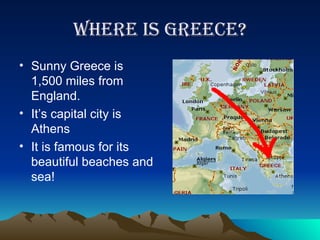
Where is Greece? Sunny Greece is 1,500 miles from England. It’s capital city is Athens It is famous for its beautiful beaches and sea!
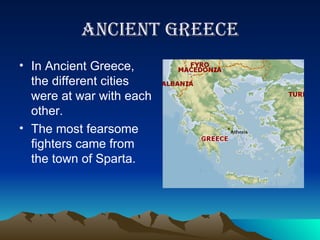
Ancient Greece In Ancient Greece, the different cities were at war with each other.  The most fearsome fighters came from the town of Sparta.
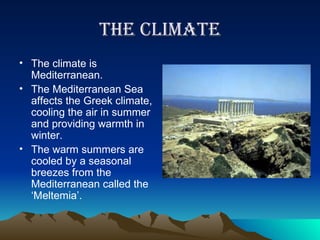
The Climate The climate is Mediterranean. The Mediterranean Sea affects the Greek climate, cooling the air in summer and providing warmth in winter.  The warm summers are cooled by a seasonal breezes from the Mediterranean called the ‘Meltemia’.
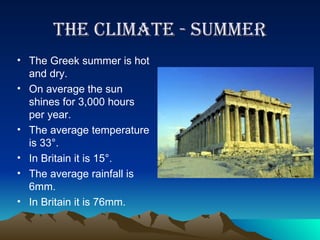
The Climate - Summer The Greek summer is hot and dry. On average the sun shines for 3,000 hours per year. The average temperature is 33 °. In Britain it is 15 °. The average rainfall is 6mm. In Britain it is 76mm.
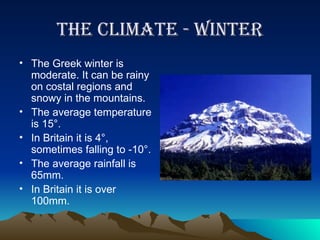
The Climate - winter The Greek winter is moderate. It can be rainy on costal regions and snowy in the mountains. The average temperature is 15 °. In Britain it is 4 °, sometimes falling to -10°. The average rainfall is 65mm. In Britain it is over 100mm.
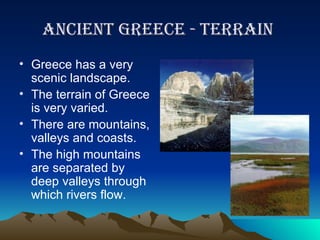
Ancient greece - terrain  Greece has a very scenic landscape.  The terrain of Greece is very varied. There are mountains, valleys and coasts. The high mountains are separated by deep valleys through which rivers flow.
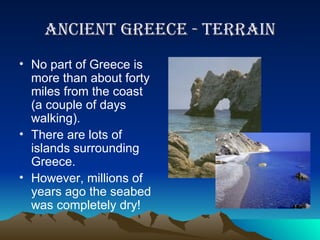
Ancient greece - terrain No part of Greece is more than about forty miles from the coast (a couple of days walking). There are lots of islands surrounding Greece. However, millions of years ago the seabed was completely dry!
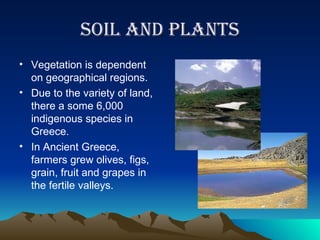
soil and plants Vegetation is dependent on geographical regions. Due to the variety of land, there a some 6,000 indigenous species in Greece. In Ancient Greece, farmers grew olives, figs, grain, fruit and grapes in the fertile valleys.
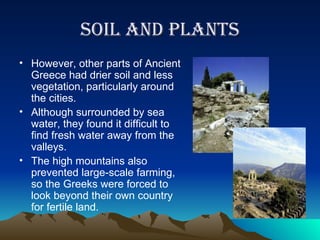
Soil and plants However, other parts of Ancient Greece had drier soil and less vegetation, particularly around the cities.  Although surrounded by sea water, they found it difficult to find fresh water away from the valleys. The high mountains also prevented large-scale farming, so the Greeks were forced to look beyond their own country for fertile land.
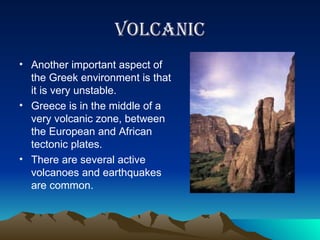
volcanic Another important aspect of the Greek environment is that it is very unstable. Greece is in the middle of a very volcanic zone, between the European and African tectonic plates. There are several active volcanoes and earthquakes are common.
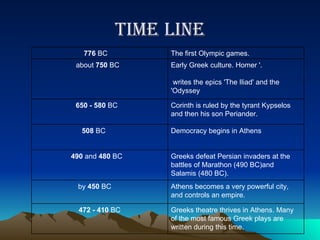
Time   Line    Greeks theatre thrives in Athens. Many of the most famous Greek plays are written during this time.      472 - 410  BC Athens becomes a very powerful city, and controls an empire.    by  450  BC      Greeks defeat Persian invaders at the battles of Marathon (490 BC)and Salamis (480 BC). 490  and  480  BC    Democracy begins in Athens    508  BC       Corinth is ruled by the tyrant Kypselos and then his son Periander.   650 - 580  BC    Early Greek culture. Homer '.  writes the epics 'The Iliad' and the 'Odyssey about  750  BC   The first Olympic games. 776  BC    
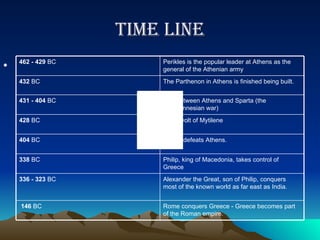
Time line   Alexander the Great, son of Philip, conquers most of the known world as far east as India. 336 - 323  BC    Rome conquers Greece - Greece becomes part of the Roman empire.    146  BC     Philip, king of Macedonia, takes control of Greece  338  BC     Sparta defeats Athens.  404  BC    The revolt of Mytilene       428  BC     War between Athens and Sparta (the Peloponnesian war)  431 - 404  BC       The Parthenon in Athens is finished being built.        432  BC     Perikles is the popular leader at Athens as the general of the Athenian army     462 - 429  BC  

Ancient greece location

  • 1.
    Where is Greece?Sunny Greece is 1,500 miles from England. It’s capital city is Athens It is famous for its beautiful beaches and sea!
  • 2.
    Ancient Greece InAncient Greece, the different cities were at war with each other. The most fearsome fighters came from the town of Sparta.
  • 3.
    The Climate Theclimate is Mediterranean. The Mediterranean Sea affects the Greek climate, cooling the air in summer and providing warmth in winter. The warm summers are cooled by a seasonal breezes from the Mediterranean called the ‘Meltemia’.
  • 4.
    The Climate -Summer The Greek summer is hot and dry. On average the sun shines for 3,000 hours per year. The average temperature is 33 °. In Britain it is 15 °. The average rainfall is 6mm. In Britain it is 76mm.
  • 5.
    The Climate -winter The Greek winter is moderate. It can be rainy on costal regions and snowy in the mountains. The average temperature is 15 °. In Britain it is 4 °, sometimes falling to -10°. The average rainfall is 65mm. In Britain it is over 100mm.
  • 6.
    Ancient greece -terrain Greece has a very scenic landscape. The terrain of Greece is very varied. There are mountains, valleys and coasts. The high mountains are separated by deep valleys through which rivers flow.
  • 7.
    Ancient greece -terrain No part of Greece is more than about forty miles from the coast (a couple of days walking). There are lots of islands surrounding Greece. However, millions of years ago the seabed was completely dry!
  • 8.
    soil and plantsVegetation is dependent on geographical regions. Due to the variety of land, there a some 6,000 indigenous species in Greece. In Ancient Greece, farmers grew olives, figs, grain, fruit and grapes in the fertile valleys.
  • 9.
    Soil and plantsHowever, other parts of Ancient Greece had drier soil and less vegetation, particularly around the cities. Although surrounded by sea water, they found it difficult to find fresh water away from the valleys. The high mountains also prevented large-scale farming, so the Greeks were forced to look beyond their own country for fertile land.
  • 10.
    volcanic Another importantaspect of the Greek environment is that it is very unstable. Greece is in the middle of a very volcanic zone, between the European and African tectonic plates. There are several active volcanoes and earthquakes are common.
  • 11.
    Time Line    Greeks theatre thrives in Athens. Many of the most famous Greek plays are written during this time.      472 - 410 BC Athens becomes a very powerful city, and controls an empire.    by 450 BC      Greeks defeat Persian invaders at the battles of Marathon (490 BC)and Salamis (480 BC). 490 and 480 BC    Democracy begins in Athens    508 BC       Corinth is ruled by the tyrant Kypselos and then his son Periander.   650 - 580 BC    Early Greek culture. Homer '. writes the epics 'The Iliad' and the 'Odyssey about 750 BC   The first Olympic games. 776 BC    
  • 12.
    Time line  Alexander the Great, son of Philip, conquers most of the known world as far east as India. 336 - 323 BC   Rome conquers Greece - Greece becomes part of the Roman empire.   146 BC    Philip, king of Macedonia, takes control of Greece 338 BC    Sparta defeats Athens. 404 BC   The revolt of Mytilene      428 BC    War between Athens and Sparta (the Peloponnesian war) 431 - 404 BC      The Parthenon in Athens is finished being built.      432 BC    Perikles is the popular leader at Athens as the general of the Athenian army    462 - 429 BC