This presentation discusses the effect of changing temperature and pressure on the three states of matter - solids, liquids, and gases. It explains that increasing the temperature of solids increases the kinetic energy of its particles, causing them to vibrate faster and potentially melt into a liquid. For liquids, higher temperatures provide particles with enough energy to break free of attraction forces and transition into a gas. The presentation also defines key terms like temperature, pressure, melting point, boiling point, latent heat of fusion, and latent heat of vaporization.
Effect of Changeof Temp. and Pressure on States of Matter By Parth Khatter Best Seller
3.
Morning students. Todaywe will learn about the 'Effect of Change of Temp. and Pressure on States of Matter. '
4.
Students, you knowthat states of matter can be changed by changing Temp. and Pressure.
5.
Temperature is aphysical property of matter that quantitatively expresses the common notions of hot and cold. Objects of low temperature are cold, while various degrees of higher temperatures are referred to as warm or hot. Quantitatively, temperature is measured with thermometers, which may be calibrated to a variety of temperature scales. The common used uits of temp. are the followig: Celcius Kelvin fahrenheit What is Temperature?
6.
Effect of Changeof Temp. on Solids On incresing the temp. of solids, the kinetic energy of particles increses.Due to the increse in kinetic energy, the particles start vibrating with greater speed.the energy supplied by heat overcomes the forces of attraction between the particles. The particles leave their fixed position and start moving more freely. A stage is reached when the solid melts and is converted to a liquid .
7.
Effect of Changeof Temp. on Liquids When we supply heat energy to water, particles start moving even faster. At a certain temperature a point is reached when the particles have enough energy to break free from the forces of attraction of each other. At this temp. the liquid starts changing into gas and finally gets converted int gas .
8.
Effect of Changeof Temp. On Gases When we supply heat energy to gases the kinetic energy of particles increases and the particle motion increases and the particles move with a greater speed.
9.
Pressure is aneffect which occurs when a force is applied on a surface. Pressure is the amount of force acting on a unit area. The symbol of pressure is P. What is Pressure?
10.
Effect of Changeof Pressure on Gases On increasing the pressure on gases, the particles come closer to eachother.
Melting point-The temp.at which a solid melts to become a liquid at the atmospheric pressure is called meltiong point . Boiling point-The temp. at which a liquid starts boiling at the atmospheric pressure is called boiling point. Some useful definations
14.
Latent heat offusion-The amount of heat required to convert one kg of a solid into liquid at atmospheric pressure at its melting point is called latent heat of fusion . Latent heat of vaporisation-The amount of heat required to convert one kg of liquid into gas at atmospheric pressure at its boiling point is called latent heat of vaporisation.
15.
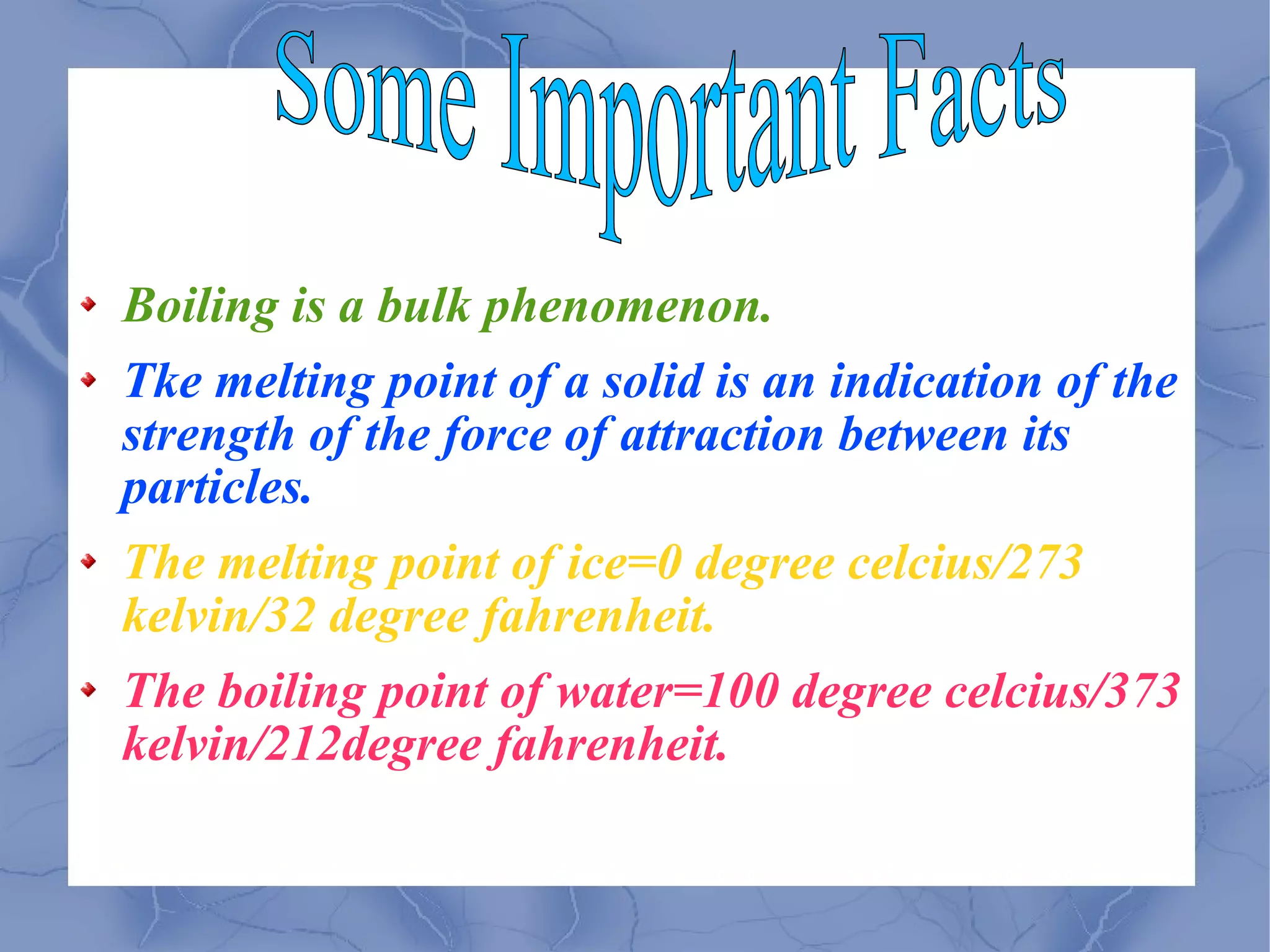
Boiling is abulk phenomenon. Tke melting point of a solid is an indication of the strength of the force of attraction between its particles. The melting point of ice=0 degree celcius/273 kelvin/32 degree fahrenheit. The boiling point of water=100 degree celcius/373 kelvin/212degree fahrenheit. Some Important Facts
16.
Students,now I hopethat you have Understood the effect of change of temp. and pressure on states of matter