Presentation
on
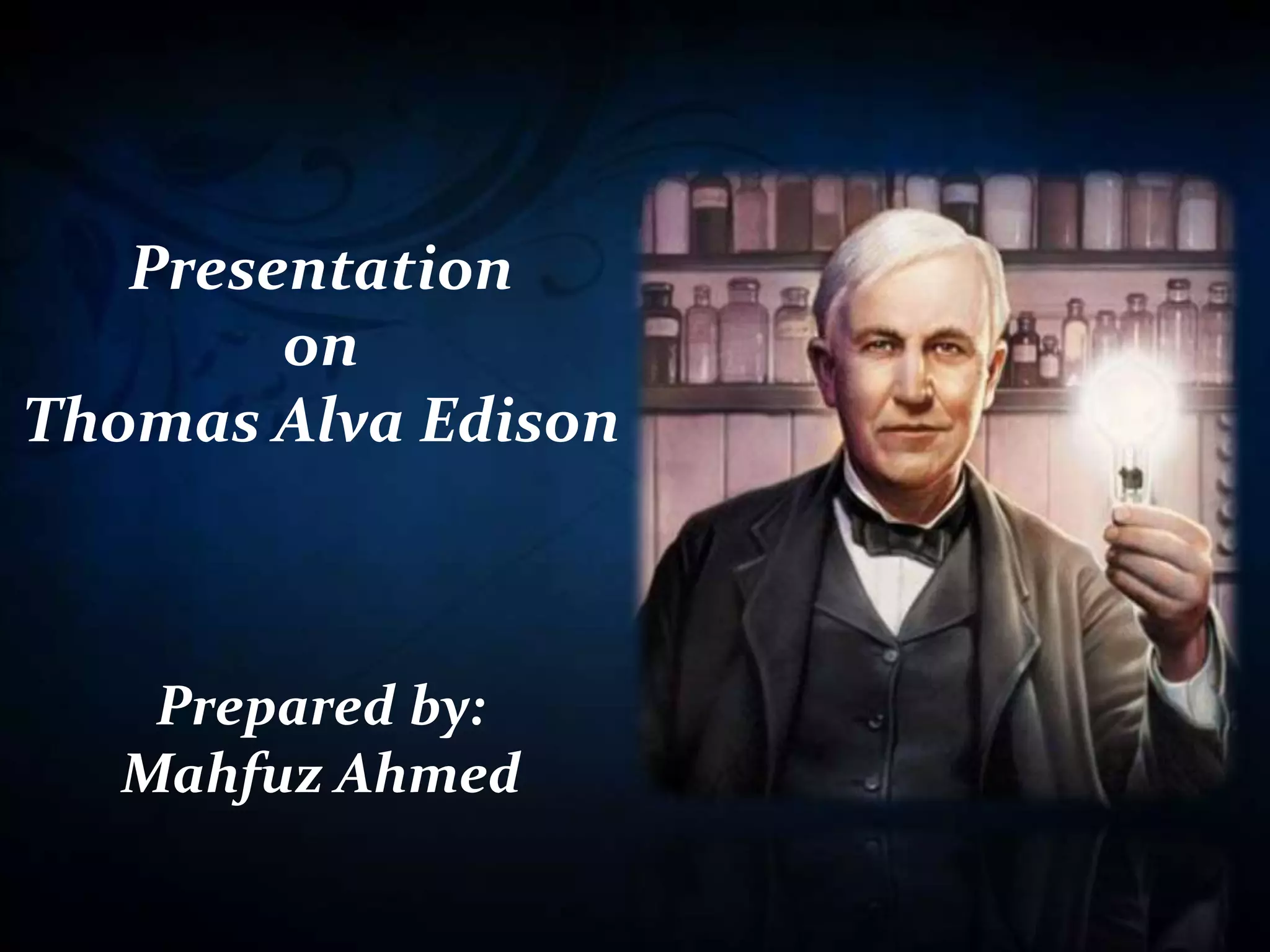
Thomas Alva Edison
Prepared by:
Mahfuz Ahmed
Key points to be discussed
 Who was Thomas Alva Edison?
 Early Life of Edison.
 Edison’s emergence as a leading inventor.
 Edison’s innovations with Electric Light
 Edison’s struggles
 Edison as an entrepreneur.
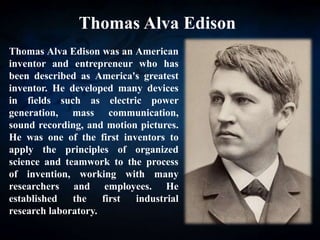
Thomas Alva Edison
Thomas Alva Edison was an American
inventor and entrepreneur who has
been described as America's greatest
inventor. He developed many devices
in fields such as electric power
generation, mass communication,
sound recording, and motion pictures.
He was one of the first inventors to
apply the principles of organized
science and teamwork to the process
of invention, working with many
researchers and employees. He
established the first industrial
research laboratory.
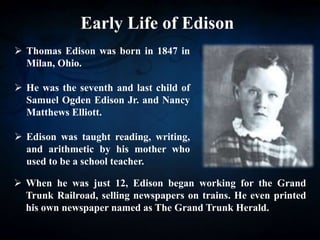
 Thomas Edison was born in 1847 in
Milan, Ohio.
 He was the seventh and last child of
Samuel Ogden Edison Jr. and Nancy
Matthews Elliott.
 Edison was taught reading, writing,
and arithmetic by his mother who
used to be a school teacher.
Early Life of Edison
 When he was just 12, Edison began working for the Grand
Trunk Railroad, selling newspapers on trains. He even printed
his own newspaper named as The Grand Trunk Herald.
Emergence as a Leading Inventor
 From 1870 to 1875, Edison worked at
New Jersey, where he developed
telegraph-related products for both
Western Union Telegraph Company
and its rivals.
 In 1876, His major innovation was the
establishment of an famous industrial research lab which was
named as Menlo Park Laboratory.
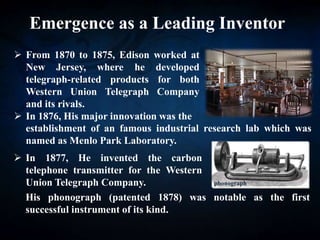
phonograph
 In 1877, He invented the carbon
telephone transmitter for the Western
Union Telegraph Company.
His phonograph (patented 1878) was notable as the first
successful instrument of its kind.
Innovations with Electric Light
 In 1878, Edison set up the Edison Electric
Light Company and began research and
development.
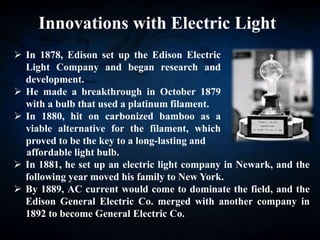
 He made a breakthrough in October 1879
with a bulb that used a platinum filament.
 In 1880, hit on carbonized bamboo as a
viable alternative for the filament, which
proved to be the key to a long-lasting and
affordable light bulb.
 In 1881, he set up an electric light company in Newark, and the
following year moved his family to New York.
 By 1889, AC current would come to dominate the field, and the
Edison General Electric Co. merged with another company in
1892 to become General Electric Co.
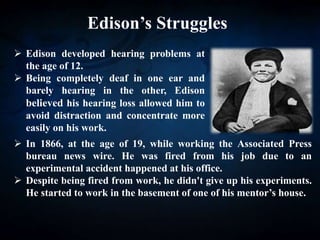
 Edison developed hearing problems at
the age of 12.
 Being completely deaf in one ear and
barely hearing in the other, Edison
believed his hearing loss allowed him to
avoid distraction and concentrate more
easily on his work.
 In 1866, at the age of 19, while working the Associated Press
bureau news wire. He was fired from his job due to an
experimental accident happened at his office.
 Despite being fired from work, he didn't give up his experiments.
He started to work in the basement of one of his mentor’s house.
Edison’s Struggles
Edison as an Entrepreneur
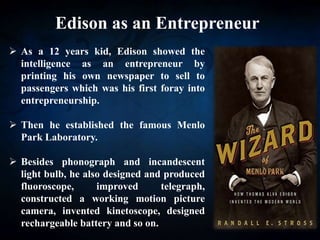
 As a 12 years kid, Edison showed the
intelligence as an entrepreneur by
printing his own newspaper to sell to
passengers which was his first foray into
entrepreneurship.
 Then he established the famous Menlo
Park Laboratory.
 Besides phonograph and incandescent
light bulb, he also designed and produced
fluoroscope, improved telegraph,
constructed a working motion picture
camera, invented kinetoscope, designed
rechargeable battery and so on.
Conclusion
In 1931, Edison succumbed to complications from diabetes. He was
survived by his second wife and their three children, as well as his
three children by his first wife. By the time he died on October 18,
1931, Edison had amassed a record 1,093 US patents in his name, as
well as patents in other countries.
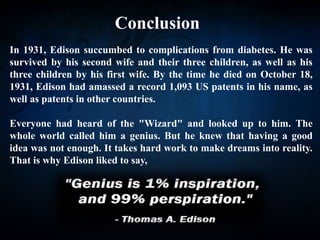
Everyone had heard of the "Wizard" and looked up to him. The
whole world called him a genius. But he knew that having a good
idea was not enough. It takes hard work to make dreams into reality.
That is why Edison liked to say,
Thomas Alva Edison

Thomas Alva Edison

  • 1.
  • 2.
    Key points tobe discussed  Who was Thomas Alva Edison?  Early Life of Edison.  Edison’s emergence as a leading inventor.  Edison’s innovations with Electric Light  Edison’s struggles  Edison as an entrepreneur.
  • 3.
    Thomas Alva Edison ThomasAlva Edison was an American inventor and entrepreneur who has been described as America's greatest inventor. He developed many devices in fields such as electric power generation, mass communication, sound recording, and motion pictures. He was one of the first inventors to apply the principles of organized science and teamwork to the process of invention, working with many researchers and employees. He established the first industrial research laboratory.
  • 4.
     Thomas Edisonwas born in 1847 in Milan, Ohio.  He was the seventh and last child of Samuel Ogden Edison Jr. and Nancy Matthews Elliott.  Edison was taught reading, writing, and arithmetic by his mother who used to be a school teacher. Early Life of Edison  When he was just 12, Edison began working for the Grand Trunk Railroad, selling newspapers on trains. He even printed his own newspaper named as The Grand Trunk Herald.
  • 5.
    Emergence as aLeading Inventor  From 1870 to 1875, Edison worked at New Jersey, where he developed telegraph-related products for both Western Union Telegraph Company and its rivals.  In 1876, His major innovation was the establishment of an famous industrial research lab which was named as Menlo Park Laboratory. phonograph  In 1877, He invented the carbon telephone transmitter for the Western Union Telegraph Company. His phonograph (patented 1878) was notable as the first successful instrument of its kind.
  • 6.
    Innovations with ElectricLight  In 1878, Edison set up the Edison Electric Light Company and began research and development.  He made a breakthrough in October 1879 with a bulb that used a platinum filament.  In 1880, hit on carbonized bamboo as a viable alternative for the filament, which proved to be the key to a long-lasting and affordable light bulb.  In 1881, he set up an electric light company in Newark, and the following year moved his family to New York.  By 1889, AC current would come to dominate the field, and the Edison General Electric Co. merged with another company in 1892 to become General Electric Co.
  • 7.
     Edison developedhearing problems at the age of 12.  Being completely deaf in one ear and barely hearing in the other, Edison believed his hearing loss allowed him to avoid distraction and concentrate more easily on his work.  In 1866, at the age of 19, while working the Associated Press bureau news wire. He was fired from his job due to an experimental accident happened at his office.  Despite being fired from work, he didn't give up his experiments. He started to work in the basement of one of his mentor’s house. Edison’s Struggles
  • 8.
    Edison as anEntrepreneur  As a 12 years kid, Edison showed the intelligence as an entrepreneur by printing his own newspaper to sell to passengers which was his first foray into entrepreneurship.  Then he established the famous Menlo Park Laboratory.  Besides phonograph and incandescent light bulb, he also designed and produced fluoroscope, improved telegraph, constructed a working motion picture camera, invented kinetoscope, designed rechargeable battery and so on.
  • 9.
    Conclusion In 1931, Edisonsuccumbed to complications from diabetes. He was survived by his second wife and their three children, as well as his three children by his first wife. By the time he died on October 18, 1931, Edison had amassed a record 1,093 US patents in his name, as well as patents in other countries. Everyone had heard of the "Wizard" and looked up to him. The whole world called him a genius. But he knew that having a good idea was not enough. It takes hard work to make dreams into reality. That is why Edison liked to say,