Ac#onable	
  vs.	
  Emancipatory	
  	
  
  Game	
  (Design)	
  Research	
  

  Capturing	
  Game	
  Design:	
  
    Who	
  Should	
  Care?	
  
                                        Aki	
  Järvinen	
  
                   Lead	
  Social	
  Designer,	
  Ph.D.	
  
                                      May	
  31,	
  2010	
  
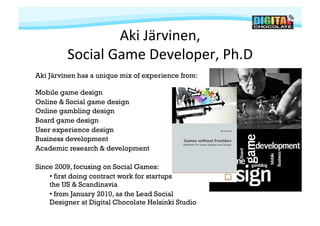
Aki	
  Järvinen,	
  	
  
          Social	
  Game	
  Developer,	
  Ph.D	
  
Aki Järvinen has a unique mix of experience from:

Mobile game design
Online & Social game design
Online gambling design
Board game design
User experience design
Business development
Academic research & development

Since 2009, focusing on Social Games:
    •  first doing contract work for startups both in
    the US & Scandinavia
    •  from January 2010, as the Lead Social
    Designer at Digital Chocolate Helsinki Studio
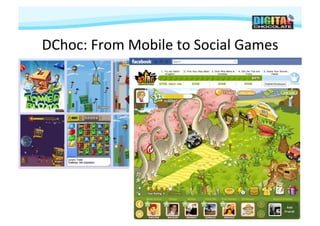
DChoc:	
  From	
  Mobile	
  to	
  Social	
  Games
                                                	
  
The	
  Problem	
  

and	
  puPng	
  it	
  into	
  context
                                    	
  
Goals	
  of	
  the	
  talk	
  
•  The	
  talk	
  discusses	
  the	
  different	
  interests	
  for	
  knowledge	
  
   between	
  those	
  researching	
  game	
  design,	
  those	
  prac#cing	
  it,	
  
   and	
  those	
  doing	
  both.	
  	
  
•  What	
  are	
  the	
  key	
  pragma#c	
  aspects	
  of	
  game	
  design	
  in	
  a	
  
   commercial	
  context	
  that	
  o/en	
  make	
  it	
  theory-­‐aversive?	
  	
  
•  Can	
  game	
  design	
  ac#vity	
  be	
  captured	
  for	
  research	
  purposes,	
  
   and	
  more	
  importantly	
  what	
  domains	
  of	
  knowledge	
  would	
  
   that	
  serve?	
  	
  
•  What	
  is	
  the	
  role	
  of	
  design	
  management	
  in	
  this?	
  	
  
•  The	
  talks	
  aims	
  at	
  giving	
  researchers	
  sensi#vity	
  towards	
  the	
  
   challenges	
  game	
  designers	
  face	
  daily,	
  and	
  places	
  game	
  
   design	
  prac#ces	
  into	
  the	
  contexts	
  of	
  design	
  management.	
  
Problem	
  formula#on	
  
•  How	
  can	
  game	
  studies/research	
  produce	
  results	
  that           	
  
   are	
  ac9onable	
  for	
  game	
  design,	
  and	
  who	
  are	
  the	
  
   stakeholders	
  in	
  this?	
  
•  Caveat:	
  Not	
  all	
  game-­‐related	
  research	
  needs	
  to	
  
   contribute	
  to	
  prac#cal	
  game	
  design	
  –	
  but	
  be	
  honest	
  
   about	
  it!	
  
•  Yet:	
  Ac#onable	
  results	
  best	
  emerge	
  from	
  the	
  
   prac#cal	
  experience	
  of	
  design	
  within	
  marketplace	
  
   and	
  management	
  constraints;	
  when	
  academic	
  
   problem	
  formula#on	
  combines	
  with	
  the	
  tacit	
  
   knowledge	
  of	
  game	
  design	
  prac#ces	
  	
  
Contextualiza#on	
  of	
  the	
  problem	
  
•  Jürgen	
  Habermas:	
  Knowledge	
  Cons#tu#ve	
  
   Interests	
  

•  ’Habermas'	
  basic	
  claim	
  is	
  that	
  different	
  forms	
  
   of	
  knowledge	
  with	
  different	
  object	
  domains	
  
   and	
  standards	
  of	
  validity	
  are	
  cons#tuted	
  by	
  
   different	
  interests	
  that	
  are	
  founded	
  in	
  dis#nct	
  
   forms	
  of	
  human	
  ac9vity.’	
  	
  
Design	
  &	
  Research	
  

                      Clarifica#on:	
     	
  
 I	
  do	
  not	
  believe	
  that	
  only	
  u#litarian	
  
research	
  is	
  useful;	
  I	
  do	
  believe	
  in	
  the	
  
          tradi#onal	
  role	
  of	
  academia      	
  
Design	
  
•  ‘Every	
  problem	
  posed	
  to	
  a	
  designer	
  demands	
  
   that	
  the	
  constraints	
  of	
  technology,	
  
   ergonomics,	
  produc#on,	
  and	
  the	
  marketplace	
  
   be	
  factored	
  in	
  and	
  a	
  balance	
  be	
  achieved.’	
  
•  ‘Design	
  [...]	
  is	
  a	
  process	
  of	
  crea#on	
  and	
  
   decision	
  making.’	
  	
  
•  Design	
  and	
  corporate	
  strategy:	
  Design	
  is	
  a	
  tool	
  
   for	
  making	
  strategy	
  visible	
  
                     (Borja	
  de	
  Mozota:	
  Design	
  Management,	
  2004)
                                                                             	
  
Design	
  management
                                     	
  
•  ‘Design	
  management	
  is	
  the	
  planned	
  implementa#on	
  
   of	
  design	
  in	
  a	
  company	
  to	
  help	
  the	
  company	
  achieve	
  
   its	
  objec#ves.’	
  (ibid.)	
  
•  Academically	
  studied	
  by,	
  e.g.,	
  Brigije	
  Borja	
  de	
  
   Mozota	
  in	
  Paris	
  
•  Why	
  is	
  this	
  important?	
  
    –  because	
  the	
  game	
  designer	
  reports	
  to	
  whomever	
  is	
  
       responsible	
  for	
  design/studio	
  management	
  
    –  thus	
  the	
  knowledge	
  gained	
  from,	
  e.g.	
  research,	
  is	
  subject	
  
       to	
  evalua#on	
  in	
  an	
  organiza#onal	
  structure	
  
Design	
  as	
  Process:	
  The	
  4	
  Cs
                                                   	
  
•    Crea.vity	
  
•    Complexity	
  
•    Compromise	
  
•    Choice	
  
•    =	
  Design	
  is	
  both	
  a	
  crea#ve	
  and	
  a	
  management	
  
     process	
  

•  Which	
  of	
  these	
  does	
  your	
  research	
  address?	
  
Design	
  Research	
  
•  Three	
  possible	
  dimensions:	
  
    –  Research	
  for	
  design	
  
    –  Research	
  into	
  design	
  
    –  Research	
  as	
  design	


                             (Lunenfeld	
  in	
  Laurel	
  [ed.]	
  Design	
  Research,	
  2004)


•  Q:	
  In	
  your	
  work,	
  do	
  you	
  explicitly	
  iden#fy	
  your	
  
   work	
  belonging	
  into	
  one	
  or	
  more	
  of	
  these	
  
   dimensions?	
  
Who	
  are	
  the	
  actors	
  in	
  GDR?	
  
•  ‘designer	
  is	
  an	
  entrepreneur,	
  an	
  authority	
  in	
  
   aesthe#cs,	
  and	
  an	
  ini#ator	
  of	
  change	
  in	
  the	
  
   society’	
  
•  players	
  –	
  the	
  ones	
  who	
  want	
  to	
  have	
  fun	
  
•  researchers	
  –	
  those	
  who	
  try	
  to	
  observe	
  and	
  
   understand,	
  from	
  various	
  perspec#ves?	
  
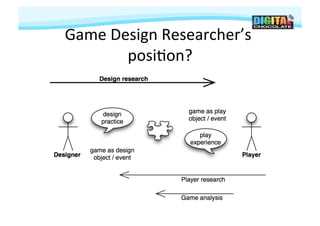
Game	
  Design	
  Researcher’s	
  
          posi#on?   	
  
How	
  to	
  be	
  cuPng	
  edge?	
  
•  E.g.	
  with	
  the	
  metrics-­‐driven	
  development	
  in	
  
   the	
  social	
  games	
  industry,	
  it	
  is	
  very	
  difficult	
  to	
  
   do	
  academic	
  research	
  (outside	
  technology)	
  
   that	
  is	
  cuPng	
  edge	
  
•  -­‐	
  from	
  afar!	
  

•  Poten#al	
  of	
  methods	
  such	
  as	
  Ac#on	
  research	
  
   and	
  Ethnography	
  
Gallup	
  part	
  1	
  
•  Q:	
  How	
  many	
  of	
  you	
  do	
  research	
  with	
  the	
  
   inten#on/belief	
  that	
  it	
  can	
  contribute	
  to/
   inform	
  game	
  design	
  in	
  prac#ce?	
  
Gallup	
  part	
  2	
  
•  Q:	
  How	
  many	
  of	
  you	
  do	
  research	
  with	
  the	
  
   inten#on/belief	
  that	
  it	
  can	
  contribute	
  to/
   inform	
  commercial	
  game	
  design	
  in	
  prac#ce?	
  
Ac#onable	
  or	
  Emancipatory?	
  

 Ask	
  this	
  of	
  your	
  research;	
  which	
  kind	
  
        of	
  knowledge	
  is	
  it	
  targe#ng?   	
  
The	
  Ques#on	
  of	
  Ac#onable	
  
•  How	
  to	
  surpass	
  the	
  insufficient	
  ‘theory	
  vs.	
  prac#ce’	
  
   dis#nc#on?	
  	
  
•  How	
  about:	
  research	
  that	
  either	
  creates	
  ac#onable	
  vs.	
  
   ‘non-­‐ac#onable’	
  results?	
  
    –  Ac#onable	
  implies	
  immediacy,	
  applica#on	
  
    –  Non-­‐ac#onable	
  implies	
  reflec#on,	
  emancipa#on	
  
•  Yet	
  ‘non’	
  is	
  a	
  nega#on	
  with	
  connota#ons	
  
•  Therefore	
  let’s	
  call	
  it	
  Emancipatory:	
  	
  
    –  Emancipa.on:	
  ‘set	
  free,	
  esp.	
  from	
  legal,	
  social,	
  or	
  poli.cal	
  
       restric.ons’	
  
Habermas’	
  categories	
  [reference	
  (.doc)]


                                      Academic	
  Game	
  	
  
                                          Research	
  
                       Commercial	
  	
  
                       Game	
  Design	
  
Emancipatory	
  research	
  results	
  tend	
  to	
  be:


•  Descrip9ve	
  –	
  rather	
  than	
  prescrip#ve	
  –	
  in	
  tone	
  
•  ‘Packaged’	
  into	
  academic	
  discourse	
  
•  Non-­‐specific	
  in	
  terms	
  of	
  demographics	
  
•  Or,	
  too	
  specific	
  to	
  the	
  point	
  of	
  being	
  marginal	
  
•  At	
  best	
  inspira9onal	
  for	
  ac#onable	
  purposes,	
  yet	
  may	
  
   demand	
  an	
  extra	
  layer	
  of	
  interpreta9on	
  (i.e.	
  a	
  specific	
  
   skillset)	
  in	
  order	
  to	
  be	
  ac#onable	
  
•  Example:	
  ‘Game	
  layers	
  of	
  DJ	
  Hero‘	
  -­‐	
  Games	
  as	
  Services	
  
   project,	
  University	
  of	
  Tampere,	
  Finland
   hjp://futureplayproject.wordpress.com/resources/	
  
Ac#onable	
  results	
  tend	
  to	
  be:
                                               	
  
•  such	
  that	
  relate	
  explicitly	
  to	
  a	
  specific	
  design	
  domain	
  &	
  
   problem	
  –	
  note	
  the	
  parallel	
  to	
  crea9vity	
  oren	
  being	
  domain-­‐
   specific	
  
•  prescrip9ve	
  
•  tangible	
  –	
  repackaged	
  for	
  the	
  design	
  stakeholders	
  
•  such	
  that	
  discuss	
  consequences	
  for	
  exis#ng	
  business/
   educa#on/development	
  models	
  or	
  methods	
  
•  pragma9c:	
  Something	
  you	
  can	
  sell	
  to	
  your	
  boss	
  in	
  commercial	
  
   contexts	
  
•  Example:	
  Gamespace	
  project	
  -­‐	
  
   hjp://gamelab.uta.fi/gamespacetool/	
  
Conclusions
                                     	
  
•  Claim:	
  Any	
  research	
  that	
  does	
  not	
  aim	
  at	
  ac#onable	
  
   results	
  cannot	
  call	
  itself	
  ‘design	
  research’	
  or	
  anything	
  
   ‘design’	
  for	
  that	
  majer	
  –	
  even	
  ‘design	
  theory’	
  
   implies	
  prac#ce!	
  
•  If	
  your	
  goal	
  is	
  to	
  produce	
  emancipatory	
  knowledge,	
  
   just	
  call	
  your	
  work	
  game	
  studies	
  or	
  game	
  research!	
  
•  Whichever	
  road	
  you	
  choose,	
  in	
  the	
  process	
  you	
  will	
  
   come	
  to	
  define	
  your	
  primary	
  audience	
  
•  ...and	
  it	
  is	
  them	
  who	
  should	
  care.	
  
Thank	
  you.


 http://www.facebook.com/socialgamesbook


     Emancipatory	
  contact:
                            	
             Ac#onable	
  contact:


  aki@gameswithoutron#ers.net
                              	
     ajarvinen@digitalchocolate.com	
  

Actionable vs. Emancipatory Game Design Research

  • 1.
    Ac#onable  vs.  Emancipatory     Game  (Design)  Research   Capturing  Game  Design:   Who  Should  Care?   Aki  Järvinen   Lead  Social  Designer,  Ph.D.   May  31,  2010  
  • 2.
    Aki  Järvinen,     Social  Game  Developer,  Ph.D   Aki Järvinen has a unique mix of experience from: Mobile game design Online & Social game design Online gambling design Board game design User experience design Business development Academic research & development Since 2009, focusing on Social Games: •  first doing contract work for startups both in the US & Scandinavia •  from January 2010, as the Lead Social Designer at Digital Chocolate Helsinki Studio
  • 3.
    DChoc:  From  Mobile  to  Social  Games  
  • 5.
    The  Problem   and  puPng  it  into  context  
  • 6.
    Goals  of  the  talk   •  The  talk  discusses  the  different  interests  for  knowledge   between  those  researching  game  design,  those  prac#cing  it,   and  those  doing  both.     •  What  are  the  key  pragma#c  aspects  of  game  design  in  a   commercial  context  that  o/en  make  it  theory-­‐aversive?     •  Can  game  design  ac#vity  be  captured  for  research  purposes,   and  more  importantly  what  domains  of  knowledge  would   that  serve?     •  What  is  the  role  of  design  management  in  this?     •  The  talks  aims  at  giving  researchers  sensi#vity  towards  the   challenges  game  designers  face  daily,  and  places  game   design  prac#ces  into  the  contexts  of  design  management.  
  • 7.
    Problem  formula#on   • How  can  game  studies/research  produce  results  that   are  ac9onable  for  game  design,  and  who  are  the   stakeholders  in  this?   •  Caveat:  Not  all  game-­‐related  research  needs  to   contribute  to  prac#cal  game  design  –  but  be  honest   about  it!   •  Yet:  Ac#onable  results  best  emerge  from  the   prac#cal  experience  of  design  within  marketplace   and  management  constraints;  when  academic   problem  formula#on  combines  with  the  tacit   knowledge  of  game  design  prac#ces    
  • 8.
    Contextualiza#on  of  the  problem   •  Jürgen  Habermas:  Knowledge  Cons#tu#ve   Interests   •  ’Habermas'  basic  claim  is  that  different  forms   of  knowledge  with  different  object  domains   and  standards  of  validity  are  cons#tuted  by   different  interests  that  are  founded  in  dis#nct   forms  of  human  ac9vity.’    
  • 9.
    Design  &  Research   Clarifica#on:     I  do  not  believe  that  only  u#litarian   research  is  useful;  I  do  believe  in  the   tradi#onal  role  of  academia  
  • 10.
    Design   •  ‘Every  problem  posed  to  a  designer  demands   that  the  constraints  of  technology,   ergonomics,  produc#on,  and  the  marketplace   be  factored  in  and  a  balance  be  achieved.’   •  ‘Design  [...]  is  a  process  of  crea#on  and   decision  making.’     •  Design  and  corporate  strategy:  Design  is  a  tool   for  making  strategy  visible   (Borja  de  Mozota:  Design  Management,  2004)  
  • 11.
    Design  management   •  ‘Design  management  is  the  planned  implementa#on   of  design  in  a  company  to  help  the  company  achieve   its  objec#ves.’  (ibid.)   •  Academically  studied  by,  e.g.,  Brigije  Borja  de   Mozota  in  Paris   •  Why  is  this  important?   –  because  the  game  designer  reports  to  whomever  is   responsible  for  design/studio  management   –  thus  the  knowledge  gained  from,  e.g.  research,  is  subject   to  evalua#on  in  an  organiza#onal  structure  
  • 12.
    Design  as  Process:  The  4  Cs   •  Crea.vity   •  Complexity   •  Compromise   •  Choice   •  =  Design  is  both  a  crea#ve  and  a  management   process   •  Which  of  these  does  your  research  address?  
  • 13.
    Design  Research   • Three  possible  dimensions:   –  Research  for  design   –  Research  into  design   –  Research  as  design     (Lunenfeld  in  Laurel  [ed.]  Design  Research,  2004) •  Q:  In  your  work,  do  you  explicitly  iden#fy  your   work  belonging  into  one  or  more  of  these   dimensions?  
  • 14.
    Who  are  the  actors  in  GDR?   •  ‘designer  is  an  entrepreneur,  an  authority  in   aesthe#cs,  and  an  ini#ator  of  change  in  the   society’   •  players  –  the  ones  who  want  to  have  fun   •  researchers  –  those  who  try  to  observe  and   understand,  from  various  perspec#ves?  
  • 15.
  • 16.
    How  to  be  cuPng  edge?   •  E.g.  with  the  metrics-­‐driven  development  in   the  social  games  industry,  it  is  very  difficult  to   do  academic  research  (outside  technology)   that  is  cuPng  edge   •  -­‐  from  afar!   •  Poten#al  of  methods  such  as  Ac#on  research   and  Ethnography  
  • 17.
    Gallup  part  1   •  Q:  How  many  of  you  do  research  with  the   inten#on/belief  that  it  can  contribute  to/ inform  game  design  in  prac#ce?  
  • 18.
    Gallup  part  2   •  Q:  How  many  of  you  do  research  with  the   inten#on/belief  that  it  can  contribute  to/ inform  commercial  game  design  in  prac#ce?  
  • 19.
    Ac#onable  or  Emancipatory?   Ask  this  of  your  research;  which  kind   of  knowledge  is  it  targe#ng?  
  • 20.
    The  Ques#on  of  Ac#onable   •  How  to  surpass  the  insufficient  ‘theory  vs.  prac#ce’   dis#nc#on?     •  How  about:  research  that  either  creates  ac#onable  vs.   ‘non-­‐ac#onable’  results?   –  Ac#onable  implies  immediacy,  applica#on   –  Non-­‐ac#onable  implies  reflec#on,  emancipa#on   •  Yet  ‘non’  is  a  nega#on  with  connota#ons   •  Therefore  let’s  call  it  Emancipatory:     –  Emancipa.on:  ‘set  free,  esp.  from  legal,  social,  or  poli.cal   restric.ons’  
  • 21.
    Habermas’  categories  [reference  (.doc)]   Academic  Game     Research   Commercial     Game  Design  
  • 22.
    Emancipatory  research  results  tend  to  be:   •  Descrip9ve  –  rather  than  prescrip#ve  –  in  tone   •  ‘Packaged’  into  academic  discourse   •  Non-­‐specific  in  terms  of  demographics   •  Or,  too  specific  to  the  point  of  being  marginal   •  At  best  inspira9onal  for  ac#onable  purposes,  yet  may   demand  an  extra  layer  of  interpreta9on  (i.e.  a  specific   skillset)  in  order  to  be  ac#onable   •  Example:  ‘Game  layers  of  DJ  Hero‘  -­‐  Games  as  Services   project,  University  of  Tampere,  Finland hjp://futureplayproject.wordpress.com/resources/  
  • 23.
    Ac#onable  results  tend  to  be:   •  such  that  relate  explicitly  to  a  specific  design  domain  &   problem  –  note  the  parallel  to  crea9vity  oren  being  domain-­‐ specific   •  prescrip9ve   •  tangible  –  repackaged  for  the  design  stakeholders   •  such  that  discuss  consequences  for  exis#ng  business/ educa#on/development  models  or  methods   •  pragma9c:  Something  you  can  sell  to  your  boss  in  commercial   contexts   •  Example:  Gamespace  project  -­‐   hjp://gamelab.uta.fi/gamespacetool/  
  • 24.
    Conclusions   •  Claim:  Any  research  that  does  not  aim  at  ac#onable   results  cannot  call  itself  ‘design  research’  or  anything   ‘design’  for  that  majer  –  even  ‘design  theory’   implies  prac#ce!   •  If  your  goal  is  to  produce  emancipatory  knowledge,   just  call  your  work  game  studies  or  game  research!   •  Whichever  road  you  choose,  in  the  process  you  will   come  to  define  your  primary  audience   •  ...and  it  is  them  who  should  care.  
  • 25.
    Thank  you.   http://www.facebook.com/socialgamesbook Emancipatory  contact:   Ac#onable  contact:    aki@gameswithoutron#ers.net   ajarvinen@digitalchocolate.com