TODAY’S AGENDA
BASICS OF DESIGN THINKING
CLASS 02
What is Design?
01.
DESIGN의 정의에 들어갈만한
세 개의 단어(키워드)를 한번 적어보세요.
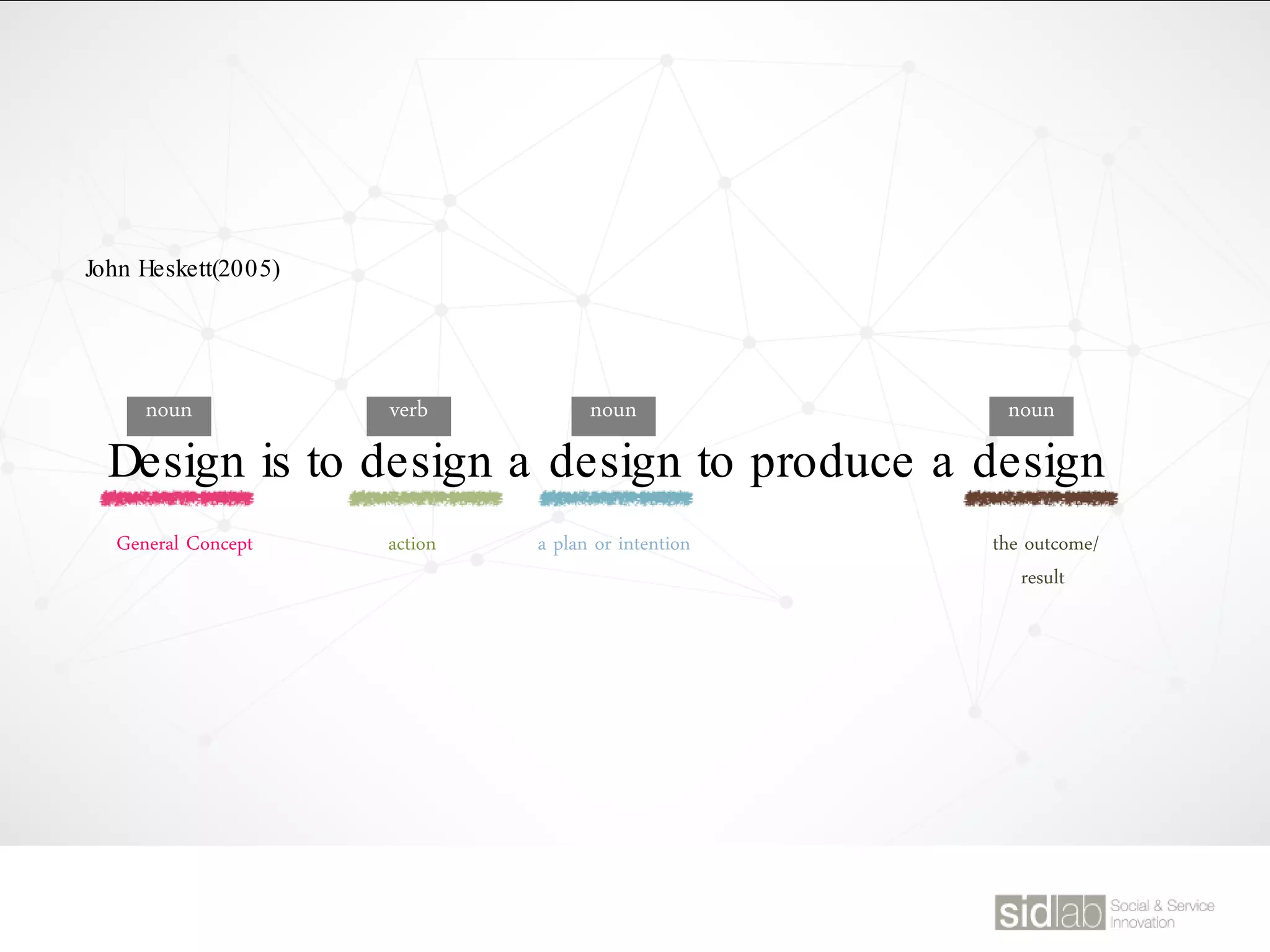
Design is to design a design to produce a design
General Concept action a plan or intention the outcome/
result
noun verb noun noun
John Heskett(2005)
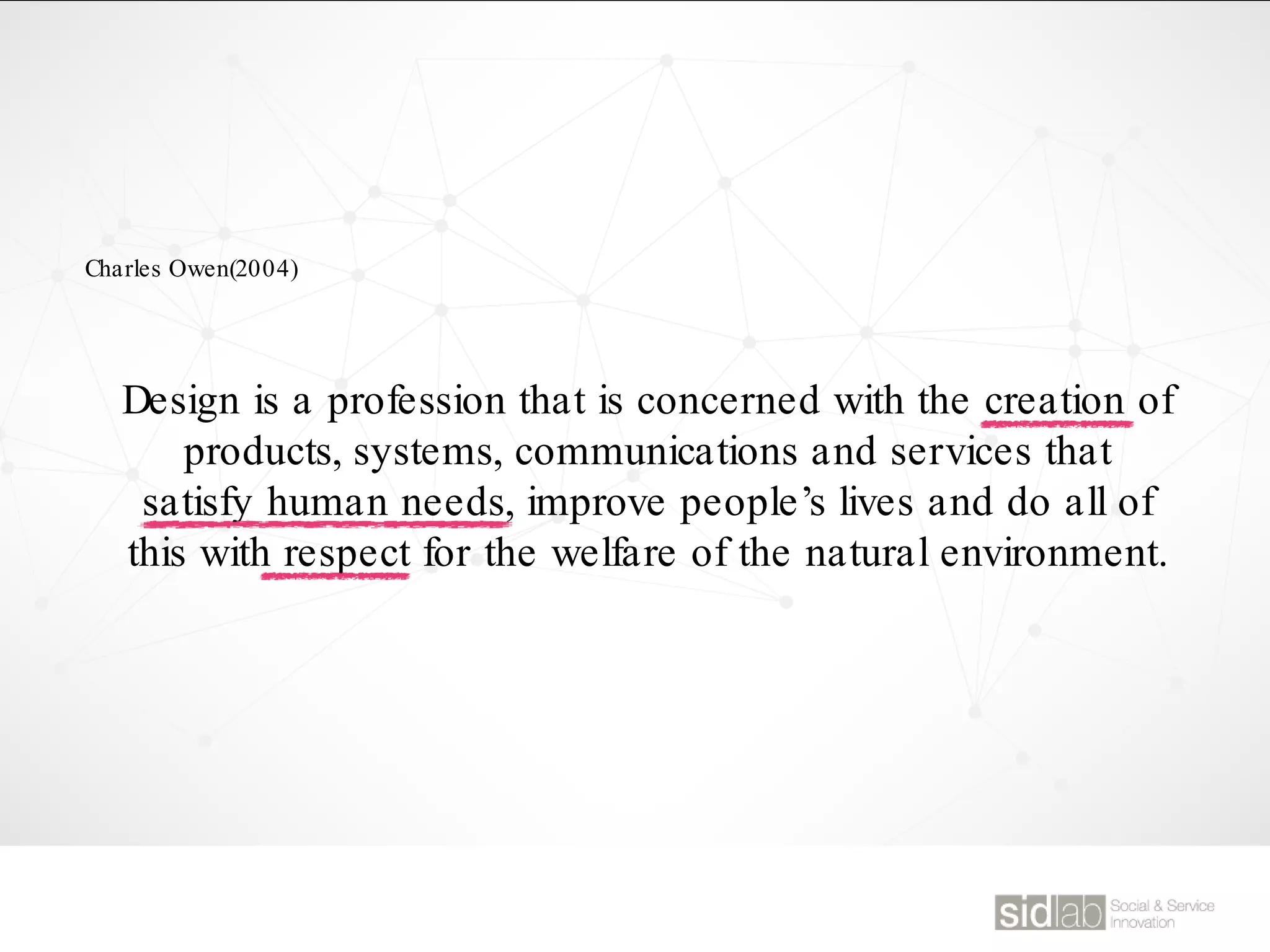
Design is a profession that is concerned with the creation of
products, systems, communications and services that
satisfy human needs, improve people’s lives and do all of
this with respect for the welfare of the natural environment.
Charles Owen(2004)
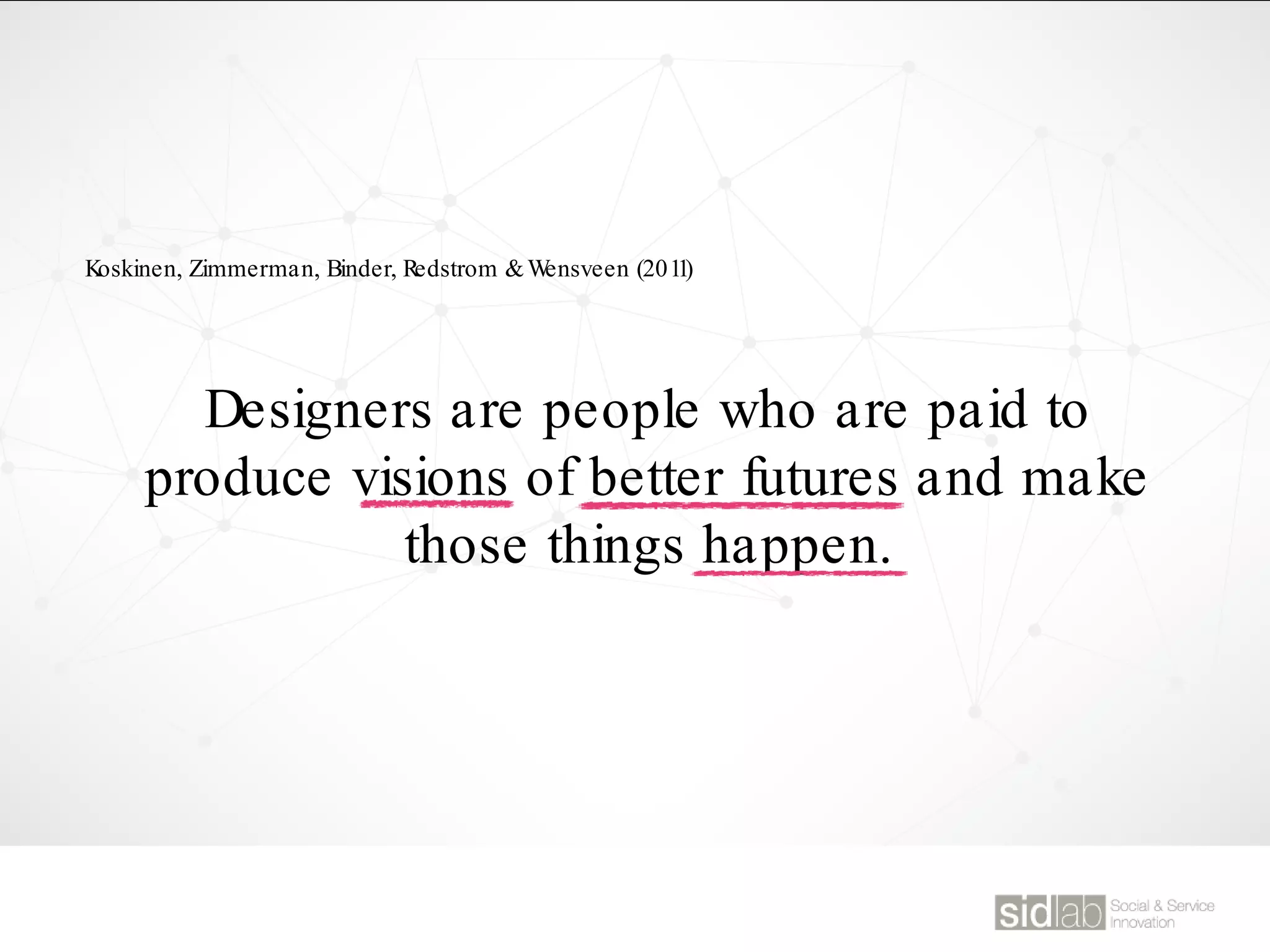
Designers are people who are paid to
produce visions of better futures and make
those things happen.
Koskinen, Zimmerman, Binder, Redstrom &Wensveen (2011)
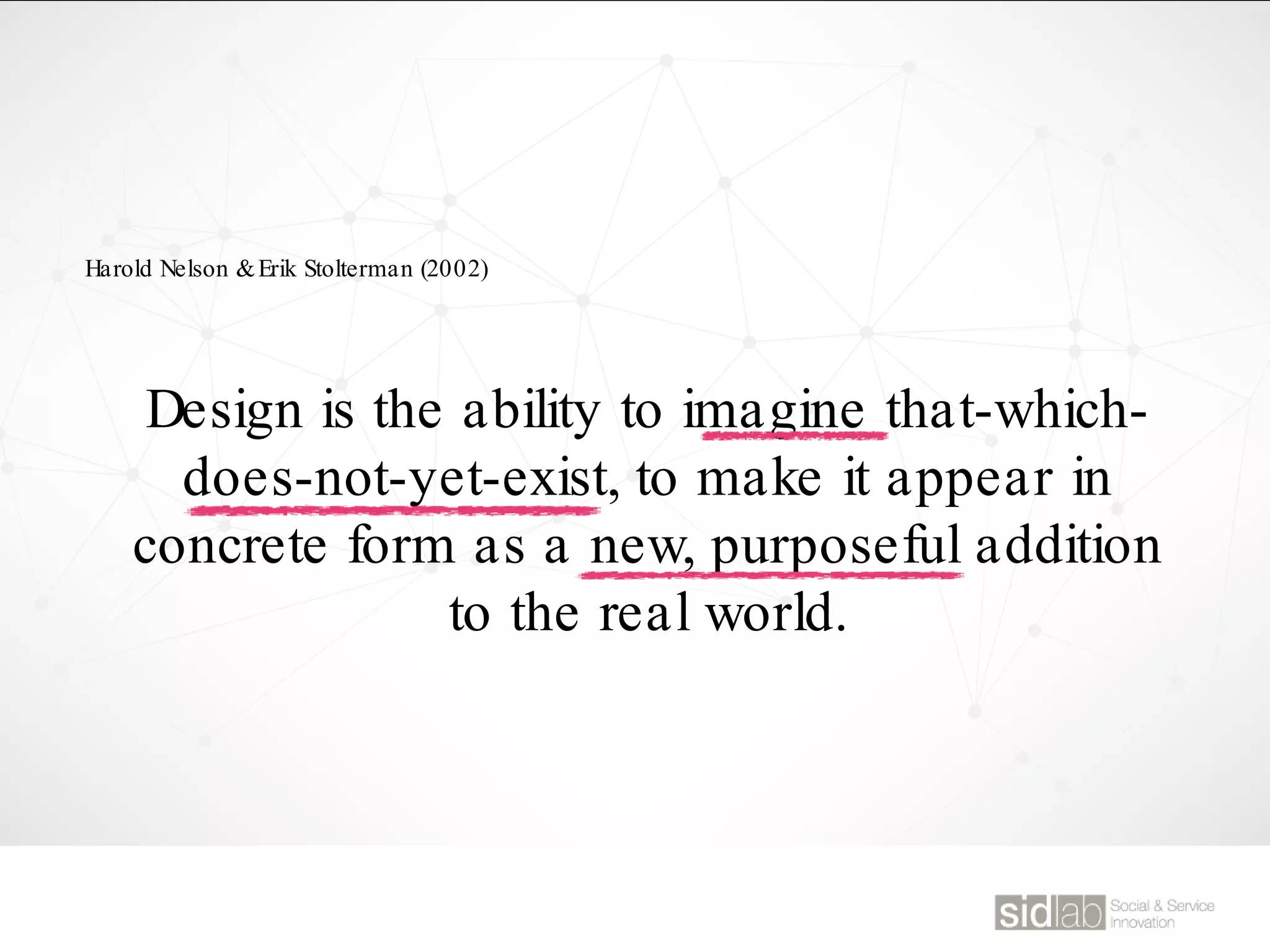
Design is the ability to imagine that-which-
does-not-yet-exist, to make it appear in
concrete form as a new, purposeful addition
to the real world.
Harold Nelson &Erik Stolterman (2002)
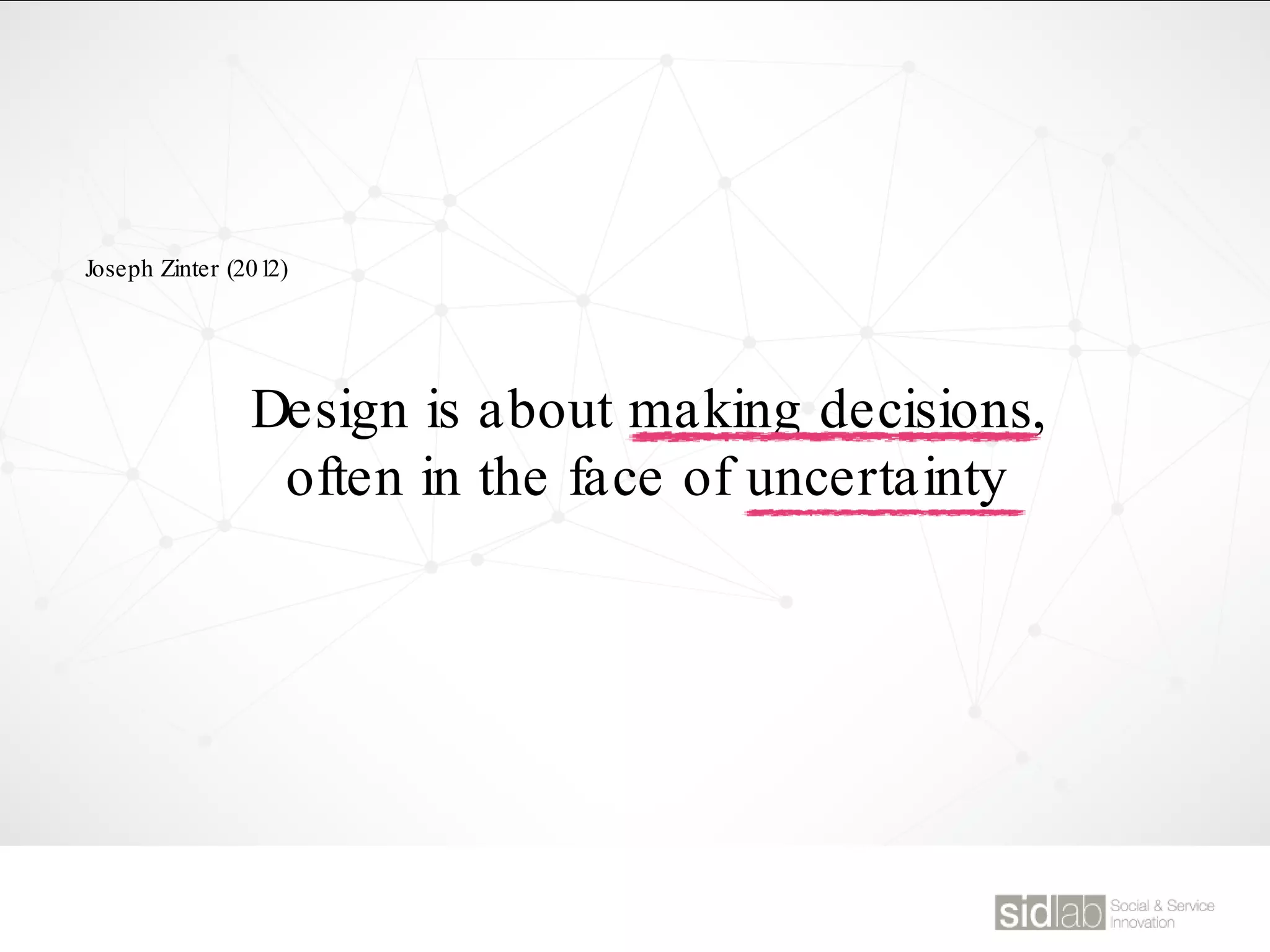
Design is about making decisions,
often in the face of uncertainty
Joseph Zinter (2012)
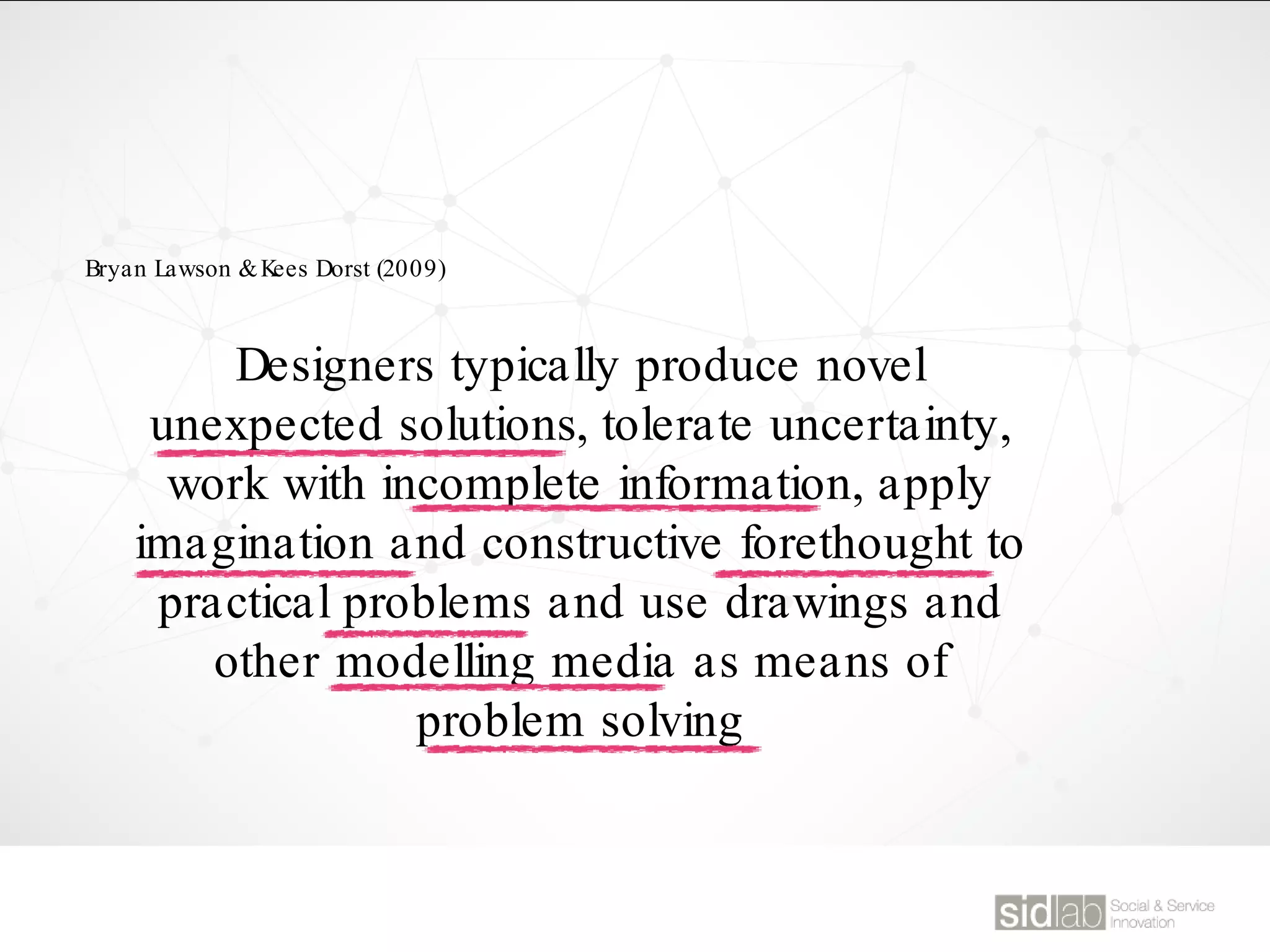
Designers typically produce novel
unexpected solutions, tolerate uncertainty,
work with incomplete information, apply
imagination and constructive forethought to
practical problems and use drawings and
other modelling media as means of
problem solving
Bryan Lawson &Kees Dorst (2009)
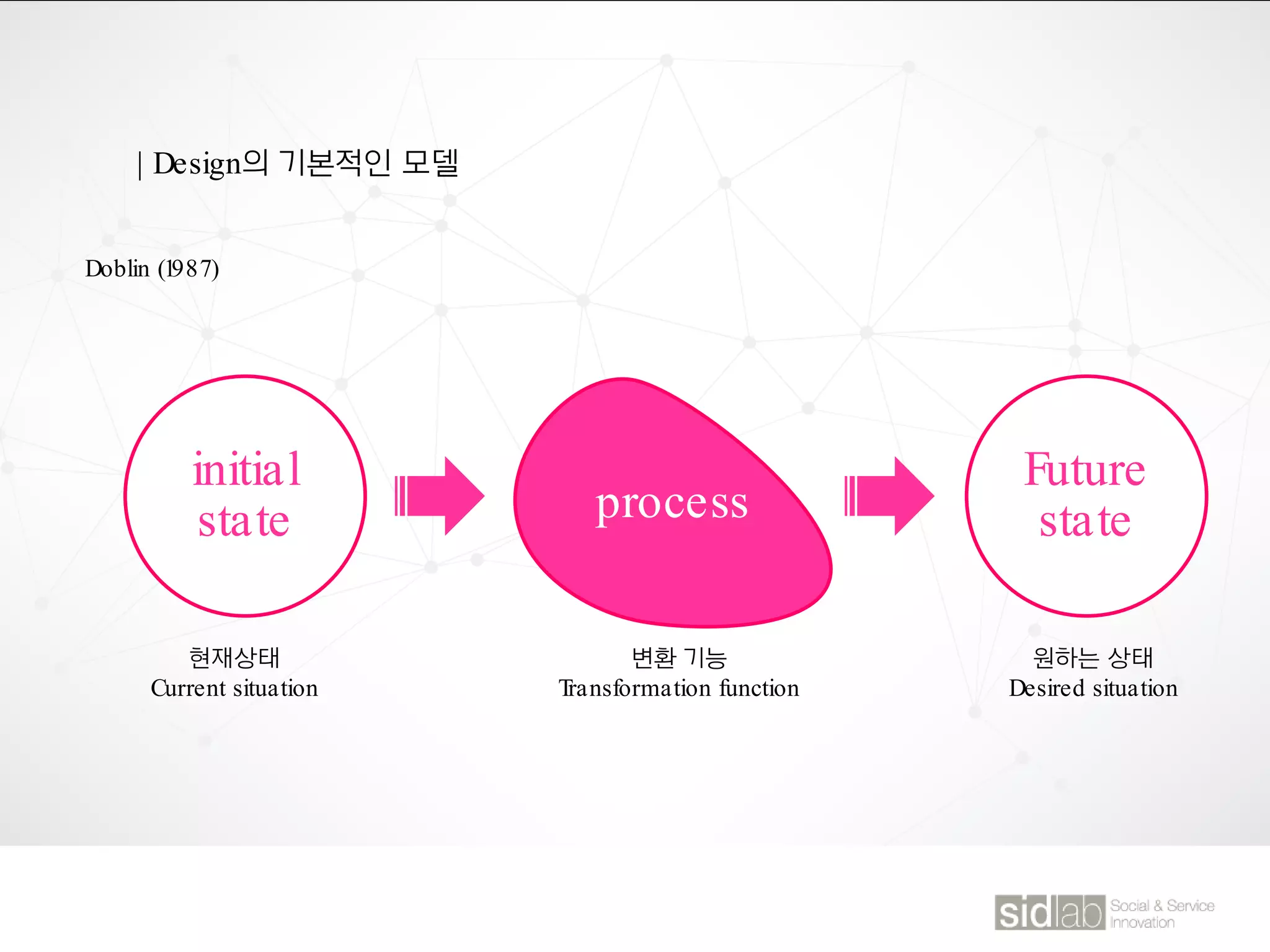
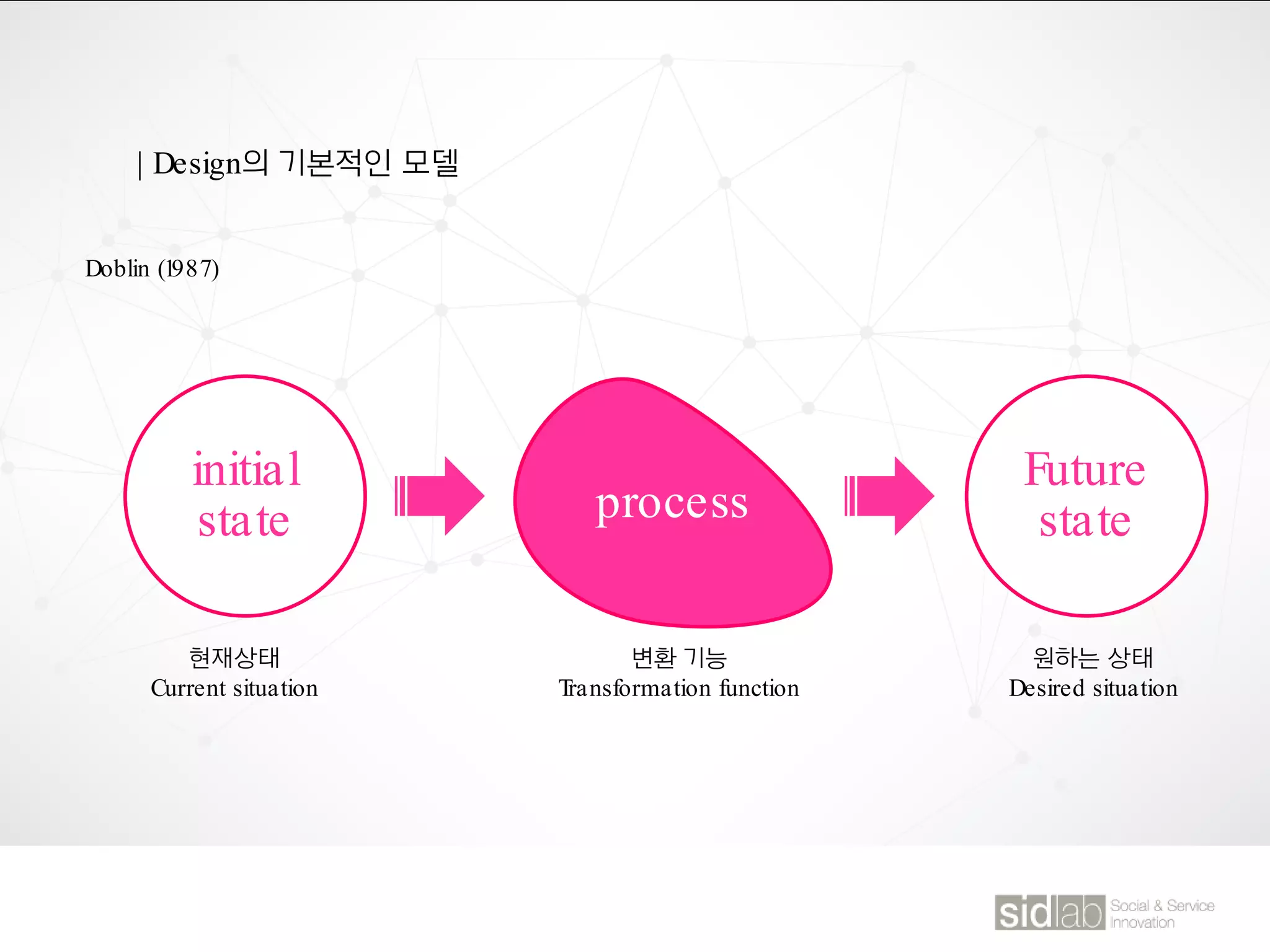
initial
state
Future
stateprocess
현재상태
Current situation
변환 기능
Transformation function
원하는 상태
Desired situation
| Design의 기본적인 모델
Doblin (1987)
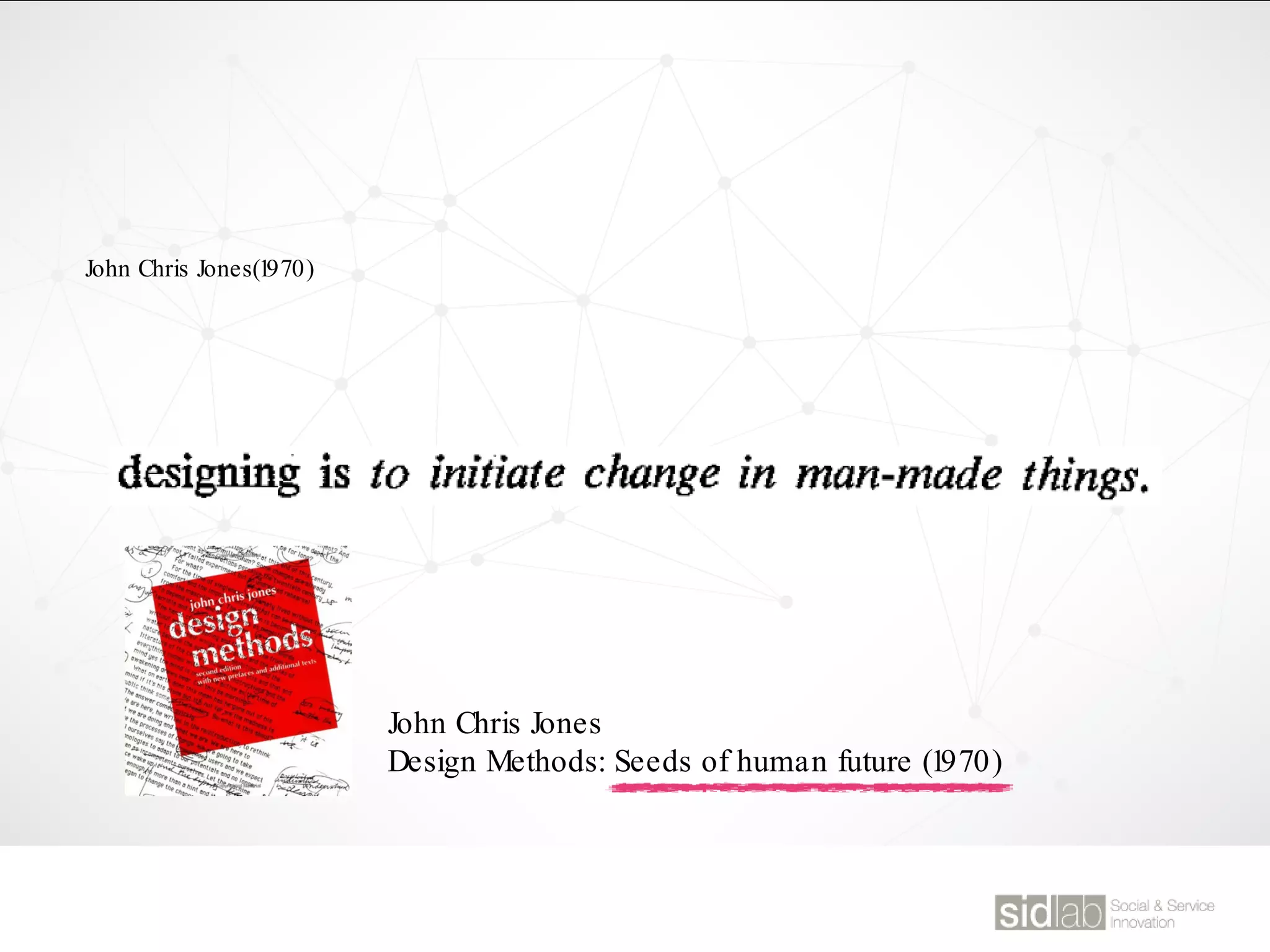
John Chris Jones(1970)
John Chris Jones
Design Methods: Seeds of human future (1970)
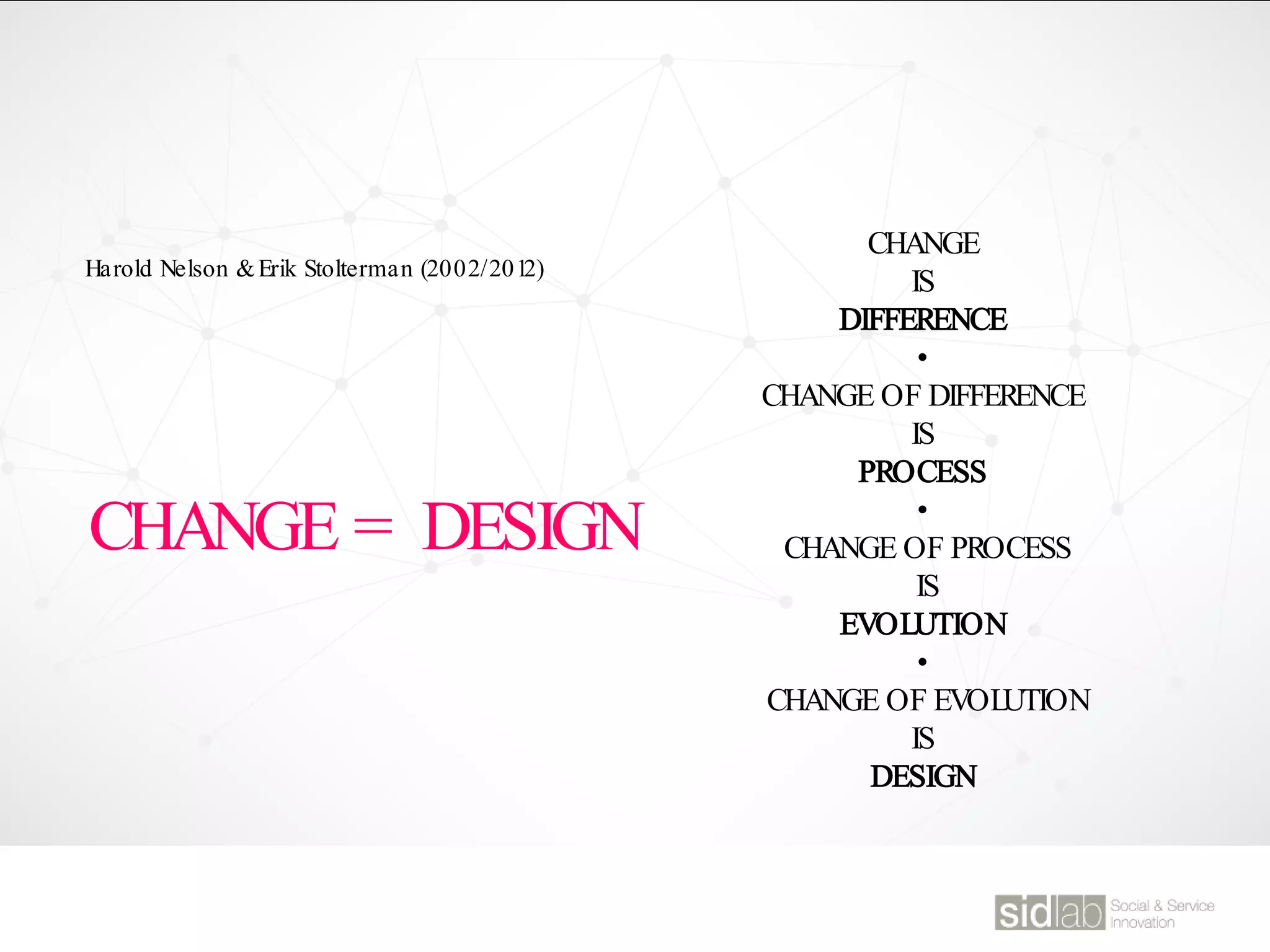
Harold Nelson &Erik Stolterman (2002/2012)
CHANGE
IS
DIFFERENCE
•
CHANGE OF DIFFERENCE
IS
PROCESS
•
CHANGE OF PROCESS
IS
EVOLUTION
•
CHANGE OF EVOLUTION
IS
DESIGN
CHANGE = DESIGN
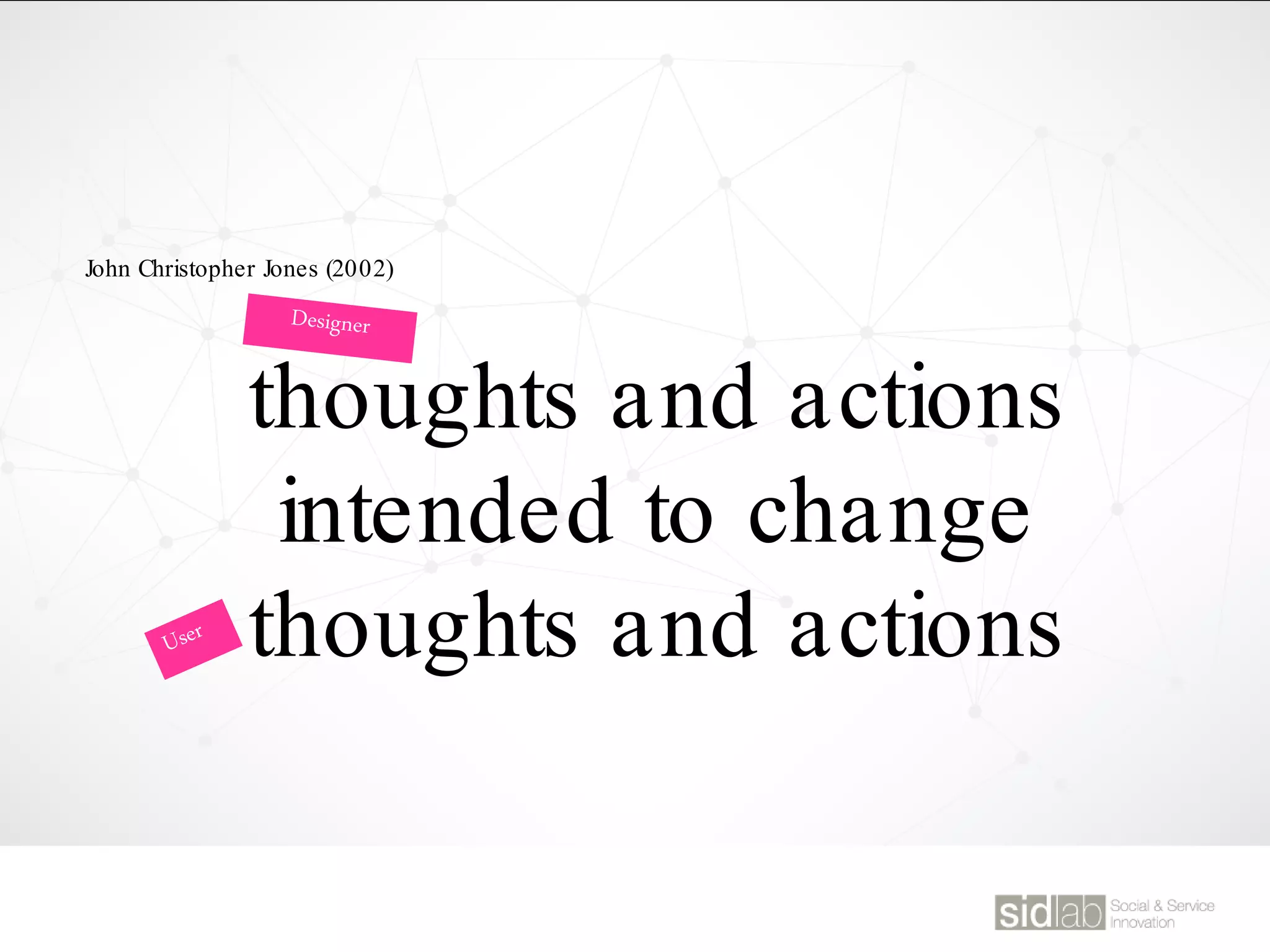
John Christopher Jones (2002)
thoughts and actions
intended to change
thoughts and actions
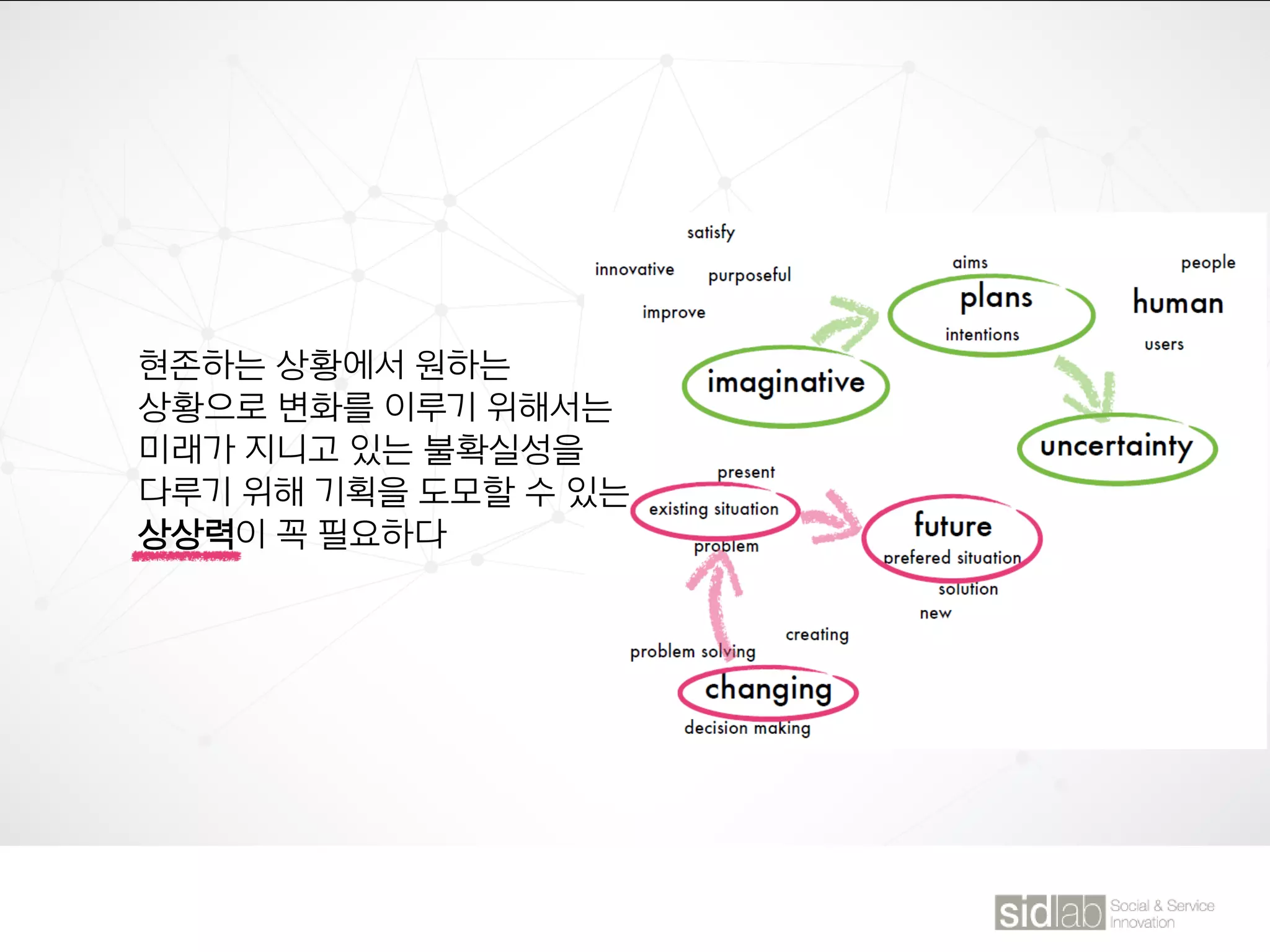
현존하는 상황에서 원하는
상황으로 변화를 이루기 위해서는
미래가 지니고 있는 불확실성을
다루기 위해 기획을 도모할 수 있는
상상력이 꼭 필요하다
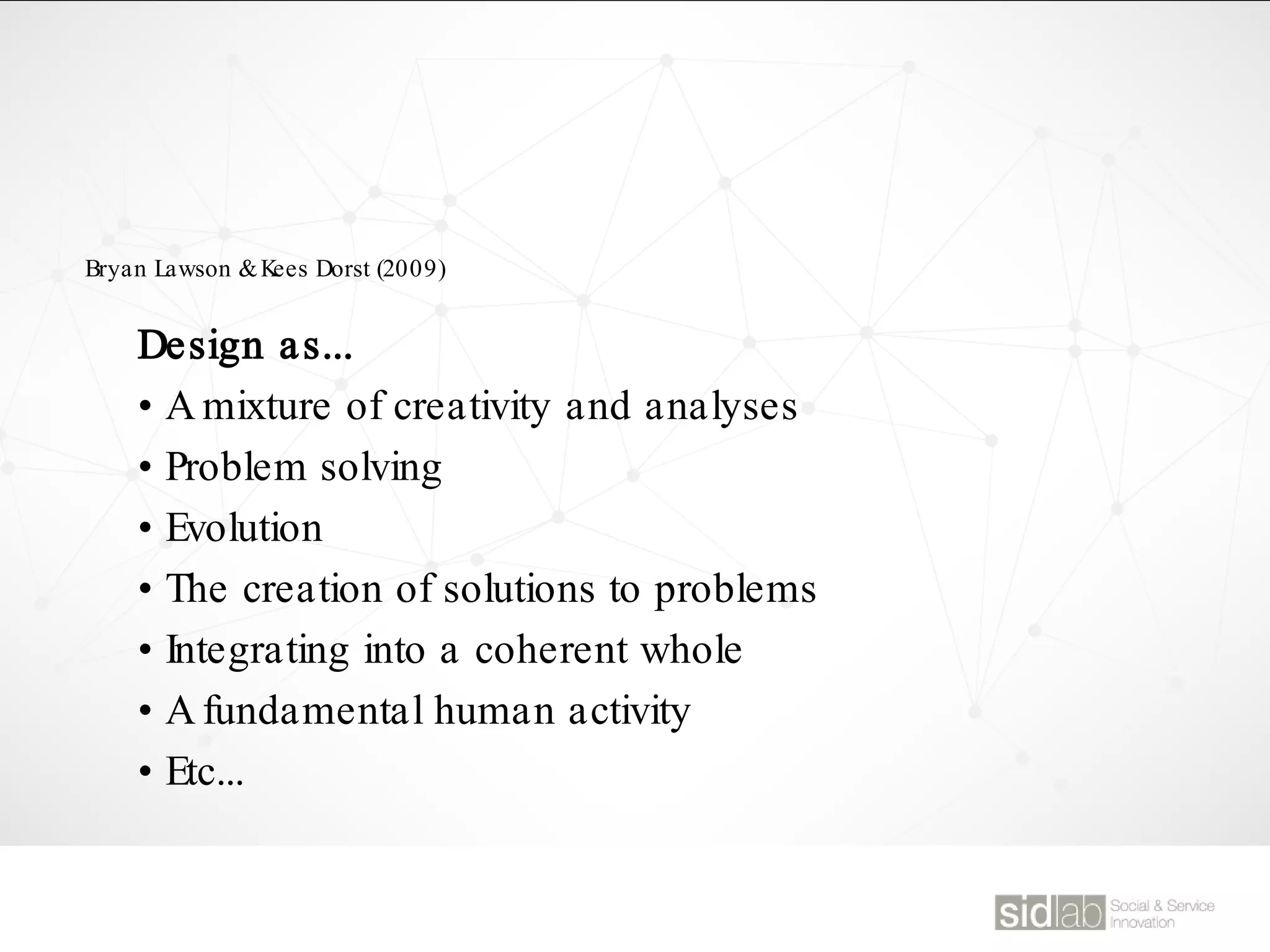
Design as...
• A mixture of creativity and analyses
• Problem solving
• Evolution
• The creation of solutions to problems
• Integrating into a coherent whole
• A fundamental human activity
• Etc...
Bryan Lawson &Kees Dorst (2009)
What is Design Activity
02.
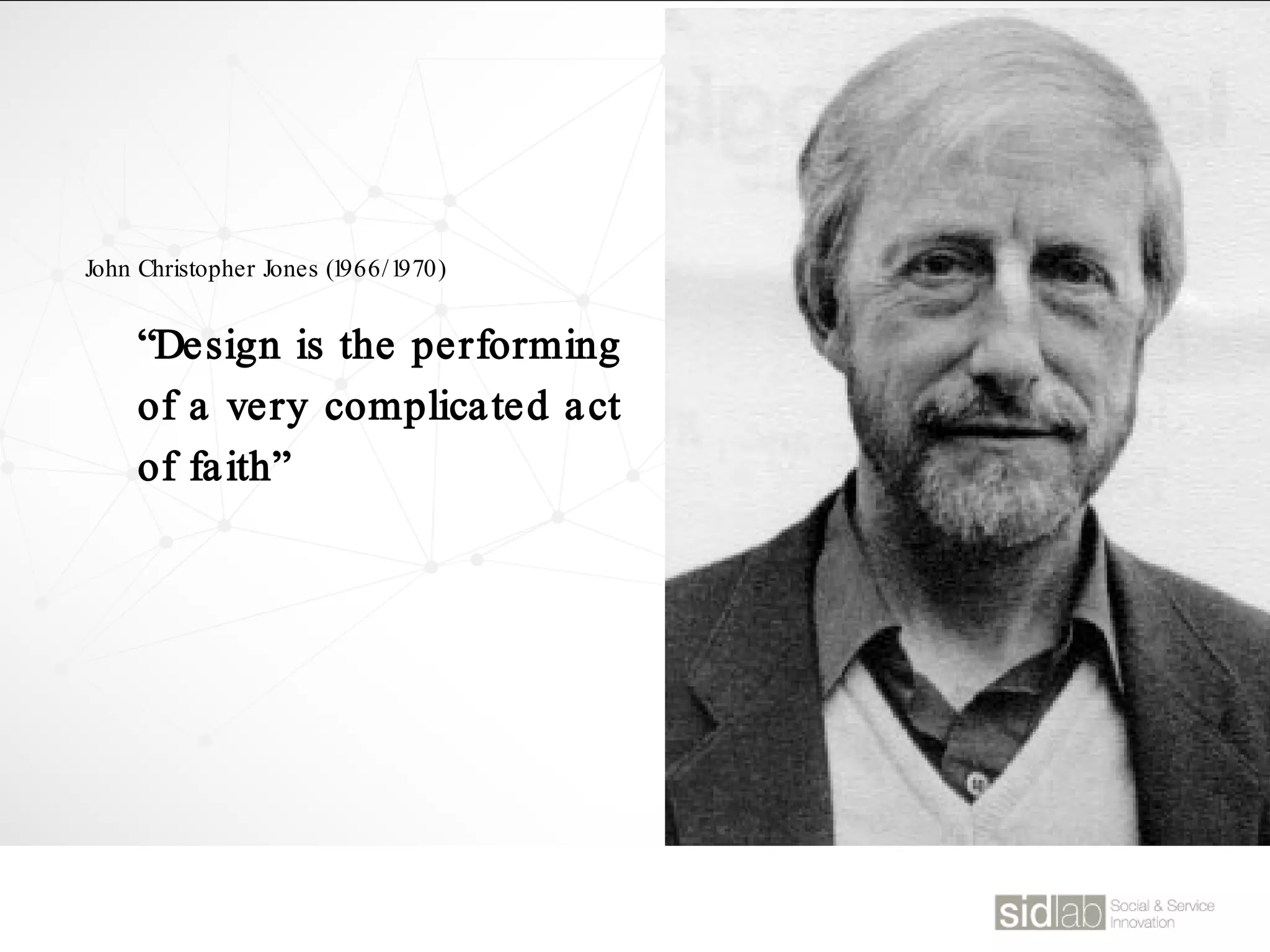
“Design is the performing
of a very complicated act
of faith”
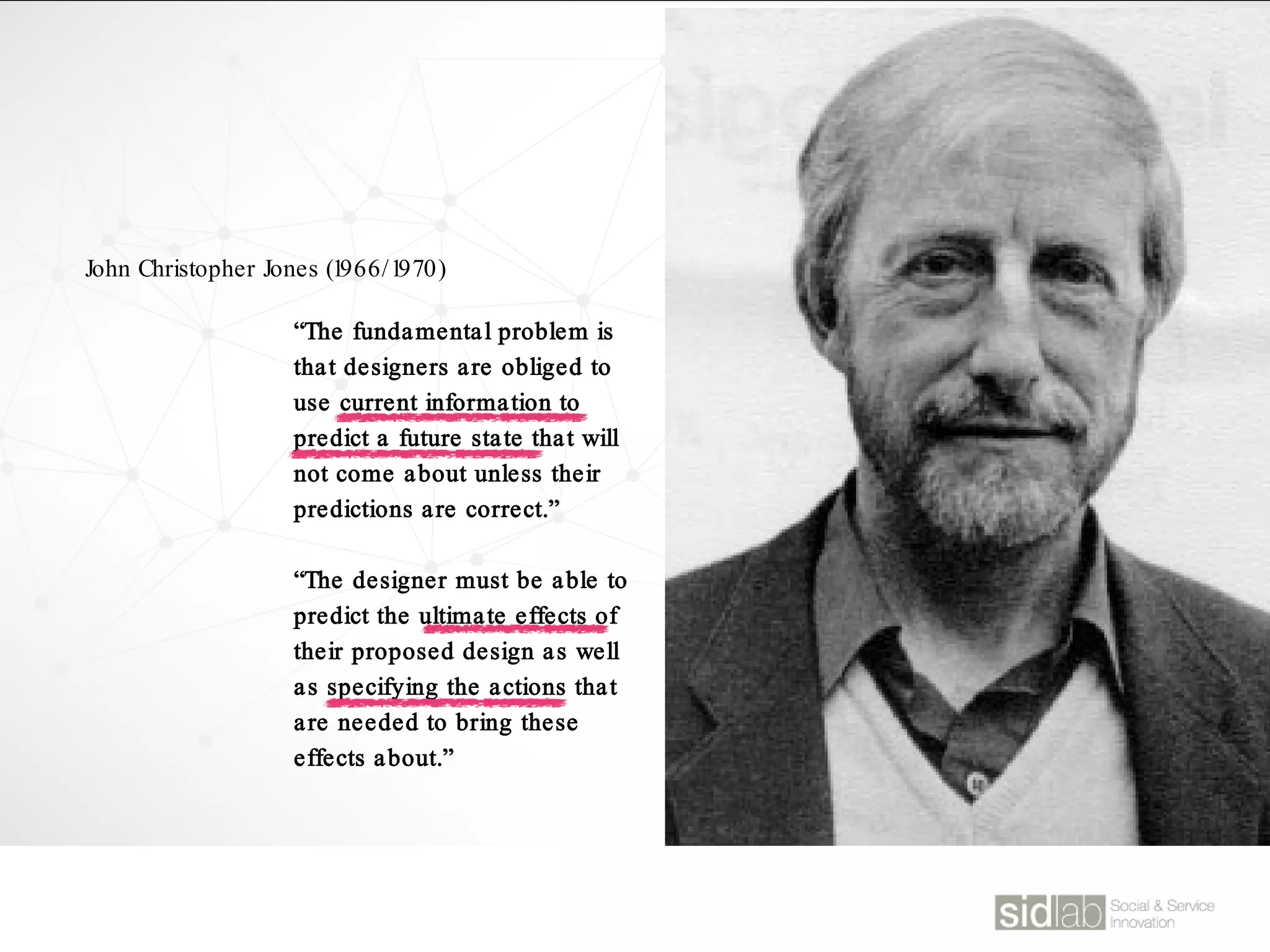
John Christopher Jones (1966/1970)
“The fundamental problem is
that designers are obliged to
use current information to
predict a future state that will
not come about unless their
predictions are correct.”
“The designer must be able to
predict the ultimate effects of
their proposed design as well
as specifying the actions that
are needed to bring these
effects about.”
John Christopher Jones (1966/1970)
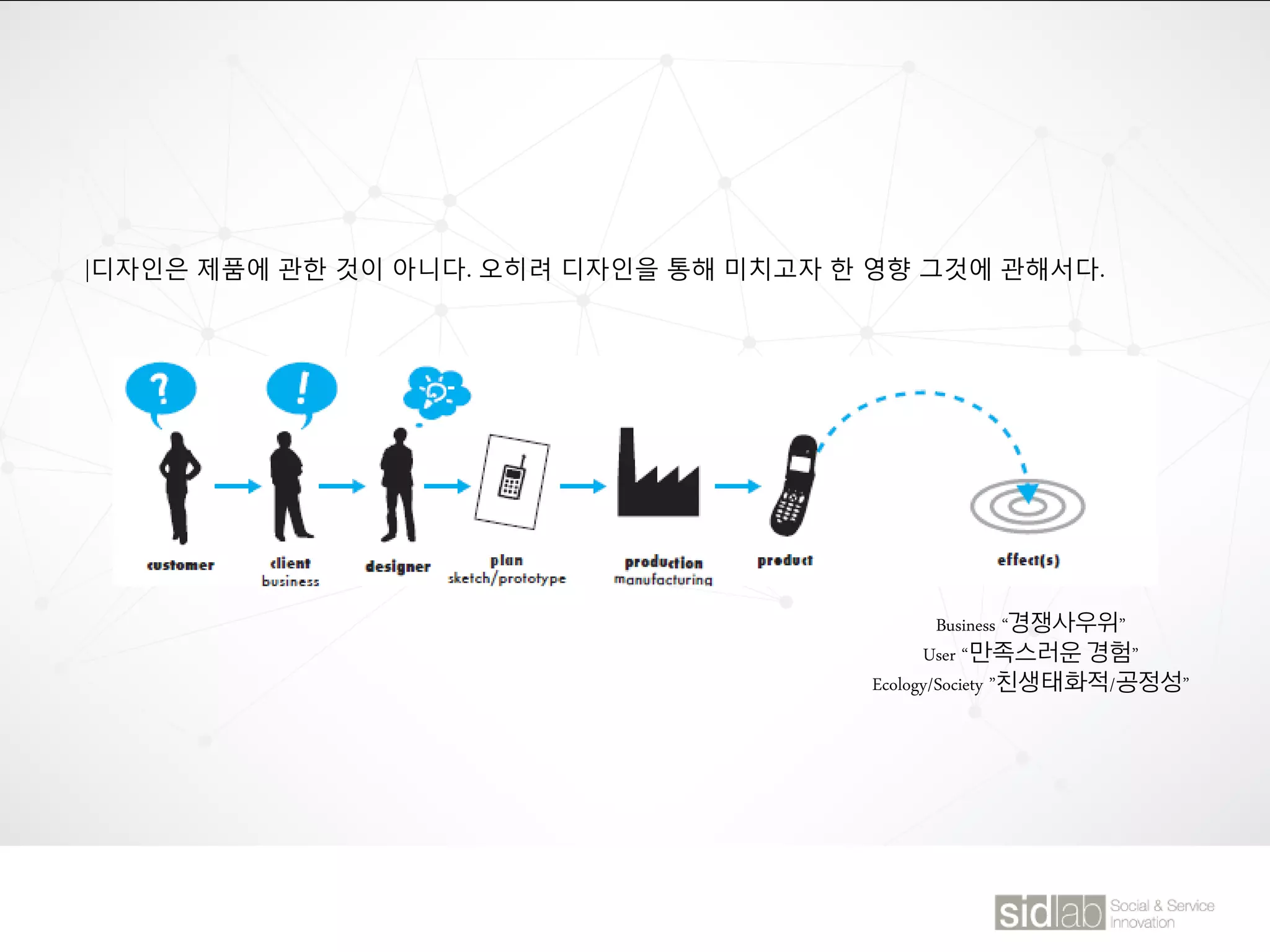
|디자인은 제품에 관한 것이 아니다. 오히려 디자인을 통해 미치고자 한 영향 그것에 관해서다.
Business “경쟁사우위”
User “만족스러운 경험”
Ecology/Society ”친생태화적/공정성”
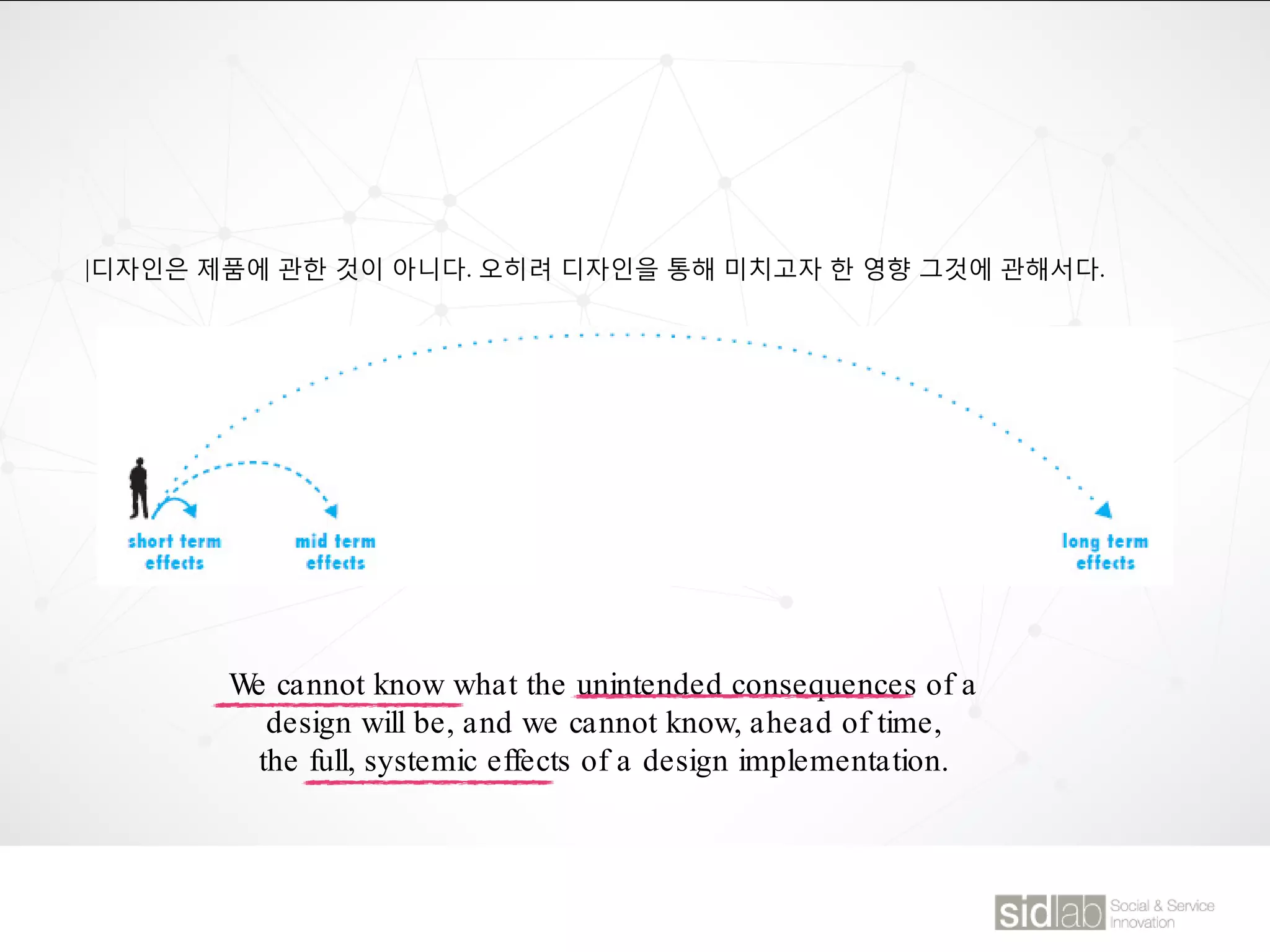
|디자인은 제품에 관한 것이 아니다. 오히려 디자인을 통해 미치고자 한 영향 그것에 관해서다.
We cannot know what the unintended consequences of a
design will be, and we cannot know, ahead of time,
the full, systemic effects of a design implementation.
WHO is Designer?
03.
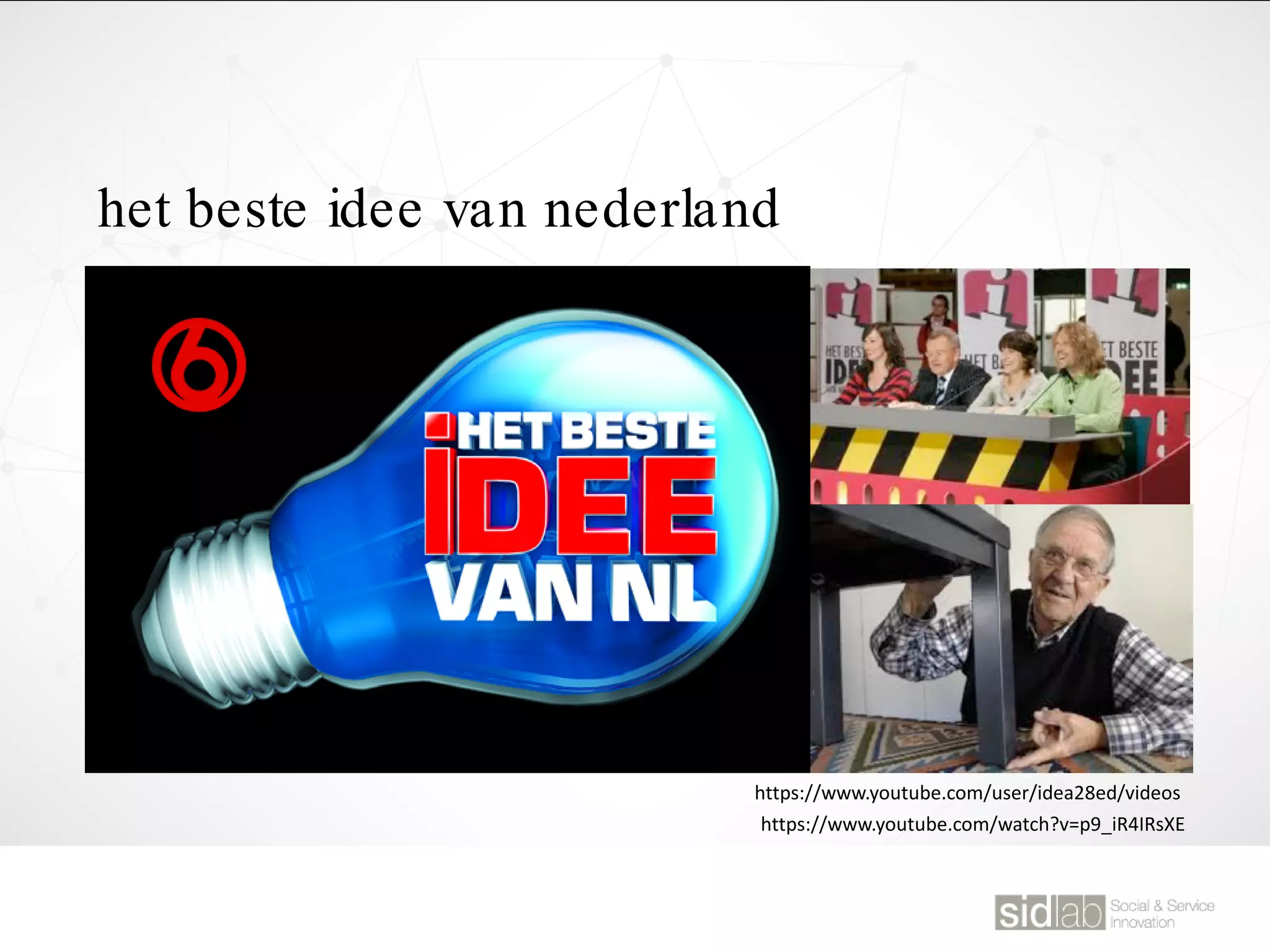
het beste idee van nederland
https://www.youtube.com/user/idea28ed/videos
https://www.youtube.com/watch?v=p9_iR4IRsXE
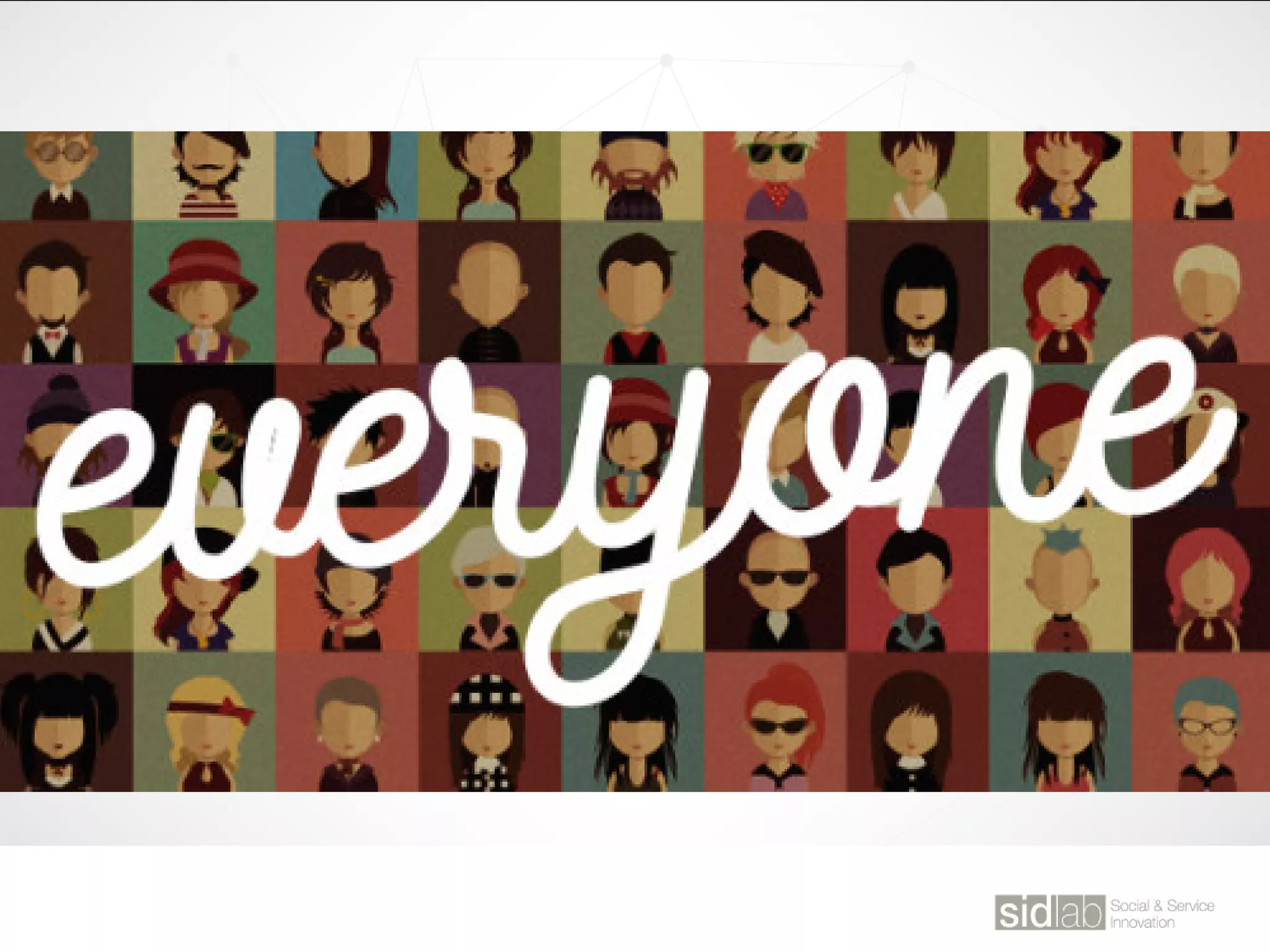
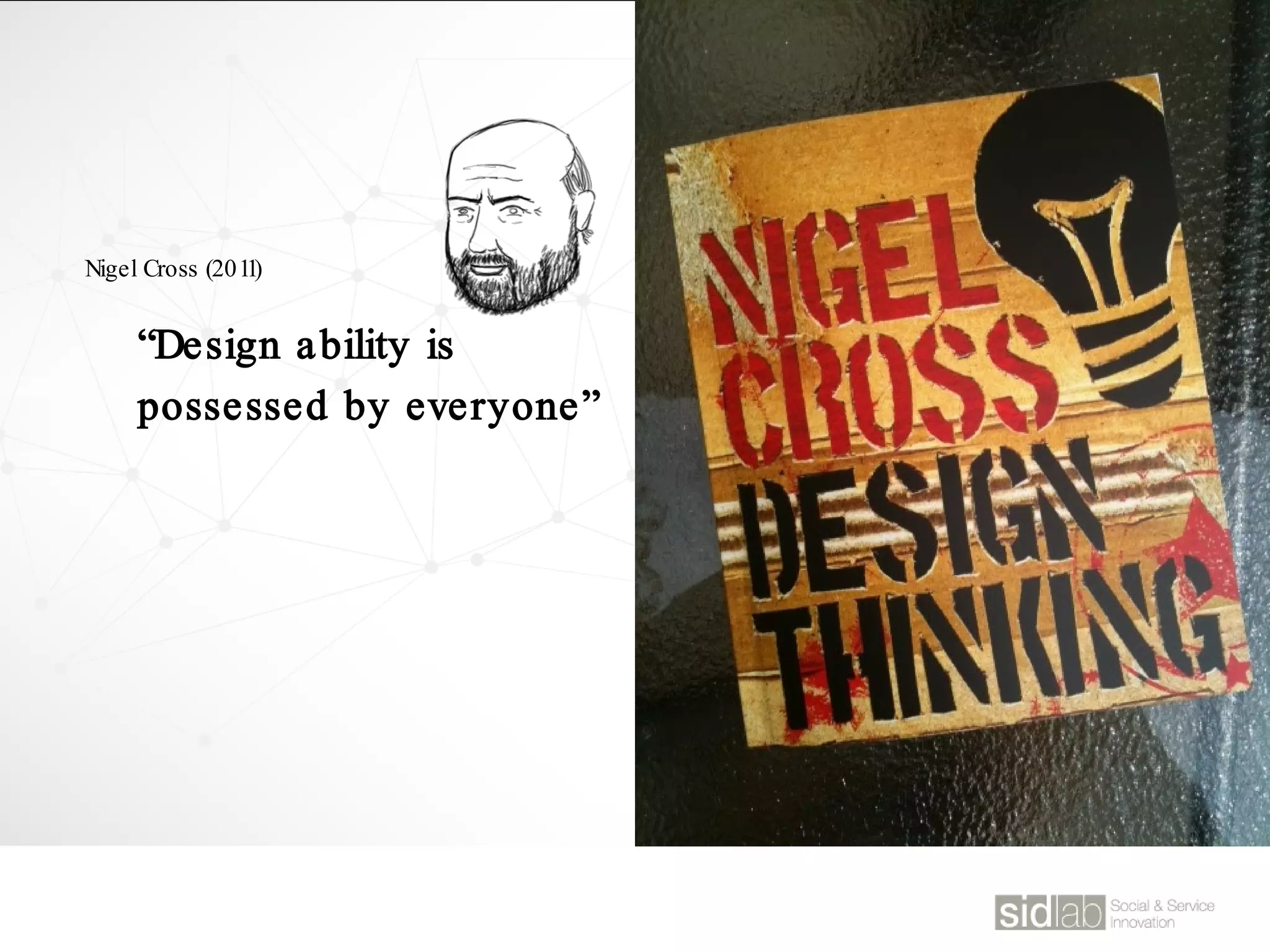
“Design ability is
possessed by everyone”
Nigel Cross (2011)
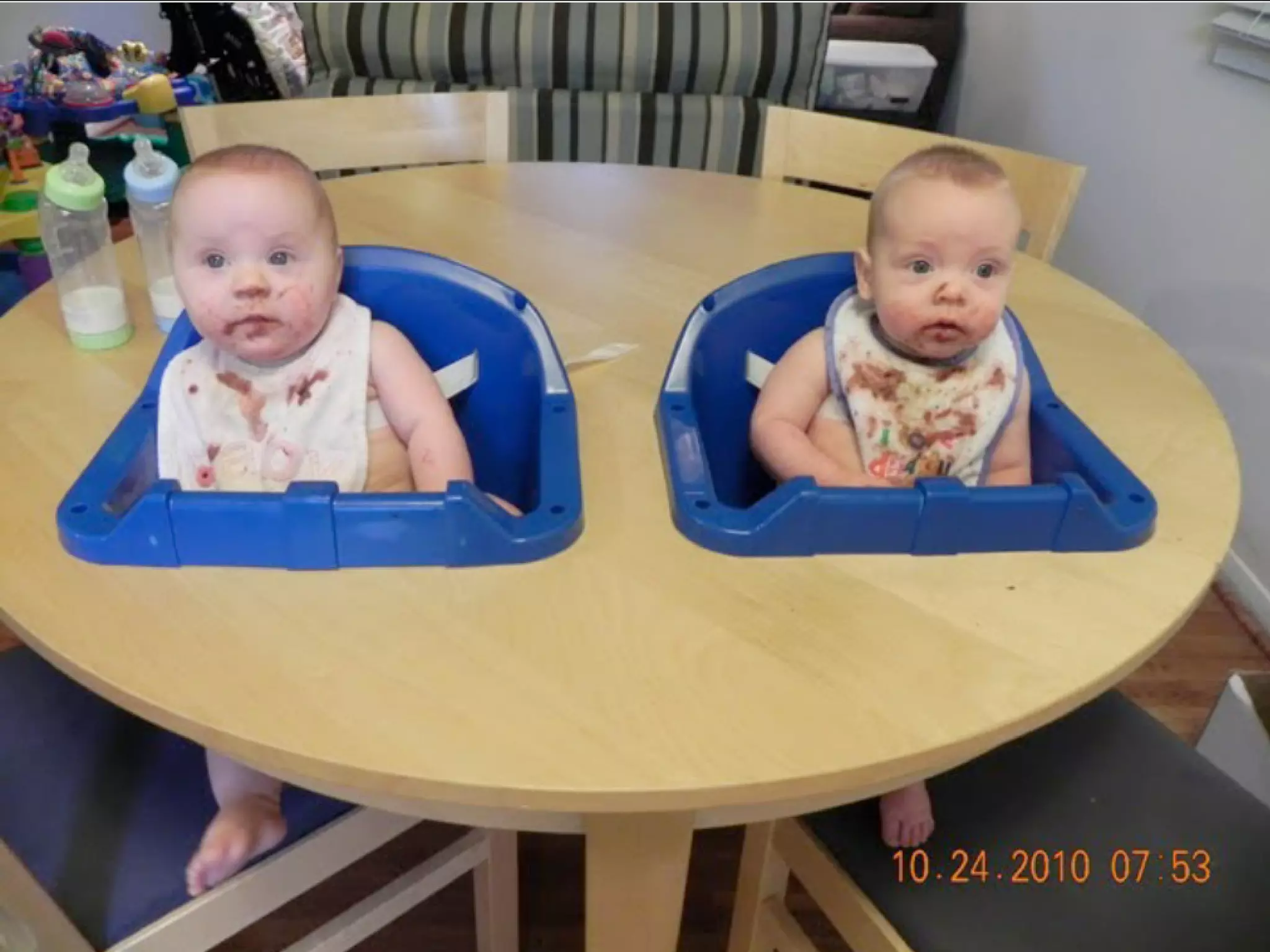
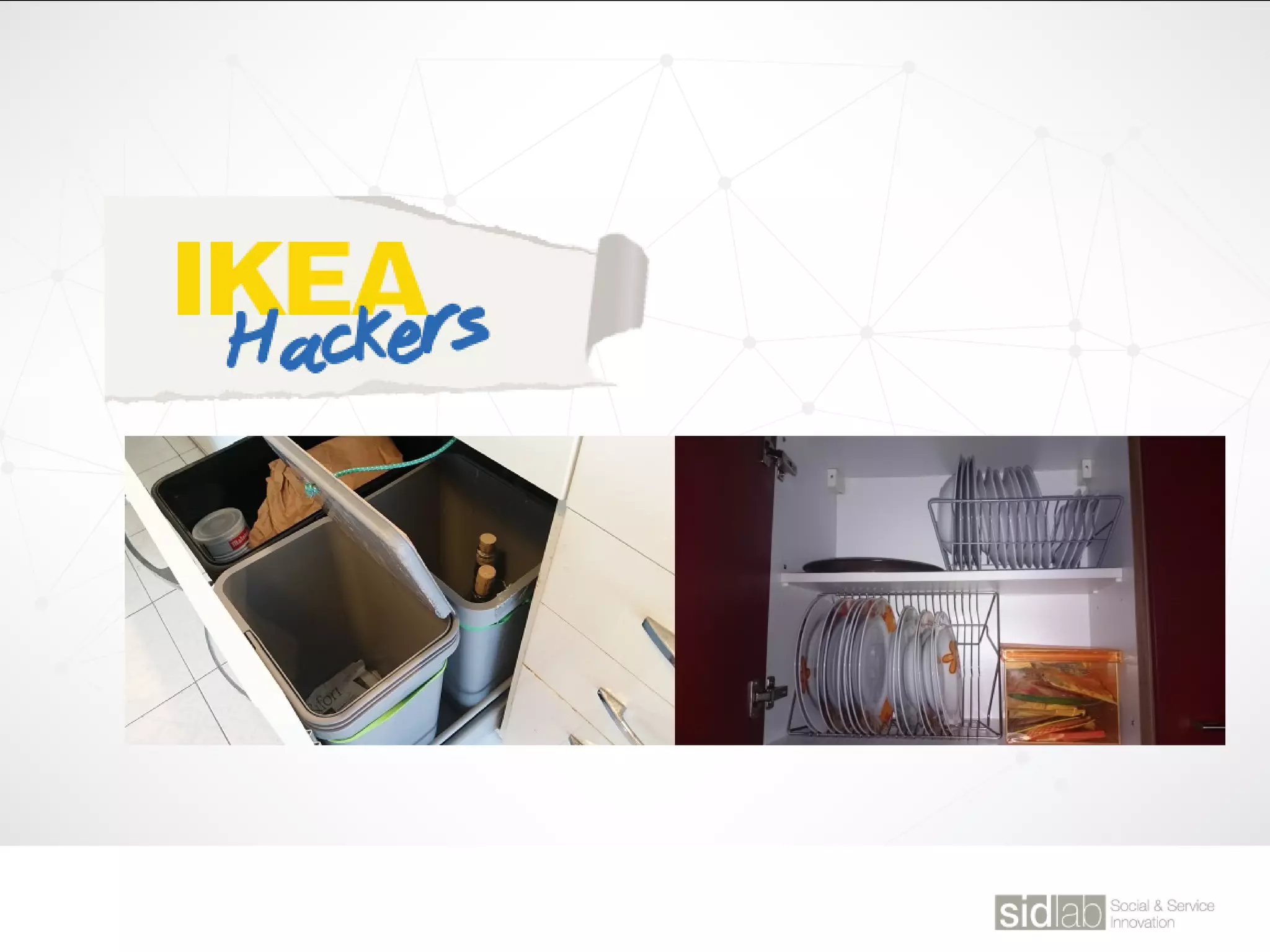
"Everyone can – and does – design.
We all design when we plan for
something new to happen, whether
that might be a new version of a recipe,
a new arrangement of the living
room furniture, or a new lay tour of a
personal web page. […] So design
thinking is something inherent within
human cognition; it is a key part of
what makes us human.” (p. 3)
Nigel Cross (2011)
"Everyone designs who devises
courses of action aimed at
changing existing situations into
preferred ones."
Herbert Simon (1969)
|그럼 우리는 왜 디자인을 하는 것인가?
“We must design, because we are not perfect.”
“Like Hephaistos, we have to design because we want to survive, but
humans also seem to have a will for continuous improvement and
development.”
“On a more abstract level, we are drawn to design because we may feel a lack
of wholeness—we do not find the world in a condition that is satisfying or
fulfilling for us. And, ultimately, we are motivated to design because it is an
accessible means to enlightenment, to bring order, and to give meaning
to our lives.”
Harold Nelson &Erik Stolterman (2002/2012)
|그럼 우리는 왜 디자인을 하는 것인가?
"Designers are change agents in
society. Their goal is to improve the
human condition, in all its aspects,
through physical change."
Harold Nelson &Erik Stolterman (2002/2012)
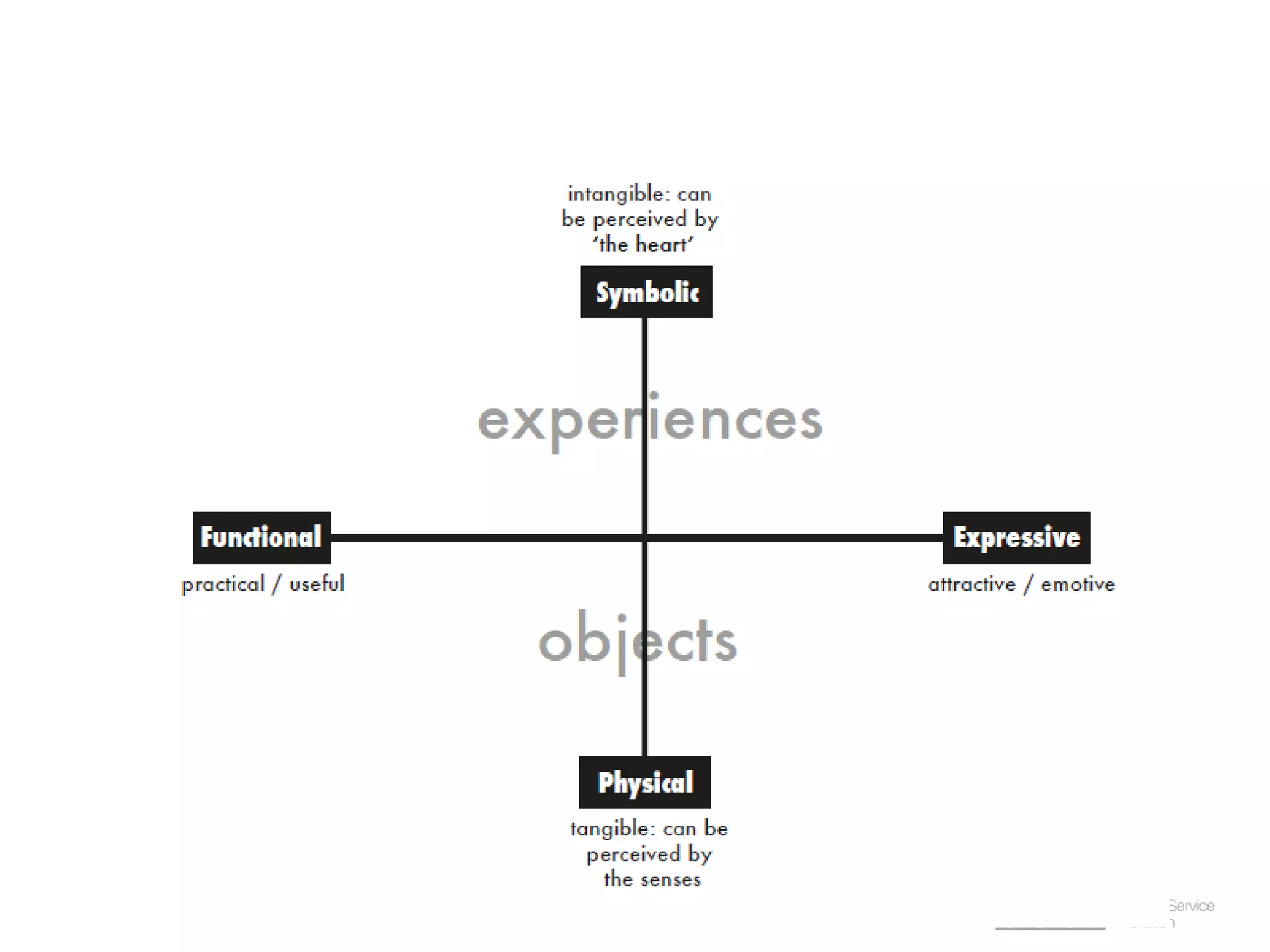
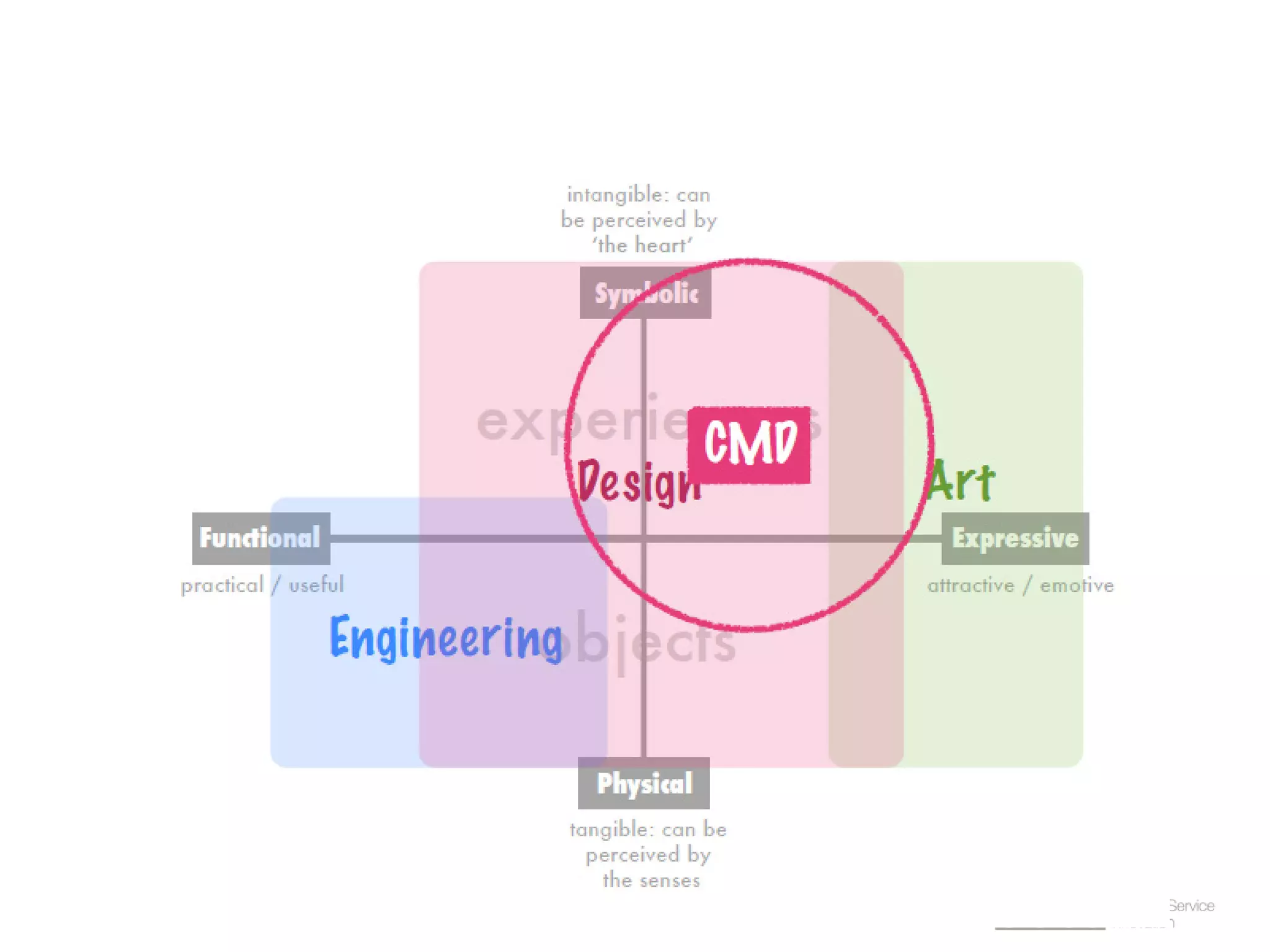
Position of Design
04.
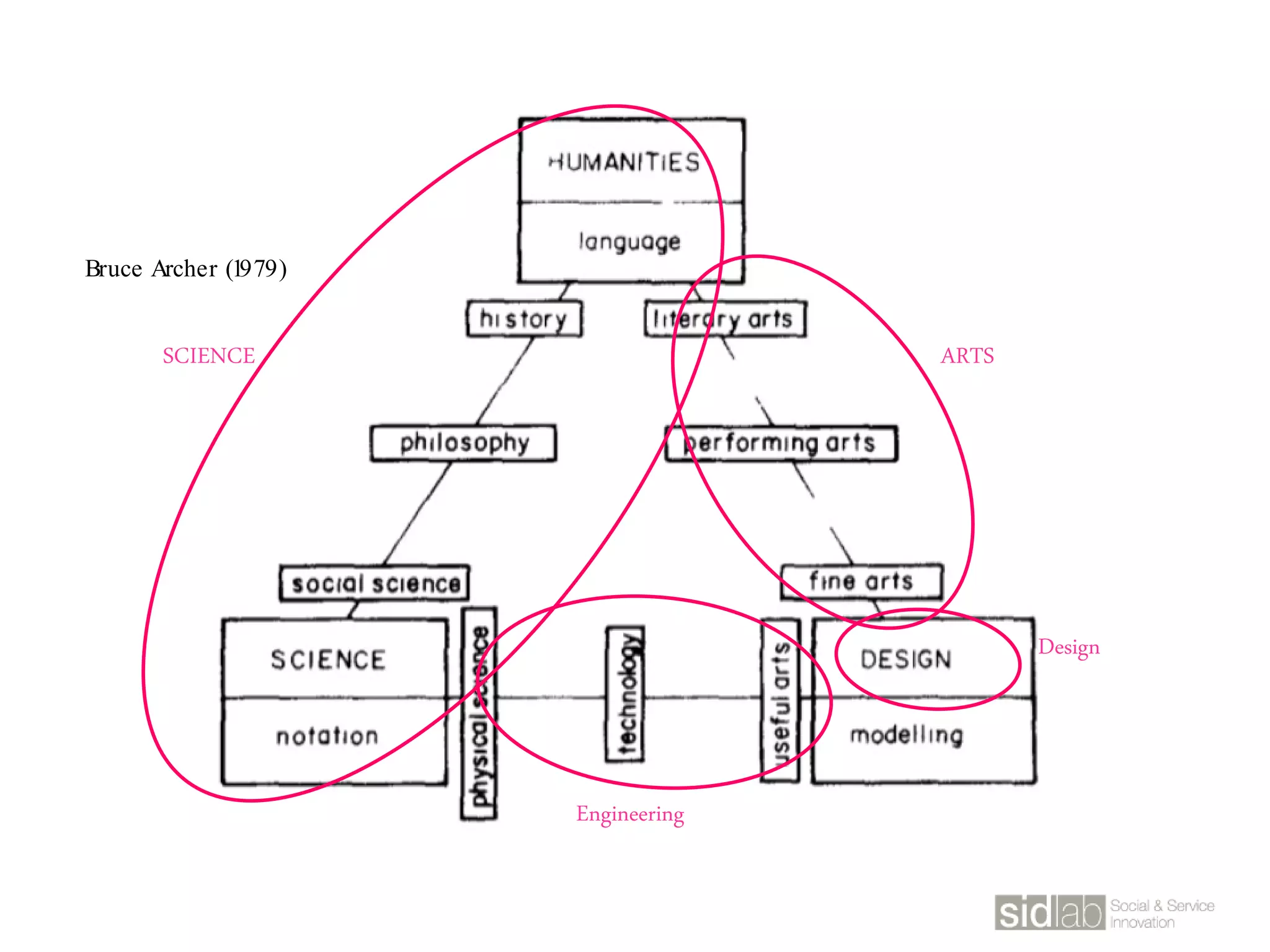
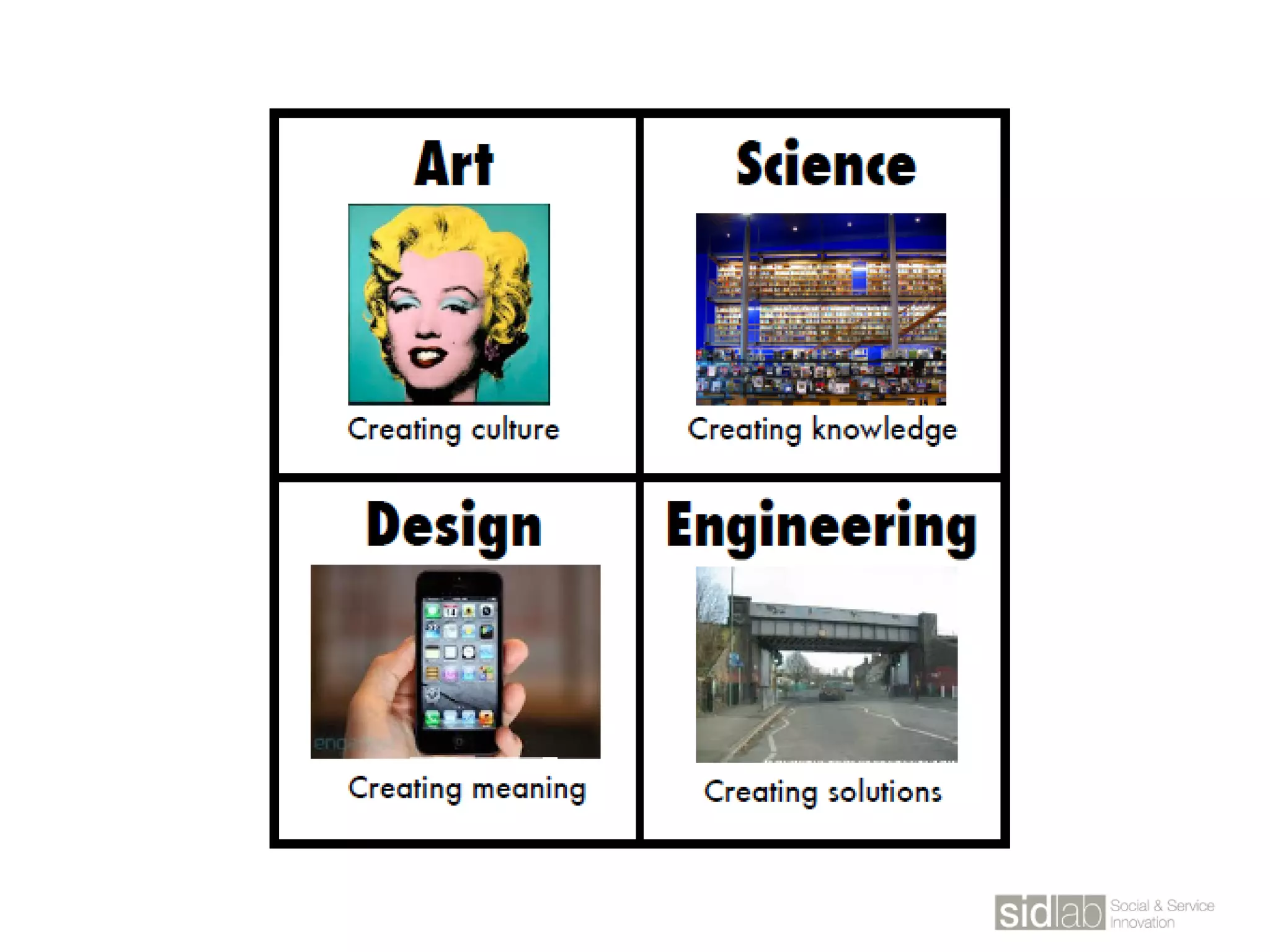
design = art
Bruce Archer (1979)
Engineering
Design
ARTSSCIENCE
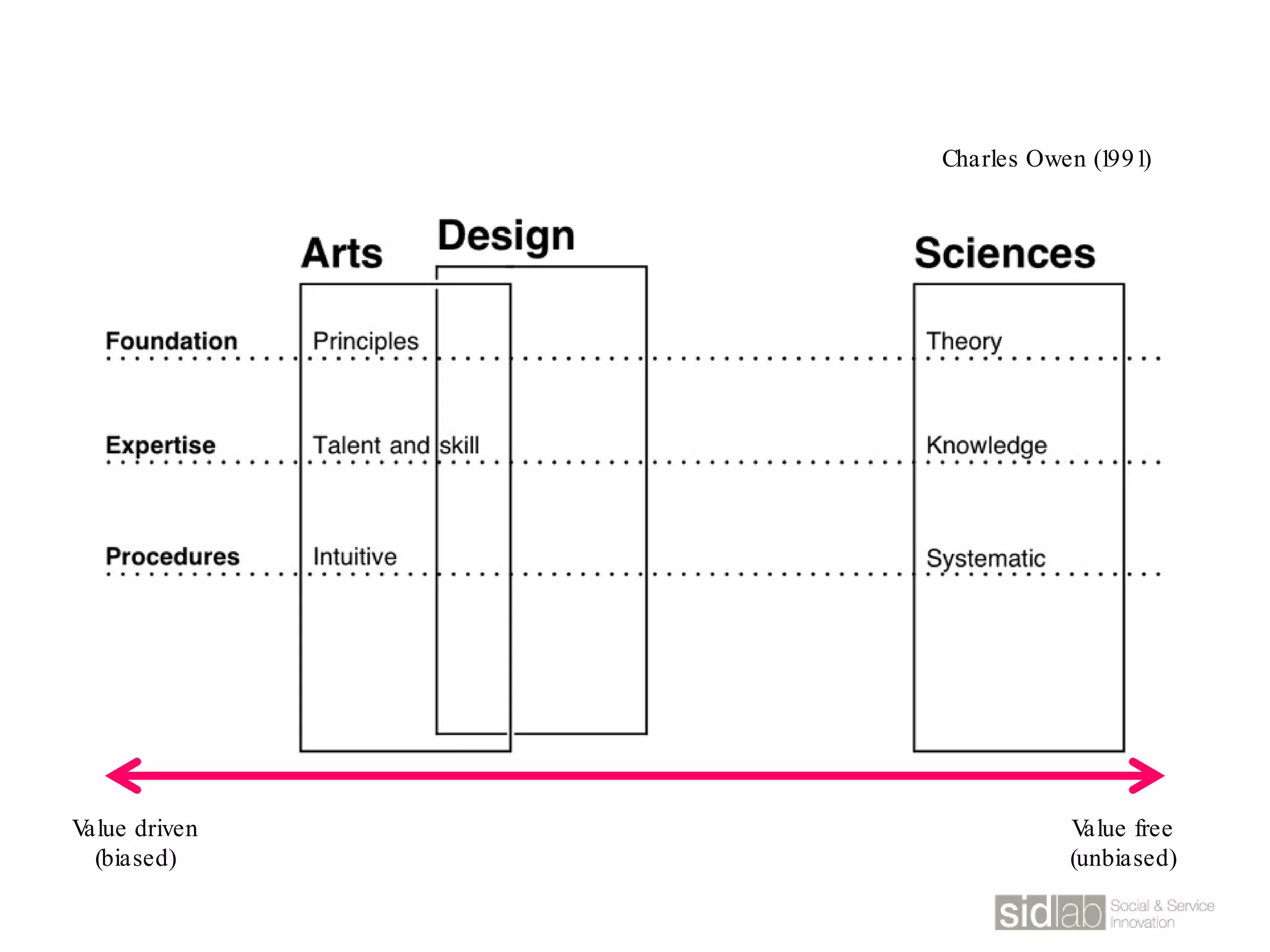
Value driven
(biased)
Value free
(unbiased)
Charles Owen (1991)
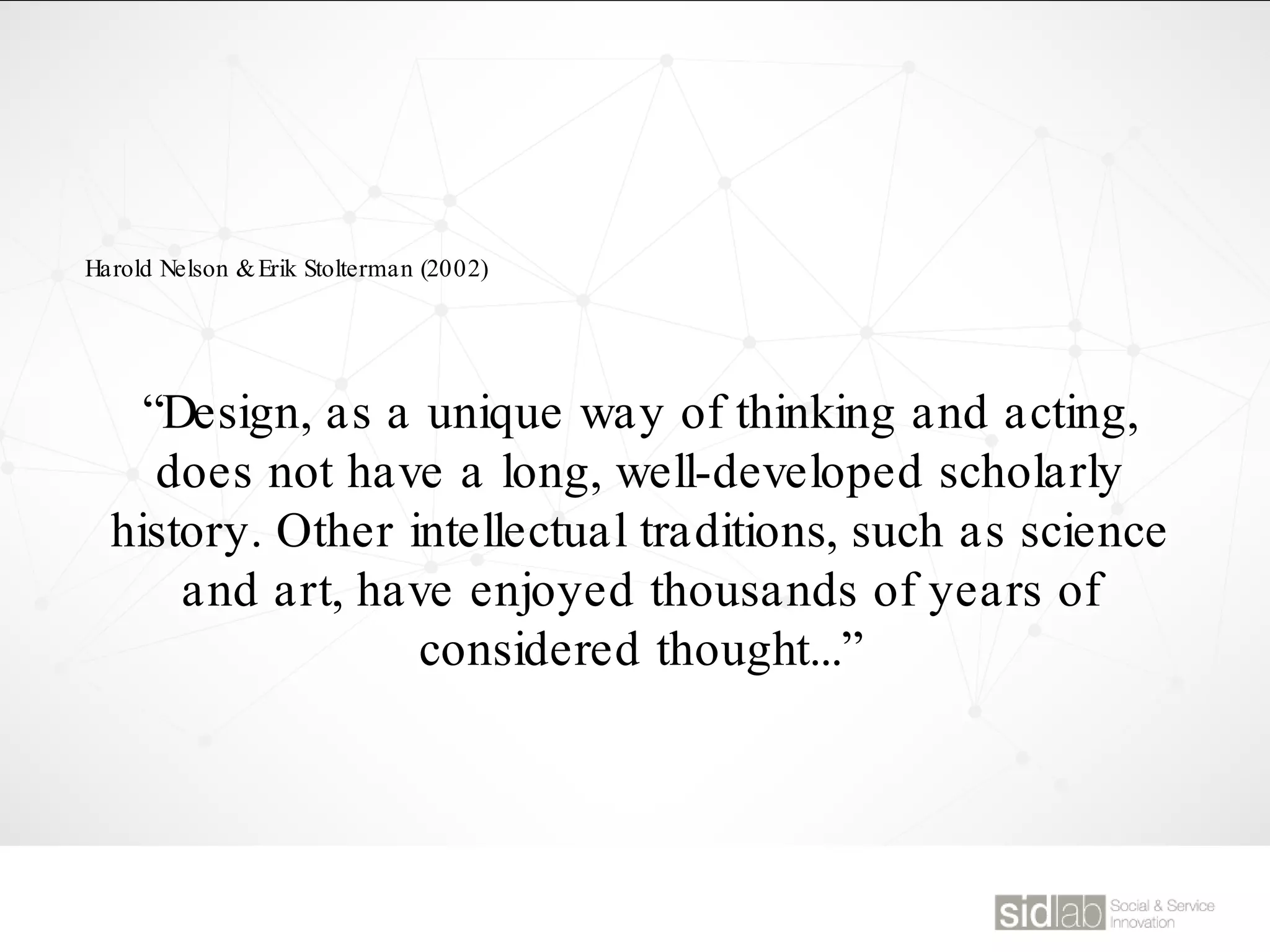
Harold Nelson &Erik Stolterman (2002)
“Design, as a unique way of thinking and acting,
does not have a long, well-developed scholarly
history. Other intellectual traditions, such as science
and art, have enjoyed thousands of years of
considered thought...”
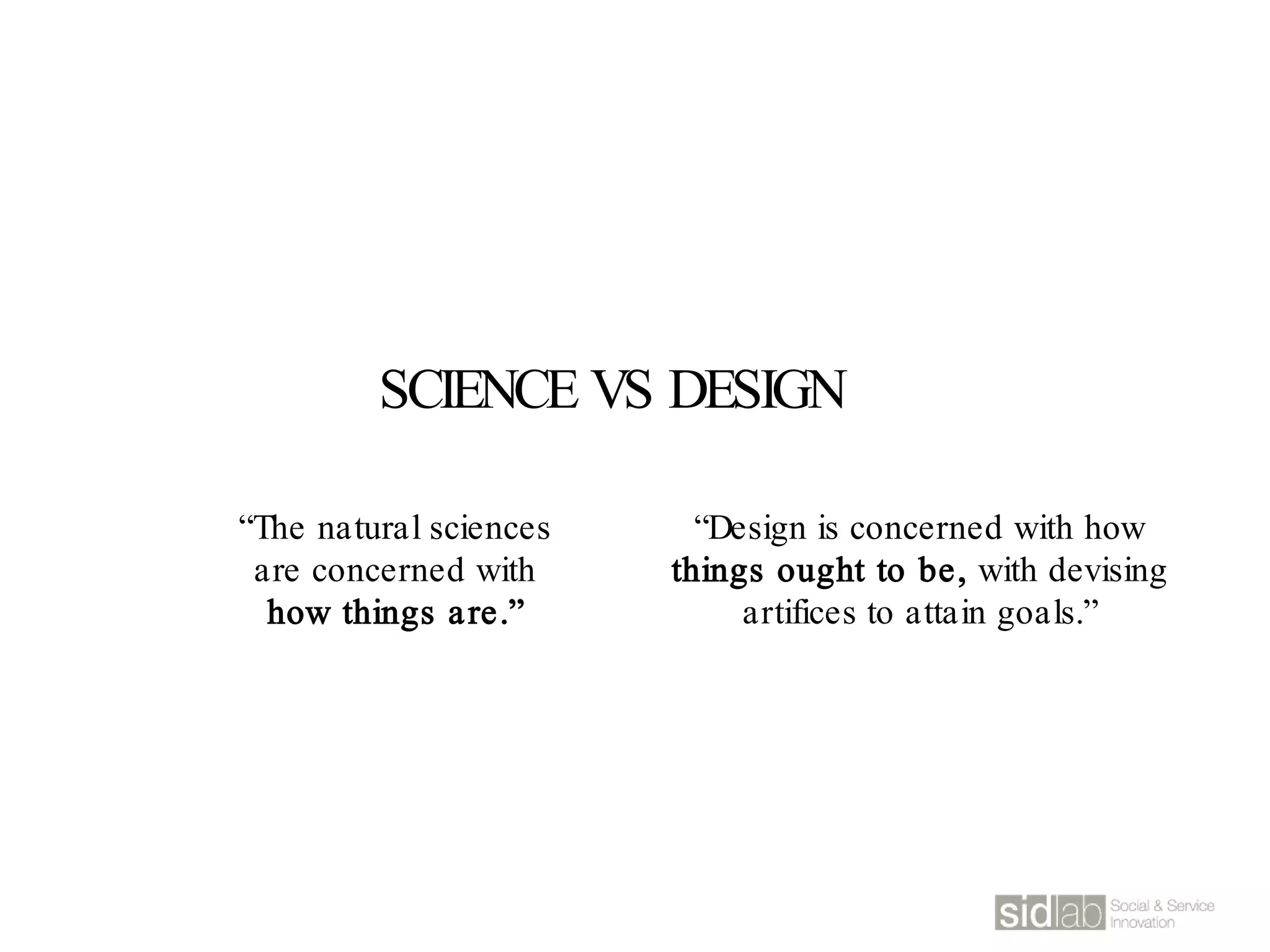
SCIENCE VS DESIGN
“The natural sciences
are concerned with
how things are.”
“Design is concerned with how
things ought to be, with devising
artifices to attain goals.”
Design Process
05.
Engineering Design Art
ExpressiveFunctional
에러에 대한
큰 리스크
에러에 대한
작은 리스크
사람이 죽을 수 있다 사람이 다칠 수 있다 사람이 공포스러울 수 있다 사람이 헷깔 릴 수 있다 사람이 짜증날 수 있다
Prescriptive use
of methods
“This is how you should
design to avoid errors”
Descriptive use
of methods
“This is how I make
my design”
Idiosyncratic or
secret methods
“I am not going to tell you
how I do it... Only the
inner circle of specialists
know how the magic
works”
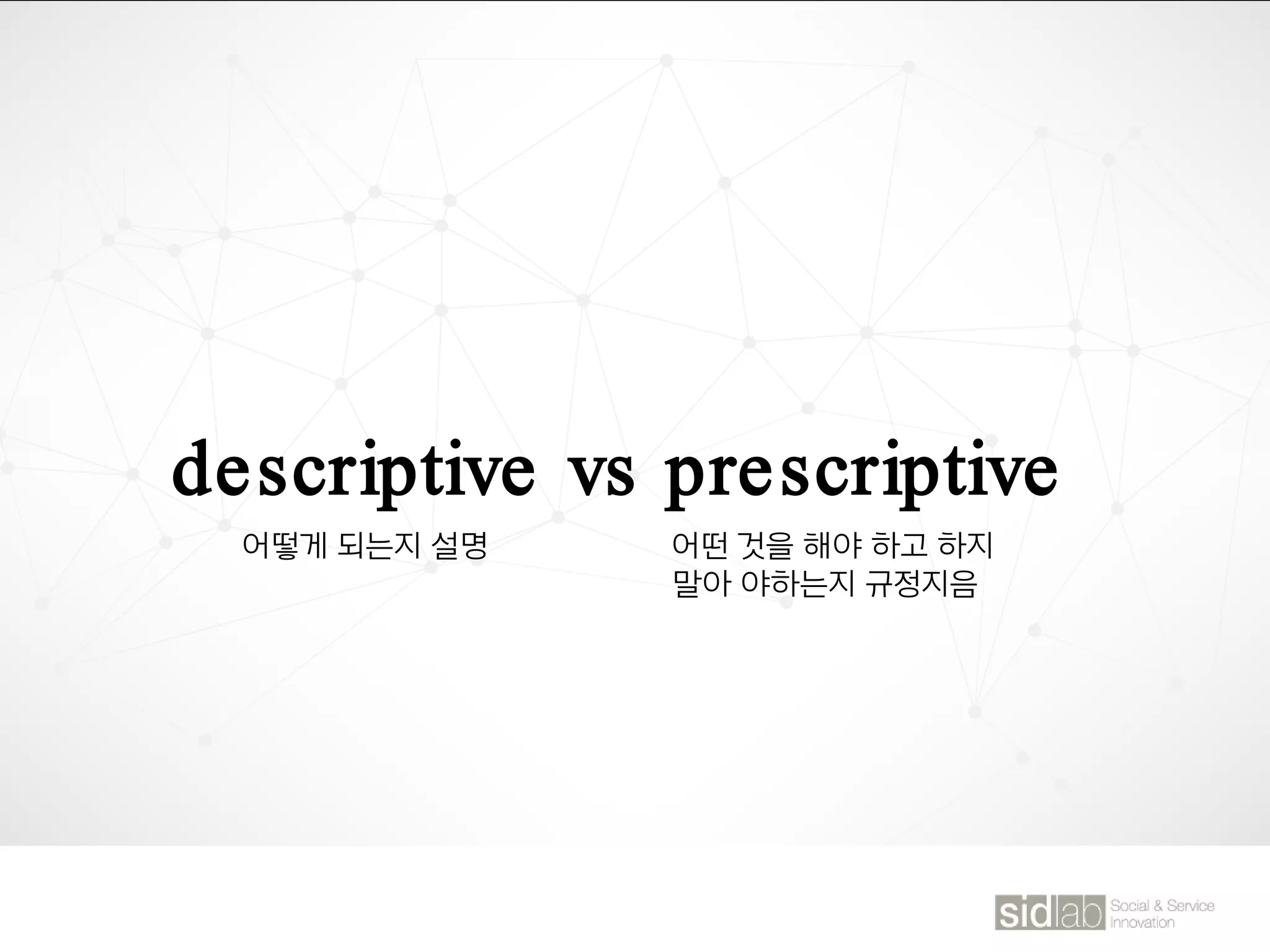
descriptive vs prescriptive
어떻게 되는지 설명 어떤 것을 해야 하고 하지
말아 야하는지 규정지음
input outputprocess
Hugh Dubberly(2008)
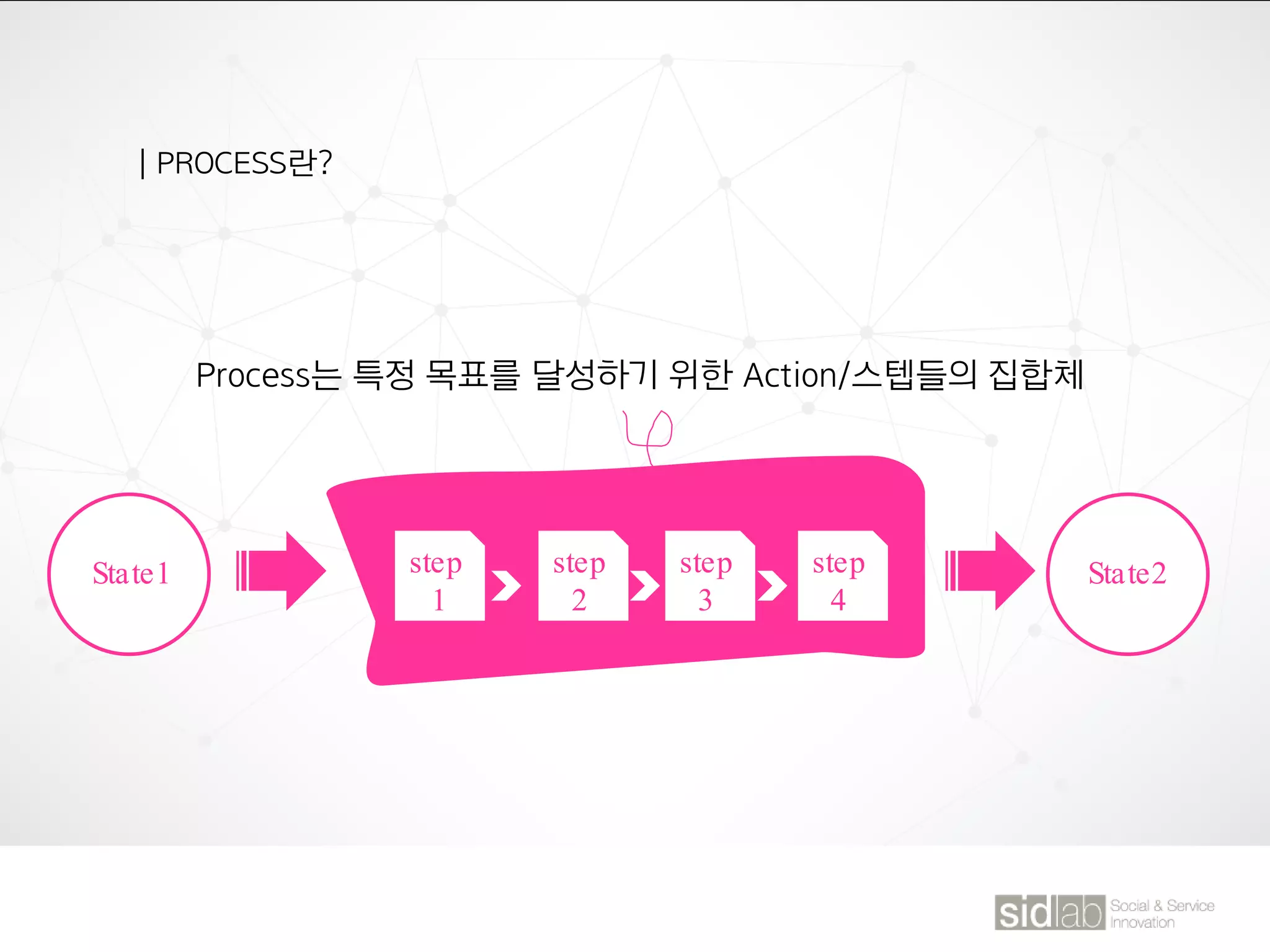
| PROCESS란?
| PROCESS란?
State1 State2step
1
step
2
step
3
step
4
Process는 특정 목표를 달성하기 위한 Action/스텝들의 집합체
initial
state
Future
stateprocess
현재상태
Current situation
변환 기능
Transformation function
원하는 상태
Desired situation
| Design의 기본적인 모델
Doblin (1987)
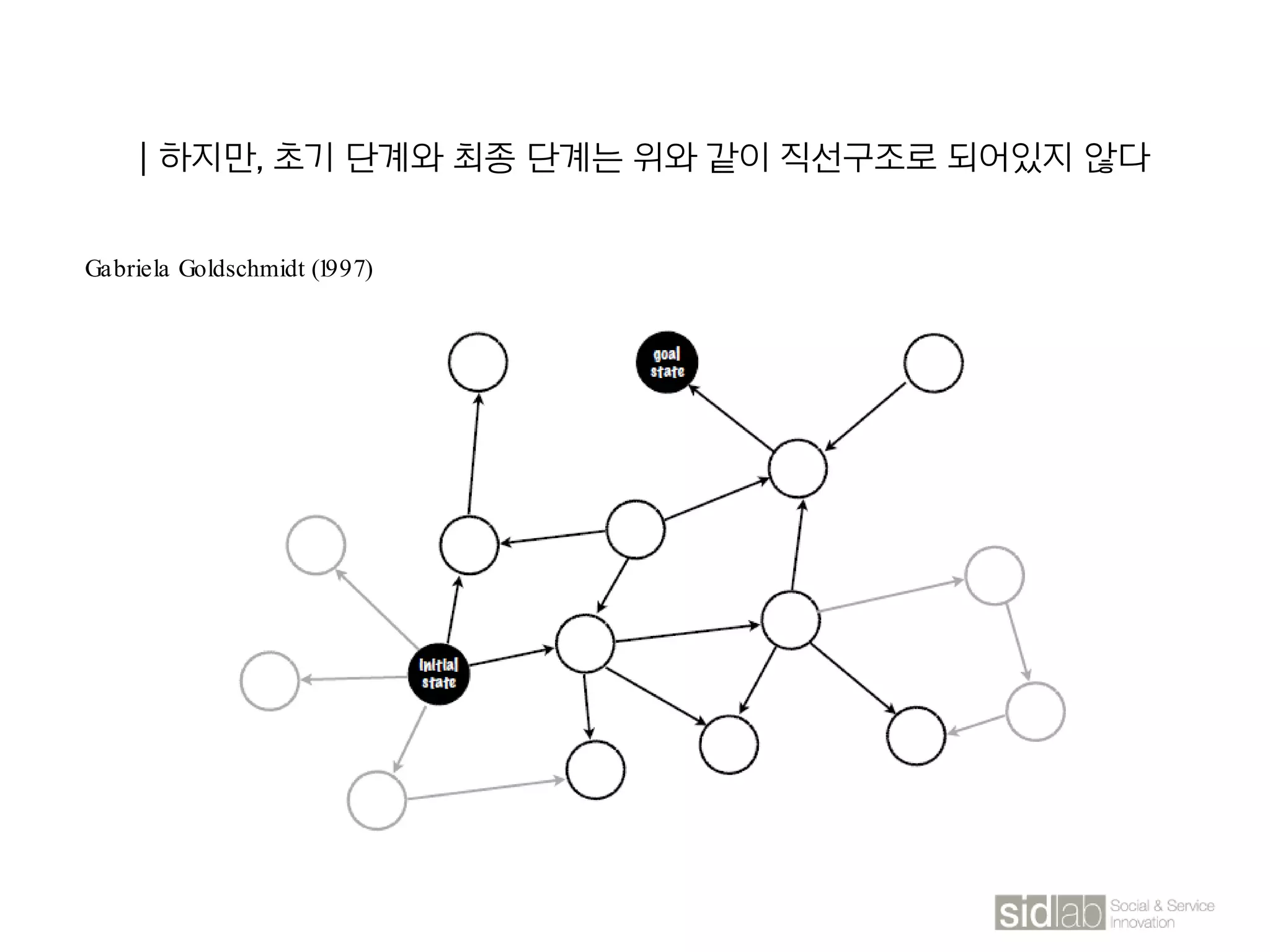
| 하지만, 초기 단계와 최종 단계는 위와 같이 직선구조로 되어있지 않다
Gabriela Goldschmidt (1997)
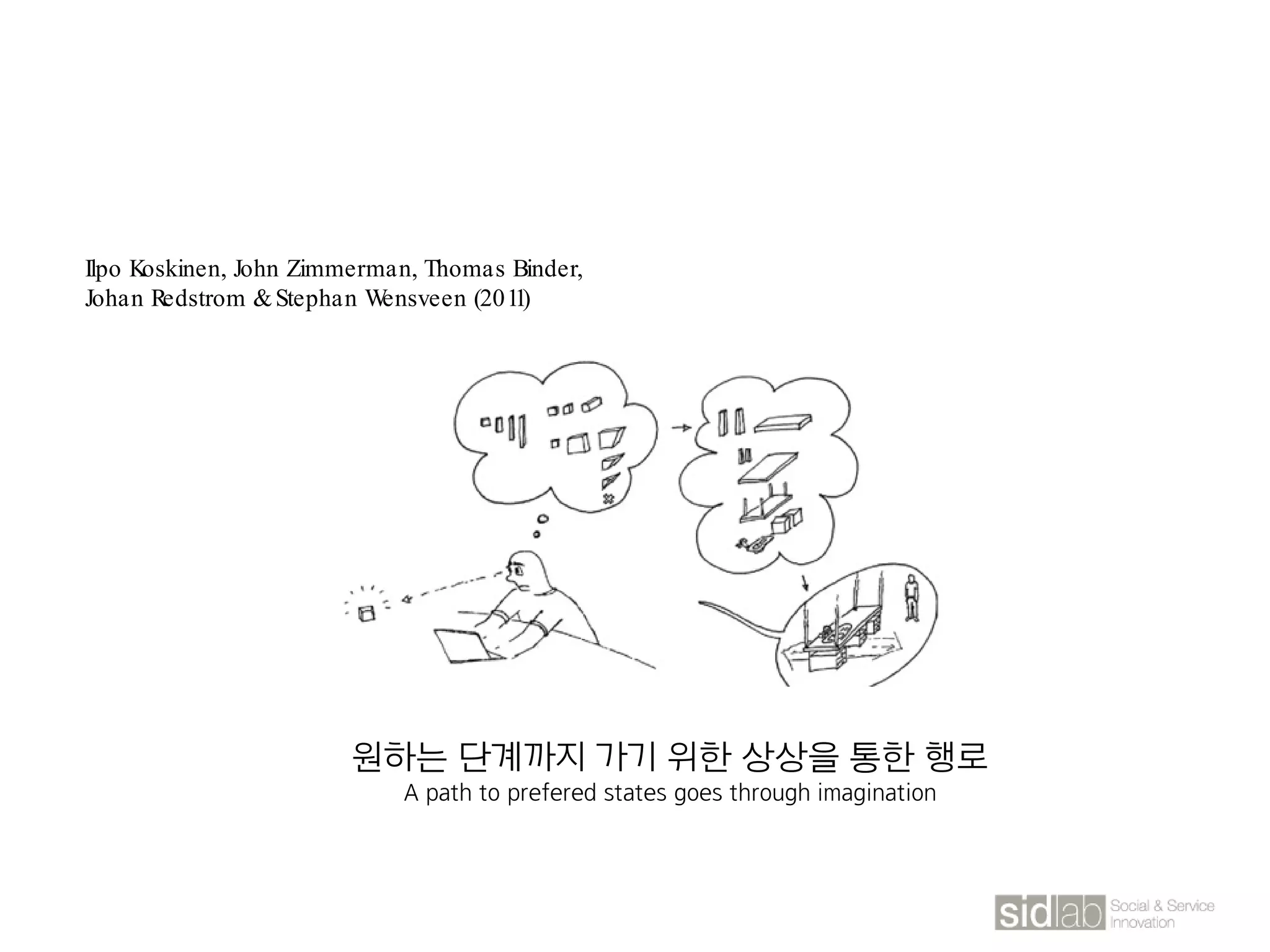
원하는 단계까지 가기 위한 상상을 통한 행로
A path to prefered states goes through imagination
Ilpo Koskinen, John Zimmerman, Thomas Binder,
Johan Redstrom &Stephan Wensveen (2011)
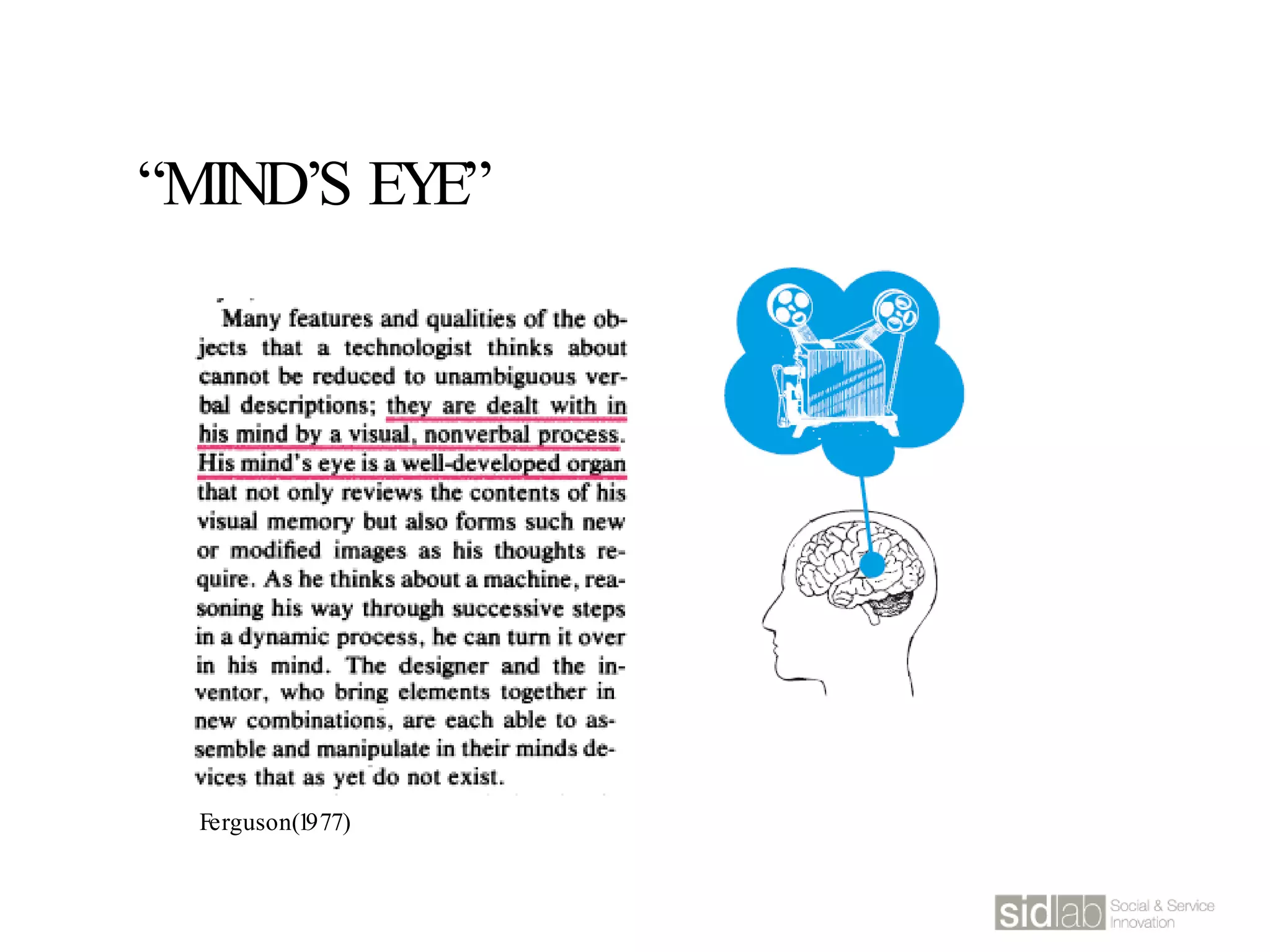
“MIND’S EYE”
Ferguson(1977)
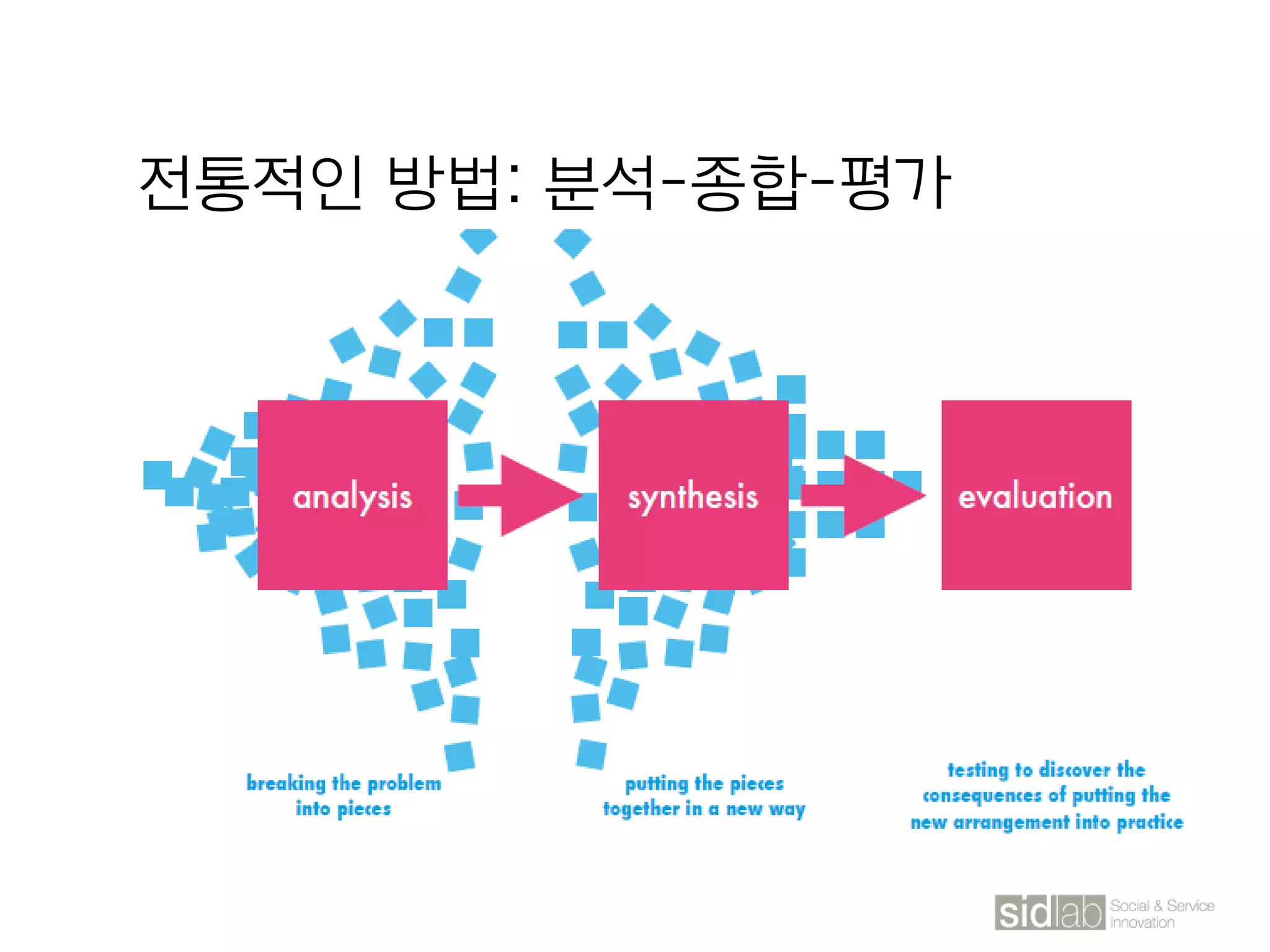
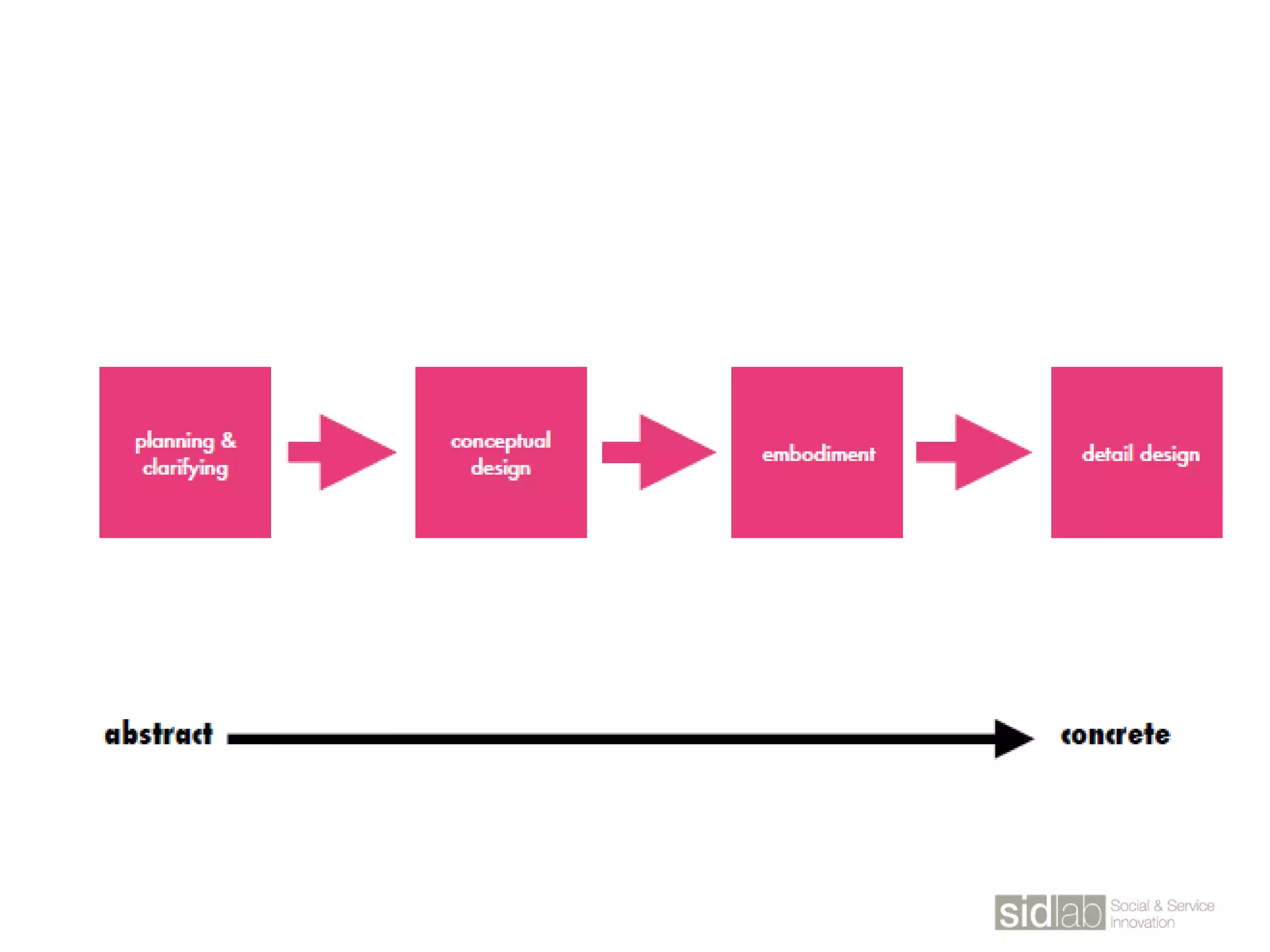
전통적인 방법: 분석-종합-평가
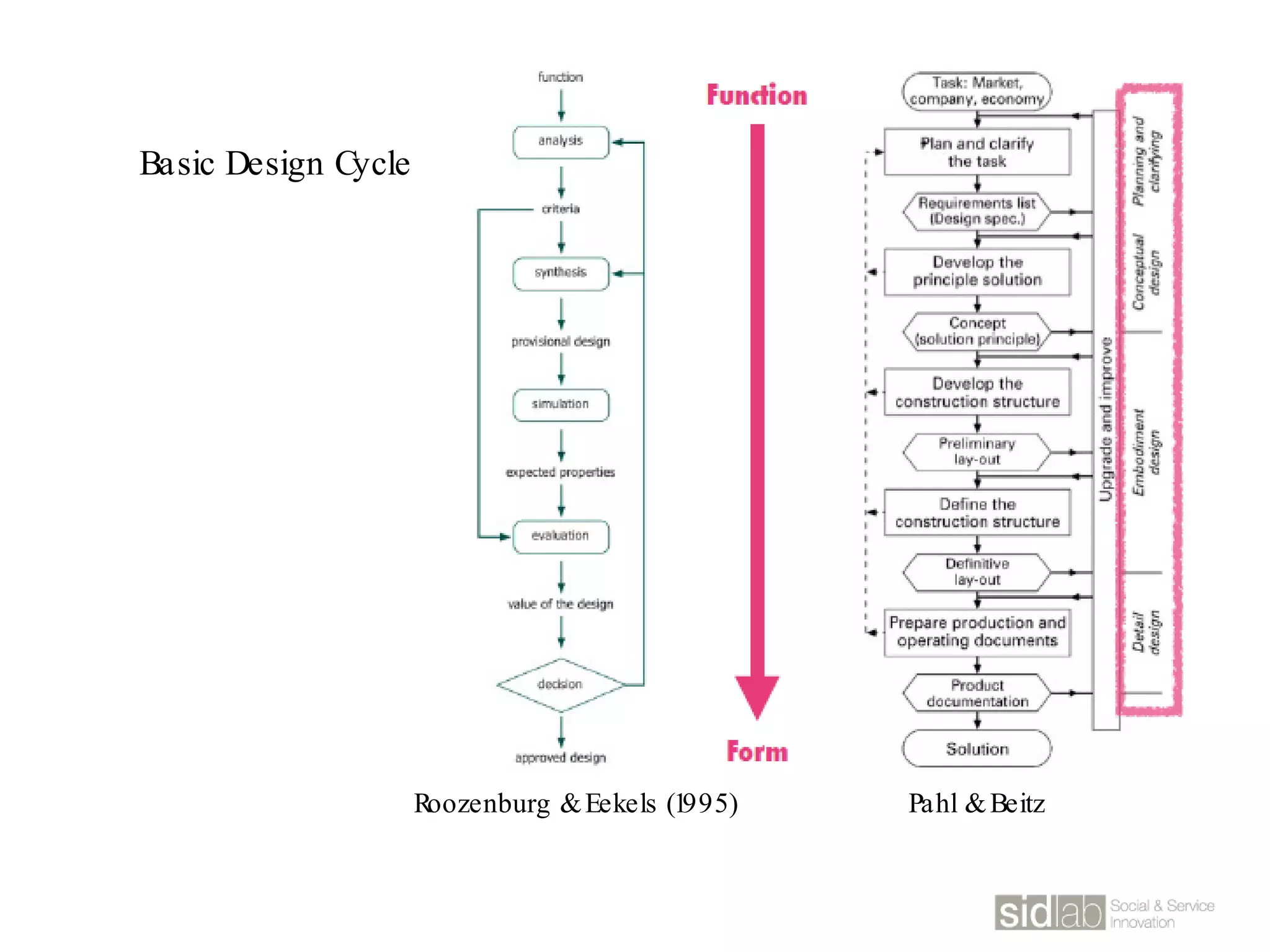
Basic Design Cycle
Pahl &BeitzRoozenburg &Eekels (1995)
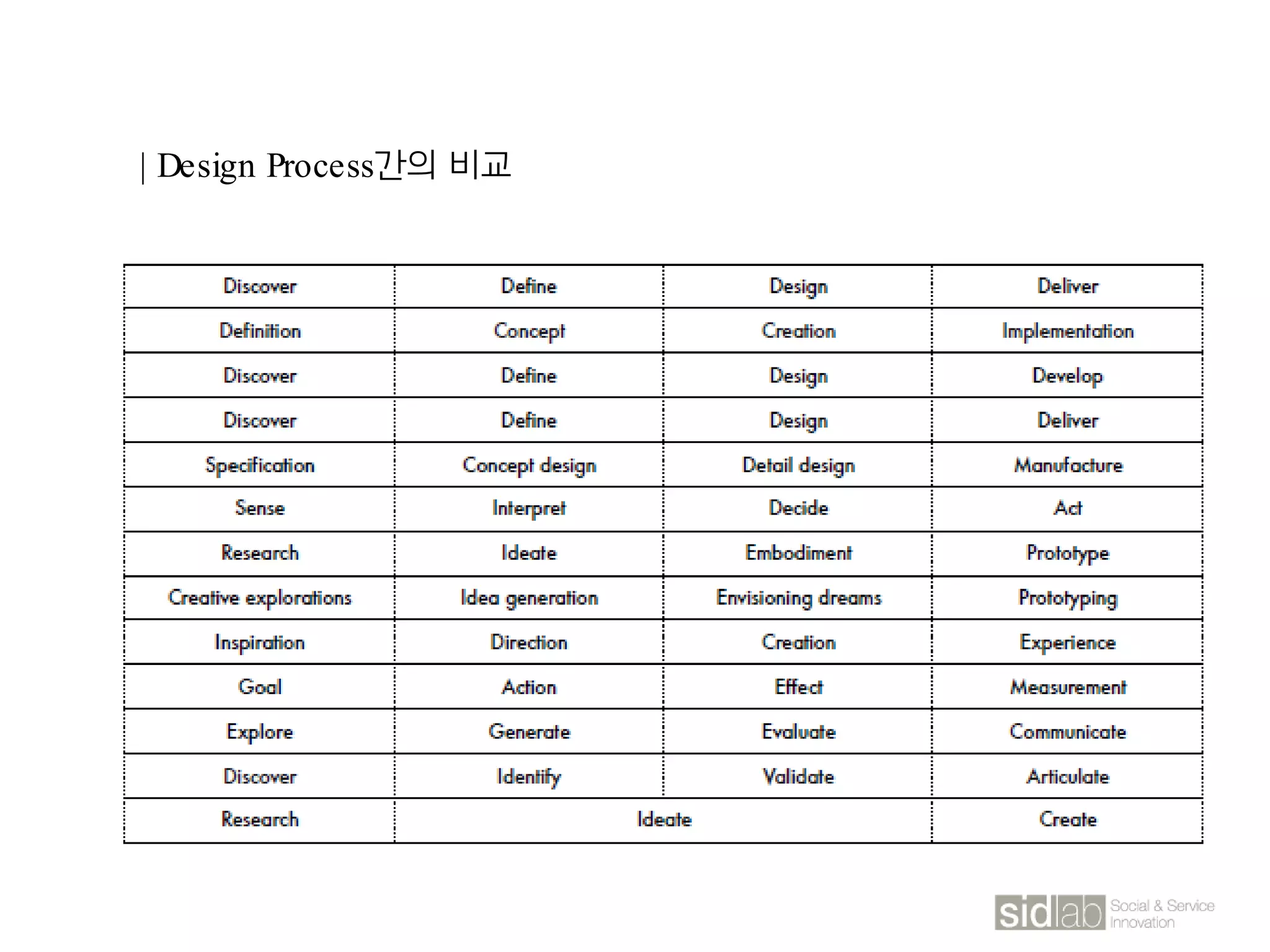
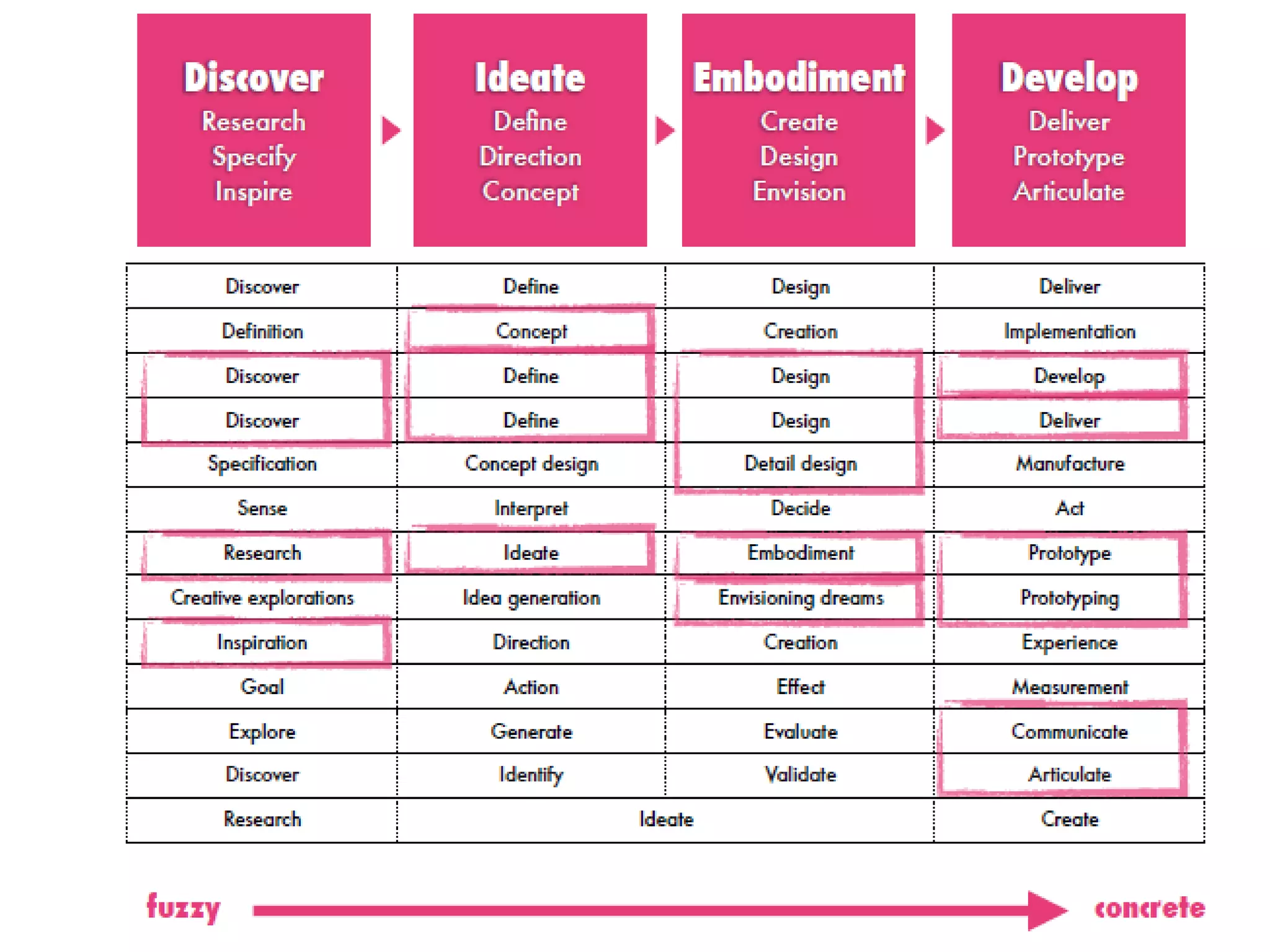
| Design Process간의 비교
| Design Process간의 비교
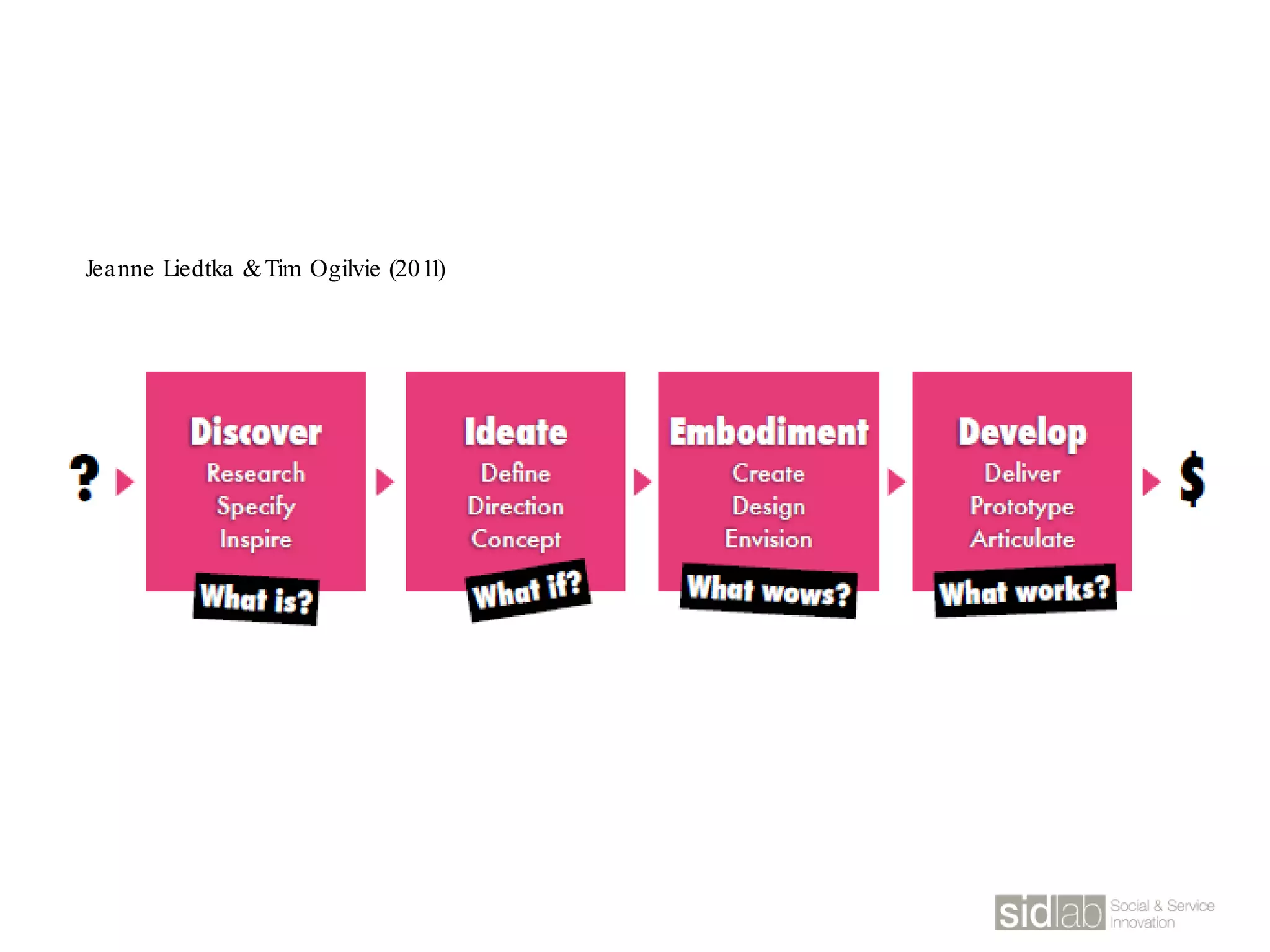
Jeanne Liedtka &Tim Ogilvie (2011)
| KGIT 뉴미디어 경영학과
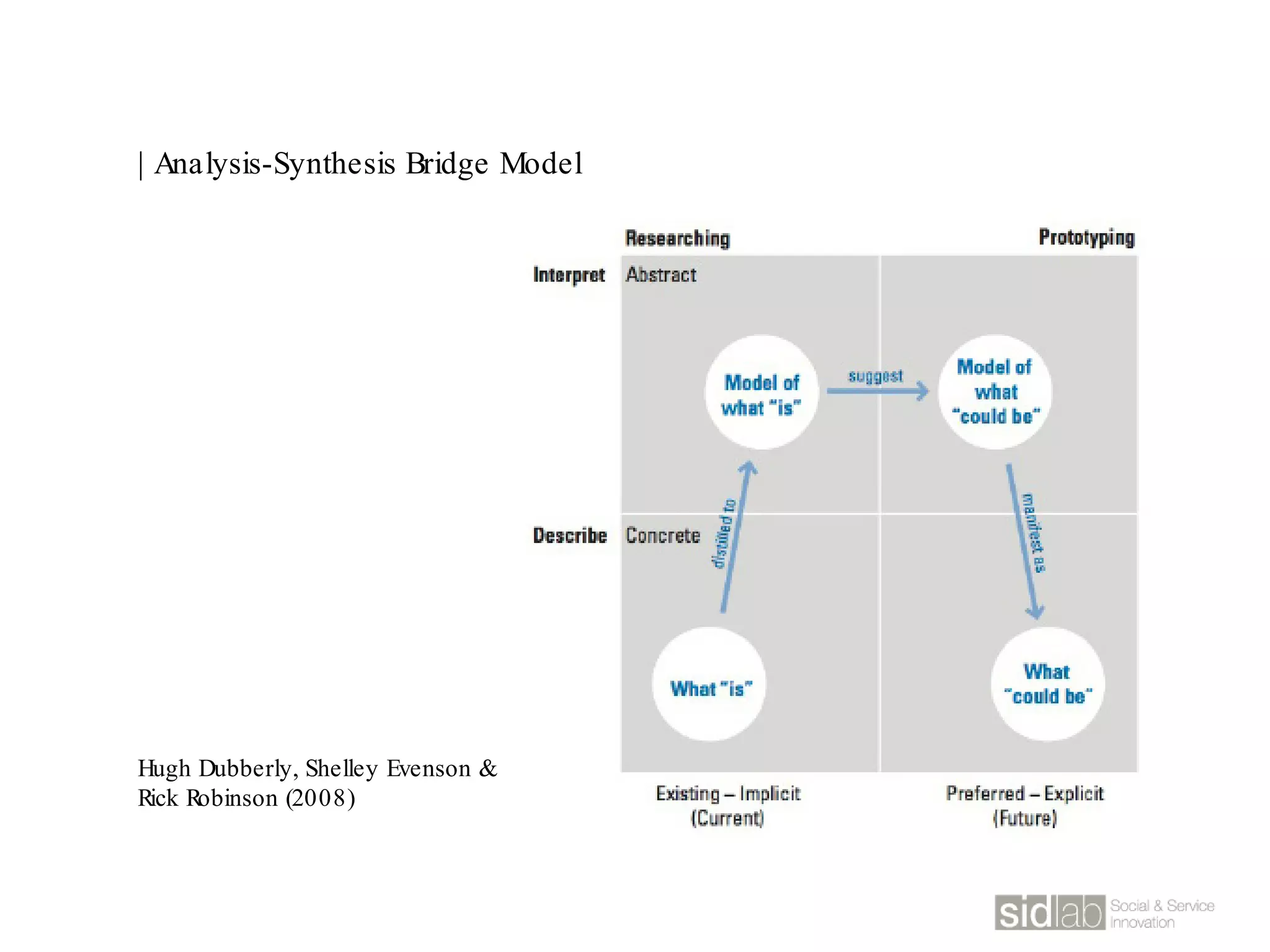
| Analysis-Synthesis Bridge Model
Hugh Dubberly, Shelley Evenson &
Rick Robinson (2008)
https://www.youtube.com/watch?v=WrdSkqRypsg
https://www.youtube.com/watch?v=a7sEoEvT8l8
Design Thinking관련 동영상 보기
Koskinen, I., Zimmerman, J., Binder, T., Redstrom, J., &Wensveen, S. (2011).Design research through practice:
From the lab, field, and showroom. Elsevier.
Nelson, H. G., &Stolterman, E. (2003). The design way: Intentional change in an unpredictable world:
Foundations and fundamentals of design competence. Educational Technology.
Lawson, B., &Dorst, K. (2013). Design expertise. Routledge.
Simon, H. A. (1969). The sciences of the artificial. Cambridge, MA.
Jones, J. C. (1992). Design methods. John Wiley &Sons.
REFERNECES

[DT2015] CLASS02

  • 2.
    TODAY’S AGENDA BASICS OFDESIGN THINKING CLASS 02
  • 3.
  • 6.
    DESIGN의 정의에 들어갈만한 세개의 단어(키워드)를 한번 적어보세요.
  • 7.
    Design is todesign a design to produce a design General Concept action a plan or intention the outcome/ result noun verb noun noun John Heskett(2005)
  • 8.
    Design is aprofession that is concerned with the creation of products, systems, communications and services that satisfy human needs, improve people’s lives and do all of this with respect for the welfare of the natural environment. Charles Owen(2004)
  • 9.
    Designers are peoplewho are paid to produce visions of better futures and make those things happen. Koskinen, Zimmerman, Binder, Redstrom &Wensveen (2011)
  • 10.
    Design is theability to imagine that-which- does-not-yet-exist, to make it appear in concrete form as a new, purposeful addition to the real world. Harold Nelson &Erik Stolterman (2002)
  • 11.
    Design is aboutmaking decisions, often in the face of uncertainty Joseph Zinter (2012)
  • 12.
    Designers typically producenovel unexpected solutions, tolerate uncertainty, work with incomplete information, apply imagination and constructive forethought to practical problems and use drawings and other modelling media as means of problem solving Bryan Lawson &Kees Dorst (2009)
  • 13.
    initial state Future stateprocess 현재상태 Current situation 변환 기능 Transformationfunction 원하는 상태 Desired situation | Design의 기본적인 모델 Doblin (1987)
  • 14.
    John Chris Jones(1970) JohnChris Jones Design Methods: Seeds of human future (1970)
  • 15.
    Harold Nelson &ErikStolterman (2002/2012) CHANGE IS DIFFERENCE • CHANGE OF DIFFERENCE IS PROCESS • CHANGE OF PROCESS IS EVOLUTION • CHANGE OF EVOLUTION IS DESIGN CHANGE = DESIGN
  • 16.
    John Christopher Jones(2002) thoughts and actions intended to change thoughts and actions
  • 17.
    현존하는 상황에서 원하는 상황으로변화를 이루기 위해서는 미래가 지니고 있는 불확실성을 다루기 위해 기획을 도모할 수 있는 상상력이 꼭 필요하다
  • 18.
    Design as... • Amixture of creativity and analyses • Problem solving • Evolution • The creation of solutions to problems • Integrating into a coherent whole • A fundamental human activity • Etc... Bryan Lawson &Kees Dorst (2009)
  • 19.
    What is DesignActivity 02.
  • 20.
    “Design is theperforming of a very complicated act of faith” John Christopher Jones (1966/1970)
  • 21.
    “The fundamental problemis that designers are obliged to use current information to predict a future state that will not come about unless their predictions are correct.” “The designer must be able to predict the ultimate effects of their proposed design as well as specifying the actions that are needed to bring these effects about.” John Christopher Jones (1966/1970)
  • 22.
    |디자인은 제품에 관한것이 아니다. 오히려 디자인을 통해 미치고자 한 영향 그것에 관해서다. Business “경쟁사우위” User “만족스러운 경험” Ecology/Society ”친생태화적/공정성”
  • 23.
    |디자인은 제품에 관한것이 아니다. 오히려 디자인을 통해 미치고자 한 영향 그것에 관해서다. We cannot know what the unintended consequences of a design will be, and we cannot know, ahead of time, the full, systemic effects of a design implementation.
  • 24.
  • 26.
    het beste ideevan nederland https://www.youtube.com/user/idea28ed/videos https://www.youtube.com/watch?v=p9_iR4IRsXE
  • 28.
    “Design ability is possessedby everyone” Nigel Cross (2011)
  • 29.
    "Everyone can –and does – design. We all design when we plan for something new to happen, whether that might be a new version of a recipe, a new arrangement of the living room furniture, or a new lay tour of a personal web page. […] So design thinking is something inherent within human cognition; it is a key part of what makes us human.” (p. 3) Nigel Cross (2011)
  • 31.
    "Everyone designs whodevises courses of action aimed at changing existing situations into preferred ones." Herbert Simon (1969)
  • 32.
    |그럼 우리는 왜디자인을 하는 것인가? “We must design, because we are not perfect.” “Like Hephaistos, we have to design because we want to survive, but humans also seem to have a will for continuous improvement and development.” “On a more abstract level, we are drawn to design because we may feel a lack of wholeness—we do not find the world in a condition that is satisfying or fulfilling for us. And, ultimately, we are motivated to design because it is an accessible means to enlightenment, to bring order, and to give meaning to our lives.” Harold Nelson &Erik Stolterman (2002/2012)
  • 33.
    |그럼 우리는 왜디자인을 하는 것인가? "Designers are change agents in society. Their goal is to improve the human condition, in all its aspects, through physical change." Harold Nelson &Erik Stolterman (2002/2012)
  • 34.
  • 35.
  • 36.
  • 37.
  • 38.
    Harold Nelson &ErikStolterman (2002) “Design, as a unique way of thinking and acting, does not have a long, well-developed scholarly history. Other intellectual traditions, such as science and art, have enjoyed thousands of years of considered thought...”
  • 41.
    SCIENCE VS DESIGN “Thenatural sciences are concerned with how things are.” “Design is concerned with how things ought to be, with devising artifices to attain goals.”
  • 43.
  • 44.
    Engineering Design Art ExpressiveFunctional 에러에대한 큰 리스크 에러에 대한 작은 리스크 사람이 죽을 수 있다 사람이 다칠 수 있다 사람이 공포스러울 수 있다 사람이 헷깔 릴 수 있다 사람이 짜증날 수 있다 Prescriptive use of methods “This is how you should design to avoid errors” Descriptive use of methods “This is how I make my design” Idiosyncratic or secret methods “I am not going to tell you how I do it... Only the inner circle of specialists know how the magic works”
  • 45.
    descriptive vs prescriptive 어떻게되는지 설명 어떤 것을 해야 하고 하지 말아 야하는지 규정지음
  • 46.
  • 47.
    | PROCESS란? State1 State2step 1 step 2 step 3 step 4 Process는특정 목표를 달성하기 위한 Action/스텝들의 집합체
  • 48.
    initial state Future stateprocess 현재상태 Current situation 변환 기능 Transformationfunction 원하는 상태 Desired situation | Design의 기본적인 모델 Doblin (1987)
  • 49.
    | 하지만, 초기단계와 최종 단계는 위와 같이 직선구조로 되어있지 않다 Gabriela Goldschmidt (1997)
  • 50.
    원하는 단계까지 가기위한 상상을 통한 행로 A path to prefered states goes through imagination Ilpo Koskinen, John Zimmerman, Thomas Binder, Johan Redstrom &Stephan Wensveen (2011)
  • 51.
  • 52.
  • 53.
    Basic Design Cycle Pahl&BeitzRoozenburg &Eekels (1995)
  • 55.
  • 56.
  • 57.
    Jeanne Liedtka &TimOgilvie (2011)
  • 58.
    | KGIT 뉴미디어경영학과
  • 59.
    | Analysis-Synthesis BridgeModel Hugh Dubberly, Shelley Evenson & Rick Robinson (2008)
  • 60.
  • 61.
    Koskinen, I., Zimmerman,J., Binder, T., Redstrom, J., &Wensveen, S. (2011).Design research through practice: From the lab, field, and showroom. Elsevier. Nelson, H. G., &Stolterman, E. (2003). The design way: Intentional change in an unpredictable world: Foundations and fundamentals of design competence. Educational Technology. Lawson, B., &Dorst, K. (2013). Design expertise. Routledge. Simon, H. A. (1969). The sciences of the artificial. Cambridge, MA. Jones, J. C. (1992). Design methods. John Wiley &Sons. REFERNECES