YUBO KOU
Florida State University
A PRACTICE-LED ACCOUNT OF
THE CONCEPTUAL EVOLUTION
OF UX KNOWLEDGE
COLIN M. GRAY
Purdue University
UX is an
emerging,
interdisciplinary
context
0
10
20
30
40
50
60
70
80
90
100
2004-01
2004-07
2005-01
2005-07
2006-01
2006-07
2007-01
2007-07
2008-01
2008-07
2009-01
2009-07
2010-01
2010-07
2011-01
2011-07
2012-01
2012-07
2013-01
2013-07
2014-01
2014-07
2015-01
2015-07
2016-01
2016-07
2017-01
2017-07
2018-01
2018-07
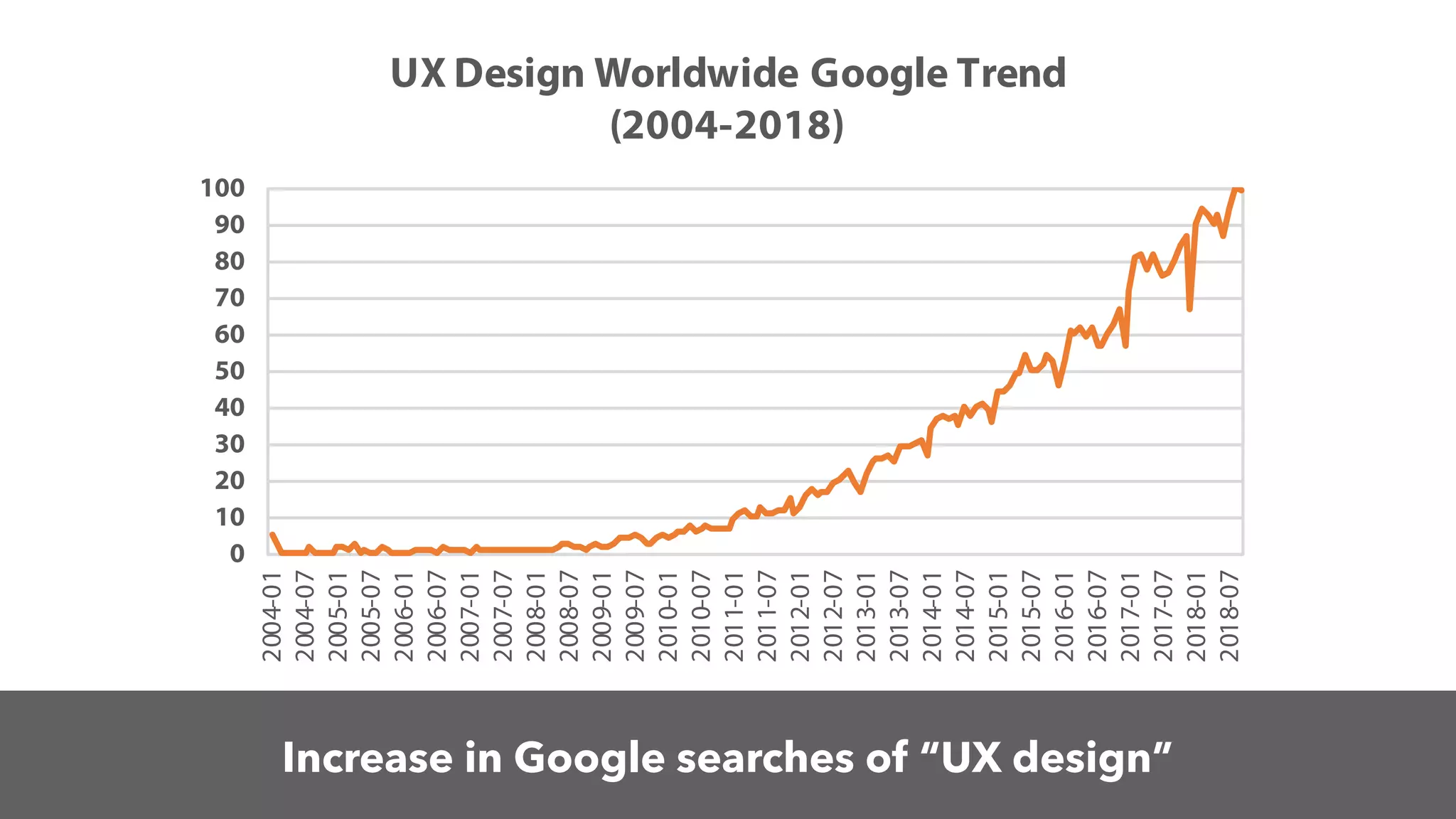
UX Design Worldwide Google Trend
(2004-2018)
Increase in Google searches of “UX design”
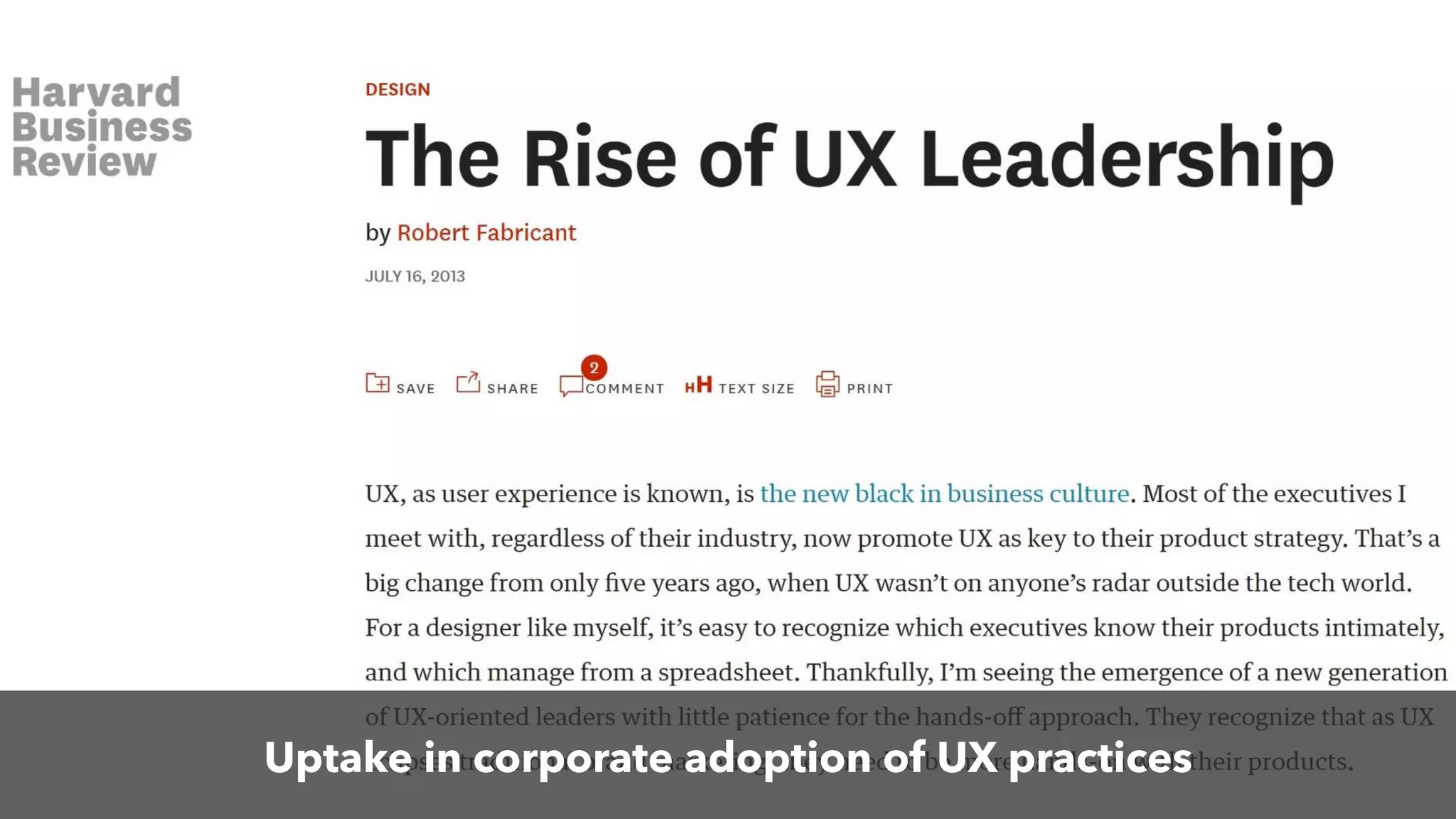
Uptake in corporate adoption of UX practices
Rapidly expanding (and diverse) program offerings
User experience: A concept without consensus? Exploring practitioners’
perspectives through an international survey
Carine Lallemand a,b,⇑
, Guillaume Gronier a
, Vincent Koenig b
a
Public Research Centre Henri Tudor, 29 Avenue John F. Kennedy, L-1855 Luxembourg, Luxembourg
b
University of Luxembourg, ECCS Research Unit, Route de Diekirch, L-7220 Walferdange, Luxembourg
a r t i c l e i n f o
Article history:
Available online 17 November 2014
Keywords:
User experience
Survey
Definition
Concept
Practitioners
a b s t r a c t
For more than a decade, User Experience (UX) has grown into a core concept of Human–Computer Inter-
action (HCI). Practitioners and researchers from a wide range of disciplines are daily working with this
concept. However, despite many attempts to understand, define and scope UX, one may still wonder
whether a consensus has been reached on this concept. In a willingness to address the complexity of this
research topic and bring the concept of UX to maturity, a replication of an international survey has been
conducted. The main goal of the present study is to get a better understanding of practitioners’ view-
points on the notion of UX and to analyze potential evolutions over time in the understanding and prac-
tical use of the concept. As both practical and theoretical implications of UX are of the greatest
Contents lists available at ScienceDirect
Computers in Human Behavior
journal homepage: www.elsevier.com/locate/comphumbeh
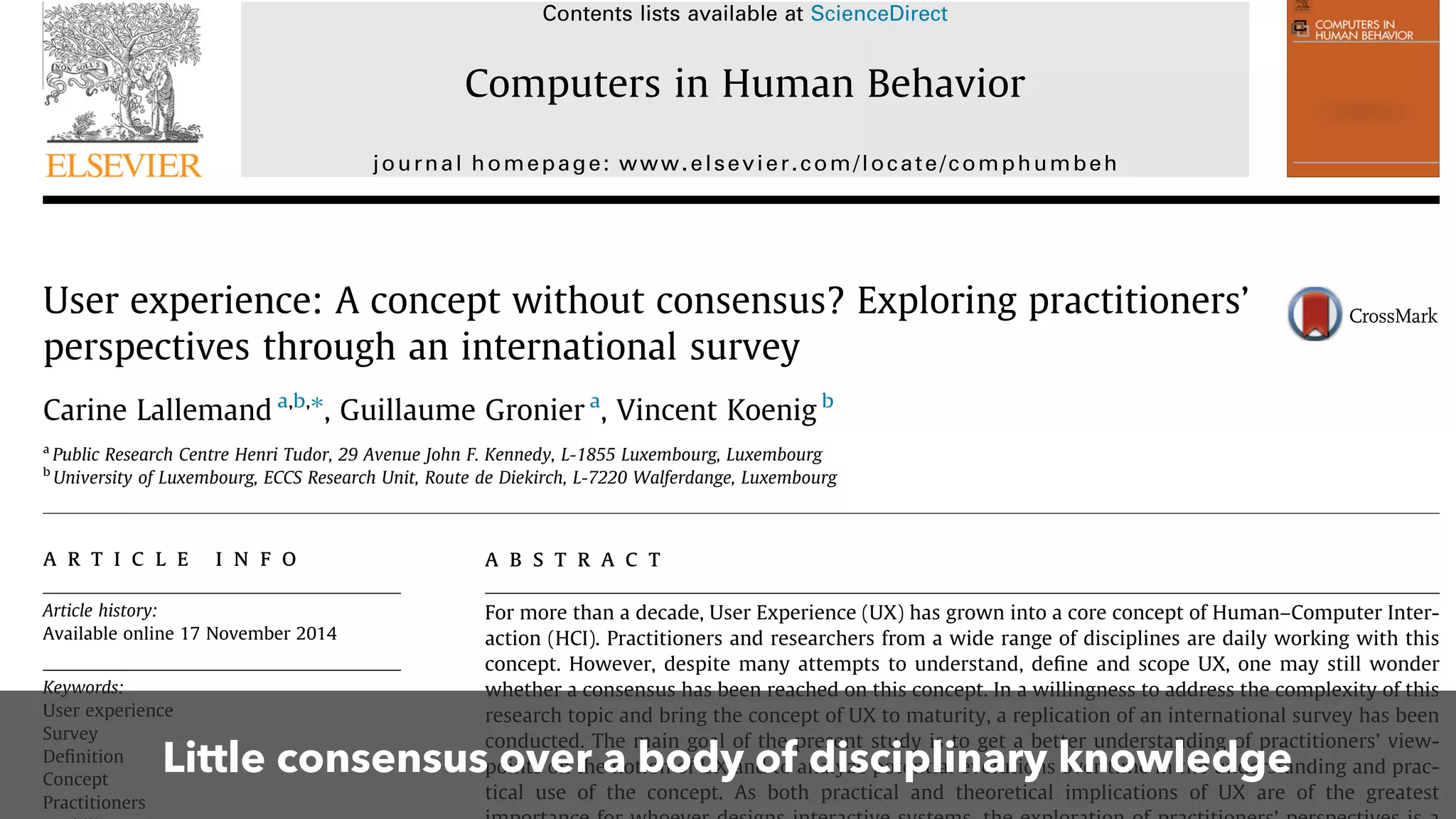
Little consensus over a body of disciplinary knowledge
GAP
RESEARCH/PRACTICEACADEMIA
PRACTICE
How do practitioners develop and 

maintain their occupational competency?
What can we do as educators to inform 

students’ professional development?
How do practitioners develop and 

maintain their occupational competency?
Prior Work on Defining and Demarcating UX
Survey of UX researchers and practitioners 

(Law et al., 2009; Lallemand et al., 2014)
Interviews with experiences designers and university students 

(Tokkonen and Saariluoma, 2013)
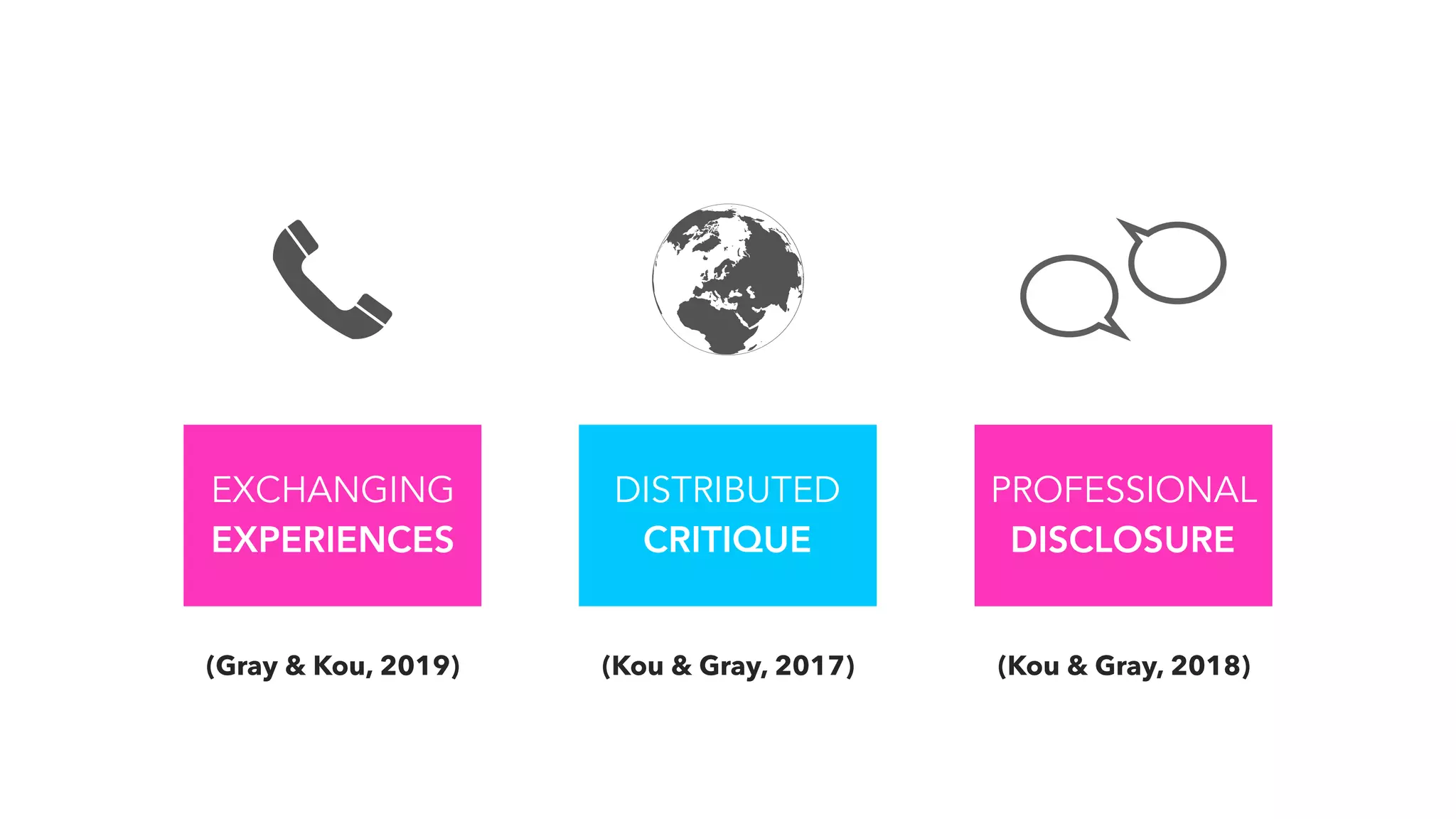
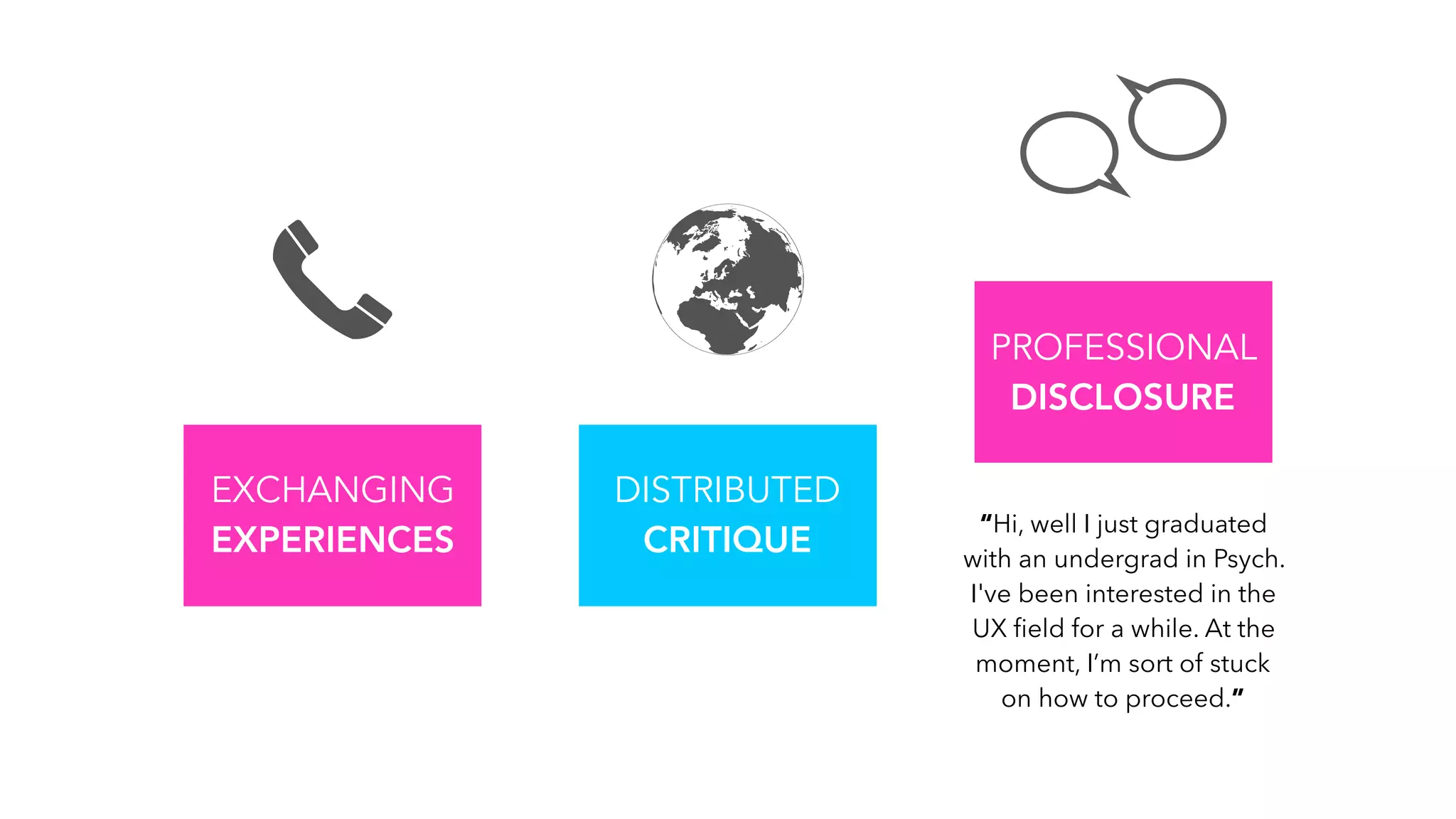
EXCHANGING 

EXPERIENCES
DISTRIBUTED

CRITIQUE
PROFESSIONAL 

DISCLOSURE
(Kou & Gray, 2017) (Kou & Gray, 2018)(Gray & Kou, 2019)
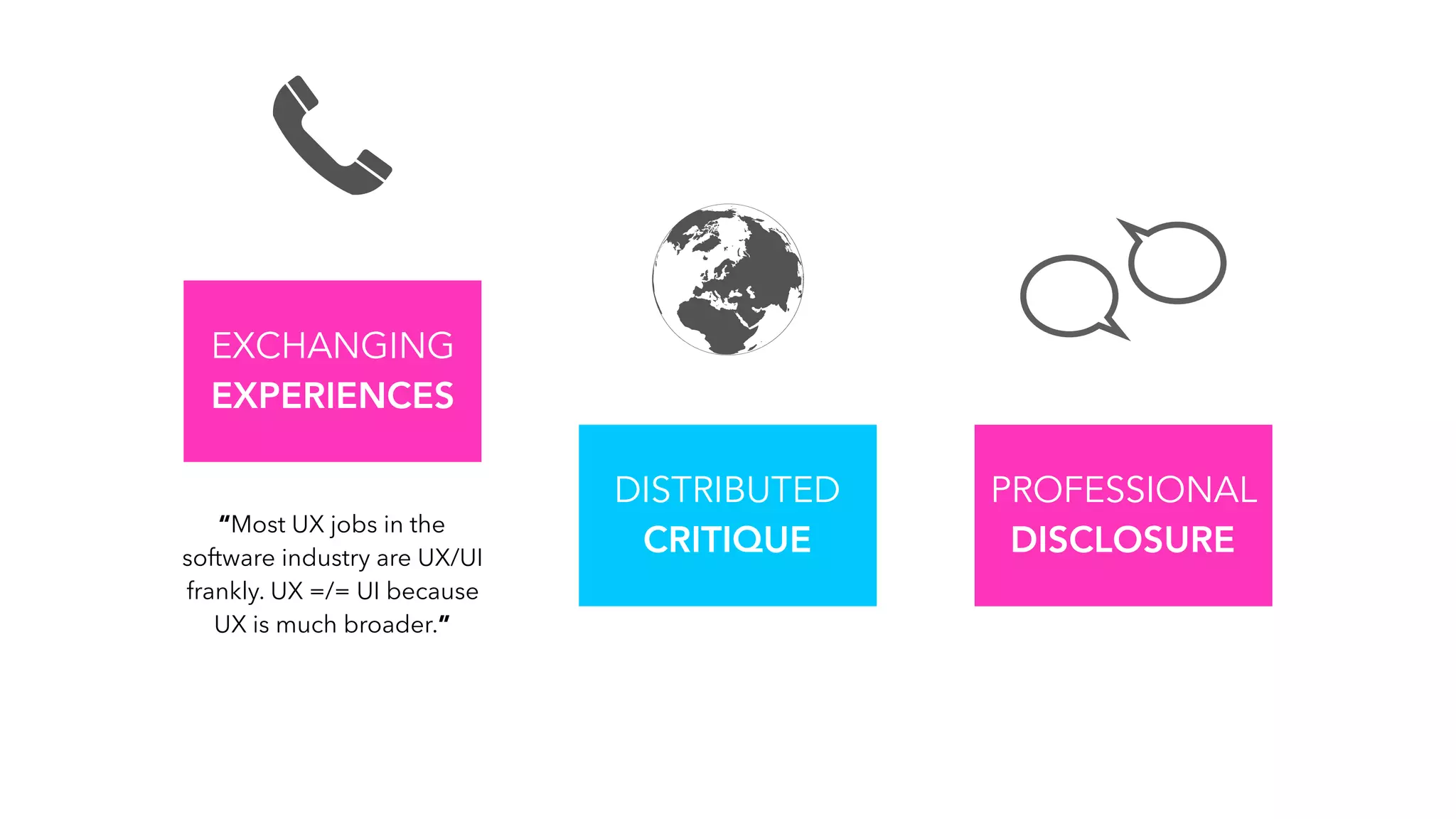
EXCHANGING 

EXPERIENCES
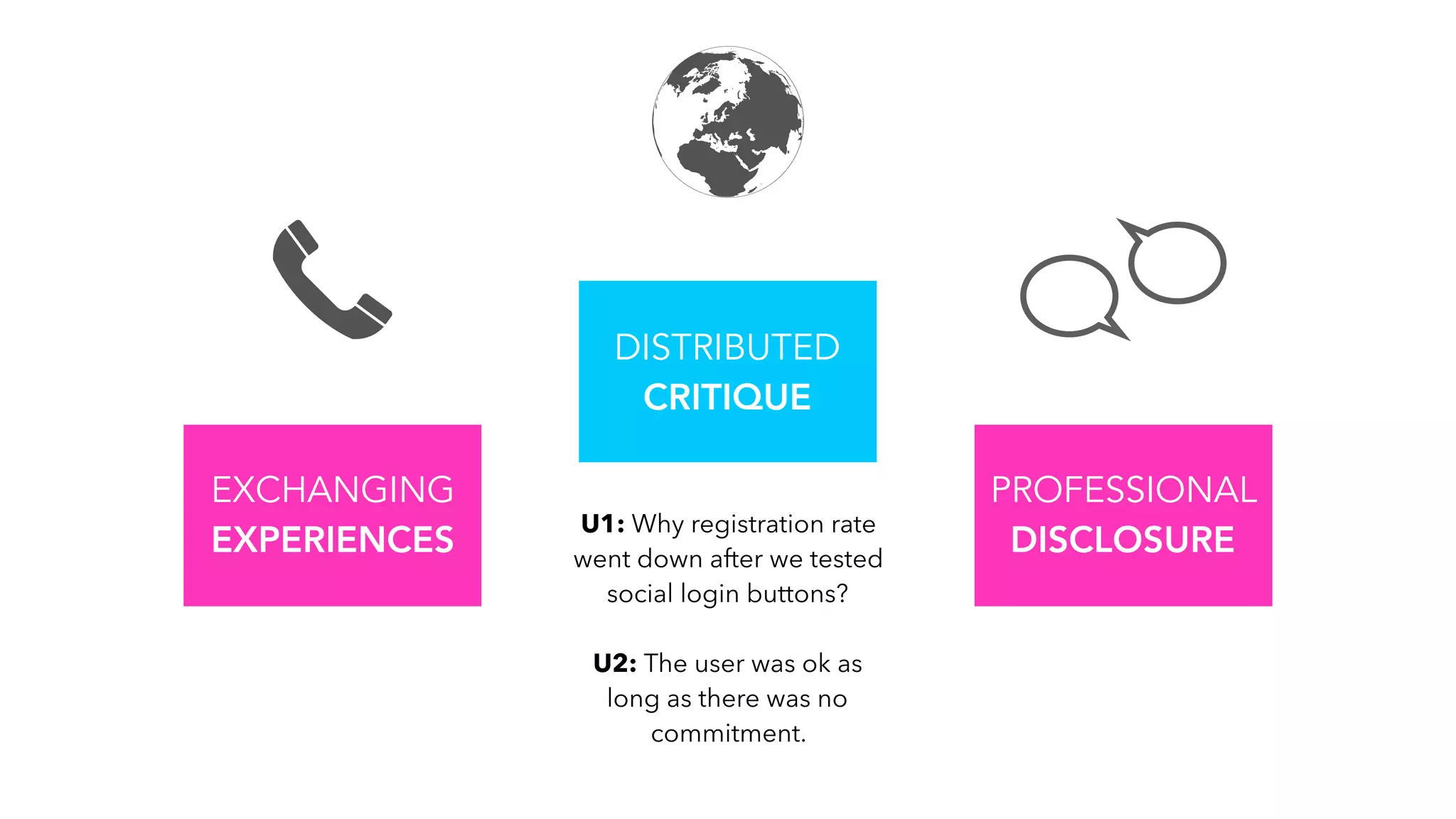
DISTRIBUTED

CRITIQUE
PROFESSIONAL 

DISCLOSURE
“Most UX jobs in the
software industry are UX/UI
frankly. UX =/= UI because
UX is much broader.”
EXCHANGING 

EXPERIENCES
DISTRIBUTED

CRITIQUE
PROFESSIONAL 

DISCLOSURE
U1: Why registration rate
went down after we tested
social login buttons? 


U2: The user was ok as
long as there was no
commitment.
EXCHANGING 

EXPERIENCES
DISTRIBUTED

CRITIQUE
PROFESSIONAL 

DISCLOSURE
“Hi, well I just graduated
with an undergrad in Psych.
I've been interested in the
UX field for a while. At the
moment, I’m sort of stuck
on how to proceed.”
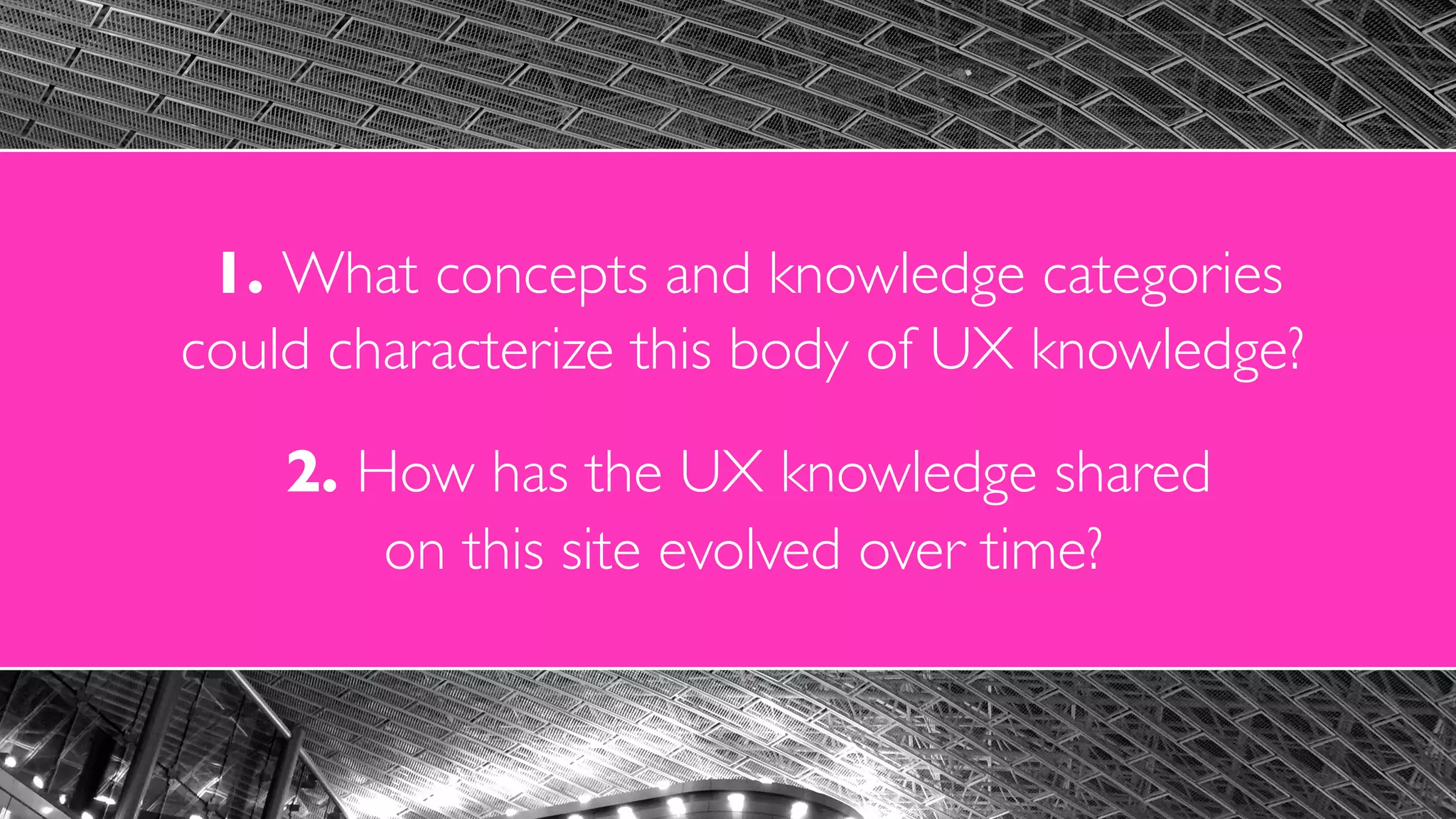
1. What concepts and knowledge categories 

could characterize this body of UX knowledge?
2. How has the UX knowledge shared 

on this site evolved over time?
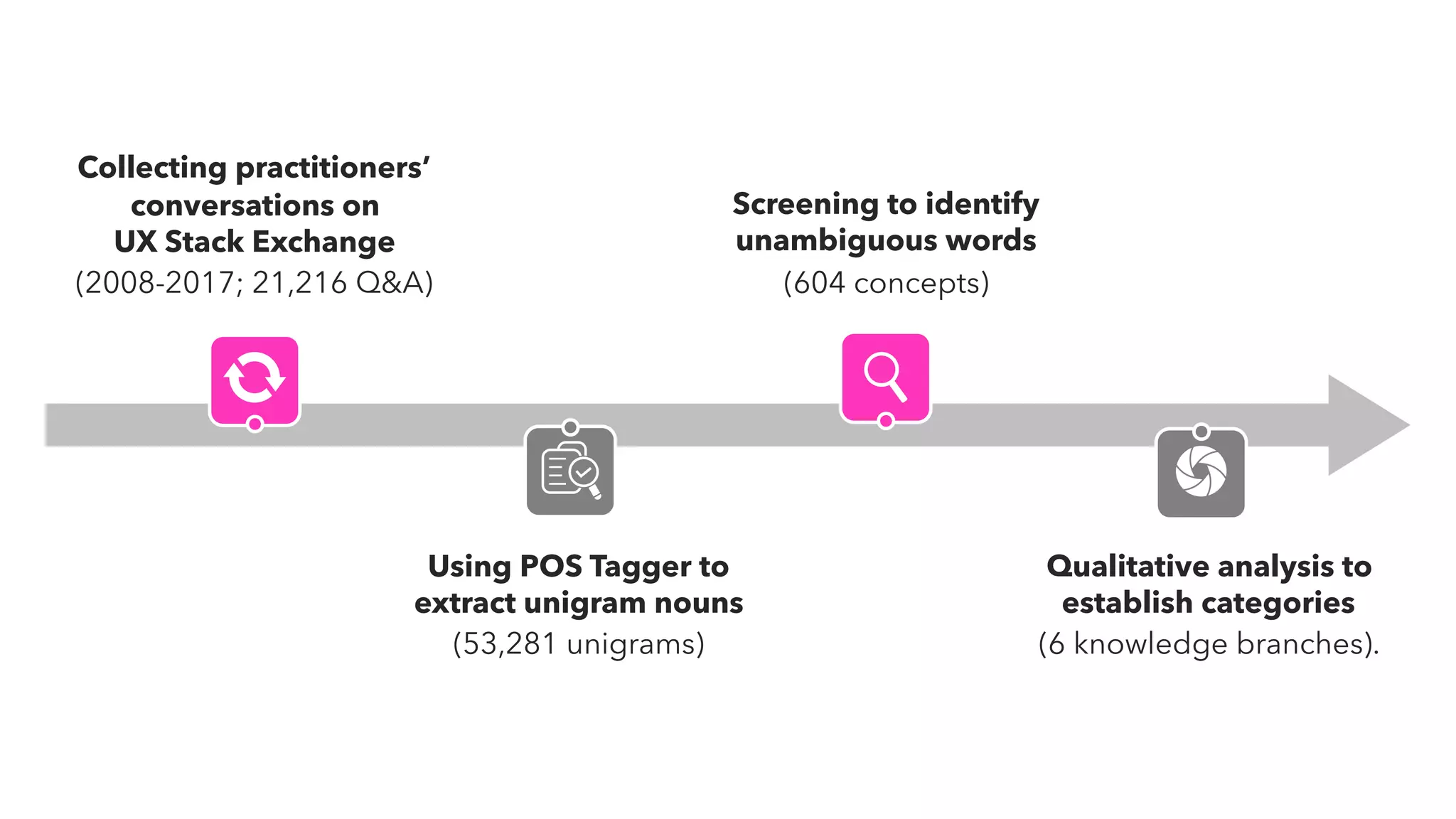
Using POS Tagger to
extract unigram nouns
(53,281 unigrams)
Collecting practitioners’
conversations on 

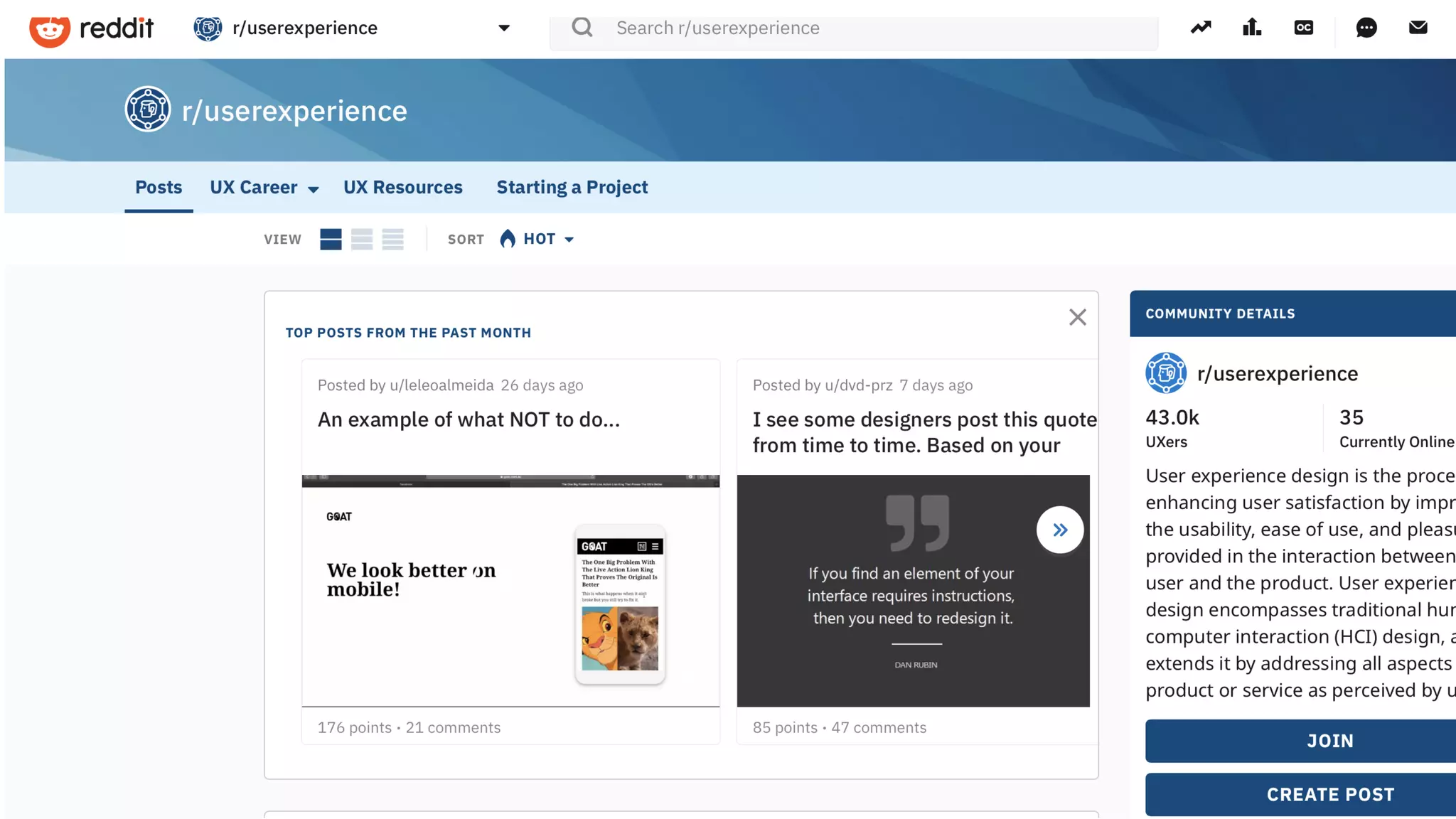
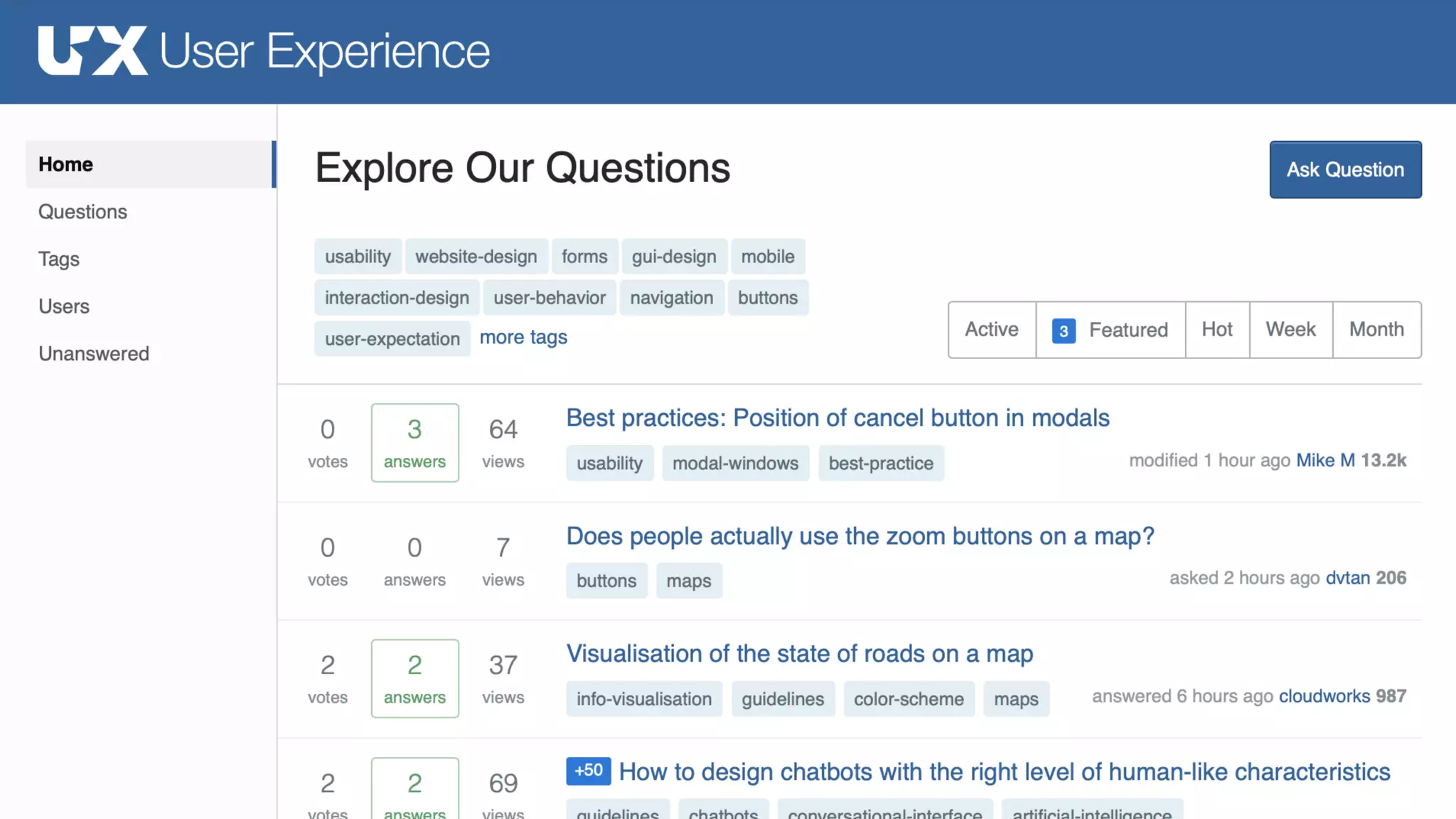
UX Stack Exchange
(2008-2017; 21,216 Q&A)
Qualitative analysis to
establish categories
(6 knowledge branches).
Screening to identify
unambiguous words
(604 concepts)
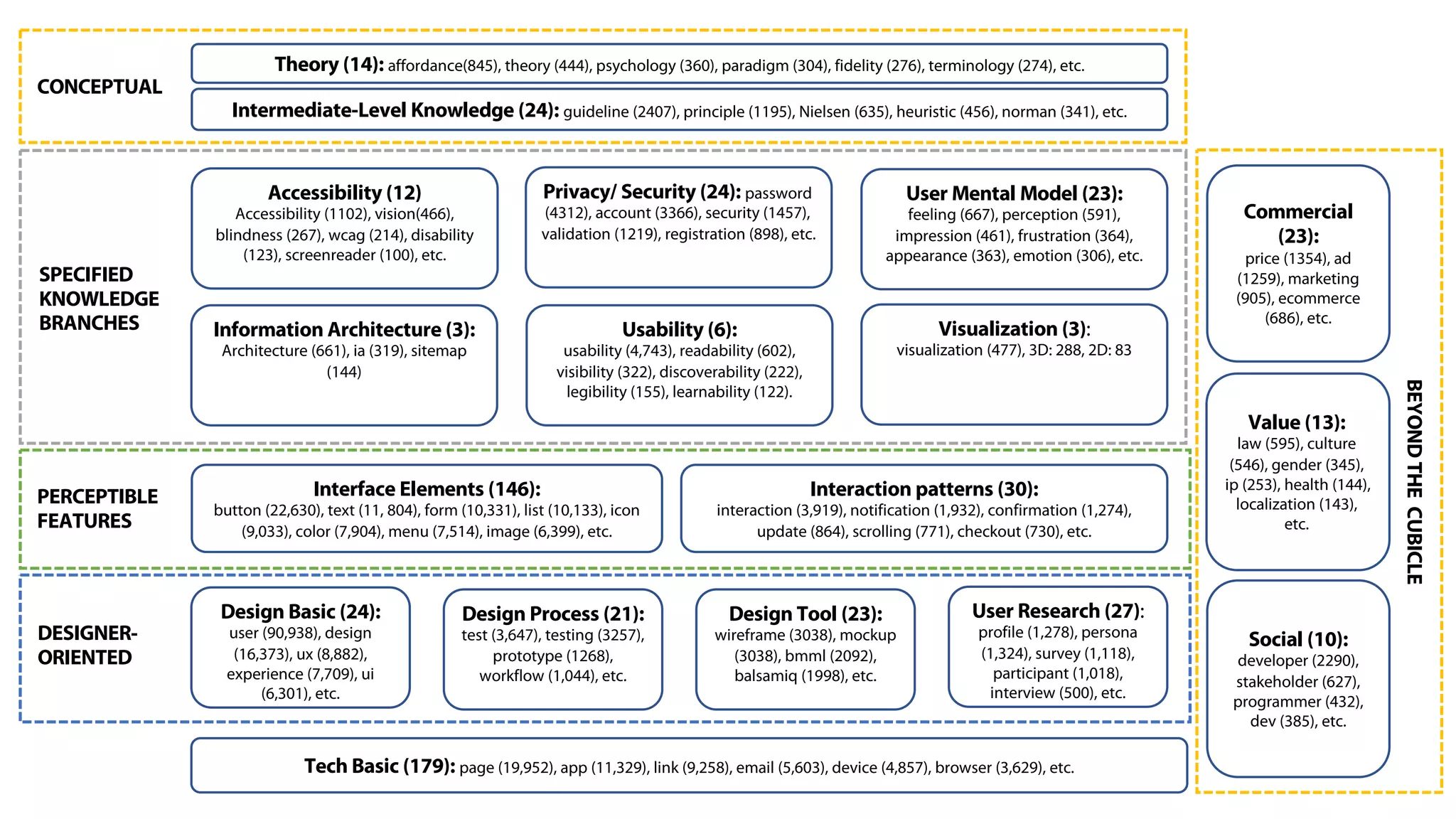
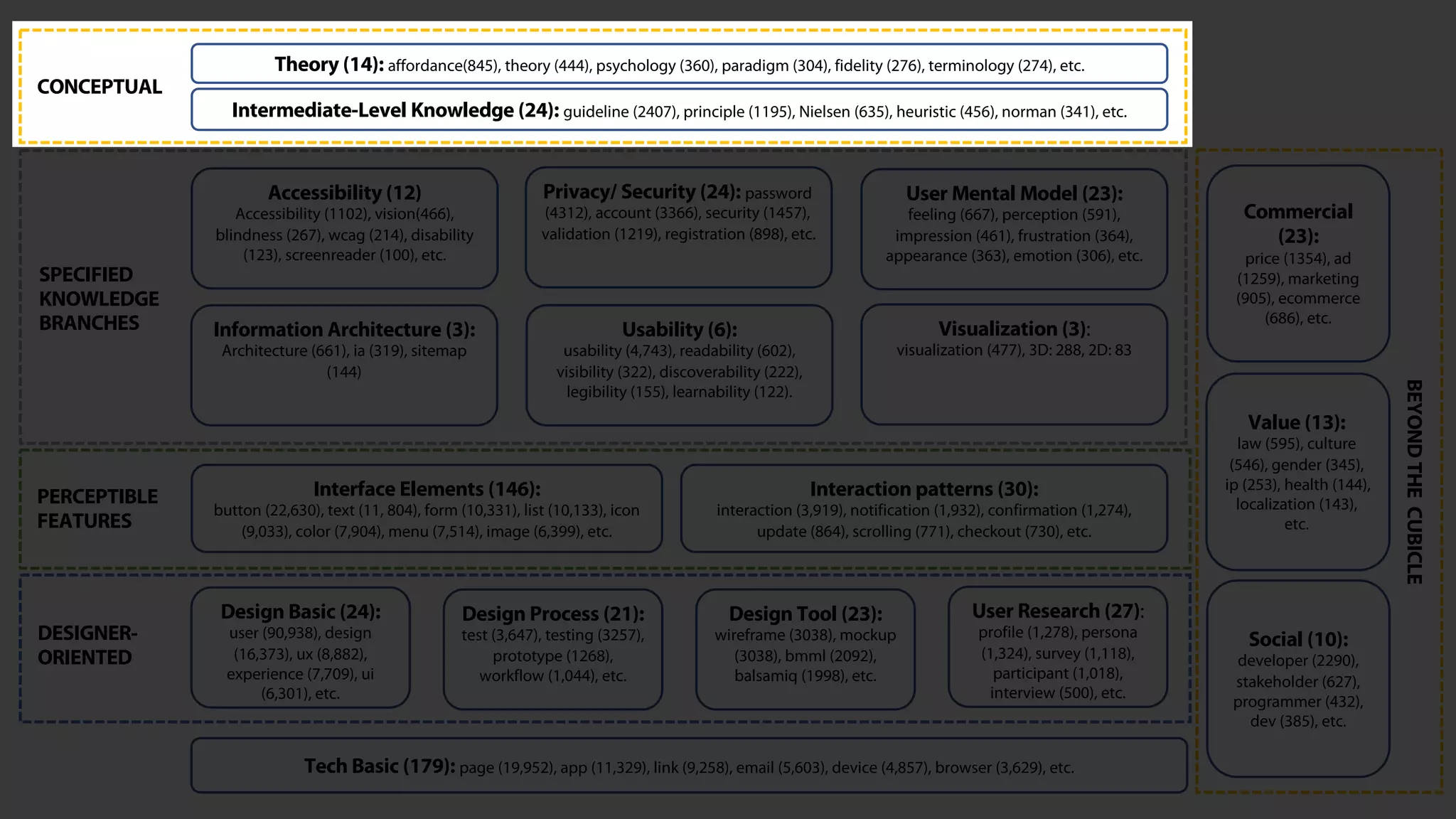
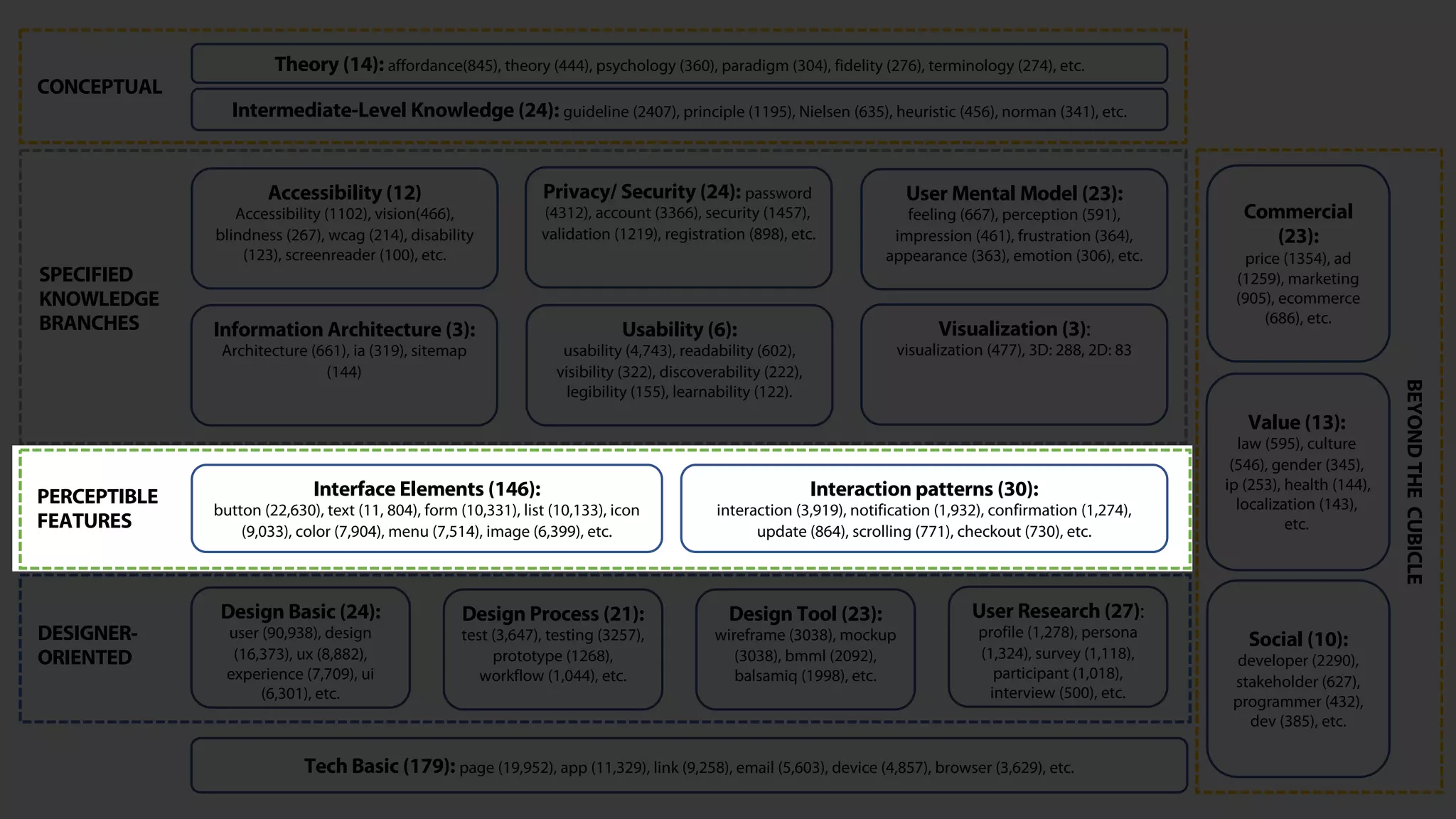
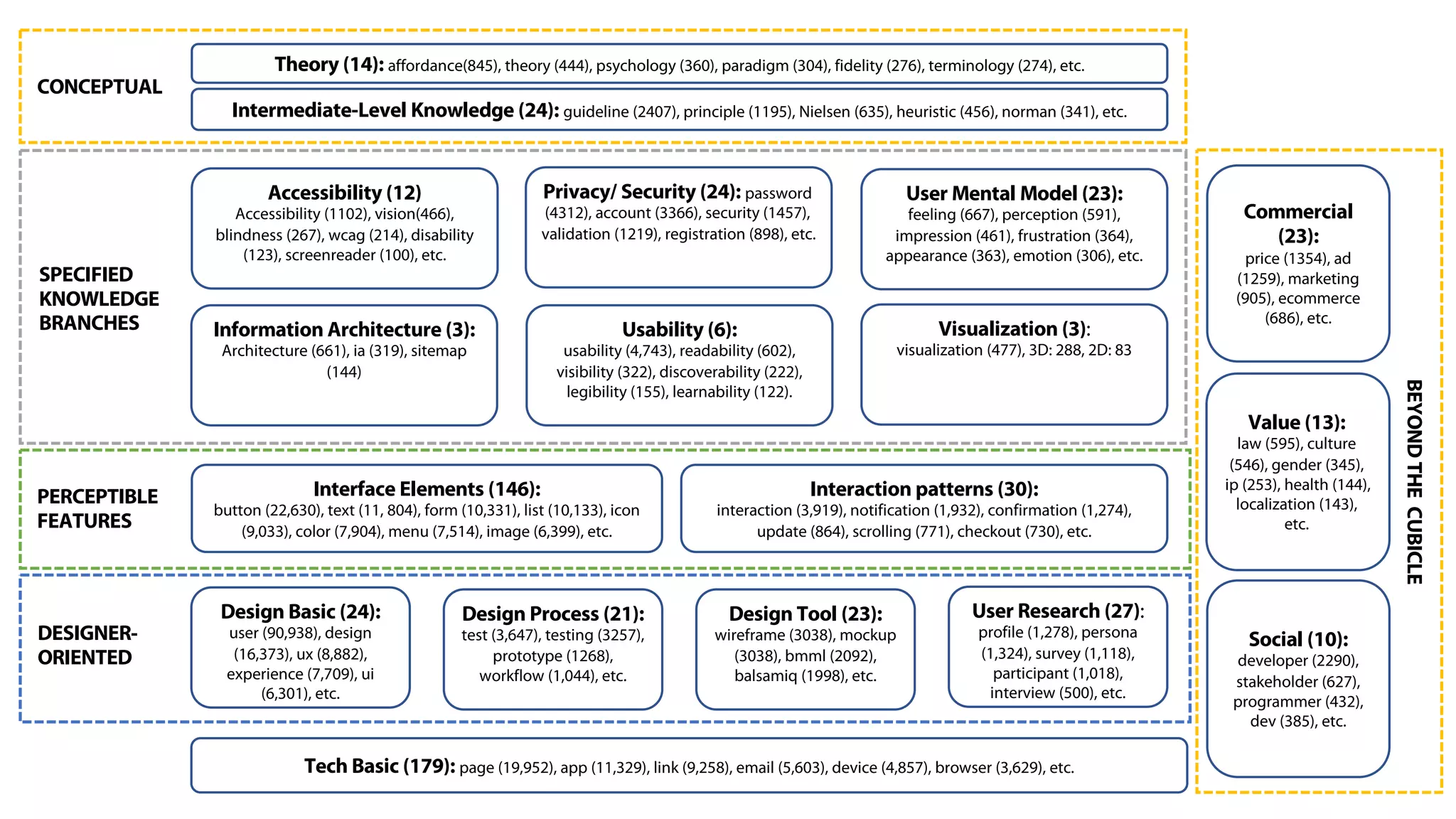
Theory (14): affordance(845), theory (444), psychology (360), paradigm (304), fidelity (276), terminology (274), etc.
Intermediate-Level Knowledge (24): guideline (2407), principle (1195), Nielsen (635), heuristic (456), norman (341), etc.
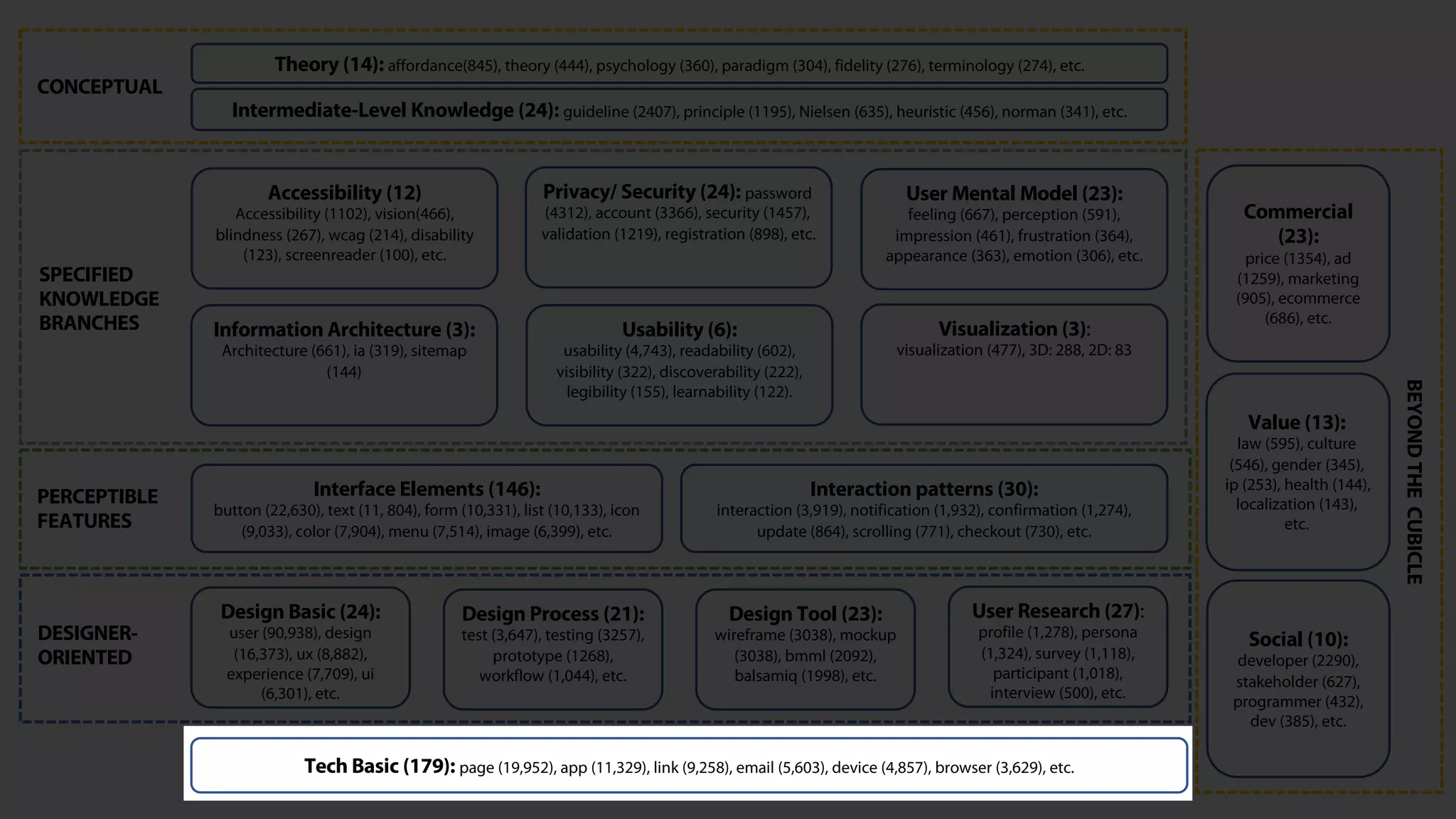
Tech Basic (179): page (19,952), app (11,329), link (9,258), email (5,603), device (4,857), browser (3,629), etc.
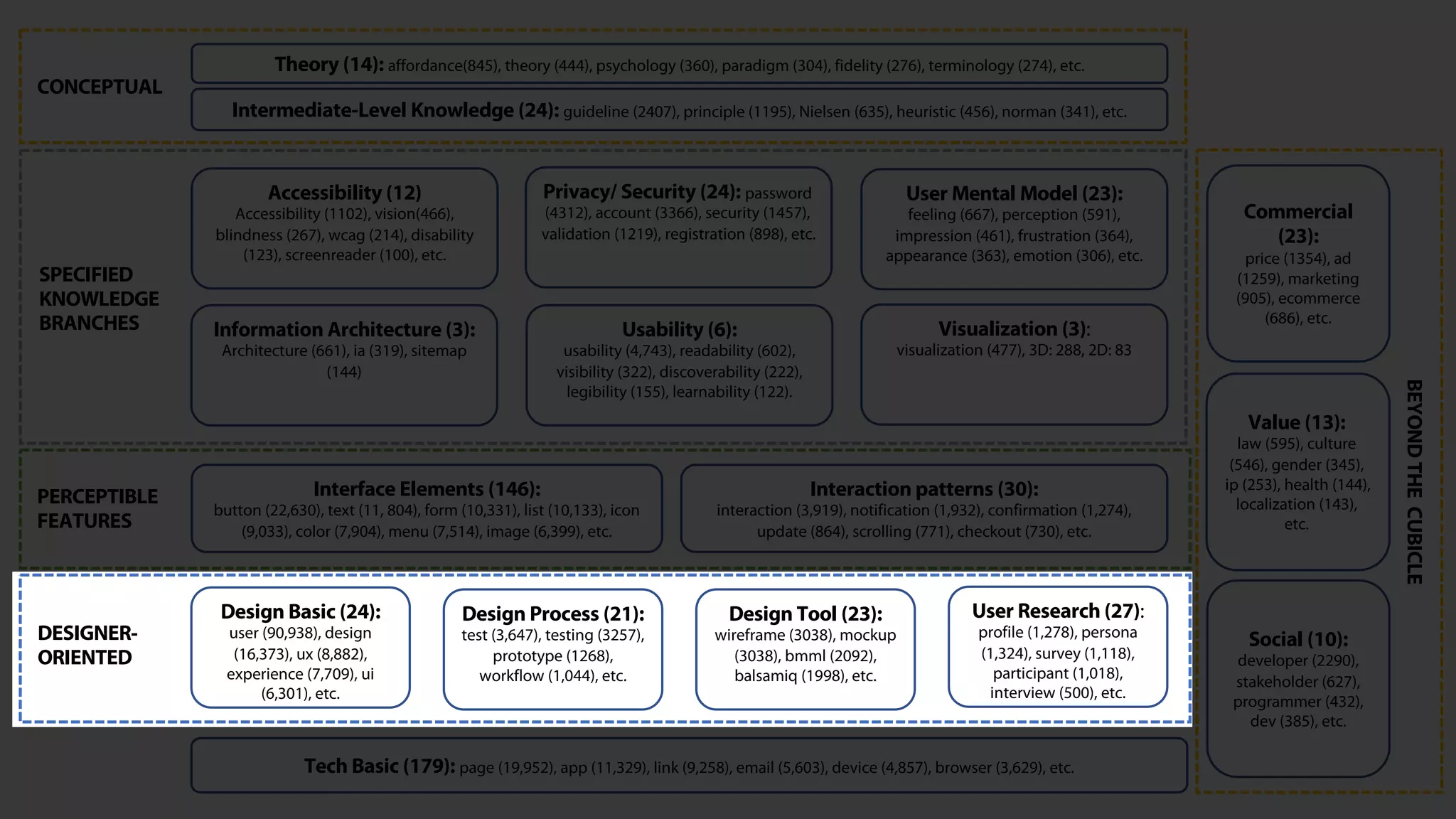
Design Basic (24):
user (90,938), design
(16,373), ux (8,882),
experience (7,709), ui
(6,301), etc.
Interface Elements (146):
button (22,630), text (11, 804), form (10,331), list (10,133), icon
(9,033), color (7,904), menu (7,514), image (6,399), etc.
Interaction patterns (30):
interaction (3,919), notification (1,932), confirmation (1,274),
update (864), scrolling (771), checkout (730), etc.
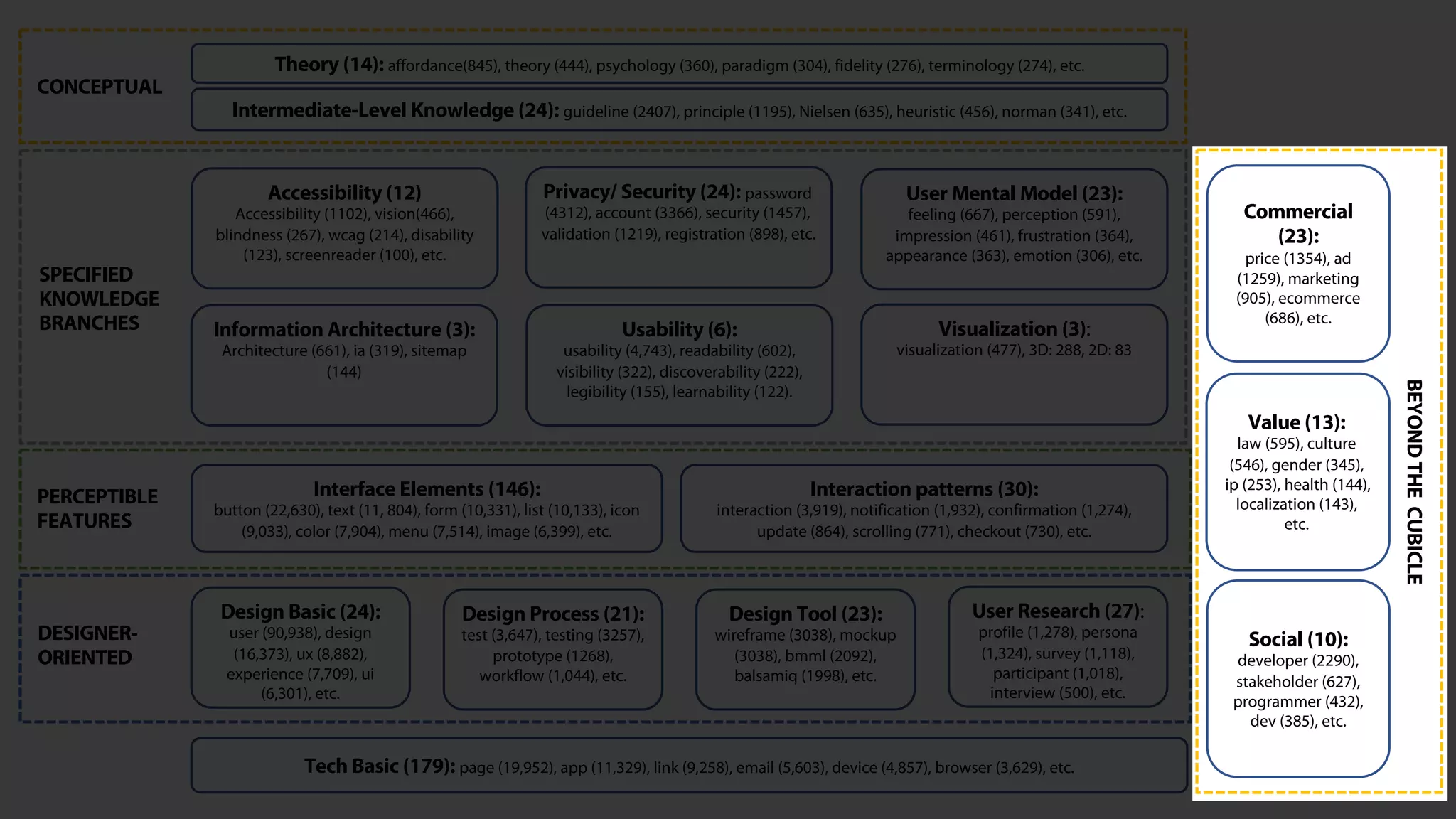
Commercial
(23):
price (1354), ad
(1259), marketing
(905), ecommerce
(686), etc.
Value (13):
law (595), culture
(546), gender (345),
ip (253), health (144),
localization (143),
etc.
Social (10):
developer (2290),
stakeholder (627),
programmer (432),
dev (385), etc.
Design Process (21):
test (3,647), testing (3257),
prototype (1268),
workflow (1,044), etc.
Design Tool (23):
wireframe (3038), mockup
(3038), bmml (2092),
balsamiq (1998), etc.
User Research (27):
profile (1,278), persona
(1,324), survey (1,118),
participant (1,018),
interview (500), etc.
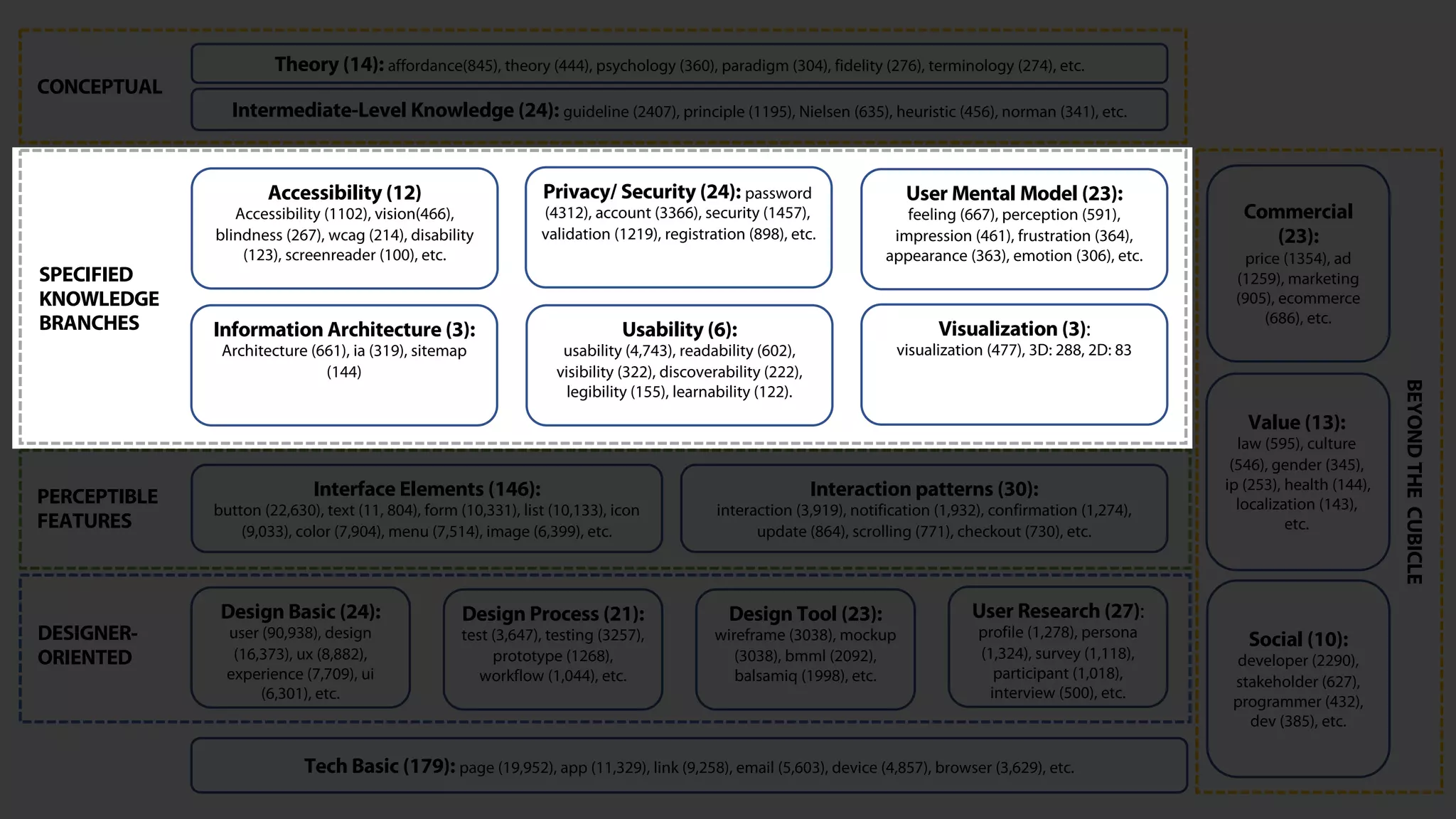
Accessibility (12)
Accessibility (1102), vision(466),
blindness (267), wcag (214), disability
(123), screenreader (100), etc.
Information Architecture (3):
Architecture (661), ia (319), sitemap
(144)
Privacy/ Security (24): password
(4312), account (3366), security (1457),
validation (1219), registration (898), etc.
Usability (6):
usability (4,743), readability (602),
visibility (322), discoverability (222),
legibility (155), learnability (122).
User Mental Model (23):
feeling (667), perception (591),
impression (461), frustration (364),
appearance (363), emotion (306), etc.
Visualization (3):
visualization (477), 3D: 288, 2D: 83
CONCEPTUAL
PERCEPTIBLE
FEATURES
DESIGNER-
ORIENTED
SPECIFIED
KNOWLEDGE
BRANCHES
BEYONDTHECUBICLE
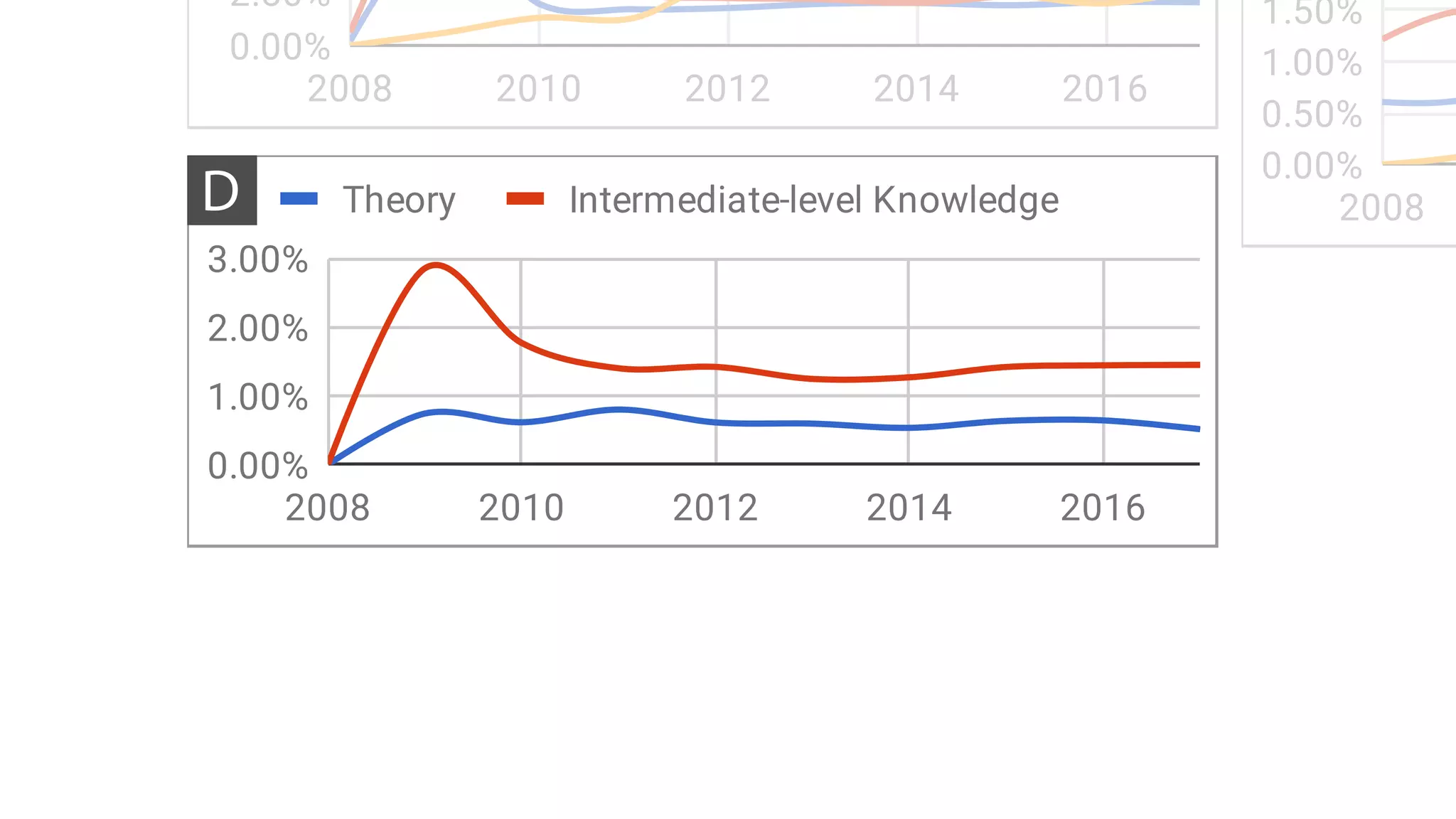
Theory (14): affordance(845), theory (444), psychology (360), paradigm (304), fidelity (276), terminology (274), etc.
Intermediate-Level Knowledge (24): guideline (2407), principle (1195), Nielsen (635), heuristic (456), norman (341), etc.
Tech Basic (179): page (19,952), app (11,329), link (9,258), email (5,603), device (4,857), browser (3,629), etc.
Design Basic (24):
user (90,938), design
(16,373), ux (8,882),
experience (7,709), ui
(6,301), etc.
Interface Elements (146):
button (22,630), text (11, 804), form (10,331), list (10,133), icon
(9,033), color (7,904), menu (7,514), image (6,399), etc.
Interaction patterns (30):
interaction (3,919), notification (1,932), confirmation (1,274),
update (864), scrolling (771), checkout (730), etc.
Commercial
(23):
price (1354), ad
(1259), marketing
(905), ecommerce
(686), etc.
Value (13):
law (595), culture
(546), gender (345),
ip (253), health (144),
localization (143),
etc.
Social (10):
developer (2290),
stakeholder (627),
programmer (432),
dev (385), etc.
Design Process (21):
test (3,647), testing (3257),
prototype (1268),
workflow (1,044), etc.
Design Tool (23):
wireframe (3038), mockup
(3038), bmml (2092),
balsamiq (1998), etc.
User Research (27):
profile (1,278), persona
(1,324), survey (1,118),
participant (1,018),
interview (500), etc.
Accessibility (12)
Accessibility (1102), vision(466),
blindness (267), wcag (214), disability
(123), screenreader (100), etc.
Information Architecture (3):
Architecture (661), ia (319), sitemap
(144)
Privacy/ Security (24): password
(4312), account (3366), security (1457),
validation (1219), registration (898), etc.
Usability (6):
usability (4,743), readability (602),
visibility (322), discoverability (222),
legibility (155), learnability (122).
User Mental Model (23):
feeling (667), perception (591),
impression (461), frustration (364),
appearance (363), emotion (306), etc.
Visualization (3):
visualization (477), 3D: 288, 2D: 83
CONCEPTUAL
PERCEPTIBLE
FEATURES
DESIGNER-
ORIENTED
SPECIFIED
KNOWLEDGE
BRANCHES
BEYONDTHECUBICLE
Theory (14): affordance(845), theory (444), psychology (360), paradigm (304), fidelity (276), terminology (274), etc.
Intermediate-Level Knowledge (24): guideline (2407), principle (1195), Nielsen (635), heuristic (456), norman (341), etc.
Tech Basic (179): page (19,952), app (11,329), link (9,258), email (5,603), device (4,857), browser (3,629), etc.
Design Basic (24):
user (90,938), design
(16,373), ux (8,882),
experience (7,709), ui
(6,301), etc.
Interface Elements (146):
button (22,630), text (11, 804), form (10,331), list (10,133), icon
(9,033), color (7,904), menu (7,514), image (6,399), etc.
Interaction patterns (30):
interaction (3,919), notification (1,932), confirmation (1,274),
update (864), scrolling (771), checkout (730), etc.
Commercial
(23):
price (1354), ad
(1259), marketing
(905), ecommerce
(686), etc.
Value (13):
law (595), culture
(546), gender (345),
ip (253), health (144),
localization (143),
etc.
Social (10):
developer (2290),
stakeholder (627),
programmer (432),
dev (385), etc.
Design Process (21):
test (3,647), testing (3257),
prototype (1268),
workflow (1,044), etc.
Design Tool (23):
wireframe (3038), mockup
(3038), bmml (2092),
balsamiq (1998), etc.
User Research (27):
profile (1,278), persona
(1,324), survey (1,118),
participant (1,018),
interview (500), etc.
Accessibility (12)
Accessibility (1102), vision(466),
blindness (267), wcag (214), disability
(123), screenreader (100), etc.
Information Architecture (3):
Architecture (661), ia (319), sitemap
(144)
Privacy/ Security (24): password
(4312), account (3366), security (1457),
validation (1219), registration (898), etc.
Usability (6):
usability (4,743), readability (602),
visibility (322), discoverability (222),
legibility (155), learnability (122).
User Mental Model (23):
feeling (667), perception (591),
impression (461), frustration (364),
appearance (363), emotion (306), etc.
Visualization (3):
visualization (477), 3D: 288, 2D: 83
CONCEPTUAL
PERCEPTIBLE
FEATURES
DESIGNER-
ORIENTED
SPECIFIED
KNOWLEDGE
BRANCHES
BEYONDTHECUBICLE
Theory (14): affordance(845), theory (444), psychology (360), paradigm (304), fidelity (276), terminology (274), etc.
Intermediate-Level Knowledge (24): guideline (2407), principle (1195), Nielsen (635), heuristic (456), norman (341), etc.
Tech Basic (179): page (19,952), app (11,329), link (9,258), email (5,603), device (4,857), browser (3,629), etc.
Design Basic (24):
user (90,938), design
(16,373), ux (8,882),
experience (7,709), ui
(6,301), etc.
Interface Elements (146):
button (22,630), text (11, 804), form (10,331), list (10,133), icon
(9,033), color (7,904), menu (7,514), image (6,399), etc.
Interaction patterns (30):
interaction (3,919), notification (1,932), confirmation (1,274),
update (864), scrolling (771), checkout (730), etc.
Commercial
(23):
price (1354), ad
(1259), marketing
(905), ecommerce
(686), etc.
Value (13):
law (595), culture
(546), gender (345),
ip (253), health (144),
localization (143),
etc.
Social (10):
developer (2290),
stakeholder (627),
programmer (432),
dev (385), etc.
Design Process (21):
test (3,647), testing (3257),
prototype (1268),
workflow (1,044), etc.
Design Tool (23):
wireframe (3038), mockup
(3038), bmml (2092),
balsamiq (1998), etc.
User Research (27):
profile (1,278), persona
(1,324), survey (1,118),
participant (1,018),
interview (500), etc.
Accessibility (12)
Accessibility (1102), vision(466),
blindness (267), wcag (214), disability
(123), screenreader (100), etc.
Information Architecture (3):
Architecture (661), ia (319), sitemap
(144)
Privacy/ Security (24): password
(4312), account (3366), security (1457),
validation (1219), registration (898), etc.
Usability (6):
usability (4,743), readability (602),
visibility (322), discoverability (222),
legibility (155), learnability (122).
User Mental Model (23):
feeling (667), perception (591),
impression (461), frustration (364),
appearance (363), emotion (306), etc.
Visualization (3):
visualization (477), 3D: 288, 2D: 83
CONCEPTUAL
PERCEPTIBLE
FEATURES
DESIGNER-
ORIENTED
SPECIFIED
KNOWLEDGE
BRANCHES
BEYONDTHECUBICLE
Theory (14): affordance(845), theory (444), psychology (360), paradigm (304), fidelity (276), terminology (274), etc.
Intermediate-Level Knowledge (24): guideline (2407), principle (1195), Nielsen (635), heuristic (456), norman (341), etc.
Tech Basic (179): page (19,952), app (11,329), link (9,258), email (5,603), device (4,857), browser (3,629), etc.
Design Basic (24):
user (90,938), design
(16,373), ux (8,882),
experience (7,709), ui
(6,301), etc.
Interface Elements (146):
button (22,630), text (11, 804), form (10,331), list (10,133), icon
(9,033), color (7,904), menu (7,514), image (6,399), etc.
Interaction patterns (30):
interaction (3,919), notification (1,932), confirmation (1,274),
update (864), scrolling (771), checkout (730), etc.
Commercial
(23):
price (1354), ad
(1259), marketing
(905), ecommerce
(686), etc.
Value (13):
law (595), culture
(546), gender (345),
ip (253), health (144),
localization (143),
etc.
Social (10):
developer (2290),
stakeholder (627),
programmer (432),
dev (385), etc.
Design Process (21):
test (3,647), testing (3257),
prototype (1268),
workflow (1,044), etc.
Design Tool (23):
wireframe (3038), mockup
(3038), bmml (2092),
balsamiq (1998), etc.
User Research (27):
profile (1,278), persona
(1,324), survey (1,118),
participant (1,018),
interview (500), etc.
Accessibility (12)
Accessibility (1102), vision(466),
blindness (267), wcag (214), disability
(123), screenreader (100), etc.
Information Architecture (3):
Architecture (661), ia (319), sitemap
(144)
Privacy/ Security (24): password
(4312), account (3366), security (1457),
validation (1219), registration (898), etc.
Usability (6):
usability (4,743), readability (602),
visibility (322), discoverability (222),
legibility (155), learnability (122).
User Mental Model (23):
feeling (667), perception (591),
impression (461), frustration (364),
appearance (363), emotion (306), etc.
Visualization (3):
visualization (477), 3D: 288, 2D: 83
CONCEPTUAL
PERCEPTIBLE
FEATURES
DESIGNER-
ORIENTED
SPECIFIED
KNOWLEDGE
BRANCHES
BEYONDTHECUBICLE
Theory (14): affordance(845), theory (444), psychology (360), paradigm (304), fidelity (276), terminology (274), etc.
Intermediate-Level Knowledge (24): guideline (2407), principle (1195), Nielsen (635), heuristic (456), norman (341), etc.
Tech Basic (179): page (19,952), app (11,329), link (9,258), email (5,603), device (4,857), browser (3,629), etc.
Design Basic (24):
user (90,938), design
(16,373), ux (8,882),
experience (7,709), ui
(6,301), etc.
Interface Elements (146):
button (22,630), text (11, 804), form (10,331), list (10,133), icon
(9,033), color (7,904), menu (7,514), image (6,399), etc.
Interaction patterns (30):
interaction (3,919), notification (1,932), confirmation (1,274),
update (864), scrolling (771), checkout (730), etc.
Commercial
(23):
price (1354), ad
(1259), marketing
(905), ecommerce
(686), etc.
Value (13):
law (595), culture
(546), gender (345),
ip (253), health (144),
localization (143),
etc.
Social (10):
developer (2290),
stakeholder (627),
programmer (432),
dev (385), etc.
Design Process (21):
test (3,647), testing (3257),
prototype (1268),
workflow (1,044), etc.
Design Tool (23):
wireframe (3038), mockup
(3038), bmml (2092),
balsamiq (1998), etc.
User Research (27):
profile (1,278), persona
(1,324), survey (1,118),
participant (1,018),
interview (500), etc.
Accessibility (12)
Accessibility (1102), vision(466),
blindness (267), wcag (214), disability
(123), screenreader (100), etc.
Information Architecture (3):
Architecture (661), ia (319), sitemap
(144)
Privacy/ Security (24): password
(4312), account (3366), security (1457),
validation (1219), registration (898), etc.
Usability (6):
usability (4,743), readability (602),
visibility (322), discoverability (222),
legibility (155), learnability (122).
User Mental Model (23):
feeling (667), perception (591),
impression (461), frustration (364),
appearance (363), emotion (306), etc.
Visualization (3):
visualization (477), 3D: 288, 2D: 83
CONCEPTUAL
PERCEPTIBLE
FEATURES
DESIGNER-
ORIENTED
SPECIFIED
KNOWLEDGE
BRANCHES
BEYONDTHECUBICLE
Theory (14): affordance(845), theory (444), psychology (360), paradigm (304), fidelity (276), terminology (274), etc.
Intermediate-Level Knowledge (24): guideline (2407), principle (1195), Nielsen (635), heuristic (456), norman (341), etc.
Tech Basic (179): page (19,952), app (11,329), link (9,258), email (5,603), device (4,857), browser (3,629), etc.
Design Basic (24):
user (90,938), design
(16,373), ux (8,882),
experience (7,709), ui
(6,301), etc.
Interface Elements (146):
button (22,630), text (11, 804), form (10,331), list (10,133), icon
(9,033), color (7,904), menu (7,514), image (6,399), etc.
Interaction patterns (30):
interaction (3,919), notification (1,932), confirmation (1,274),
update (864), scrolling (771), checkout (730), etc.
Commercial
(23):
price (1354), ad
(1259), marketing
(905), ecommerce
(686), etc.
Value (13):
law (595), culture
(546), gender (345),
ip (253), health (144),
localization (143),
etc.
Social (10):
developer (2290),
stakeholder (627),
programmer (432),
dev (385), etc.
Design Process (21):
test (3,647), testing (3257),
prototype (1268),
workflow (1,044), etc.
Design Tool (23):
wireframe (3038), mockup
(3038), bmml (2092),
balsamiq (1998), etc.
User Research (27):
profile (1,278), persona
(1,324), survey (1,118),
participant (1,018),
interview (500), etc.
Accessibility (12)
Accessibility (1102), vision(466),
blindness (267), wcag (214), disability
(123), screenreader (100), etc.
Information Architecture (3):
Architecture (661), ia (319), sitemap
(144)
Privacy/ Security (24): password
(4312), account (3366), security (1457),
validation (1219), registration (898), etc.
Usability (6):
usability (4,743), readability (602),
visibility (322), discoverability (222),
legibility (155), learnability (122).
User Mental Model (23):
feeling (667), perception (591),
impression (461), frustration (364),
appearance (363), emotion (306), etc.
Visualization (3):
visualization (477), 3D: 288, 2D: 83
CONCEPTUAL
PERCEPTIBLE
FEATURES
DESIGNER-
ORIENTED
SPECIFIED
KNOWLEDGE
BRANCHES
BEYONDTHECUBICLE
Theory (14): affordance(845), theory (444), psychology (360), paradigm (304), fidelity (276), terminology (274), etc.
Intermediate-Level Knowledge (24): guideline (2407), principle (1195), Nielsen (635), heuristic (456), norman (341), etc.
Tech Basic (179): page (19,952), app (11,329), link (9,258), email (5,603), device (4,857), browser (3,629), etc.
Design Basic (24):
user (90,938), design
(16,373), ux (8,882),
experience (7,709), ui
(6,301), etc.
Interface Elements (146):
button (22,630), text (11, 804), form (10,331), list (10,133), icon
(9,033), color (7,904), menu (7,514), image (6,399), etc.
Interaction patterns (30):
interaction (3,919), notification (1,932), confirmation (1,274),
update (864), scrolling (771), checkout (730), etc.
Commercial
(23):
price (1354), ad
(1259), marketing
(905), ecommerce
(686), etc.
Value (13):
law (595), culture
(546), gender (345),
ip (253), health (144),
localization (143),
etc.
Social (10):
developer (2290),
stakeholder (627),
programmer (432),
dev (385), etc.
Design Process (21):
test (3,647), testing (3257),
prototype (1268),
workflow (1,044), etc.
Design Tool (23):
wireframe (3038), mockup
(3038), bmml (2092),
balsamiq (1998), etc.
User Research (27):
profile (1,278), persona
(1,324), survey (1,118),
participant (1,018),
interview (500), etc.
Accessibility (12)
Accessibility (1102), vision(466),
blindness (267), wcag (214), disability
(123), screenreader (100), etc.
Information Architecture (3):
Architecture (661), ia (319), sitemap
(144)
Privacy/ Security (24): password
(4312), account (3366), security (1457),
validation (1219), registration (898), etc.
Usability (6):
usability (4,743), readability (602),
visibility (322), discoverability (222),
legibility (155), learnability (122).
User Mental Model (23):
feeling (667), perception (591),
impression (461), frustration (364),
appearance (363), emotion (306), etc.
Visualization (3):
visualization (477), 3D: 288, 2D: 83
CONCEPTUAL
PERCEPTIBLE
FEATURES
DESIGNER-
ORIENTED
SPECIFIED
KNOWLEDGE
BRANCHES
BEYONDTHECUBICLE
A
B
D
E
C
User Mental Model
Usability
Accessiblity
Privacy/Security
Info. Architecture
Visualization
A
B
C
P
I
V
B
D
E
D
We have used social media data and data
analytics to define and demarcate UX
knowledge
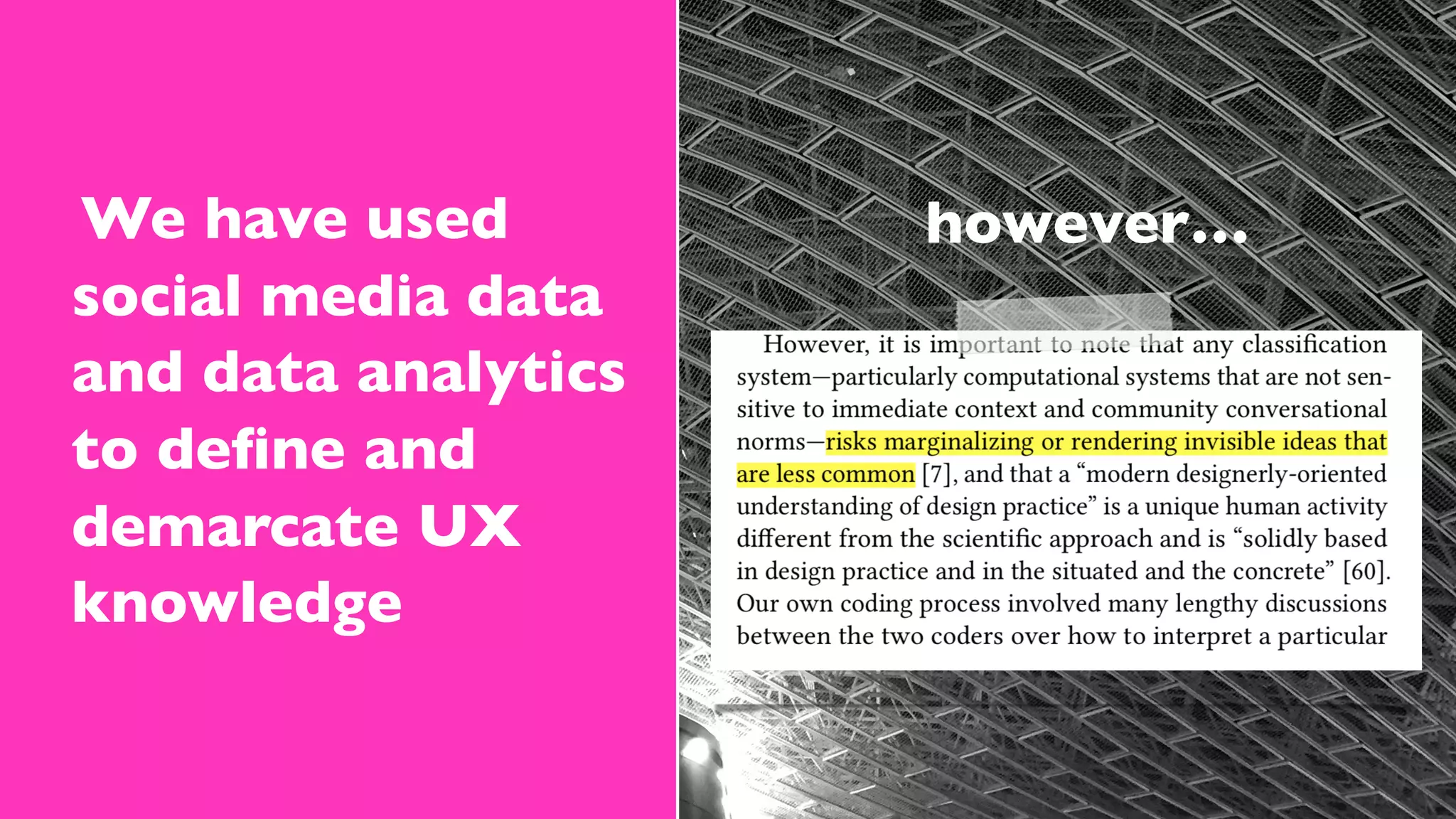
We have used
social media data
and data analytics
to define and
demarcate UX
knowledge
however…
Limitations and Future Work
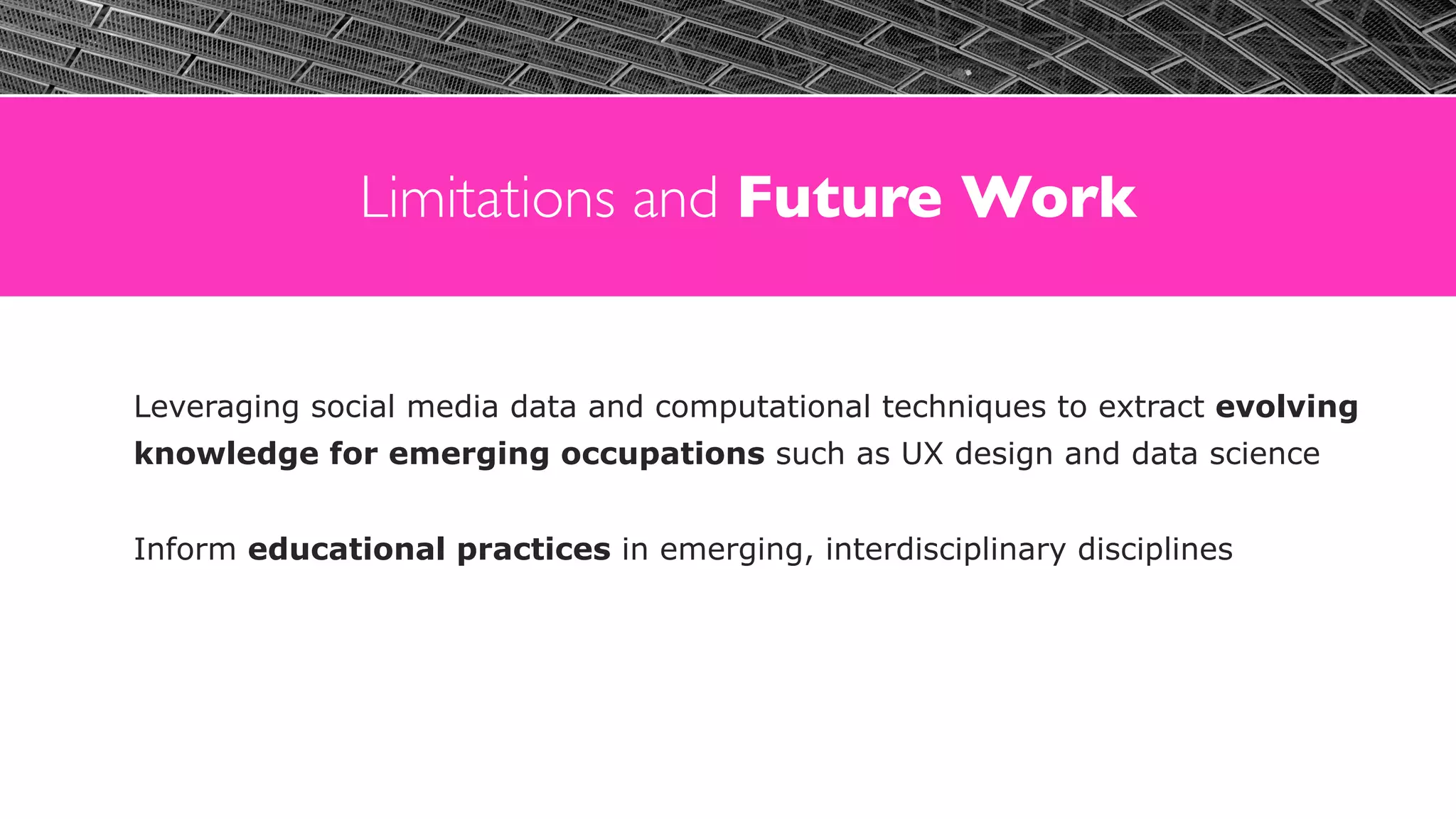
Leveraging social media data and computational techniques to extract evolving
knowledge for emerging occupations such as UX design and data science
Inform educational practices in emerging, interdisciplinary disciplines
YUBO KOU
yubokou.info 

ykou@fsu.edu
COLIN M. GRAY
colingray.me | uxp2.com 

gray42@purdue.edu
THANK YOU

A Practice-Led Account of the Conceptual Evolution of UX Knowledge

  • 1.
    YUBO KOU Florida StateUniversity A PRACTICE-LED ACCOUNT OF THE CONCEPTUAL EVOLUTION OF UX KNOWLEDGE COLIN M. GRAY Purdue University
  • 2.
  • 3.
  • 4.
    Uptake in corporateadoption of UX practices
  • 5.
    Rapidly expanding (anddiverse) program offerings
  • 6.
    User experience: Aconcept without consensus? Exploring practitioners’ perspectives through an international survey Carine Lallemand a,b,⇑ , Guillaume Gronier a , Vincent Koenig b a Public Research Centre Henri Tudor, 29 Avenue John F. Kennedy, L-1855 Luxembourg, Luxembourg b University of Luxembourg, ECCS Research Unit, Route de Diekirch, L-7220 Walferdange, Luxembourg a r t i c l e i n f o Article history: Available online 17 November 2014 Keywords: User experience Survey Definition Concept Practitioners a b s t r a c t For more than a decade, User Experience (UX) has grown into a core concept of Human–Computer Inter- action (HCI). Practitioners and researchers from a wide range of disciplines are daily working with this concept. However, despite many attempts to understand, define and scope UX, one may still wonder whether a consensus has been reached on this concept. In a willingness to address the complexity of this research topic and bring the concept of UX to maturity, a replication of an international survey has been conducted. The main goal of the present study is to get a better understanding of practitioners’ view- points on the notion of UX and to analyze potential evolutions over time in the understanding and prac- tical use of the concept. As both practical and theoretical implications of UX are of the greatest Contents lists available at ScienceDirect Computers in Human Behavior journal homepage: www.elsevier.com/locate/comphumbeh Little consensus over a body of disciplinary knowledge
  • 7.
  • 8.
    How do practitionersdevelop and 
 maintain their occupational competency?
  • 9.
    What can wedo as educators to inform 
 students’ professional development? How do practitioners develop and 
 maintain their occupational competency?
  • 10.
    Prior Work onDefining and Demarcating UX Survey of UX researchers and practitioners 
 (Law et al., 2009; Lallemand et al., 2014) Interviews with experiences designers and university students 
 (Tokkonen and Saariluoma, 2013)
  • 11.
  • 12.
    EXCHANGING 
 EXPERIENCES DISTRIBUTED
 CRITIQUE PROFESSIONAL 
 DISCLOSURE “MostUX jobs in the software industry are UX/UI frankly. UX =/= UI because UX is much broader.”
  • 13.
    EXCHANGING 
 EXPERIENCES DISTRIBUTED
 CRITIQUE PROFESSIONAL 
 DISCLOSURE U1:Why registration rate went down after we tested social login buttons? 
 
 U2: The user was ok as long as there was no commitment.
  • 14.
    EXCHANGING 
 EXPERIENCES DISTRIBUTED
 CRITIQUE PROFESSIONAL 
 DISCLOSURE “Hi,well I just graduated with an undergrad in Psych. I've been interested in the UX field for a while. At the moment, I’m sort of stuck on how to proceed.”
  • 17.
    1. What conceptsand knowledge categories 
 could characterize this body of UX knowledge? 2. How has the UX knowledge shared 
 on this site evolved over time?
  • 18.
    Using POS Taggerto extract unigram nouns (53,281 unigrams) Collecting practitioners’ conversations on 
 UX Stack Exchange (2008-2017; 21,216 Q&A) Qualitative analysis to establish categories (6 knowledge branches). Screening to identify unambiguous words (604 concepts)
  • 19.
    Theory (14): affordance(845),theory (444), psychology (360), paradigm (304), fidelity (276), terminology (274), etc. Intermediate-Level Knowledge (24): guideline (2407), principle (1195), Nielsen (635), heuristic (456), norman (341), etc. Tech Basic (179): page (19,952), app (11,329), link (9,258), email (5,603), device (4,857), browser (3,629), etc. Design Basic (24): user (90,938), design (16,373), ux (8,882), experience (7,709), ui (6,301), etc. Interface Elements (146): button (22,630), text (11, 804), form (10,331), list (10,133), icon (9,033), color (7,904), menu (7,514), image (6,399), etc. Interaction patterns (30): interaction (3,919), notification (1,932), confirmation (1,274), update (864), scrolling (771), checkout (730), etc. Commercial (23): price (1354), ad (1259), marketing (905), ecommerce (686), etc. Value (13): law (595), culture (546), gender (345), ip (253), health (144), localization (143), etc. Social (10): developer (2290), stakeholder (627), programmer (432), dev (385), etc. Design Process (21): test (3,647), testing (3257), prototype (1268), workflow (1,044), etc. Design Tool (23): wireframe (3038), mockup (3038), bmml (2092), balsamiq (1998), etc. User Research (27): profile (1,278), persona (1,324), survey (1,118), participant (1,018), interview (500), etc. Accessibility (12) Accessibility (1102), vision(466), blindness (267), wcag (214), disability (123), screenreader (100), etc. Information Architecture (3): Architecture (661), ia (319), sitemap (144) Privacy/ Security (24): password (4312), account (3366), security (1457), validation (1219), registration (898), etc. Usability (6): usability (4,743), readability (602), visibility (322), discoverability (222), legibility (155), learnability (122). User Mental Model (23): feeling (667), perception (591), impression (461), frustration (364), appearance (363), emotion (306), etc. Visualization (3): visualization (477), 3D: 288, 2D: 83 CONCEPTUAL PERCEPTIBLE FEATURES DESIGNER- ORIENTED SPECIFIED KNOWLEDGE BRANCHES BEYONDTHECUBICLE
  • 20.
    Theory (14): affordance(845),theory (444), psychology (360), paradigm (304), fidelity (276), terminology (274), etc. Intermediate-Level Knowledge (24): guideline (2407), principle (1195), Nielsen (635), heuristic (456), norman (341), etc. Tech Basic (179): page (19,952), app (11,329), link (9,258), email (5,603), device (4,857), browser (3,629), etc. Design Basic (24): user (90,938), design (16,373), ux (8,882), experience (7,709), ui (6,301), etc. Interface Elements (146): button (22,630), text (11, 804), form (10,331), list (10,133), icon (9,033), color (7,904), menu (7,514), image (6,399), etc. Interaction patterns (30): interaction (3,919), notification (1,932), confirmation (1,274), update (864), scrolling (771), checkout (730), etc. Commercial (23): price (1354), ad (1259), marketing (905), ecommerce (686), etc. Value (13): law (595), culture (546), gender (345), ip (253), health (144), localization (143), etc. Social (10): developer (2290), stakeholder (627), programmer (432), dev (385), etc. Design Process (21): test (3,647), testing (3257), prototype (1268), workflow (1,044), etc. Design Tool (23): wireframe (3038), mockup (3038), bmml (2092), balsamiq (1998), etc. User Research (27): profile (1,278), persona (1,324), survey (1,118), participant (1,018), interview (500), etc. Accessibility (12) Accessibility (1102), vision(466), blindness (267), wcag (214), disability (123), screenreader (100), etc. Information Architecture (3): Architecture (661), ia (319), sitemap (144) Privacy/ Security (24): password (4312), account (3366), security (1457), validation (1219), registration (898), etc. Usability (6): usability (4,743), readability (602), visibility (322), discoverability (222), legibility (155), learnability (122). User Mental Model (23): feeling (667), perception (591), impression (461), frustration (364), appearance (363), emotion (306), etc. Visualization (3): visualization (477), 3D: 288, 2D: 83 CONCEPTUAL PERCEPTIBLE FEATURES DESIGNER- ORIENTED SPECIFIED KNOWLEDGE BRANCHES BEYONDTHECUBICLE
  • 21.
    Theory (14): affordance(845),theory (444), psychology (360), paradigm (304), fidelity (276), terminology (274), etc. Intermediate-Level Knowledge (24): guideline (2407), principle (1195), Nielsen (635), heuristic (456), norman (341), etc. Tech Basic (179): page (19,952), app (11,329), link (9,258), email (5,603), device (4,857), browser (3,629), etc. Design Basic (24): user (90,938), design (16,373), ux (8,882), experience (7,709), ui (6,301), etc. Interface Elements (146): button (22,630), text (11, 804), form (10,331), list (10,133), icon (9,033), color (7,904), menu (7,514), image (6,399), etc. Interaction patterns (30): interaction (3,919), notification (1,932), confirmation (1,274), update (864), scrolling (771), checkout (730), etc. Commercial (23): price (1354), ad (1259), marketing (905), ecommerce (686), etc. Value (13): law (595), culture (546), gender (345), ip (253), health (144), localization (143), etc. Social (10): developer (2290), stakeholder (627), programmer (432), dev (385), etc. Design Process (21): test (3,647), testing (3257), prototype (1268), workflow (1,044), etc. Design Tool (23): wireframe (3038), mockup (3038), bmml (2092), balsamiq (1998), etc. User Research (27): profile (1,278), persona (1,324), survey (1,118), participant (1,018), interview (500), etc. Accessibility (12) Accessibility (1102), vision(466), blindness (267), wcag (214), disability (123), screenreader (100), etc. Information Architecture (3): Architecture (661), ia (319), sitemap (144) Privacy/ Security (24): password (4312), account (3366), security (1457), validation (1219), registration (898), etc. Usability (6): usability (4,743), readability (602), visibility (322), discoverability (222), legibility (155), learnability (122). User Mental Model (23): feeling (667), perception (591), impression (461), frustration (364), appearance (363), emotion (306), etc. Visualization (3): visualization (477), 3D: 288, 2D: 83 CONCEPTUAL PERCEPTIBLE FEATURES DESIGNER- ORIENTED SPECIFIED KNOWLEDGE BRANCHES BEYONDTHECUBICLE
  • 22.
    Theory (14): affordance(845),theory (444), psychology (360), paradigm (304), fidelity (276), terminology (274), etc. Intermediate-Level Knowledge (24): guideline (2407), principle (1195), Nielsen (635), heuristic (456), norman (341), etc. Tech Basic (179): page (19,952), app (11,329), link (9,258), email (5,603), device (4,857), browser (3,629), etc. Design Basic (24): user (90,938), design (16,373), ux (8,882), experience (7,709), ui (6,301), etc. Interface Elements (146): button (22,630), text (11, 804), form (10,331), list (10,133), icon (9,033), color (7,904), menu (7,514), image (6,399), etc. Interaction patterns (30): interaction (3,919), notification (1,932), confirmation (1,274), update (864), scrolling (771), checkout (730), etc. Commercial (23): price (1354), ad (1259), marketing (905), ecommerce (686), etc. Value (13): law (595), culture (546), gender (345), ip (253), health (144), localization (143), etc. Social (10): developer (2290), stakeholder (627), programmer (432), dev (385), etc. Design Process (21): test (3,647), testing (3257), prototype (1268), workflow (1,044), etc. Design Tool (23): wireframe (3038), mockup (3038), bmml (2092), balsamiq (1998), etc. User Research (27): profile (1,278), persona (1,324), survey (1,118), participant (1,018), interview (500), etc. Accessibility (12) Accessibility (1102), vision(466), blindness (267), wcag (214), disability (123), screenreader (100), etc. Information Architecture (3): Architecture (661), ia (319), sitemap (144) Privacy/ Security (24): password (4312), account (3366), security (1457), validation (1219), registration (898), etc. Usability (6): usability (4,743), readability (602), visibility (322), discoverability (222), legibility (155), learnability (122). User Mental Model (23): feeling (667), perception (591), impression (461), frustration (364), appearance (363), emotion (306), etc. Visualization (3): visualization (477), 3D: 288, 2D: 83 CONCEPTUAL PERCEPTIBLE FEATURES DESIGNER- ORIENTED SPECIFIED KNOWLEDGE BRANCHES BEYONDTHECUBICLE
  • 23.
    Theory (14): affordance(845),theory (444), psychology (360), paradigm (304), fidelity (276), terminology (274), etc. Intermediate-Level Knowledge (24): guideline (2407), principle (1195), Nielsen (635), heuristic (456), norman (341), etc. Tech Basic (179): page (19,952), app (11,329), link (9,258), email (5,603), device (4,857), browser (3,629), etc. Design Basic (24): user (90,938), design (16,373), ux (8,882), experience (7,709), ui (6,301), etc. Interface Elements (146): button (22,630), text (11, 804), form (10,331), list (10,133), icon (9,033), color (7,904), menu (7,514), image (6,399), etc. Interaction patterns (30): interaction (3,919), notification (1,932), confirmation (1,274), update (864), scrolling (771), checkout (730), etc. Commercial (23): price (1354), ad (1259), marketing (905), ecommerce (686), etc. Value (13): law (595), culture (546), gender (345), ip (253), health (144), localization (143), etc. Social (10): developer (2290), stakeholder (627), programmer (432), dev (385), etc. Design Process (21): test (3,647), testing (3257), prototype (1268), workflow (1,044), etc. Design Tool (23): wireframe (3038), mockup (3038), bmml (2092), balsamiq (1998), etc. User Research (27): profile (1,278), persona (1,324), survey (1,118), participant (1,018), interview (500), etc. Accessibility (12) Accessibility (1102), vision(466), blindness (267), wcag (214), disability (123), screenreader (100), etc. Information Architecture (3): Architecture (661), ia (319), sitemap (144) Privacy/ Security (24): password (4312), account (3366), security (1457), validation (1219), registration (898), etc. Usability (6): usability (4,743), readability (602), visibility (322), discoverability (222), legibility (155), learnability (122). User Mental Model (23): feeling (667), perception (591), impression (461), frustration (364), appearance (363), emotion (306), etc. Visualization (3): visualization (477), 3D: 288, 2D: 83 CONCEPTUAL PERCEPTIBLE FEATURES DESIGNER- ORIENTED SPECIFIED KNOWLEDGE BRANCHES BEYONDTHECUBICLE
  • 24.
    Theory (14): affordance(845),theory (444), psychology (360), paradigm (304), fidelity (276), terminology (274), etc. Intermediate-Level Knowledge (24): guideline (2407), principle (1195), Nielsen (635), heuristic (456), norman (341), etc. Tech Basic (179): page (19,952), app (11,329), link (9,258), email (5,603), device (4,857), browser (3,629), etc. Design Basic (24): user (90,938), design (16,373), ux (8,882), experience (7,709), ui (6,301), etc. Interface Elements (146): button (22,630), text (11, 804), form (10,331), list (10,133), icon (9,033), color (7,904), menu (7,514), image (6,399), etc. Interaction patterns (30): interaction (3,919), notification (1,932), confirmation (1,274), update (864), scrolling (771), checkout (730), etc. Commercial (23): price (1354), ad (1259), marketing (905), ecommerce (686), etc. Value (13): law (595), culture (546), gender (345), ip (253), health (144), localization (143), etc. Social (10): developer (2290), stakeholder (627), programmer (432), dev (385), etc. Design Process (21): test (3,647), testing (3257), prototype (1268), workflow (1,044), etc. Design Tool (23): wireframe (3038), mockup (3038), bmml (2092), balsamiq (1998), etc. User Research (27): profile (1,278), persona (1,324), survey (1,118), participant (1,018), interview (500), etc. Accessibility (12) Accessibility (1102), vision(466), blindness (267), wcag (214), disability (123), screenreader (100), etc. Information Architecture (3): Architecture (661), ia (319), sitemap (144) Privacy/ Security (24): password (4312), account (3366), security (1457), validation (1219), registration (898), etc. Usability (6): usability (4,743), readability (602), visibility (322), discoverability (222), legibility (155), learnability (122). User Mental Model (23): feeling (667), perception (591), impression (461), frustration (364), appearance (363), emotion (306), etc. Visualization (3): visualization (477), 3D: 288, 2D: 83 CONCEPTUAL PERCEPTIBLE FEATURES DESIGNER- ORIENTED SPECIFIED KNOWLEDGE BRANCHES BEYONDTHECUBICLE
  • 25.
    Theory (14): affordance(845),theory (444), psychology (360), paradigm (304), fidelity (276), terminology (274), etc. Intermediate-Level Knowledge (24): guideline (2407), principle (1195), Nielsen (635), heuristic (456), norman (341), etc. Tech Basic (179): page (19,952), app (11,329), link (9,258), email (5,603), device (4,857), browser (3,629), etc. Design Basic (24): user (90,938), design (16,373), ux (8,882), experience (7,709), ui (6,301), etc. Interface Elements (146): button (22,630), text (11, 804), form (10,331), list (10,133), icon (9,033), color (7,904), menu (7,514), image (6,399), etc. Interaction patterns (30): interaction (3,919), notification (1,932), confirmation (1,274), update (864), scrolling (771), checkout (730), etc. Commercial (23): price (1354), ad (1259), marketing (905), ecommerce (686), etc. Value (13): law (595), culture (546), gender (345), ip (253), health (144), localization (143), etc. Social (10): developer (2290), stakeholder (627), programmer (432), dev (385), etc. Design Process (21): test (3,647), testing (3257), prototype (1268), workflow (1,044), etc. Design Tool (23): wireframe (3038), mockup (3038), bmml (2092), balsamiq (1998), etc. User Research (27): profile (1,278), persona (1,324), survey (1,118), participant (1,018), interview (500), etc. Accessibility (12) Accessibility (1102), vision(466), blindness (267), wcag (214), disability (123), screenreader (100), etc. Information Architecture (3): Architecture (661), ia (319), sitemap (144) Privacy/ Security (24): password (4312), account (3366), security (1457), validation (1219), registration (898), etc. Usability (6): usability (4,743), readability (602), visibility (322), discoverability (222), legibility (155), learnability (122). User Mental Model (23): feeling (667), perception (591), impression (461), frustration (364), appearance (363), emotion (306), etc. Visualization (3): visualization (477), 3D: 288, 2D: 83 CONCEPTUAL PERCEPTIBLE FEATURES DESIGNER- ORIENTED SPECIFIED KNOWLEDGE BRANCHES BEYONDTHECUBICLE
  • 26.
    Theory (14): affordance(845),theory (444), psychology (360), paradigm (304), fidelity (276), terminology (274), etc. Intermediate-Level Knowledge (24): guideline (2407), principle (1195), Nielsen (635), heuristic (456), norman (341), etc. Tech Basic (179): page (19,952), app (11,329), link (9,258), email (5,603), device (4,857), browser (3,629), etc. Design Basic (24): user (90,938), design (16,373), ux (8,882), experience (7,709), ui (6,301), etc. Interface Elements (146): button (22,630), text (11, 804), form (10,331), list (10,133), icon (9,033), color (7,904), menu (7,514), image (6,399), etc. Interaction patterns (30): interaction (3,919), notification (1,932), confirmation (1,274), update (864), scrolling (771), checkout (730), etc. Commercial (23): price (1354), ad (1259), marketing (905), ecommerce (686), etc. Value (13): law (595), culture (546), gender (345), ip (253), health (144), localization (143), etc. Social (10): developer (2290), stakeholder (627), programmer (432), dev (385), etc. Design Process (21): test (3,647), testing (3257), prototype (1268), workflow (1,044), etc. Design Tool (23): wireframe (3038), mockup (3038), bmml (2092), balsamiq (1998), etc. User Research (27): profile (1,278), persona (1,324), survey (1,118), participant (1,018), interview (500), etc. Accessibility (12) Accessibility (1102), vision(466), blindness (267), wcag (214), disability (123), screenreader (100), etc. Information Architecture (3): Architecture (661), ia (319), sitemap (144) Privacy/ Security (24): password (4312), account (3366), security (1457), validation (1219), registration (898), etc. Usability (6): usability (4,743), readability (602), visibility (322), discoverability (222), legibility (155), learnability (122). User Mental Model (23): feeling (667), perception (591), impression (461), frustration (364), appearance (363), emotion (306), etc. Visualization (3): visualization (477), 3D: 288, 2D: 83 CONCEPTUAL PERCEPTIBLE FEATURES DESIGNER- ORIENTED SPECIFIED KNOWLEDGE BRANCHES BEYONDTHECUBICLE
  • 27.
  • 28.
  • 29.
  • 30.
  • 31.
    We have usedsocial media data and data analytics to define and demarcate UX knowledge
  • 32.
    We have used socialmedia data and data analytics to define and demarcate UX knowledge however…
  • 34.
    Limitations and FutureWork Leveraging social media data and computational techniques to extract evolving knowledge for emerging occupations such as UX design and data science Inform educational practices in emerging, interdisciplinary disciplines
  • 35.
    YUBO KOU yubokou.info 
 ykou@fsu.edu COLINM. GRAY colingray.me | uxp2.com 
 gray42@purdue.edu THANK YOU