Designing for Learning, Learning to Design, Learning by Design: Meeting the Challenges of 201x EducationYishay MorMilton Keynes, June 20111
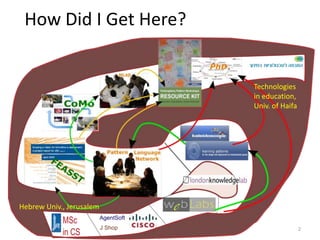
2How Did I Get Here?Technologies in education,Univ. of HaifaHebrew Univ., Jerusalem
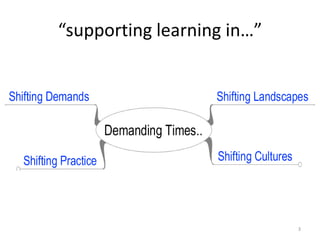
“supporting learning in…”3
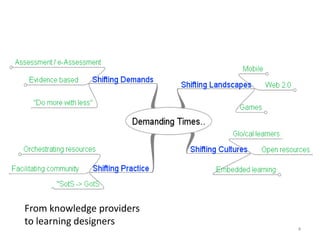
4From knowledge providers to learning designers
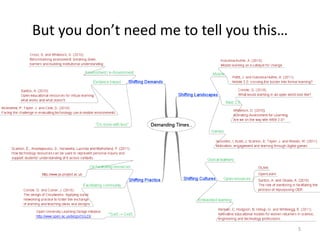
But you don’t need me to tell you this…5
The ChallengeHow do we support educators’ shift from knowledge providers to learning designers?How do we leverage design experiences as drivers of learning?6Despite the growing number of learning design tools, repositories of case studies and exemplars, standards and specifications, evidence of widespread uptake and adoption remains scattered and inconclusive.  (Conole et al 2008)
A Culture of Learning DesignHow do we -Facilitate design-level conversation among educational practitioners?Represent design knowledge in (technology-enhanced) education?Enculturate educators as learning designers?Establish a discourse of learning design that is scientifically valid and yet widely accessible?7
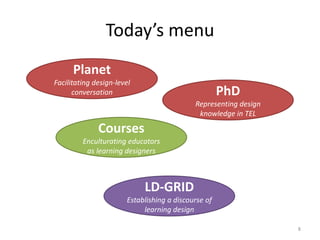
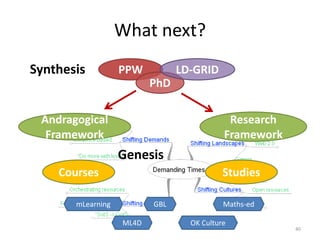
Today’s menu8PlanetFacilitating design-level conversationPhDRepresenting design knowledge in TELCoursesEnculturating educators as learning designersLD-GRIDEstablishing a discourse of learning design
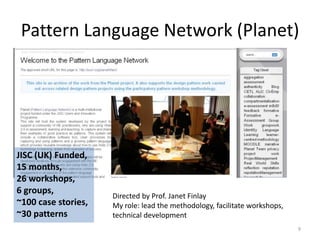
Pattern Language Network (Planet)9JISC (UK) Funded, 15 months, 26 workshops,6 groups, ~100 case stories, ~30 patternsDirected by Prof. Janet FinlayMy role: lead the methodology, facilitate workshops, technical development
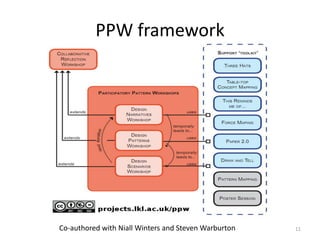
Participatory Pattern Workshops MethodologyProblemAcceleration -> need for effective protocols for sharing of design knowledge Contextinterdisciplinary communities of practitioners engaged in collaborative reflection on a common theme of their practice.blended setting: co-located meetings + on-line collaborative authoring system.10
PPW framework11Co-authored with Niall Winters and Steven Warburton
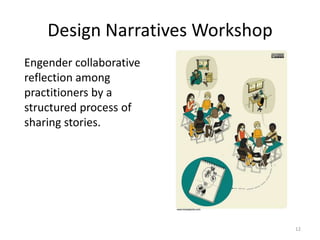
Design Narratives Workshop12Engender collaborative reflection among practitioners by a structured process of sharing stories.
13Three hats
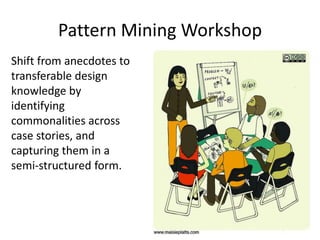
Pattern Mining Workshop14Shift from anecdotes to transferable design knowledge by identifying commonalities across case stories, and capturing them in a semi-structured form.
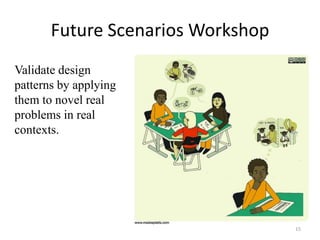
Future Scenarios Workshop15Validate design patterns by applying them to novel real problems in real contexts.
And the outcomes..16Mor, Y. (2011). Embedding Design Patterns in a Methodology for a Design Science of e-Learning. In C. Kohls & J. Wedekind (Eds.), Problems Investigations of E-Learning Patterns: Context Factors Solutions. Mor, Y., Mellar, H., Pachler, N., & Daly, C. (2011). Formative e-Assessment: case stories, design patterns and future scenarios. In C. Kohls & J. Wedekind (Eds.), Problems Investigations of E-Learning Patterns: Context Factors SolutionsDaly, C., Pachler, N., Mor, Y., & Mellar, H. (2010). Exploring formative e-assessment: Using case stories and design patterns. Assessment & Evaluation in Higher Education, 35(5), 619-636. Pachler, N., Daly, C., Mor, Y., & Mellar, H. (2010). Formative e-assessment: practitioner cases. Computers and Education, 54(3), 2010.Mor, Y. (2010). Guess my X and other patterns for teaching and learning mathematics. In T. Schümmer & A. Kelly (Eds.), Proceedings of EuroPLoP 2008			And hundreds of happy customers..
But is it methodical?17
PhD18winner of the second TELEARC award for PhD excellence, 2011.
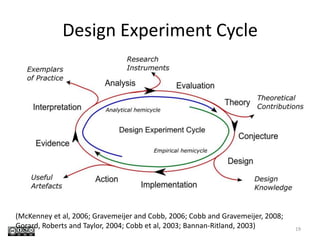
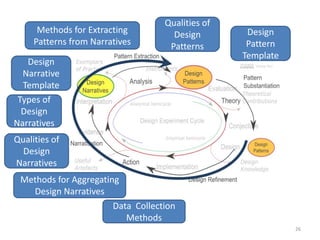
Design Experiment Cycle19(McKenney et al, 2006; Gravemeijer and Cobb, 2006; Cobb and Gravemeijer, 2008; Gorard, Roberts and Taylor, 2004; Cobb et al, 2003; Bannan-Ritland, 2003)
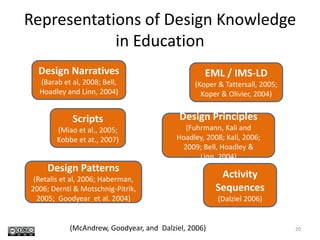
Representations of Design Knowledge in Education20Design Narratives(Barab et al, 2008; Bell, Hoadley and Linn, 2004)EML / IMS-LD(Koper & Tattersall, 2005; Koper & Olivier, 2004)Scripts(Miao et al., 2005; Kobbe et at., 2007)Design Principles(Fuhrmann, Kali and Hoadley, 2008; Kali, 2006; 2009; Bell, Hoadley & Linn, 2004)Design Patterns(Retalis et al, 2006; Haberman, 2006; Derntl & Motschnig-Pitrik, 2005;  Goodyear  et al. 2004)Activity Sequences(Dalziel 2006)(McAndrew, Goodyear, and  Dalziel, 2006)
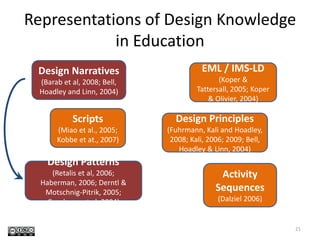
Representations of Design Knowledge in Education21Design Narratives(Barab et al, 2008; Bell, Hoadley and Linn, 2004)EML / IMS-LD(Koper & Tattersall, 2005; Koper & Olivier, 2004)Scripts(Miao et al., 2005; Kobbe et at., 2007)Design Principles(Fuhrmann, Kali and Hoadley, 2008; Kali, 2006; 2009; Bell, Hoadley & Linn, 2004)Design Patterns(Retalis et al, 2006; Haberman, 2006; Derntl & Motschnig-Pitrik, 2005;  Goodyear  et al. 2004)Activity Sequences(Dalziel 2006)
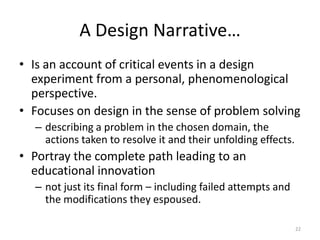
A Design Narrative… Is an account of critical events in a design experiment from a personal, phenomenological perspective. Focuses on design in the sense of problem solving describing a problem in the chosen domain, the actions taken to resolve it and their unfolding effects. Portray the complete path leading to an educational innovationnot just its final form – including failed attempts and the modifications they espoused.22
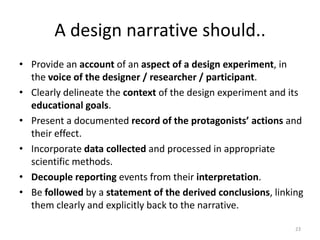
A design narrative should..Provide an account of an aspect of a design experiment, in the voice of the designer / researcher / participant.Clearly delineate the context of the design experiment and its educational goals.Present a documented record of the protagonists’ actions and their effect.Incorporate data collected and processed in appropriate scientific methods.Decouple reporting events from their interpretation.Be followed by a statement of the derived conclusions, linking them clearly and explicitly back to the narrative.23
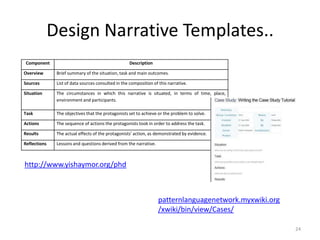
Design Narrative Templates..24http://www.yishaymor.org/phdpatternlanguagenetwork.myxwiki.org/xwiki/bin/view/Cases/
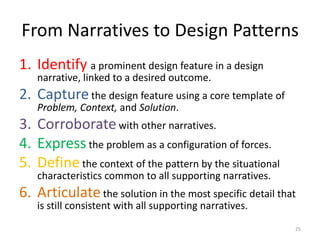
From Narratives to Design PatternsIdentifya prominent design feature in a design narrative, linked to a desired outcome.Capture the design feature using a core template of Problem, Context, and Solution. Corroborate with other narratives.Express the problem as a configuration of forces. Define the context of the pattern by the situational characteristics common to all supporting narratives.Articulate the solution in the most specific detail that is still consistent with all supporting narratives.25
26Qualities of Design PatternsMethods for Extracting Patterns from NarrativesDesign Pattern TemplateDesign Narrative TemplateTypes of Design NarrativesQualities of Design NarrativesMethods for Aggregating Design NarrativesData  CollectionMethods
But is it practical?(does it affect practice?)27
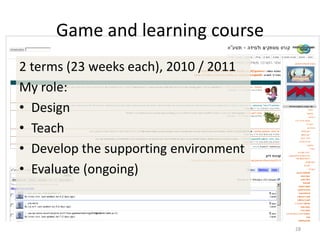
Game and learning course2 terms (23 weeks each), 2010 / 2011My role:Design TeachDevelop the supporting environmentEvaluate (ongoing)28
Digital Cities programme2 year, non-research MA programme in ed-tech
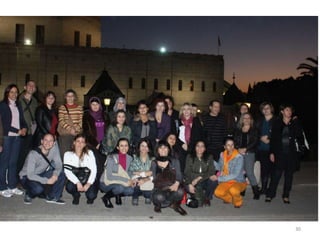
22 students: all female, in-service teachers, age 25-40, 13 from Nazareth (Palestinian), 9 from Upper Nazareth (Jewish)
Aims to establish a group which will lead techno-pedagogical innovation in the two cities.29
30
Games & Learning courseTo gain theoretical and practical understanding of the educational potential of computer games.
To acknowledge the knowledge domain of digital games, and in particular their relationship to learning and teaching.
To gain practical skills for integrating digital games into educational activities.31
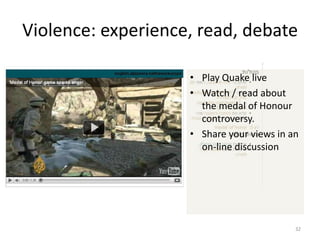
Violence: experience, read, debate32Play Quake liveWatch / read about the medal of Honour controversy.Share your views in an on-line discussion
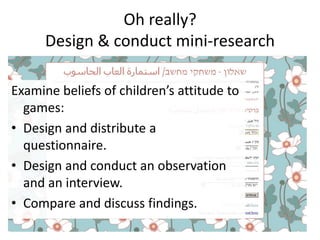
Oh really? Design & conduct mini-research33Examine beliefs of children’s attitude to games:Design and distribute a questionnaire.Design and conduct an observation and an interview.Compare and discuss findings.

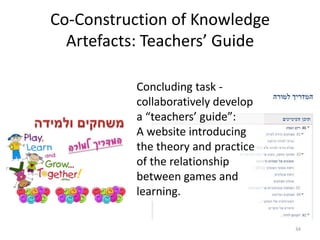
Co-Construction of Knowledge Artefacts: Teachers’ Guide34Concluding task - collaboratively develop a “teachers’ guide”:A website introducing the theory and practice of the relationship between games and learning.
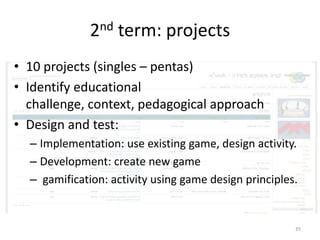
2nd term: projects3510 projects (singles – pentas)Identify educational challenge, context, pedagogical approachDesign and test:Implementation: use existing game, design activity.Development: create new gamegamification: activity using game design principles.
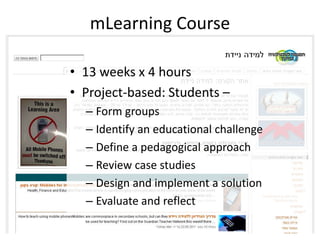
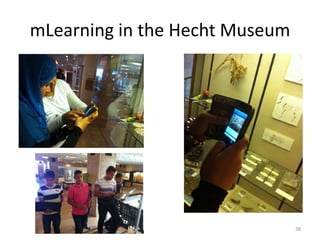
36mLearning Course13 weeks x 4 hoursProject-based: Students –Form groups Identify an educational challengeDefine a pedagogical approachReview case studiesDesign and implement a solutionEvaluate and reflect

OU 2011

  • 1.
    Designing for Learning,Learning to Design, Learning by Design: Meeting the Challenges of 201x EducationYishay MorMilton Keynes, June 20111
  • 2.
    2How Did IGet Here?Technologies in education,Univ. of HaifaHebrew Univ., Jerusalem
  • 3.
  • 4.
    4From knowledge providersto learning designers
  • 5.
    But you don’tneed me to tell you this…5
  • 6.
    The ChallengeHow dowe support educators’ shift from knowledge providers to learning designers?How do we leverage design experiences as drivers of learning?6Despite the growing number of learning design tools, repositories of case studies and exemplars, standards and specifications, evidence of widespread uptake and adoption remains scattered and inconclusive. (Conole et al 2008)
  • 7.
    A Culture ofLearning DesignHow do we -Facilitate design-level conversation among educational practitioners?Represent design knowledge in (technology-enhanced) education?Enculturate educators as learning designers?Establish a discourse of learning design that is scientifically valid and yet widely accessible?7
  • 8.
    Today’s menu8PlanetFacilitating design-levelconversationPhDRepresenting design knowledge in TELCoursesEnculturating educators as learning designersLD-GRIDEstablishing a discourse of learning design
  • 9.
    Pattern Language Network(Planet)9JISC (UK) Funded, 15 months, 26 workshops,6 groups, ~100 case stories, ~30 patternsDirected by Prof. Janet FinlayMy role: lead the methodology, facilitate workshops, technical development
  • 10.
    Participatory Pattern WorkshopsMethodologyProblemAcceleration -> need for effective protocols for sharing of design knowledge Contextinterdisciplinary communities of practitioners engaged in collaborative reflection on a common theme of their practice.blended setting: co-located meetings + on-line collaborative authoring system.10
  • 11.
    PPW framework11Co-authored withNiall Winters and Steven Warburton
  • 12.
    Design Narratives Workshop12Engendercollaborative reflection among practitioners by a structured process of sharing stories.
  • 13.
  • 14.
    Pattern Mining Workshop14Shiftfrom anecdotes to transferable design knowledge by identifying commonalities across case stories, and capturing them in a semi-structured form.
  • 15.
    Future Scenarios Workshop15Validatedesign patterns by applying them to novel real problems in real contexts.
  • 16.
    And the outcomes..16Mor,Y. (2011). Embedding Design Patterns in a Methodology for a Design Science of e-Learning. In C. Kohls & J. Wedekind (Eds.), Problems Investigations of E-Learning Patterns: Context Factors Solutions. Mor, Y., Mellar, H., Pachler, N., & Daly, C. (2011). Formative e-Assessment: case stories, design patterns and future scenarios. In C. Kohls & J. Wedekind (Eds.), Problems Investigations of E-Learning Patterns: Context Factors SolutionsDaly, C., Pachler, N., Mor, Y., & Mellar, H. (2010). Exploring formative e-assessment: Using case stories and design patterns. Assessment & Evaluation in Higher Education, 35(5), 619-636. Pachler, N., Daly, C., Mor, Y., & Mellar, H. (2010). Formative e-assessment: practitioner cases. Computers and Education, 54(3), 2010.Mor, Y. (2010). Guess my X and other patterns for teaching and learning mathematics. In T. Schümmer & A. Kelly (Eds.), Proceedings of EuroPLoP 2008 And hundreds of happy customers..
  • 17.
    But is itmethodical?17
  • 18.
    PhD18winner of the secondTELEARC award for PhD excellence, 2011.
  • 19.
    Design Experiment Cycle19(McKenneyet al, 2006; Gravemeijer and Cobb, 2006; Cobb and Gravemeijer, 2008; Gorard, Roberts and Taylor, 2004; Cobb et al, 2003; Bannan-Ritland, 2003)
  • 20.
    Representations of DesignKnowledge in Education20Design Narratives(Barab et al, 2008; Bell, Hoadley and Linn, 2004)EML / IMS-LD(Koper & Tattersall, 2005; Koper & Olivier, 2004)Scripts(Miao et al., 2005; Kobbe et at., 2007)Design Principles(Fuhrmann, Kali and Hoadley, 2008; Kali, 2006; 2009; Bell, Hoadley & Linn, 2004)Design Patterns(Retalis et al, 2006; Haberman, 2006; Derntl & Motschnig-Pitrik, 2005; Goodyear et al. 2004)Activity Sequences(Dalziel 2006)(McAndrew, Goodyear, and  Dalziel, 2006)
  • 21.
    Representations of DesignKnowledge in Education21Design Narratives(Barab et al, 2008; Bell, Hoadley and Linn, 2004)EML / IMS-LD(Koper & Tattersall, 2005; Koper & Olivier, 2004)Scripts(Miao et al., 2005; Kobbe et at., 2007)Design Principles(Fuhrmann, Kali and Hoadley, 2008; Kali, 2006; 2009; Bell, Hoadley & Linn, 2004)Design Patterns(Retalis et al, 2006; Haberman, 2006; Derntl & Motschnig-Pitrik, 2005; Goodyear et al. 2004)Activity Sequences(Dalziel 2006)
  • 22.
    A Design Narrative…Is an account of critical events in a design experiment from a personal, phenomenological perspective. Focuses on design in the sense of problem solving describing a problem in the chosen domain, the actions taken to resolve it and their unfolding effects. Portray the complete path leading to an educational innovationnot just its final form – including failed attempts and the modifications they espoused.22
  • 23.
    A design narrativeshould..Provide an account of an aspect of a design experiment, in the voice of the designer / researcher / participant.Clearly delineate the context of the design experiment and its educational goals.Present a documented record of the protagonists’ actions and their effect.Incorporate data collected and processed in appropriate scientific methods.Decouple reporting events from their interpretation.Be followed by a statement of the derived conclusions, linking them clearly and explicitly back to the narrative.23
  • 24.
  • 25.
    From Narratives toDesign PatternsIdentifya prominent design feature in a design narrative, linked to a desired outcome.Capture the design feature using a core template of Problem, Context, and Solution. Corroborate with other narratives.Express the problem as a configuration of forces. Define the context of the pattern by the situational characteristics common to all supporting narratives.Articulate the solution in the most specific detail that is still consistent with all supporting narratives.25
  • 26.
    26Qualities of DesignPatternsMethods for Extracting Patterns from NarrativesDesign Pattern TemplateDesign Narrative TemplateTypes of Design NarrativesQualities of Design NarrativesMethods for Aggregating Design NarrativesData CollectionMethods
  • 27.
    But is itpractical?(does it affect practice?)27
  • 28.
    Game and learningcourse2 terms (23 weeks each), 2010 / 2011My role:Design TeachDevelop the supporting environmentEvaluate (ongoing)28
  • 29.
    Digital Cities programme2year, non-research MA programme in ed-tech
  • 30.
    22 students: allfemale, in-service teachers, age 25-40, 13 from Nazareth (Palestinian), 9 from Upper Nazareth (Jewish)
  • 31.
    Aims to establisha group which will lead techno-pedagogical innovation in the two cities.29
  • 32.
  • 33.
    Games & LearningcourseTo gain theoretical and practical understanding of the educational potential of computer games.
  • 34.
    To acknowledge theknowledge domain of digital games, and in particular their relationship to learning and teaching.
  • 35.
    To gain practicalskills for integrating digital games into educational activities.31
  • 36.
    Violence: experience, read,debate32Play Quake liveWatch / read about the medal of Honour controversy.Share your views in an on-line discussion
  • 37.
    Oh really? Design& conduct mini-research33Examine beliefs of children’s attitude to games:Design and distribute a questionnaire.Design and conduct an observation and an interview.Compare and discuss findings.
  • 38.
    Co-Construction of KnowledgeArtefacts: Teachers’ Guide34Concluding task - collaboratively develop a “teachers’ guide”:A website introducing the theory and practice of the relationship between games and learning.
  • 39.
    2nd term: projects3510projects (singles – pentas)Identify educational challenge, context, pedagogical approachDesign and test:Implementation: use existing game, design activity.Development: create new gamegamification: activity using game design principles.
  • 40.
    36mLearning Course13 weeksx 4 hoursProject-based: Students –Form groups Identify an educational challengeDefine a pedagogical approachReview case studiesDesign and implement a solutionEvaluate and reflect