Embedded Linux Conference Europe Choosing free software graphical libraries for embedded devices Thomas Petazzoni Free Electrons http://free-electrons.com/
About this document This document is released under the terms of the Creative-Commons BY-SA 3.0 license: http://creativecommons.org/licenses/by-sa/3.0/ Documents updates can be found or described on http://free-electrons.com/pub/conferences/2008/elce/
Introduction Graphical interfaces are a major component of many embedded systems As usual, the free software and open source world offers a lot of choices to implement graphical interfaces Such a diversity makes it difficult to find one's way through all the available solutions This talk in the result of an investigation of the most popular graphical libraries, and describe them in terms of functionality, size, popularity, and ability to combine with other components, etc. Some solutions or details might have been missed, don't hesitate to share your knowledge and experience during the talk
Building and testing All of our tests have been made with Buildroot A filesystem builder for embedded systems http://buildroot.uclibc.org Many fixes contributed to get all the graphical libraries to build properly Size of libraries and components given in the talk correspond to the ARM, stripped version Basic tests made in Qemu Not very « flashy » We will soon release target filesystems that'll allow anyone to quickly try and test the different solutions
« Low-level » solutions
DirectFB Low-level graphical library Lines, rectangles, triangles drawing and filling Blitting, flipping Text drawing Windows and transparency Image loading and video display But also handles input event handling: mouse, keyboard, joystick, touchscreen, etc. Provides accelerated graphic operations on various hardware, more can be added in an easy way Integrated windowing infrastructure
DirectFB (2) Single-application by default, but multiple applications can share the framebuffer thanks to « fusion » Development and community: very active See also Denis Oliver Kropp talk, « Open Integration Layer - DirectFB 2.0 », tomorrow at 15:25 Denis is the main developer of DirectFB License: LGPL 2.1 http://www.directfb.org
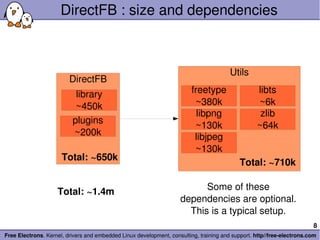
DirectFB : size and dependencies Some of these dependencies are optional. This is a typical setup. Total: ~1.4m Utils zlib ~64k freetype ~380k libjpeg ~130k libpng ~130k libts ~6k Total: ~710k DirectFB library ~450k plugins ~200k Total: ~650k
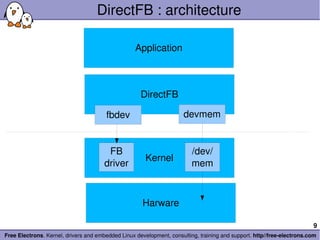
DirectFB : architecture Harware Kernel FB driver DirectFB Application fbdev devmem /dev/ mem
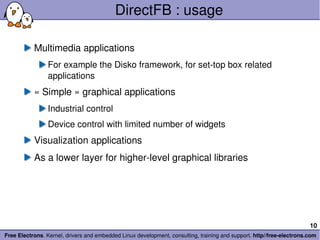
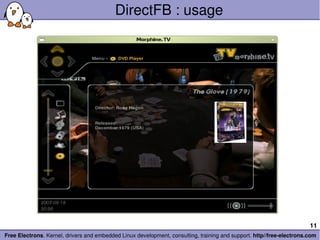
DirectFB : usage Multimedia applications For example the Disko framework, for set-top box related applications « Simple » graphical applications Industrial control Device control with limited number of widgets Visualization applications As a lower layer for higher-level graphical libraries
DirectFB : usage
SDL A library originally designed for game development In addition to graphic display, also provides input event management, sound, CD-ROM audio, threads, timers, etc. Can work on top of X11, the framebuffer or DirectFB And DirectFB can work on top of SDL as well :-) The API is roughly the same level as the one of DirectFB Developed in C, C API, many bindings available Actively maintained DirectFB is probably more common in embedded systems, while SDL is more common for small desktop games License: LGPL http://www.libsdl.org/
X.org - KDrive Stand-alone simplified version of the X server, for embedded systems Formerly know as Tiny-X Kdrive is integrated in  the official X.org server Works on top of the Linux frame buffer, thanks to the Xfbdev variant of the server Real X server Fully supports the X11 protocol : drawing, input event handling, etc. Allows to use any existing X11 application or library Actively developed and maintained X11 license http://www.x.org
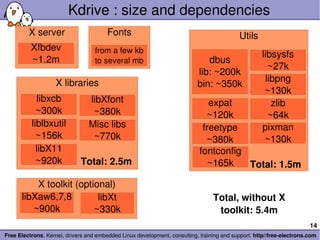
Kdrive : size and dependencies Total: 2.5m Total: 1.5m Total, without X toolkit: 5.4m Utils zlib ~64k fontconfig ~165k dbus lib: ~200k bin: ~350k freetype ~380k expat ~120k pixman ~130k libpng ~130k X server Xfbdev ~1.2m X libraries liblbxutil ~156k libsysfs ~27k libX11 ~920k libxcb ~300k libXfont ~380k Misc libs ~770k X toolkit (optional) libXaw6,7,8 ~900k libXt ~330k Fonts from a few kb to several mb
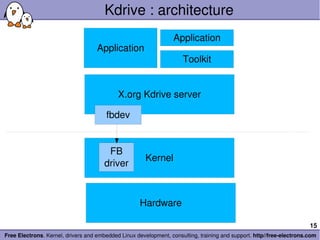
Kdrive : architecture Hardware Kernel FB driver X.org Kdrive server Application fbdev Toolkit Application
Kdrive : usage Can be directly programmed using Xlib / XCB Low-level graphic library Probably doesn't make sense since DirectFB is a more lightweight solution for an API of roughly the same level (no widgets) Or, usually used with a toolkit on top of it Gtk Qt Fltk WxEmbedded
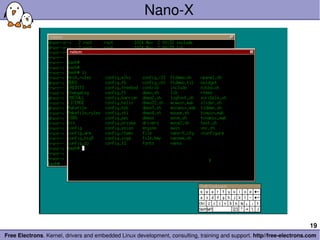
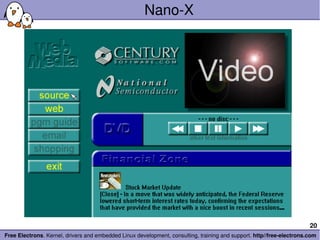
Nano-X An alternative graphic system Various graphic back-ends, including Linux framebuffer Provides two programming APIs A Win32-like API A Xlib-like API, but not compatible with Xlib Requires specially designed widget toolkits Client/server model, with clients communicating with the server through an Unix socket. Optionally, a client can be directly linked with the server Lightweight
Nano-X Doesn't come with a widget library, but offers a window manager Relatively small user and developer base. No release since 2005, but some activity on the mailing-list, including the official maintainer. Probably not lively enough to provide a long-term maintenance guarantee Licensed under the Mozilla Public License Webpage:  http://www.microwindows.org/
Nano-X
Nano-X
« High-level » solutions
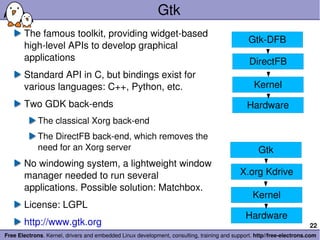
Gtk The famous toolkit, providing widget-based high-level APIs to develop graphical applications Standard API in C, but bindings exist for various languages: C++, Python, etc. Two GDK back-ends The classical Xorg back-end The DirectFB back-end, which removes the need for an Xorg server No windowing system, a lightweight window manager needed to run several applications. Possible solution: Matchbox. License: LGPL http://www.gtk.org Hardware Kernel DirectFB Gtk-DFB Hardware Kernel X.org Kdrive Gtk
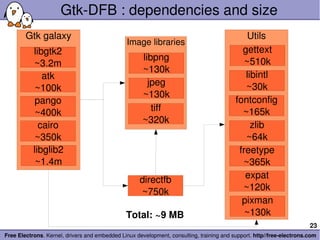
Gtk-DFB : dependencies and size Total: ~9 MB Utils Gtk galaxy libgtk2 ~3.2m Image libraries libpng ~130k jpeg ~130k tiff ~320k libglib2 ~1.4m atk ~100k pango ~400k cairo ~350k directfb ~750k zlib ~64k fontconfig ~165k gettext ~510k libintl ~30k freetype ~365k expat ~120k pixman ~130k
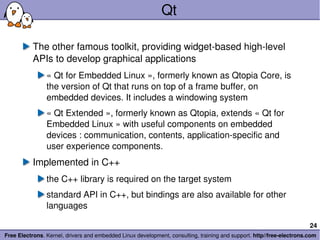
Qt The other famous toolkit, providing widget-based high-level APIs to develop graphical applications « Qt for Embedded Linux », formerly known as Qtopia Core, is the version of Qt that runs on top of a frame buffer, on embedded devices. It includes a windowing system « Qt Extended », formerly known as Qtopia, extends « Qt for Embedded Linux » with useful components on embedded devices : communication, contents, application-specific and user experience components. Implemented in C++ the C++ library is required on the target system standard API in C++, but bindings are also available for other languages
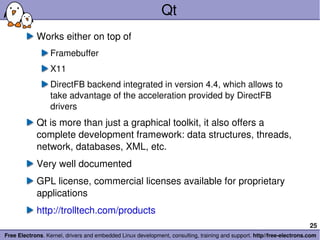
Qt Works either on top of Framebuffer X11 DirectFB backend integrated in version 4.4, which allows to take advantage of the acceleration provided by DirectFB drivers Qt is more than just a graphical toolkit, it also offers a complete development framework: data structures, threads, network, databases, XML, etc. Very well documented GPL license, commercial licenses available for proprietary applications http://trolltech.com/products
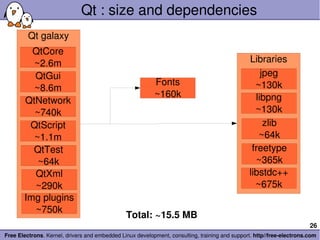
Qt : size and dependencies Total: ~15.5 MB Qt galaxy QtCore ~2.6m QtTest ~64k QtGui ~8.6m QtNetwork ~740k QtScript ~1.1m QtXml ~290k Img plugins ~750k Fonts ~160k Libraries zlib ~64k freetype ~365k jpeg ~130k libpng ~130k libstdc++ ~675k
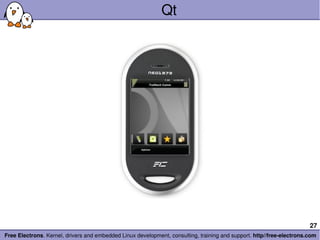
Qt
FLTK Another high-level toolkit, providing widget-level graphic programming, currently in version 2.x Written in C++, main programming API in C++ Designed with smallness in mind Designed to reduce size when statically linked, small memory consumption for each widget Core of the library, as included in an statically compiled hello world program: 82K. An example application which uses all widgets: 352K Works on top of Xlib Actively maintained, licensed under the LGPL A port of FLTK 1.x to DirectFB was made, available from DirectFB's git repository, but only maintained by a single person http://www.fltk.org
WxEmbedded Originally, WxWidgets is a library abstracting existing toolkits (Win32 native toolkit, Gtk2, etc.), allowing the creation of portable applications Depends on an underlying toolkit An internal toolkit, WxUniversal has been implemented. It allows to write WxWidgets applications without the need for an underlying toolkit. Works on top of various graphic back-ends X11 DirectFB Nano-X Xlib-like and Win32-like APIs Written in C++, C++ API, C++ library required
WxEmbedded Size 2.5 Mb of shared library size 1 Mb for a simple statically-linked example, but the size doesn't increase much for more complicated examples While WxWidgets is active and well-maintained, the amount of attention given to WxUniversal and WxEmbedded is much smaller Some widgets are not implemented, some graphic backends don't receive a lot of attention Licensed under the LGPL, with an exception giving more freedom on distribution of derived works in binary form WxEmbedded:  http://www.wxwidgets.org/docs/embedded.htm WxUniversal:  http://www.wxwidgets.org/about/wxuniv.htm
LiTE LiTE is a Toolbox Engine Designed exclusively for DirectFB Two layers Lite: low-level plumbing to ease the implementation of widgets Leck: implementation of the widgets Only very simple widgets available Limited user base Very small: only 43k + 36k in addition to a typical DirectFB installation. LGPL 2.1 http://www.directfb.org/wiki/index.php/LiTE:About
Other untested solutions MiniGUI Another toolkit, with several graphical backends including a frame buffer backend The GPL version is limited in functionalities, commercial versions available http://www.minigui.org/ Enlightenment foundation libraries See Gustavo Sverzut Barbieri talk, « Rich GUI Without Pain » today at 14:45 http://www.enlightenment.org/p.php?p=about/efl
Conclusion Low-level components: DirectFB, X.org, Nano-X High-level components: Gtk, Qt, Fltk, WxEmbedded, EFL, miniGUI There is a large number of solutions to develop graphical interfaces with free software libraries However, the size of the user and developer community and its vitality is one of the most important criteria when choosing a solution For that reason, DirectFB, X.org, Gtk and Qt seem to be most interesting solutions today
Questions ? What solutions are you using for your graphical interfaces ? What were your decision criteria ? Are you satisfied with the chosen solution ? The existing ones ? ?
Xynth Clutter Pigment

Graphical libraries

  • 1.
    Embedded Linux ConferenceEurope Choosing free software graphical libraries for embedded devices Thomas Petazzoni Free Electrons http://free-electrons.com/
  • 2.
    About this documentThis document is released under the terms of the Creative-Commons BY-SA 3.0 license: http://creativecommons.org/licenses/by-sa/3.0/ Documents updates can be found or described on http://free-electrons.com/pub/conferences/2008/elce/
  • 3.
    Introduction Graphical interfacesare a major component of many embedded systems As usual, the free software and open source world offers a lot of choices to implement graphical interfaces Such a diversity makes it difficult to find one's way through all the available solutions This talk in the result of an investigation of the most popular graphical libraries, and describe them in terms of functionality, size, popularity, and ability to combine with other components, etc. Some solutions or details might have been missed, don't hesitate to share your knowledge and experience during the talk
  • 4.
    Building and testingAll of our tests have been made with Buildroot A filesystem builder for embedded systems http://buildroot.uclibc.org Many fixes contributed to get all the graphical libraries to build properly Size of libraries and components given in the talk correspond to the ARM, stripped version Basic tests made in Qemu Not very « flashy » We will soon release target filesystems that'll allow anyone to quickly try and test the different solutions
  • 5.
    « Low-level »solutions
  • 6.
    DirectFB Low-level graphicallibrary Lines, rectangles, triangles drawing and filling Blitting, flipping Text drawing Windows and transparency Image loading and video display But also handles input event handling: mouse, keyboard, joystick, touchscreen, etc. Provides accelerated graphic operations on various hardware, more can be added in an easy way Integrated windowing infrastructure
  • 7.
    DirectFB (2) Single-applicationby default, but multiple applications can share the framebuffer thanks to « fusion » Development and community: very active See also Denis Oliver Kropp talk, « Open Integration Layer - DirectFB 2.0 », tomorrow at 15:25 Denis is the main developer of DirectFB License: LGPL 2.1 http://www.directfb.org
  • 8.
    DirectFB : sizeand dependencies Some of these dependencies are optional. This is a typical setup. Total: ~1.4m Utils zlib ~64k freetype ~380k libjpeg ~130k libpng ~130k libts ~6k Total: ~710k DirectFB library ~450k plugins ~200k Total: ~650k
  • 9.
    DirectFB : architectureHarware Kernel FB driver DirectFB Application fbdev devmem /dev/ mem
  • 10.
    DirectFB : usageMultimedia applications For example the Disko framework, for set-top box related applications « Simple » graphical applications Industrial control Device control with limited number of widgets Visualization applications As a lower layer for higher-level graphical libraries
  • 11.
  • 12.
    SDL A libraryoriginally designed for game development In addition to graphic display, also provides input event management, sound, CD-ROM audio, threads, timers, etc. Can work on top of X11, the framebuffer or DirectFB And DirectFB can work on top of SDL as well :-) The API is roughly the same level as the one of DirectFB Developed in C, C API, many bindings available Actively maintained DirectFB is probably more common in embedded systems, while SDL is more common for small desktop games License: LGPL http://www.libsdl.org/
  • 13.
    X.org - KDriveStand-alone simplified version of the X server, for embedded systems Formerly know as Tiny-X Kdrive is integrated in the official X.org server Works on top of the Linux frame buffer, thanks to the Xfbdev variant of the server Real X server Fully supports the X11 protocol : drawing, input event handling, etc. Allows to use any existing X11 application or library Actively developed and maintained X11 license http://www.x.org
  • 14.
    Kdrive : sizeand dependencies Total: 2.5m Total: 1.5m Total, without X toolkit: 5.4m Utils zlib ~64k fontconfig ~165k dbus lib: ~200k bin: ~350k freetype ~380k expat ~120k pixman ~130k libpng ~130k X server Xfbdev ~1.2m X libraries liblbxutil ~156k libsysfs ~27k libX11 ~920k libxcb ~300k libXfont ~380k Misc libs ~770k X toolkit (optional) libXaw6,7,8 ~900k libXt ~330k Fonts from a few kb to several mb
  • 15.
    Kdrive : architectureHardware Kernel FB driver X.org Kdrive server Application fbdev Toolkit Application
  • 16.
    Kdrive : usageCan be directly programmed using Xlib / XCB Low-level graphic library Probably doesn't make sense since DirectFB is a more lightweight solution for an API of roughly the same level (no widgets) Or, usually used with a toolkit on top of it Gtk Qt Fltk WxEmbedded
  • 17.
    Nano-X An alternativegraphic system Various graphic back-ends, including Linux framebuffer Provides two programming APIs A Win32-like API A Xlib-like API, but not compatible with Xlib Requires specially designed widget toolkits Client/server model, with clients communicating with the server through an Unix socket. Optionally, a client can be directly linked with the server Lightweight
  • 18.
    Nano-X Doesn't comewith a widget library, but offers a window manager Relatively small user and developer base. No release since 2005, but some activity on the mailing-list, including the official maintainer. Probably not lively enough to provide a long-term maintenance guarantee Licensed under the Mozilla Public License Webpage: http://www.microwindows.org/
  • 19.
  • 20.
  • 21.
  • 22.
    Gtk The famoustoolkit, providing widget-based high-level APIs to develop graphical applications Standard API in C, but bindings exist for various languages: C++, Python, etc. Two GDK back-ends The classical Xorg back-end The DirectFB back-end, which removes the need for an Xorg server No windowing system, a lightweight window manager needed to run several applications. Possible solution: Matchbox. License: LGPL http://www.gtk.org Hardware Kernel DirectFB Gtk-DFB Hardware Kernel X.org Kdrive Gtk
  • 23.
    Gtk-DFB : dependenciesand size Total: ~9 MB Utils Gtk galaxy libgtk2 ~3.2m Image libraries libpng ~130k jpeg ~130k tiff ~320k libglib2 ~1.4m atk ~100k pango ~400k cairo ~350k directfb ~750k zlib ~64k fontconfig ~165k gettext ~510k libintl ~30k freetype ~365k expat ~120k pixman ~130k
  • 24.
    Qt The otherfamous toolkit, providing widget-based high-level APIs to develop graphical applications « Qt for Embedded Linux », formerly known as Qtopia Core, is the version of Qt that runs on top of a frame buffer, on embedded devices. It includes a windowing system « Qt Extended », formerly known as Qtopia, extends « Qt for Embedded Linux » with useful components on embedded devices : communication, contents, application-specific and user experience components. Implemented in C++ the C++ library is required on the target system standard API in C++, but bindings are also available for other languages
  • 25.
    Qt Works eitheron top of Framebuffer X11 DirectFB backend integrated in version 4.4, which allows to take advantage of the acceleration provided by DirectFB drivers Qt is more than just a graphical toolkit, it also offers a complete development framework: data structures, threads, network, databases, XML, etc. Very well documented GPL license, commercial licenses available for proprietary applications http://trolltech.com/products
  • 26.
    Qt : sizeand dependencies Total: ~15.5 MB Qt galaxy QtCore ~2.6m QtTest ~64k QtGui ~8.6m QtNetwork ~740k QtScript ~1.1m QtXml ~290k Img plugins ~750k Fonts ~160k Libraries zlib ~64k freetype ~365k jpeg ~130k libpng ~130k libstdc++ ~675k
  • 27.
  • 28.
    FLTK Another high-leveltoolkit, providing widget-level graphic programming, currently in version 2.x Written in C++, main programming API in C++ Designed with smallness in mind Designed to reduce size when statically linked, small memory consumption for each widget Core of the library, as included in an statically compiled hello world program: 82K. An example application which uses all widgets: 352K Works on top of Xlib Actively maintained, licensed under the LGPL A port of FLTK 1.x to DirectFB was made, available from DirectFB's git repository, but only maintained by a single person http://www.fltk.org
  • 29.
    WxEmbedded Originally, WxWidgetsis a library abstracting existing toolkits (Win32 native toolkit, Gtk2, etc.), allowing the creation of portable applications Depends on an underlying toolkit An internal toolkit, WxUniversal has been implemented. It allows to write WxWidgets applications without the need for an underlying toolkit. Works on top of various graphic back-ends X11 DirectFB Nano-X Xlib-like and Win32-like APIs Written in C++, C++ API, C++ library required
  • 30.
    WxEmbedded Size 2.5Mb of shared library size 1 Mb for a simple statically-linked example, but the size doesn't increase much for more complicated examples While WxWidgets is active and well-maintained, the amount of attention given to WxUniversal and WxEmbedded is much smaller Some widgets are not implemented, some graphic backends don't receive a lot of attention Licensed under the LGPL, with an exception giving more freedom on distribution of derived works in binary form WxEmbedded: http://www.wxwidgets.org/docs/embedded.htm WxUniversal: http://www.wxwidgets.org/about/wxuniv.htm
  • 31.
    LiTE LiTE isa Toolbox Engine Designed exclusively for DirectFB Two layers Lite: low-level plumbing to ease the implementation of widgets Leck: implementation of the widgets Only very simple widgets available Limited user base Very small: only 43k + 36k in addition to a typical DirectFB installation. LGPL 2.1 http://www.directfb.org/wiki/index.php/LiTE:About
  • 32.
    Other untested solutionsMiniGUI Another toolkit, with several graphical backends including a frame buffer backend The GPL version is limited in functionalities, commercial versions available http://www.minigui.org/ Enlightenment foundation libraries See Gustavo Sverzut Barbieri talk, « Rich GUI Without Pain » today at 14:45 http://www.enlightenment.org/p.php?p=about/efl
  • 33.
    Conclusion Low-level components:DirectFB, X.org, Nano-X High-level components: Gtk, Qt, Fltk, WxEmbedded, EFL, miniGUI There is a large number of solutions to develop graphical interfaces with free software libraries However, the size of the user and developer community and its vitality is one of the most important criteria when choosing a solution For that reason, DirectFB, X.org, Gtk and Qt seem to be most interesting solutions today
  • 34.
    Questions ? Whatsolutions are you using for your graphical interfaces ? What were your decision criteria ? Are you satisfied with the chosen solution ? The existing ones ? ?
  • 35.