Graph Operations And
Representation
Sample Graph Problems
• Path problems.
• Connectedness problems.
• Spanning tree problems.
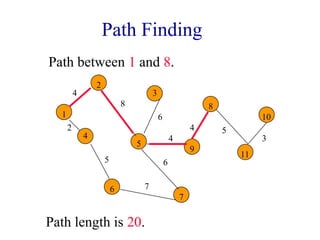
Path Finding
Path between 1 and 8.
2
3
8
10
1
4
5
9
11
6
7
4
8
6
6
7
5
2
4
4 5
3
Path length is 20.
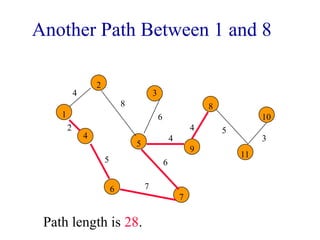
Another Path Between 1 and 8
2
3
8
10
1
4
5
9
11
6
7
4
8
6
6
7
5
2
4
4 5
3
Path length is 28.
Example Of No Path
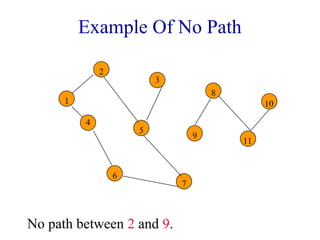
No path between 2 and 9.
2
3
8
10
1
4
5
9
11
6
7
Connected Graph
• Undirected graph.
• There is a path between every pair of
vertices.
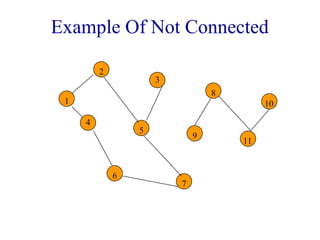
Example Of Not Connected
2
3
8
10
1
4
5
9
11
6
7
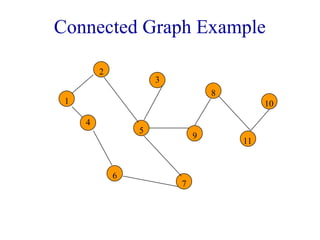
Connected Graph Example
2
3
8
10
1
4
5
9
11
6
7
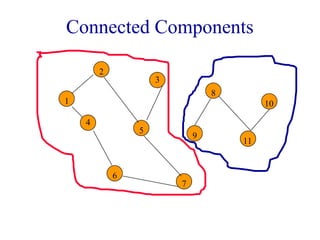
Connected Components
2
3
8
10
1
4
5
9
11
6
7
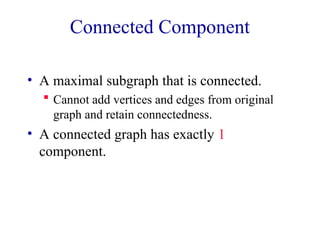
Connected Component
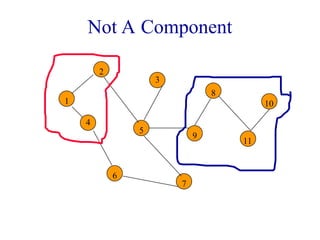
• A maximal subgraph that is connected.
 Cannot add vertices and edges from original
graph and retain connectedness.
• A connected graph has exactly 1
component.
Not A Component
2
3
8
10
1
4
5
9
11
6
7
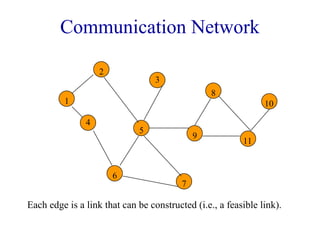
Communication Network
Each edge is a link that can be constructed (i.e., a feasible link).
2
3
8
10
1
4
5
9
11
6
7
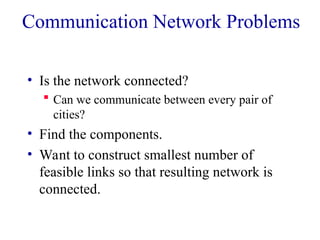
Communication Network Problems
• Is the network connected?
 Can we communicate between every pair of
cities?
• Find the components.
• Want to construct smallest number of
feasible links so that resulting network is
connected.
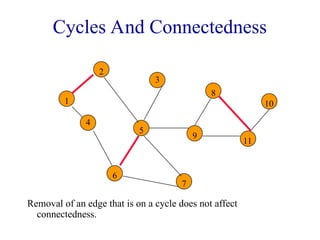
Cycles And Connectedness
2
3
8
10
1
4
5
9
11
6
7
Removal of an edge that is on a cycle does not affect
connectedness.
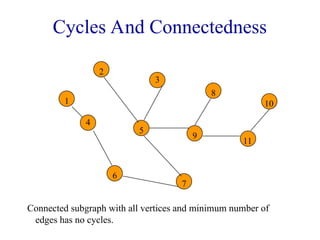
Cycles And Connectedness
2
3
8
10
1
4
5
9
11
6
7
Connected subgraph with all vertices and minimum number of
edges has no cycles.
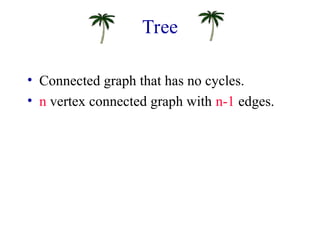
Tree
• Connected graph that has no cycles.
• n vertex connected graph with n-1 edges.
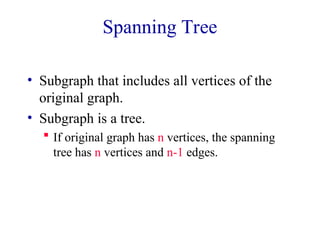
Spanning Tree
• Subgraph that includes all vertices of the
original graph.
• Subgraph is a tree.
 If original graph has n vertices, the spanning
tree has n vertices and n-1 edges.
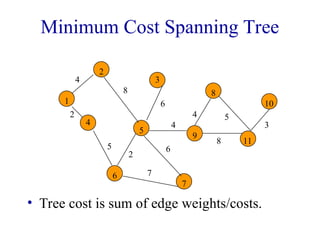
Minimum Cost Spanning Tree
• Tree cost is sum of edge weights/costs.
2
3
8
10
1
4
5
9
11
6
7
4
8
6
6
7
5
2
4
4 5
3
8
2
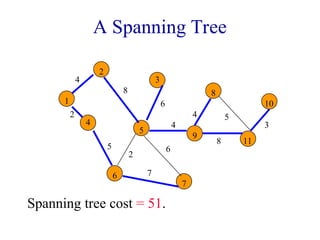
A Spanning Tree
Spanning tree cost = 51.
2
3
8
10
1
4
5
9
11
6
7
4
8
6
6
7
5
2
4
4 5
3
8
2
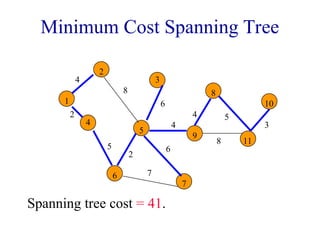
Minimum Cost Spanning Tree
Spanning tree cost = 41.
2
3
8
10
1
4
5
9
11
6
7
4
8
6
6
7
5
2
4
4 5
3
8
2
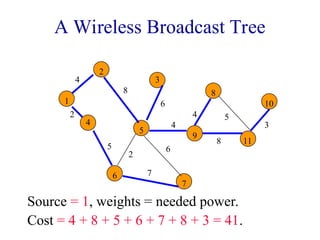
A Wireless Broadcast Tree
Source = 1, weights = needed power.
Cost = 4 + 8 + 5 + 6 + 7 + 8 + 3 = 41.
2
3
8
10
1
4
5
9
11
6
7
4
8
6
6
7
5
2
4
4 5
3
8
2
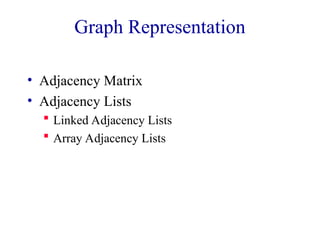
Graph Representation
• Adjacency Matrix
• Adjacency Lists
 Linked Adjacency Lists
 Array Adjacency Lists
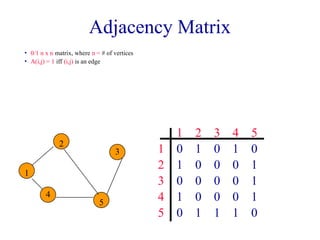
Adjacency Matrix
• 0/1 n x n matrix, where n = # of vertices
• A(i,j) = 1 iff (i,j) is an edge
2
3
1
4
5
1 2 3 4 5
1
2
3
4
5
0 1 0 1 0
1 0 0 0 1
0 0 0 0 1
1 0 0 0 1
0 1 1 1 0
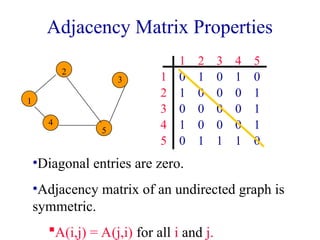
Adjacency Matrix Properties
2
3
1
4
5
1 2 3 4 5
1
2
3
4
5
0 1 0 1 0
1 0 0 0 1
0 0 0 0 1
1 0 0 0 1
0 1 1 1 0
•Diagonal entries are zero.
•Adjacency matrix of an undirected graph is
symmetric.
A(i,j) = A(j,i) for all i and j.
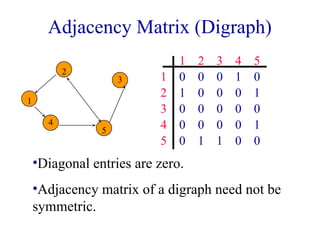
Adjacency Matrix (Digraph)
2
3
1
4
5
1 2 3 4 5
1
2
3
4
5
0 0 0 1 0
1 0 0 0 1
0 0 0 0 0
0 0 0 0 1
0 1 1 0 0
•Diagonal entries are zero.
•Adjacency matrix of a digraph need not be
symmetric.
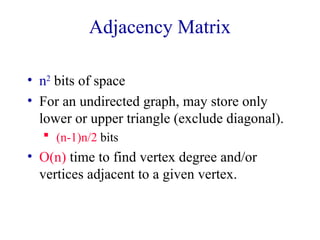
Adjacency Matrix
• n2
bits of space
• For an undirected graph, may store only
lower or upper triangle (exclude diagonal).
 (n-1)n/2 bits
• O(n) time to find vertex degree and/or
vertices adjacent to a given vertex.
Adjacency Lists
• Adjacency list for vertex i is a linear list of vertices adjacent from vertex i.
• An array of n adjacency lists.
2
3
1
4
5
aList[1] = (2,4)
aList[2] = (1,5)
aList[3] = (5)
aList[4] = (5,1)
aList[5] = (2,4,3)
Linked Adjacency Lists
• Each adjacency list is a chain.
2
3
1
4
5
aList[1]
aList[5]
[2]
[3]
[4]
2 4
1 5
5
5 1
2 4 3
Array Length = n
# of chain nodes = 2e (undirected graph)
# of chain nodes = e (digraph)
Array Adjacency Lists
• Each adjacency list is an array list.
2
3
1
4
5
aList[1]
aList[5]
[2]
[3]
[4]
2 4
1 5
5
5 1
2 4 3
Array Length = n
# of list elements = 2e (undirected graph)
# of list elements = e (digraph)
Weighted Graphs
• Cost adjacency matrix.
 C(i,j) = cost of edge (i,j)
• Adjacency lists => each list element is a
pair (adjacent vertex, edge weight)
Number Of Java Classes Needed
• Graph representations
 Adjacency Matrix
 Adjacency Lists
Linked Adjacency Lists
Array Adjacency Lists
 3 representations
• Graph types
 Directed and undirected.
 Weighted and unweighted.
 2 x 2 = 4 graph types
• 3 x 4 = 12 Java classes
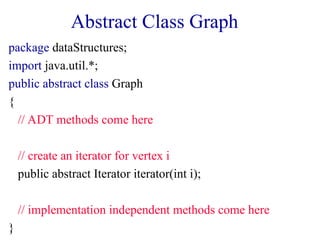
Abstract Class Graph
package dataStructures;
import java.util.*;
public abstract class Graph
{
// ADT methods come here
// create an iterator for vertex i
public abstract Iterator iterator(int i);
// implementation independent methods come here
}
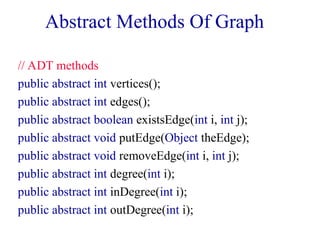
Abstract Methods Of Graph
// ADT methods
public abstract int vertices();
public abstract int edges();
public abstract boolean existsEdge(int i, int j);
public abstract void putEdge(Object theEdge);
public abstract void removeEdge(int i, int j);
public abstract int degree(int i);
public abstract int inDegree(int i);
public abstract int outDegree(int i);

graph4Its about graph topic in data structure.ppt

  • 1.
  • 2.
    Sample Graph Problems •Path problems. • Connectedness problems. • Spanning tree problems.
  • 3.
    Path Finding Path between1 and 8. 2 3 8 10 1 4 5 9 11 6 7 4 8 6 6 7 5 2 4 4 5 3 Path length is 20.
  • 4.
    Another Path Between1 and 8 2 3 8 10 1 4 5 9 11 6 7 4 8 6 6 7 5 2 4 4 5 3 Path length is 28.
  • 5.
    Example Of NoPath No path between 2 and 9. 2 3 8 10 1 4 5 9 11 6 7
  • 6.
    Connected Graph • Undirectedgraph. • There is a path between every pair of vertices.
  • 7.
    Example Of NotConnected 2 3 8 10 1 4 5 9 11 6 7
  • 8.
  • 9.
  • 10.
    Connected Component • Amaximal subgraph that is connected.  Cannot add vertices and edges from original graph and retain connectedness. • A connected graph has exactly 1 component.
  • 11.
  • 12.
    Communication Network Each edgeis a link that can be constructed (i.e., a feasible link). 2 3 8 10 1 4 5 9 11 6 7
  • 13.
    Communication Network Problems •Is the network connected?  Can we communicate between every pair of cities? • Find the components. • Want to construct smallest number of feasible links so that resulting network is connected.
  • 14.
    Cycles And Connectedness 2 3 8 10 1 4 5 9 11 6 7 Removalof an edge that is on a cycle does not affect connectedness.
  • 15.
    Cycles And Connectedness 2 3 8 10 1 4 5 9 11 6 7 Connectedsubgraph with all vertices and minimum number of edges has no cycles.
  • 16.
    Tree • Connected graphthat has no cycles. • n vertex connected graph with n-1 edges.
  • 17.
    Spanning Tree • Subgraphthat includes all vertices of the original graph. • Subgraph is a tree.  If original graph has n vertices, the spanning tree has n vertices and n-1 edges.
  • 18.
    Minimum Cost SpanningTree • Tree cost is sum of edge weights/costs. 2 3 8 10 1 4 5 9 11 6 7 4 8 6 6 7 5 2 4 4 5 3 8 2
  • 19.
    A Spanning Tree Spanningtree cost = 51. 2 3 8 10 1 4 5 9 11 6 7 4 8 6 6 7 5 2 4 4 5 3 8 2
  • 20.
    Minimum Cost SpanningTree Spanning tree cost = 41. 2 3 8 10 1 4 5 9 11 6 7 4 8 6 6 7 5 2 4 4 5 3 8 2
  • 21.
    A Wireless BroadcastTree Source = 1, weights = needed power. Cost = 4 + 8 + 5 + 6 + 7 + 8 + 3 = 41. 2 3 8 10 1 4 5 9 11 6 7 4 8 6 6 7 5 2 4 4 5 3 8 2
  • 22.
    Graph Representation • AdjacencyMatrix • Adjacency Lists  Linked Adjacency Lists  Array Adjacency Lists
  • 23.
    Adjacency Matrix • 0/1n x n matrix, where n = # of vertices • A(i,j) = 1 iff (i,j) is an edge 2 3 1 4 5 1 2 3 4 5 1 2 3 4 5 0 1 0 1 0 1 0 0 0 1 0 0 0 0 1 1 0 0 0 1 0 1 1 1 0
  • 24.
    Adjacency Matrix Properties 2 3 1 4 5 12 3 4 5 1 2 3 4 5 0 1 0 1 0 1 0 0 0 1 0 0 0 0 1 1 0 0 0 1 0 1 1 1 0 •Diagonal entries are zero. •Adjacency matrix of an undirected graph is symmetric. A(i,j) = A(j,i) for all i and j.
  • 25.
    Adjacency Matrix (Digraph) 2 3 1 4 5 12 3 4 5 1 2 3 4 5 0 0 0 1 0 1 0 0 0 1 0 0 0 0 0 0 0 0 0 1 0 1 1 0 0 •Diagonal entries are zero. •Adjacency matrix of a digraph need not be symmetric.
  • 26.
    Adjacency Matrix • n2 bitsof space • For an undirected graph, may store only lower or upper triangle (exclude diagonal).  (n-1)n/2 bits • O(n) time to find vertex degree and/or vertices adjacent to a given vertex.
  • 27.
    Adjacency Lists • Adjacencylist for vertex i is a linear list of vertices adjacent from vertex i. • An array of n adjacency lists. 2 3 1 4 5 aList[1] = (2,4) aList[2] = (1,5) aList[3] = (5) aList[4] = (5,1) aList[5] = (2,4,3)
  • 28.
    Linked Adjacency Lists •Each adjacency list is a chain. 2 3 1 4 5 aList[1] aList[5] [2] [3] [4] 2 4 1 5 5 5 1 2 4 3 Array Length = n # of chain nodes = 2e (undirected graph) # of chain nodes = e (digraph)
  • 29.
    Array Adjacency Lists •Each adjacency list is an array list. 2 3 1 4 5 aList[1] aList[5] [2] [3] [4] 2 4 1 5 5 5 1 2 4 3 Array Length = n # of list elements = 2e (undirected graph) # of list elements = e (digraph)
  • 30.
    Weighted Graphs • Costadjacency matrix.  C(i,j) = cost of edge (i,j) • Adjacency lists => each list element is a pair (adjacent vertex, edge weight)
  • 31.
    Number Of JavaClasses Needed • Graph representations  Adjacency Matrix  Adjacency Lists Linked Adjacency Lists Array Adjacency Lists  3 representations • Graph types  Directed and undirected.  Weighted and unweighted.  2 x 2 = 4 graph types • 3 x 4 = 12 Java classes
  • 32.
    Abstract Class Graph packagedataStructures; import java.util.*; public abstract class Graph { // ADT methods come here // create an iterator for vertex i public abstract Iterator iterator(int i); // implementation independent methods come here }
  • 33.
    Abstract Methods OfGraph // ADT methods public abstract int vertices(); public abstract int edges(); public abstract boolean existsEdge(int i, int j); public abstract void putEdge(Object theEdge); public abstract void removeEdge(int i, int j); public abstract int degree(int i); public abstract int inDegree(int i); public abstract int outDegree(int i);

Editor's Notes

  • #3 Vertices represent cities and edges represent highways. Edge weights are distances or driving times. Depending on the context, path length may either be the number of edges on the path or the sum of the weights of the edges on the path.
  • #4 Since a graph may have more than one path between two vertices, we may be interested in finding a path with a particular property. For example, find a path with minimum length
  • #8 Determine whether an undirected graph is connected.
  • #11 Determine connected components of an undirected graph
  • #16 In graph terminology, the term rooted tree is used to denote what we were earlier calling a tree (Chapter 12).
  • #20 In the communication networks area, we are interested in finding minimum cost spanning trees.
  • #21 Edge cost is power needed to reach a node. If vertex 1 broadcasts with power 2, only vertex 4 is reached. If it broadcasts with power 4, both 2 and 4 are reached. Min-broadcast rooted spanning tree is NP-hard. Cost of tree of previous slide becomes 26.
  • #28 Array length n simply means we need an array with n spots. A direct implementation using a Java array would need n+1 spots, because spot 0 would not be utilized. However, by using spot 0 for vertex 1, spot 1 for vertex 2, and so on, we could get by with a Java array whose length is actually n.