DESCRIBING GRAPHS
PRESENTATION 1
TYPES OF GRAPHS
WHY WE NEED GRAPHS
• Graphs, charts and diagrams are visual
methods commonly used to present data in a
concise manner offering clear and easy-to-
comprehend illustrations of data relationships
and trends. Without visual methods, data
would be too numerous or too complicated to
be understood in limited time and space.
TYPES
• There are 5 main types of visual methods
presenting data:
• a bar graph (or bar chart)
• table
• line graph
• pie chart
• diagram
BAR GRAPHS
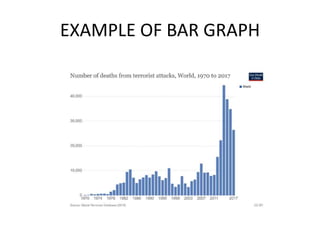
• Bar graphs are used to show relationships
between different data series that are
independent of each other. In this case, the
height or length of the bar indicates the
measured value or frequency. Below, you can
see the example of a bar graph which is the
most widespread visual for presenting
statistical data.
EXAMPLE OF BAR GRAPH
TABLES
• Tables typically show data in columns and rows.
With tables, users can read the data
chronologically as they compare individual
numbers. Tables allow users to focus on a couple
of numbers at a time. They are good for
presenting data that uses multiple units of
measurement or data that involves exact values.
It can be difficult to compare data on tables
because they require detailed reading and focus.
EXAMPLE OF TABLE
Terrorism fatalities (GTD, 2018)
Afghanistan
0.00 in
1973
6,092.00 in
2017
+6,092.00
Albania
0.00 in
1981
0.00 in 2017 +0.00
Algeria
0.00 in
1972
12.00 in 2017 +12.00
Andorra
0.00 in
1974
0.00 in 1974 +0.00
Angola
0.00 in
1977
7.00 in 2017 +7.00
Antigua and
Barbuda
0.00 in
1992
0.00 in 1992 +0.00
Argentina
5.00 in
1970
0.00 in 2017 -5.00
-
100%
Armenia
0.00 in
1991
6.00 in 2016 +6.00
Australasia &
Oceania
0.00 in
1970
4.00 in 2017 +4.00
Australia
0.00 in
1970
4.00 in 2017 +4.00
LINE GRAPHS
• Line graphs represent how data has
changed over time. This type of charts is
especially useful when you want to
demonstrate trends or numbers that are
connected. For example, how incidents vary
over the years. Besides, line graphs can show
dependencies between two objects during a
particular period.
EXAMPLE OF LINE GRAPH
PIE CHARTS
• Pie charts are designed to visualize how a
whole is divided into various parts. Each
segment of the pie is a particular category
within the total data set. In this way, it
represents a percentage distribution.
EXAMPLE OF PIE CHART
DIAGRAMS
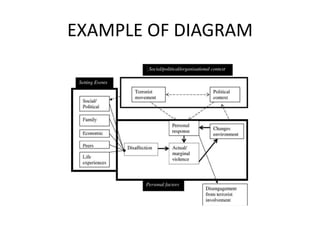
• Diagram is a plan, drawing, or outline created
to illustrate how separate parts work and
overlap at the connecting points.
EXAMPLE OF DIAGRAM
SOURCES
• https://ourworldindata.org/terrorism
• https://towardsdatascience.com/how-geo-mapping-
helps-identify-trends-in-global-terrorism-
5881bf0a0659
• https://www.researchgate.net/figure/Involvement-
with-terrorism_fig2_255632758

GRAPH Presentation 1 -TYPES.pptx

  • 1.
  • 2.
    WHY WE NEEDGRAPHS • Graphs, charts and diagrams are visual methods commonly used to present data in a concise manner offering clear and easy-to- comprehend illustrations of data relationships and trends. Without visual methods, data would be too numerous or too complicated to be understood in limited time and space.
  • 3.
    TYPES • There are5 main types of visual methods presenting data: • a bar graph (or bar chart) • table • line graph • pie chart • diagram
  • 4.
    BAR GRAPHS • Bargraphs are used to show relationships between different data series that are independent of each other. In this case, the height or length of the bar indicates the measured value or frequency. Below, you can see the example of a bar graph which is the most widespread visual for presenting statistical data.
  • 5.
  • 6.
    TABLES • Tables typicallyshow data in columns and rows. With tables, users can read the data chronologically as they compare individual numbers. Tables allow users to focus on a couple of numbers at a time. They are good for presenting data that uses multiple units of measurement or data that involves exact values. It can be difficult to compare data on tables because they require detailed reading and focus.
  • 7.
    EXAMPLE OF TABLE Terrorismfatalities (GTD, 2018) Afghanistan 0.00 in 1973 6,092.00 in 2017 +6,092.00 Albania 0.00 in 1981 0.00 in 2017 +0.00 Algeria 0.00 in 1972 12.00 in 2017 +12.00 Andorra 0.00 in 1974 0.00 in 1974 +0.00 Angola 0.00 in 1977 7.00 in 2017 +7.00 Antigua and Barbuda 0.00 in 1992 0.00 in 1992 +0.00 Argentina 5.00 in 1970 0.00 in 2017 -5.00 - 100% Armenia 0.00 in 1991 6.00 in 2016 +6.00 Australasia & Oceania 0.00 in 1970 4.00 in 2017 +4.00 Australia 0.00 in 1970 4.00 in 2017 +4.00
  • 8.
    LINE GRAPHS • Linegraphs represent how data has changed over time. This type of charts is especially useful when you want to demonstrate trends or numbers that are connected. For example, how incidents vary over the years. Besides, line graphs can show dependencies between two objects during a particular period.
  • 9.
  • 10.
    PIE CHARTS • Piecharts are designed to visualize how a whole is divided into various parts. Each segment of the pie is a particular category within the total data set. In this way, it represents a percentage distribution.
  • 11.
  • 12.
    DIAGRAMS • Diagram isa plan, drawing, or outline created to illustrate how separate parts work and overlap at the connecting points.
  • 13.
  • 14.