Download to read offline




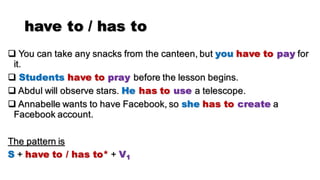
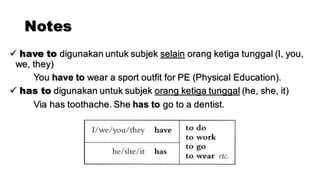

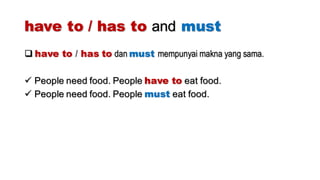



This document discusses how to use "have to/has to" and "don't have to/doesn't have to" to express obligations and lack thereof in English. It explains that "have to/has to" are used to indicate something that is obligatory, while "don't have to/doesn't have to" suggest something that is not required. Examples are provided to illustrate the proper usage of these phrases with different subjects. A comparison is also made between "have to/has to" and "must", noting they have similar meanings, as well as between "don't have to/doesn't have to" and "must not".


![I agree with you [exercise1]](https://cdn.slidesharecdn.com/ss_thumbnails/iagreewithyouexercise1-190916230715-thumbnail.jpg?width=640&height=640&fit=bounds)


