GROUP NO.6
JANAKI RANI D-60
MONIKA LOHIA D-54
P.SRINATH B-03
WHAT IS CURRENCY WAR???
 Currency war” - term coined by Guido Mantega,
the finance minister of Brazil, 2010.
 Manipulation of currencies to boost exports.
 Also known as competitive devaluation.
MECHANISM OF DEVALUATION
 Control over exchange rates
 Selling own currency to buy foreign currency
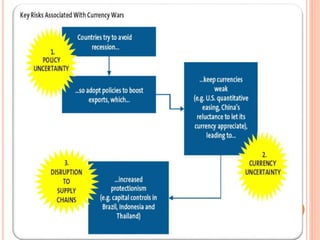
 Quantitative easing
HISTORICAL OVERVIEW
 During the Great Depression of the 1930s, most
countries abandoned the gold standard.
 "beggar thy neighbour “
 Negative impact on international trade
 The currency wars of the 1930s ended with
the Tripartite Agreement in September 1936,
stabilizing exchange rates .
AFTER GREAT RECESSION OF 2008…
 Sharp decline in world trade.
 Export led strategy for growth.
 Export based countries such as China and South
Korea devalued their currencies to export more
commodities to the global market.
 US and UK introduced monetary policies to devalue
their currencies in order to compete in the export
market.
PRESENT DAY…
 A €60bn per month quantitative easing programme
was launched in January 2015 by the European
Central Bank.
 China has recently devalued “Yuan” in august
2015,due to weakening export.
 This resulted in further devaluation by Asian
currencies like, Vietnam dong and the Kazakhstan
tenge.
REASONS FOR CURRENCY WAR
 Trade disputes between countries
 Currency Volatility
 Trade Protectionism
ADVANTAGES
 Boost in exports
 Employment
 Demand and consumptions
DISADVANTAGES
 Impact on productivity
 Rising inflation and capital outflows.
 Trade barriers
WHY WOULD WE NEED DEVALUATION ??
 Export growth
 Rising inflation
 Relief for debtors
ANY QUERIES ???
THANK YOU!!!

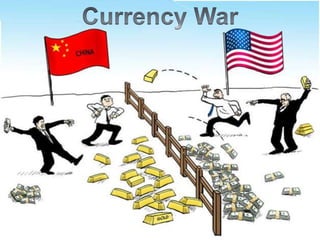
Currency wars

  • 1.
    GROUP NO.6 JANAKI RANID-60 MONIKA LOHIA D-54 P.SRINATH B-03
  • 3.
    WHAT IS CURRENCYWAR???  Currency war” - term coined by Guido Mantega, the finance minister of Brazil, 2010.  Manipulation of currencies to boost exports.  Also known as competitive devaluation.
  • 4.
    MECHANISM OF DEVALUATION Control over exchange rates  Selling own currency to buy foreign currency  Quantitative easing
  • 5.
    HISTORICAL OVERVIEW  Duringthe Great Depression of the 1930s, most countries abandoned the gold standard.  "beggar thy neighbour “  Negative impact on international trade  The currency wars of the 1930s ended with the Tripartite Agreement in September 1936, stabilizing exchange rates .
  • 6.
    AFTER GREAT RECESSIONOF 2008…  Sharp decline in world trade.  Export led strategy for growth.  Export based countries such as China and South Korea devalued their currencies to export more commodities to the global market.  US and UK introduced monetary policies to devalue their currencies in order to compete in the export market.
  • 7.
    PRESENT DAY…  A€60bn per month quantitative easing programme was launched in January 2015 by the European Central Bank.  China has recently devalued “Yuan” in august 2015,due to weakening export.  This resulted in further devaluation by Asian currencies like, Vietnam dong and the Kazakhstan tenge.
  • 8.
    REASONS FOR CURRENCYWAR  Trade disputes between countries  Currency Volatility  Trade Protectionism
  • 9.
    ADVANTAGES  Boost inexports  Employment  Demand and consumptions
  • 10.
    DISADVANTAGES  Impact onproductivity  Rising inflation and capital outflows.  Trade barriers
  • 11.
    WHY WOULD WENEED DEVALUATION ??  Export growth  Rising inflation  Relief for debtors
  • 13.
  • 14.