Prepared by: Daniel M. Alcazarin
Science Teacher I
Talangan Integrated National High School
sirDA
PRE-HISTORIC ERA
 Includes all human existence before the
emergence of writing. Their work of art is of
interest not only to the art historians but also to
archeologists and anthropologists, for whom the
art is the only one clue-along with fossils,
pollens and other archeological discoveries that
lead to an understanding of early human life and
culture.
THREE PERIODS OF
PRE-HISTORIC ART
1. Paleolithic Era (Old Stone)
2. Mesolithic Era (Middle Stone Age)
3. Neolithic Era (New Stone Age)
PAINTINGS FROM THE PRE-HISTORIC ERA
Paintings during the pre-historic era were
found inside caves which may have been the pre-
historic people’s way of communicating with
each other. It may also be for religious or
ceremonial.
These symbols for these people paintings
may be considered more an artifact of
archeological evidence than a true picture of
human’s first created art.
Pre-historic drawings of animals were
usually correct in proportion.
CAVE OF LASCAUX
5,000-10,000 BC-Stone Age 1
Paleolithic Paintings
Southwestern France
 The dominant features in the painting were large animals
native in the region. It was discovered on 12th of September 1940,
and was given a statutory historic monument protection. It was
discovered by 18-year-old Marcel Ravidat. Ravidat returned to
the scene with three friends, Jacques Marsal, Georges Agnel, and
Simon Coencas, and entered the cave via a long shaft. The
teenagers discovered that the cave walls were covered with
depictions of animals.
Six Sections identified in the cave:
1. The Great Hall of the Bulls
2. The Lateral Passage
3. The Shaft of the Dead Man
4. The Chamber of Engraving
5. The Painted Gallery
6. The Chamber of Felines
1. THE GREAT HALL OF THE
BULLS
2. THE LATERAL PASSAGE
3. THE SHAFT OF THE DEAD
MAN
4. THE CHAMBER OF
ENGRAVINGS
5. THE PAINTED GALLERY
6. THE CHAMBER OF FELINES
The cave complex was opened to the public in 1948. By
1955, the carbon dioxide, heat, humidity, and other
contaminants produced by 1,200 visitors per day had visibly
damaged the paintings and introduced lichen on the walls.
The cave was closed to the public in 1963 to preserve the
art. after the cave was closed, the paintings were restored to
their original state and were monitored daily.
PRE-HISTORIC ERA ART
QUIZ #1
1. An era including all human existence before the emergence of
writing. __________________
2. Who discovered the cave of Lascaux in 1940? ___________
3. Where is the Cave of Lascaux located? _______________
4. It is the Middle Stone age. __________________
5. It is the New Stone age. __________________
6-7. For them art is the only one clue -along with fossils,
pollens and other archeological discoveries that lead
to an understanding of early human life and culture.
8-10. Name three different sections inside the Cave of Lascaux.
ANSWERS
1. Pre-historic Era
2. Marcel Ravidat
3. Southwestern France
4. Mesolithic Era
5. Neolithic Era
6-7. a. Art Historians b. Archeologists c. Anthropologist
8-10. Paintings that named inside the Cave of Lascaux.
- The Great Hall of the Bulls - The Chamber of Engravings
- The Lateral Passage - The Painted Gallery
- The Shaft of the Dead Man - Chamber of Felines
Paintings
FROM
ANCIENT EGYPT
PAINTINGS FROM ANCIENT
EGYPT
The purpose of Egyptian Paintings is to make the
deceased person’s afterlife place pleasant. With this in
mind, themes include journey to the underworld or the
presentation of the deceased to the gods of the
underworld by their protective deities.
It emphasizes the importance of life after death and the
preservation of the knowledge of the past.
Most paintings were highly stylized and symbolic, and
show profile view of animals or people. the dominant colors
used were red, black, blue, gold and green derived from
mineral pigments that can with stand strong sunlight without
fading.
The paintings on the walls on the tomb show events of the
life of the king while he was still on earth and the scenes he
expects to encounter in the underworld after his death.
Paintings from
Sarcophagus of
Tutankhamen XVIII
dynasty.
1362 A.D. – 1253 B.C.
OTHER PAINTINGS FROM ANCIENT EGYPT
WHAT CAN YOU SAY ABOUT THE
PAINTINGS OF EGYPT?
Paintings
FROM
CLASSICAL GREEK ERA
PAINTING FROM CLASSICAL GREEK ERA
Painting from the Classical Greek Era were
most commonly found in vases, panels and tomb. It
depicts natural figures with dynamic compositions.
Most of the subjects were battle scenes,
mythological figures and everyday scenes. It reveals
a grasp of linear perspective and
naturalist representation.
MOST COMMON METHODS OF GREEK
PAINTING
1. FRESCO- method of painting water-
based pigments usually on a wall
surfaces.
2. ENCAUSTIC- developed to be used by
Greek ship builders, who used the hot
wax to fill the cracks of the ship. Soon
pigments (colors) was added and used
to paint a wax hull.
Judgment of
Paris
(370-330 B.C.)
A. VASE PAINTING
Kerch Style - also referred to as
Kerch Vases; are red-figured
pottery named after where it was
found.
Shapes commonly found are:
1. Pelike – wine container
2. Lekanis- a low bowl with two horizontal handles and
a low broad foot
3. Lebes gamikos- with high handles and lid use to
carry bridal bath
4. Krater –bowl used for mixing wine and water
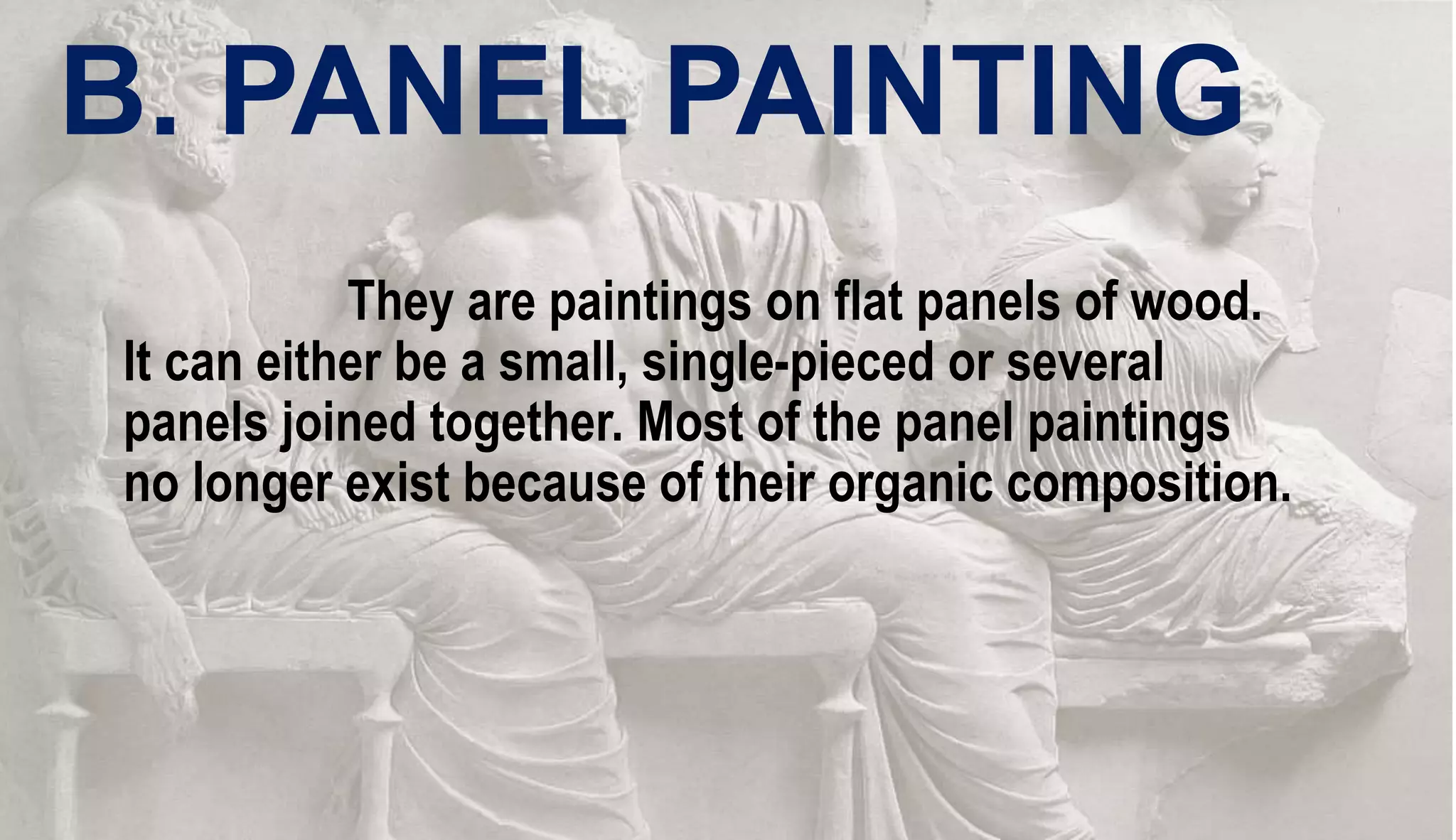
B. PANEL PAINTING
They are paintings on flat panels of wood.
It can either be a small, single-pieced or several
panels joined together. Most of the panel paintings
no longer exist because of their organic composition.
Pitsa panel (540 – 530 B.C.E)
- the earliest known panel painting
C. TOMB/ WALL
PAINTING
It was popular during the classical period.
It uses the method frescos in either TEMPERA
(water-based) or ENCAUSTIC (wax). It has a sharp,
flatly outlined style of painting and because it uses
water-based materials, very few samples survived.
TOMB OF THE DIVER (PAESTRUM 480B.C.E)
1. The purpose of this painting is to make the deceased afterlife
place pleasant. __________________
2. A method of Greek painting water based pigments on a freshly
applied plaster usually on a wall surface___________
3. A method of Greek painting that is developed to use by Greek
ship builders, who used the hot wax to fill the cracks of the
ship._______________
4-7. Shapes that are commonly found in Greek Kerch Style Vase
painting.
8.One of the most famous vase painting in the classical Greek
period.
9. It is the earliest known panel painting.
10. The most famous tomb painting in the classical period.
ANSWER
1. EGYPTIAN OR EGYPTIAN PAINTING
2. FRESCO
3. ENCAUSTIC
4. PELIKE
5. LEKANIS
6. LEBES GAMIKOS
7. KRATER
8. JUDGMENT OF PARIS
9. PITSA PANEL
10. TOMB OF THE DIVER
Paintings
FROM
THE ROMAN ERA
Most of the painting from this era were
copied or imitated from Hellenic Greek paintings.
Fresco technique was used in brightly colored
backgrounds; division of the wall into a multiple
rectangular areas (tic-tac-toe design); multi-point
perspective; and a tropme-l’-oeil effect.
Tropme-l’-oeil effect
- is an art technique that uses
realistic imagery to create the
optical illusion that the depicted
objects exist in three dimensions.
Roman paintings have a wide variety of
subjects: animals, everyday life, still life,
mythological subjects, portraits and landscapes.
The development of landscape painting is the
main innovation of Roman painting from Greek
painting.
MOSAIC- it is a process where an image is created using
an assemblage of small pieces of colored glass, stones, or other
materials. This technique use for decorative art or interior
decorations.
HEAD OF ALEXANDER
The full image is a
Roman floor mosaic in the
House of Fun Pompei, dated
100 BC.The whole mosaic
depicts the battle between
the armies of Alexander the
Great and Darius III of Persia
FRESCO FROM
THE VILLA OF
MYSTERIES
(Pompeii 80 BC)
This fresco painting
was believed to depict
ceremonial rites, either
marriage or an
initiation of a woman in
a mystery cult.
BOSCOTRECASE, POMPEII
BYZANTINE
Paintings
BYZANTINE PAINTING
The lively styles of paintings which had
been invented in Greek and Rome lived on
Byzantium but this time for Christians.
By the 11th century, the Greek and Oriental
styles seem to blend together in magnificent,
imposing images, which adorned the churches in
large and small forms.
Theodora - was an
asian queen with dark
eyes and hair with
fierce expression.
THE COURT OF EMPRESS TEODORA,
MOSAIC
ROMANESQUE
Paintings
These are largely placed mosaics on the walls of the
churches that follows a strict frontal pose.
It has remarkable variety of artistic traditions such as
modeling and treatment of faces and draperies that follow
Byzantine convention while the refreshingly decorative
feelings comes from Southern French Styles. It also
shows traces of MOZARABIC influence (Arabize influence)
through elongated oval faces, large staring eyes and long
noses, figures against flat colored bands and heavy
outlining.
CHRIST IN MAJESTY
Painting from the Church of St. Clemente, Tahull, Lerida Spain c. 1123
Mandorla
Paintings
FROM
THE GOTHIC ERA
Paintings have been confined in the illumination
of manuscript pages and the painting of frescoes on
the walls of churches in cosmopolitan style, elegant
mannered and sophisticated.
THE LADY AND THE UNICORN
TAPESTRY
1506-1513
Subjects usually
depicts popular legends
and love stories,
patterns like “ mille
fleur” or thousand
flowers show influence
which may have been
due to the crusades.
 THE LADY AND THE UNICORN TAPESTRY
ROSE WINDOW
ABOUT 1230
Stained Glass
windows were created to
transform the vast stone
interiors with warm and
glowing color and at the
same time to instruct
Christians in their faith.
ROSE WINDOWS SAMPLES
THE SHEPHERD DAVID
13th Century
The paintings show
some realistic details and
shows naïve naturalism.
THE SHEPHERD DAVID
13TH CENTURY GOTHIC MANUSCRIPT ILLUSTRATION
INDIVIDUAL ACTIVITY
To know how much you have learned from the discussion about the
paintings of the Early Age, fill in the box with the characteristics and functions
that would best describe the painting in every era/period.
PERIOD/ERA CHARACTERISTICS FUNCTIONS
ANCIENT PAINTINGS
PRE-HISTORIC
EGYPTIANS
CLASSICAL PAINTINGS
Greek
Roman
MEDIEVAL PAINTINGS
Byzantine
Romanesque
Gothic
LET’S REVIEW
CAVE OF LASCAUX
Sarcophagus of Tutankhamen XVIII
Judgment of Paris
Pitsa Panel
Theodora
Head of Alexander
Fresco from the Villa of Mysteries
Christ in Majesty
The Lady and the Unicorn Tapestry
Rose Window
The Shepherd David
Tomb of the Diver
The Great Hall of the Bulls
The Court of Empress Theodora
DEPARTMENT OF EDUCATION
REGION IV – A CALABARZON
DIVISION OF LAGUNA
DISTRICT OF NAGCARLAN-RIZAL
TALANGAN INTEGRATED
NATIONAL HIGH SCHOOL
Talangan, Nagcarlan, Laguna
Daniel M. Alcazarin
MAPEH/ Science Teacher I
For more inquiries, kindly message me in any of
my social media accts and follow me  :
FB acct: “Daniel Alcazarin”
IG acct. “@danielalcazarin”
Twitter acct: “@DanielAlcazarin”
 Let me know if you downloaded this
presentation so I’ll be more encouraged to
upload more. Thank you!

grade9-arts-paintings-firstquarter-190812152638.pdf

  • 1.
    Prepared by: DanielM. Alcazarin Science Teacher I Talangan Integrated National High School sirDA
  • 2.
    PRE-HISTORIC ERA  Includesall human existence before the emergence of writing. Their work of art is of interest not only to the art historians but also to archeologists and anthropologists, for whom the art is the only one clue-along with fossils, pollens and other archeological discoveries that lead to an understanding of early human life and culture.
  • 3.
    THREE PERIODS OF PRE-HISTORICART 1. Paleolithic Era (Old Stone) 2. Mesolithic Era (Middle Stone Age) 3. Neolithic Era (New Stone Age)
  • 10.
    PAINTINGS FROM THEPRE-HISTORIC ERA Paintings during the pre-historic era were found inside caves which may have been the pre- historic people’s way of communicating with each other. It may also be for religious or ceremonial. These symbols for these people paintings may be considered more an artifact of archeological evidence than a true picture of human’s first created art. Pre-historic drawings of animals were usually correct in proportion.
  • 11.
    CAVE OF LASCAUX 5,000-10,000BC-Stone Age 1 Paleolithic Paintings Southwestern France
  • 12.
     The dominantfeatures in the painting were large animals native in the region. It was discovered on 12th of September 1940, and was given a statutory historic monument protection. It was discovered by 18-year-old Marcel Ravidat. Ravidat returned to the scene with three friends, Jacques Marsal, Georges Agnel, and Simon Coencas, and entered the cave via a long shaft. The teenagers discovered that the cave walls were covered with depictions of animals.
  • 13.
    Six Sections identifiedin the cave: 1. The Great Hall of the Bulls 2. The Lateral Passage 3. The Shaft of the Dead Man 4. The Chamber of Engraving 5. The Painted Gallery 6. The Chamber of Felines
  • 14.
    1. THE GREATHALL OF THE BULLS
  • 15.
  • 16.
    3. THE SHAFTOF THE DEAD MAN
  • 17.
    4. THE CHAMBEROF ENGRAVINGS
  • 18.
  • 19.
    6. THE CHAMBEROF FELINES
  • 20.
    The cave complexwas opened to the public in 1948. By 1955, the carbon dioxide, heat, humidity, and other contaminants produced by 1,200 visitors per day had visibly damaged the paintings and introduced lichen on the walls. The cave was closed to the public in 1963 to preserve the art. after the cave was closed, the paintings were restored to their original state and were monitored daily.
  • 21.
  • 22.
  • 23.
    QUIZ #1 1. Anera including all human existence before the emergence of writing. __________________ 2. Who discovered the cave of Lascaux in 1940? ___________ 3. Where is the Cave of Lascaux located? _______________ 4. It is the Middle Stone age. __________________ 5. It is the New Stone age. __________________ 6-7. For them art is the only one clue -along with fossils, pollens and other archeological discoveries that lead to an understanding of early human life and culture. 8-10. Name three different sections inside the Cave of Lascaux.
  • 24.
    ANSWERS 1. Pre-historic Era 2.Marcel Ravidat 3. Southwestern France 4. Mesolithic Era 5. Neolithic Era 6-7. a. Art Historians b. Archeologists c. Anthropologist 8-10. Paintings that named inside the Cave of Lascaux. - The Great Hall of the Bulls - The Chamber of Engravings - The Lateral Passage - The Painted Gallery - The Shaft of the Dead Man - Chamber of Felines
  • 25.
  • 26.
    PAINTINGS FROM ANCIENT EGYPT Thepurpose of Egyptian Paintings is to make the deceased person’s afterlife place pleasant. With this in mind, themes include journey to the underworld or the presentation of the deceased to the gods of the underworld by their protective deities.
  • 27.
    It emphasizes theimportance of life after death and the preservation of the knowledge of the past. Most paintings were highly stylized and symbolic, and show profile view of animals or people. the dominant colors used were red, black, blue, gold and green derived from mineral pigments that can with stand strong sunlight without fading.
  • 29.
    The paintings onthe walls on the tomb show events of the life of the king while he was still on earth and the scenes he expects to encounter in the underworld after his death. Paintings from Sarcophagus of Tutankhamen XVIII dynasty. 1362 A.D. – 1253 B.C.
  • 30.
    OTHER PAINTINGS FROMANCIENT EGYPT
  • 37.
    WHAT CAN YOUSAY ABOUT THE PAINTINGS OF EGYPT?
  • 38.
  • 39.
    PAINTING FROM CLASSICALGREEK ERA Painting from the Classical Greek Era were most commonly found in vases, panels and tomb. It depicts natural figures with dynamic compositions. Most of the subjects were battle scenes, mythological figures and everyday scenes. It reveals a grasp of linear perspective and naturalist representation.
  • 40.
    MOST COMMON METHODSOF GREEK PAINTING 1. FRESCO- method of painting water- based pigments usually on a wall surfaces. 2. ENCAUSTIC- developed to be used by Greek ship builders, who used the hot wax to fill the cracks of the ship. Soon pigments (colors) was added and used to paint a wax hull.
  • 41.
  • 42.
    A. VASE PAINTING KerchStyle - also referred to as Kerch Vases; are red-figured pottery named after where it was found. Shapes commonly found are: 1. Pelike – wine container
  • 43.
    2. Lekanis- alow bowl with two horizontal handles and a low broad foot
  • 44.
    3. Lebes gamikos-with high handles and lid use to carry bridal bath
  • 45.
    4. Krater –bowlused for mixing wine and water
  • 46.
    B. PANEL PAINTING Theyare paintings on flat panels of wood. It can either be a small, single-pieced or several panels joined together. Most of the panel paintings no longer exist because of their organic composition.
  • 47.
    Pitsa panel (540– 530 B.C.E) - the earliest known panel painting
  • 48.
    C. TOMB/ WALL PAINTING Itwas popular during the classical period. It uses the method frescos in either TEMPERA (water-based) or ENCAUSTIC (wax). It has a sharp, flatly outlined style of painting and because it uses water-based materials, very few samples survived.
  • 49.
    TOMB OF THEDIVER (PAESTRUM 480B.C.E)
  • 50.
    1. The purposeof this painting is to make the deceased afterlife place pleasant. __________________ 2. A method of Greek painting water based pigments on a freshly applied plaster usually on a wall surface___________ 3. A method of Greek painting that is developed to use by Greek ship builders, who used the hot wax to fill the cracks of the ship._______________ 4-7. Shapes that are commonly found in Greek Kerch Style Vase painting. 8.One of the most famous vase painting in the classical Greek period. 9. It is the earliest known panel painting. 10. The most famous tomb painting in the classical period.
  • 51.
    ANSWER 1. EGYPTIAN OREGYPTIAN PAINTING 2. FRESCO 3. ENCAUSTIC 4. PELIKE 5. LEKANIS 6. LEBES GAMIKOS 7. KRATER 8. JUDGMENT OF PARIS 9. PITSA PANEL 10. TOMB OF THE DIVER
  • 52.
  • 53.
    Most of thepainting from this era were copied or imitated from Hellenic Greek paintings. Fresco technique was used in brightly colored backgrounds; division of the wall into a multiple rectangular areas (tic-tac-toe design); multi-point perspective; and a tropme-l’-oeil effect.
  • 54.
    Tropme-l’-oeil effect - isan art technique that uses realistic imagery to create the optical illusion that the depicted objects exist in three dimensions.
  • 55.
    Roman paintings havea wide variety of subjects: animals, everyday life, still life, mythological subjects, portraits and landscapes. The development of landscape painting is the main innovation of Roman painting from Greek painting.
  • 56.
    MOSAIC- it isa process where an image is created using an assemblage of small pieces of colored glass, stones, or other materials. This technique use for decorative art or interior decorations. HEAD OF ALEXANDER The full image is a Roman floor mosaic in the House of Fun Pompei, dated 100 BC.The whole mosaic depicts the battle between the armies of Alexander the Great and Darius III of Persia
  • 58.
    FRESCO FROM THE VILLAOF MYSTERIES (Pompeii 80 BC) This fresco painting was believed to depict ceremonial rites, either marriage or an initiation of a woman in a mystery cult.
  • 59.
  • 60.
  • 61.
    BYZANTINE PAINTING The livelystyles of paintings which had been invented in Greek and Rome lived on Byzantium but this time for Christians. By the 11th century, the Greek and Oriental styles seem to blend together in magnificent, imposing images, which adorned the churches in large and small forms.
  • 62.
    Theodora - wasan asian queen with dark eyes and hair with fierce expression.
  • 63.
    THE COURT OFEMPRESS TEODORA, MOSAIC
  • 64.
  • 65.
    These are largelyplaced mosaics on the walls of the churches that follows a strict frontal pose. It has remarkable variety of artistic traditions such as modeling and treatment of faces and draperies that follow Byzantine convention while the refreshingly decorative feelings comes from Southern French Styles. It also shows traces of MOZARABIC influence (Arabize influence) through elongated oval faces, large staring eyes and long noses, figures against flat colored bands and heavy outlining.
  • 66.
    CHRIST IN MAJESTY Paintingfrom the Church of St. Clemente, Tahull, Lerida Spain c. 1123
  • 67.
  • 68.
  • 69.
    Paintings have beenconfined in the illumination of manuscript pages and the painting of frescoes on the walls of churches in cosmopolitan style, elegant mannered and sophisticated.
  • 70.
    THE LADY ANDTHE UNICORN TAPESTRY 1506-1513
  • 71.
    Subjects usually depicts popularlegends and love stories, patterns like “ mille fleur” or thousand flowers show influence which may have been due to the crusades.  THE LADY AND THE UNICORN TAPESTRY
  • 72.
    ROSE WINDOW ABOUT 1230 StainedGlass windows were created to transform the vast stone interiors with warm and glowing color and at the same time to instruct Christians in their faith.
  • 73.
  • 74.
    THE SHEPHERD DAVID 13thCentury The paintings show some realistic details and shows naïve naturalism.
  • 75.
    THE SHEPHERD DAVID 13THCENTURY GOTHIC MANUSCRIPT ILLUSTRATION
  • 76.
    INDIVIDUAL ACTIVITY To knowhow much you have learned from the discussion about the paintings of the Early Age, fill in the box with the characteristics and functions that would best describe the painting in every era/period. PERIOD/ERA CHARACTERISTICS FUNCTIONS ANCIENT PAINTINGS PRE-HISTORIC EGYPTIANS CLASSICAL PAINTINGS Greek Roman MEDIEVAL PAINTINGS Byzantine Romanesque Gothic
  • 77.
  • 78.
  • 79.
  • 80.
  • 81.
  • 82.
  • 83.
  • 84.
    Fresco from theVilla of Mysteries
  • 85.
  • 86.
    The Lady andthe Unicorn Tapestry
  • 87.
  • 88.
  • 89.
  • 90.
    The Great Hallof the Bulls
  • 91.
    The Court ofEmpress Theodora
  • 92.
    DEPARTMENT OF EDUCATION REGIONIV – A CALABARZON DIVISION OF LAGUNA DISTRICT OF NAGCARLAN-RIZAL TALANGAN INTEGRATED NATIONAL HIGH SCHOOL Talangan, Nagcarlan, Laguna Daniel M. Alcazarin MAPEH/ Science Teacher I For more inquiries, kindly message me in any of my social media accts and follow me  : FB acct: “Daniel Alcazarin” IG acct. “@danielalcazarin” Twitter acct: “@DanielAlcazarin”  Let me know if you downloaded this presentation so I’ll be more encouraged to upload more. Thank you!