
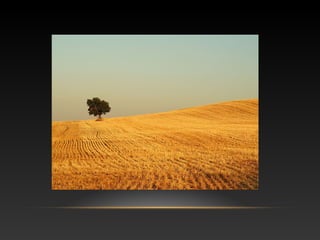
GRADE 8 - ICT
IMAGE COMPOSITION RULES
WHAT IS IMAGE COMPOSITION?
• In the visual arts—in particular painting, graphic
design, photography, and sculpture—composition is
the placement or arrangement of visual elements or
ingredients in a work of art, as distinct from the subject of
a work.
1. RULE OF THIRDS
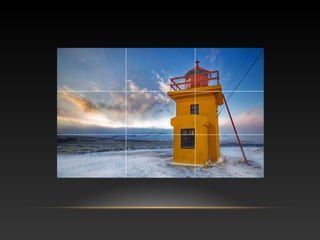
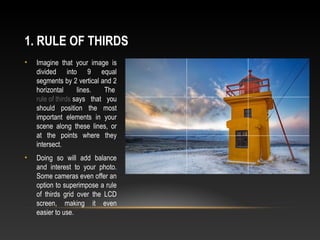
• Imagine that your image is
divided into 9 equal
segments by 2 vertical and 2
horizontal lines. The
rule of thirds says that you
should position the most
important elements in your
scene along these lines, or
at the points where they
intersect.
• Doing so will add balance
and interest to your photo.
Some cameras even offer an
option to superimpose a rule
of thirds grid over the LCD
screen, making it even
easier to use.
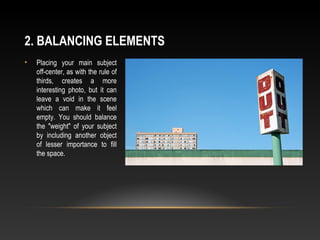
2. BALANCING ELEMENTS
• Placing your main subject
off-center, as with the rule of
thirds, creates a more
interesting photo, but it can
leave a void in the scene
which can make it feel
empty. You should balance
the "weight" of your subject
by including another object
of lesser importance to fill
the space.
3. LEADING LINES
• When we look at a photo our eye
is naturally drawn along lines. By
thinking about how you place
lines in your composition, you can
affect the way we view the image,
pulling us into the picture,
towards the subject, or on a
journey "through" the scene.
There are many different types of
line - straight, diagonal, curvy,
zigzag, radial etc - and each can
be used to enhance our photo's
composition.
4. SYMMETRY AND PATTERNS
• We are surrounded by symmetry
and patterns, both natural and
man-made., They can make for
very eye-catching compositions,
particularly in situations where
they are not expected. Another
great way to use them is to break
the symmetry or pattern in some
way, introducing tension and a
focal point to the scene
5. VIEWPOINT
• Before photographing your
subject, take time to think about
where you will shoot it from. Our
viewpoint has a massive impact
on the composition of our photo,
and as a result it can greatly
affect the message that the shot
conveys. Rather than just
shooting from eye level, consider
photographing from high above,
down at ground level, from the
side, from the back, from a long
way away, from very close up,
and so on.
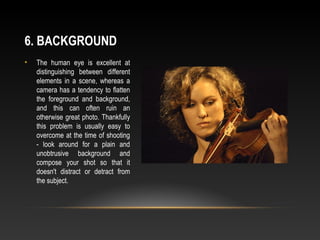
6. BACKGROUND
• The human eye is excellent at
distinguishing between different
elements in a scene, whereas a
camera has a tendency to flatten
the foreground and background,
and this can often ruin an
otherwise great photo. Thankfully
this problem is usually easy to
overcome at the time of shooting
- look around for a plain and
unobtrusive background and
compose your shot so that it
doesn't distract or detract from
the subject.
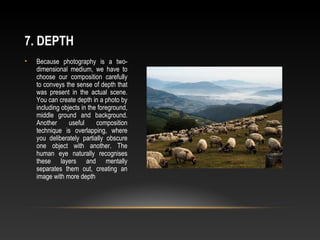
7. DEPTH
• Because photography is a two-
dimensional medium, we have to
choose our composition carefully
to conveys the sense of depth that
was present in the actual scene.
You can create depth in a photo by
including objects in the foreground,
middle ground and background.
Another useful composition
technique is overlapping, where
you deliberately partially obscure
one object with another. The
human eye naturally recognises
these layers and mentally
separates them out, creating an
image with more depth
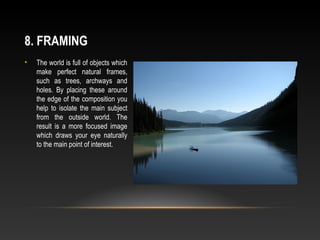
8. FRAMING
• The world is full of objects which
make perfect natural frames,
such as trees, archways and
holes. By placing these around
the edge of the composition you
help to isolate the main subject
from the outside world. The
result is a more focused image
which draws your eye naturally
to the main point of interest.
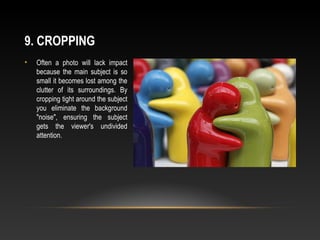
9. CROPPING
• Often a photo will lack impact
because the main subject is so
small it becomes lost among the
clutter of its surroundings. By
cropping tight around the subject
you eliminate the background
"noise", ensuring the subject
gets the viewer's undivided
attention.
10. EXPERIMENTATION
• With the dawn of the digital age
in photography we no longer
have to worry about film
processing costs or running out
of shots. As a result,
experimenting with our photos'
composition has become a real
possibility; we can fire off tons of
shots and delete the unwanted
ones later at absolutely no extra
cost. Take advantage of this fact
and experiment with your
composition - you never know
whether an idea will work until
you try it

Grade 8 composition techniques

  • 1.
    GRADE 8 -ICT IMAGE COMPOSITION RULES
  • 2.
    WHAT IS IMAGECOMPOSITION? • In the visual arts—in particular painting, graphic design, photography, and sculpture—composition is the placement or arrangement of visual elements or ingredients in a work of art, as distinct from the subject of a work.
  • 4.
    1. RULE OFTHIRDS • Imagine that your image is divided into 9 equal segments by 2 vertical and 2 horizontal lines. The rule of thirds says that you should position the most important elements in your scene along these lines, or at the points where they intersect. • Doing so will add balance and interest to your photo. Some cameras even offer an option to superimpose a rule of thirds grid over the LCD screen, making it even easier to use.
  • 6.
    2. BALANCING ELEMENTS •Placing your main subject off-center, as with the rule of thirds, creates a more interesting photo, but it can leave a void in the scene which can make it feel empty. You should balance the "weight" of your subject by including another object of lesser importance to fill the space.
  • 8.
    3. LEADING LINES •When we look at a photo our eye is naturally drawn along lines. By thinking about how you place lines in your composition, you can affect the way we view the image, pulling us into the picture, towards the subject, or on a journey "through" the scene. There are many different types of line - straight, diagonal, curvy, zigzag, radial etc - and each can be used to enhance our photo's composition.
  • 10.
    4. SYMMETRY ANDPATTERNS • We are surrounded by symmetry and patterns, both natural and man-made., They can make for very eye-catching compositions, particularly in situations where they are not expected. Another great way to use them is to break the symmetry or pattern in some way, introducing tension and a focal point to the scene
  • 12.
    5. VIEWPOINT • Beforephotographing your subject, take time to think about where you will shoot it from. Our viewpoint has a massive impact on the composition of our photo, and as a result it can greatly affect the message that the shot conveys. Rather than just shooting from eye level, consider photographing from high above, down at ground level, from the side, from the back, from a long way away, from very close up, and so on.
  • 14.
    6. BACKGROUND • Thehuman eye is excellent at distinguishing between different elements in a scene, whereas a camera has a tendency to flatten the foreground and background, and this can often ruin an otherwise great photo. Thankfully this problem is usually easy to overcome at the time of shooting - look around for a plain and unobtrusive background and compose your shot so that it doesn't distract or detract from the subject.
  • 16.
    7. DEPTH • Becausephotography is a two- dimensional medium, we have to choose our composition carefully to conveys the sense of depth that was present in the actual scene. You can create depth in a photo by including objects in the foreground, middle ground and background. Another useful composition technique is overlapping, where you deliberately partially obscure one object with another. The human eye naturally recognises these layers and mentally separates them out, creating an image with more depth
  • 18.
    8. FRAMING • Theworld is full of objects which make perfect natural frames, such as trees, archways and holes. By placing these around the edge of the composition you help to isolate the main subject from the outside world. The result is a more focused image which draws your eye naturally to the main point of interest.
  • 20.
    9. CROPPING • Oftena photo will lack impact because the main subject is so small it becomes lost among the clutter of its surroundings. By cropping tight around the subject you eliminate the background "noise", ensuring the subject gets the viewer's undivided attention.
  • 22.
    10. EXPERIMENTATION • Withthe dawn of the digital age in photography we no longer have to worry about film processing costs or running out of shots. As a result, experimenting with our photos' composition has become a real possibility; we can fire off tons of shots and delete the unwanted ones later at absolutely no extra cost. Take advantage of this fact and experiment with your composition - you never know whether an idea will work until you try it