Composition

10 Techniques To Help Your Photos


Content in this presentation taken from Photography Mad at
                 www.photographymad.com
Important Terms
• Composition: The way elements in an image
  are arranged.
• Foreground: Elements that are closest to the
  viewer.
• Background: Elements that are in deep space
  or behind the focal point in a composition.
• Focal Point: The subject (either visual or
  emotional) of a composition.
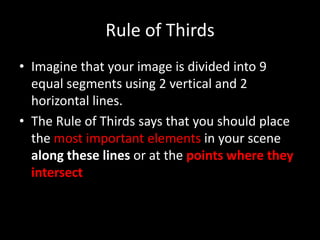
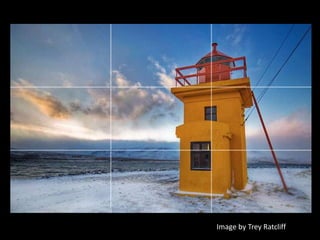
Rule of Thirds
• Imagine that your image is divided into 9
  equal segments using 2 vertical and 2
  horizontal lines.
• The Rule of Thirds says that you should place
  the most important elements in your scene
  along these lines or at the points where they
  intersect
Image by Trey Ratcliff
Balancing Elements
• Placing your main subject off center can make
  your composition more interesting.
• But, you need to balance the visual weight of
  your subject by including another object of
  lesser importance.
Image by Shannon Kokoska
Leading Lines
• When looking at photographs our eye is
  naturally drawn along lines.
• By thinking about how lines are placed in your
  composition you can lead or guide the viewer
  through a scene.
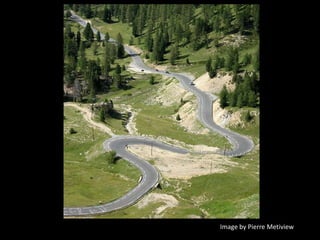
• Line can be straight, diagonal, curvy, zigzag,
  radial, etc.
Image by Pierre Metiview
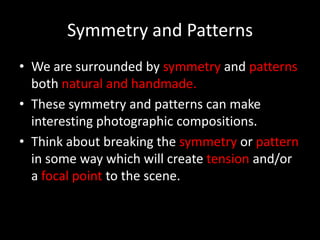
Symmetry and Patterns
• We are surrounded by symmetry and patterns
  both natural and handmade.
• These symmetry and patterns can make
  interesting photographic compositions.
• Think about breaking the symmetry or pattern
  in some way which will create tension and/or
  a focal point to the scene.
Image by Fabio Montalto
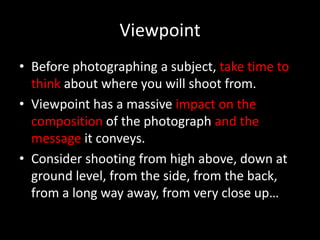
Viewpoint
• Before photographing a subject, take time to
  think about where you will shoot from.
• Viewpoint has a massive impact on the
  composition of the photograph and the
  message it conveys.
• Consider shooting from high above, down at
  ground level, from the side, from the back,
  from a long way away, from very close up…
Image by ronsho
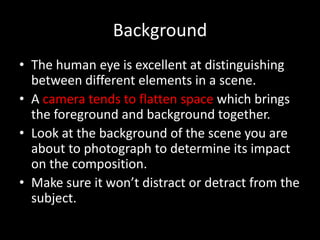
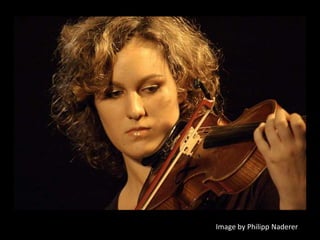
Background
• The human eye is excellent at distinguishing
  between different elements in a scene.
• A camera tends to flatten space which brings
  the foreground and background together.
• Look at the background of the scene you are
  about to photograph to determine its impact
  on the composition.
• Make sure it won’t distract or detract from the
  subject.
Image by Philipp Naderer
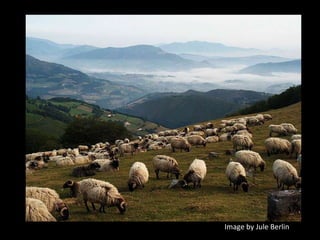
Depth
• You can create depth in a photo by including
  objects in the foreground, middle ground and
  background.
• Overlapping is a useful compositional
  technique where you deliberately partially
  obscure one object with another.
• The human eye recognizes and separates
  them, creating an understandable sense of
  depth.
Image by Jule Berlin
Framing
• Using natural objects, such as trees, archways
  and holes can create perfect natural frames.
• By placing these around the edge of a
  composition you can help isolate the main
  subject.
• The result is a more focused image which
  draws your eye naturally to the main point of
  interest.
Image by Sally Crossthwaite
Cropping
• By cropping tight around a subject you
  eliminate the background “noise”.
• This ensures the viewer will see the focal point
  of a composition and not be confused by the
  surrounding imagery.
• In the following example you’ll see repetition
  used as a compositional technique, too.
Image by Hien Nguyen
Experimentation
• One of the most important compositional and
  photographic techniques is experimentation.
• With digital photography you can experiment
  endlessly without any financial consequence
  (unlike film photography).
• Give yourself time to experiment so that you
  can discover new possibilities.
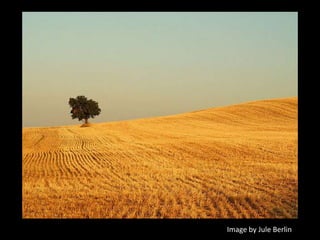
Image by Jule Berlin
Content in this presentation taken
   from Photography Mad at
  www.photographymad.com

Photo composition

  • 1.
    Composition 10 Techniques ToHelp Your Photos Content in this presentation taken from Photography Mad at www.photographymad.com
  • 2.
    Important Terms • Composition:The way elements in an image are arranged. • Foreground: Elements that are closest to the viewer. • Background: Elements that are in deep space or behind the focal point in a composition. • Focal Point: The subject (either visual or emotional) of a composition.
  • 3.
    Rule of Thirds •Imagine that your image is divided into 9 equal segments using 2 vertical and 2 horizontal lines. • The Rule of Thirds says that you should place the most important elements in your scene along these lines or at the points where they intersect
  • 4.
    Image by TreyRatcliff
  • 5.
    Balancing Elements • Placingyour main subject off center can make your composition more interesting. • But, you need to balance the visual weight of your subject by including another object of lesser importance.
  • 6.
  • 7.
    Leading Lines • Whenlooking at photographs our eye is naturally drawn along lines. • By thinking about how lines are placed in your composition you can lead or guide the viewer through a scene. • Line can be straight, diagonal, curvy, zigzag, radial, etc.
  • 8.
  • 9.
    Symmetry and Patterns •We are surrounded by symmetry and patterns both natural and handmade. • These symmetry and patterns can make interesting photographic compositions. • Think about breaking the symmetry or pattern in some way which will create tension and/or a focal point to the scene.
  • 10.
  • 11.
    Viewpoint • Before photographinga subject, take time to think about where you will shoot from. • Viewpoint has a massive impact on the composition of the photograph and the message it conveys. • Consider shooting from high above, down at ground level, from the side, from the back, from a long way away, from very close up…
  • 12.
  • 13.
    Background • The humaneye is excellent at distinguishing between different elements in a scene. • A camera tends to flatten space which brings the foreground and background together. • Look at the background of the scene you are about to photograph to determine its impact on the composition. • Make sure it won’t distract or detract from the subject.
  • 14.
  • 15.
    Depth • You cancreate depth in a photo by including objects in the foreground, middle ground and background. • Overlapping is a useful compositional technique where you deliberately partially obscure one object with another. • The human eye recognizes and separates them, creating an understandable sense of depth.
  • 16.
  • 17.
    Framing • Using naturalobjects, such as trees, archways and holes can create perfect natural frames. • By placing these around the edge of a composition you can help isolate the main subject. • The result is a more focused image which draws your eye naturally to the main point of interest.
  • 18.
    Image by SallyCrossthwaite
  • 19.
    Cropping • By croppingtight around a subject you eliminate the background “noise”. • This ensures the viewer will see the focal point of a composition and not be confused by the surrounding imagery. • In the following example you’ll see repetition used as a compositional technique, too.
  • 20.
  • 21.
    Experimentation • One ofthe most important compositional and photographic techniques is experimentation. • With digital photography you can experiment endlessly without any financial consequence (unlike film photography). • Give yourself time to experiment so that you can discover new possibilities.
  • 22.
  • 23.
    Content in thispresentation taken from Photography Mad at www.photographymad.com