ZOE PRINDS-FLASH
RULE OF THIRDS
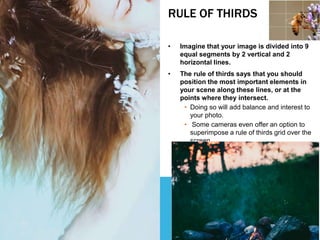
• Imagine that your image is divided into 9
equal segments by 2 vertical and 2
horizontal lines.
• The rule of thirds says that you should
position the most important elements in
your scene along these lines, or at the
points where they intersect.
• Doing so will add balance and interest to
your photo.
• Some cameras even offer an option to
superimpose a rule of thirds grid over the
screen.
BALANCING ELEMENTS
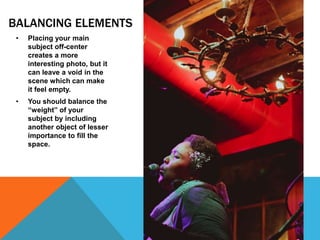
• Placing your main
subject off-center
creates a more
interesting photo, but it
can leave a void in the
scene which can make
it feel empty.
• You should balance the
“weight” of your
subject by including
another object of lesser
importance to fill the
space.
LEADING LINES
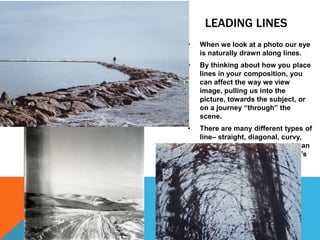
• When we look at a photo our eye
is naturally drawn along lines.
• By thinking about how you place
lines in your composition, you
can affect the way we view
image, pulling us into the
picture, towards the subject, or
on a journey “through” the
scene.
• There are many different types of
line– straight, diagonal, curvy,
zigzag, radial etc – and each can
be used to enhance our photo’s
composition.
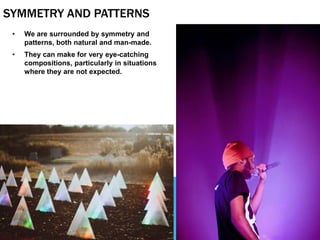
SYMMETRY AND PATTERNS
• We are surrounded by symmetry and
patterns, both natural and man-made.
• They can make for very eye-catching
compositions, particularly in situations
where they are not expected.
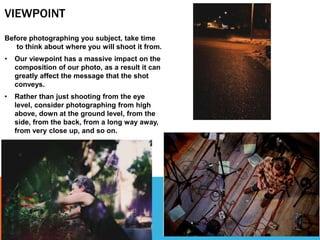
VIEWPOINT
Before photographing you subject, take time
to think about where you will shoot it from.
• Our viewpoint has a massive impact on the
composition of our photo, as a result it can
greatly affect the message that the shot
conveys.
• Rather than just shooting from the eye
level, consider photographing from high
above, down at the ground level, from the
side, from the back, from a long way away,
from very close up, and so on.
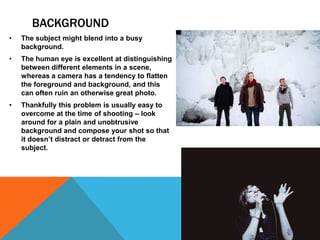
BACKGROUND
• The subject might blend into a busy
background.
• The human eye is excellent at distinguishing
between different elements in a scene,
whereas a camera has a tendency to flatten
the foreground and background, and this
can often ruin an otherwise great photo.
• Thankfully this problem is usually easy to
overcome at the time of shooting – look
around for a plain and unobtrusive
background and compose your shot so that
it doesn’t distract or detract from the
subject.
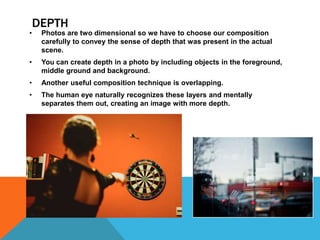
DEPTH
• Photos are two dimensional so we have to choose our composition
carefully to convey the sense of depth that was present in the actual
scene.
• You can create depth in a photo by including objects in the foreground,
middle ground and background.
• Another useful composition technique is overlapping.
• The human eye naturally recognizes these layers and mentally
separates them out, creating an image with more depth.
FRAMING
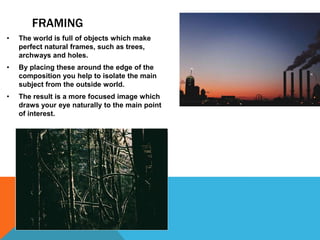
• The world is full of objects which make
perfect natural frames, such as trees,
archways and holes.
• By placing these around the edge of the
composition you help to isolate the main
subject from the outside world.
• The result is a more focused image which
draws your eye naturally to the main point
of interest.
CROPPING
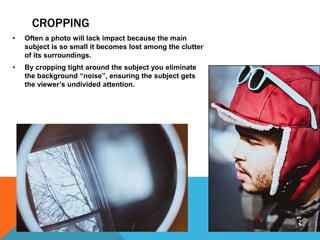
• Often a photo will lack impact because the main
subject is so small it becomes lost among the clutter
of its surroundings.
• By cropping tight around the subject you eliminate
the background “noise”, ensuring the subject gets
the viewer’s undivided attention.
EXPERIMENTATION
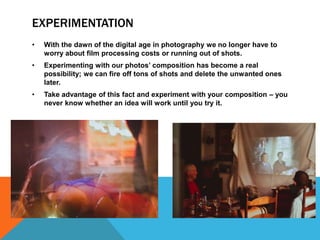
• With the dawn of the digital age in photography we no longer have to
worry about film processing costs or running out of shots.
• Experimenting with our photos’ composition has become a real
possibility; we can fire off tons of shots and delete the unwanted ones
later.
• Take advantage of this fact and experiment with your composition – you
never know whether an idea will work until you try it.
COMPOSITION RULES
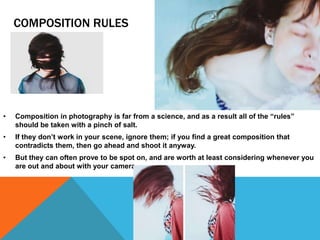
• Composition in photography is far from a science, and as a result all of the “rules”
should be taken with a pinch of salt.
• If they don’t work in your scene, ignore them; if you find a great composition that
contradicts them, then go ahead and shoot it anyway.
• But they can often prove to be spot on, and are worth at least considering whenever you
are out and about with your camera.

Photography Composition Tips w/ Zoe Prinds-Flash

  • 2.
  • 3.
    RULE OF THIRDS •Imagine that your image is divided into 9 equal segments by 2 vertical and 2 horizontal lines. • The rule of thirds says that you should position the most important elements in your scene along these lines, or at the points where they intersect. • Doing so will add balance and interest to your photo. • Some cameras even offer an option to superimpose a rule of thirds grid over the screen.
  • 4.
    BALANCING ELEMENTS • Placingyour main subject off-center creates a more interesting photo, but it can leave a void in the scene which can make it feel empty. • You should balance the “weight” of your subject by including another object of lesser importance to fill the space.
  • 5.
    LEADING LINES • Whenwe look at a photo our eye is naturally drawn along lines. • By thinking about how you place lines in your composition, you can affect the way we view image, pulling us into the picture, towards the subject, or on a journey “through” the scene. • There are many different types of line– straight, diagonal, curvy, zigzag, radial etc – and each can be used to enhance our photo’s composition.
  • 6.
    SYMMETRY AND PATTERNS •We are surrounded by symmetry and patterns, both natural and man-made. • They can make for very eye-catching compositions, particularly in situations where they are not expected.
  • 7.
    VIEWPOINT Before photographing yousubject, take time to think about where you will shoot it from. • Our viewpoint has a massive impact on the composition of our photo, as a result it can greatly affect the message that the shot conveys. • Rather than just shooting from the eye level, consider photographing from high above, down at the ground level, from the side, from the back, from a long way away, from very close up, and so on.
  • 8.
    BACKGROUND • The subjectmight blend into a busy background. • The human eye is excellent at distinguishing between different elements in a scene, whereas a camera has a tendency to flatten the foreground and background, and this can often ruin an otherwise great photo. • Thankfully this problem is usually easy to overcome at the time of shooting – look around for a plain and unobtrusive background and compose your shot so that it doesn’t distract or detract from the subject.
  • 9.
    DEPTH • Photos aretwo dimensional so we have to choose our composition carefully to convey the sense of depth that was present in the actual scene. • You can create depth in a photo by including objects in the foreground, middle ground and background. • Another useful composition technique is overlapping. • The human eye naturally recognizes these layers and mentally separates them out, creating an image with more depth.
  • 10.
    FRAMING • The worldis full of objects which make perfect natural frames, such as trees, archways and holes. • By placing these around the edge of the composition you help to isolate the main subject from the outside world. • The result is a more focused image which draws your eye naturally to the main point of interest.
  • 11.
    CROPPING • Often aphoto will lack impact because the main subject is so small it becomes lost among the clutter of its surroundings. • By cropping tight around the subject you eliminate the background “noise”, ensuring the subject gets the viewer’s undivided attention.
  • 12.
    EXPERIMENTATION • With thedawn of the digital age in photography we no longer have to worry about film processing costs or running out of shots. • Experimenting with our photos’ composition has become a real possibility; we can fire off tons of shots and delete the unwanted ones later. • Take advantage of this fact and experiment with your composition – you never know whether an idea will work until you try it.
  • 13.
    COMPOSITION RULES • Compositionin photography is far from a science, and as a result all of the “rules” should be taken with a pinch of salt. • If they don’t work in your scene, ignore them; if you find a great composition that contradicts them, then go ahead and shoot it anyway. • But they can often prove to be spot on, and are worth at least considering whenever you are out and about with your camera.