1
The Institute of ELC
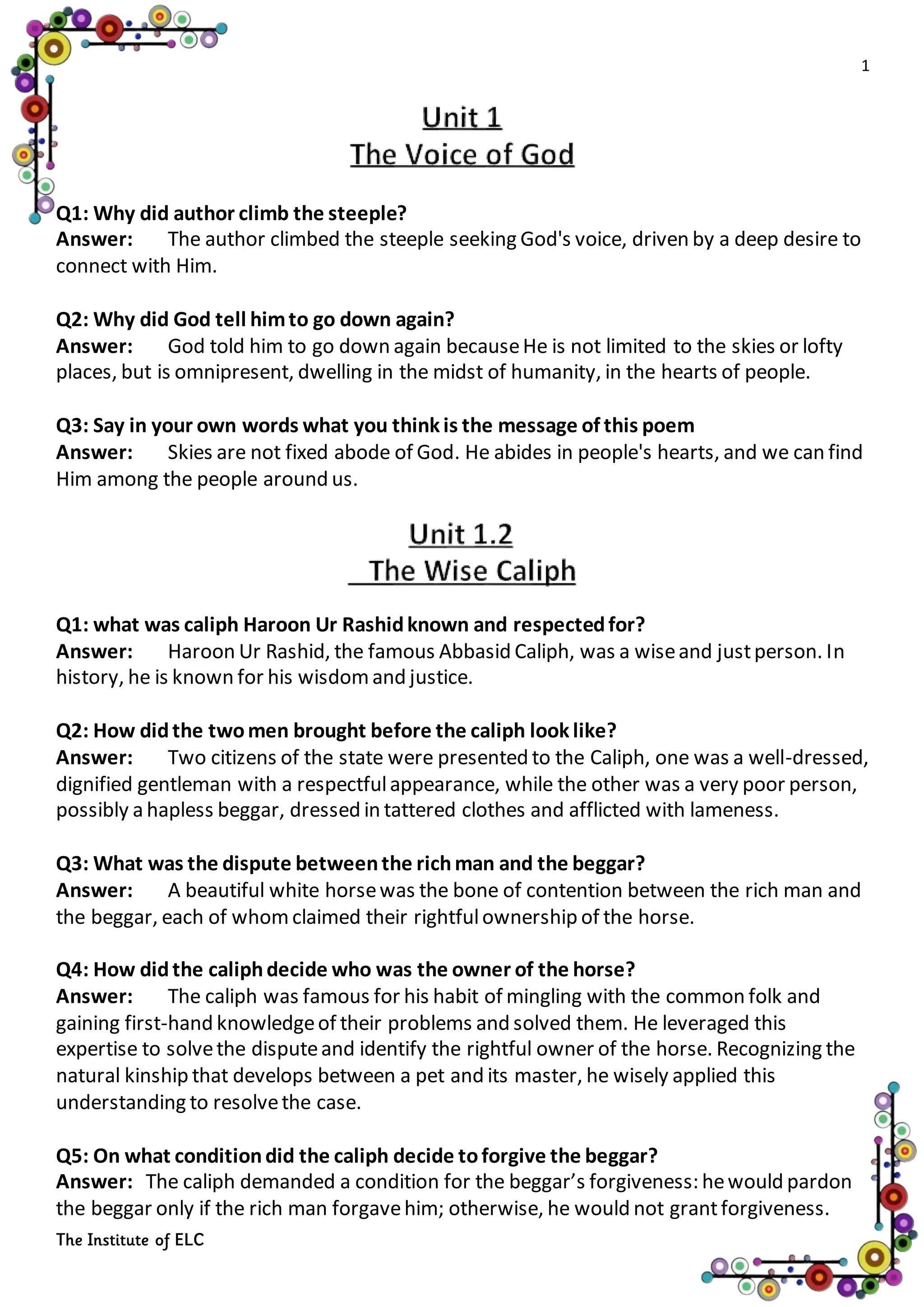
Q1: Why did author climb the steeple?
Answer: The author climbed the steeple seeking God's voice, driven by a deep desire to
connect with Him.
Q2: Why did God tell himto go down again?
Answer: God told him to go down again becauseHe is not limited to the skies or lofty
places, but is omnipresent, dwelling in the midst of humanity, in the hearts of people.
Q3: Say in your own words what you think is the message of this poem
Answer: Skies are not fixed abode of God. He abides in people's hearts, and we can find
Him among the people around us.
Q1: what was caliph Haroon Ur Rashidknown and respectedfor?
Answer: Haroon Ur Rashid, the famous Abbasid Caliph, was a wiseand justperson. In
history, he is known for his wisdomand justice.
Q2: How didthe twomen brought before the caliph look like?
Answer: Two citizens of the state were presented to the Caliph, one was a well-dressed,
dignified gentleman with a respectfulappearance, while the other was a very poor person,
possibly a hapless beggar, dressed in tattered clothes and afflicted with lameness.
Q3: What was the dispute betweenthe richman and the beggar?
Answer: A beautiful white horsewas the bone of contention between the rich man and
the beggar, each of whomclaimed their rightfulownership of the horse.
Q4: How didthe caliphdecide who was the owner of the horse?
Answer: The caliph was famous for his habit of mingling with the common folk and
gaining first-hand knowledgeof their problems and solved them. He leveraged this
expertise to solvethe disputeand identify the rightful owner of the horse. Recognizing the
natural kinship that develops between a pet and its master, he wisely applied this
understanding to resolvethe case.
Q5: On what conditiondid the caliph decide toforgive the beggar?
Answer: The caliph demanded a condition for the beggar’s forgiveness: hewould pardon
the beggar only if the rich man forgavehim; otherwise, he would not grantforgiveness.
2
The Institute of ELC
Q6: After getting the horse howdidthe richman behave?
Answer: When the horsewas finally returned to its legitimate (legal) owner, the rich
man not only forgavethe beggar but showed great sympathy and generosity toward the
beggar and gave him a handful of gold coins. This unexpected act of kindness was highly
impressed by everyonepresented in the court.
3
The Institute of ELC
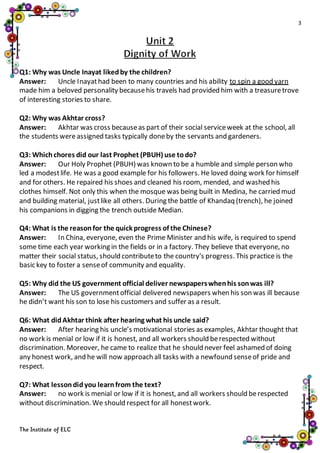
Q1: Why was Uncle Inayat likedby the children?
Answer: Uncle Inayathad been to many countries and his ability to spin a good yarn
made him a beloved personality becausehis travels had provided him with a treasuretrove
of interesting stories to share.
Q2: Why was Akhtar cross?
Answer: Akhtar was cross becauseas part of their social serviceweek at the school, all
the students wereassigned tasks typically doneby the servants and gardeners.
Q3: Whichchores did our last Prophet (PBUH) use todo?
Answer: Our Holy Prophet (PBUH) was known to be a humble and simple person who
led a modestlife. He was a good example for his followers. He loved doing work for himself
and for others. He repaired his shoes and cleaned his room, mended, and washed his
clothes himself. Not only this when the mosque was being built in Medina, he carried mud
and building material, justlike all others. During the battle of Khandaq (trench), he joined
his companions in digging the trench outside Median.
Q4: What is the reasonfor the quick progress of the Chinese?
Answer: In China, everyone, even the Prime Minister and his wife, is required to spend
some time each year working in the fields or in a factory. They believe that everyone, no
matter their social status, should contributeto the country's progress. This practice is the
basic key to foster a senseof community and equality.
Q5: Why did the US government official deliver newspaperswhenhis sonwas ill?
Answer: The US governmentofficial delivered newspapers when his son was ill because
he didn’t want his son to lose his customers and suffer as a result.
Q6: What didAkhtar think after hearing what his uncle said?
Answer: After hearing his uncle’s motivational stories as examples, Akhtar thought that
no work is menial or low if it is honest, and all workers should berespected without
discrimination. Moreover, he came to realize that he should never feel ashamed of doing
any honest work, and he will now approach all tasks with a newfound senseof pride and
respect.
Q7: What lessondidyou learnfrom the text?
Answer: no work is menial or low if it is honest, and all workers should berespected
without discrimination. We should respect for all honestwork.
4
The Institute of ELC
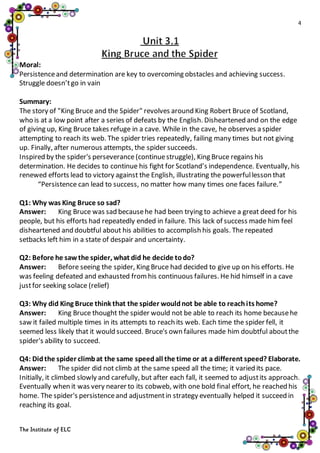
Moral:
Persistenceand determination are key to overcoming obstacles and achieving success.
Struggle doesn’tgo in vain
Summary:
The story of "King Bruce and the Spider" revolves around King Robert Bruce of Scotland,
who is at a low point after a series of defeats by the English. Disheartened and on the edge
of giving up, King Bruce takes refuge in a cave. While in the cave, he observes a spider
attempting to reach its web. The spider tries repeatedly, failing many times but not giving
up. Finally, after numerous attempts, the spider succeeds.
Inspired by the spider's perseverance(continuestruggle), King Bruce regains his
determination. He decides to continue his fight for Scotland’s independence. Eventually, his
renewed efforts lead to victory against the English, illustrating the powerfullesson that
“Persistence can lead to success, no matter how many times one faces failure.”
Q1: Why was King Bruce so sad?
Answer: King Bruce was sad becausehe had been trying to achieve a great deed for his
people, but his efforts had repeatedly ended in failure. This lack of success made him feel
disheartened and doubtful about his abilities to accomplish his goals. The repeated
setbacks left him in a state of despair and uncertainty.
Q2: Before he sawthe spider, what did he decide todo?
Answer: Before seeing the spider, King Bruce had decided to give up on his efforts. He
was feeling defeated and exhausted fromhis continuous failures. He hid himself in a cave
justfor seeking solace (relief)
Q3: Why did King Bruce think that the spider wouldnot be able to reachits home?
Answer: King Bruce thought the spider would not be able to reach its home becausehe
saw it failed multiple times in its attempts to reach its web. Each time the spider fell, it
seemed less likely that it would succeed. Bruce's own failures made him doubtful aboutthe
spider's ability to succeed.
Q4: Didthe spider climbat the same speedall the time or at a different speed? Elaborate.
Answer: The spider did not climb at the same speed all the time; it varied its pace.
Initially, it climbed slowly and carefully, but after each fall, it seemed to adjustits approach.
Eventually when it was very nearer to its cobweb, with one bold final effort, he reached his
home. The spider's persistenceand adjustmentin strategy eventually helped it succeed in
reaching its goal.
5
The Institute of ELC
Q5: How didthe spider finally reachits home?
Answer: The spider finally reached its home through persistenteffort and multiple
attempts. After nine failures, it made a final attempt with renewed determination and
finally succeeded in attaching its web. This last successfuleffortdemonstrated the spider’s
spirit and resolute resolve.
Q6: Why did the king decide totry again?
Answer: The king decided to try again after being inspired by the spider’s persistence
and eventual success. Witnessing thespider's repeated efforts and final victory, despite
numerous failures, revived his own determination. He realized that perseverancecould lead
to success, no matter how many times one fails, motivating him to renew his efforts to
achieve his goals.
MainIdea:
Small actions, both positive and negative, collectively shapeour world and lives while
kindness and love can create a better world
Summary:
"Little Things" by Julia A. Carney is a poem that highlights the profound impact of small
actions and moments in our lives. The poem begins with two examples; little drops of water
and grains of sand to the formation of large bodies like the ocean and land.
The poem then shifts its focus to the positiveinfluence of little deeds of kindness and words
of love. Itsuggests thatthese small acts have the power to transformour world into a place
resembling Eden.
The Man Who Wins
MainIdea:
Self-belief and a positive mindset are crucial for achieving success. One's attitude and
confidence play a more significantrole in overcoming challenges than physicalstrength or
external circumstances.
Summary:
The poem emphasizes the power of positive thinking and self-belief. According to the
poem, success and victory in life's challenges are determined primarily by one's mindset
rather than the strugglea person goes through to achieve them. If someonewants to
overcomeobstacles and achieve goals, they mustbelieve in themselves. On a larger scale, it
points out the notion that self-confidenceand determination are more important than
external factors like strength or speed. Ultimately, the poem conveys that a person's
thoughts and attitude significantly influence their ability to succeed.
6
The Institute of ELC
Q1: How has social mediarevolutionizedthe concept of communication?
Answer: Social media has revolutionized communication by transforming the idea of
community into a global phenomenon, allowing people to connect beyond their immediate
surroundings. Itenables users to share information, videos, and original ideas instantly with
a worldwideaudience. This rapid exchange of information and ideas has fundamentally
changed how people interact and stay informed.
Q2: How is social mediaassisting studentsandprofessionals intheir respectivefields?
Answer: Social media assists students by enabling easy interaction with educators and
researchers worldwide, providing access to a vast pool of knowledge and wisdom. For
professionals, itfacilitates networking and the exchange of views with counterparts
globally, enhancing collaboration and career development. These interactions help in
expanding learning opportunities and professionalgrowth.
Q3: How can a business be initiatedona virtual platform?
Answer: A business can be initiated on a virtual platformby posting products and
inviting buyers fromaround the world through social media. Businesspersons can interact
directly with customers, respond to their queries, and address their needs instantly. This
ease of connectivity and accessibility makes it possibleto start and manage a business with
minimal physicalpresence.
Q4: How can employers hunt the right candidates for their jobposition?
Answer: Employers can hunt for the right candidates by advertising job vacancies on
social media platforms, wherethey can reach a large pool of potential candidates. They can
also search for individuals with specific skills and qualifications who promotetheir talents
online. This process allows for a more targeted and efficient recruitment strategy.
Q5: Why can people easily have a constant connectionwithrelativesindistant parts of
the world?
Answer: People can maintain constantconnections with distant relatives through social
media due to its affordability and easy accessibility. It enables instant communication and
virtual participation in family events, strengthening bonds despite physicaldistances. This
continuous connectivity helps maintain relationships and shareimportant moments with
loved ones.
Q6: How is social media affecting the relationships of people?
Answer: Social media affects relationships by reducing the frequency and quality of
face-to-facecommunication, leading to weaker bonds between family members and
friends. While it allows for interaction with a large number of people quickly, these
7
The Institute of ELC
interactions are often shallow and cannotreplace the depth of in-person communication.
In conclusion; Relying too much on social media for communication can weaken personal
relationships.
8
The Institute of ELC
Q1. Describe the initial moodand activities of Mr. Aziz's family during the trainjourney.
Answer: Mr. Aziz's family was very excited and in a good mood during the train journey.
They had booked a whole compartment, and the elders were talking about the village they
were going to visit. Meanwhile, the children wereplaying cards, joking, and teasing each
other. Everyonewas looking forward to their long-awaited holiday.
Q 2. What didMr. Aziz andhis family find whenthey arrivedat the rentedhouse, and
how did they initially feel about it?
Answer: Upon arriving at the rented house, Mr. Aziz and his family found it to be big,
airy, and with a nice view of the fields and the village. Despite the driver mentioning that
the housewas believed to be haunted, they liked the houseand did not find anything
strangeabout it. They felt relaxed and enjoyed the clean air and fresh vegetables fromthe
fields.
Q 3. Explainthe strange experiencesMr. Karimhad on the seventhnight inthe house.
Answer: On the seventh night, Mr. Karimexperienced someonepulling his blanket,
which he initially thought was a cat. When it happened again, he held the blanket tightly
under his head and feet. Then, he felt someone pulling his bed, which scared him. Although
the disturbances eventually stopped, he couldn't sleep the rest of the night.
Q 4. How did Mr. Karim's family react to his story about the strange occurrences, and
what did they do afterward?
Answer: Mr. Karim's family did not believe his story about the strangeoccurrences and
thought he was joking. They laughed it off and dismissed his concerns. Later, they all
decided to go for a walk in the fields, enjoying the cool breeze and fresh cucumbers, while
Mr. Karim went for a longer walk alone.
Q 5. Describe what happenedtoMr. Karim during his walk alone in the fields.
Answer: During his walk alone in the fields, Mr. Karim was deep in thought about the
previous night's incident when he felt someone walking behind him. Though he didn't see
anyone, he had a strangefeeling. When a head suddenly jumped and blocked his way, he
got scared and ran back to the house, eventually calming down only after reaching home.
Q 6. What was the family's reactiontothe hair-raising occurrence at the dining table, and
how did it affect Mr. Karim?
Answer: The family was stunned and terrified when an empty chair at the dining table
moved as if someone invisible had saton it. They wereall too scared to speak and started
screaming. This occurrencefurther disturbed Mr. Karim, who had already been frightened
by his previous experiences in the house.
9
The Institute of ELC
Q 7. What realizationdidMr. Karimcome toin the end, and how didit change the
context of the story?
Answer: At the end of the passage, Mr. Karimrealized that all the strangeand frightening
experiences were part of a bad dream. He wokeup to find that they had not yet left for
their trip. This realization shifted the context of the story froma spooky adventureto a
mere dream.
10
The Institute of ELC
MainIdea
Speaking gently fosters love, respect, and peace, creating lasting positiveeffects. Kind
words, though simple, can profoundly enhanceour interactions with children, the elderly,
and everyonewe meet.
Summary
The poem "Speak Gently" by David Bates emphasizes the importance of using kind and
gentle words in our communications with others. Itsuggests thatruling with love is more
effective and noble than using fear. Speaking kindly can enhance the good we do, especially
towards children, as gentle speech fosters their love and respect. The poem also highlights
the significanceof treating the elderly with kindness and compassion, acknowledging the
hardships they have endured and allowing them to find peace. Overall, the poem conveys
that gentle speech, though simple, can have profound and lasting positiveeffects.
1. What does the poem "Speak Gently"suggest is more effective andnoble than
ruling withfear?
Answer: The poem suggests thatruling with love is moreeffective and noble than using
fear.
2. According tothe poem, how does speaking kindly affect children?
Answer: Speaking kindly fosters children's loveand respect, enhancing the good we do
towards them.
3. How does the poem suggest we shouldtreat the elderly, andwhy?
Answer: The poem suggests thatwe should treat the elderly with kindness and
compassion, acknowledging thehardships they have endured and allowing them to find
peace.
11
The Institute of ELC
Q1: Whichtwo great saints are mentionedinthe text?
Answer: The two great saints mentioned in the text are Lal Shahbaz Qalandar and
HazratShah Abdul Latif Bhitai.
Q2: Why did Asif’s parents decidetotake himto the Gorakh Hills for his birthday?
Answer: Asif’s parents decided to take him to the Gorakh Hills for his birthday because
they knew about his love for travel.
Q3: Why is Gorakh Hills a good place for a holiday?
Answer: Gorakh Hills is a good place for a holiday becauseit is situated at an elevation
of 5,690 ft. fromsea level, offering a scenic and calm environmentperfect for reconnecting
with nature and oneself.
Q4: What was servedfor lunch and where was it served?
Answer: Lunch, which included spicy fish fromManchar Lake and fresh sugar canejuice,
was served on the bus after leaving Sehwan.
Q5: Why did they have to leave the bus and take the jeepto reachthe top?
Answer: They had to leave the bus and take a jeep to reach the top because the road to
the summitwas steep and zigzag, making it unsuitable for a bus.
Q6: Why did Asif andhis family have to sleepina tent?
Answer: Asif and his family had to sleep in a tent because all the rooms at the peak
were occupied.
Q7: What did Asif appreciate deeply about his parents?
Answer: Asif deeply appreciated his parents'love and meticulous (careful) planning for
making his birthday celebration special at the Gorakh Hills.
Q8: How was the returnroute differentfrom the up journey route?
Answer: The return route was differentbecause they traveled via the Dadu-Moro
Bridge, crossing theriver Indus to the greener left bank, and made stops at Hala and
glimpsed the historical city of Matiari.
12
The Institute of ELC
Q1: What twoimportant safety measures cansave people’s lives?
Answer: The two important safety measures that can savepeople’s lives are wearing
helmets for motorbikeriders and fastening seat belts for those traveling in various other
types of vehicles. These measures help protect individuals fromserious injuries and
fatalities.
Q2: Why is a helmet animportant safety gear?
Answer: A helmet is an important safety gear becauseit minimizes the risks of head
injuries, which are the mostcommon causeof death and disability in motorcycle crashes.
Helmets absorb the impact of a crash or fall, significantly reducing the possibility of serious
head injuries.
Q3: How can not wearing a helmet change the life of bike riders and their families
forever?
Answer: Not wearing a helmet can resultin fatal or serious head injuries, including
traumatic brain injury, which can lead to permanent disability or death. Such outcomes not
only affect the rider but also causeimmense emotional and financial suffering for their
families.
Q4: What happens when a car stops suddenly?
Answer: When a car stops suddenly, the car itself halts, but the bodies of the
passengers insidecontinue to move at the same speed the car was traveling. Without a seat
belt, passengers can bethrown forward, potentially through the windshield, leading to
serious injuries or death.
Q5: How is the click of a seat belt buttonan insurance?
Answer: The click of a seat belt button is an insurancebecause it significantly increases
the possibility of surviving a car crash with fewer injuries. Wearing a seat belt minimizes the
chances of being killed or seriously injured, providing a critical layer of protection during
accidents.
13
The Institute of ELC
MainIdea:
The main idea of the poem is to illustrate the limitations of subjectiveperspectives and to
emphasizethat individual viewpoints can be incomplete or misleading when taken in
isolation.
Summary:
The poem "TheBlind Men and the Elephant" by John Godfrey Saxe is a humorous yet
insightful story aboutsix blind men from Indostan (India) who, eager to expand their
knowledge, visit an elephant. Each man touches a differentpart of the elephant and, based
on his limited experience, draws a unique and partial conclusion about the animal. One
touches the side and thinks the elephant is like a wall, another feels the tusk and concludes
it's like a spear, a third touches the trunk and believes it's like a snake, the fourth feels the
knee and says it's like a tree, the fifth touches the ear and thinks it resembles a fan, and the
sixth grabs the tail and asserts it's like a rope. Each man is convinced of his own perspective
and they arguestrongly, each insisting that his own interpretation is the correct one. The
poem ends by noting that while each man is partly right, they are all ultimately wrong, as
none can see the wholetruth.

Grade 10th STBB English Book Solution.pdf

  • 1.
    1 The Institute ofELC Q1: Why did author climb the steeple? Answer: The author climbed the steeple seeking God's voice, driven by a deep desire to connect with Him. Q2: Why did God tell himto go down again? Answer: God told him to go down again becauseHe is not limited to the skies or lofty places, but is omnipresent, dwelling in the midst of humanity, in the hearts of people. Q3: Say in your own words what you think is the message of this poem Answer: Skies are not fixed abode of God. He abides in people's hearts, and we can find Him among the people around us. Q1: what was caliph Haroon Ur Rashidknown and respectedfor? Answer: Haroon Ur Rashid, the famous Abbasid Caliph, was a wiseand justperson. In history, he is known for his wisdomand justice. Q2: How didthe twomen brought before the caliph look like? Answer: Two citizens of the state were presented to the Caliph, one was a well-dressed, dignified gentleman with a respectfulappearance, while the other was a very poor person, possibly a hapless beggar, dressed in tattered clothes and afflicted with lameness. Q3: What was the dispute betweenthe richman and the beggar? Answer: A beautiful white horsewas the bone of contention between the rich man and the beggar, each of whomclaimed their rightfulownership of the horse. Q4: How didthe caliphdecide who was the owner of the horse? Answer: The caliph was famous for his habit of mingling with the common folk and gaining first-hand knowledgeof their problems and solved them. He leveraged this expertise to solvethe disputeand identify the rightful owner of the horse. Recognizing the natural kinship that develops between a pet and its master, he wisely applied this understanding to resolvethe case. Q5: On what conditiondid the caliph decide toforgive the beggar? Answer: The caliph demanded a condition for the beggar’s forgiveness: hewould pardon the beggar only if the rich man forgavehim; otherwise, he would not grantforgiveness.
  • 2.
    2 The Institute ofELC Q6: After getting the horse howdidthe richman behave? Answer: When the horsewas finally returned to its legitimate (legal) owner, the rich man not only forgavethe beggar but showed great sympathy and generosity toward the beggar and gave him a handful of gold coins. This unexpected act of kindness was highly impressed by everyonepresented in the court.
  • 3.
    3 The Institute ofELC Q1: Why was Uncle Inayat likedby the children? Answer: Uncle Inayathad been to many countries and his ability to spin a good yarn made him a beloved personality becausehis travels had provided him with a treasuretrove of interesting stories to share. Q2: Why was Akhtar cross? Answer: Akhtar was cross becauseas part of their social serviceweek at the school, all the students wereassigned tasks typically doneby the servants and gardeners. Q3: Whichchores did our last Prophet (PBUH) use todo? Answer: Our Holy Prophet (PBUH) was known to be a humble and simple person who led a modestlife. He was a good example for his followers. He loved doing work for himself and for others. He repaired his shoes and cleaned his room, mended, and washed his clothes himself. Not only this when the mosque was being built in Medina, he carried mud and building material, justlike all others. During the battle of Khandaq (trench), he joined his companions in digging the trench outside Median. Q4: What is the reasonfor the quick progress of the Chinese? Answer: In China, everyone, even the Prime Minister and his wife, is required to spend some time each year working in the fields or in a factory. They believe that everyone, no matter their social status, should contributeto the country's progress. This practice is the basic key to foster a senseof community and equality. Q5: Why did the US government official deliver newspaperswhenhis sonwas ill? Answer: The US governmentofficial delivered newspapers when his son was ill because he didn’t want his son to lose his customers and suffer as a result. Q6: What didAkhtar think after hearing what his uncle said? Answer: After hearing his uncle’s motivational stories as examples, Akhtar thought that no work is menial or low if it is honest, and all workers should berespected without discrimination. Moreover, he came to realize that he should never feel ashamed of doing any honest work, and he will now approach all tasks with a newfound senseof pride and respect. Q7: What lessondidyou learnfrom the text? Answer: no work is menial or low if it is honest, and all workers should berespected without discrimination. We should respect for all honestwork.
  • 4.
    4 The Institute ofELC Moral: Persistenceand determination are key to overcoming obstacles and achieving success. Struggle doesn’tgo in vain Summary: The story of "King Bruce and the Spider" revolves around King Robert Bruce of Scotland, who is at a low point after a series of defeats by the English. Disheartened and on the edge of giving up, King Bruce takes refuge in a cave. While in the cave, he observes a spider attempting to reach its web. The spider tries repeatedly, failing many times but not giving up. Finally, after numerous attempts, the spider succeeds. Inspired by the spider's perseverance(continuestruggle), King Bruce regains his determination. He decides to continue his fight for Scotland’s independence. Eventually, his renewed efforts lead to victory against the English, illustrating the powerfullesson that “Persistence can lead to success, no matter how many times one faces failure.” Q1: Why was King Bruce so sad? Answer: King Bruce was sad becausehe had been trying to achieve a great deed for his people, but his efforts had repeatedly ended in failure. This lack of success made him feel disheartened and doubtful about his abilities to accomplish his goals. The repeated setbacks left him in a state of despair and uncertainty. Q2: Before he sawthe spider, what did he decide todo? Answer: Before seeing the spider, King Bruce had decided to give up on his efforts. He was feeling defeated and exhausted fromhis continuous failures. He hid himself in a cave justfor seeking solace (relief) Q3: Why did King Bruce think that the spider wouldnot be able to reachits home? Answer: King Bruce thought the spider would not be able to reach its home becausehe saw it failed multiple times in its attempts to reach its web. Each time the spider fell, it seemed less likely that it would succeed. Bruce's own failures made him doubtful aboutthe spider's ability to succeed. Q4: Didthe spider climbat the same speedall the time or at a different speed? Elaborate. Answer: The spider did not climb at the same speed all the time; it varied its pace. Initially, it climbed slowly and carefully, but after each fall, it seemed to adjustits approach. Eventually when it was very nearer to its cobweb, with one bold final effort, he reached his home. The spider's persistenceand adjustmentin strategy eventually helped it succeed in reaching its goal.
  • 5.
    5 The Institute ofELC Q5: How didthe spider finally reachits home? Answer: The spider finally reached its home through persistenteffort and multiple attempts. After nine failures, it made a final attempt with renewed determination and finally succeeded in attaching its web. This last successfuleffortdemonstrated the spider’s spirit and resolute resolve. Q6: Why did the king decide totry again? Answer: The king decided to try again after being inspired by the spider’s persistence and eventual success. Witnessing thespider's repeated efforts and final victory, despite numerous failures, revived his own determination. He realized that perseverancecould lead to success, no matter how many times one fails, motivating him to renew his efforts to achieve his goals. MainIdea: Small actions, both positive and negative, collectively shapeour world and lives while kindness and love can create a better world Summary: "Little Things" by Julia A. Carney is a poem that highlights the profound impact of small actions and moments in our lives. The poem begins with two examples; little drops of water and grains of sand to the formation of large bodies like the ocean and land. The poem then shifts its focus to the positiveinfluence of little deeds of kindness and words of love. Itsuggests thatthese small acts have the power to transformour world into a place resembling Eden. The Man Who Wins MainIdea: Self-belief and a positive mindset are crucial for achieving success. One's attitude and confidence play a more significantrole in overcoming challenges than physicalstrength or external circumstances. Summary: The poem emphasizes the power of positive thinking and self-belief. According to the poem, success and victory in life's challenges are determined primarily by one's mindset rather than the strugglea person goes through to achieve them. If someonewants to overcomeobstacles and achieve goals, they mustbelieve in themselves. On a larger scale, it points out the notion that self-confidenceand determination are more important than external factors like strength or speed. Ultimately, the poem conveys that a person's thoughts and attitude significantly influence their ability to succeed.
  • 6.
    6 The Institute ofELC Q1: How has social mediarevolutionizedthe concept of communication? Answer: Social media has revolutionized communication by transforming the idea of community into a global phenomenon, allowing people to connect beyond their immediate surroundings. Itenables users to share information, videos, and original ideas instantly with a worldwideaudience. This rapid exchange of information and ideas has fundamentally changed how people interact and stay informed. Q2: How is social mediaassisting studentsandprofessionals intheir respectivefields? Answer: Social media assists students by enabling easy interaction with educators and researchers worldwide, providing access to a vast pool of knowledge and wisdom. For professionals, itfacilitates networking and the exchange of views with counterparts globally, enhancing collaboration and career development. These interactions help in expanding learning opportunities and professionalgrowth. Q3: How can a business be initiatedona virtual platform? Answer: A business can be initiated on a virtual platformby posting products and inviting buyers fromaround the world through social media. Businesspersons can interact directly with customers, respond to their queries, and address their needs instantly. This ease of connectivity and accessibility makes it possibleto start and manage a business with minimal physicalpresence. Q4: How can employers hunt the right candidates for their jobposition? Answer: Employers can hunt for the right candidates by advertising job vacancies on social media platforms, wherethey can reach a large pool of potential candidates. They can also search for individuals with specific skills and qualifications who promotetheir talents online. This process allows for a more targeted and efficient recruitment strategy. Q5: Why can people easily have a constant connectionwithrelativesindistant parts of the world? Answer: People can maintain constantconnections with distant relatives through social media due to its affordability and easy accessibility. It enables instant communication and virtual participation in family events, strengthening bonds despite physicaldistances. This continuous connectivity helps maintain relationships and shareimportant moments with loved ones. Q6: How is social media affecting the relationships of people? Answer: Social media affects relationships by reducing the frequency and quality of face-to-facecommunication, leading to weaker bonds between family members and friends. While it allows for interaction with a large number of people quickly, these
  • 7.
    7 The Institute ofELC interactions are often shallow and cannotreplace the depth of in-person communication. In conclusion; Relying too much on social media for communication can weaken personal relationships.
  • 8.
    8 The Institute ofELC Q1. Describe the initial moodand activities of Mr. Aziz's family during the trainjourney. Answer: Mr. Aziz's family was very excited and in a good mood during the train journey. They had booked a whole compartment, and the elders were talking about the village they were going to visit. Meanwhile, the children wereplaying cards, joking, and teasing each other. Everyonewas looking forward to their long-awaited holiday. Q 2. What didMr. Aziz andhis family find whenthey arrivedat the rentedhouse, and how did they initially feel about it? Answer: Upon arriving at the rented house, Mr. Aziz and his family found it to be big, airy, and with a nice view of the fields and the village. Despite the driver mentioning that the housewas believed to be haunted, they liked the houseand did not find anything strangeabout it. They felt relaxed and enjoyed the clean air and fresh vegetables fromthe fields. Q 3. Explainthe strange experiencesMr. Karimhad on the seventhnight inthe house. Answer: On the seventh night, Mr. Karimexperienced someonepulling his blanket, which he initially thought was a cat. When it happened again, he held the blanket tightly under his head and feet. Then, he felt someone pulling his bed, which scared him. Although the disturbances eventually stopped, he couldn't sleep the rest of the night. Q 4. How did Mr. Karim's family react to his story about the strange occurrences, and what did they do afterward? Answer: Mr. Karim's family did not believe his story about the strangeoccurrences and thought he was joking. They laughed it off and dismissed his concerns. Later, they all decided to go for a walk in the fields, enjoying the cool breeze and fresh cucumbers, while Mr. Karim went for a longer walk alone. Q 5. Describe what happenedtoMr. Karim during his walk alone in the fields. Answer: During his walk alone in the fields, Mr. Karim was deep in thought about the previous night's incident when he felt someone walking behind him. Though he didn't see anyone, he had a strangefeeling. When a head suddenly jumped and blocked his way, he got scared and ran back to the house, eventually calming down only after reaching home. Q 6. What was the family's reactiontothe hair-raising occurrence at the dining table, and how did it affect Mr. Karim? Answer: The family was stunned and terrified when an empty chair at the dining table moved as if someone invisible had saton it. They wereall too scared to speak and started screaming. This occurrencefurther disturbed Mr. Karim, who had already been frightened by his previous experiences in the house.
  • 9.
    9 The Institute ofELC Q 7. What realizationdidMr. Karimcome toin the end, and how didit change the context of the story? Answer: At the end of the passage, Mr. Karimrealized that all the strangeand frightening experiences were part of a bad dream. He wokeup to find that they had not yet left for their trip. This realization shifted the context of the story froma spooky adventureto a mere dream.
  • 10.
    10 The Institute ofELC MainIdea Speaking gently fosters love, respect, and peace, creating lasting positiveeffects. Kind words, though simple, can profoundly enhanceour interactions with children, the elderly, and everyonewe meet. Summary The poem "Speak Gently" by David Bates emphasizes the importance of using kind and gentle words in our communications with others. Itsuggests thatruling with love is more effective and noble than using fear. Speaking kindly can enhance the good we do, especially towards children, as gentle speech fosters their love and respect. The poem also highlights the significanceof treating the elderly with kindness and compassion, acknowledging the hardships they have endured and allowing them to find peace. Overall, the poem conveys that gentle speech, though simple, can have profound and lasting positiveeffects. 1. What does the poem "Speak Gently"suggest is more effective andnoble than ruling withfear? Answer: The poem suggests thatruling with love is moreeffective and noble than using fear. 2. According tothe poem, how does speaking kindly affect children? Answer: Speaking kindly fosters children's loveand respect, enhancing the good we do towards them. 3. How does the poem suggest we shouldtreat the elderly, andwhy? Answer: The poem suggests thatwe should treat the elderly with kindness and compassion, acknowledging thehardships they have endured and allowing them to find peace.
  • 11.
    11 The Institute ofELC Q1: Whichtwo great saints are mentionedinthe text? Answer: The two great saints mentioned in the text are Lal Shahbaz Qalandar and HazratShah Abdul Latif Bhitai. Q2: Why did Asif’s parents decidetotake himto the Gorakh Hills for his birthday? Answer: Asif’s parents decided to take him to the Gorakh Hills for his birthday because they knew about his love for travel. Q3: Why is Gorakh Hills a good place for a holiday? Answer: Gorakh Hills is a good place for a holiday becauseit is situated at an elevation of 5,690 ft. fromsea level, offering a scenic and calm environmentperfect for reconnecting with nature and oneself. Q4: What was servedfor lunch and where was it served? Answer: Lunch, which included spicy fish fromManchar Lake and fresh sugar canejuice, was served on the bus after leaving Sehwan. Q5: Why did they have to leave the bus and take the jeepto reachthe top? Answer: They had to leave the bus and take a jeep to reach the top because the road to the summitwas steep and zigzag, making it unsuitable for a bus. Q6: Why did Asif andhis family have to sleepina tent? Answer: Asif and his family had to sleep in a tent because all the rooms at the peak were occupied. Q7: What did Asif appreciate deeply about his parents? Answer: Asif deeply appreciated his parents'love and meticulous (careful) planning for making his birthday celebration special at the Gorakh Hills. Q8: How was the returnroute differentfrom the up journey route? Answer: The return route was differentbecause they traveled via the Dadu-Moro Bridge, crossing theriver Indus to the greener left bank, and made stops at Hala and glimpsed the historical city of Matiari.
  • 12.
    12 The Institute ofELC Q1: What twoimportant safety measures cansave people’s lives? Answer: The two important safety measures that can savepeople’s lives are wearing helmets for motorbikeriders and fastening seat belts for those traveling in various other types of vehicles. These measures help protect individuals fromserious injuries and fatalities. Q2: Why is a helmet animportant safety gear? Answer: A helmet is an important safety gear becauseit minimizes the risks of head injuries, which are the mostcommon causeof death and disability in motorcycle crashes. Helmets absorb the impact of a crash or fall, significantly reducing the possibility of serious head injuries. Q3: How can not wearing a helmet change the life of bike riders and their families forever? Answer: Not wearing a helmet can resultin fatal or serious head injuries, including traumatic brain injury, which can lead to permanent disability or death. Such outcomes not only affect the rider but also causeimmense emotional and financial suffering for their families. Q4: What happens when a car stops suddenly? Answer: When a car stops suddenly, the car itself halts, but the bodies of the passengers insidecontinue to move at the same speed the car was traveling. Without a seat belt, passengers can bethrown forward, potentially through the windshield, leading to serious injuries or death. Q5: How is the click of a seat belt buttonan insurance? Answer: The click of a seat belt button is an insurancebecause it significantly increases the possibility of surviving a car crash with fewer injuries. Wearing a seat belt minimizes the chances of being killed or seriously injured, providing a critical layer of protection during accidents.
  • 13.
    13 The Institute ofELC MainIdea: The main idea of the poem is to illustrate the limitations of subjectiveperspectives and to emphasizethat individual viewpoints can be incomplete or misleading when taken in isolation. Summary: The poem "TheBlind Men and the Elephant" by John Godfrey Saxe is a humorous yet insightful story aboutsix blind men from Indostan (India) who, eager to expand their knowledge, visit an elephant. Each man touches a differentpart of the elephant and, based on his limited experience, draws a unique and partial conclusion about the animal. One touches the side and thinks the elephant is like a wall, another feels the tusk and concludes it's like a spear, a third touches the trunk and believes it's like a snake, the fourth feels the knee and says it's like a tree, the fifth touches the ear and thinks it resembles a fan, and the sixth grabs the tail and asserts it's like a rope. Each man is convinced of his own perspective and they arguestrongly, each insisting that his own interpretation is the correct one. The poem ends by noting that while each man is partly right, they are all ultimately wrong, as none can see the wholetruth.