For Inner Peace
Inner peace is a universal need
• Everyone on this planet desires inner peace
• Everybody has been searching for it
  throughout the ages
• Search goes on regardless of
  color, creed, religion, race, nationality, age, s
  ex
• Search does not end with wealth or
  technological advancement
Different paths in trying to achieve
                inner peace
•   Accumulating material possessions and wealth
•   Drugs;
•   Music
•   Meditation
•   Spousal and family relations
•   Careers
•   Children’s achievements
•   Physical comforts through technology
Inner peace remains elusive
• in America some 18.8 million adults or 9.5%
  US population suffer from depression yearly
• Depression is but a total lack of inner peace
• In the year 2000, death rate due to suicide
  was double of those who died of Aids
• More people die from suicide in America
  than from homicide
• Homicide rates themselves are massive
Personal pleasures do not bring inner
                peace
• We achieve elements of pleasure from a
  variety of things
  , e.g., wealth, food, comforts, intimate
  spousal relations
• But these do not last, they come and go
• True inner peace is a sense of stability and
  contentment
• This carries us through all the trials and
  difficulties of life.
What is inner peace and true
               happiness ?
• Happiness is that state of body and soul that
  encompasses contentment and
  peacefulness; it is the soft joy that causes
  our lips, faces and hearts to smile.
• It is determined by faith in Almighty God
  (Allah) and obedience to Him
• Life of this world is nothing more than a
  temporary joy and means of attaining the
  eternal happiness in the Hereafter.
Inner Peace and good life promised to
     those who believe & act right


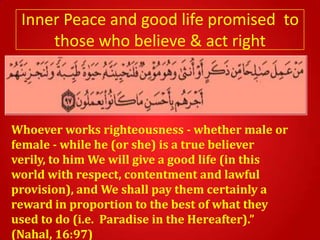
Whoever works righteousness - whether male or
female - while he (or she) is a true believer
verily, to him We will give a good life (in this
world with respect, contentment and lawful
provision), and We shall pay them certainly a
reward in proportion to the best of what they
used to do (i.e. Paradise in the Hereafter).”
(Nahal, 16:97)
Muslim finds inner peace in all
            circumstances
• He gets it through, Iman, sincere
  worship, hastening to do virtuous deeds, and
  by performing acts of kindness or giving
  charity.
• Prophet Mohammad said, “Indeed amazing are
  the affairs of a believer! They are all for his
  benefit. If he is granted ease then he is
  thankful, and this is good for him. And if he is
  afflicted with a hardship, he perseveres, and
  this is good for him. ”(Muslim)
No true inner peace for those who
    turn away from Zikr of Allah


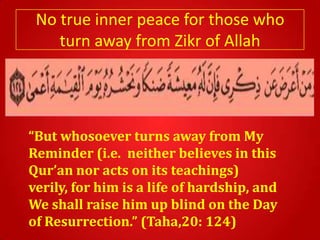
“But whosoever turns away from My
Reminder (i.e. neither believes in this
Qur’an nor acts on its teachings)
verily, for him is a life of hardship, and
We shall raise him up blind on the Day
of Resurrection.” (Taha,20: 124)
Man is created to face struggles


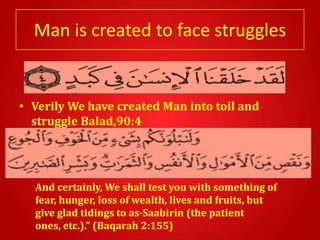
• Verily We have created Man into toil and
  struggle Balad,90:4


  And certainly, We shall test you with something of
  fear, hunger, loss of wealth, lives and fruits, but
  give glad tidings to as-Saabirin (the patient
  ones, etc.).” (Baqarah 2:155)
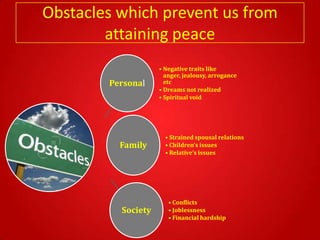
Obstacles which prevent us from
        attaining peace
                    • Negative traits like
                      anger, jealousy, arrogance
        Personal      etc
                    • Dreams not realized
                    • Spiritual void


                      • Strained spousal relations
          Family      • Children’s issues
                      • Relative’s issues


                       • Conflicts
          Society      • Joblessness
                       • Financial hardship
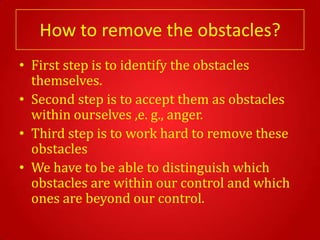
How to remove the obstacles?
• First step is to identify the obstacles
  themselves.
• Second step is to accept them as obstacles
  within ourselves ,e. g., anger.
• Third step is to work hard to remove these
  obstacles
• We have to be able to distinguish which
  obstacles are within our control and which
  ones are beyond our control.
To remove obstacles we have to focus
        mostly on self-change


• Verily! God will not change the condition of a
  people as long as they do not change their state
  of good within themselves…” (Quran 13:11)
• “Whoever pretends to be patient (with a desire
  to be patient) God will give him patience.”
   [Saheeh Al-Bukhari.]
Accepting Destiny (Qadar)
• God has destined for us some things in our
  lives
• They are not really obstacles, but we have
  misinterpreted them as being obstacles.
• One might find oneself born black in a world
  that favors white people over black
• Born poor in a world that favors the rich over
  the poor
• Born short, or crippled, or with any other
  physical condition which is considered a
  handicap
Things that are beyond our control
• We did not choose which family to be born
• We did not choose which body for our spirit
  to be blown into
• Inner peace can only be achieved if the
  obstacles that are beyond our control are
  accepted by us patiently as part of God’s
  destiny.
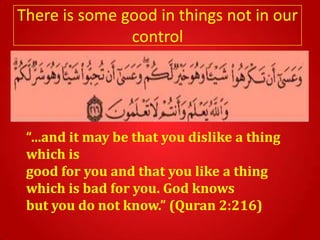
There is some good in things not in our
               control


 “…and it may be that you dislike a thing
 which is
 good for you and that you like a thing
 which is bad for you. God knows
 but you do not know.” (Quran 2:216)
Lessons from story of Khidr and Musa
            in Surah Kahf
• Khidr made a hole in the boat of the people
  who were kind enough to take him and Musa
  across the river
• Owners saw the hole in the boat and they
  wondered who did it and thought that it was a
  nasty thing to have done
• A king came down to the river and forcefully
  took away for himself all the boats except the
  one with a hole in it.
• So the owners of the boat praised God due to
  the fact that there was a hole in the boat
Khidr Kills a Boy
• Then they journeyed on until they met a boy
  and Khidr slew him.
• Musa cried out, "have you killed an innocent
  person, though he had killed no body?
• Khidr explained it latter that his parents were
  true believers and he could trouble them with
  his rebellion and unbelief.
• Therefore Allah Willed to grant them another
  child who may be more righteous and filial.
Khidr repairs a Falling Wall
• Then they traveled on until they reached a town
  and requested some food but people declined to
  entertain them.
• There they saw a wall which was about to fall
  down and Khidr set it up.
• Musa said, "Had you wanted, you could have
  demanded for your labor".
• The wall belonged to two orphan boys, who
  resided in that city. A treasure for them lied under
  that wall.
• As their father was a righteous man, Allah willed
  that when those children grow, they should dig out
  their treasure.
Major lessons from this story
• Constant effort is necessary to keep our knowledge
  square with the march of time

• We might set out with realistic aims and attainable
  ambitions.

• Soon we get obsessed with the journey, forget about the
  destination and run after vain illusions and fancy
  deceptions.

• If we settle for what we initially wanted, we can be
  happy and the world would be a much better place to
  live in.
Lessons from this story
• When one grows in prosperity beyond a limit which one cannot
  control with ease, he would attract envy, hatred and enmity

• Man must be content with the decree of God

• Some defeats or losses may actually be a blessing in disguise

• We tend to let stereo-typed impressions and the external
  environment cloud our judgment.

•   In the middle of evil there might be a single hidden good which
    we often overlook
How to deal with material element of
                our lives?
• “Do not look to those above you who are more
  fortunate, instead, look to those below you or less
  fortunate…” Hadith

• If you give the son of Adam a valley of gold he would
  want another one.” (Saheeh Muslim)

• Whoever makes this world his goal God will confuse his
  affairs and place poverty before his eyes and he will be
  able to attain nothing from this world except for what
  God has already written for him…” (Ibn Maajah, Ibn
  Hibbaan)
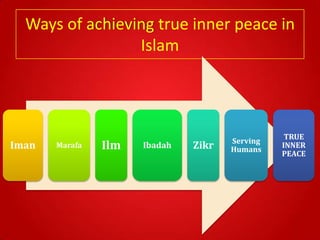
Ways of achieving true inner peace in
                 Islam


                                                 TRUE
                                      Serving
Iman   Marafa   Ilm   Ibadah   Zikr   Humans
                                                INNER
                                                PEACE
1- Iman or strong fai
• God is the only Creator and continual
  Sustainer of the Universe, worthy of
  worship
• Muslims believe that God is
  Loving, Compassionate and Merciful, and
  that He is concerned with the daily affairs of
  human beings
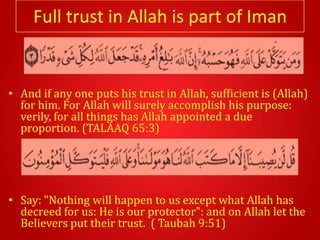
Full trust in Allah is part of Iman


• And if any one puts his trust in Allah, sufficient is (Allah)
  for him. For Allah will surely accomplish his purpose:
  verily, for all things has Allah appointed a due
  proportion. (TALAAQ 65:3)


• Say: "Nothing will happen to us except what Allah has
  decreed for us: He is our protector": and on Allah let the
  Believers put their trust. ( Taubah 9:51)
2-Marafa or recognizing God
• God calls on man to ponder over the creation in
  order to build a better understanding of his
  Creator

• The Quran is the literal word of God. Its recitation
  with understanding brings true recognition of God
  and His complete Guidance in all matters of life.
•
• Muhammad taught Quran, preached it, lived it and
  put it into practice. Following his footsteps, takes
  one to God.His Mercy and Love.
3- Ilm or knowledge


• "And Allaah has brought you out from the wombs of
  your mothers while you know nothing. And He gave you
  hearing, sight, and hearts that you might give thanks (to
  Allaah)" [Quran, 16:78]


• "and say: `My Lord! Increase me in knowledge"
  [Quran, 20:114]
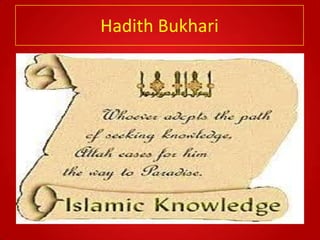
Hadith Bukhari
Ilm leads to path of inner peace and
                Jannah
• The main purpose of acquiring knowledge is
  to bring us closer to our Creator.

• Knowledge is to be pursued and practiced
  with modesty and humility

• Knowledge leads to dignity, freedom and
  justice which leads to inner peace.
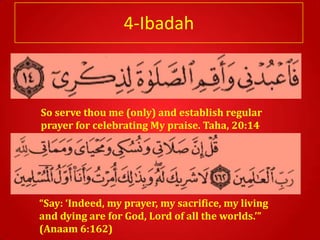
4-Ibadah


So serve thou me (only) and establish regular
prayer for celebrating My praise. Taha, 20:14


“Say: ‘Indeed, my prayer, my sacrifice, my living
and dying are for God, Lord of all the worlds.’”
(Anaam 6:162)
Inner Peace is reached by submitting
                 to God
• Whoever sets the Hereafter as
  his goal, God gathers his affairs
  for him, gives him richness of
  (faith in) the heart and the
  world will come to him
  grudgingly and submissively.
  Ibn Majah
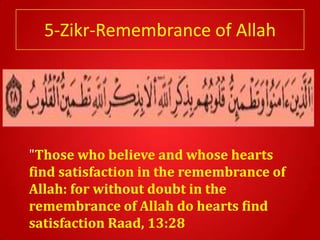
5-Zikr-Remembrance of Allah


"Those who believe and whose hearts
find satisfaction in the remembrance of
Allah: for without doubt in the
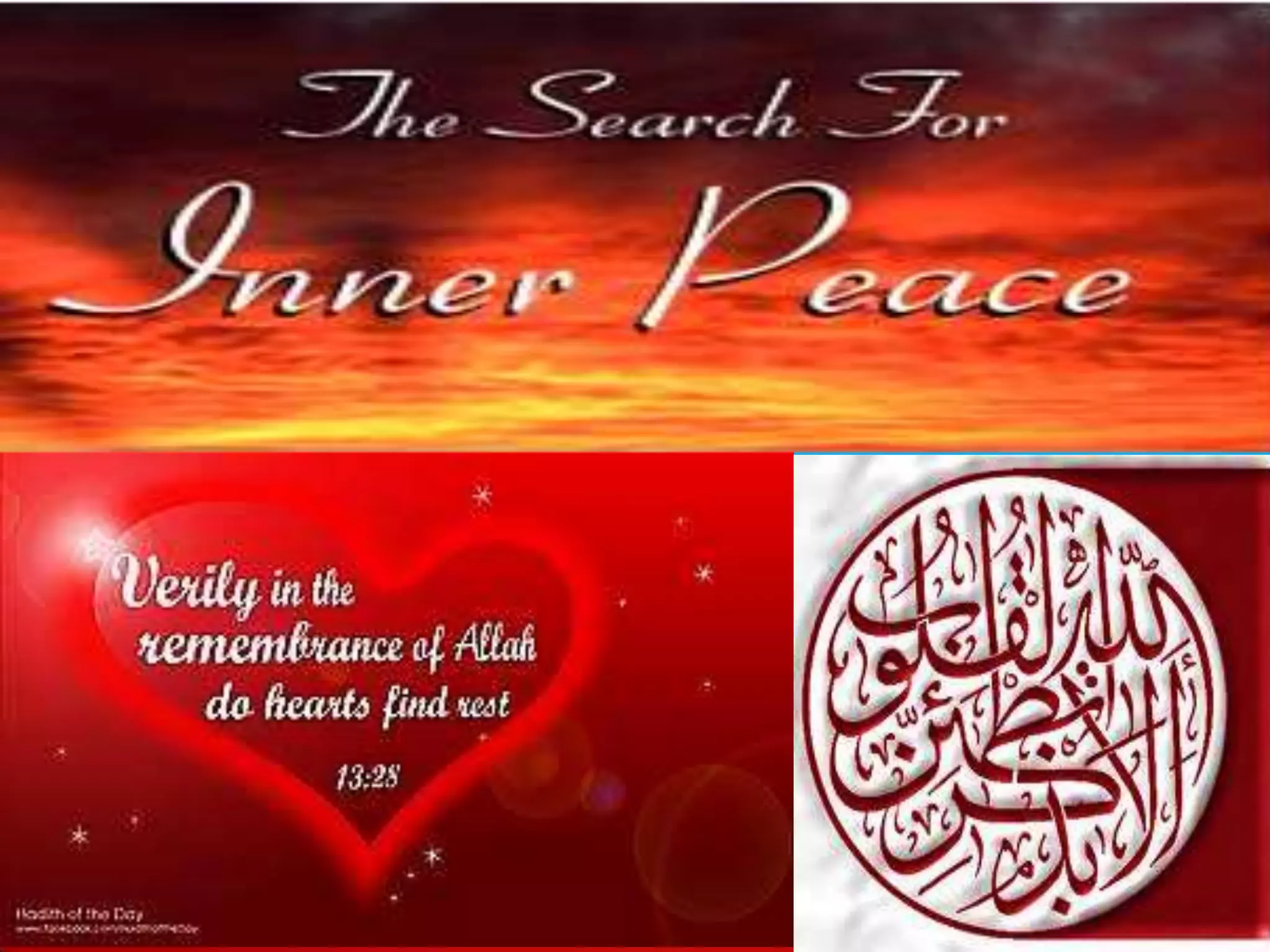
remembrance of Allah do hearts find
satisfaction Raad, 13:28
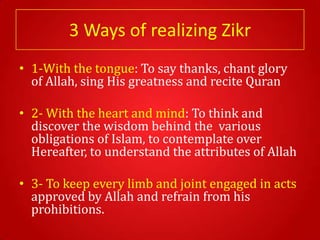
3 Ways of realizing Zikr
• 1-With the tongue: To say thanks, chant glory
  of Allah, sing His greatness and recite Quran

• 2- With the heart and mind: To think and
  discover the wisdom behind the various
  obligations of Islam, to contemplate over
  Hereafter, to understand the attributes of Allah

• 3- To keep every limb and joint engaged in acts
  approved by Allah and refrain from his
  prohibitions.
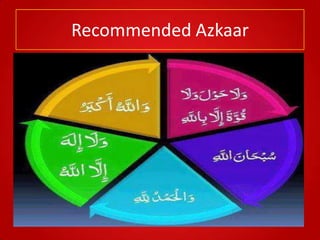
Recommended Azkaar
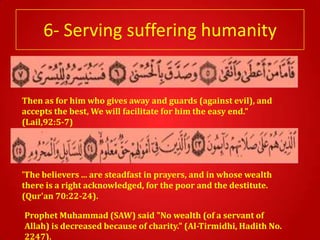
6- Serving suffering humanity


Then as for him who gives away and guards (against evil), and
accepts the best, We will facilitate for him the easy end."
(Lail,92:5-7)


'The believers ... are steadfast in prayers, and in whose wealth
there is a right acknowledged, for the poor and the destitute.
(Qur'an 70:22-24).

Prophet Muhammad (SAW) said "No wealth (of a servant of
Allah) is decreased because of charity." (Al-Tirmidhi, Hadith No.
2247).
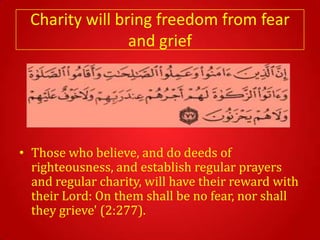
Charity will bring freedom from fear
                and grief


• Those who believe, and do deeds of
  righteousness, and establish regular prayers
  and regular charity, will have their reward with
  their Lord: On them shall be no fear, nor shall
  they grieve' (2:277).
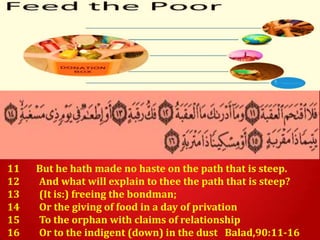
11   But he hath made no haste on the path that is steep.
12   And what will explain to thee the path that is steep?
13   (It is:) freeing the bondman;
14   Or the giving of food in a day of privation
15   To the orphan with claims of relationship
16   Or to the indigent (down) in the dust Balad,90:11-16
Some acts of Charity and kindness
• Emancipation of slaves (90:13; 2:177),
• Feeding of the poor (69:34; 90:11-16; 107:1-3),
• Taking care of orphans (17:34; 76:8; 89:17;
  90:15; 93:9, 107:2) and
• Doing good to humanity in general,
• Speaking of a kind word to parents is referred
  to as Ihsan (doing good) in 17:23
• Use of the kind words is recommended as in
  itself a charitable deed in 2:83, 4:8
Search for inner peace

Search for inner peace

  • 1.
  • 2.
    Inner peace isa universal need • Everyone on this planet desires inner peace • Everybody has been searching for it throughout the ages • Search goes on regardless of color, creed, religion, race, nationality, age, s ex • Search does not end with wealth or technological advancement
  • 3.
    Different paths intrying to achieve inner peace • Accumulating material possessions and wealth • Drugs; • Music • Meditation • Spousal and family relations • Careers • Children’s achievements • Physical comforts through technology
  • 4.
    Inner peace remainselusive • in America some 18.8 million adults or 9.5% US population suffer from depression yearly • Depression is but a total lack of inner peace • In the year 2000, death rate due to suicide was double of those who died of Aids • More people die from suicide in America than from homicide • Homicide rates themselves are massive
  • 5.
    Personal pleasures donot bring inner peace • We achieve elements of pleasure from a variety of things , e.g., wealth, food, comforts, intimate spousal relations • But these do not last, they come and go • True inner peace is a sense of stability and contentment • This carries us through all the trials and difficulties of life.
  • 6.
    What is innerpeace and true happiness ? • Happiness is that state of body and soul that encompasses contentment and peacefulness; it is the soft joy that causes our lips, faces and hearts to smile. • It is determined by faith in Almighty God (Allah) and obedience to Him • Life of this world is nothing more than a temporary joy and means of attaining the eternal happiness in the Hereafter.
  • 7.
    Inner Peace andgood life promised to those who believe & act right Whoever works righteousness - whether male or female - while he (or she) is a true believer verily, to him We will give a good life (in this world with respect, contentment and lawful provision), and We shall pay them certainly a reward in proportion to the best of what they used to do (i.e. Paradise in the Hereafter).” (Nahal, 16:97)
  • 8.
    Muslim finds innerpeace in all circumstances • He gets it through, Iman, sincere worship, hastening to do virtuous deeds, and by performing acts of kindness or giving charity. • Prophet Mohammad said, “Indeed amazing are the affairs of a believer! They are all for his benefit. If he is granted ease then he is thankful, and this is good for him. And if he is afflicted with a hardship, he perseveres, and this is good for him. ”(Muslim)
  • 9.
    No true innerpeace for those who turn away from Zikr of Allah “But whosoever turns away from My Reminder (i.e. neither believes in this Qur’an nor acts on its teachings) verily, for him is a life of hardship, and We shall raise him up blind on the Day of Resurrection.” (Taha,20: 124)
  • 10.
    Man is createdto face struggles • Verily We have created Man into toil and struggle Balad,90:4 And certainly, We shall test you with something of fear, hunger, loss of wealth, lives and fruits, but give glad tidings to as-Saabirin (the patient ones, etc.).” (Baqarah 2:155)
  • 11.
    Obstacles which preventus from attaining peace • Negative traits like anger, jealousy, arrogance Personal etc • Dreams not realized • Spiritual void • Strained spousal relations Family • Children’s issues • Relative’s issues • Conflicts Society • Joblessness • Financial hardship
  • 12.
    How to removethe obstacles? • First step is to identify the obstacles themselves. • Second step is to accept them as obstacles within ourselves ,e. g., anger. • Third step is to work hard to remove these obstacles • We have to be able to distinguish which obstacles are within our control and which ones are beyond our control.
  • 13.
    To remove obstacleswe have to focus mostly on self-change • Verily! God will not change the condition of a people as long as they do not change their state of good within themselves…” (Quran 13:11) • “Whoever pretends to be patient (with a desire to be patient) God will give him patience.” [Saheeh Al-Bukhari.]
  • 14.
    Accepting Destiny (Qadar) •God has destined for us some things in our lives • They are not really obstacles, but we have misinterpreted them as being obstacles. • One might find oneself born black in a world that favors white people over black • Born poor in a world that favors the rich over the poor • Born short, or crippled, or with any other physical condition which is considered a handicap
  • 15.
    Things that arebeyond our control • We did not choose which family to be born • We did not choose which body for our spirit to be blown into • Inner peace can only be achieved if the obstacles that are beyond our control are accepted by us patiently as part of God’s destiny.
  • 16.
    There is somegood in things not in our control “…and it may be that you dislike a thing which is good for you and that you like a thing which is bad for you. God knows but you do not know.” (Quran 2:216)
  • 17.
    Lessons from storyof Khidr and Musa in Surah Kahf • Khidr made a hole in the boat of the people who were kind enough to take him and Musa across the river • Owners saw the hole in the boat and they wondered who did it and thought that it was a nasty thing to have done • A king came down to the river and forcefully took away for himself all the boats except the one with a hole in it. • So the owners of the boat praised God due to the fact that there was a hole in the boat
  • 18.
    Khidr Kills aBoy • Then they journeyed on until they met a boy and Khidr slew him. • Musa cried out, "have you killed an innocent person, though he had killed no body? • Khidr explained it latter that his parents were true believers and he could trouble them with his rebellion and unbelief. • Therefore Allah Willed to grant them another child who may be more righteous and filial.
  • 19.
    Khidr repairs aFalling Wall • Then they traveled on until they reached a town and requested some food but people declined to entertain them. • There they saw a wall which was about to fall down and Khidr set it up. • Musa said, "Had you wanted, you could have demanded for your labor". • The wall belonged to two orphan boys, who resided in that city. A treasure for them lied under that wall. • As their father was a righteous man, Allah willed that when those children grow, they should dig out their treasure.
  • 20.
    Major lessons fromthis story • Constant effort is necessary to keep our knowledge square with the march of time • We might set out with realistic aims and attainable ambitions. • Soon we get obsessed with the journey, forget about the destination and run after vain illusions and fancy deceptions. • If we settle for what we initially wanted, we can be happy and the world would be a much better place to live in.
  • 21.
    Lessons from thisstory • When one grows in prosperity beyond a limit which one cannot control with ease, he would attract envy, hatred and enmity • Man must be content with the decree of God • Some defeats or losses may actually be a blessing in disguise • We tend to let stereo-typed impressions and the external environment cloud our judgment. • In the middle of evil there might be a single hidden good which we often overlook
  • 22.
    How to dealwith material element of our lives? • “Do not look to those above you who are more fortunate, instead, look to those below you or less fortunate…” Hadith • If you give the son of Adam a valley of gold he would want another one.” (Saheeh Muslim) • Whoever makes this world his goal God will confuse his affairs and place poverty before his eyes and he will be able to attain nothing from this world except for what God has already written for him…” (Ibn Maajah, Ibn Hibbaan)
  • 23.
    Ways of achievingtrue inner peace in Islam TRUE Serving Iman Marafa Ilm Ibadah Zikr Humans INNER PEACE
  • 24.
    1- Iman orstrong fai • God is the only Creator and continual Sustainer of the Universe, worthy of worship • Muslims believe that God is Loving, Compassionate and Merciful, and that He is concerned with the daily affairs of human beings
  • 25.
    Full trust inAllah is part of Iman • And if any one puts his trust in Allah, sufficient is (Allah) for him. For Allah will surely accomplish his purpose: verily, for all things has Allah appointed a due proportion. (TALAAQ 65:3) • Say: "Nothing will happen to us except what Allah has decreed for us: He is our protector": and on Allah let the Believers put their trust. ( Taubah 9:51)
  • 26.
    2-Marafa or recognizingGod • God calls on man to ponder over the creation in order to build a better understanding of his Creator • The Quran is the literal word of God. Its recitation with understanding brings true recognition of God and His complete Guidance in all matters of life. • • Muhammad taught Quran, preached it, lived it and put it into practice. Following his footsteps, takes one to God.His Mercy and Love.
  • 27.
    3- Ilm orknowledge • "And Allaah has brought you out from the wombs of your mothers while you know nothing. And He gave you hearing, sight, and hearts that you might give thanks (to Allaah)" [Quran, 16:78] • "and say: `My Lord! Increase me in knowledge" [Quran, 20:114]
  • 28.
  • 29.
    Ilm leads topath of inner peace and Jannah • The main purpose of acquiring knowledge is to bring us closer to our Creator. • Knowledge is to be pursued and practiced with modesty and humility • Knowledge leads to dignity, freedom and justice which leads to inner peace.
  • 30.
    4-Ibadah So serve thoume (only) and establish regular prayer for celebrating My praise. Taha, 20:14 “Say: ‘Indeed, my prayer, my sacrifice, my living and dying are for God, Lord of all the worlds.’” (Anaam 6:162)
  • 31.
    Inner Peace isreached by submitting to God • Whoever sets the Hereafter as his goal, God gathers his affairs for him, gives him richness of (faith in) the heart and the world will come to him grudgingly and submissively. Ibn Majah
  • 32.
    5-Zikr-Remembrance of Allah "Thosewho believe and whose hearts find satisfaction in the remembrance of Allah: for without doubt in the remembrance of Allah do hearts find satisfaction Raad, 13:28
  • 34.
    3 Ways ofrealizing Zikr • 1-With the tongue: To say thanks, chant glory of Allah, sing His greatness and recite Quran • 2- With the heart and mind: To think and discover the wisdom behind the various obligations of Islam, to contemplate over Hereafter, to understand the attributes of Allah • 3- To keep every limb and joint engaged in acts approved by Allah and refrain from his prohibitions.
  • 35.
  • 37.
    6- Serving sufferinghumanity Then as for him who gives away and guards (against evil), and accepts the best, We will facilitate for him the easy end." (Lail,92:5-7) 'The believers ... are steadfast in prayers, and in whose wealth there is a right acknowledged, for the poor and the destitute. (Qur'an 70:22-24). Prophet Muhammad (SAW) said "No wealth (of a servant of Allah) is decreased because of charity." (Al-Tirmidhi, Hadith No. 2247).
  • 38.
    Charity will bringfreedom from fear and grief • Those who believe, and do deeds of righteousness, and establish regular prayers and regular charity, will have their reward with their Lord: On them shall be no fear, nor shall they grieve' (2:277).
  • 39.
    11 But he hath made no haste on the path that is steep. 12 And what will explain to thee the path that is steep? 13 (It is:) freeing the bondman; 14 Or the giving of food in a day of privation 15 To the orphan with claims of relationship 16 Or to the indigent (down) in the dust Balad,90:11-16
  • 40.
    Some acts ofCharity and kindness • Emancipation of slaves (90:13; 2:177), • Feeding of the poor (69:34; 90:11-16; 107:1-3), • Taking care of orphans (17:34; 76:8; 89:17; 90:15; 93:9, 107:2) and • Doing good to humanity in general, • Speaking of a kind word to parents is referred to as Ihsan (doing good) in 17:23 • Use of the kind words is recommended as in itself a charitable deed in 2:83, 4:8