LINEAR VS CYCLIC GRADATION
-BUSHRA AHMAD
MA ELT (II SEMESTER)
16ETM05
WHAT IS GRADATION
◦ The next step after selection
◦ Organising/arranging course content
◦ In the order to be taught
◦ To achieve objectives efficiently
◦ Rationale – strong foundation, clear chain of connection
◦ Orderly progress through successive stages
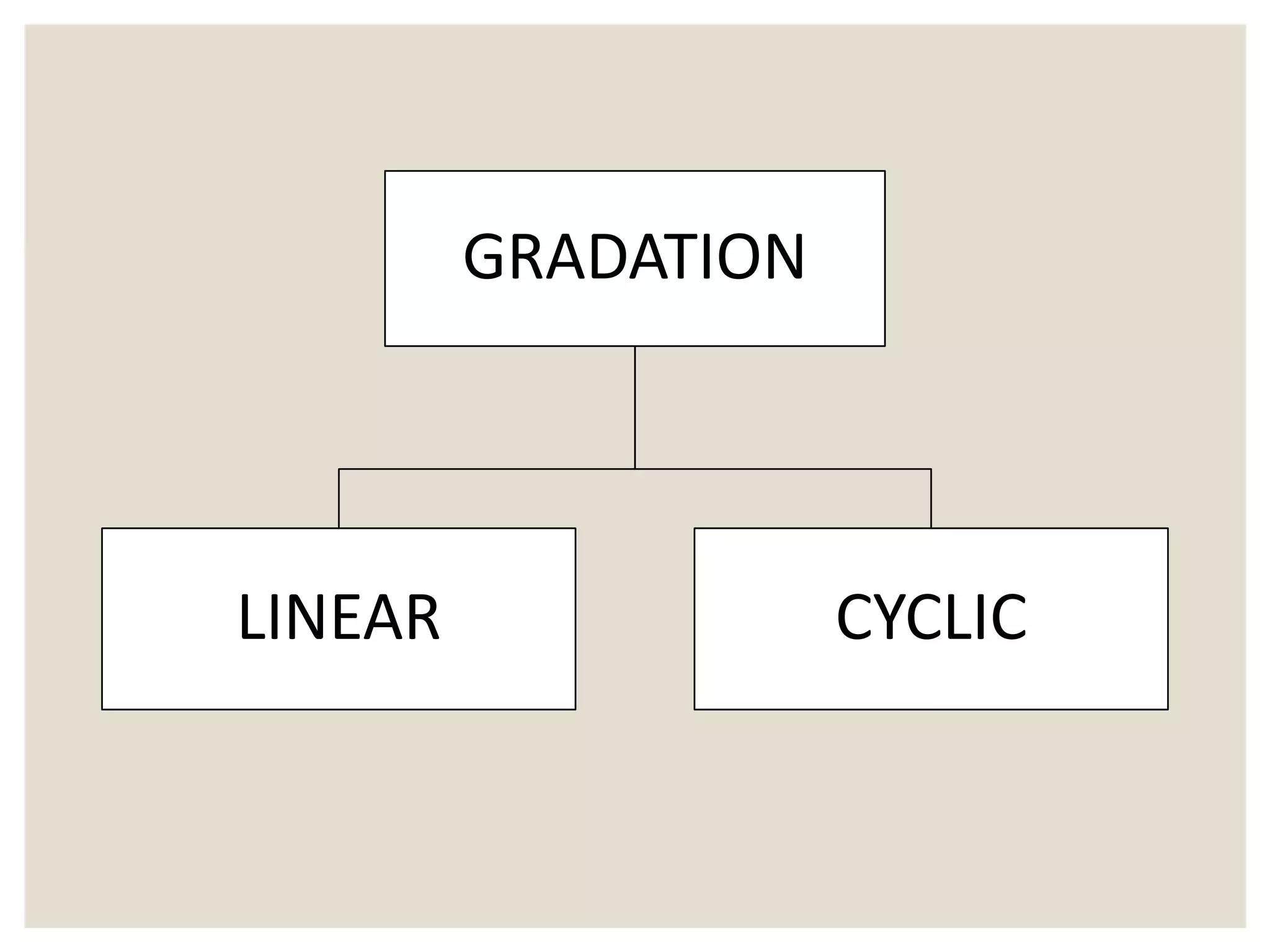
GRADATION
LINEAR CYCLIC
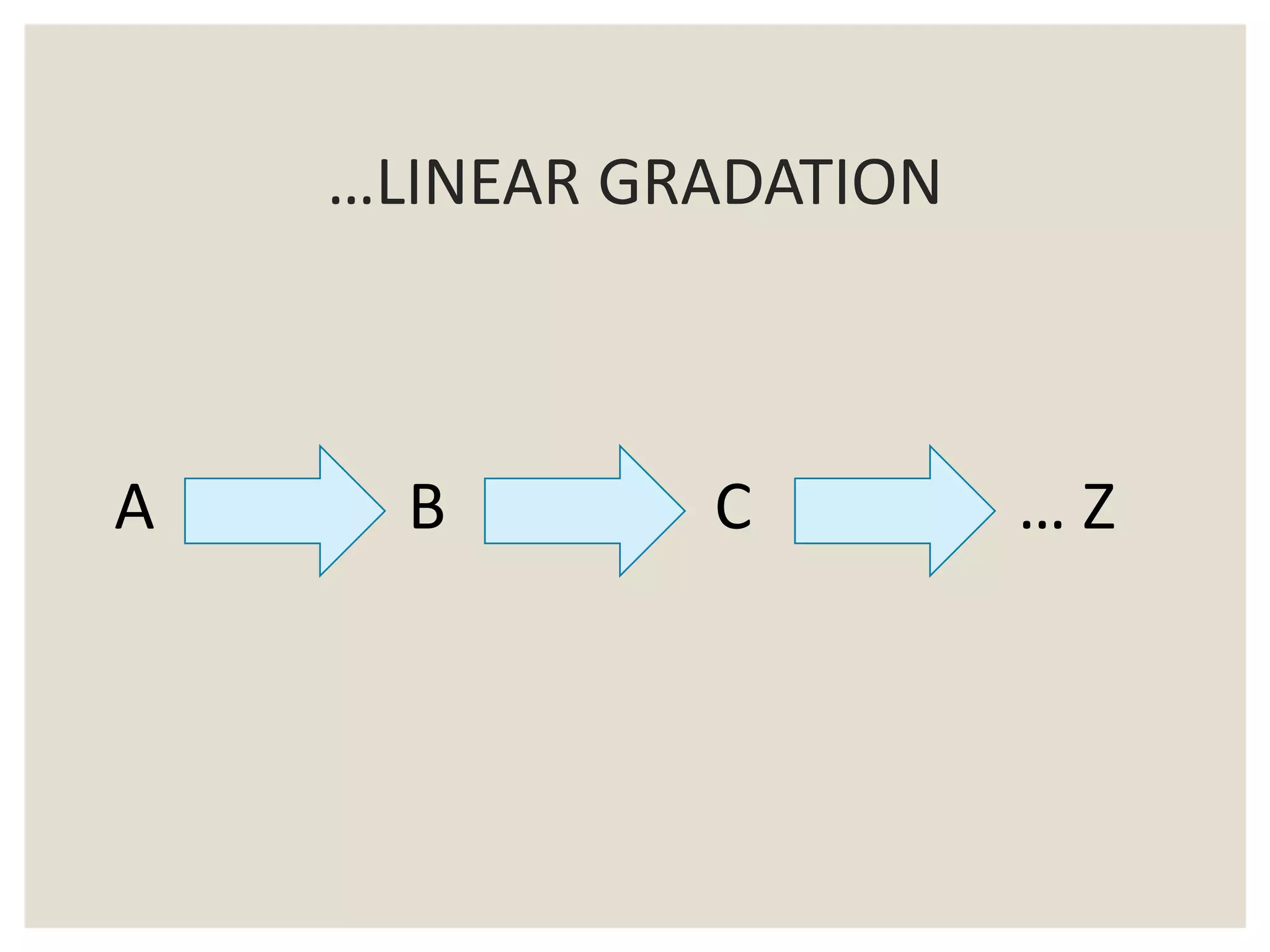
◦ Successive gradation
◦ More popular in the past
◦ With research in FLT – replaced
◦ Moves strictly in one direction
◦ Items presented one by one
◦ Discussed in detail
◦ Practised extensively
◦ Aim – achieve mastery
LINEAR GRADATION
…LINEAR GRADATION
B CA … Z
◦ Difficult to retain learning
◦ Since each item presented only once
◦ Only encountered briefly in revision units in the same
context
◦ Progress slow in the beginning
◦ Considerable time before real life communication
◦ Demotivating
OBJECTIONS
CYCLIC GRADATION
◦ Concentric/spiral gradation
◦ Bosco and Di Pietro (1970) - …”presentation of a point in
a way:
◦ Leading to gradual familiarisation
◦ By returning to it at different intervals in the course of
instruction
◦ …mastery is achieved by successive approximation to
a given standard.”
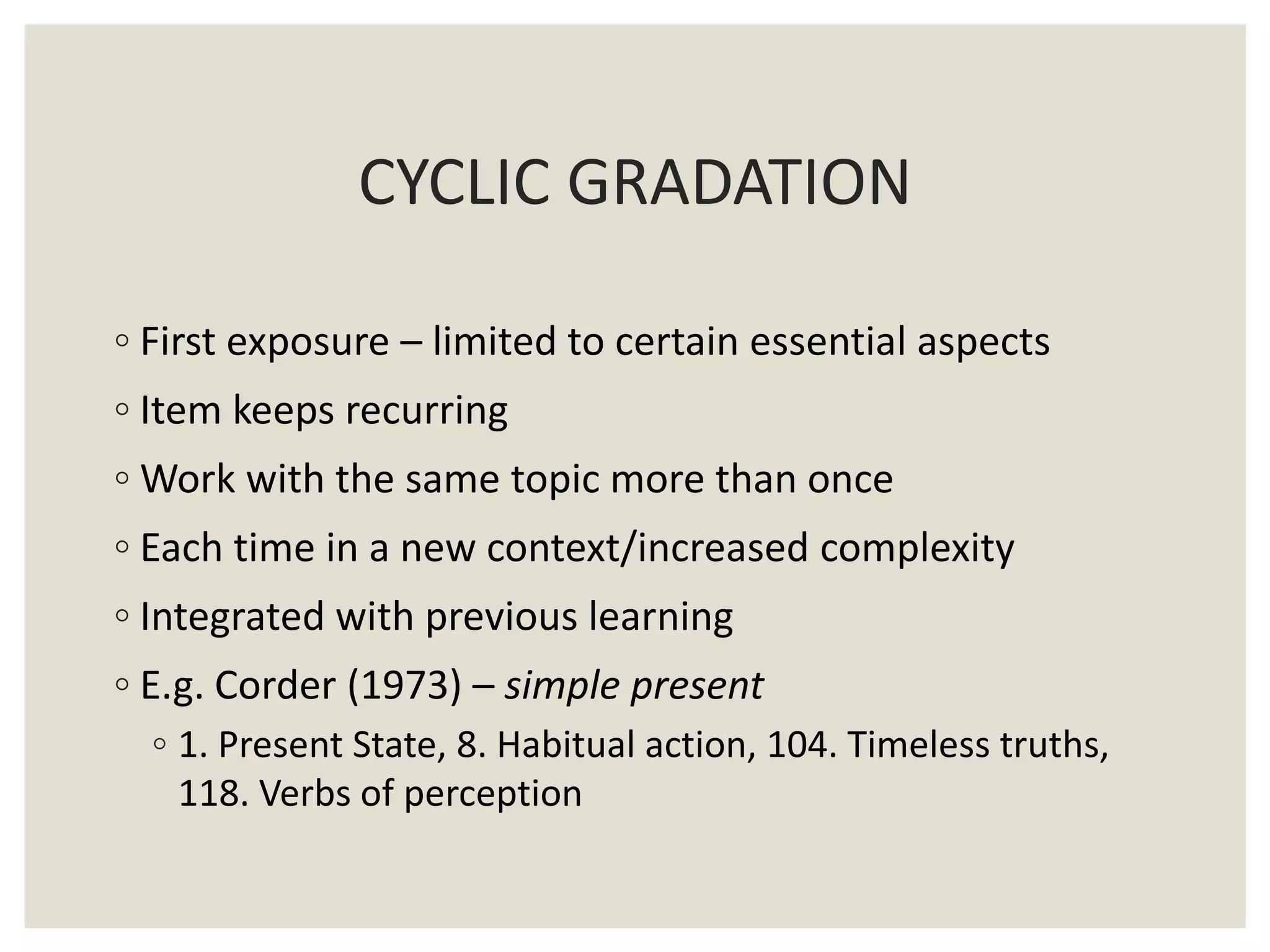
◦ First exposure – limited to certain essential aspects
◦ Item keeps recurring
◦ Work with the same topic more than once
◦ Each time in a new context/increased complexity
◦ Integrated with previous learning
◦ E.g. Corder (1973) – simple present
◦ 1. Present State, 8. Habitual action, 104. Timeless truths,
118. Verbs of perception
CYCLIC GRADATION
A
B + a
C + b
G + a
LINEAR GRADATION CYCLIC GRADATION
TARGET
PROFICIENCY
ADVANTAGES
◦ Corder (1973) – closer to the way language is structured
◦ Howatt (1974) – resembles the natural process of
language learning
◦ Constant revision
◦ Gradual familiarisation  coherent system of language
for communication
THANK YOU

Gradation of Materials

  • 1.
    LINEAR VS CYCLICGRADATION -BUSHRA AHMAD MA ELT (II SEMESTER) 16ETM05
  • 2.
    WHAT IS GRADATION ◦The next step after selection ◦ Organising/arranging course content ◦ In the order to be taught ◦ To achieve objectives efficiently ◦ Rationale – strong foundation, clear chain of connection ◦ Orderly progress through successive stages
  • 3.
  • 4.
    ◦ Successive gradation ◦More popular in the past ◦ With research in FLT – replaced ◦ Moves strictly in one direction ◦ Items presented one by one ◦ Discussed in detail ◦ Practised extensively ◦ Aim – achieve mastery LINEAR GRADATION
  • 5.
  • 6.
    ◦ Difficult toretain learning ◦ Since each item presented only once ◦ Only encountered briefly in revision units in the same context ◦ Progress slow in the beginning ◦ Considerable time before real life communication ◦ Demotivating OBJECTIONS
  • 7.
    CYCLIC GRADATION ◦ Concentric/spiralgradation ◦ Bosco and Di Pietro (1970) - …”presentation of a point in a way: ◦ Leading to gradual familiarisation ◦ By returning to it at different intervals in the course of instruction ◦ …mastery is achieved by successive approximation to a given standard.”
  • 8.
    ◦ First exposure– limited to certain essential aspects ◦ Item keeps recurring ◦ Work with the same topic more than once ◦ Each time in a new context/increased complexity ◦ Integrated with previous learning ◦ E.g. Corder (1973) – simple present ◦ 1. Present State, 8. Habitual action, 104. Timeless truths, 118. Verbs of perception CYCLIC GRADATION
  • 9.
    A B + a C+ b G + a
  • 10.
    LINEAR GRADATION CYCLICGRADATION TARGET PROFICIENCY
  • 11.
    ADVANTAGES ◦ Corder (1973)– closer to the way language is structured ◦ Howatt (1974) – resembles the natural process of language learning ◦ Constant revision ◦ Gradual familiarisation  coherent system of language for communication
  • 12.