Deep Learning-Based
Stereo Super-Resolution
전석준, 백승환, 최인창, 김민혁
2018.08.09
Enhancing the Spatial Resolution of Stereo Images using a Parallax Prior
Daniel S. Jeon, Seung-Hwan Baek, Inchang Choi, Min H. Kim
Proc. IEEE Computer Vision and Pattern Recognition (CVPR 2018)
Salt Lake City, USA, June 18, 2018
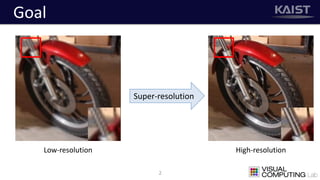
Goal
2
Super-resolution
Low-resolution High-resolution
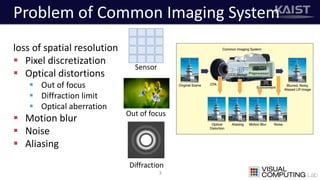
Problem of Common Imaging System
3
loss of spatial resolution
 Pixel discretization
 Optical distortions
 Out of focus
 Diffraction limit
 Optical aberration
 Motion blur
 Noise
 Aliasing
Out of focus
Diffraction
Sensor
BACKGROUND
4
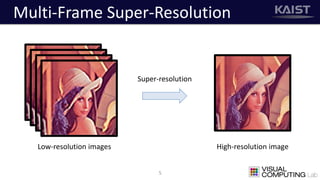
Multi-Frame Super-Resolution
5
Low-resolution images High-resolution image
Super-resolution
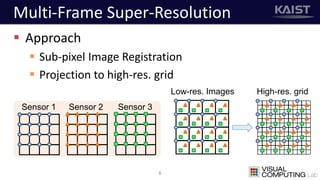
Multi-Frame Super-Resolution
6
Sensor 1 Sensor 2 Sensor 3
 Approach
 Sub-pixel Image Registration
 Projection to high-res. grid
Low-res. Images High-res. grid
Sub-Pixel Image Registration
7
Image 1 Image 2 Cross-correlation
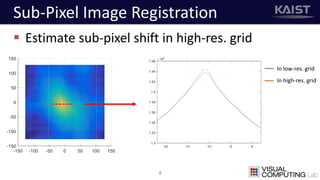
Sub-Pixel Image Registration
8
 Estimate sub-pixel shift in high-res. grid
In low-res. grid
In high-res. grid
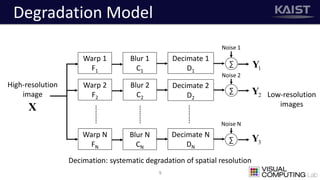
Degradation Model
9
High-resolution
image
X
Warp 1
F1
Warp N
FN
Warp 2
F2
Blur 1
C1
Blur 2
C2
Blur N
CN
Decimate 1
D1
Decimate 2
D2
Decimate N
DN
……….
……….
……….
∑
∑
∑
Noise 1
Noise 2
Noise N
1Y
2Y
3Y
Low-resolution
images
Decimation: systematic degradation of spatial resolution
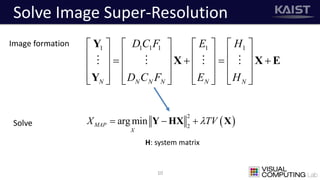
Solve Image Super-Resolution
10
1 1 1 1 1 1
N N N N N N
D C F E H
D C F E H
       
                 
              
Y
X X E
Y
Image formation
 
2
2
arg minMAP
X
X TV  Y HX XSolve
H: system matrix
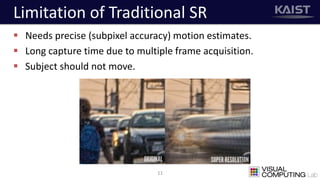
Limitation of Traditional SR
 Needs precise (subpixel accuracy) motion estimates.
 Long capture time due to multiple frame acquisition.
 Subject should not move.
11
RELATED WORK
12
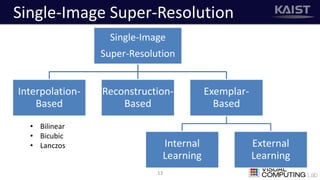
Single-Image Super-Resolution
Single-Image
Super-Resolution
Interpolation-
Based
Reconstruction-
Based
Exemplar-
Based
Internal
Learning
External
Learning
13
• Bilinear
• Bicubic
• Lanczos
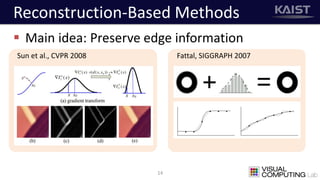
Reconstruction-Based Methods
 Main idea: Preserve edge information
14
Sun et al., CVPR 2008 Fattal, SIGGRAPH 2007
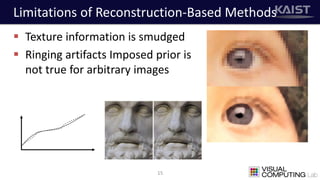
Limitations of Reconstruction-Based Methods
 Texture information is smudged
 Ringing artifacts Imposed prior is
not true for arbitrary images
15
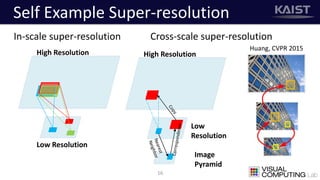
Self Example Super-resolution
16
Low Resolution
High Resolution
Low
Resolution
High Resolution
Image
Pyramid
In-scale super-resolution Cross-scale super-resolution
Huang, CVPR 2015
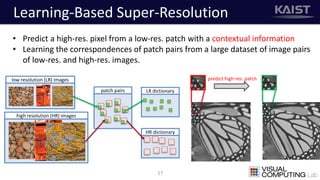
Learning-Based Super-Resolution
17
• Predict a high-res. pixel from a low-res. patch with a contextual information
• Learning the correspondences of patch pairs from a large dataset of image pairs
of low-res. and high-res. images.
predict high-res. patchlow resolution (LR) images
high resolution (HR) images
patch pairs LR dictionary
HR dictionary
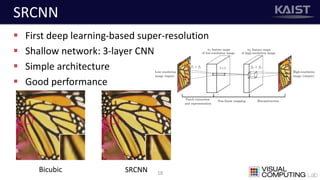
SRCNN
 First deep learning-based super-resolution
 Shallow network: 3-layer CNN
 Simple architecture
 Good performance
18
Bicubic SRCNN
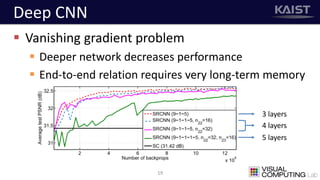
Deep CNN
 Vanishing gradient problem
 Deeper network decreases performance
 End-to-end relation requires very long-term memory
19
3 layers
4 layers
5 layers
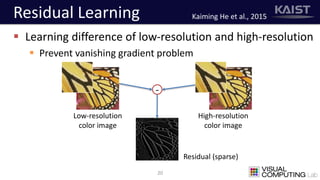
 Learning difference of low-resolution and high-resolution
 Prevent vanishing gradient problem
Residual Learning
20
Low-resolution
color image
High-resolution
color image
-
Residual (sparse)
Kaiming He et al., 2015
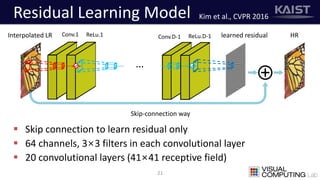
Residual Learning Model
 Skip connection to learn residual only
 64 channels, 3×3 filters in each convolutional layer
 20 convolutional layers (41×41 receptive field)
21
Interpolated LR HR
Skip-connection way
learned residualConv.1 Conv.D-1ReLu.1 ReLu.D-1
Kim et al., CVPR 2016
OUR METHOD
22
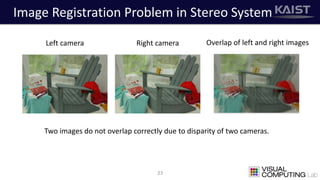
Image Registration Problem in Stereo System
23
Left camera Right camera
Two images do not overlap correctly due to disparity of two cameras.
Overlap of left and right images
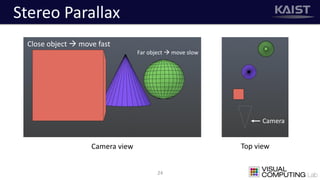
Stereo Parallax
24
Camera view Top view
Close object  move fast
Far object  move slow
Camera
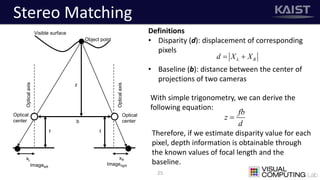
Stereo Matching
25
Object point
b
z
Imageleft
Imageright
f f
Visible surface
Opticalaxis
Opticalaxis
xL xR
Optical
center
Optical
center
Definitions
• Disparity (d): displacement of corresponding
pixels
• Baseline (b): distance between the center of
projections of two cameras
With simple trigonometry, we can derive the
following equation:
Therefore, if we estimate disparity value for each
pixel, depth information is obtainable through
the known values of focal length and the
baseline.
L Rd X X 
fb
z
d

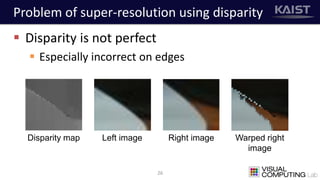
Problem of super-resolution using disparity
26
Disparity map Left image Warped right
image
Right image
 Disparity is not perfect
 Especially incorrect on edges
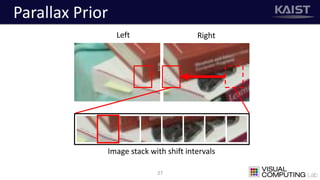
Parallax Prior
27
Left Right
Image stack with shift intervals
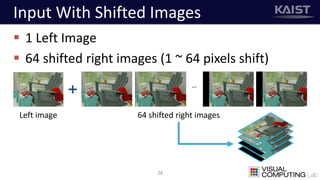
Input With Shifted Images
 1 Left Image
 64 shifted right images (1 ~ 64 pixels shift)
28
…
Left image 64 shifted right images
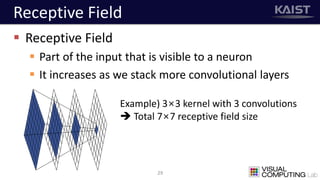
Receptive Field
 Receptive Field
 Part of the input that is visible to a neuron
 It increases as we stack more convolutional layers
29
Example) 3×3 kernel with 3 convolutions
 Total 7×7 receptive field size
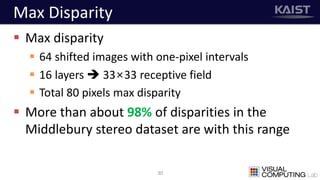
Max Disparity
 Max disparity
 64 shifted images with one-pixel intervals
 16 layers  33×33 receptive field
 Total 80 pixels max disparity
 More than about 98% of disparities in the
Middlebury stereo dataset are with this range
30
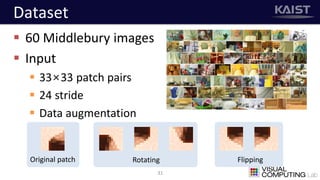
 60 Middlebury images
 Input
 33×33 patch pairs
 24 stride
 Data augmentation
Dataset
31
Original patch Rotating Flipping
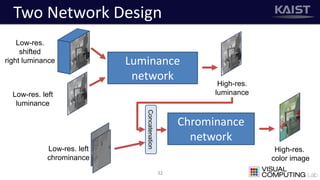
Two Network Design
32
Low-res. left
luminance
Low-res.
shifted
right luminance
Low-res. left
chrominance
Luminance
network
Chrominance
network
High-res.
color image
High-res.
luminance
Concatenation
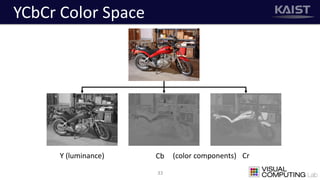
YCbCr Color Space
33
Y (luminance) Cb Cr(color components)
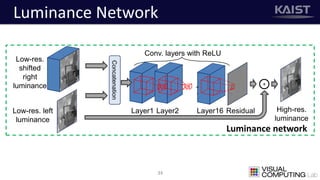
Luminance Network
34
Low-res. left
luminance
Low-res.
shifted
right
luminance
High-res.
luminance
··
·
Layer1 Layer2 Layer16 Residual
Conv. layers with ReLU
+
Luminance network
Concatenation
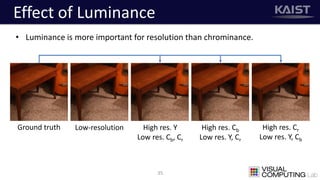
Effect of Luminance
35
Ground truth Low-resolution High res. Y
Low res. Cb, Cr
High res. Cb
Low res. Y, Cr
High res. Cr
Low res. Y, Cb
• Luminance is more important for resolution than chrominance.
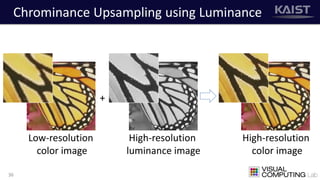
Chrominance Upsampling using Luminance
36
+
Low-resolution
color image
High-resolution
luminance image
High-resolution
color image
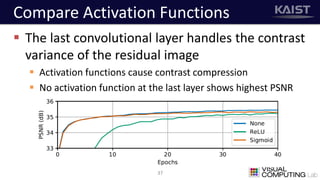
Compare Activation Functions
37
 The last convolutional layer handles the contrast
variance of the residual image
 Activation functions cause contrast compression
 No activation function at the last layer shows highest PSNR
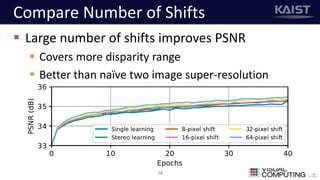
Compare Number of Shifts
38
 Large number of shifts improves PSNR
 Covers more disparity range
 Better than naïve two image super-resolution
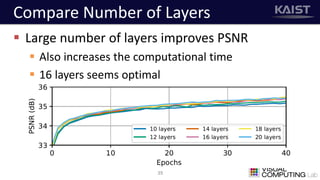
Compare Number of Layers
39
 Large number of layers improves PSNR
 Also increases the computational time
 16 layers seems optimal
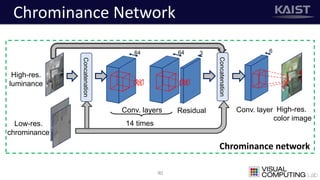
Chrominance Network
40
Low-res.
chrominance
High-res.
luminance
High-res.
color image
Conv. layers
14 times
Conv. layer
64 3 6
Residual
…
64
Concatenation
Chrominance network
Concatenation
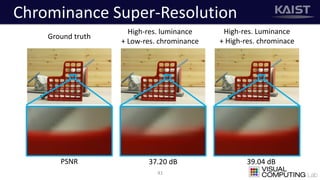
Chrominance Super-Resolution
41
Ground truth
High-res. luminance
+ Low-res. chrominance
High-res. Luminance
+ High-res. chrominace
PSNR 37.20 dB 39.04 dB
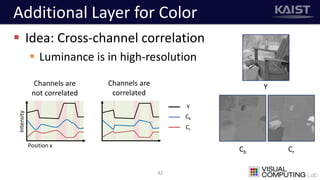
Additional Layer for Color
 Idea: Cross-channel correlation
 Luminance is in high-resolution
42
Position x
Intensity
Y
Cb
Cr
Channels are
not correlated
Channels are
correlated
Y
Cb Cr
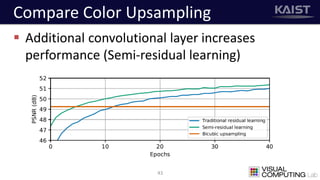
Compare Color Upsampling
43
 Additional convolutional layer increases
performance (Semi-residual learning)
RESULTS
44
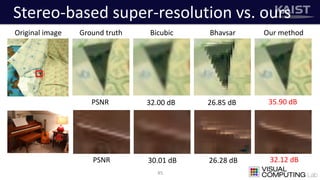
Stereo-based super-resolution vs. ours
45
PSNR 32.00 dB 26.85 dB 35.90 dB
Ground truth Bicubic Bhavsar Our methodOriginal image
PSNR 30.01 dB 26.28 dB 32.12 dB
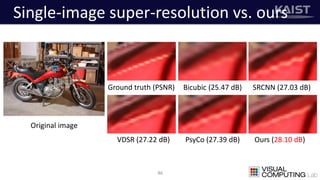
Single-image super-resolution vs. ours
46
Ground truth (PSNR) Bicubic (25.47 dB) SRCNN (27.03 dB)
VDSR (27.22 dB) PsyCo (27.39 dB) Ours (28.10 dB)
Original image
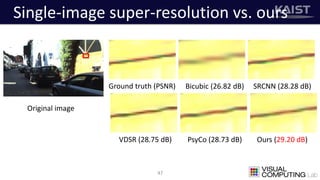
Single-image super-resolution vs. ours
47
Ground truth (PSNR) Bicubic (26.82 dB) SRCNN (28.28 dB)
VDSR (28.75 dB) PsyCo (28.73 dB) Ours (29.20 dB)
Original image
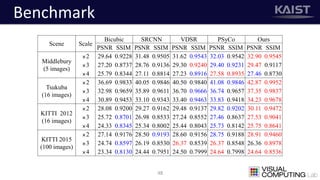
Benchmark
48
Scene Scale
Bicubic SRCNN VDSR PSyCo Ours
PSNR SSIM PSNR SSIM PSNR SSIM PSNR SSIM PSNR SSIM
Middlebury
(5 images)
×2 29.64 0.9228 31.48 0.9505 31.62 0.9543 32.03 0.9542 32.90 0.9545
×3 27.20 0.8737 28.76 0.9136 29.30 0.9240 29.40 0.9231 29.47 0.9117
×4 25.79 0.8344 27.11 0.8814 27.23 0.8916 27.58 0.8935 27.46 0.8730
Tsukuba
(16 images)
×2 36.69 0.9833 40.05 0.9846 40.50 0.9840 41.08 0.9846 42.87 0.9952
×3 32.98 0.9659 35.89 0.9611 36.70 0.9666 36.74 0.9657 37.35 0.9837
×4 30.89 0.9453 33.10 0.9343 33.40 0.9463 33.83 0.9418 34.23 0.9678
KITTI 2012
(16 images)
×2 28.08 0.9200 29.27 0.9162 29.48 0.9137 29.82 0.9202 30.11 0.9472
×3 25.72 0.8701 26.98 0.8533 27.24 0.8552 27.46 0.8637 27.53 0.9041
×4 24.33 0.8345 25.34 0.8002 25.44 0.8043 25.73 0.8142 25.75 0.8641
KITTI 2015
(100 images)
×2 27.14 0.9176 28.50 0.9193 28.60 0.9156 28.75 0.9188 28.91 0.9460
×3 24.74 0.8597 26.19 0.8530 26.37 0.8539 26.37 0.8548 26.36 0.8978
×4 23.34 0.8130 24.44 0.7951 24.50 0.7999 24.64 0.7998 24.64 0.8536
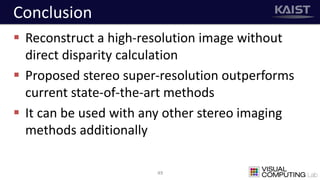
Conclusion
 Reconstruct a high-resolution image without
direct disparity calculation
 Proposed stereo super-resolution outperforms
current state-of-the-art methods
 It can be used with any other stereo imaging
methods additionally
49

Deep-Learning Based Stereo Super-Resolution

  • 1.
    Deep Learning-Based Stereo Super-Resolution 전석준,백승환, 최인창, 김민혁 2018.08.09 Enhancing the Spatial Resolution of Stereo Images using a Parallax Prior Daniel S. Jeon, Seung-Hwan Baek, Inchang Choi, Min H. Kim Proc. IEEE Computer Vision and Pattern Recognition (CVPR 2018) Salt Lake City, USA, June 18, 2018
  • 2.
  • 3.
    Problem of CommonImaging System 3 loss of spatial resolution  Pixel discretization  Optical distortions  Out of focus  Diffraction limit  Optical aberration  Motion blur  Noise  Aliasing Out of focus Diffraction Sensor
  • 4.
  • 5.
    Multi-Frame Super-Resolution 5 Low-resolution imagesHigh-resolution image Super-resolution
  • 6.
    Multi-Frame Super-Resolution 6 Sensor 1Sensor 2 Sensor 3  Approach  Sub-pixel Image Registration  Projection to high-res. grid Low-res. Images High-res. grid
  • 7.
    Sub-Pixel Image Registration 7 Image1 Image 2 Cross-correlation
  • 8.
    Sub-Pixel Image Registration 8 Estimate sub-pixel shift in high-res. grid In low-res. grid In high-res. grid
  • 9.
    Degradation Model 9 High-resolution image X Warp 1 F1 WarpN FN Warp 2 F2 Blur 1 C1 Blur 2 C2 Blur N CN Decimate 1 D1 Decimate 2 D2 Decimate N DN ………. ………. ………. ∑ ∑ ∑ Noise 1 Noise 2 Noise N 1Y 2Y 3Y Low-resolution images Decimation: systematic degradation of spatial resolution
  • 10.
    Solve Image Super-Resolution 10 11 1 1 1 1 N N N N N N D C F E H D C F E H                                          Y X X E Y Image formation   2 2 arg minMAP X X TV  Y HX XSolve H: system matrix
  • 11.
    Limitation of TraditionalSR  Needs precise (subpixel accuracy) motion estimates.  Long capture time due to multiple frame acquisition.  Subject should not move. 11
  • 12.
  • 13.
  • 14.
    Reconstruction-Based Methods  Mainidea: Preserve edge information 14 Sun et al., CVPR 2008 Fattal, SIGGRAPH 2007
  • 15.
    Limitations of Reconstruction-BasedMethods  Texture information is smudged  Ringing artifacts Imposed prior is not true for arbitrary images 15
  • 16.
    Self Example Super-resolution 16 LowResolution High Resolution Low Resolution High Resolution Image Pyramid In-scale super-resolution Cross-scale super-resolution Huang, CVPR 2015
  • 17.
    Learning-Based Super-Resolution 17 • Predicta high-res. pixel from a low-res. patch with a contextual information • Learning the correspondences of patch pairs from a large dataset of image pairs of low-res. and high-res. images. predict high-res. patchlow resolution (LR) images high resolution (HR) images patch pairs LR dictionary HR dictionary
  • 18.
    SRCNN  First deeplearning-based super-resolution  Shallow network: 3-layer CNN  Simple architecture  Good performance 18 Bicubic SRCNN
  • 19.
    Deep CNN  Vanishinggradient problem  Deeper network decreases performance  End-to-end relation requires very long-term memory 19 3 layers 4 layers 5 layers
  • 20.
     Learning differenceof low-resolution and high-resolution  Prevent vanishing gradient problem Residual Learning 20 Low-resolution color image High-resolution color image - Residual (sparse) Kaiming He et al., 2015
  • 21.
    Residual Learning Model Skip connection to learn residual only  64 channels, 3×3 filters in each convolutional layer  20 convolutional layers (41×41 receptive field) 21 Interpolated LR HR Skip-connection way learned residualConv.1 Conv.D-1ReLu.1 ReLu.D-1 Kim et al., CVPR 2016
  • 22.
  • 23.
    Image Registration Problemin Stereo System 23 Left camera Right camera Two images do not overlap correctly due to disparity of two cameras. Overlap of left and right images
  • 24.
    Stereo Parallax 24 Camera viewTop view Close object  move fast Far object  move slow Camera
  • 25.
    Stereo Matching 25 Object point b z Imageleft Imageright ff Visible surface Opticalaxis Opticalaxis xL xR Optical center Optical center Definitions • Disparity (d): displacement of corresponding pixels • Baseline (b): distance between the center of projections of two cameras With simple trigonometry, we can derive the following equation: Therefore, if we estimate disparity value for each pixel, depth information is obtainable through the known values of focal length and the baseline. L Rd X X  fb z d 
  • 26.
    Problem of super-resolutionusing disparity 26 Disparity map Left image Warped right image Right image  Disparity is not perfect  Especially incorrect on edges
  • 27.
    Parallax Prior 27 Left Right Imagestack with shift intervals
  • 28.
    Input With ShiftedImages  1 Left Image  64 shifted right images (1 ~ 64 pixels shift) 28 … Left image 64 shifted right images
  • 29.
    Receptive Field  ReceptiveField  Part of the input that is visible to a neuron  It increases as we stack more convolutional layers 29 Example) 3×3 kernel with 3 convolutions  Total 7×7 receptive field size
  • 30.
    Max Disparity  Maxdisparity  64 shifted images with one-pixel intervals  16 layers  33×33 receptive field  Total 80 pixels max disparity  More than about 98% of disparities in the Middlebury stereo dataset are with this range 30
  • 31.
     60 Middleburyimages  Input  33×33 patch pairs  24 stride  Data augmentation Dataset 31 Original patch Rotating Flipping
  • 32.
    Two Network Design 32 Low-res.left luminance Low-res. shifted right luminance Low-res. left chrominance Luminance network Chrominance network High-res. color image High-res. luminance Concatenation
  • 33.
    YCbCr Color Space 33 Y(luminance) Cb Cr(color components)
  • 34.
    Luminance Network 34 Low-res. left luminance Low-res. shifted right luminance High-res. luminance ·· · Layer1Layer2 Layer16 Residual Conv. layers with ReLU + Luminance network Concatenation
  • 35.
    Effect of Luminance 35 Groundtruth Low-resolution High res. Y Low res. Cb, Cr High res. Cb Low res. Y, Cr High res. Cr Low res. Y, Cb • Luminance is more important for resolution than chrominance.
  • 36.
    Chrominance Upsampling usingLuminance 36 + Low-resolution color image High-resolution luminance image High-resolution color image
  • 37.
    Compare Activation Functions 37 The last convolutional layer handles the contrast variance of the residual image  Activation functions cause contrast compression  No activation function at the last layer shows highest PSNR
  • 38.
    Compare Number ofShifts 38  Large number of shifts improves PSNR  Covers more disparity range  Better than naïve two image super-resolution
  • 39.
    Compare Number ofLayers 39  Large number of layers improves PSNR  Also increases the computational time  16 layers seems optimal
  • 40.
    Chrominance Network 40 Low-res. chrominance High-res. luminance High-res. color image Conv.layers 14 times Conv. layer 64 3 6 Residual … 64 Concatenation Chrominance network Concatenation
  • 41.
    Chrominance Super-Resolution 41 Ground truth High-res.luminance + Low-res. chrominance High-res. Luminance + High-res. chrominace PSNR 37.20 dB 39.04 dB
  • 42.
    Additional Layer forColor  Idea: Cross-channel correlation  Luminance is in high-resolution 42 Position x Intensity Y Cb Cr Channels are not correlated Channels are correlated Y Cb Cr
  • 43.
    Compare Color Upsampling 43 Additional convolutional layer increases performance (Semi-residual learning)
  • 44.
  • 45.
    Stereo-based super-resolution vs.ours 45 PSNR 32.00 dB 26.85 dB 35.90 dB Ground truth Bicubic Bhavsar Our methodOriginal image PSNR 30.01 dB 26.28 dB 32.12 dB
  • 46.
    Single-image super-resolution vs.ours 46 Ground truth (PSNR) Bicubic (25.47 dB) SRCNN (27.03 dB) VDSR (27.22 dB) PsyCo (27.39 dB) Ours (28.10 dB) Original image
  • 47.
    Single-image super-resolution vs.ours 47 Ground truth (PSNR) Bicubic (26.82 dB) SRCNN (28.28 dB) VDSR (28.75 dB) PsyCo (28.73 dB) Ours (29.20 dB) Original image
  • 48.
    Benchmark 48 Scene Scale Bicubic SRCNNVDSR PSyCo Ours PSNR SSIM PSNR SSIM PSNR SSIM PSNR SSIM PSNR SSIM Middlebury (5 images) ×2 29.64 0.9228 31.48 0.9505 31.62 0.9543 32.03 0.9542 32.90 0.9545 ×3 27.20 0.8737 28.76 0.9136 29.30 0.9240 29.40 0.9231 29.47 0.9117 ×4 25.79 0.8344 27.11 0.8814 27.23 0.8916 27.58 0.8935 27.46 0.8730 Tsukuba (16 images) ×2 36.69 0.9833 40.05 0.9846 40.50 0.9840 41.08 0.9846 42.87 0.9952 ×3 32.98 0.9659 35.89 0.9611 36.70 0.9666 36.74 0.9657 37.35 0.9837 ×4 30.89 0.9453 33.10 0.9343 33.40 0.9463 33.83 0.9418 34.23 0.9678 KITTI 2012 (16 images) ×2 28.08 0.9200 29.27 0.9162 29.48 0.9137 29.82 0.9202 30.11 0.9472 ×3 25.72 0.8701 26.98 0.8533 27.24 0.8552 27.46 0.8637 27.53 0.9041 ×4 24.33 0.8345 25.34 0.8002 25.44 0.8043 25.73 0.8142 25.75 0.8641 KITTI 2015 (100 images) ×2 27.14 0.9176 28.50 0.9193 28.60 0.9156 28.75 0.9188 28.91 0.9460 ×3 24.74 0.8597 26.19 0.8530 26.37 0.8539 26.37 0.8548 26.36 0.8978 ×4 23.34 0.8130 24.44 0.7951 24.50 0.7999 24.64 0.7998 24.64 0.8536
  • 49.
    Conclusion  Reconstruct ahigh-resolution image without direct disparity calculation  Proposed stereo super-resolution outperforms current state-of-the-art methods  It can be used with any other stereo imaging methods additionally 49