   Commercial systems dedicated to assess print quality already
    exist. They usually implement the ISO 13660 standard with a
    focus on character and line attributes (raggedness, line
    width, darkness, character, contrast, fill, extraneous marks,
    character field, background haze, character field)

   However, they are expensive, lack of flexibility and the access
    to their algorithms is not possible.

   Fiji/ImageJ and its environment enables to develop an open
    source program dedicated to print quality assessment
    ›   free license
    ›   Interface based
    ›   Development using Java language and pre-coded functions
    ›   Enhance collaboration
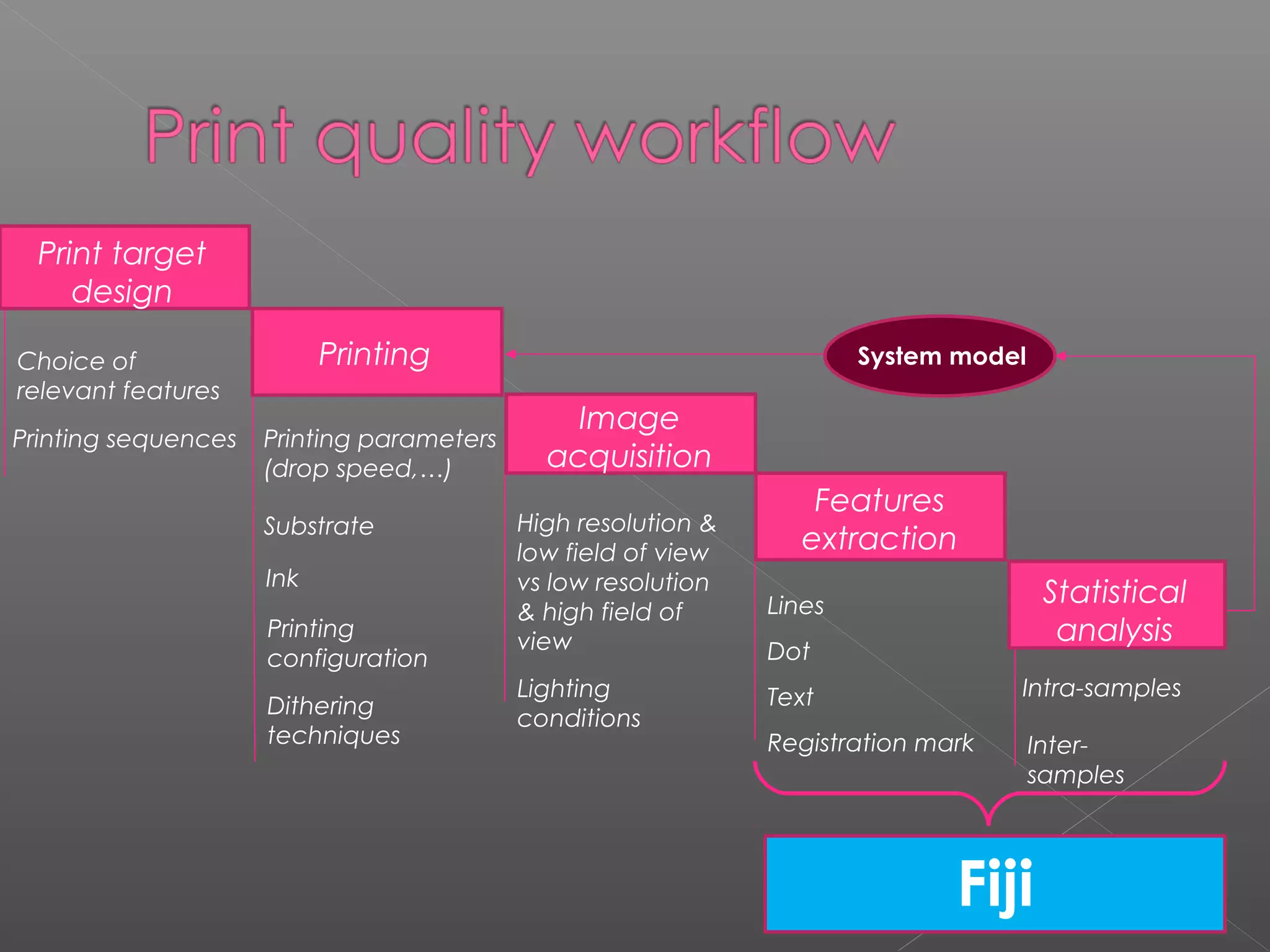
Print target
     design

Choice of                  Printing                                    System model
relevant features
                                               Image
Printing sequences   Printing parameters
                     (drop speed,…)          acquisition
                                                                   Features
                     Substrate             High resolution &
                                           low field of view      extraction
                     Ink                   vs low resolution
                                                               Lines                   Statistical
                                           & high field of
                     Printing
                                           view                                         analysis
                     configuration                             Dot
                                           Lighting            Text                Intra-samples
                     Dithering             conditions
                     techniques                                Registration mark      Inter-
                                                                                      samples


                                                                              Fiji
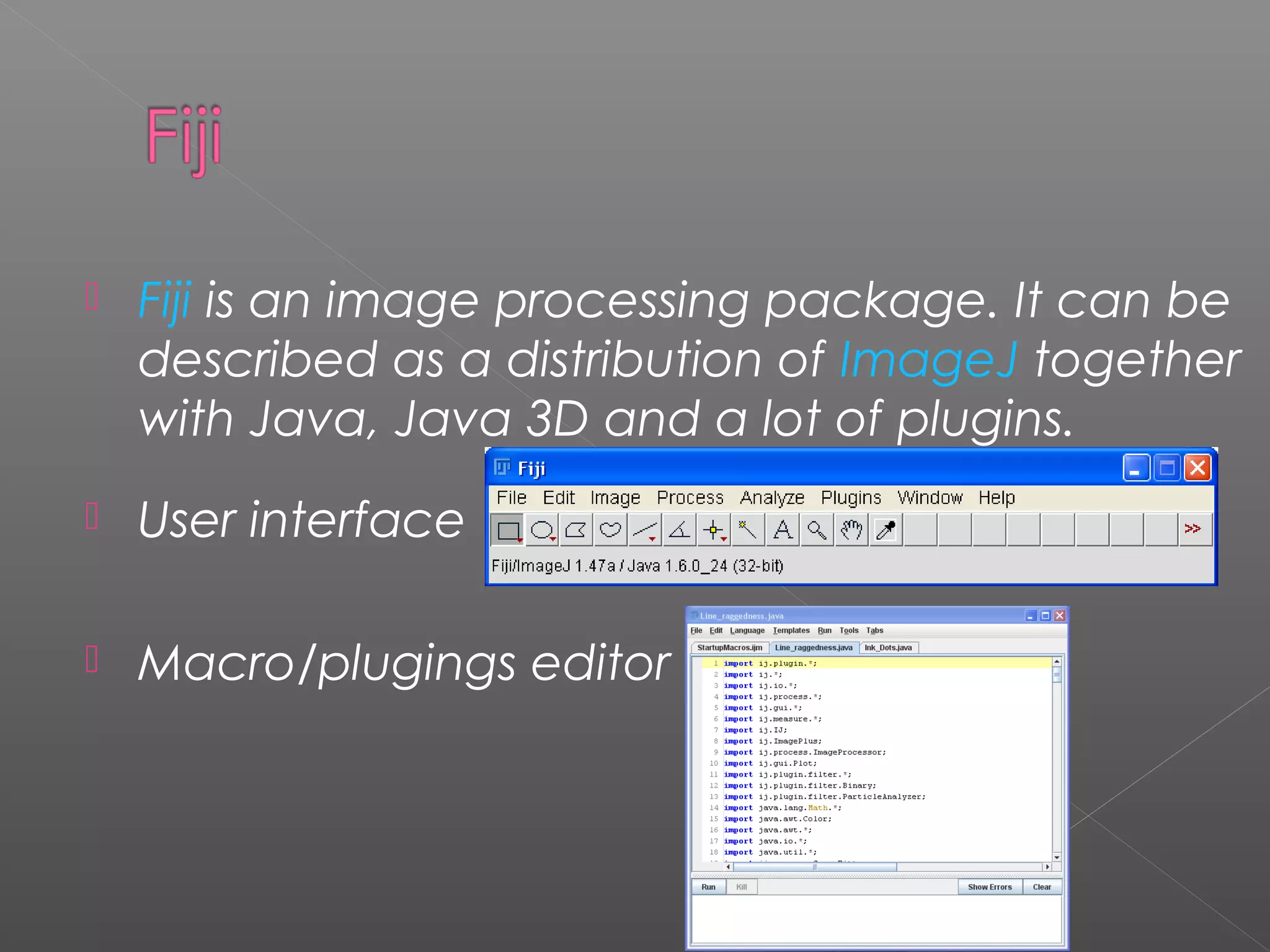
   Fiji is an image processing package. It can be
    described as a distribution of ImageJ together
    with Java, Java 3D and a lot of plugins.
   User interface

   Macro/plugings editor
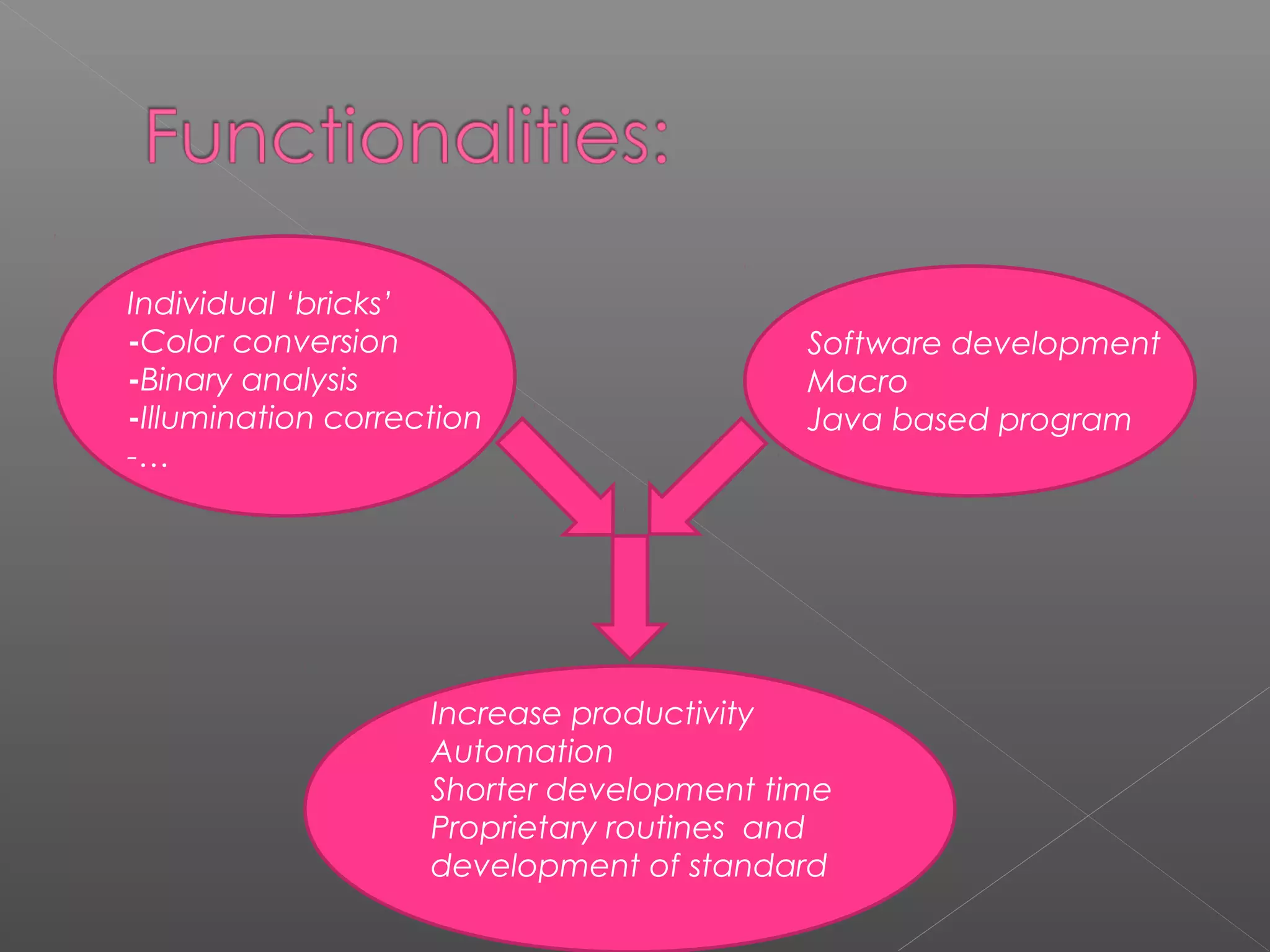
Individual ‘bricks’
-Color conversion                         Software development
-Binary analysis                          Macro
-Illumination correction                  Java based program
-…


                    Increase productivity
                    Automation
                    Shorter development time
                    Proprietary routines and
                    development of standard
   Image creation to design test charts

   Dithering techniques

   Dots and satellites

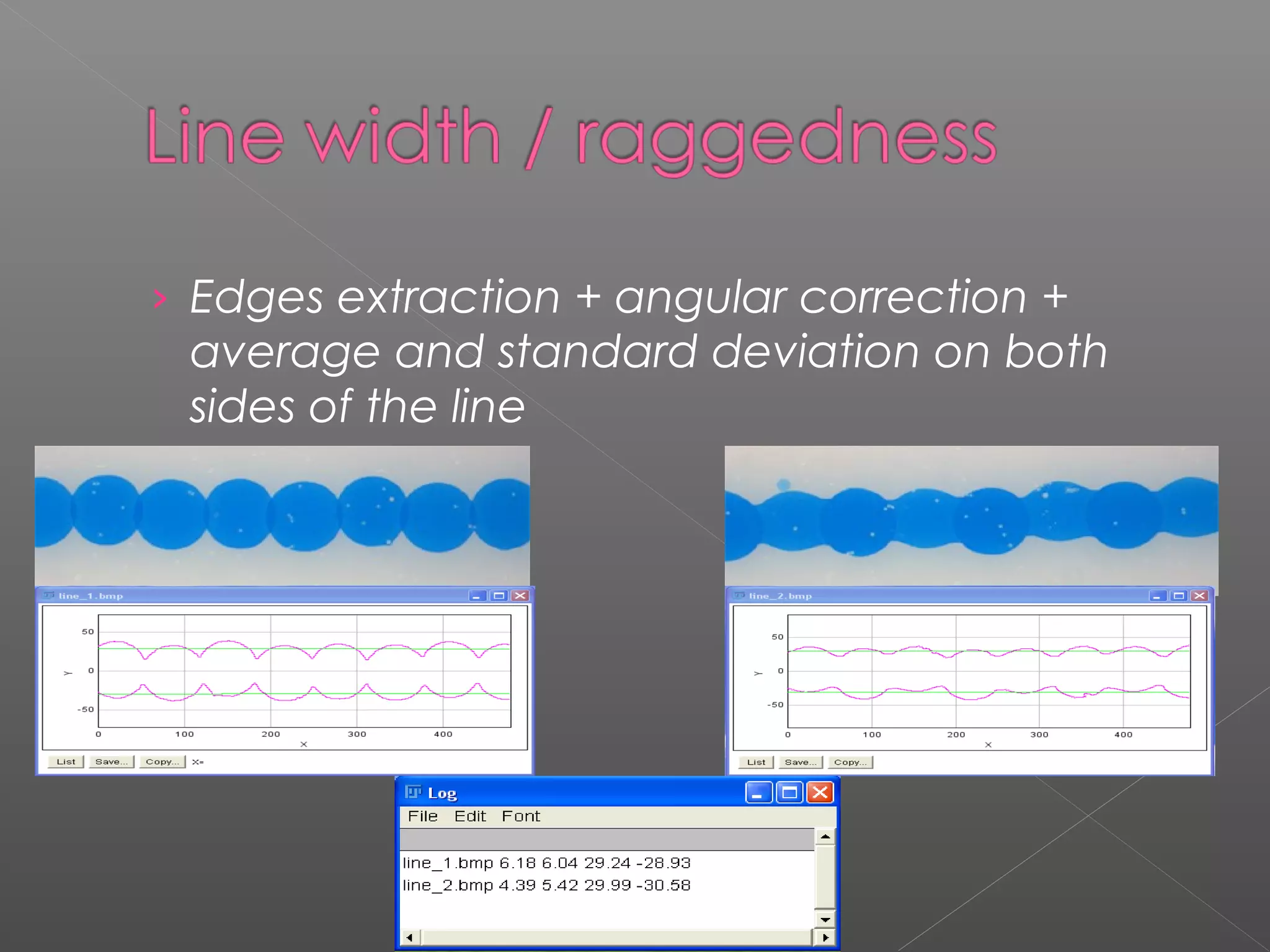
   Line width/raggedness

   Series of parallel lines
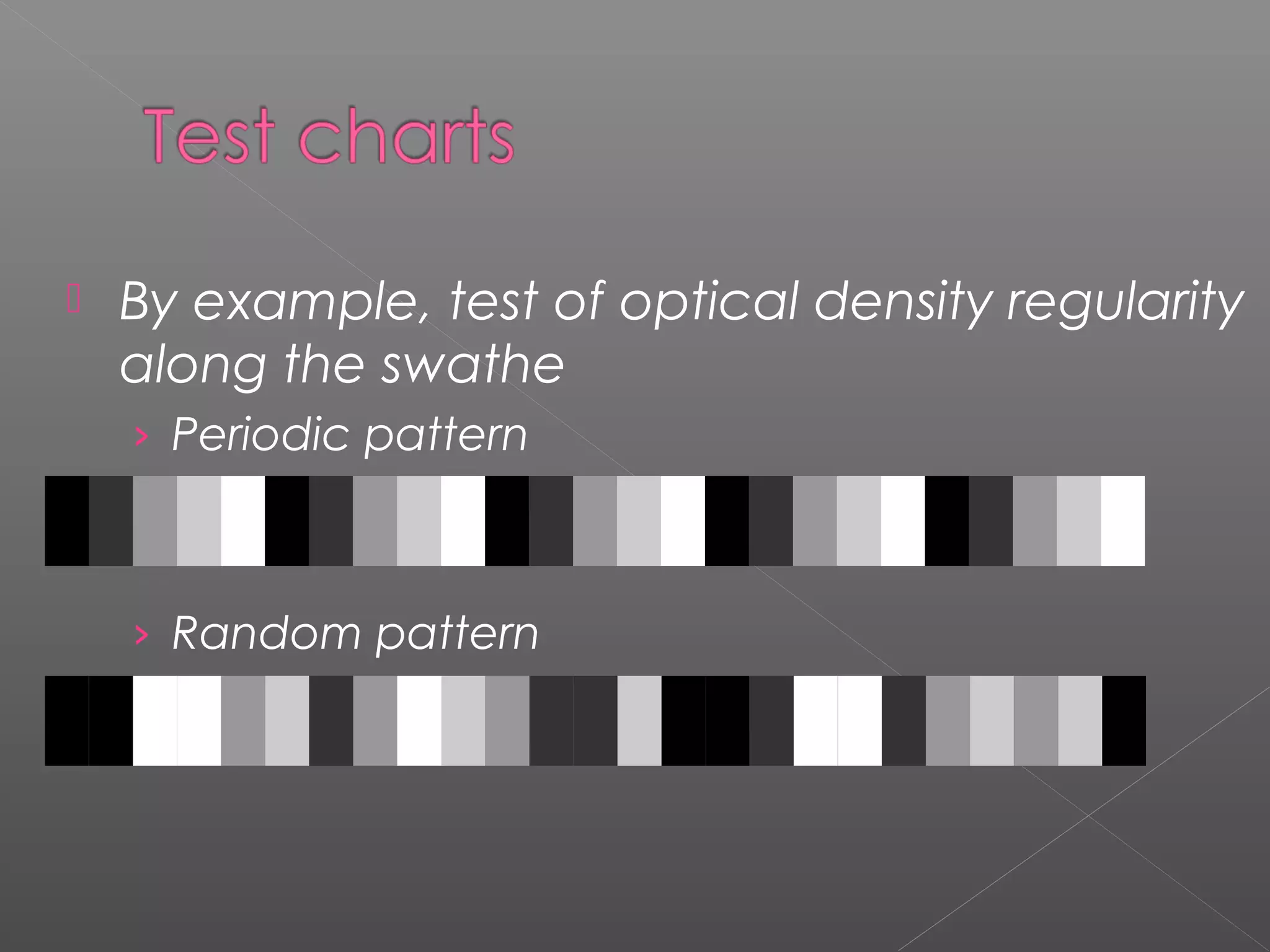
   By example, test of optical density regularity
    along the swathe
    › Periodic pattern


    › Random pattern
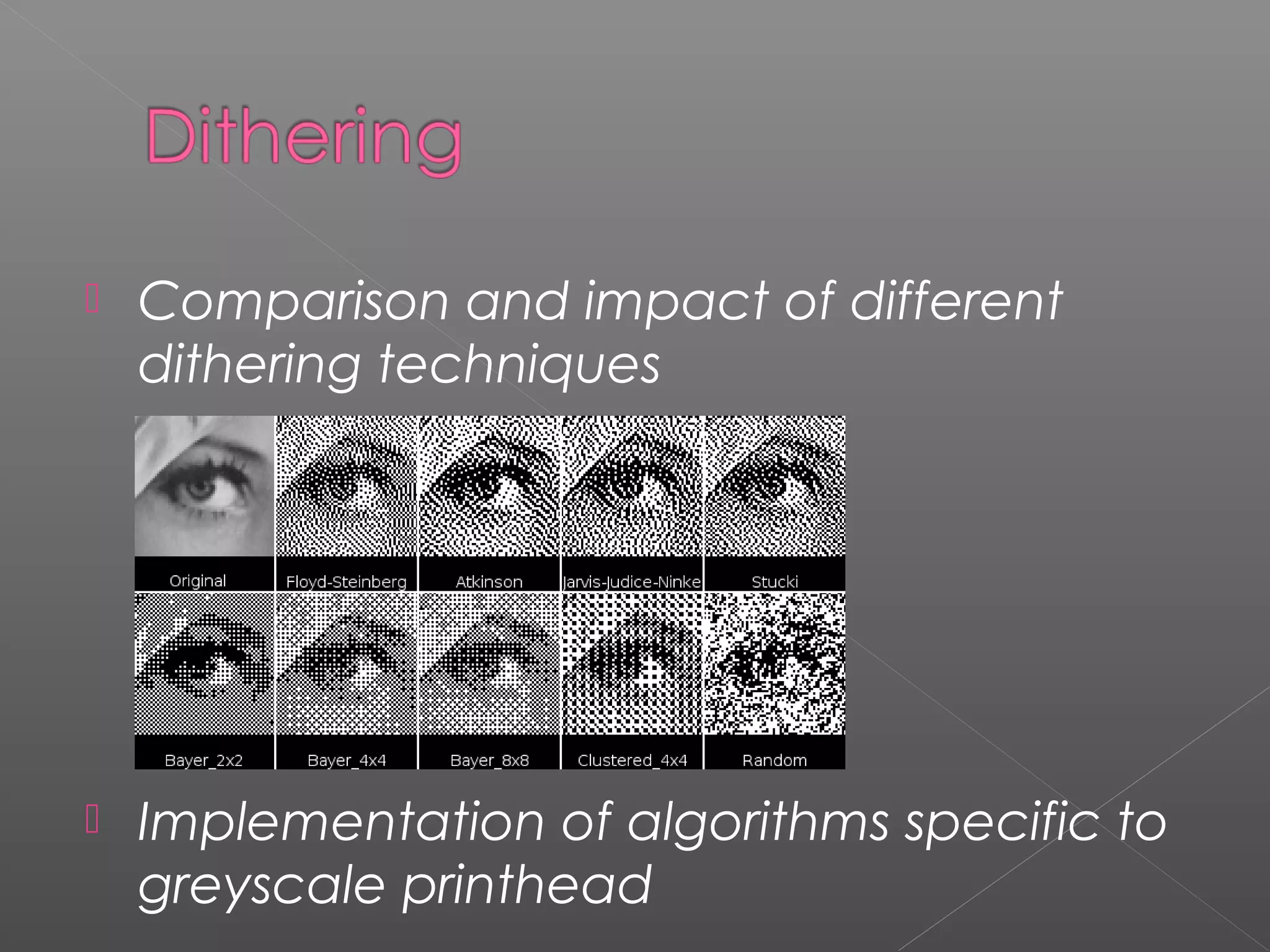
   Comparison and impact of different
    dithering techniques


   Implementation of algorithms specific to
    greyscale printhead
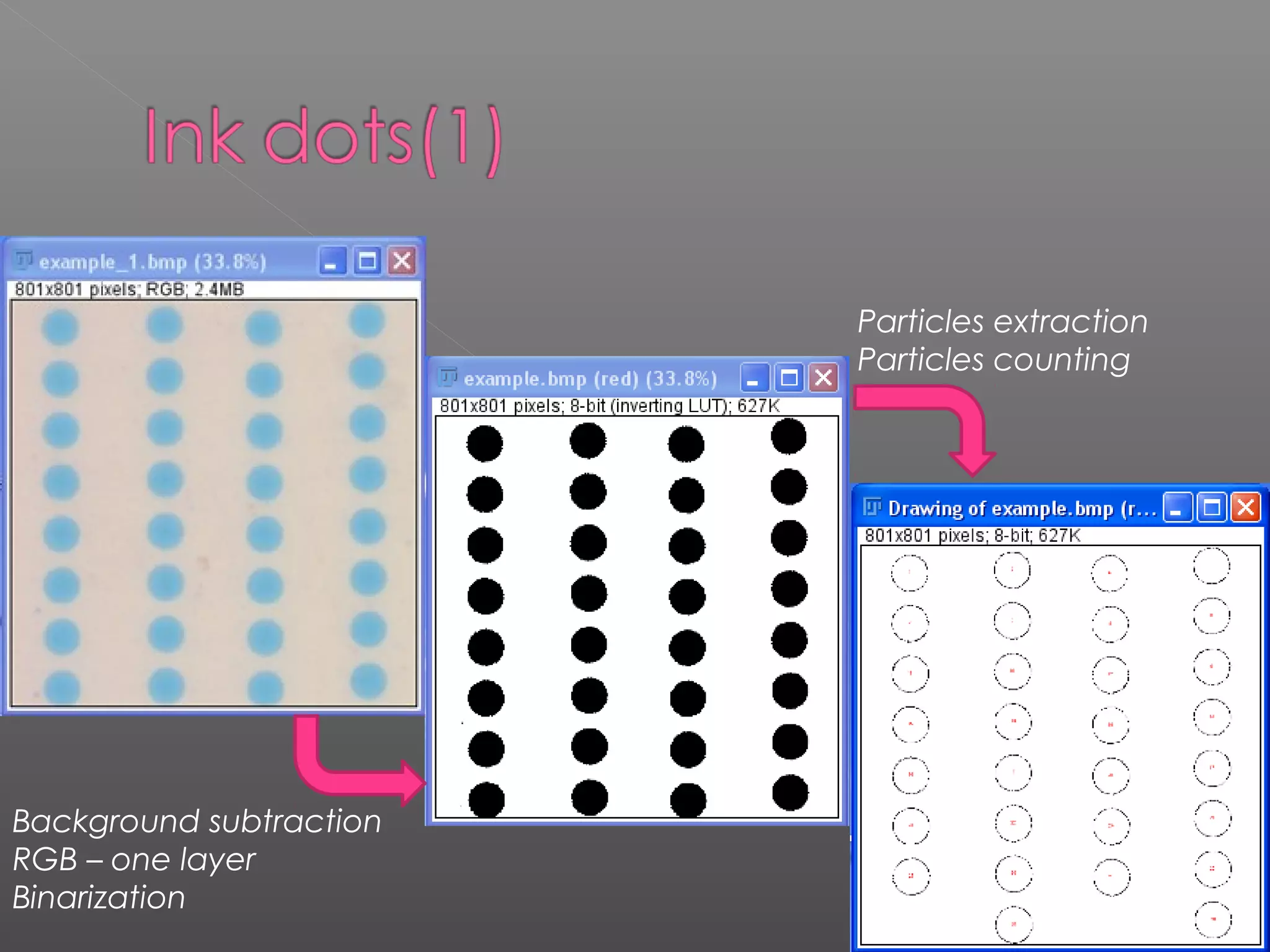
Particles extraction
                         Particles counting


Background subtraction
RGB – one layer
Binarization
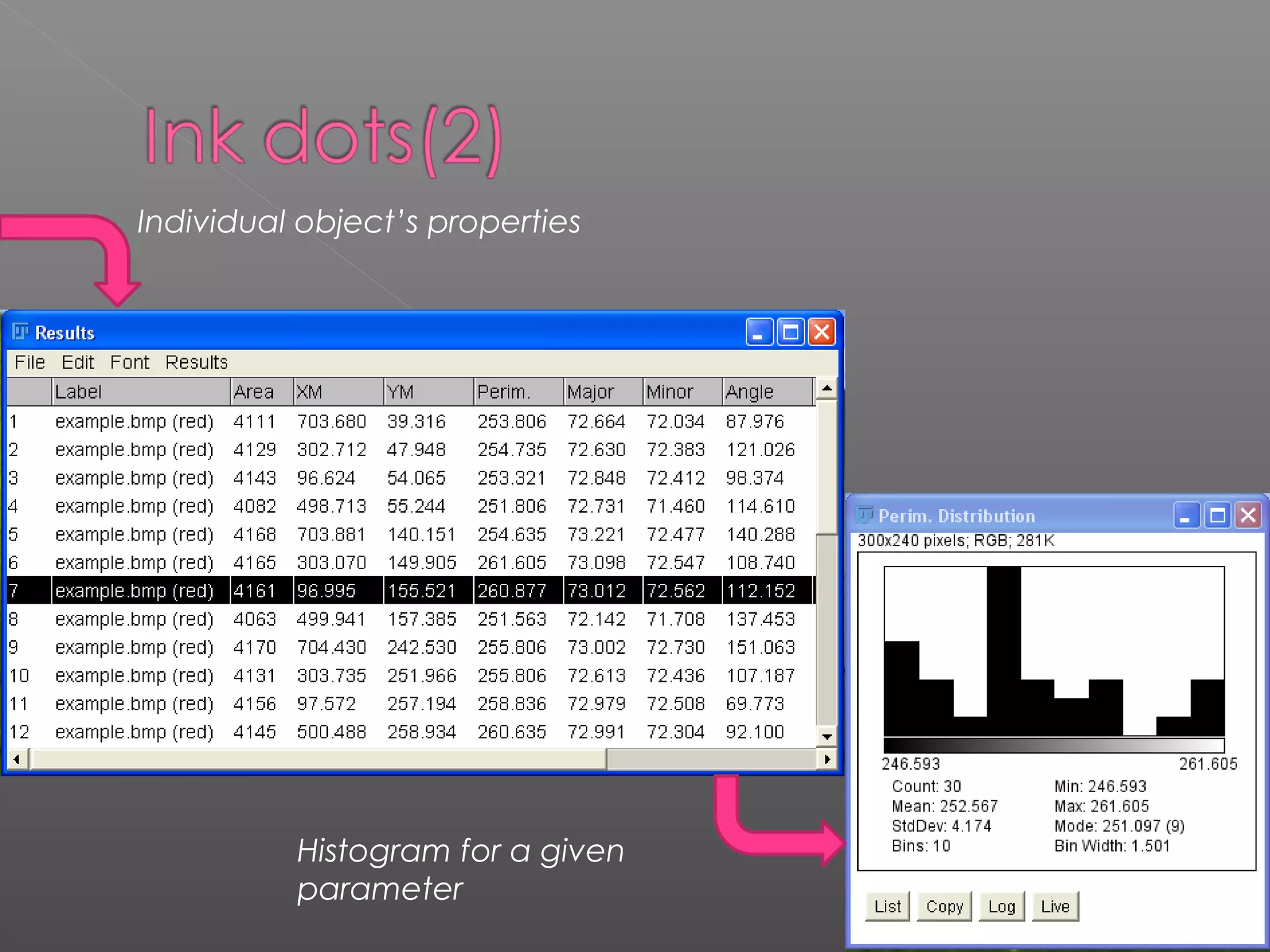
Individual object’s properties


          Histogram for a given
          parameter
› Edges extraction + angular correction +
 average and standard deviation on both
 sides of the line
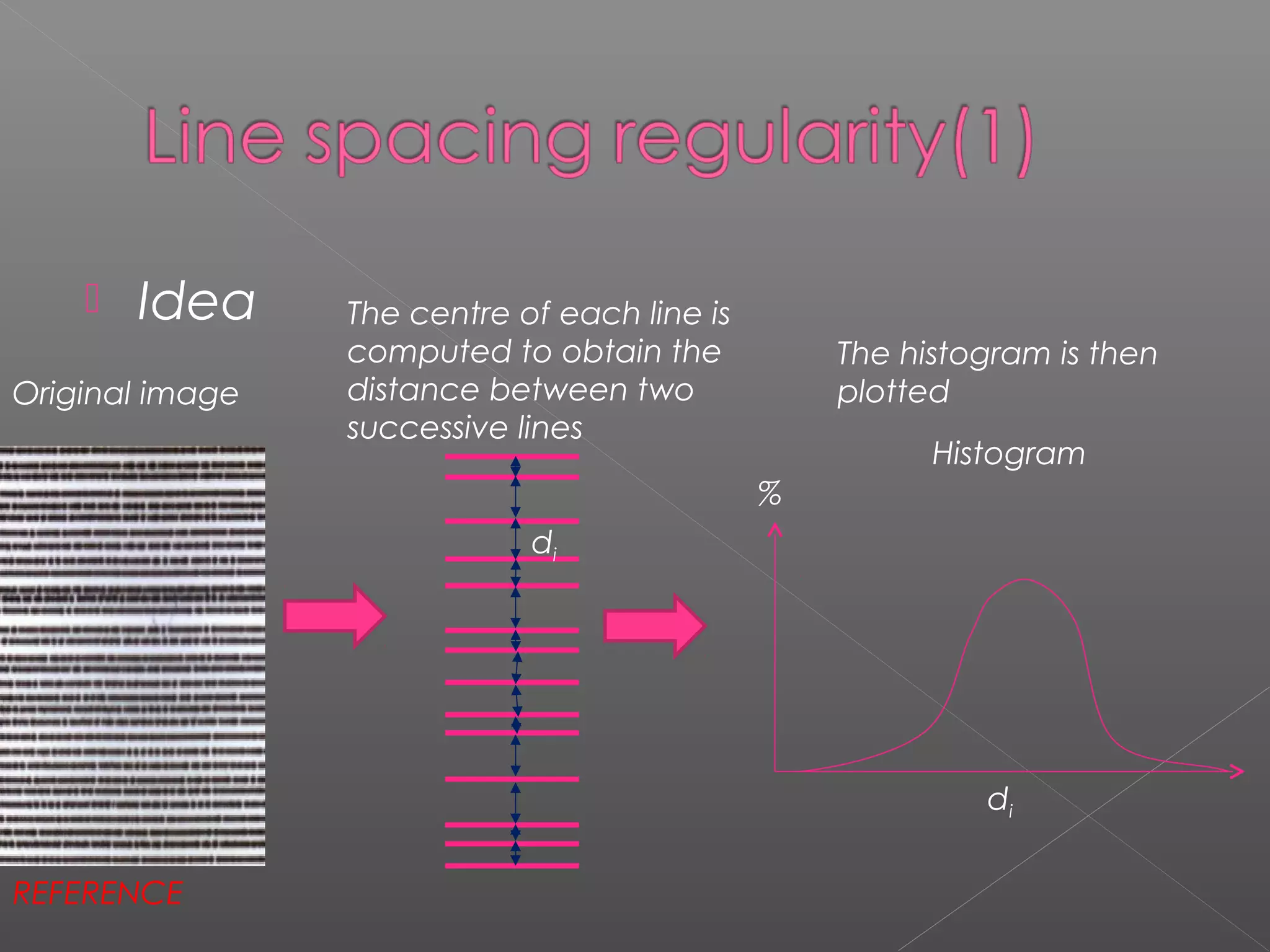
   Idea     The centre of each line is
                 computed to obtain the           The histogram is then
Original image   distance between two             plotted
                 successive lines
                                                        Histogram
                                              %
                             di


                                                           di

REFERENCE
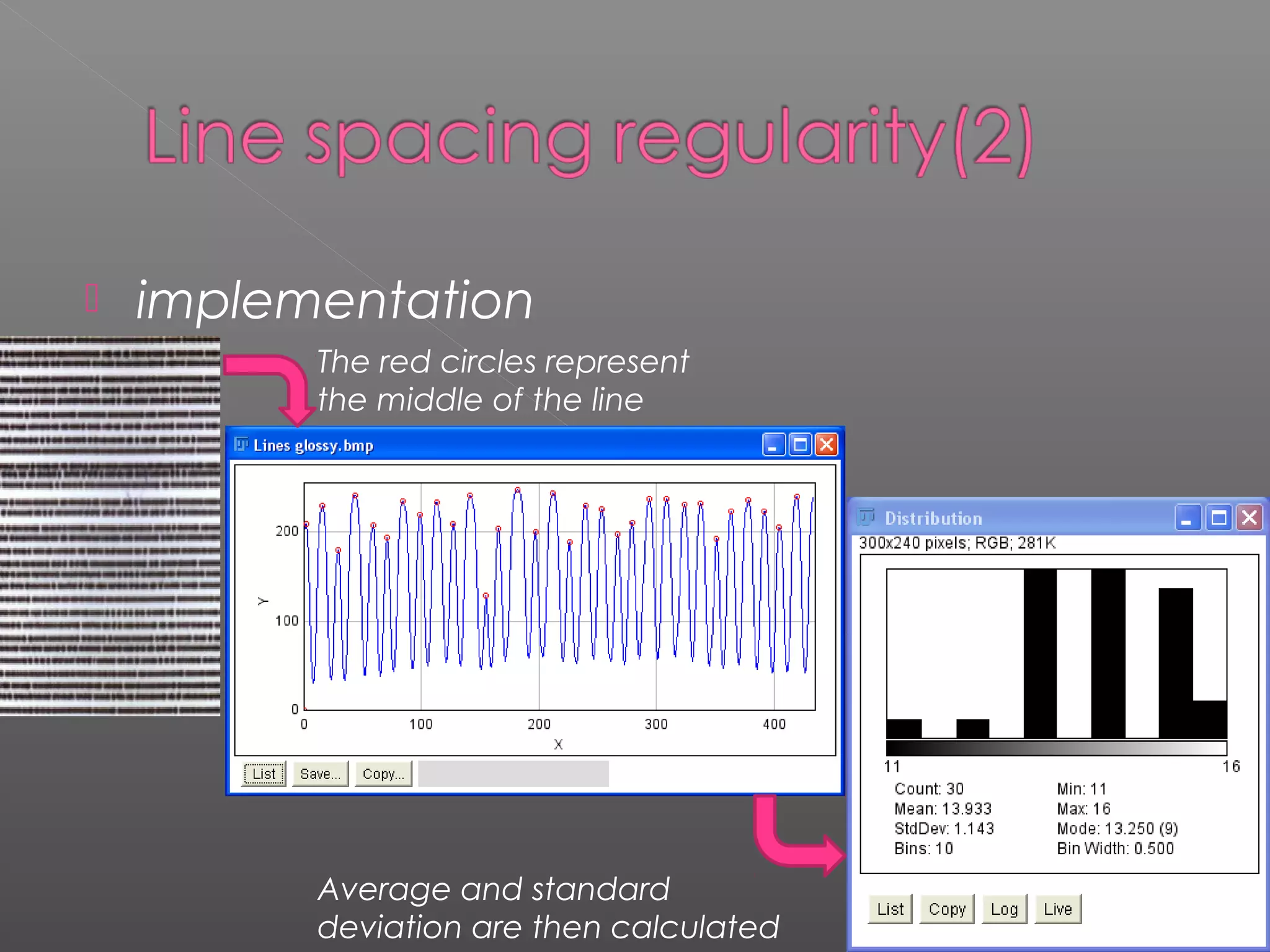
   implementation
          The red circles represent
          the middle of the line


          Average and standard
          deviation are then calculated
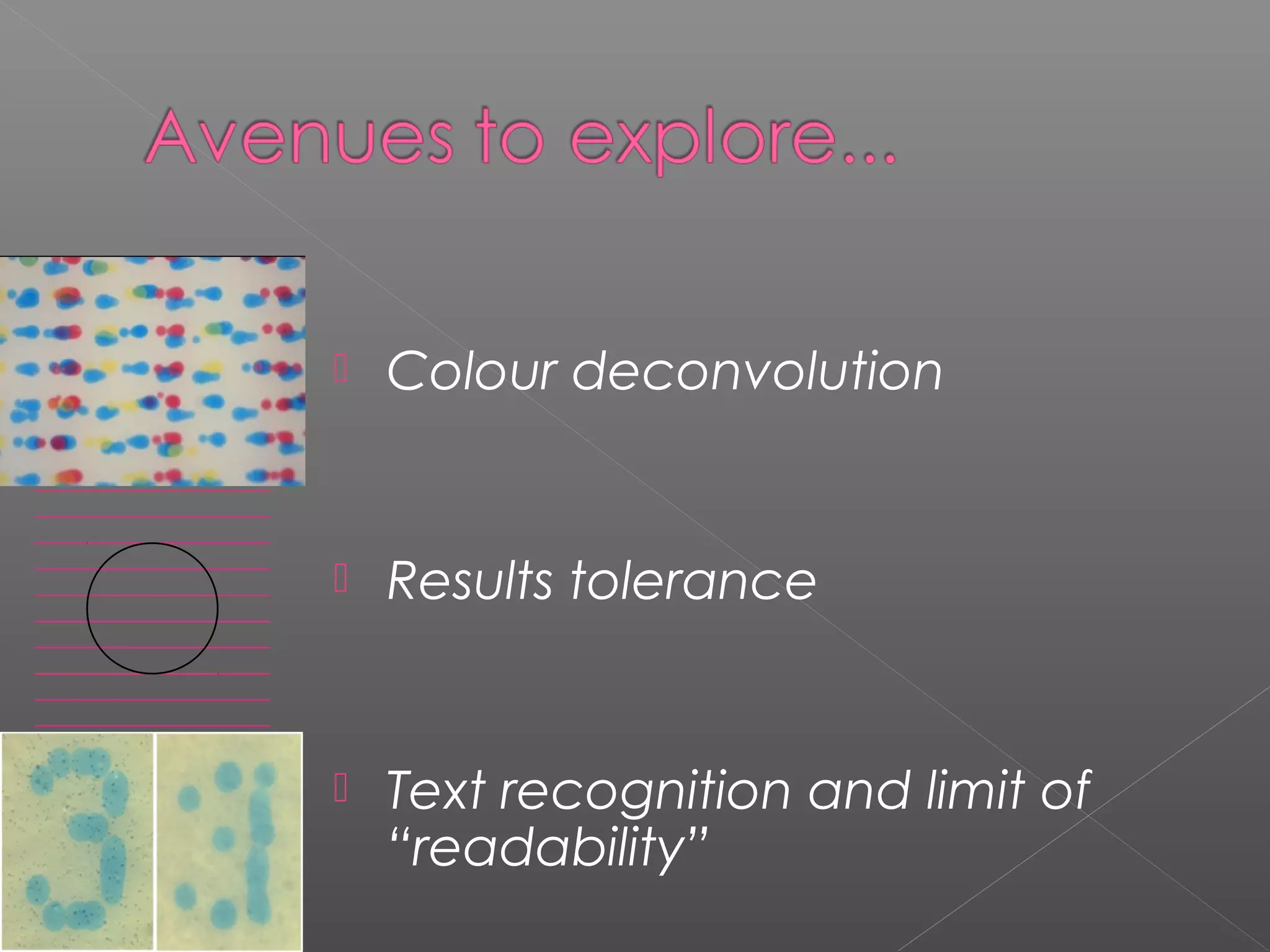
   Colour deconvolution


   Results tolerance


   Text recognition and limit of
    “readability”
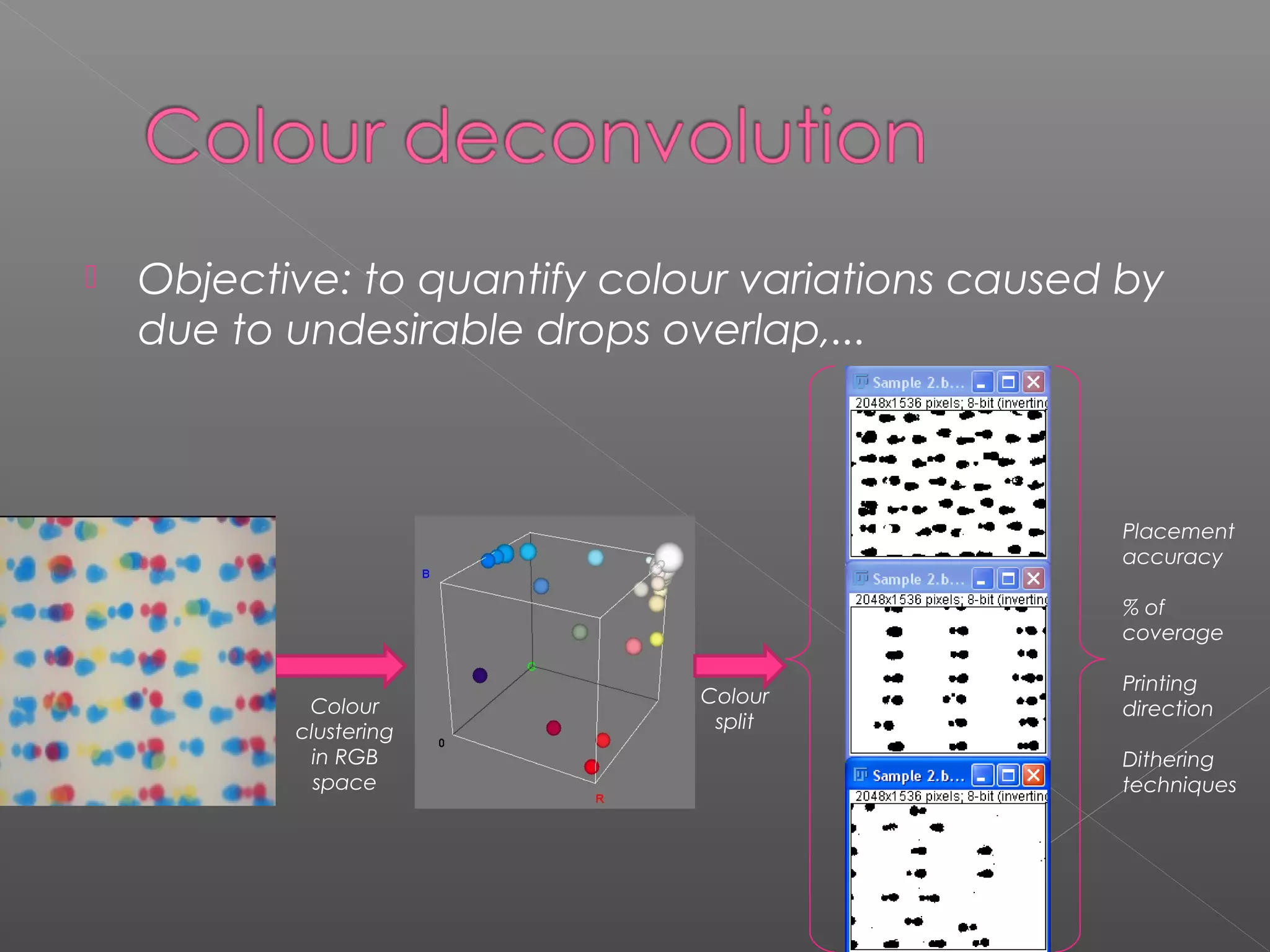
   Objective: to quantify colour variations caused by
    due to undesirable drops overlap,...


                                                   Placement
                                                   accuracy

                                                   % of
                                                   coverage

                                                   Printing
            Colour             Colour
                                                   direction
           clustering           split
            in RGB                                 Dithering
             space                                 techniques
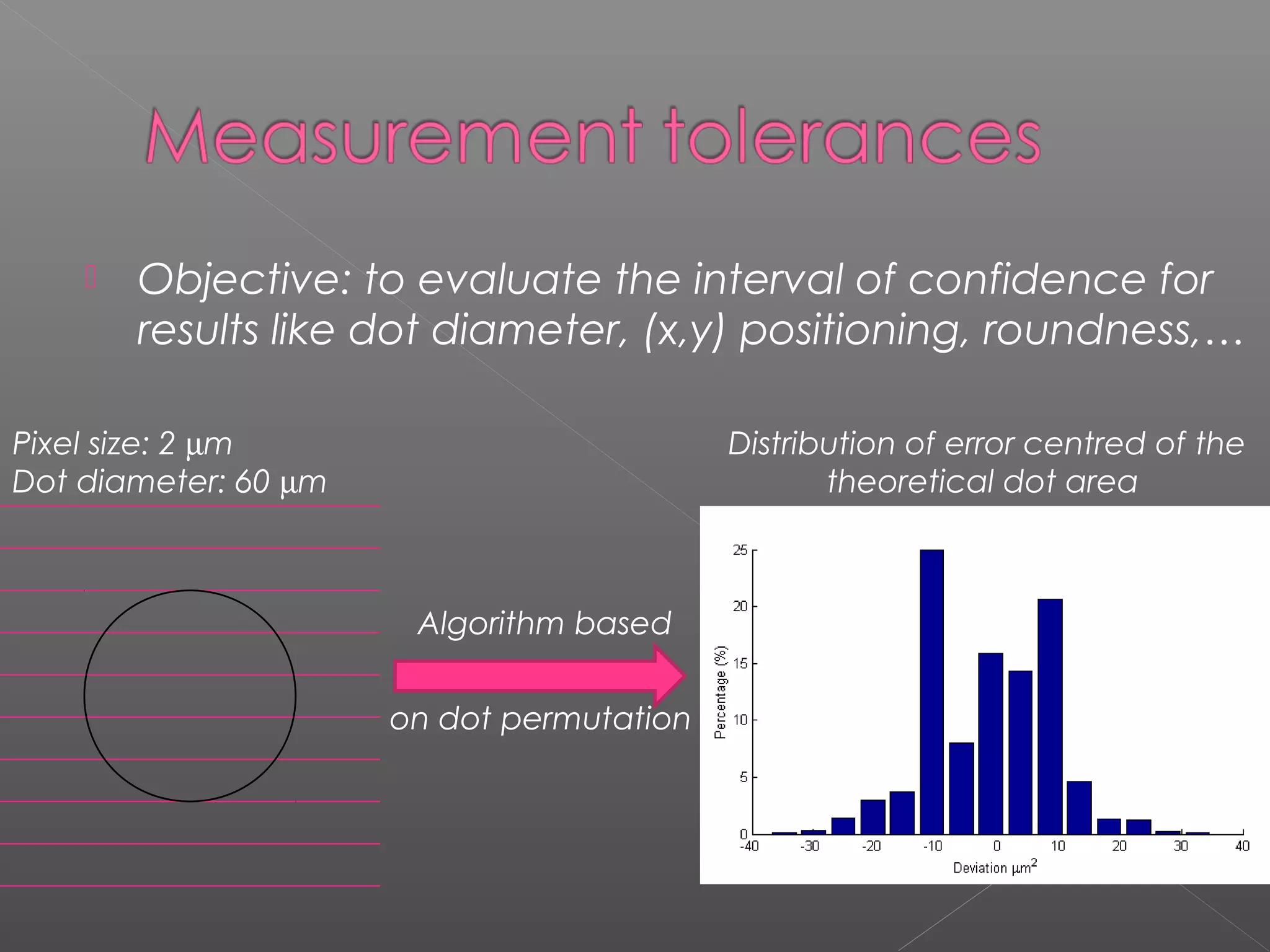
   Objective: to evaluate the interval of confidence for
        results like dot diameter, (x,y) positioning, roundness,…

Pixel size: 2 µm                           Distribution of error centred of the
Dot diameter: 60 µm                               theoretical dot area


                       Algorithm based


                      on dot permutation
   Image analysis is an approach, but not
    the end of the story

   PQ can be described along several others
    physical dimensions (Optical density,
    colour gamut, full tone uniformity…)

   Some levels of overlapping exist between
    them
   If you:
    › want to know more about ImageJ / Fiji
    › are interested in developing an ISO13660
      open source software
    › have a specific need regarding print quality
      assessment, beyond image analysis

   I would be please to heard from you.

Open source print quality software

  • 2.
    Commercial systems dedicated to assess print quality already exist. They usually implement the ISO 13660 standard with a focus on character and line attributes (raggedness, line width, darkness, character, contrast, fill, extraneous marks, character field, background haze, character field)  However, they are expensive, lack of flexibility and the access to their algorithms is not possible.  Fiji/ImageJ and its environment enables to develop an open source program dedicated to print quality assessment › free license › Interface based › Development using Java language and pre-coded functions › Enhance collaboration
  • 3.
    Print target design Choice of Printing System model relevant features Image Printing sequences Printing parameters (drop speed,…) acquisition Features Substrate High resolution & low field of view extraction Ink vs low resolution Lines Statistical & high field of Printing view analysis configuration Dot Lighting Text Intra-samples Dithering conditions techniques Registration mark Inter- samples Fiji
  • 4.
    Fiji is an image processing package. It can be described as a distribution of ImageJ together with Java, Java 3D and a lot of plugins.  User interface  Macro/plugings editor
  • 5.
    Individual ‘bricks’ -Color conversion Software development -Binary analysis Macro -Illumination correction Java based program -… Increase productivity Automation Shorter development time Proprietary routines and development of standard
  • 6.
    Image creation to design test charts  Dithering techniques  Dots and satellites  Line width/raggedness  Series of parallel lines
  • 7.
    By example, test of optical density regularity along the swathe › Periodic pattern › Random pattern
  • 8.
    Comparison and impact of different dithering techniques  Implementation of algorithms specific to greyscale printhead
  • 9.
    Particles extraction Particles counting Background subtraction RGB – one layer Binarization
  • 10.
    Individual object’s properties Histogram for a given parameter
  • 11.
    › Edges extraction+ angular correction + average and standard deviation on both sides of the line
  • 12.
    Idea The centre of each line is computed to obtain the The histogram is then Original image distance between two plotted successive lines Histogram % di di REFERENCE
  • 13.
    implementation The red circles represent the middle of the line Average and standard deviation are then calculated
  • 14.
    Colour deconvolution  Results tolerance  Text recognition and limit of “readability”
  • 15.
    Objective: to quantify colour variations caused by due to undesirable drops overlap,... Placement accuracy % of coverage Printing Colour Colour direction clustering split in RGB Dithering space techniques
  • 16.
    Objective: to evaluate the interval of confidence for results like dot diameter, (x,y) positioning, roundness,… Pixel size: 2 µm Distribution of error centred of the Dot diameter: 60 µm theoretical dot area Algorithm based on dot permutation
  • 17.
    Image analysis is an approach, but not the end of the story  PQ can be described along several others physical dimensions (Optical density, colour gamut, full tone uniformity…)  Some levels of overlapping exist between them
  • 18.
    If you: › want to know more about ImageJ / Fiji › are interested in developing an ISO13660 open source software › have a specific need regarding print quality assessment, beyond image analysis  I would be please to heard from you.