topic 3
The State
BackBackBack
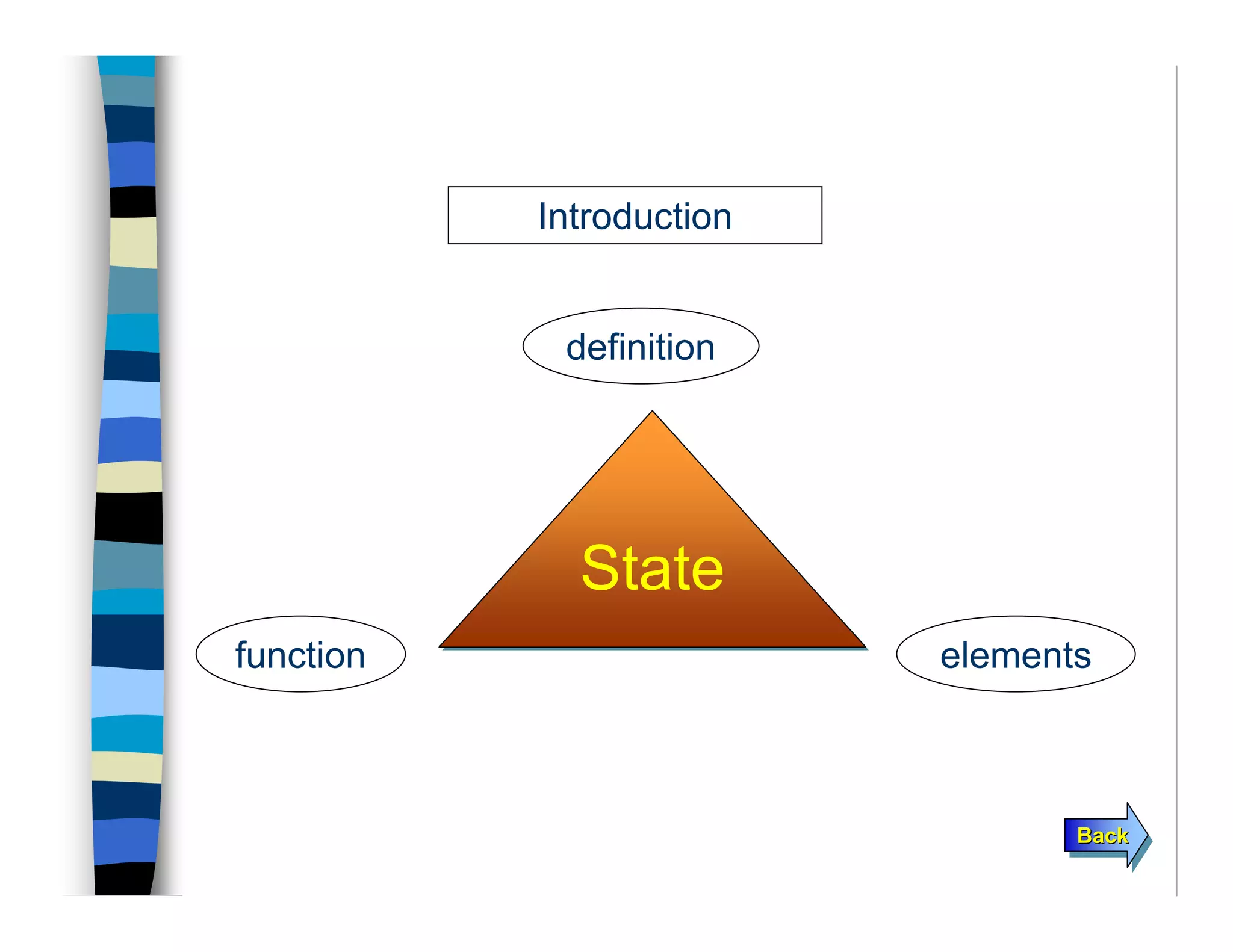
StateState
definition
elementsfunction
Introduction
introduction
A state is an organization
Simple mean a country or constituent
unit
A synonym for nation, society
government etc.
BackBackBack
BackBackBack
definition
Woodrow Wilson: “A state is a people
organized for law within a definite
territory”.
Max Weber (1970): “human community
that (successfully) claims the monopoly
of the legitimate use of physical
violence in a given territory”.
Robert Dahl (1961): “State as a
collection of individuals occupying role
positions (those of governing authority)
and acting as a group to govern”.
Bluntschli: “The State is the politically
organized people of a definite territory”
Harold Laski: “a territorial society
divided into Government and subjects
claiming, within its allots physical area,
a supremacy over all other institutions”.
According to J. H. Price (1975), note
the four essential elements contained
or implied in these definitions: -
i) A definite territory,
ii) A government organized to achieve
the purposes for which the state
was set up,
iii) A system of laws, and
iv) A body of men and women having a
common purpose
element
According to some scholars, these
attributes are at best a model or “ideal
type” to which few states actually
correspond. No state possesses all
four of these attributes, and some
recently formed states in the world lack
several of them. The four elements are:
i) Population
ii) Territory
iii) Government
iv) Sovereignty
Population
Population and land
population must be large enough to
make a state and sustain it
Two conclusions;
i) the State is a human institution, the
product of man’s gregarious nature
and the result of necessities of
human’s life and
ii) population and land are the starting
point of any study of man in his
organized groups.
Territory
There can be NO State without a fixed
territory
territory that normally creates our
membership of a State – citizenship
Land, water and airspace within the
defined territorial area comprise the
territory of the State
Government
Government - medium that common
policies are determined, common
affairs are regulated and common
interests promoted.
Government refers to social
organization that has authority to rule
the state.
Sovereignty
Sovereignty refers to the fount of
authority in society
The doctrine of sovereignty asserts that
the state is the supreme decision-
making power within a geographically
delineated frontier and is subject to
external authority only by its consent.
Belongs to the body which has the right
to make laws for a country.
Two aspects:
i) Internal sovereignty - the right of
state to make laws applying within
its boundaries (cannot be shared
with any other state)
ii) External sovereignty - the
recognition in international law that a
state has jurisdiction (authority) over
a territory.
functions of the state
Soltau (as cited by Kapur, 1984)
mentioned the function of state is to
give opportunities for the people's
development and capabilities in
managing their life.
According to Laski (1931), the function
of the state is to create one situation
that can achieve a maximum desire.
BackBackBack
Generally, main function – to achieve
political stability
Other function:
i) The implementation of laws and
regulations
ii) Establishing prosperity and stability
of people
iii) Maintaining peace and stability,
away from being threatened from
external and internal forces
iv) The implementation of justice and
human rights.
the crises of nation building
Leonard Binder et. Al (1971), some
social scientists argue that the process
of constructing nations – if the process
is to be successful – requires that
countries go through the same 5
stages in approximately. Namely;
i) Identity
ii) Legitimacy
iii) Penetration
iv) Participation
v) Distribution
Identity
The ‘identity crisis’ – people who
previously identified with a tribe, region,
or other subnational group must com to
think of themselves as first foremost
citizens of the nation.
Example; Yugoslavia – never
established a national identity for its
Serbs, Croats, Slovenes, Bosnians,
Macedonians and others.
Malay Vs. Malaysia
Legitimacy
A government must cultivate the
respect and willing obedience of its
citizens, the widespread feeling among
the people that the regime’s rule is
rightful.
Ultimately, as in the case of
Yugoslavia, NO LEGITIMACT = NO
NATION
Penetration
Related to both identity and legitimacy
The ‘crisis of penetration’ means that
the nation must get substantially all the
population, even in out lying or
culturally distinct regions, to obey the
government’s writ.
Lack of penetration – government can
have a law on its books.
Participation
As people become more aware that
they are being governed they demand
to have a say in their governance.
Regimes are often fearful of the
consequences of expanding voting
rights.
The best way to solve the participation
crisis is through slow and incremental
step – Britain with a series of Reform
Act.
Distribution
Classic question of “who get what”
Economic rewards of the nations are
unfairly apportioned
Welfare benefits
The distribution question in never
settled, however, because the poorer
sectors of society always want more
welfare, whereas the better-off, argue
that the welfare state has gotten out of
hand, taxes are too high and benefits
too generous.
Example; The conservatives win
elections – as Margaret Thatcher did in
Britain in 1979 and Ronald Reagan in
US in 1980 – they try to cut welfare
programs.
- THE END -

C3 the state

  • 1.
  • 2.
  • 3.
    introduction A state isan organization Simple mean a country or constituent unit A synonym for nation, society government etc. BackBackBack
  • 4.
    BackBackBack definition Woodrow Wilson: “Astate is a people organized for law within a definite territory”. Max Weber (1970): “human community that (successfully) claims the monopoly of the legitimate use of physical violence in a given territory”.
  • 5.
    Robert Dahl (1961):“State as a collection of individuals occupying role positions (those of governing authority) and acting as a group to govern”. Bluntschli: “The State is the politically organized people of a definite territory” Harold Laski: “a territorial society divided into Government and subjects claiming, within its allots physical area, a supremacy over all other institutions”.
  • 6.
    According to J.H. Price (1975), note the four essential elements contained or implied in these definitions: - i) A definite territory, ii) A government organized to achieve the purposes for which the state was set up, iii) A system of laws, and iv) A body of men and women having a common purpose
  • 7.
    element According to somescholars, these attributes are at best a model or “ideal type” to which few states actually correspond. No state possesses all four of these attributes, and some recently formed states in the world lack several of them. The four elements are: i) Population ii) Territory iii) Government iv) Sovereignty
  • 8.
    Population Population and land populationmust be large enough to make a state and sustain it Two conclusions; i) the State is a human institution, the product of man’s gregarious nature and the result of necessities of human’s life and ii) population and land are the starting point of any study of man in his organized groups.
  • 9.
    Territory There can beNO State without a fixed territory territory that normally creates our membership of a State – citizenship Land, water and airspace within the defined territorial area comprise the territory of the State
  • 10.
    Government Government - mediumthat common policies are determined, common affairs are regulated and common interests promoted. Government refers to social organization that has authority to rule the state.
  • 11.
    Sovereignty Sovereignty refers tothe fount of authority in society The doctrine of sovereignty asserts that the state is the supreme decision- making power within a geographically delineated frontier and is subject to external authority only by its consent. Belongs to the body which has the right to make laws for a country.
  • 12.
    Two aspects: i) Internalsovereignty - the right of state to make laws applying within its boundaries (cannot be shared with any other state) ii) External sovereignty - the recognition in international law that a state has jurisdiction (authority) over a territory.
  • 13.
    functions of thestate Soltau (as cited by Kapur, 1984) mentioned the function of state is to give opportunities for the people's development and capabilities in managing their life. According to Laski (1931), the function of the state is to create one situation that can achieve a maximum desire.
  • 14.
    BackBackBack Generally, main function– to achieve political stability Other function: i) The implementation of laws and regulations ii) Establishing prosperity and stability of people iii) Maintaining peace and stability, away from being threatened from external and internal forces iv) The implementation of justice and human rights.
  • 15.
    the crises ofnation building Leonard Binder et. Al (1971), some social scientists argue that the process of constructing nations – if the process is to be successful – requires that countries go through the same 5 stages in approximately. Namely; i) Identity ii) Legitimacy iii) Penetration iv) Participation v) Distribution
  • 16.
    Identity The ‘identity crisis’– people who previously identified with a tribe, region, or other subnational group must com to think of themselves as first foremost citizens of the nation. Example; Yugoslavia – never established a national identity for its Serbs, Croats, Slovenes, Bosnians, Macedonians and others. Malay Vs. Malaysia
  • 17.
    Legitimacy A government mustcultivate the respect and willing obedience of its citizens, the widespread feeling among the people that the regime’s rule is rightful. Ultimately, as in the case of Yugoslavia, NO LEGITIMACT = NO NATION
  • 18.
    Penetration Related to bothidentity and legitimacy The ‘crisis of penetration’ means that the nation must get substantially all the population, even in out lying or culturally distinct regions, to obey the government’s writ. Lack of penetration – government can have a law on its books.
  • 19.
    Participation As people becomemore aware that they are being governed they demand to have a say in their governance. Regimes are often fearful of the consequences of expanding voting rights. The best way to solve the participation crisis is through slow and incremental step – Britain with a series of Reform Act.
  • 20.
    Distribution Classic question of“who get what” Economic rewards of the nations are unfairly apportioned Welfare benefits The distribution question in never settled, however, because the poorer sectors of society always want more welfare, whereas the better-off, argue that the welfare state has gotten out of hand, taxes are too high and benefits too generous.
  • 21.
    Example; The conservativeswin elections – as Margaret Thatcher did in Britain in 1979 and Ronald Reagan in US in 1980 – they try to cut welfare programs.
  • 22.