Your Strategic plan
YBI Global Forum 2010, Mexico City
Gia Campari
21 September 2010
Your Strategic plan
An effective organisation is one where everyone is making
progress towards the achievement of a shared and meaningful
goal.
The first step in the process of creating an effective
organisation is to obtain consensus within the leadership team
on where you are taking the organisation, that is, on your
strategic plan.
Your Strategic Plan, GF 2010
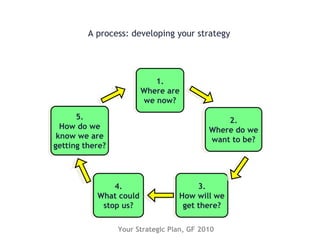
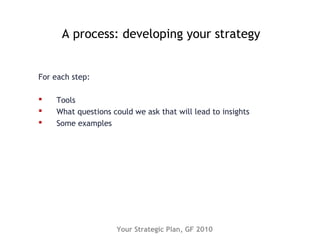
A process: developing your strategy
2.
Where do we
want to be?
2.
Where do we
want to be?
1.
Where are
we now?
1.
Where are
we now?
3.
How will we
get there?
3.
How will we
get there?
5.
How do we
know we are
getting there?
5.
How do we
know we are
getting there?
4.
What could
stop us?
4.
What could
stop us?
Your Strategic Plan, GF 2010
A process: developing your strategy
For each step:
 Tools
 What questions could we ask that will lead to insights
 Some examples
Your Strategic Plan, GF 2010
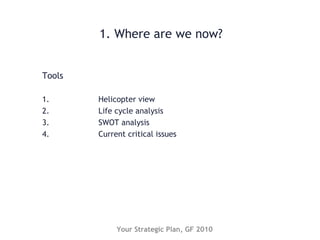
1. Where are we now?
Tools
1. Helicopter view
2. Life cycle analysis
3. SWOT analysis
4. Current critical issues
Your Strategic Plan, GF 2010
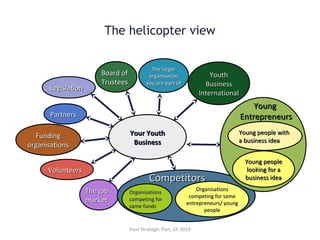
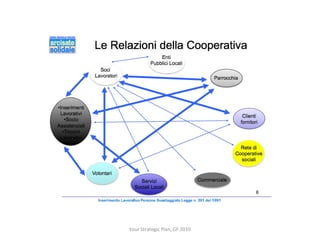
The helicopter view
Your YouthYour Youth
BusinessBusiness
Board ofBoard of
TrusteesTrustees
The largerThe larger
organisationorganisation
you are part ofyou are part of
LegislationLegislation
PartnersPartners
FundingFunding
organisationsorganisations
The jobThe job
marketmarket
VolunteersVolunteers
YouthYouth
BusinessBusiness
InternationalInternational
CompetitorsCompetitors
OrganisationsOrganisations
competing forcompeting for
same fundssame funds
OrganisationsOrganisations
competing for samecompeting for same
entrepreneurs/ youngentrepreneurs/ young
peoplepeople
Young people withYoung people with
a business ideaa business idea
Young peopleYoung people
looking for alooking for a
business ideabusiness idea
YoungYoung
EntrepreneursEntrepreneurs
Your Strategic Plan, GF 2010
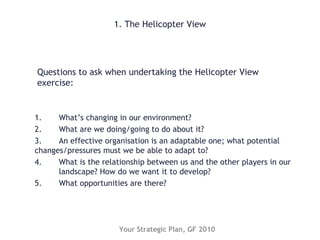
1. The Helicopter View
1. What’s changing in our environment?
2. What are we doing/going to do about it?
3. An effective organisation is an adaptable one; what potential
changes/pressures must we be able to adapt to?
4. What is the relationship between us and the other players in our
landscape? How do we want it to develop?
5. What opportunities are there?
Questions to ask when undertaking the Helicopter View
exercise:
Your Strategic Plan, GF 2010
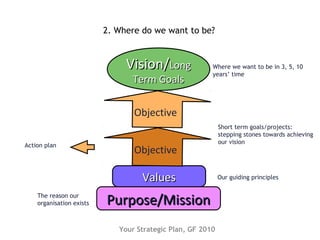
2. Where do we want to be?
Purpose/MissionPurpose/Mission
Vision/Vision/LongLong
Term GoalsTerm Goals
Objective
ValuesValues
Objective
The reason our
organisation exists
Our guiding principles
Short term goals/projects:
stepping stones towards achieving
our vision
Where we want to be in 3, 5, 10
years’ time
Action plan
Your Strategic Plan, GF 2010
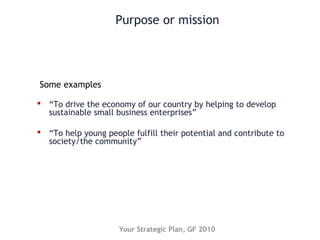
Purpose or mission
 “To drive the economy of our country by helping to develop
sustainable small business enterprises”
 “To help young people fulfill their potential and contribute to
society/the community”
Some examples
Your Strategic Plan, GF 2010
Purpose or mission
 “Provide start-up mentoring, financing and business resources
that empower young people 20-33 to start and grow businesses
which contribute to sustainable economic development across
the country”
 “Helping young people make a contribution to society”
Your Strategic Plan, GF 2010
Some examples
Vision or Long term goals
 The picture you have of where your organisation will be in 3, 5,
10 year’s time.
 The clearer and more detailed, the better. Yet there must be
room for maneuver.
Your Strategic Plan, GF 2010
“By the end of 2014 we will have:
 Assisted with 100 new start-ups
 Recruited 120 new volunteer business mentors
 Established 60 new partnerships in the public sector, private
sector and civil society”
Example
Your Strategic Plan, GF 2010
Could be much richer, more detailed
Vision or long term goals
 To extend start-up capital, business mentoring and business
development support directly or indirectly to young entrepreneurs
 To foster the concept of self-employment/enterprise from amongst
the Nation’s youth.
 To introduce young entrepreneurs to sources of business expertise
through its advisory network.
 To complement other youth programmes sponsored by
private/public sector institutions
 To re-direct away from entrepreneurship to employment those
young persons who would not be successful
Example
Your Strategic Plan, GF 2010
Could be more specific
Vision or long term goals
3. How will we get there?
 Values determine how we behave and how we take decisions
as we are getting there
 Objectives are short term goals that are stepping stones
towards achieving the vision or long term goals and should be
treated as projects
 Objectives generate an action plan
Your Strategic Plan, GF 2010
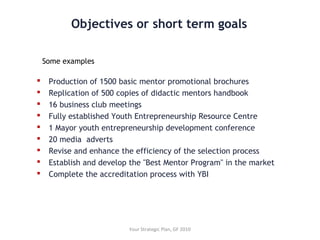
Objectives or short term goals
 Production of 1500 basic mentor promotional brochures
 Replication of 500 copies of didactic mentors handbook
 16 business club meetings
 Fully established Youth Entrepreneurship Resource Centre
 1 Mayor youth entrepreneurship development conference
 20 media adverts
 Revise and enhance the efficiency of the selection process
 Establish and develop the "Best Mentor Program" in the market
 Complete the accreditation process with YBI
Some examples
Your Strategic Plan, GF 2010
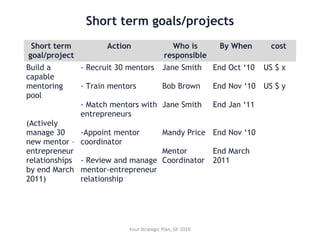
Short term goals/projects
Short term
goal/project
Action Who is
responsible
By When cost
Build a
capable
mentoring
pool
(Actively
manage 30
new mentor –
entrepreneur
relationships
by end March
2011)
- Recruit 30 mentors
- Train mentors
- Match mentors with
entrepreneurs
-Appoint mentor
coordinator
- Review and manage
mentor-entrepreneur
relationship
Jane Smith
Bob Brown
Jane Smith
Mandy Price
Mentor
Coordinator
End Oct ‘10
End Nov ‘10
End Jan ‘11
End Nov ‘10
End March
2011
US $ x
US $ y
Your Strategic Plan, GF 2010
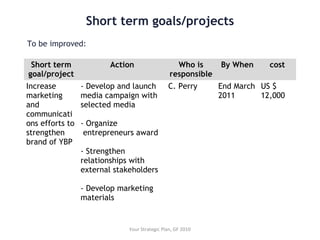
Short term goals/projects
Short term
goal/project
Action Who is
responsible
By When cost
Increase
marketing
and
communicati
ons efforts to
strengthen
brand of YBP
- Develop and launch
media campaign with
selected media
- Organize
entrepreneurs award
- Strengthen
relationships with
external stakeholders
- Develop marketing
materials
C. Perry End March
2011
US $
12,000
Your Strategic Plan, GF 2010
To be improved:
4. What Could stop us?
• What organizational and/or individuals’ ‘habits’ could stop us
from achieving our vision and goals?
• What factors beyond our control could stop us?
• What factors within our control could stop us?
• What can we do to mitigate the risks?
• What are our contingency measures?
Questions to ask
Your Strategic Plan, GF 2010
5. How do we know we are getting there?
 Strategy Project Milestones – from project plans
 Financial measures – Profit & Loss, Cash Flow, loan repayment
timing
 Core Process Measures – Young Entrepreneur selection
process; Mentor recruitment process; fund raising process; etc.
Your Strategic Plan, GF 2010
In Summary
 The Strategic Process is an iterative process - the more
turbulent your environment, the more frequently your
strategic plan needs to be reviewed
 It’s asking the right questions that makes the difference
 Always start with the helicopter view!
Your Strategic Plan, GF 2010

TUESDAY. Strategic Thinking: Your Strategic Plan (Option A)

  • 1.
    Your Strategic plan YBIGlobal Forum 2010, Mexico City Gia Campari 21 September 2010
  • 2.
    Your Strategic plan Aneffective organisation is one where everyone is making progress towards the achievement of a shared and meaningful goal. The first step in the process of creating an effective organisation is to obtain consensus within the leadership team on where you are taking the organisation, that is, on your strategic plan. Your Strategic Plan, GF 2010
  • 3.
    A process: developingyour strategy 2. Where do we want to be? 2. Where do we want to be? 1. Where are we now? 1. Where are we now? 3. How will we get there? 3. How will we get there? 5. How do we know we are getting there? 5. How do we know we are getting there? 4. What could stop us? 4. What could stop us? Your Strategic Plan, GF 2010
  • 4.
    A process: developingyour strategy For each step:  Tools  What questions could we ask that will lead to insights  Some examples Your Strategic Plan, GF 2010
  • 5.
    1. Where arewe now? Tools 1. Helicopter view 2. Life cycle analysis 3. SWOT analysis 4. Current critical issues Your Strategic Plan, GF 2010
  • 6.
    The helicopter view YourYouthYour Youth BusinessBusiness Board ofBoard of TrusteesTrustees The largerThe larger organisationorganisation you are part ofyou are part of LegislationLegislation PartnersPartners FundingFunding organisationsorganisations The jobThe job marketmarket VolunteersVolunteers YouthYouth BusinessBusiness InternationalInternational CompetitorsCompetitors OrganisationsOrganisations competing forcompeting for same fundssame funds OrganisationsOrganisations competing for samecompeting for same entrepreneurs/ youngentrepreneurs/ young peoplepeople Young people withYoung people with a business ideaa business idea Young peopleYoung people looking for alooking for a business ideabusiness idea YoungYoung EntrepreneursEntrepreneurs Your Strategic Plan, GF 2010
  • 7.
  • 8.
  • 9.
    1. The HelicopterView 1. What’s changing in our environment? 2. What are we doing/going to do about it? 3. An effective organisation is an adaptable one; what potential changes/pressures must we be able to adapt to? 4. What is the relationship between us and the other players in our landscape? How do we want it to develop? 5. What opportunities are there? Questions to ask when undertaking the Helicopter View exercise: Your Strategic Plan, GF 2010
  • 10.
    2. Where dowe want to be? Purpose/MissionPurpose/Mission Vision/Vision/LongLong Term GoalsTerm Goals Objective ValuesValues Objective The reason our organisation exists Our guiding principles Short term goals/projects: stepping stones towards achieving our vision Where we want to be in 3, 5, 10 years’ time Action plan Your Strategic Plan, GF 2010
  • 11.
    Purpose or mission “To drive the economy of our country by helping to develop sustainable small business enterprises”  “To help young people fulfill their potential and contribute to society/the community” Some examples Your Strategic Plan, GF 2010
  • 12.
    Purpose or mission “Provide start-up mentoring, financing and business resources that empower young people 20-33 to start and grow businesses which contribute to sustainable economic development across the country”  “Helping young people make a contribution to society” Your Strategic Plan, GF 2010 Some examples
  • 13.
    Vision or Longterm goals  The picture you have of where your organisation will be in 3, 5, 10 year’s time.  The clearer and more detailed, the better. Yet there must be room for maneuver. Your Strategic Plan, GF 2010
  • 14.
    “By the endof 2014 we will have:  Assisted with 100 new start-ups  Recruited 120 new volunteer business mentors  Established 60 new partnerships in the public sector, private sector and civil society” Example Your Strategic Plan, GF 2010 Could be much richer, more detailed Vision or long term goals
  • 15.
     To extendstart-up capital, business mentoring and business development support directly or indirectly to young entrepreneurs  To foster the concept of self-employment/enterprise from amongst the Nation’s youth.  To introduce young entrepreneurs to sources of business expertise through its advisory network.  To complement other youth programmes sponsored by private/public sector institutions  To re-direct away from entrepreneurship to employment those young persons who would not be successful Example Your Strategic Plan, GF 2010 Could be more specific Vision or long term goals
  • 16.
    3. How willwe get there?  Values determine how we behave and how we take decisions as we are getting there  Objectives are short term goals that are stepping stones towards achieving the vision or long term goals and should be treated as projects  Objectives generate an action plan Your Strategic Plan, GF 2010
  • 17.
    Objectives or shortterm goals  Production of 1500 basic mentor promotional brochures  Replication of 500 copies of didactic mentors handbook  16 business club meetings  Fully established Youth Entrepreneurship Resource Centre  1 Mayor youth entrepreneurship development conference  20 media adverts  Revise and enhance the efficiency of the selection process  Establish and develop the "Best Mentor Program" in the market  Complete the accreditation process with YBI Some examples Your Strategic Plan, GF 2010
  • 18.
    Short term goals/projects Shortterm goal/project Action Who is responsible By When cost Build a capable mentoring pool (Actively manage 30 new mentor – entrepreneur relationships by end March 2011) - Recruit 30 mentors - Train mentors - Match mentors with entrepreneurs -Appoint mentor coordinator - Review and manage mentor-entrepreneur relationship Jane Smith Bob Brown Jane Smith Mandy Price Mentor Coordinator End Oct ‘10 End Nov ‘10 End Jan ‘11 End Nov ‘10 End March 2011 US $ x US $ y Your Strategic Plan, GF 2010
  • 19.
    Short term goals/projects Shortterm goal/project Action Who is responsible By When cost Increase marketing and communicati ons efforts to strengthen brand of YBP - Develop and launch media campaign with selected media - Organize entrepreneurs award - Strengthen relationships with external stakeholders - Develop marketing materials C. Perry End March 2011 US $ 12,000 Your Strategic Plan, GF 2010 To be improved:
  • 20.
    4. What Couldstop us? • What organizational and/or individuals’ ‘habits’ could stop us from achieving our vision and goals? • What factors beyond our control could stop us? • What factors within our control could stop us? • What can we do to mitigate the risks? • What are our contingency measures? Questions to ask Your Strategic Plan, GF 2010
  • 21.
    5. How dowe know we are getting there?  Strategy Project Milestones – from project plans  Financial measures – Profit & Loss, Cash Flow, loan repayment timing  Core Process Measures – Young Entrepreneur selection process; Mentor recruitment process; fund raising process; etc. Your Strategic Plan, GF 2010
  • 22.
    In Summary  TheStrategic Process is an iterative process - the more turbulent your environment, the more frequently your strategic plan needs to be reviewed  It’s asking the right questions that makes the difference  Always start with the helicopter view! Your Strategic Plan, GF 2010

Editor's Notes

  • #10 Positioning yourself Understanding the trends in your environment Developing relationships with relevant organisations, networks, etc.
  • #12 Good examples
  • #13 No 2 is too broad: (implications: we must find partners to refer people who do not want to set up own business)
  • #15 OK example
  • #16 good intentions, need to be more specific, quantify some of them
  • #21 Fixed ways of being, of thinking, of doing, root cause analysis