

Capacity Building
Seminar Presented
at The University of
Mkar, Benue State
Title: How To
   Start and
Finance a Small
   Business
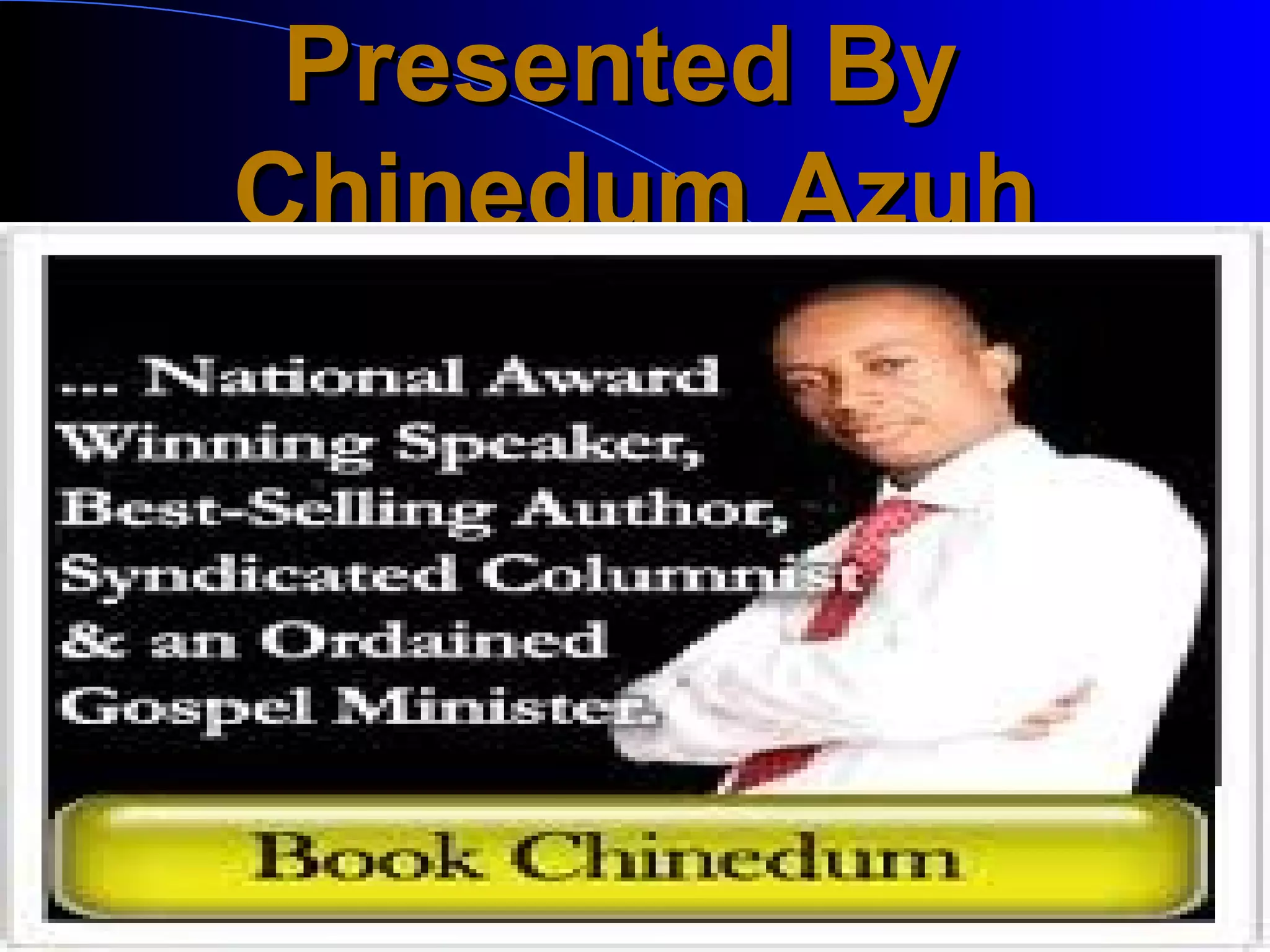
Presented By
Chinedum Azuh
Getting Started
Is business ownership right for you?
An “entrepreneur” is a person who starts
 his or her own business
Self-assessment questions:
 – Are you a self-starter?
 – How well do you plan and organize?
 – Can you work long hours?
 – How will the business affect your family?
What Type of Business

          Do You Want?
A startup:
 A startup:
 – Follow your own dream
Buying an existing business:
 – You will have current customers and a
   known track record of performance
Franchising:
 – Brand recognition reduces marketing
   costs
Questions to Ask When
  Starting Up A New Business
 Does the idea suit your personality and interests?
 Will you use your own name to brand the
  business?
 Will it be financially viable?
   – Do you have startup money to invest?
   – What will your monthly expenses be?
   – Is there a current need in the marketplace?
   – Who are you competing with?
The Business Plan
A “business plan” is a roadmap that
 describes where you’re going and how
 you’re going to get there
A guide to achieving your goals
A tool to spark investors’ interest
A document that helps employees
 understand the company’s mission
Key Elements
    of the Business Plan
Description of your products and services
Market and industry analysis that demonstrates
 the need for your business
List of competitors, including their strengths
 and weaknesses
Marketing strategy (sales approach)
Management team and operations plan
Financial analysis: the investment needed
Test Your Business
  Idea Before You Invest
The greatest mistake you can make is to
launch a new idea without testing it. Many
millions of Naira every year on products
they did not test before introducing them to
the market. Though entrepreneurial life is
full of risky adventures but what we shall
be discussing is how to take calculated risks.
Steps To Testing
    Your Business Idea
Be Your Own Devil’s Advocate
Seek Out People in The Same Business
Confirm The Demand
Check With Family & Family
Create a Selling Promotion
Use The Seminar Approach
Marketing Plan
 A “marketing plan” serves as a blueprint for you
 to follow to get your products and services
 known and recognized. It has:
  – Competitor and issue analysis: challenges and
    opportunities facing the business
  – Objectives: What do you want to achieve?
  – Action program: A “to-do” list
  – Budget: Detail expenses
  – Strategy: The Four “P’s”
Name Your
             Business
What is in a business name? The right
 business will distinguish you from a sea of
 multitude of competitors, give your
 customers a reason to patronize you, and
 help in the branding of your company.
Register Your Business
Starting a small business requires the usual
  paperwork and registration.

 Corporate Affairs Commission (CAC) is
 responsible for this. But for a startup you
 might not really need to incorporate. A
 business name registration will do. Getting
 a business name registration will enable you
 to create a corporate account.
The Four P’s of
          Marketing
Product: Describes features and benefits
Price: Lists prices and pricing strategy
Promotion: Tools or tactics to achieve
 marketing objectives
Placement: Sales philosophies and methods
Licensing
 Licenses or permits are required to operate
  certain types of businesses
 One or more licenses may be required from the
  city, State, county, and/or Federal Government
   – You may need multiple licenses if you work in
     more than one jurisdiction
 Failure to obtain the proper licenses can result in
  fines or the loss of your business
 The application process varies according to
  jurisdiction; research the requirements in your
  area
Copyrights, Trademarks,
       and Patents
Copyrights, trademarks, and patents all
 deal with intellectual property and how to
 protect it
“Intellectual property” is a product based
 on an idea and it has some type of
 commercial value
Intellectual property includes a wide range
 of products, such as books, musical
 compositions, and works of art.
Copyrights
 Copyrights protect individual creative
  expression. The Federal Copyright Act of 1976
  specifies how to register a copyright; there are no
  State copyright laws
 If a work is in the “public domain,” anyone can
  use it without permission from the author or the
  author’s heirs
 The U.S. Copyright Office explains how to
  register literary works, visual art works,
  performance works, sound recording, serials and
  periodicals, and mask works
Trademarks
A “trademark” is a brand name--a
 distinctive sign, logo, slogan, symbol, or
 other emblem used by businesses to
 distinguish their products from others
Trademarks do not expire and can apply
 indefinitely
Although trademarks can be registered, it is
 not required; just using a mark establishes
 a common law right to it
Patents
A “patent” gives an inventor exclusive
 use of his or her invention
Patents are issued by the United States
 Patent and Trade Office (USPTO)
Most inventors use a patent lawyer to
 help with the application process
Accounting
Sound accounting and bookkeeping
 practices are essential to any business
Many businesses rely on an accountant
 to handle financial recordkeeping
Computer programs such as Quicken,
 Peachtree, or Quickbooks can simplify
 some bookkeeping tasks
Human Resources
The Human Resources function deals with
 hiring and managing employees
Be specific when interviewing candidates
 – Avoid inappropriate and illegal questions
   during the interview
Provide competitive compensation and
 benefits
Maintain detailed employee records
Creating an Online
       Presence
A Website can attract customers and boost
 earnings
Sales through the Internet can take place
 internationally, 24 hours a day
A professional Website designer can
 develop your site at a relatively low cost
Promote your site through major search
 engines or a link exchange program
Creating an Online
               Presence
 Put Your Business on Social Media: Facebook,
  Linedin, Tweeter etc.
 Write Articles and Publish on Article Directories
  Like Ezine, Hubpages and Many More
 Create a PowerPoint Presentation of Your
  Business and Post it on a Site Like Slideshare.net
 Create an E-book and Publish it Amazon Kindle,
  Smashword etc.
 Participate in Online Forums and Blogs Related
  to Your Business.
How To Raise Money To
        Start Your Business
  There are several sources of money that you can tap
  to start and build your own business. I have
  compiled a list of creative ideas I have heard and
  used.
1. Joint Venture
2. Dip Into Your Savings
3. Sell Some Assets
4. Get Love Money
 5. Obtain Supplier Financing
How To Raise Money To Start
         Your Business
6. Online Crowd Funding
www.kickstarter.com, www.indiegogo.com or
  www.RocketHub.com and www.vfinance.com.

7. Sell Other People’s Stuff for Commission
8. Sell Information Products Created from Your
  Expertise
9. Take an Extra Job
10. Get a Business Advisory Coach
Thank You
    for
Listening !
Direct Contact
Mobile: 08032069925

pstchinedum@gmail.com

How to Start and Finance a Business

  • 1.
    Capacity Building Seminar Presented atThe University of Mkar, Benue State
  • 2.
    Title: How To Start and Finance a Small Business
  • 3.
  • 4.
    Getting Started Is businessownership right for you? An “entrepreneur” is a person who starts his or her own business Self-assessment questions: – Are you a self-starter? – How well do you plan and organize? – Can you work long hours? – How will the business affect your family?
  • 5.
    What Type ofBusiness Do You Want? A startup: A startup: – Follow your own dream Buying an existing business: – You will have current customers and a known track record of performance Franchising: – Brand recognition reduces marketing costs
  • 6.
    Questions to AskWhen Starting Up A New Business  Does the idea suit your personality and interests?  Will you use your own name to brand the business?  Will it be financially viable? – Do you have startup money to invest? – What will your monthly expenses be? – Is there a current need in the marketplace? – Who are you competing with?
  • 7.
    The Business Plan A“business plan” is a roadmap that describes where you’re going and how you’re going to get there A guide to achieving your goals A tool to spark investors’ interest A document that helps employees understand the company’s mission
  • 8.
    Key Elements of the Business Plan Description of your products and services Market and industry analysis that demonstrates the need for your business List of competitors, including their strengths and weaknesses Marketing strategy (sales approach) Management team and operations plan Financial analysis: the investment needed
  • 9.
    Test Your Business Idea Before You Invest The greatest mistake you can make is to launch a new idea without testing it. Many millions of Naira every year on products they did not test before introducing them to the market. Though entrepreneurial life is full of risky adventures but what we shall be discussing is how to take calculated risks.
  • 10.
    Steps To Testing Your Business Idea Be Your Own Devil’s Advocate Seek Out People in The Same Business Confirm The Demand Check With Family & Family Create a Selling Promotion Use The Seminar Approach
  • 11.
    Marketing Plan  A“marketing plan” serves as a blueprint for you to follow to get your products and services known and recognized. It has: – Competitor and issue analysis: challenges and opportunities facing the business – Objectives: What do you want to achieve? – Action program: A “to-do” list – Budget: Detail expenses – Strategy: The Four “P’s”
  • 12.
    Name Your Business What is in a business name? The right business will distinguish you from a sea of multitude of competitors, give your customers a reason to patronize you, and help in the branding of your company.
  • 13.
    Register Your Business Startinga small business requires the usual paperwork and registration. Corporate Affairs Commission (CAC) is responsible for this. But for a startup you might not really need to incorporate. A business name registration will do. Getting a business name registration will enable you to create a corporate account.
  • 14.
    The Four P’sof Marketing Product: Describes features and benefits Price: Lists prices and pricing strategy Promotion: Tools or tactics to achieve marketing objectives Placement: Sales philosophies and methods
  • 15.
    Licensing  Licenses orpermits are required to operate certain types of businesses  One or more licenses may be required from the city, State, county, and/or Federal Government – You may need multiple licenses if you work in more than one jurisdiction  Failure to obtain the proper licenses can result in fines or the loss of your business  The application process varies according to jurisdiction; research the requirements in your area
  • 16.
    Copyrights, Trademarks, and Patents Copyrights, trademarks, and patents all deal with intellectual property and how to protect it “Intellectual property” is a product based on an idea and it has some type of commercial value Intellectual property includes a wide range of products, such as books, musical compositions, and works of art.
  • 17.
    Copyrights  Copyrights protectindividual creative expression. The Federal Copyright Act of 1976 specifies how to register a copyright; there are no State copyright laws  If a work is in the “public domain,” anyone can use it without permission from the author or the author’s heirs  The U.S. Copyright Office explains how to register literary works, visual art works, performance works, sound recording, serials and periodicals, and mask works
  • 18.
    Trademarks A “trademark” isa brand name--a distinctive sign, logo, slogan, symbol, or other emblem used by businesses to distinguish their products from others Trademarks do not expire and can apply indefinitely Although trademarks can be registered, it is not required; just using a mark establishes a common law right to it
  • 19.
    Patents A “patent” givesan inventor exclusive use of his or her invention Patents are issued by the United States Patent and Trade Office (USPTO) Most inventors use a patent lawyer to help with the application process
  • 20.
    Accounting Sound accounting andbookkeeping practices are essential to any business Many businesses rely on an accountant to handle financial recordkeeping Computer programs such as Quicken, Peachtree, or Quickbooks can simplify some bookkeeping tasks
  • 21.
    Human Resources The HumanResources function deals with hiring and managing employees Be specific when interviewing candidates – Avoid inappropriate and illegal questions during the interview Provide competitive compensation and benefits Maintain detailed employee records
  • 22.
    Creating an Online Presence A Website can attract customers and boost earnings Sales through the Internet can take place internationally, 24 hours a day A professional Website designer can develop your site at a relatively low cost Promote your site through major search engines or a link exchange program
  • 23.
    Creating an Online Presence  Put Your Business on Social Media: Facebook, Linedin, Tweeter etc.  Write Articles and Publish on Article Directories Like Ezine, Hubpages and Many More  Create a PowerPoint Presentation of Your Business and Post it on a Site Like Slideshare.net  Create an E-book and Publish it Amazon Kindle, Smashword etc.  Participate in Online Forums and Blogs Related to Your Business.
  • 24.
    How To RaiseMoney To Start Your Business There are several sources of money that you can tap to start and build your own business. I have compiled a list of creative ideas I have heard and used. 1. Joint Venture 2. Dip Into Your Savings 3. Sell Some Assets 4. Get Love Money 5. Obtain Supplier Financing
  • 25.
    How To RaiseMoney To Start Your Business 6. Online Crowd Funding www.kickstarter.com, www.indiegogo.com or www.RocketHub.com and www.vfinance.com. 7. Sell Other People’s Stuff for Commission 8. Sell Information Products Created from Your Expertise 9. Take an Extra Job 10. Get a Business Advisory Coach
  • 26.
    Thank You for Listening !
  • 27.