



YOU HAVE A
STRATEGIC PLAN,
BUT YOU MAY NOT
HAVE A STRATEGY
Presented by Tim Williams
@TimWilliamsICG
Ignition Consulting Group
In a single sentence,
describe your firm as though
you were talking to a
prospective client.
What is your
elevator pitch?
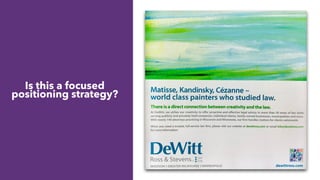
Is this a focused positioning strategy?
Is this a focused
positioning strategy?
Is this a focused positioning strategy?
One of the most comprehensive studies of business
success ever published, in which over 200
management practices were studied
A clearly stated,
focused strategy
Source: Nohria, Joyce, & Roberson, “What Really Works,” Harvard Business Review,
Only one business practice has a causal
relationship to superior business performance:
What is good strategy?
What is bad strategy?
1. We will be the law firm of choice in our region.
2. We will delight our clients with unique, effective solutions to their problems.
3. We will grow revenue by at least 20% each year.
4. We will maintain a profit margin of at least 20%.
5. We will have a culture of commitment.
6. We will foster an honest and open work environment.
7. We will work to support the broader community in which we operate.
OUR STRATEGY
1. We will be the law firm of choice in our region.
2. We will delight our clients with unique, effective solutions to their problems.
3. We will grow revenue by at least 20% each year.
4. We will maintain a profit margin of at least 20%.
5. We will have a culture of commitment.
6. We will foster an honest and open work environment.
7. We will work to support the broader community in which we operate.
OUR STRATEGY
Mistaking goals for strategy
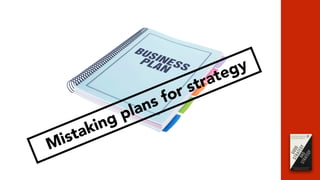
Mistaking plans for strategy
= Taking steps
Business Planning
Business Strategy
What to include
Forecasting finances
= Making choices
What to leave out
Forecasting the future
Emergent
Deliberate
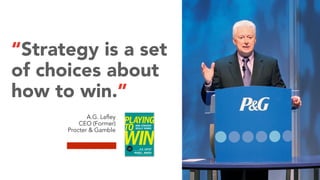
“Strategy is a set
of choices about
how to win.”
A.G. Lafley
CEO (Former)
Procter & Gamble
“Strategy is a set
of choices about
how to win.”
A.G. Lafley
CEO (Former)
Procter & Gamble
Michael Porter
Harvard Business School
“The essence of strategy is
choosing what not to do.”
Positioning = Trade Offs
Positioning = Deciding what not to do
CLIENT SIZE
FIRM FOCUS
Best-of-Breed Firms
Larger National Clients
“Generalist” Firms
Smaller Regional Clients
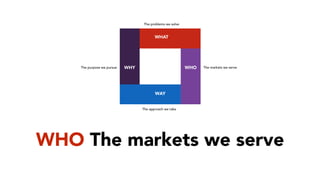
WHAT
WHY WHO
WAY
The problems we solve
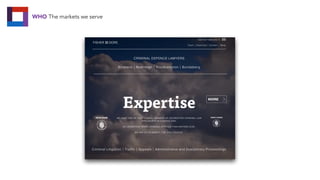
The markets we serve
The approach we take
The purpose we pursue
WHAT The problems we solve
Jobs to be done to solve an important
problem or fulfill and important need.
Offering, which satisfies the problem
or fulfills the need.
CLAYTON CHRISTENSEN
HARVARD BUSINESS SCHOOL
Jobs to Be Done Theory
WHAT The problems we solve
You can be good at
something, but you can’t
be good at everything.
WHAT The problems we solve
Are you selling the drill or the hole?
WHAT The problems we solve
Drills.
WHAT The problems we solve
CLIENT Business problems they
are trying to solve Specific outcomes
they seek
Services they buy from us to
solve these problems and
produce these outcomes
WHAT The problems we solve
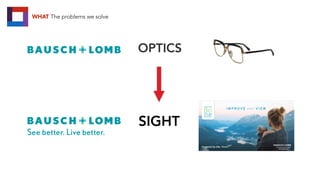
OPTICS
SIGHT
WHAT The problems we solve
Walt Disney’s approach to maximizing value
from a core competency.
WHAT The problems we solve
Not just capabilities,
but a self-reinforcing
system of capabilities.
WHAT The problems we solve
APPLE
Mac
iPhone
iPad
iWatch
iTunes
An ecosystem that provides
exponential benefits for customers.
WHAT The problems we solve
An ecosystem that provides
exponential benefits for customers.
Nike+ Running App
Shoes
Apparel
Equipment
Nike+ FuelBand Nike+ SportWatch
WHAT The problems we solve
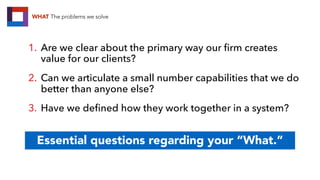
1. Are we clear about the primary way our firm creates
value for our clients?
2. Can we articulate a small number capabilities that we do
better than anyone else?
3. Have we defined how they work together in a system?
Essential questions regarding your “What.”
WHO The markets we serve
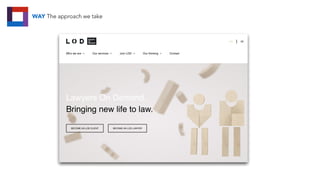
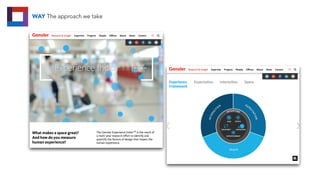
WAY The approach we take
SOURCES OF
DIFFERENTIATION
How you solve.
How you produce.
How you collaborate.
How you deliver.
How you serve.
How you price.
How you manage.
How you look.
How you promote.
WAY The approach we take
WHY The purpose we pursue
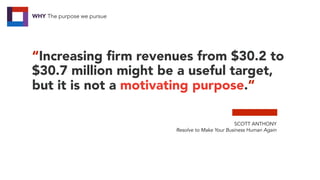
“Increasing firm revenues from $30.2 to
$30.7 million might be a useful target,
but it is not a motivating purpose.”
SCOTT ANTHONY
Resolve to Make Your Business Human Again
WHY The purpose we pursue
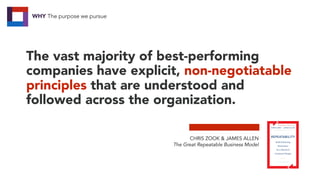
The vast majority of best-performing
companies have explicit, non-negotiatable
principles that are understood and
followed across the organization.
CHRIS ZOOK & JAMES ALLEN
The Great Repeatable Business Model
WHY The purpose we pursue
Your statement of purpose.
The reason your firm exists beyond making money.
Your credo.
Your non-negotiable principles.
Your rules of engagement.
WHY The purpose we pursue
WHY =
Putting it all together.
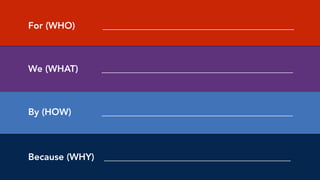
For (WHO) _________________________________________
We (WHAT) _________________________________________
By (HOW) _________________________________________
Because (WHY) ________________________________________
For (WHO) technology and life sciences companies
We (WHAT) help protect their intellectual property and financial future
By (HOW) coupling deep industry expertise with state-of-the-art project management
Because (WHY) we believe in the power of technology to transform the world
Positioning Brief
SETTING
What are the main dynamics of the current
environment in which our firm competes
(considering both direct and indirect forms of
competition)?
CONSTRAINTS
In creating a unique story about our firm, what are
the primary challenges or obstacles we must
overcome?
OUTCOMES
What outcomes or results are we trying to
produce with our positioning strategy?
POSITIONING
What is the specific position we’re attempting to
occupy in the marketplace?
Describe this strategy as:
“For (Who), we (What) by (How) because (Why).”
Who = The specific type of client we are targeting
(inspired by categories, audiences, types of brands, etc.)
What = The unique solutions or benefits we provide to
these clients
How = The distinctive way in which we deliver the above
(inspired by philosophies, methods, etc.)
Why = The underlying motivation for what we do; our
purpose as a business
SUPPORTING IDEAS
For each of the major dimensions of our strategy,
what can we can we offer as proof points,
examples, or supporting ideas?
AUDIENCE PERSONA
Based on the target market defined in our
positioning above, what are the key
characteristics of this audience?
THEME
What kind of themes could we use to describe
our positioning strategy? What type of language
or symbols could help bring it to life?
Putting it all together
The Positioning Brief
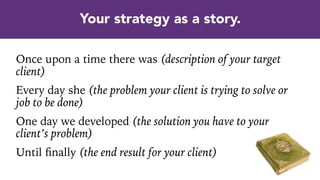
Once upon a time there was (description of your target
client)
Every day she (the problem your client is trying to solve or
job to be done)
One day we developed (the solution you have to your
client’s problem)
Until finally (the end result for your client)
Your strategy as a story.
Some tools and
thought starters.
DIVERGE
Create choices
CONVERGE
Make choices
A
High Interest / Low Expertise
B
High Interest / High Expertise
C
Low Interest / Low Expertise
D
Low Interest / High Expertise
Interest
Expertise
Evaluating interest vs. expertise.
AUTHENTIC ASPIRATIONAL
WHAT we do
WHO we do it for
WAY we do it
WHY we do it
Identifying what’s authentic vs. what’s aspirational.
How your strategy should guide client selection.
① Does it allow for clear identification of target prospects?
② Does it help us say no to the wrong prospects?
③ Does it help expand our geographical footprint?  
④ Does it create strong barriers to entry?  
⑤ Does it result in fewer competitors?  
⑥ Does it allow us to charge higher fees?  
⑦ Does it make our business development cycle shorter
and less expensive?  
Validating your
strategy.
Bringing your strategy to life
in all key areas of your firm.
A 100+ person independent marketing firm in Charlotte, North Carolina.
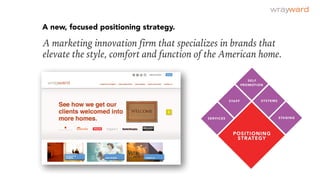
A marketing innovation firm that specializes in brands that
elevate the style, comfort and function of the American home.
A new, focused positioning strategy.
Services and solutions that support the strategy
PROFILE
• Small, often family-owned firms; 2–10 emplo
• 34–64 years old
• Average company age is 13 years
• Predominately uses own crew but will hire
subcontractors
• Main decision-maker on projects
– Contractors are highly influential with
homeowners regarding materials and bran
– In repair and remodeling, contractors prima
influence decisions regarding brand/
manufacturer and trim materials
INFLUENCERS
• Building Materials Distributor
• Manufacturer sales rep
A skilled and experienced craftsman and small
business owner, he takes pride in his work. Qual
dependability, timelines and efficiency are key fac
to maintaining a good reputation, so the products
chooses must help him consistently deliver.
JOURNEY
DESIRED BEHAVIOR Be aware of company
AWARE
MINDSETS & MOTIVATORS
• Time-starved problem-solvers	 • Low recognition of brands made by Ply Gem:
• Future Success Attributes	 Georgia Pacific highest at 23%
– Doing the best work	 • Ply Gem most known as a window manufacturer
– Visibility and reputation	 (56%); less so for exterior cladding and trim, doors,
– Effective management of the right employees	 roofing, decking and stone (34% or less)
• Convenience of dealer/distributor is a high priority;	 • Generally strong brand ratings for Ply Gem brands
distributor relationship trumps brand	 	 (7.78 to 9.0 on 10-point scale)
ity,	 • Come to trust certain brands and suppliers; can be
tors	 	 hesitant to switch
he	 • Top window and siding brand selection factors
– Dependable, quality, long-lasting products
– Brand you can trust	 “Homeowners do their research before a project,
– Trusted customer service	 so they come to their project educated, but
• Energy-saving and non-toxic materials are of	
maybe not opinionated. They always ask our
opinion on products and brands.”
yees	 increasing interest	 - Remodeling Contractor
• Pro awareness of Ply Gem brands is low:
– Windows: Ply Gem and Simonton <22%
– Siding: Mastic 28%; Ply Gem 24%
MEDIA & RESOURCES
ds
rily	 Top info sources Most trusted sources

• Search engines
• Email newsletters	 SOCIAL

• Industry print	 MEDIA

• Manufacturer website	 DEALER/ MANUFACTURER INDUSTRY IN-PERSON
DISTRIBUTOR SALES MATERIALS PRINT CONFERENCES
Source: Hanley Wood Media Consumption, Builders
RESEARCH PURCHASE PREFER
Associate desirable traits	 Choose/purchase	 Positive experience/expand relationship
Contractor-Remodeler Persona
Production Builder Persona
MINDSETS & MOTIVATIONS
MEDIA & RESOURCES
PROFILE
• 35 – 54 years old; mostly male
• Manager at top national and regional home
builders (i.e. D.R. Horton, Lennar, Pulte, Toll
Brothers, etc.)
• Earns $75k – $150k/year
• Generally operate within clearly define niches
(starter, move-up, luxury)
• Primarily influence decisions regarding materials,
brand/manufacturer and trim materials
INFLUENCERS
• Inside Designer
• Manufacturer sales rep
Managers at large national builders whose job is to
position their business to respond to changing
consumer and market trends, to deliver value to
homeowners and achieve sales and profitperformance.
• Larger, national firms procurement driven; seek stability,
best price and distribution capabilities
• Smaller, regional firms often require more marketing
and merchandising support
• Advanced/new product features, different housing
types and quality are reasons to try new brands
• Responding to high consumer expectations with
design, energy efficiency and technology
• Proficient with computers and technology for business
and personal use
– Heavy users; Excel, PPT, account software
– 6 to 14+ hrs. at computer/internet
• Pro awareness of Ply Gem brands is low:
– Windows: Ply Gem and Simonton <22%
– Siding: Mastic 28%; Ply Gem 24%
• Low recognition of brands made by Ply Gem: Georgia
Pacific highest at 23%
• Ply Gem most known as a window manufacturer
(56%); less so for exterior cladding & trim, doors,
roofing, decking and stone (34% or less)
• Generally strong brand ratings for Ply Gem brands
(7.78 to 9.0 on 10-point scale)
IN-PERSON
CONFERENCES
Top info sources
• Search engines
• Email newsletters
• Industry print
• Manufacturer website
Most trusted sources
Source: Hanley Wood Media Consumption, Builders
MANUFACTURER
SALESMATERIALS
INDUSTRY
PRINT
PEERS
JOURNEY
DESIREDBEHAVIOR
Be aware of company Associate desirable traits Choose/purchase
REPEATAWARE RESEARCH PURCHASE
Positive experience/expand relationship
“With builders, you need to get the purchasing
—the pricing decision—and the designers
simultaneously because they workhand-in-hand.
We work together.”
- National Single Family Builder
SOCIAL
MEDIA
New solution sets that deliver the strategy.
Hom
LUXURY NE
Remodel·
AtAGlan
HOME IMPROVEME
GROWTH HORIZON
Source 1-brdeyWood/Re, ling(
TOP COST VS. VALU
'8Entry Door Repla
e anufacured Ston
GarageDoorRep
Otherprojects incllide attic
Source·TheFamswol1hGroupw h
Home I
AMERICANS PLAN
30% 'ntetior pain
25% andscaping
14% new windO
13% ex erior pai
TOP 5 MOST POPU
Bathroom remodel or
Kitchen remodel or addi
Floonng
Pat10orl d capo
doorsWi dows01
Som - H JZZ
Key Influ
CONTRACTORS, RE
640,00
contrac•or rms in
68% ,
brand
REASONSFOR WIWNGNESS
Advanced or newprodu
Green/sustainablefeatl.Xe
POPULATION
Home I
AGING HOUSING
•
1150 QQ<Q
760,000
oinglefamily+l7¼
' ' 390 000
Totalhousing starts +I5%1 Multi ;mity+10%
0 5,630,000(
510,000
6
5 ; 00
Total housingsales+5%1 isting 4%
Housing/Non-Residential Construction
AtAGlance
2015 RESIDENTIAL PROJECTIONS NON-RESIDENTIAL CO
FORECAST
New research initiatives to further deepen the firm’s expertise.
CII t;,t t .,,_
C http .w yward.co /'wort<
-w
w
w
Blot I .IUft 22. 201,
Whe. Do deas Come F om? Ge ng toFORMatJO
Dope
I J"" 11, 201t I nI, 2011
·sPr ty Consumer. B a
Ben
e
frornF.
esse ge ...
Rela
boo
nshps Ho
Cen
I II. 1011 , .. 2011
Home
- - - -
.
.
, --'
--
A body of work focused on the new strategic direction.
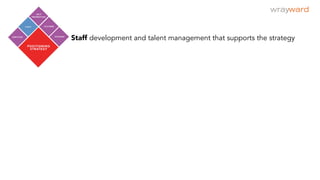
Staff development and talent management that supports the strategy
New organizational structure that supports the strategy.
Supporting causes that align with the strategy.
Self-promotion and business development that support the strategy
New marketing materials that effective promote the new strategy.
Thought leadership strategy that showcases the strategy.
Systems and processes that support the strategy
New internal processes that optimize the success of the strategy.
Staging and resources that support the strategy
e
Redesigned space that showcases the strategy.
A transformed client base that aligns with the strategy.
BEFORE AFTER
An expanded geographical client base as a result of the new strategy.
BEFORE AFTER
Dealing effectively with the
complexities of the external market.
By minimizing the complexities of
your internal business model.
“T” shaped business model
A business model that proves its success.
“Not better than the
competition, but different
from the competition.”
ADAM MORGAN AND MARK BARDEN
TWilliams@IgnitionGroup.com
@TimWilliamsICG
linkedin.com/in/TimWilliamsICG
Positioning for Professionals
Available at www.wiley.com

A Plan is Not a Strategy

  • 1.
    YOU HAVE A STRATEGICPLAN, BUT YOU MAY NOT HAVE A STRATEGY Presented by Tim Williams @TimWilliamsICG Ignition Consulting Group
  • 2.
    In a singlesentence, describe your firm as though you were talking to a prospective client. What is your elevator pitch?
  • 3.
    Is this afocused positioning strategy?
  • 4.
    Is this afocused positioning strategy?
  • 5.
    Is this afocused positioning strategy?
  • 6.
    One of themost comprehensive studies of business success ever published, in which over 200 management practices were studied A clearly stated, focused strategy Source: Nohria, Joyce, & Roberson, “What Really Works,” Harvard Business Review, Only one business practice has a causal relationship to superior business performance:
  • 7.
    What is goodstrategy? What is bad strategy?
  • 8.
    1. We willbe the law firm of choice in our region. 2. We will delight our clients with unique, effective solutions to their problems. 3. We will grow revenue by at least 20% each year. 4. We will maintain a profit margin of at least 20%. 5. We will have a culture of commitment. 6. We will foster an honest and open work environment. 7. We will work to support the broader community in which we operate. OUR STRATEGY
  • 9.
    1. We willbe the law firm of choice in our region. 2. We will delight our clients with unique, effective solutions to their problems. 3. We will grow revenue by at least 20% each year. 4. We will maintain a profit margin of at least 20%. 5. We will have a culture of commitment. 6. We will foster an honest and open work environment. 7. We will work to support the broader community in which we operate. OUR STRATEGY Mistaking goals for strategy
  • 10.
  • 11.
    = Taking steps BusinessPlanning Business Strategy What to include Forecasting finances = Making choices What to leave out Forecasting the future Emergent Deliberate
  • 12.
    “Strategy is aset of choices about how to win.” A.G. Lafley CEO (Former) Procter & Gamble
  • 13.
    “Strategy is aset of choices about how to win.” A.G. Lafley CEO (Former) Procter & Gamble
  • 14.
    Michael Porter Harvard BusinessSchool “The essence of strategy is choosing what not to do.”
  • 15.
  • 16.
    Positioning = Decidingwhat not to do
  • 17.
    Positioning = Decidingwhat not to do
  • 18.
    CLIENT SIZE FIRM FOCUS Best-of-BreedFirms Larger National Clients “Generalist” Firms Smaller Regional Clients
  • 19.
    WHAT WHY WHO WAY The problemswe solve The markets we serve The approach we take The purpose we pursue
  • 20.
  • 21.
    Jobs to bedone to solve an important problem or fulfill and important need. Offering, which satisfies the problem or fulfills the need. CLAYTON CHRISTENSEN HARVARD BUSINESS SCHOOL Jobs to Be Done Theory WHAT The problems we solve
  • 22.
    You can begood at something, but you can’t be good at everything. WHAT The problems we solve
  • 23.
    WHAT The problemswe solve Are you selling the drill or the hole?
  • 24.
    WHAT The problemswe solve Drills.
  • 25.
    WHAT The problemswe solve CLIENT Business problems they are trying to solve Specific outcomes they seek Services they buy from us to solve these problems and produce these outcomes
  • 26.
    WHAT The problemswe solve OPTICS SIGHT
  • 27.
  • 28.
  • 29.
  • 30.
    Walt Disney’s approachto maximizing value from a core competency. WHAT The problems we solve Not just capabilities, but a self-reinforcing system of capabilities.
  • 31.
    WHAT The problemswe solve APPLE Mac iPhone iPad iWatch iTunes An ecosystem that provides exponential benefits for customers.
  • 32.
    WHAT The problemswe solve An ecosystem that provides exponential benefits for customers. Nike+ Running App Shoes Apparel Equipment Nike+ FuelBand Nike+ SportWatch
  • 33.
    WHAT The problemswe solve 1. Are we clear about the primary way our firm creates value for our clients? 2. Can we articulate a small number capabilities that we do better than anyone else? 3. Have we defined how they work together in a system? Essential questions regarding your “What.”
  • 34.
  • 35.
  • 36.
  • 37.
  • 38.
  • 39.
  • 40.
  • 41.
  • 42.
  • 43.
  • 44.
  • 45.
    SOURCES OF DIFFERENTIATION How yousolve. How you produce. How you collaborate. How you deliver. How you serve. How you price. How you manage. How you look. How you promote. WAY The approach we take
  • 46.
    WHY The purposewe pursue
  • 47.
    “Increasing firm revenuesfrom $30.2 to $30.7 million might be a useful target, but it is not a motivating purpose.” SCOTT ANTHONY Resolve to Make Your Business Human Again WHY The purpose we pursue
  • 48.
    WHY The purposewe pursue
  • 49.
    The vast majorityof best-performing companies have explicit, non-negotiatable principles that are understood and followed across the organization. CHRIS ZOOK & JAMES ALLEN The Great Repeatable Business Model WHY The purpose we pursue
  • 50.
    Your statement ofpurpose. The reason your firm exists beyond making money. Your credo. Your non-negotiable principles. Your rules of engagement. WHY The purpose we pursue WHY =
  • 51.
    Putting it alltogether.
  • 52.
    For (WHO) _________________________________________ We(WHAT) _________________________________________ By (HOW) _________________________________________ Because (WHY) ________________________________________
  • 53.
    For (WHO) technologyand life sciences companies We (WHAT) help protect their intellectual property and financial future By (HOW) coupling deep industry expertise with state-of-the-art project management Because (WHY) we believe in the power of technology to transform the world
  • 54.
    Positioning Brief SETTING What arethe main dynamics of the current environment in which our firm competes (considering both direct and indirect forms of competition)? CONSTRAINTS In creating a unique story about our firm, what are the primary challenges or obstacles we must overcome? OUTCOMES What outcomes or results are we trying to produce with our positioning strategy? POSITIONING What is the specific position we’re attempting to occupy in the marketplace? Describe this strategy as: “For (Who), we (What) by (How) because (Why).” Who = The specific type of client we are targeting (inspired by categories, audiences, types of brands, etc.) What = The unique solutions or benefits we provide to these clients How = The distinctive way in which we deliver the above (inspired by philosophies, methods, etc.) Why = The underlying motivation for what we do; our purpose as a business SUPPORTING IDEAS For each of the major dimensions of our strategy, what can we can we offer as proof points, examples, or supporting ideas? AUDIENCE PERSONA Based on the target market defined in our positioning above, what are the key characteristics of this audience? THEME What kind of themes could we use to describe our positioning strategy? What type of language or symbols could help bring it to life? Putting it all together The Positioning Brief
  • 55.
    Once upon atime there was (description of your target client) Every day she (the problem your client is trying to solve or job to be done) One day we developed (the solution you have to your client’s problem) Until finally (the end result for your client) Your strategy as a story.
  • 56.
  • 57.
  • 58.
    A High Interest /Low Expertise B High Interest / High Expertise C Low Interest / Low Expertise D Low Interest / High Expertise Interest Expertise Evaluating interest vs. expertise.
  • 59.
    AUTHENTIC ASPIRATIONAL WHAT wedo WHO we do it for WAY we do it WHY we do it Identifying what’s authentic vs. what’s aspirational.
  • 60.
    How your strategyshould guide client selection.
  • 61.
    ① Does itallow for clear identification of target prospects? ② Does it help us say no to the wrong prospects? ③ Does it help expand our geographical footprint?   ④ Does it create strong barriers to entry?   ⑤ Does it result in fewer competitors?   ⑥ Does it allow us to charge higher fees?   ⑦ Does it make our business development cycle shorter and less expensive?   Validating your strategy.
  • 62.
    Bringing your strategyto life in all key areas of your firm.
  • 63.
    A 100+ personindependent marketing firm in Charlotte, North Carolina.
  • 65.
    A marketing innovationfirm that specializes in brands that elevate the style, comfort and function of the American home. A new, focused positioning strategy.
  • 66.
    Services and solutionsthat support the strategy
  • 67.
    PROFILE • Small, oftenfamily-owned firms; 2–10 emplo • 34–64 years old • Average company age is 13 years • Predominately uses own crew but will hire subcontractors • Main decision-maker on projects – Contractors are highly influential with homeowners regarding materials and bran – In repair and remodeling, contractors prima influence decisions regarding brand/ manufacturer and trim materials INFLUENCERS • Building Materials Distributor • Manufacturer sales rep A skilled and experienced craftsman and small business owner, he takes pride in his work. Qual dependability, timelines and efficiency are key fac to maintaining a good reputation, so the products chooses must help him consistently deliver. JOURNEY DESIRED BEHAVIOR Be aware of company AWARE MINDSETS & MOTIVATORS • Time-starved problem-solvers • Low recognition of brands made by Ply Gem: • Future Success Attributes Georgia Pacific highest at 23% – Doing the best work • Ply Gem most known as a window manufacturer – Visibility and reputation (56%); less so for exterior cladding and trim, doors, – Effective management of the right employees roofing, decking and stone (34% or less) • Convenience of dealer/distributor is a high priority; • Generally strong brand ratings for Ply Gem brands distributor relationship trumps brand (7.78 to 9.0 on 10-point scale) ity, • Come to trust certain brands and suppliers; can be tors hesitant to switch he • Top window and siding brand selection factors – Dependable, quality, long-lasting products – Brand you can trust “Homeowners do their research before a project, – Trusted customer service so they come to their project educated, but • Energy-saving and non-toxic materials are of maybe not opinionated. They always ask our opinion on products and brands.” yees increasing interest - Remodeling Contractor • Pro awareness of Ply Gem brands is low: – Windows: Ply Gem and Simonton <22% – Siding: Mastic 28%; Ply Gem 24% MEDIA & RESOURCES ds rily Top info sources Most trusted sources • Search engines • Email newsletters SOCIAL • Industry print MEDIA • Manufacturer website DEALER/ MANUFACTURER INDUSTRY IN-PERSON DISTRIBUTOR SALES MATERIALS PRINT CONFERENCES Source: Hanley Wood Media Consumption, Builders RESEARCH PURCHASE PREFER Associate desirable traits Choose/purchase Positive experience/expand relationship Contractor-Remodeler Persona Production Builder Persona MINDSETS & MOTIVATIONS MEDIA & RESOURCES PROFILE • 35 – 54 years old; mostly male • Manager at top national and regional home builders (i.e. D.R. Horton, Lennar, Pulte, Toll Brothers, etc.) • Earns $75k – $150k/year • Generally operate within clearly define niches (starter, move-up, luxury) • Primarily influence decisions regarding materials, brand/manufacturer and trim materials INFLUENCERS • Inside Designer • Manufacturer sales rep Managers at large national builders whose job is to position their business to respond to changing consumer and market trends, to deliver value to homeowners and achieve sales and profitperformance. • Larger, national firms procurement driven; seek stability, best price and distribution capabilities • Smaller, regional firms often require more marketing and merchandising support • Advanced/new product features, different housing types and quality are reasons to try new brands • Responding to high consumer expectations with design, energy efficiency and technology • Proficient with computers and technology for business and personal use – Heavy users; Excel, PPT, account software – 6 to 14+ hrs. at computer/internet • Pro awareness of Ply Gem brands is low: – Windows: Ply Gem and Simonton <22% – Siding: Mastic 28%; Ply Gem 24% • Low recognition of brands made by Ply Gem: Georgia Pacific highest at 23% • Ply Gem most known as a window manufacturer (56%); less so for exterior cladding & trim, doors, roofing, decking and stone (34% or less) • Generally strong brand ratings for Ply Gem brands (7.78 to 9.0 on 10-point scale) IN-PERSON CONFERENCES Top info sources • Search engines • Email newsletters • Industry print • Manufacturer website Most trusted sources Source: Hanley Wood Media Consumption, Builders MANUFACTURER SALESMATERIALS INDUSTRY PRINT PEERS JOURNEY DESIREDBEHAVIOR Be aware of company Associate desirable traits Choose/purchase REPEATAWARE RESEARCH PURCHASE Positive experience/expand relationship “With builders, you need to get the purchasing —the pricing decision—and the designers simultaneously because they workhand-in-hand. We work together.” - National Single Family Builder SOCIAL MEDIA New solution sets that deliver the strategy.
  • 68.
    Hom LUXURY NE Remodel· AtAGlan HOME IMPROVEME GROWTHHORIZON Source 1-brdeyWood/Re, ling( TOP COST VS. VALU '8Entry Door Repla e anufacured Ston GarageDoorRep Otherprojects incllide attic Source·TheFamswol1hGroupw h Home I AMERICANS PLAN 30% 'ntetior pain 25% andscaping 14% new windO 13% ex erior pai TOP 5 MOST POPU Bathroom remodel or Kitchen remodel or addi Floonng Pat10orl d capo doorsWi dows01 Som - H JZZ Key Influ CONTRACTORS, RE 640,00 contrac•or rms in 68% , brand REASONSFOR WIWNGNESS Advanced or newprodu Green/sustainablefeatl.Xe POPULATION Home I AGING HOUSING • 1150 QQ<Q 760,000 oinglefamily+l7¼ ' ' 390 000 Totalhousing starts +I5%1 Multi ;mity+10% 0 5,630,000( 510,000 6 5 ; 00 Total housingsales+5%1 isting 4% Housing/Non-Residential Construction AtAGlance 2015 RESIDENTIAL PROJECTIONS NON-RESIDENTIAL CO FORECAST New research initiatives to further deepen the firm’s expertise.
  • 69.
    CII t;,t t.,,_ C http .w yward.co /'wort< -w w w Blot I .IUft 22. 201, Whe. Do deas Come F om? Ge ng toFORMatJO Dope I J"" 11, 201t I nI, 2011 ·sPr ty Consumer. B a Ben e frornF. esse ge ... Rela boo nshps Ho Cen I II. 1011 , .. 2011 Home - - - - . . , --' -- A body of work focused on the new strategic direction.
  • 70.
    Staff development andtalent management that supports the strategy
  • 72.
    New organizational structurethat supports the strategy.
  • 73.
    Supporting causes thatalign with the strategy.
  • 74.
    Self-promotion and businessdevelopment that support the strategy
  • 75.
    New marketing materialsthat effective promote the new strategy.
  • 76.
    Thought leadership strategythat showcases the strategy.
  • 77.
    Systems and processesthat support the strategy
  • 78.
    New internal processesthat optimize the success of the strategy.
  • 79.
    Staging and resourcesthat support the strategy
  • 80.
    e Redesigned space thatshowcases the strategy.
  • 81.
    A transformed clientbase that aligns with the strategy. BEFORE AFTER
  • 82.
    An expanded geographicalclient base as a result of the new strategy. BEFORE AFTER
  • 83.
    Dealing effectively withthe complexities of the external market. By minimizing the complexities of your internal business model. “T” shaped business model A business model that proves its success.
  • 84.
    “Not better thanthe competition, but different from the competition.” ADAM MORGAN AND MARK BARDEN
  • 85.