A Decade of Google: From
AlgorithmUpdates to AI
Advancements
Anjali
Upgb-3673
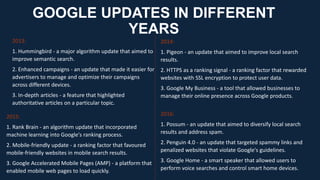
GOOGLE UPDATES IN DIFFERENT
YEARS
2013:
1. Hummingbird - a major algorithm update that aimed to
improve semantic search.
2. Enhanced campaigns - an update that made it easier for
advertisers to manage and optimize their campaigns
across different devices.
3. In-depth articles - a feature that highlighted
authoritative articles on a particular topic.
2014:
1. Pigeon - an update that aimed to improve local search
results.
2. HTTPS as a ranking signal - a ranking factor that rewarded
websites with SSL encryption to protect user data.
3. Google My Business - a tool that allowed businesses to
manage their online presence across Google products.
2015:
1. Rank Brain - an algorithm update that incorporated
machine learning into Google's ranking process.
2. Mobile-friendly update - a ranking factor that favoured
mobile-friendly websites in mobile search results.
3. Google Accelerated Mobile Pages (AMP) - a platform that
enabled mobile web pages to load quickly.
2016:
1. Possum - an update that aimed to diversify local search
results and address spam.
2. Penguin 4.0 - an update that targeted spammy links and
penalized websites that violate Google's guidelines.
3. Google Home - a smart speaker that allowed users to
perform voice searches and control smart home devices.
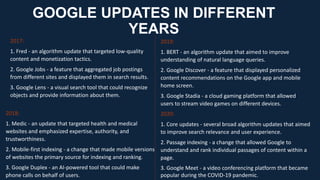
GOOGLE UPDATES IN DIFFERENT
YEARS
2017:
1. Fred - an algorithm update that targeted low-quality
content and monetization tactics.
2. Google Jobs - a feature that aggregated job postings
from different sites and displayed them in search results.
3. Google Lens - a visual search tool that could recognize
objects and provide information about them.
2019:
1. BERT - an algorithm update that aimed to improve
understanding of natural language queries.
2. Google Discover - a feature that displayed personalized
content recommendations on the Google app and mobile
home screen.
3. Google Stadia - a cloud gaming platform that allowed
users to stream video games on different devices.
2018:
1. Medic - an update that targeted health and medical
websites and emphasized expertise, authority, and
trustworthiness.
2. Mobile-first indexing - a change that made mobile versions
of websites the primary source for indexing and ranking.
3. Google Duplex - an AI-powered tool that could make
phone calls on behalf of users.
2020:
1. Core updates - several broad algorithm updates that aimed
to improve search relevance and user experience.
2. Passage indexing - a change that allowed Google to
understand and rank individual passages of content within a
page.
3. Google Meet - a video conferencing platform that became
popular during the COVID-19 pandemic.
GOOGLE UPDATES IN DIFFERENT
YEARS
2021 (as of Q2):
1. Page Experience update - a ranking factor that takes into
account page loading speed, responsiveness, and other
user-centric metrics.
2. Google Workspace - a rebranding of Google's
productivity tools, which now includes Google Meet,
Google Chat, and other collaboration features.
3. Google I/O 2021 - an annual developer conference at
which Google announced updates to Android, Google
Maps, Google Photos, and other products.
2022:
1. Link spam update.
2. Google helpful content system update.
3. Spam update.
4. Product Reviews Update.
5. Core Update.
6. Helpful content update.
7. Product Reviews Update.
8. Core Update.
IMPORTANT Google
Updates
• Google Hummingbird (2013)
• Google Pigeon (2014)
• Google Mobile-Friendly (2015)
• Google Rank Brain (2015)
• Google BERT (2019)
• Google MUM (2023)
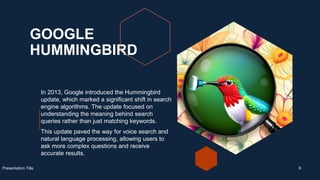
GOOGLE
HUMMINGBIRD
In 2013, Google introduced the Hummingbird
update, which marked a significant shift in search
engine algorithms. The update focused on
understanding the meaning behind search
queries rather than just matching keywords.
This update paved the way for voice search and
natural language processing, allowing users to
ask more complex questions and receive
accurate results.
Presentation Title 6
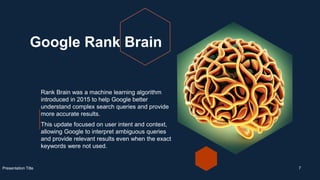
Google Rank Brain
Rank Brain was a machine learning algorithm
introduced in 2015 to help Google better
understand complex search queries and provide
more accurate results.
This update focused on user intent and context,
allowing Google to interpret ambiguous queries
and provide relevant results even when the exact
keywords were not used.
Presentation Title 7
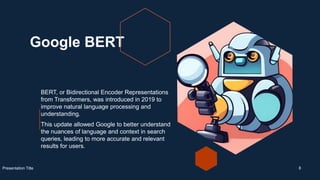
Google BERT
BERT, or Bidirectional Encoder Representations
from Transformers, was introduced in 2019 to
improve natural language processing and
understanding.
This update allowed Google to better understand
the nuances of language and context in search
queries, leading to more accurate and relevant
results for users.
Presentation Title 8
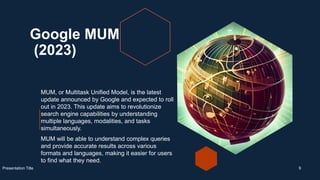
Google MUM
(2023)
MUM, or Multitask Unified Model, is the latest
update announced by Google and expected to roll
out in 2023. This update aims to revolutionize
search engine capabilities by understanding
multiple languages, modalities, and tasks
simultaneously.
MUM will be able to understand complex queries
and provide accurate results across various
formats and languages, making it easier for users
to find what they need.
Presentation Title 9
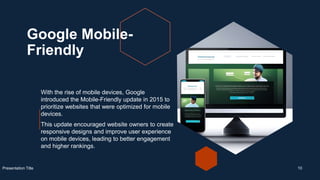
Google Mobile-
Friendly
With the rise of mobile devices, Google
introduced the Mobile-Friendly update in 2015 to
prioritize websites that were optimized for mobile
devices.
This update encouraged website owners to create
responsive designs and improve user experience
on mobile devices, leading to better engagement
and higher rankings.
Presentation Title 10
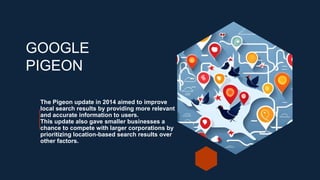
The Pigeon update in 2014 aimed to improve
local search results by providing more relevant
and accurate information to users.
This update also gave smaller businesses a
chance to compete with larger corporations by
prioritizing location-based search results over
other factors.
GOOGLE
PIGEON
Thank you

google update.pptx

  • 1.
    A Decade ofGoogle: From AlgorithmUpdates to AI Advancements Anjali Upgb-3673
  • 2.
    GOOGLE UPDATES INDIFFERENT YEARS 2013: 1. Hummingbird - a major algorithm update that aimed to improve semantic search. 2. Enhanced campaigns - an update that made it easier for advertisers to manage and optimize their campaigns across different devices. 3. In-depth articles - a feature that highlighted authoritative articles on a particular topic. 2014: 1. Pigeon - an update that aimed to improve local search results. 2. HTTPS as a ranking signal - a ranking factor that rewarded websites with SSL encryption to protect user data. 3. Google My Business - a tool that allowed businesses to manage their online presence across Google products. 2015: 1. Rank Brain - an algorithm update that incorporated machine learning into Google's ranking process. 2. Mobile-friendly update - a ranking factor that favoured mobile-friendly websites in mobile search results. 3. Google Accelerated Mobile Pages (AMP) - a platform that enabled mobile web pages to load quickly. 2016: 1. Possum - an update that aimed to diversify local search results and address spam. 2. Penguin 4.0 - an update that targeted spammy links and penalized websites that violate Google's guidelines. 3. Google Home - a smart speaker that allowed users to perform voice searches and control smart home devices.
  • 3.
    GOOGLE UPDATES INDIFFERENT YEARS 2017: 1. Fred - an algorithm update that targeted low-quality content and monetization tactics. 2. Google Jobs - a feature that aggregated job postings from different sites and displayed them in search results. 3. Google Lens - a visual search tool that could recognize objects and provide information about them. 2019: 1. BERT - an algorithm update that aimed to improve understanding of natural language queries. 2. Google Discover - a feature that displayed personalized content recommendations on the Google app and mobile home screen. 3. Google Stadia - a cloud gaming platform that allowed users to stream video games on different devices. 2018: 1. Medic - an update that targeted health and medical websites and emphasized expertise, authority, and trustworthiness. 2. Mobile-first indexing - a change that made mobile versions of websites the primary source for indexing and ranking. 3. Google Duplex - an AI-powered tool that could make phone calls on behalf of users. 2020: 1. Core updates - several broad algorithm updates that aimed to improve search relevance and user experience. 2. Passage indexing - a change that allowed Google to understand and rank individual passages of content within a page. 3. Google Meet - a video conferencing platform that became popular during the COVID-19 pandemic.
  • 4.
    GOOGLE UPDATES INDIFFERENT YEARS 2021 (as of Q2): 1. Page Experience update - a ranking factor that takes into account page loading speed, responsiveness, and other user-centric metrics. 2. Google Workspace - a rebranding of Google's productivity tools, which now includes Google Meet, Google Chat, and other collaboration features. 3. Google I/O 2021 - an annual developer conference at which Google announced updates to Android, Google Maps, Google Photos, and other products. 2022: 1. Link spam update. 2. Google helpful content system update. 3. Spam update. 4. Product Reviews Update. 5. Core Update. 6. Helpful content update. 7. Product Reviews Update. 8. Core Update.
  • 5.
    IMPORTANT Google Updates • GoogleHummingbird (2013) • Google Pigeon (2014) • Google Mobile-Friendly (2015) • Google Rank Brain (2015) • Google BERT (2019) • Google MUM (2023)
  • 6.
    GOOGLE HUMMINGBIRD In 2013, Googleintroduced the Hummingbird update, which marked a significant shift in search engine algorithms. The update focused on understanding the meaning behind search queries rather than just matching keywords. This update paved the way for voice search and natural language processing, allowing users to ask more complex questions and receive accurate results. Presentation Title 6
  • 7.
    Google Rank Brain RankBrain was a machine learning algorithm introduced in 2015 to help Google better understand complex search queries and provide more accurate results. This update focused on user intent and context, allowing Google to interpret ambiguous queries and provide relevant results even when the exact keywords were not used. Presentation Title 7
  • 8.
    Google BERT BERT, orBidirectional Encoder Representations from Transformers, was introduced in 2019 to improve natural language processing and understanding. This update allowed Google to better understand the nuances of language and context in search queries, leading to more accurate and relevant results for users. Presentation Title 8
  • 9.
    Google MUM (2023) MUM, orMultitask Unified Model, is the latest update announced by Google and expected to roll out in 2023. This update aims to revolutionize search engine capabilities by understanding multiple languages, modalities, and tasks simultaneously. MUM will be able to understand complex queries and provide accurate results across various formats and languages, making it easier for users to find what they need. Presentation Title 9
  • 10.
    Google Mobile- Friendly With therise of mobile devices, Google introduced the Mobile-Friendly update in 2015 to prioritize websites that were optimized for mobile devices. This update encouraged website owners to create responsive designs and improve user experience on mobile devices, leading to better engagement and higher rankings. Presentation Title 10
  • 11.
    The Pigeon updatein 2014 aimed to improve local search results by providing more relevant and accurate information to users. This update also gave smaller businesses a chance to compete with larger corporations by prioritizing location-based search results over other factors. GOOGLE PIGEON
  • 12.