GOOGLE
ALGORITHMS/UPDATES
*What Is Google Algorithm/Update?
• A google algorithm/update is a change made to Google’s Search Engine in
order to improve the quality, relevance, and overall user experience of its
search results.
• Google's mission to serve users quality content
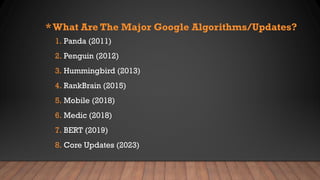
* What Are The Major Google Algorithms/Updates?
1. Panda (2011)
2. Penguin (2012)
3. Hummingbird (2013)
4. RankBrain (2015)
5. Mobile (2018)
6. Medic (2018)
7. BERT (2019)
8. Core Updates (2023)
1. Panda (2011)
The Panda update introduced a new ranking signal
which penalized
• Duplicate
• Thin Content
• User-generated spam
• Keyword stuffing
After identifying these factors in a website, it
removes the website from top search rankings.
2. Penguin (2012)
Penguin is a filter that is designed to penalize
websites that have
• Bad link Building Techniques
• Keyword Stuffing
Because of this update, the algorithm is now able
to identify whether or not the links going back to a
certain page are legitimate or are simply spam.
3. Humming Bird (2013)
• The new algorithm works to understand the
meaning of the query and match it with relevant
results. (making search more predictive and
topically relevant).
• Ex:- If you searched for “pay your bills through
citizens bank and trust bank”, you receive the
link directly for the page about paying bills.
4. Mobile (2015)
• This is the first major update to address
Google's "mobile-first" initiative.
• In order for a page to be considered mobile-
friendly, it needs to meet specific visual
requirements.
• Specifically, the proportions need to be
conductive to the screen of a mobile device
(smartphone).
• Sites with really fast mobile pages did better in
search results, while pages with slow speeds
lost rankings.(2018)
5. Rank Brain (2015)
• The RankBrain update introduced a new machine
learning Artificial Intelligence to help determine
the most relevant search results for a given query.
• It helps Google to process search results and
provide more relevant search results for users.
• Artificial Intelligence is a study to train computers
of how they could do things better.
6. Medic (2018)
• The Medic update's purpose was to emphasize and
improve the Expertise, Authority, and Trustworthiness
(E-A-T) of pages that have the power to affect a
person's well-being and happiness.
• Google punished pages it perceived to have a no or
low E-A-T and rewarded website that had a high
E-A-T.
• High E-A-T medical advice should be written or
produced by people or organizations with
appropriate medical expertise or accreditation.
• High E-A-T news articles should be produced with
journalistic professionalism that helps users achieve
a better understanding of events.
• Related to safety of other people
7. BERT (2019)
• BERT stands for Bidirectional Encoder
Representations from Transformers
• Google, adjusted its algorithm to better
understand natural language processing and
natural language generation.
• Ex 1:- If you put your flight number into Google, it
shows you the flight status. Or a calculator may
come up when you type in a math equation. Or if
you put a stock symbol in, you’ll get a stock chart.
• Ex 2:- When you start typing into Google, its
autocomplete feature figures out what you are
searching for before you even finishing typing it
in.
8. Broad Core Update (2023)
• The Broad Core update aims to improve the
overall quality of search results by identifying and
rewarding high-quality content while penalizing
low-quality or spammy content.
• Websites that see a decline in rankings after an
update may not necessarily have done anything
wrong, but rather they may not be meeting the
new criteria for what Google considers to be high-
quality content.
• To stay ahead, website owners and digital
marketers should regularly monitor updates and
changes to Google's algorithm and adjust their
strategies accordingly.
THANK YOU

Google Algorithms | Digital Marketing Course | www.odmt.in

  • 1.
  • 2.
    *What Is GoogleAlgorithm/Update? • A google algorithm/update is a change made to Google’s Search Engine in order to improve the quality, relevance, and overall user experience of its search results. • Google's mission to serve users quality content
  • 3.
    * What AreThe Major Google Algorithms/Updates? 1. Panda (2011) 2. Penguin (2012) 3. Hummingbird (2013) 4. RankBrain (2015) 5. Mobile (2018) 6. Medic (2018) 7. BERT (2019) 8. Core Updates (2023)
  • 4.
    1. Panda (2011) ThePanda update introduced a new ranking signal which penalized • Duplicate • Thin Content • User-generated spam • Keyword stuffing After identifying these factors in a website, it removes the website from top search rankings.
  • 5.
    2. Penguin (2012) Penguinis a filter that is designed to penalize websites that have • Bad link Building Techniques • Keyword Stuffing Because of this update, the algorithm is now able to identify whether or not the links going back to a certain page are legitimate or are simply spam.
  • 6.
    3. Humming Bird(2013) • The new algorithm works to understand the meaning of the query and match it with relevant results. (making search more predictive and topically relevant). • Ex:- If you searched for “pay your bills through citizens bank and trust bank”, you receive the link directly for the page about paying bills.
  • 7.
    4. Mobile (2015) •This is the first major update to address Google's "mobile-first" initiative. • In order for a page to be considered mobile- friendly, it needs to meet specific visual requirements. • Specifically, the proportions need to be conductive to the screen of a mobile device (smartphone). • Sites with really fast mobile pages did better in search results, while pages with slow speeds lost rankings.(2018)
  • 8.
    5. Rank Brain(2015) • The RankBrain update introduced a new machine learning Artificial Intelligence to help determine the most relevant search results for a given query. • It helps Google to process search results and provide more relevant search results for users. • Artificial Intelligence is a study to train computers of how they could do things better.
  • 9.
    6. Medic (2018) •The Medic update's purpose was to emphasize and improve the Expertise, Authority, and Trustworthiness (E-A-T) of pages that have the power to affect a person's well-being and happiness. • Google punished pages it perceived to have a no or low E-A-T and rewarded website that had a high E-A-T. • High E-A-T medical advice should be written or produced by people or organizations with appropriate medical expertise or accreditation. • High E-A-T news articles should be produced with journalistic professionalism that helps users achieve a better understanding of events. • Related to safety of other people
  • 10.
    7. BERT (2019) •BERT stands for Bidirectional Encoder Representations from Transformers • Google, adjusted its algorithm to better understand natural language processing and natural language generation. • Ex 1:- If you put your flight number into Google, it shows you the flight status. Or a calculator may come up when you type in a math equation. Or if you put a stock symbol in, you’ll get a stock chart. • Ex 2:- When you start typing into Google, its autocomplete feature figures out what you are searching for before you even finishing typing it in.
  • 11.
    8. Broad CoreUpdate (2023) • The Broad Core update aims to improve the overall quality of search results by identifying and rewarding high-quality content while penalizing low-quality or spammy content. • Websites that see a decline in rankings after an update may not necessarily have done anything wrong, but rather they may not be meeting the new criteria for what Google considers to be high- quality content. • To stay ahead, website owners and digital marketers should regularly monitor updates and changes to Google's algorithm and adjust their strategies accordingly.
  • 12.