SEO Tips Today:
Google Algorithm
Porsh 2020.9.25
HELLO!
I am Porsh Tsai
Google Product Expert(webmaster)
SEO & Game addict/Family person/Drummer
2
3
What is Google
Algorithm
Google’s algorithms are a complex system used to retrieve data from its
search index and instantly deliver the best possible results for a query.
The search engine uses a combination of algorithms and numerous ranking
signals to deliver web pages ranked by relevance on its search engine
results pages (SERPs)
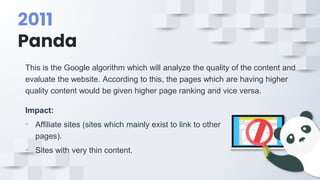
2011
Panda
This is the Google algorithm which will analyze the quality of the content and
evaluate the website. According to this, the pages which are having higher
quality content would be given higher page ranking and vice versa.
Impact:
• Affiliate sites (sites which mainly exist to link to other
pages).
• Sites with very thin content.
2012
Penguin
It evaluates the website on varied factors. They can affect the site’s ranking
based on the backlinks of the site. Contextual page linking, content based on
the linked page, links from trustworthy sources and from different domains
can adversely affect the page ranking.
Impact:
• Site with artificial links or low quality links
2013
Hummingbird
The main purpose of Hummingbird’s algorithm was to translate semantic
search from a concept to a reality and one that would ultimately become the
search standard. The Hummingbird update saw Google lay down the
groundwork for voice-search.
Hummingbird pays more attention to each word in a query, ensuring that the
whole search phrase is taken into account, rather than just particular words.
Impact:
• Over-optimized for the same few words
2014
HTTPS/SSL
To underline the importance of security, Google decided to give a small
ranking boost to sites that correctly implemented HTTPS to make the
connection between website and user secure. At the time, HTTPS was
introduced as a lightweight ranking signal. But Google had already hinted at
the possibility of making encryption more important, once webmasters had
had the time to implement it.
Impact:
• Webisite without HTTPS/SSL
2015
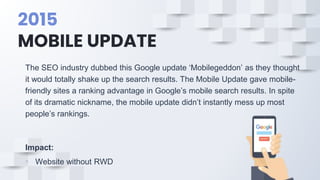
MOBILE UPDATE
The SEO industry dubbed this Google update ‘​Mobilegeddon​’ as they thought
it would totally shake up the search results. The Mobile Update gave mobile-
friendly sites a ranking advantage in Google’s mobile search results. In spite
of its dramatic nickname, the mobile update didn’t instantly mess up most
people’s rankings.
Impact:
• Website without RWD
2015
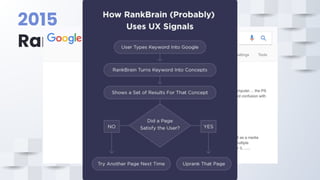
RankBrain
RankBrain is a state-of-the-art Google algorithm, employing machine learning
to handle queries. It can make guesses about words it doesn’t know, to find
words with similar meanings and then offer relevant results. The Rank Brain
algorithm analyzed past searches, determining the best result, in order to
improve. It is one of the three most important of its ranking signals.
2015
RankBrain
2016
Possum
Google’s algorithm update ​Possum update​ applied several changes to
Google’s local ranking filter to further improve local search. After Possum,
local results became more varied, depending more on the physical location of
the searcher and the phrasing of the query.
2016
Possum
2018
Speed Update(Mobile)
Acknowledging users’ need for fast delivery of information, Google implemented
this update that made page speed a ranking factor for mobile searches, as was
already the case for desktop searches.
Impact:
• Mobile webpage with slow speed performance
2018
Medic
This broad core algorithm update caused quite a stir for those affected,
leading to some shifts in ranking. While a relatively high number of medical
sites were hit with lower rankings.
2018
Medic
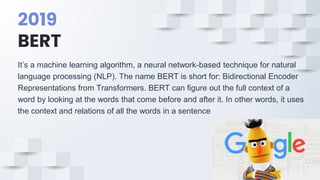
2019
BERT
It’s a machine learning algorithm, a neural network-based technique for natural
language processing (NLP). The name BERT is short for: Bidirectional Encoder
Representations from Transformers. BERT can figure out the full context of a
word by looking at the words that come before and after it. In other words, it uses
the context and relations of all the words in a sentence
2019
BERT
18
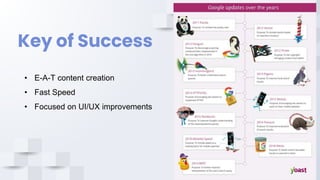
Key of Success
• E-A-T content creation
• Fast Speed
• Focused on UI/UX improvements
Thank You
Let’s learn SEO together and make our
website better!
19

2020 Google Algoritm Update Timeline

  • 1.
    SEO Tips Today: GoogleAlgorithm Porsh 2020.9.25
  • 2.
    HELLO! I am PorshTsai Google Product Expert(webmaster) SEO & Game addict/Family person/Drummer 2
  • 3.
    3 What is Google Algorithm Google’salgorithms are a complex system used to retrieve data from its search index and instantly deliver the best possible results for a query. The search engine uses a combination of algorithms and numerous ranking signals to deliver web pages ranked by relevance on its search engine results pages (SERPs)
  • 4.
    2011 Panda This is theGoogle algorithm which will analyze the quality of the content and evaluate the website. According to this, the pages which are having higher quality content would be given higher page ranking and vice versa. Impact: • Affiliate sites (sites which mainly exist to link to other pages). • Sites with very thin content.
  • 5.
    2012 Penguin It evaluates thewebsite on varied factors. They can affect the site’s ranking based on the backlinks of the site. Contextual page linking, content based on the linked page, links from trustworthy sources and from different domains can adversely affect the page ranking. Impact: • Site with artificial links or low quality links
  • 6.
    2013 Hummingbird The main purposeof Hummingbird’s algorithm was to translate semantic search from a concept to a reality and one that would ultimately become the search standard. The Hummingbird update saw Google lay down the groundwork for voice-search. Hummingbird pays more attention to each word in a query, ensuring that the whole search phrase is taken into account, rather than just particular words. Impact: • Over-optimized for the same few words
  • 7.
    2014 HTTPS/SSL To underline theimportance of security, Google decided to give a small ranking boost to sites that correctly implemented HTTPS to make the connection between website and user secure. At the time, HTTPS was introduced as a lightweight ranking signal. But Google had already hinted at the possibility of making encryption more important, once webmasters had had the time to implement it. Impact: • Webisite without HTTPS/SSL
  • 8.
    2015 MOBILE UPDATE The SEOindustry dubbed this Google update ‘​Mobilegeddon​’ as they thought it would totally shake up the search results. The Mobile Update gave mobile- friendly sites a ranking advantage in Google’s mobile search results. In spite of its dramatic nickname, the mobile update didn’t instantly mess up most people’s rankings. Impact: • Website without RWD
  • 9.
    2015 RankBrain RankBrain is astate-of-the-art Google algorithm, employing machine learning to handle queries. It can make guesses about words it doesn’t know, to find words with similar meanings and then offer relevant results. The Rank Brain algorithm analyzed past searches, determining the best result, in order to improve. It is one of the three most important of its ranking signals.
  • 10.
  • 11.
    2016 Possum Google’s algorithm update​Possum update​ applied several changes to Google’s local ranking filter to further improve local search. After Possum, local results became more varied, depending more on the physical location of the searcher and the phrasing of the query.
  • 12.
  • 13.
    2018 Speed Update(Mobile) Acknowledging users’need for fast delivery of information, Google implemented this update that made page speed a ranking factor for mobile searches, as was already the case for desktop searches. Impact: • Mobile webpage with slow speed performance
  • 14.
    2018 Medic This broad corealgorithm update caused quite a stir for those affected, leading to some shifts in ranking. While a relatively high number of medical sites were hit with lower rankings.
  • 15.
  • 16.
    2019 BERT It’s a machinelearning algorithm, a neural network-based technique for natural language processing (NLP). The name BERT is short for: Bidirectional Encoder Representations from Transformers. BERT can figure out the full context of a word by looking at the words that come before and after it. In other words, it uses the context and relations of all the words in a sentence
  • 17.
  • 18.
    18 Key of Success •E-A-T content creation • Fast Speed • Focused on UI/UX improvements
  • 19.
    Thank You Let’s learnSEO together and make our website better! 19

Editor's Notes

  • #11 Organic Click-Through-Rate Dwell Time Bounce Rate Pogo-sticking
  • #17 Google用神經網絡技術BERT來改善自家搜尋品質,英文自然語言搜尋品質能提高1成。BERT可以讓電腦更貼近人類語言,理解使用者在Google搜尋時的意圖和真正想找的資訊是什麼。