GOOGLE
ALGORITHM
AGENDA
What is Google Algorithm?
How it works?
What it considers?
How they’re Up-dated?
8 major Google Algorithm updates
WHAT IS GOOGLE ALGORITHM?
Google's algorithm is a complex
system of rules that ranks websites
in search results.
HOW IT WORKS?
Google's algorithm searches its index of billions of web
pages for content that matches a user's query. It then
ranks the most relevant pages and presents them in a
list.
WHAT IT CONSIDERS?
Google's algorithm considers many factors, including:
• Keywords: If the keyword appears in the page's title, header
tags, and meta description
• Backlinks: The number of organic links to the page
• Page speed: How quickly the page loads
• Content quality: Whether the page contains relevant content
beyond the keyword
• Mobile performance: How the website performs on mobile
devices
HOW THEY’RE UP-DATED?
Google regularly updates its
algorithms to improve search results
and stay ahead of spammers. These
updates are often minor, but Google
also makes major changes called core
updates several times a year.
8 MAJOR GOOGLE
ALGORITHM UPDATES
1. PANDA
2. PENGUIN
3. HUMMING-BIRD
4. MOBILE
5. RANK-BRAIN
6. MEDIC
7. BERT
8. CORE UP-DATES
1.PANDA
The Panda algorithm, launched by Google in 2011, targets
low-quality content, such as duplicate or spammy text, and
penalizes websites for practices like keyword stuffing. It
assigns a "quality score" to pages, which affects their
rankings. Since becoming part of Google's core algorithm
in 2016, updates have been more frequent, speeding up
penalties and recoveries. To avoid these issues, regularly
check for content problems using tools like Website Auditor,
which can also help you create high-quality pages by
analyzing your competitors' successful content.
2.PENGUIN
The Google Penguin update, launched on April 24,
2012, targets websites with unnatural or spammy
backlinks, such as those from link farms or PBNs. To
avoid penalties, monitor your backlink profile with
tools like SEO Spy-Glass, which helps identify
suspicious link growth. If you find harmful links, you
can disavow them using Google’s Disavow Links Tool
to prevent ranking damage.
3.HUMMING-BIRD
The Google Hummingbird update, launched on August
22, 2013, focuses on understanding searcher intent
rather than just matching keywords. It uses natural
language processing to rank pages based on related
terms and synonyms. To adjust, expand your keyword
research to include related concepts and synonyms using
tools like Rank Tracker. Creating content that aligns
with searcher intent helps improve both engagement and
SEO.
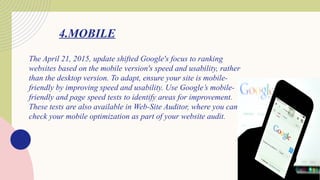
4.MOBILE
The April 21, 2015, update shifted Google's focus to ranking
websites based on the mobile version's speed and usability, rather
than the desktop version. To adapt, ensure your site is mobile-
friendly by improving speed and usability. Use Google’s mobile-
friendly and page speed tests to identify areas for improvement.
These tests are also available in Web-Site Auditor, where you can
check your mobile optimization as part of your website audit.
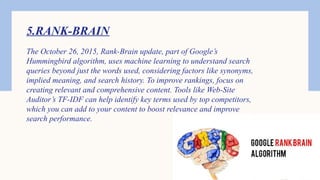
5.RANK-BRAIN
The October 26, 2015, Rank-Brain update, part of Google’s
Hummingbird algorithm, uses machine learning to understand search
queries beyond just the words used, considering factors like synonyms,
implied meaning, and search history. To improve rankings, focus on
creating relevant and comprehensive content. Tools like Web-Site
Auditor’s TF-IDF can help identify key terms used by top competitors,
which you can add to your content to boost relevance and improve
search performance.
6.MEDIC
The May 4, 2018, Google Medic update targeted websites
in sensitive areas like health and finance, emphasizing E-
A-T (expertise, authority, trust). To adapt, improve your
site's authority by building a strong backlink profile. Tools
like SEO Spy-Glass can help identify high-authority
backlinks from competitors to boost your site’s credibility
and E-A-T signals.
7.BERT
The October 22, 2019, Google BERT update improves
how Google understands search queries and content
context. To adapt, focus on writing high-quality,
meaningful content with relevant entities and clear
context, avoiding fluff. Google now rewards well-written,
informative copy more than ever.
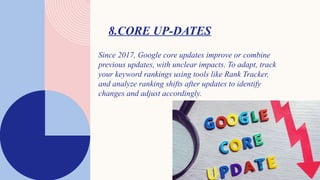
8.CORE UP-DATES
Since 2017, Google core updates improve or combine
previous updates, with unclear impacts. To adapt, track
your keyword rankings using tools like Rank Tracker,
and analyze ranking shifts after updates to identify
changes and adjust accordingly.
THANK-YOU
MADE BY: ARBAB

Google Algorithm | By Arbab/Adan IT Center

  • 1.
  • 2.
    AGENDA What is GoogleAlgorithm? How it works? What it considers? How they’re Up-dated? 8 major Google Algorithm updates
  • 3.
    WHAT IS GOOGLEALGORITHM? Google's algorithm is a complex system of rules that ranks websites in search results.
  • 4.
    HOW IT WORKS? Google'salgorithm searches its index of billions of web pages for content that matches a user's query. It then ranks the most relevant pages and presents them in a list.
  • 5.
    WHAT IT CONSIDERS? Google'salgorithm considers many factors, including: • Keywords: If the keyword appears in the page's title, header tags, and meta description • Backlinks: The number of organic links to the page • Page speed: How quickly the page loads • Content quality: Whether the page contains relevant content beyond the keyword • Mobile performance: How the website performs on mobile devices
  • 6.
    HOW THEY’RE UP-DATED? Googleregularly updates its algorithms to improve search results and stay ahead of spammers. These updates are often minor, but Google also makes major changes called core updates several times a year.
  • 7.
    8 MAJOR GOOGLE ALGORITHMUPDATES 1. PANDA 2. PENGUIN 3. HUMMING-BIRD 4. MOBILE 5. RANK-BRAIN 6. MEDIC 7. BERT 8. CORE UP-DATES
  • 8.
    1.PANDA The Panda algorithm,launched by Google in 2011, targets low-quality content, such as duplicate or spammy text, and penalizes websites for practices like keyword stuffing. It assigns a "quality score" to pages, which affects their rankings. Since becoming part of Google's core algorithm in 2016, updates have been more frequent, speeding up penalties and recoveries. To avoid these issues, regularly check for content problems using tools like Website Auditor, which can also help you create high-quality pages by analyzing your competitors' successful content.
  • 9.
    2.PENGUIN The Google Penguinupdate, launched on April 24, 2012, targets websites with unnatural or spammy backlinks, such as those from link farms or PBNs. To avoid penalties, monitor your backlink profile with tools like SEO Spy-Glass, which helps identify suspicious link growth. If you find harmful links, you can disavow them using Google’s Disavow Links Tool to prevent ranking damage.
  • 10.
    3.HUMMING-BIRD The Google Hummingbirdupdate, launched on August 22, 2013, focuses on understanding searcher intent rather than just matching keywords. It uses natural language processing to rank pages based on related terms and synonyms. To adjust, expand your keyword research to include related concepts and synonyms using tools like Rank Tracker. Creating content that aligns with searcher intent helps improve both engagement and SEO.
  • 11.
    4.MOBILE The April 21,2015, update shifted Google's focus to ranking websites based on the mobile version's speed and usability, rather than the desktop version. To adapt, ensure your site is mobile- friendly by improving speed and usability. Use Google’s mobile- friendly and page speed tests to identify areas for improvement. These tests are also available in Web-Site Auditor, where you can check your mobile optimization as part of your website audit.
  • 12.
    5.RANK-BRAIN The October 26,2015, Rank-Brain update, part of Google’s Hummingbird algorithm, uses machine learning to understand search queries beyond just the words used, considering factors like synonyms, implied meaning, and search history. To improve rankings, focus on creating relevant and comprehensive content. Tools like Web-Site Auditor’s TF-IDF can help identify key terms used by top competitors, which you can add to your content to boost relevance and improve search performance.
  • 13.
    6.MEDIC The May 4,2018, Google Medic update targeted websites in sensitive areas like health and finance, emphasizing E- A-T (expertise, authority, trust). To adapt, improve your site's authority by building a strong backlink profile. Tools like SEO Spy-Glass can help identify high-authority backlinks from competitors to boost your site’s credibility and E-A-T signals.
  • 14.
    7.BERT The October 22,2019, Google BERT update improves how Google understands search queries and content context. To adapt, focus on writing high-quality, meaningful content with relevant entities and clear context, avoiding fluff. Google now rewards well-written, informative copy more than ever.
  • 15.
    8.CORE UP-DATES Since 2017,Google core updates improve or combine previous updates, with unclear impacts. To adapt, track your keyword rankings using tools like Rank Tracker, and analyze ranking shifts after updates to identify changes and adjust accordingly.
  • 16.