Google uses many algorithms and ranking systems behind the scenes to decide which pages show up in search results, in what order, and which special features (snippets, knowledge panels, etc.) they earn.
What are Google
algorithms?
Googlealgorithms are complex sets
of rules and systems that Google
uses to rank and deliver the most
relevant and high-quality search
results in response to a user's query.
3.
Why updates
matter forSEO?
Google updates matter for SEO because
they frequently change the rules and
criteria for how websites are ranked,
requiring ongoing adaptation of SEO
strategies to maintain or improve
visibility and traffic.
4.
Importance of KeepingUp
With Updates
Impacts search rankings
directly
Keeping up with Google updates is crucial for SEO because these frequent
changes to the search algorithm directly impact website rankings and
visibility, requiring continuous adaptation of strategies to maintain or improve
organic traffic.
5.
Panda Update (2011)
•KTarget: Low-quality, thin content
• Rewards: Original, in-depth content
• Result: Content farms penalized
The Google Panda Update was a significant algorithm change, launched in 2011, aimed
at improving search result quality by demoting websites with "low-quality" content (e.g.,
thin, duplicated, or unoriginal content) and promoting those with high-quality, valuable
content.
6.
Penguin Update (2012)
•Target: Spammy backlinks
• Focus on link quality, not quantity
• Encouraged natural link-building
The Google Penguin Update was an algorithm update launched in 2012 to combat
webspam, specifically targeting websites using manipulative and unnatural link-building
practices to artificially inflate their search rankings.
7.
Hummingbird Update (2013)
•Emphasis on semantic search
• Understanding intent, not just keywords
• Helped long-tail keywords perform better
The Google Hummingbird Update, launched in 2013, was a significant overhaul of
Google's search algorithm designed to better understand the meaning and context
behind entire search queries, rather than just individual keywords, leading to more
relevant results for complex and conversational searches.
8.
Mobile-friendliness (2015)
• Mobile-friendlinessbecomes ranking factor
• Responsive design prioritized
• Pushed mobile-first indexing
The Google Mobile-friendliness Update, often called "Mobilegeddon," was an algorithm
change rolled out in 2015 that prioritized mobile-friendly websites in mobile search
results to provide a better user experience on smartphones and tablets.
9.
RankBrain (2015)
• AI-poweredalgorithm component
• Understands user behavior & context
• Signals content relevance beyond keywords
The Google RankBrain update is a machine learning-based artificial intelligence system
that helps Google better understand the meaning and intent behind complex or
ambiguous search queries, especially those it has never seen before, to deliver more
relevant search results.
10.
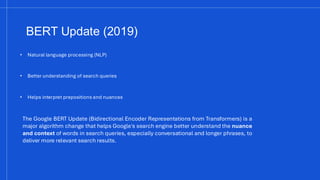
BERT Update (2019)
•Natural language processing (NLP)
• Better understanding of search queries
• Helps interpret prepositions and nuances
The Google BERT Update (Bidirectional Encoder Representations from Transformers) is a
major algorithm change that helps Google's search engine better understand the nuance
and context of words in search queries, especially conversational and longer phrases, to
deliver more relevant search results.
11.
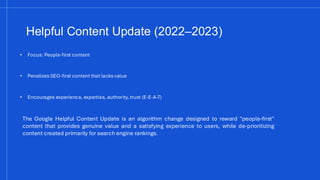
Helpful Content Update(2022–2023)
• Focus: People-first content
• Penalizes SEO-first content that lacks value
• Encourages experience, expertise, authority, trust (E-E-A-T)
The Google Helpful Content Update is an algorithm change designed to reward "people-first"
content that provides genuine value and a satisfying experience to users, while de-prioritizing
content created primarily for search engine rankings.
12.
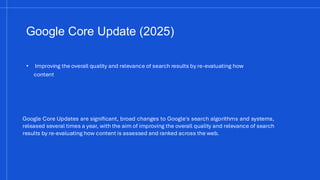
Google Core Update(2025)
• Improving the overall quality and relevance of search results by re-evaluating how
content
Google Core Updates are significant, broad changes to Google's search algorithms and systems,
released several times a year, with the aim of improving the overall quality and relevance of search
results by re-evaluating how content is assessed and ranked across the web.