An Overview of Cloud Computing:
My Other Computer is a Data Center
Robert Grossman
Open Data Group &
University of Illinois at Chicago
IEEE New Technologies Conference
August 6, 2009
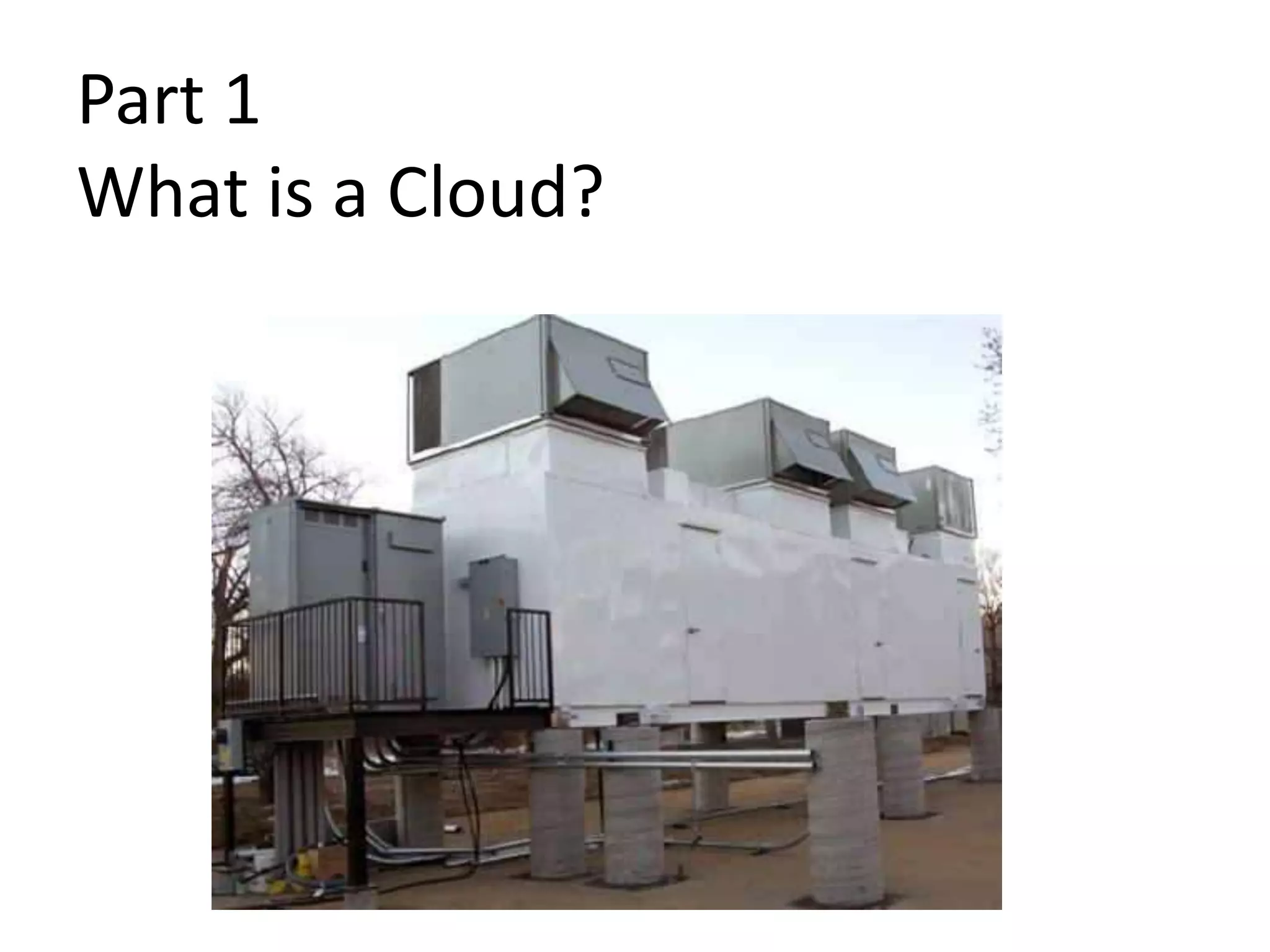
Part 1
What is a Cloud?
2
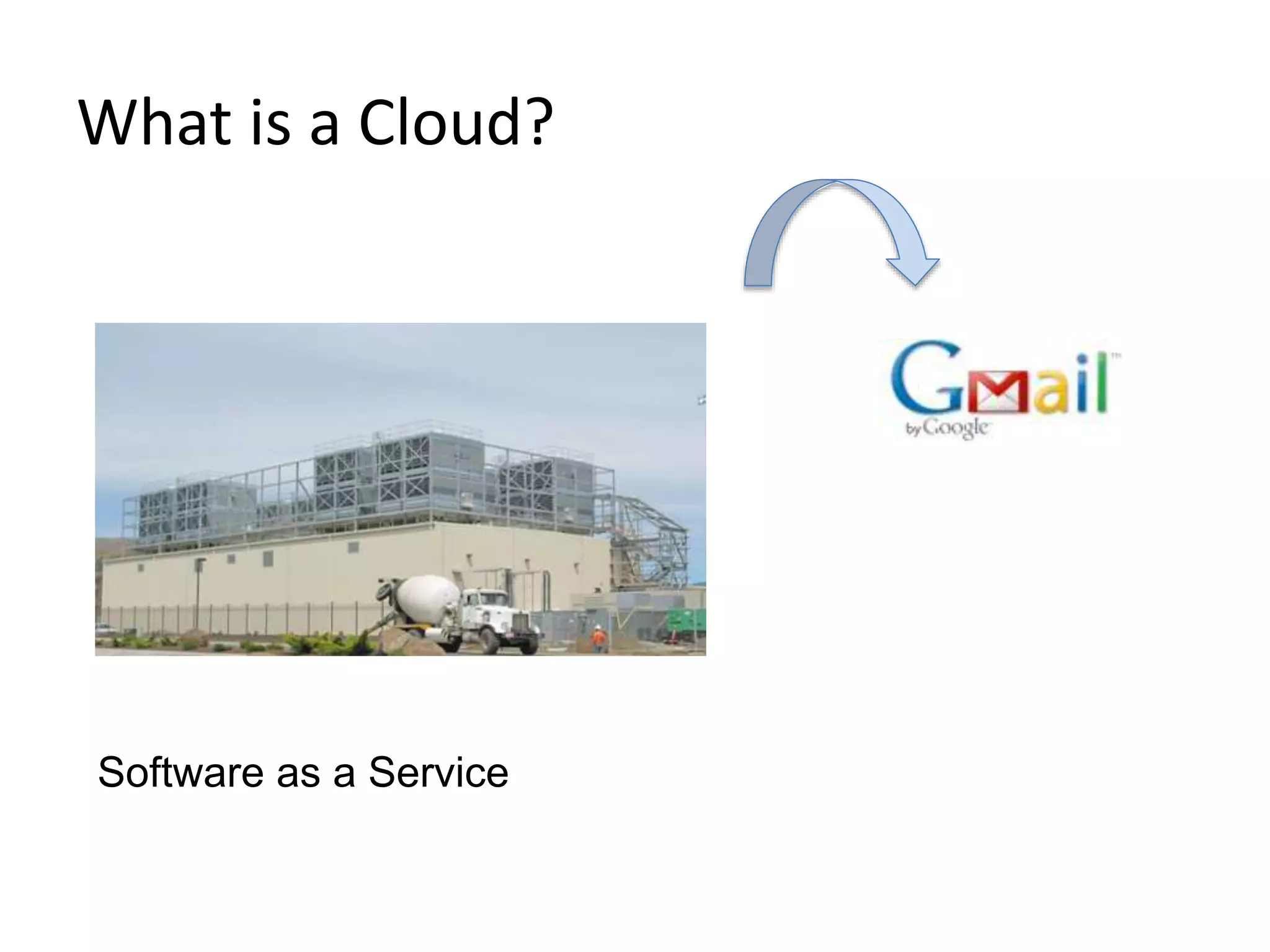
What is a Cloud?
3
Software as a Service
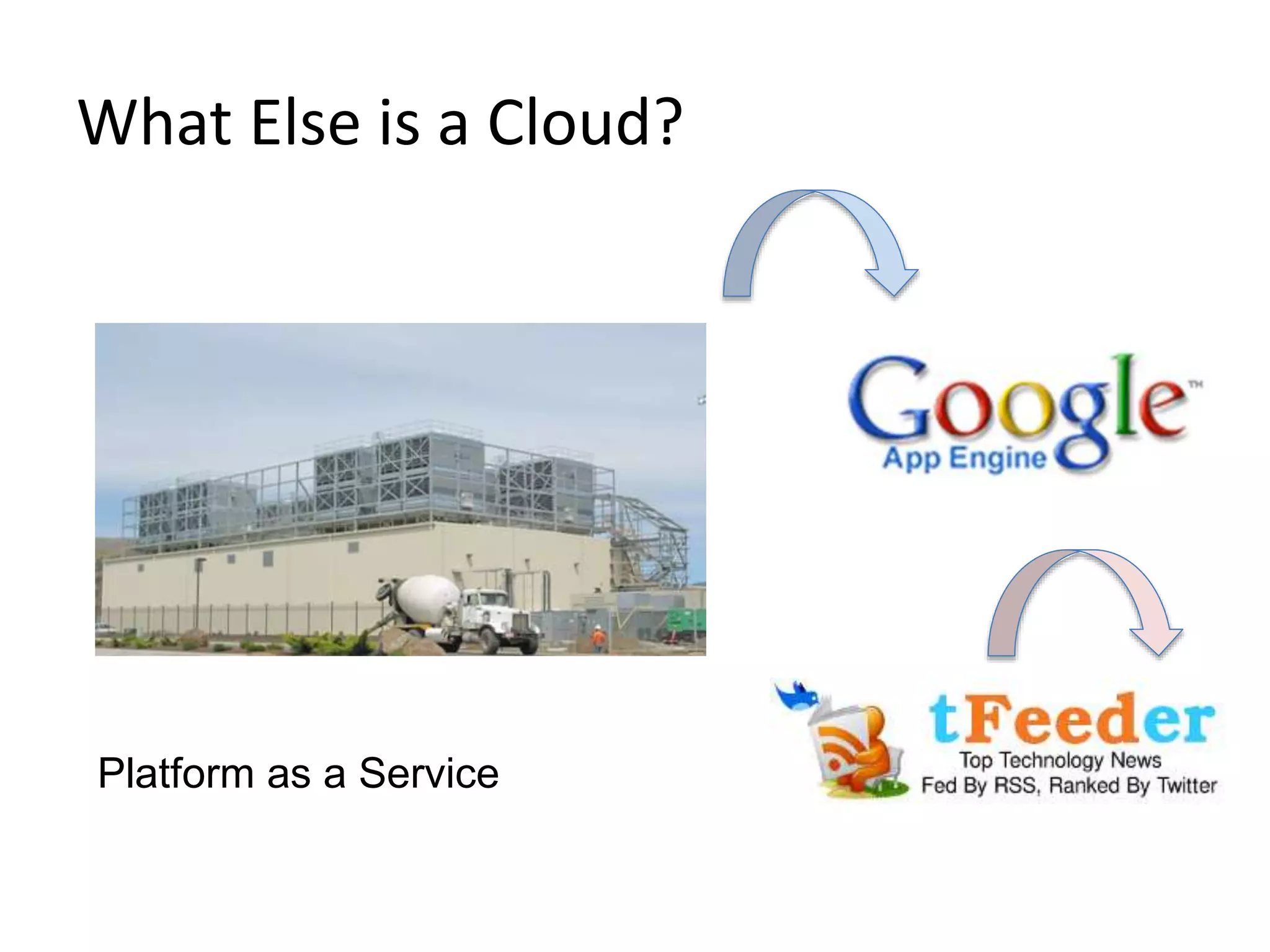
What Else is a Cloud?
4
Platform as a Service
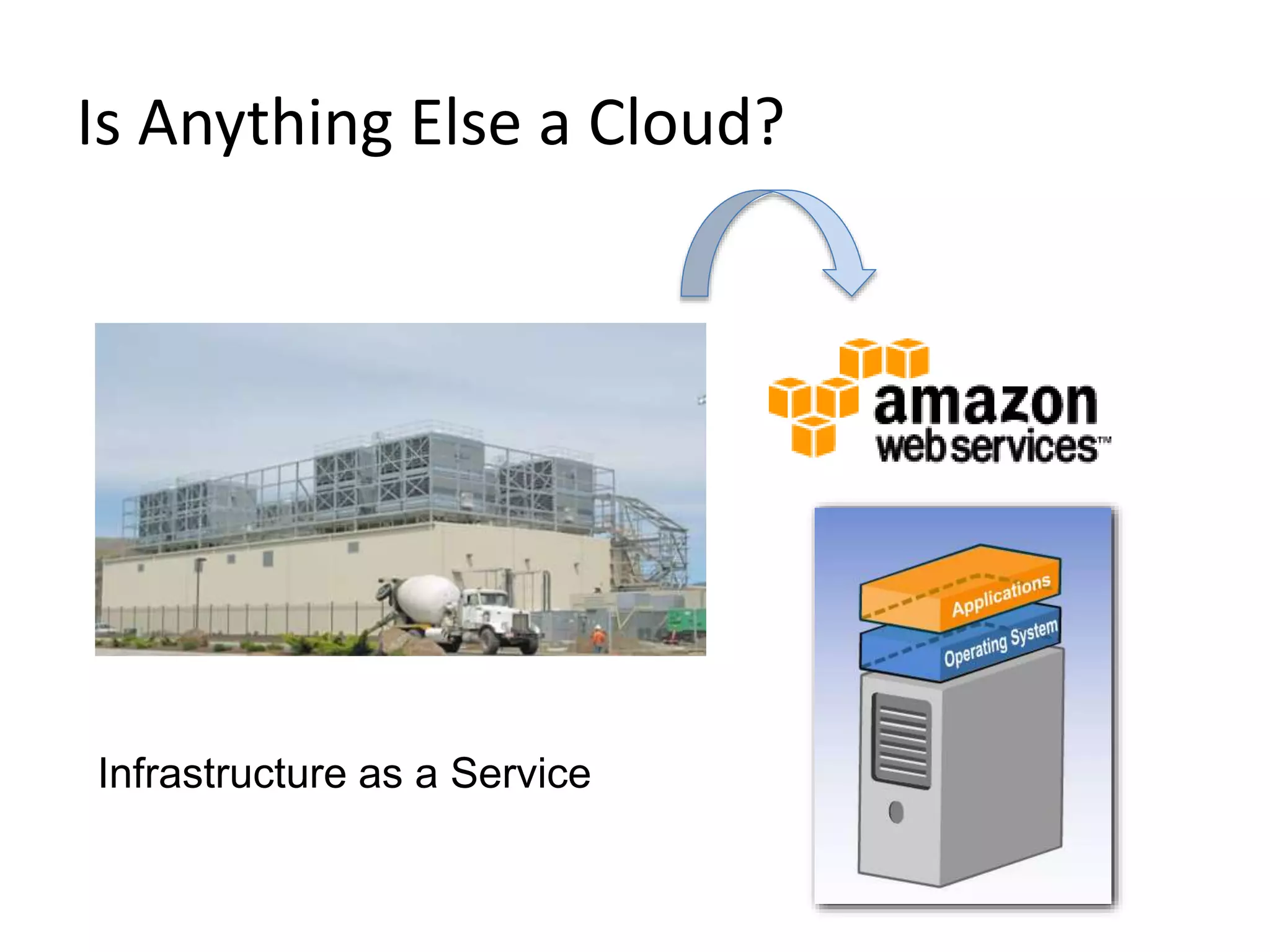
Is Anything Else a Cloud?
5
Infrastructure as a Service
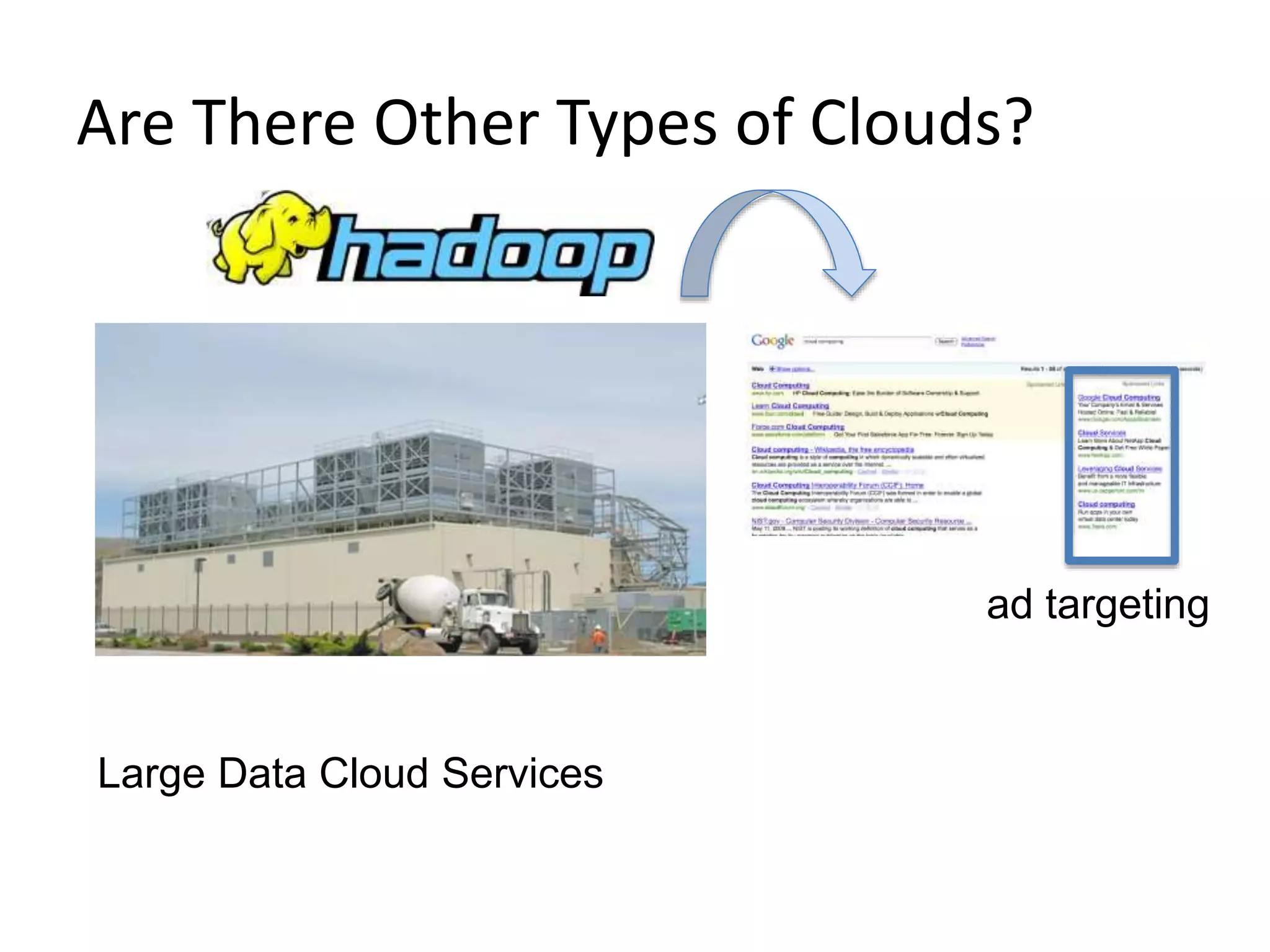
Are There Other Types of Clouds?
6
Large Data Cloud Services
ad targeting
One Definition
 Clouds provide on-demand resources or
services over a network, often the Internet,
with the scale and reliability of a data center.
 No standard definition.
 Cloud architectures are not new.
 What is new:
– Scale
– Ease of use
– Pricing model.
7
8
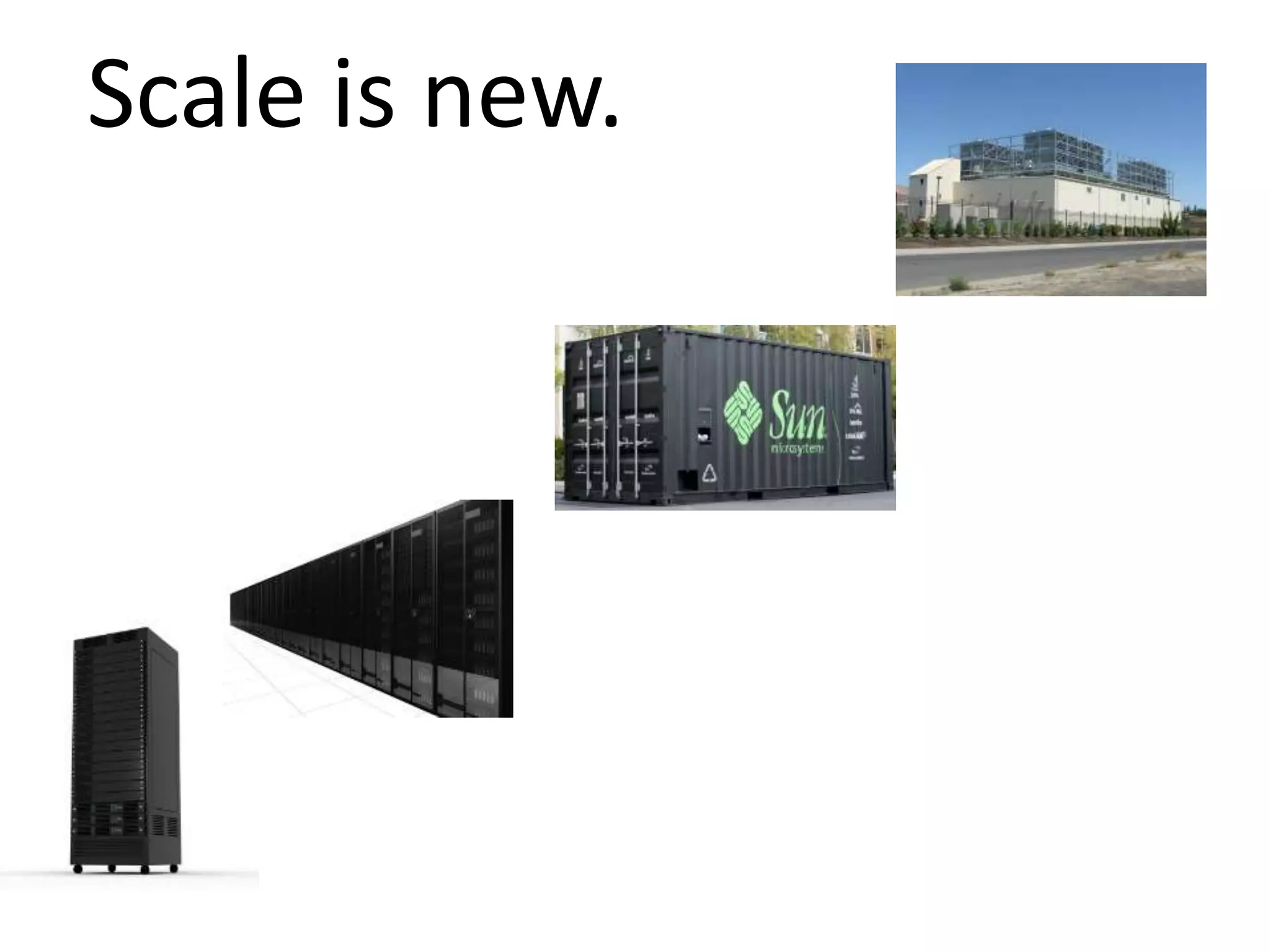
Scale is new.
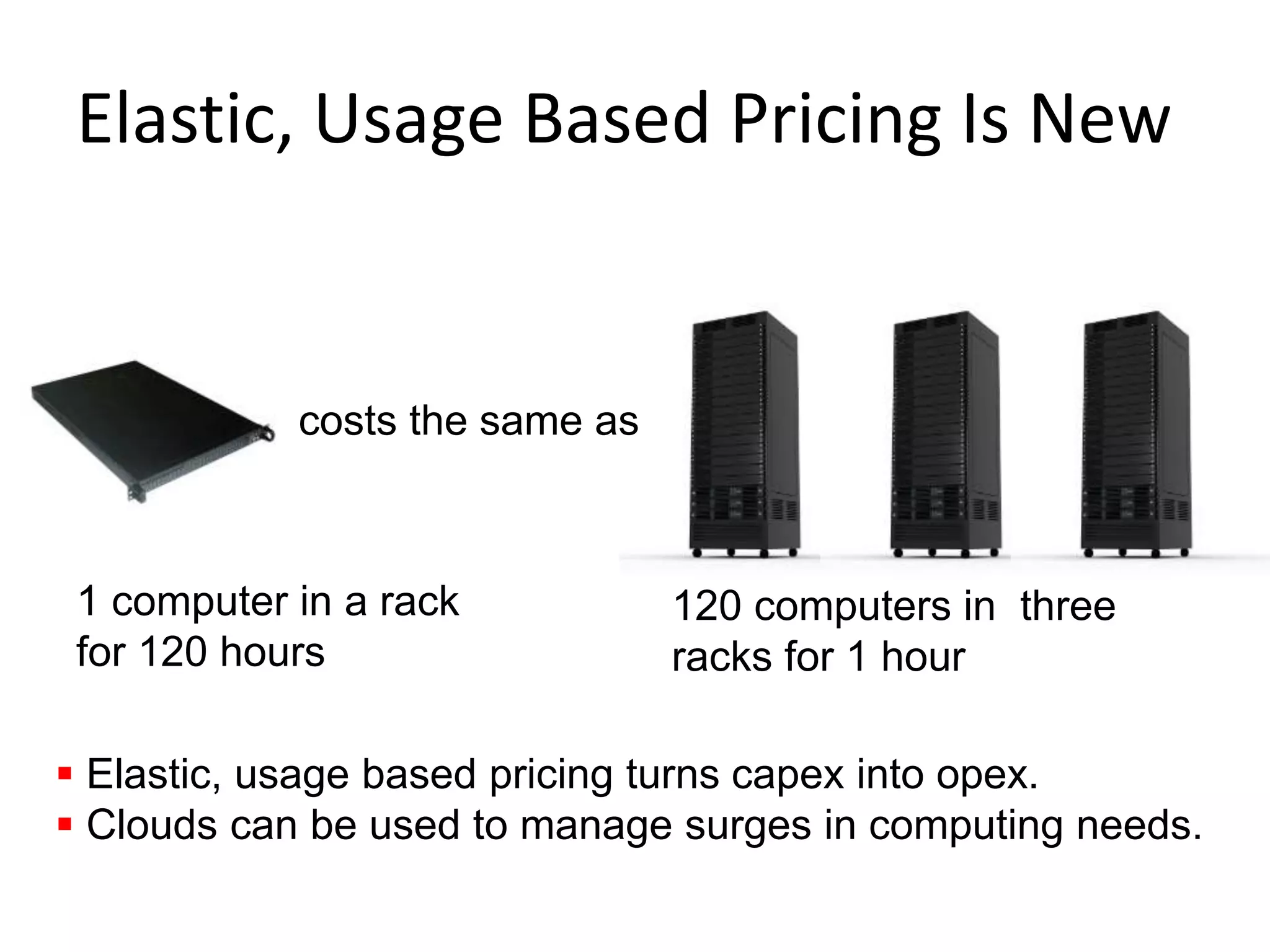
Elastic, Usage Based Pricing Is New
9
1 computer in a rack
for 120 hours
120 computers in three
racks for 1 hour
costs the same as
 Elastic, usage based pricing turns capex into opex.
 Clouds can be used to manage surges in computing needs.
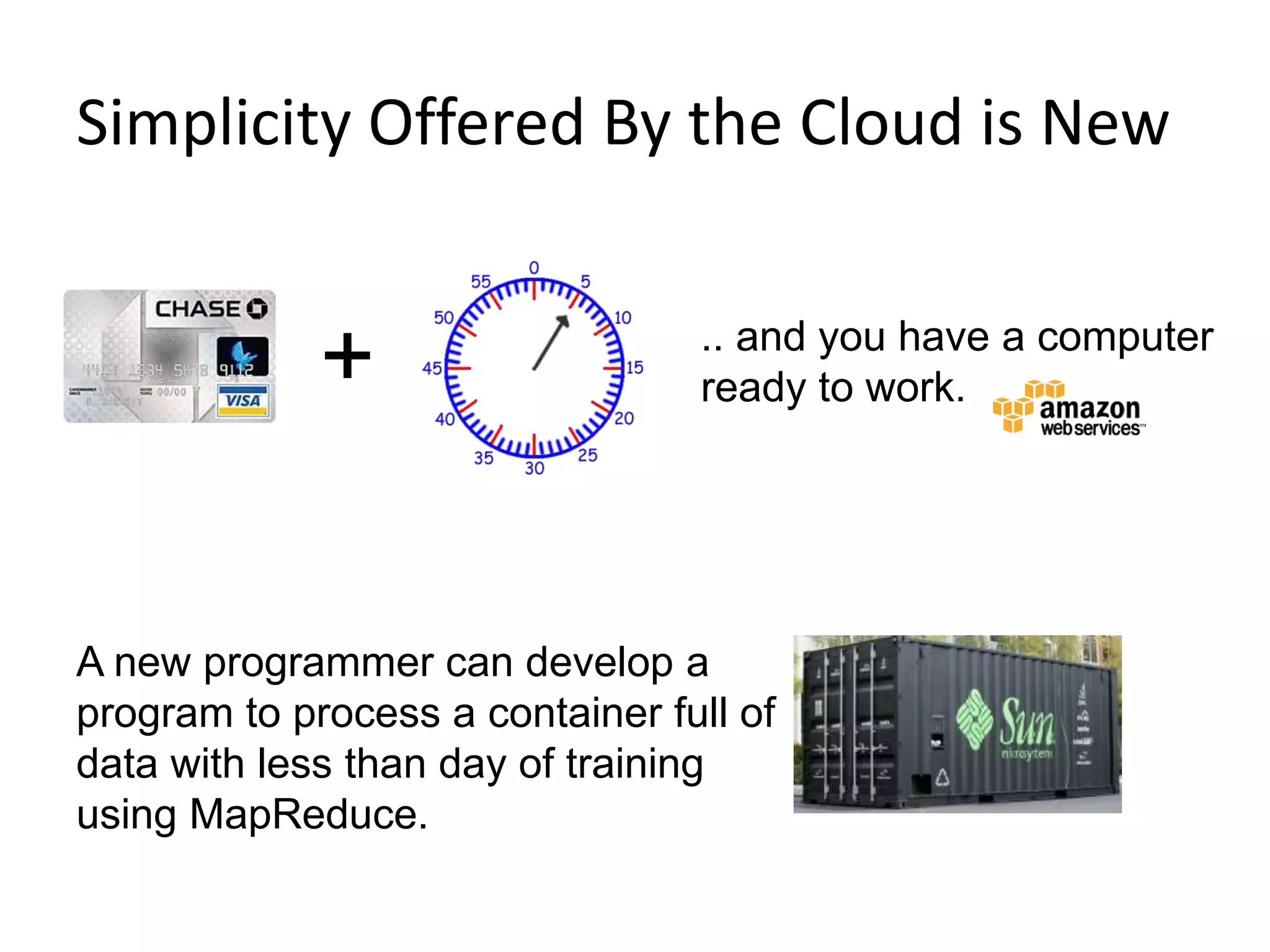
Simplicity Offered By the Cloud is New
10
+ .. and you have a computer
ready to work.
A new programmer can develop a
program to process a container full of
data with less than day of training
using MapReduce.
Part 2
Varieties of Clouds
11
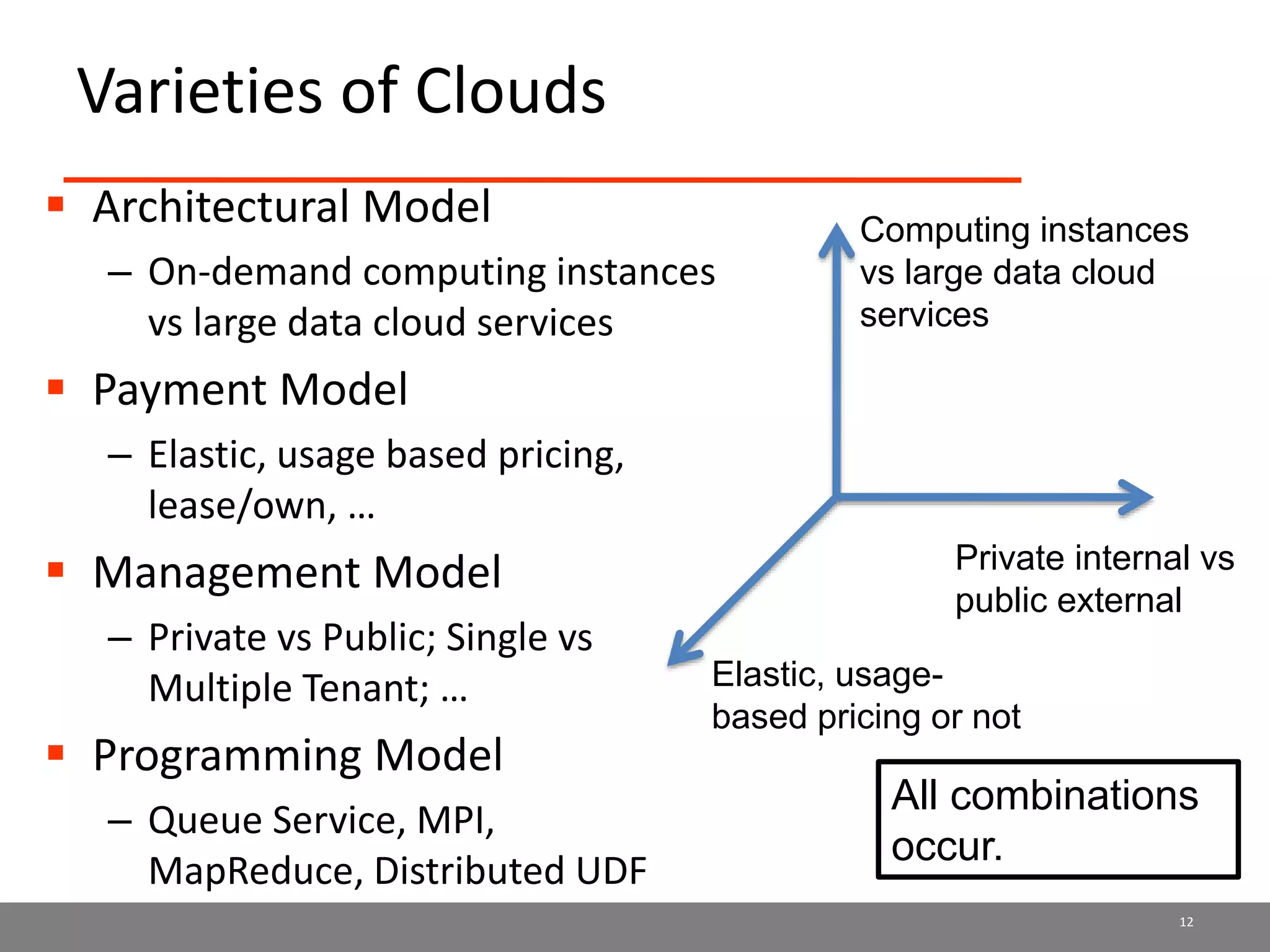
Varieties of Clouds
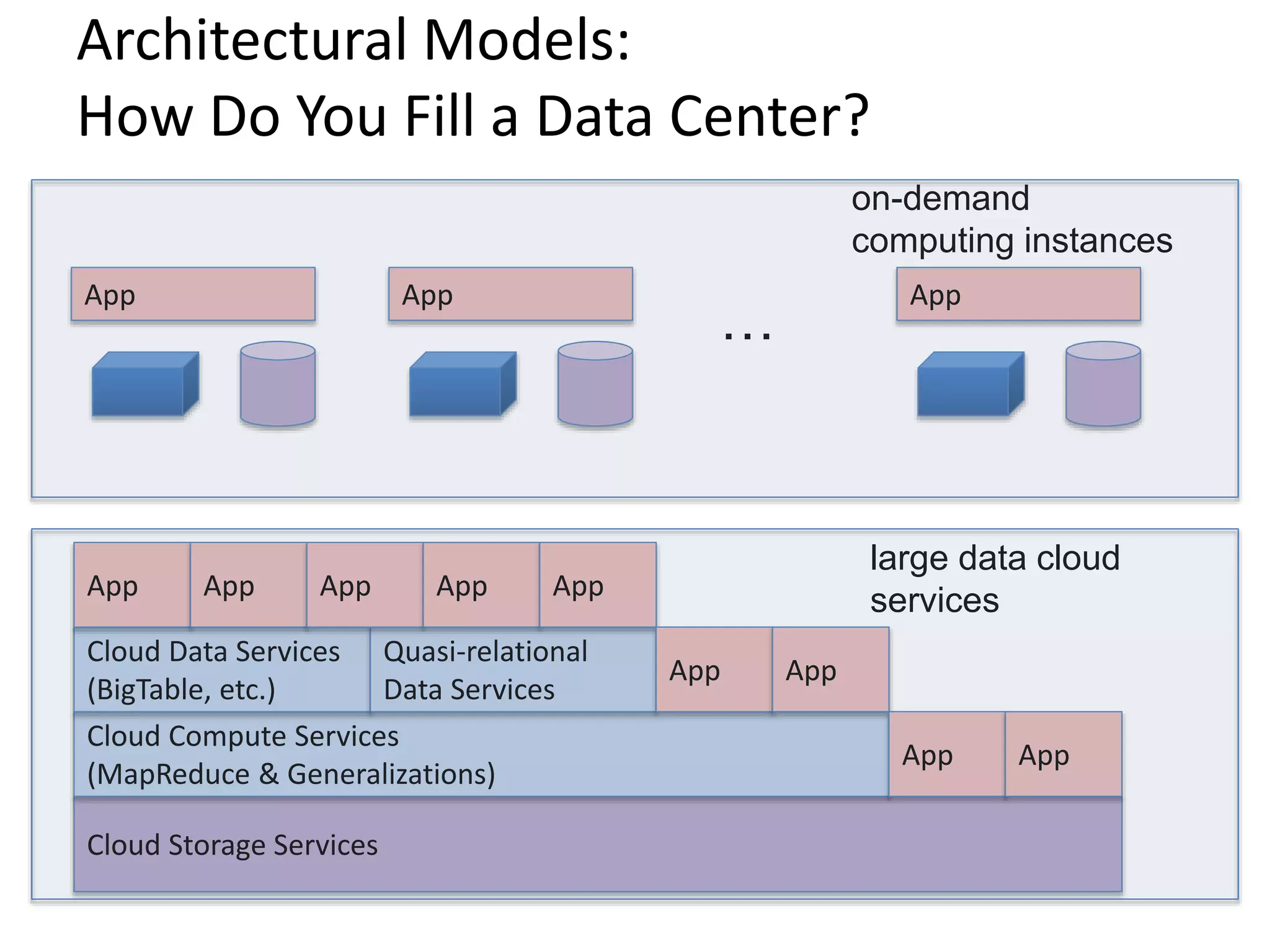
 Architectural Model
– On-demand computing instances
vs large data cloud services
 Payment Model
– Elastic, usage based pricing,
lease/own, …
 Management Model
– Private vs Public; Single vs
Multiple Tenant; …
 Programming Model
– Queue Service, MPI,
MapReduce, Distributed UDF
12
Computing instances
vs large data cloud
services
Private internal vs
public external
Elastic, usage-
based pricing or not
All combinations
occur.
Architectural Models:
How Do You Fill a Data Center?
Cloud Storage Services
Cloud Compute Services
(MapReduce & Generalizations)
Cloud Data Services
(BigTable, etc.)
Quasi-relational
Data Services
App App App App App
App App
App App
large data cloud
services
App App App
…
on-demand
computing instances
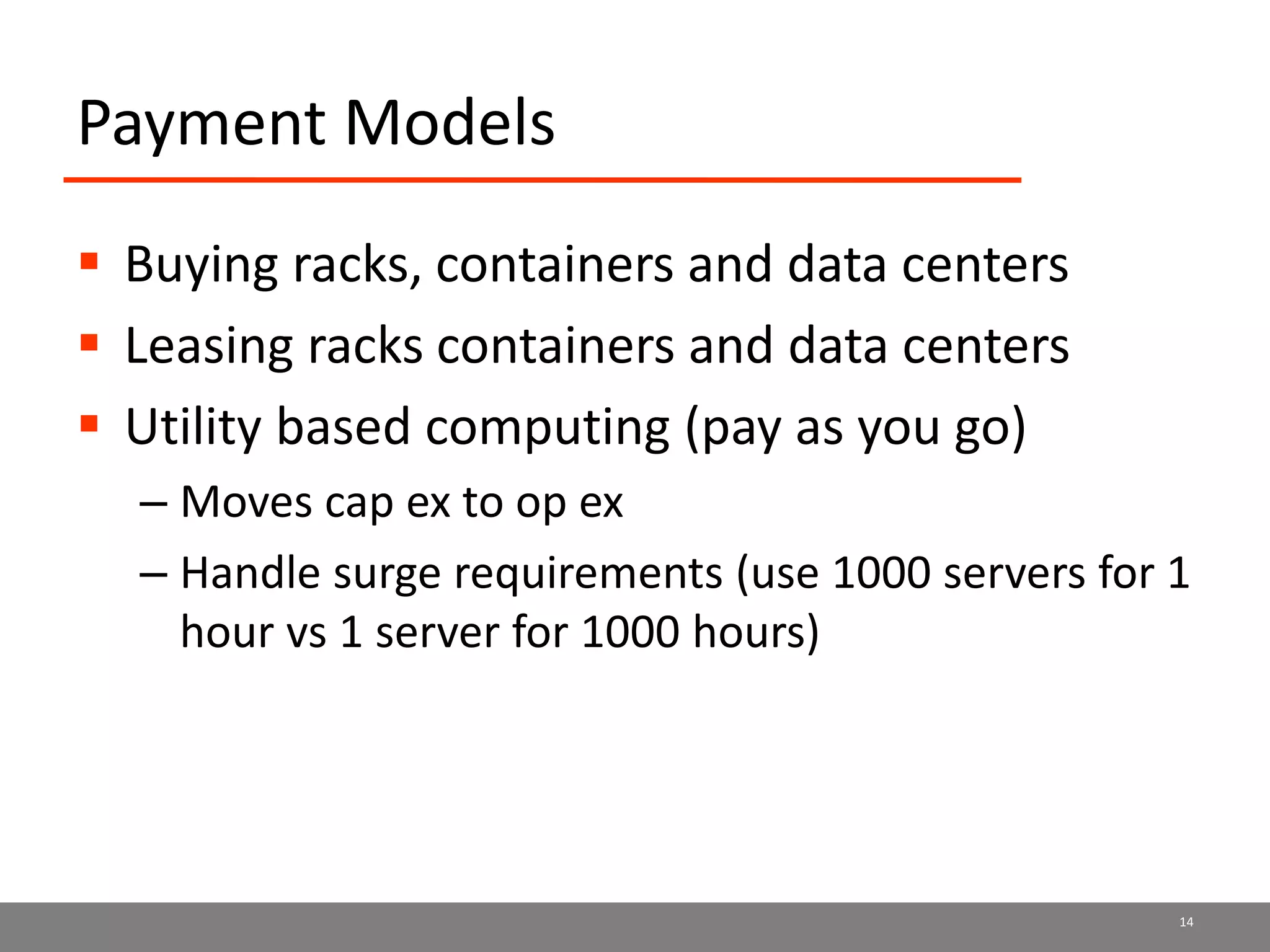
Payment Models
 Buying racks, containers and data centers
 Leasing racks containers and data centers
 Utility based computing (pay as you go)
– Moves cap ex to op ex
– Handle surge requirements (use 1000 servers for 1
hour vs 1 server for 1000 hours)
14
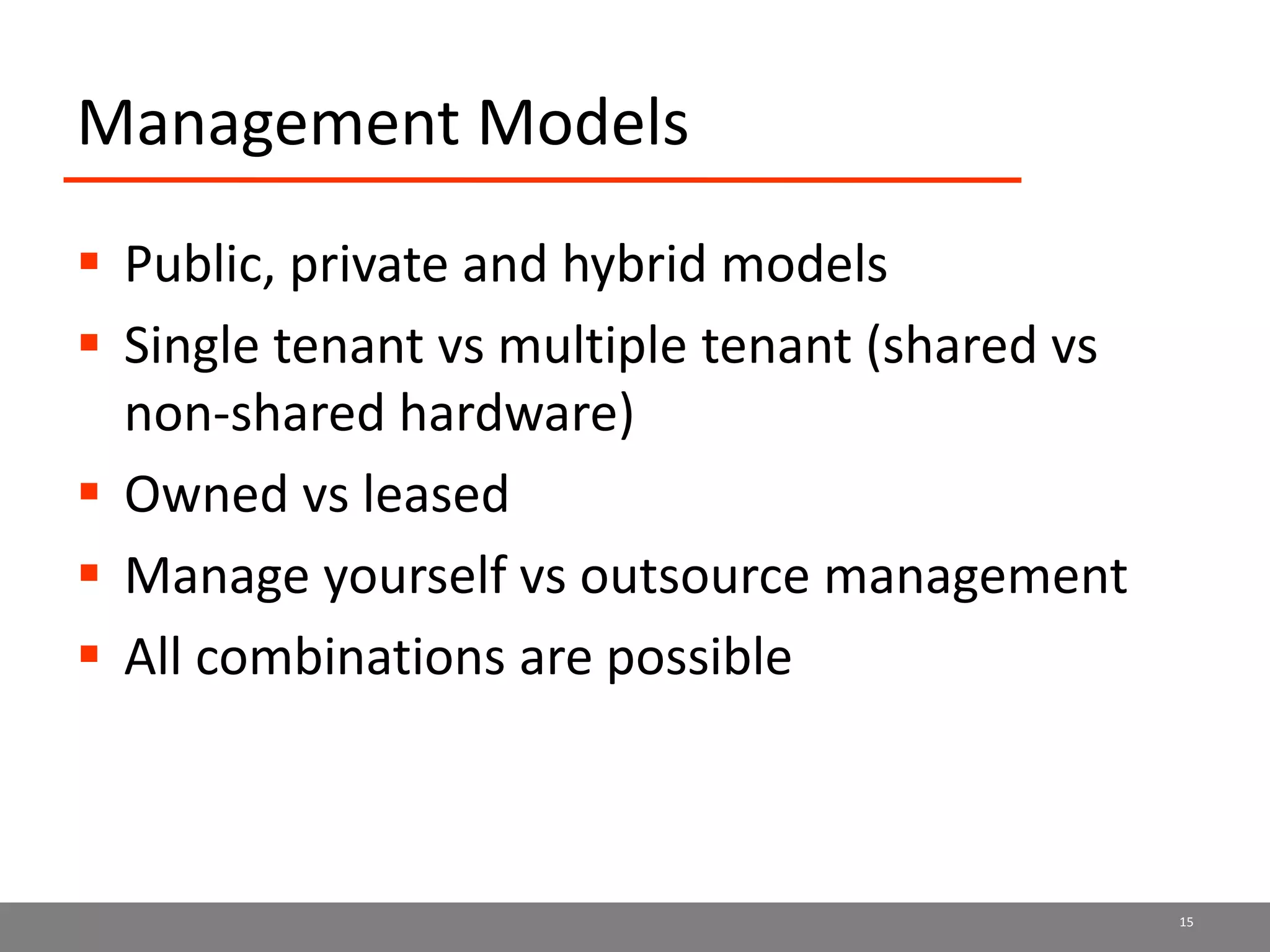
Management Models
 Public, private and hybrid models
 Single tenant vs multiple tenant (shared vs
non-shared hardware)
 Owned vs leased
 Manage yourself vs outsource management
 All combinations are possible
15
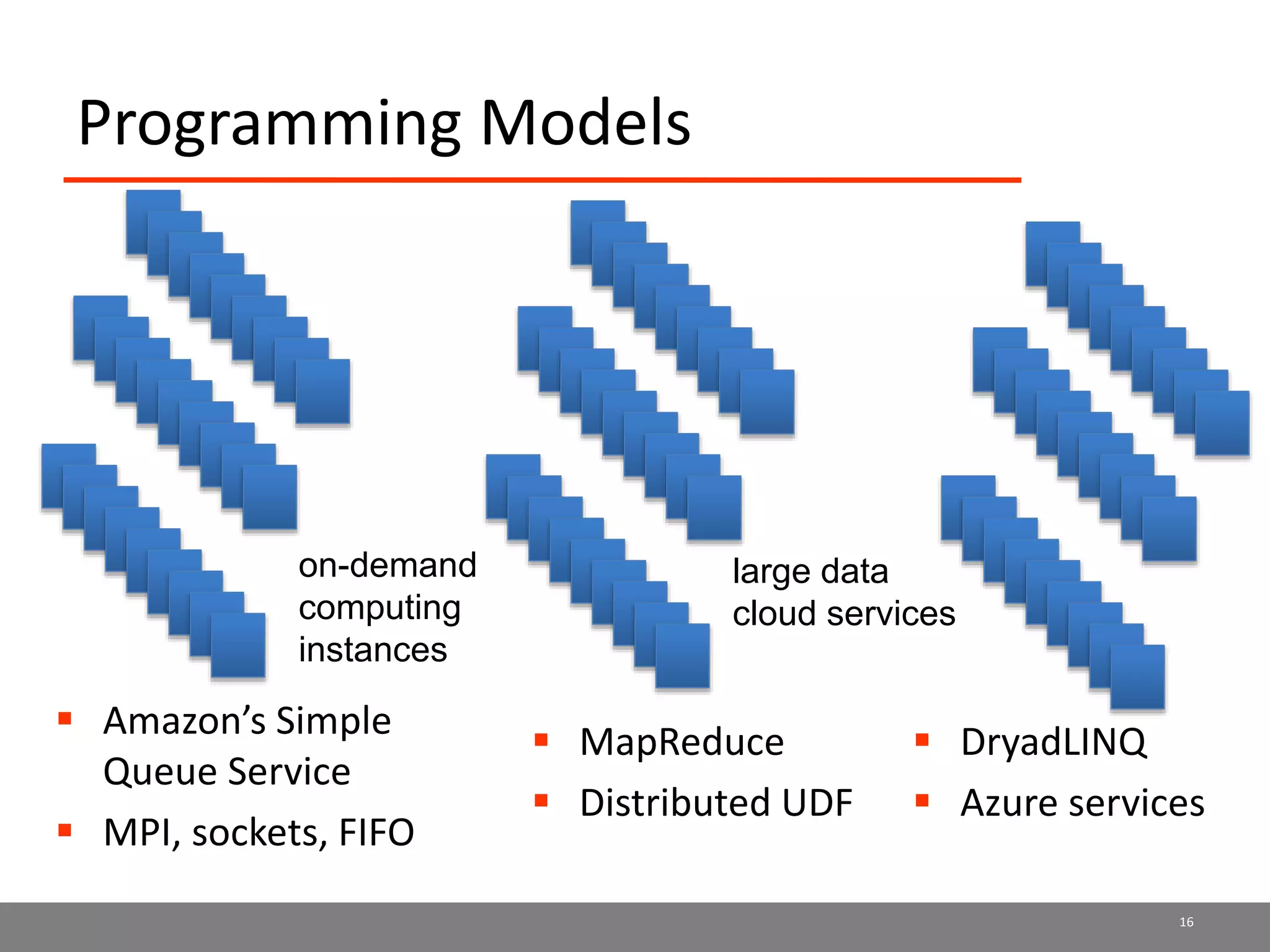
Programming Models
 Amazon’s Simple
Queue Service
 MPI, sockets, FIFO
16
 MapReduce
 Distributed UDF
on-demand
computing
instances
large data
cloud services
 DryadLINQ
 Azure services
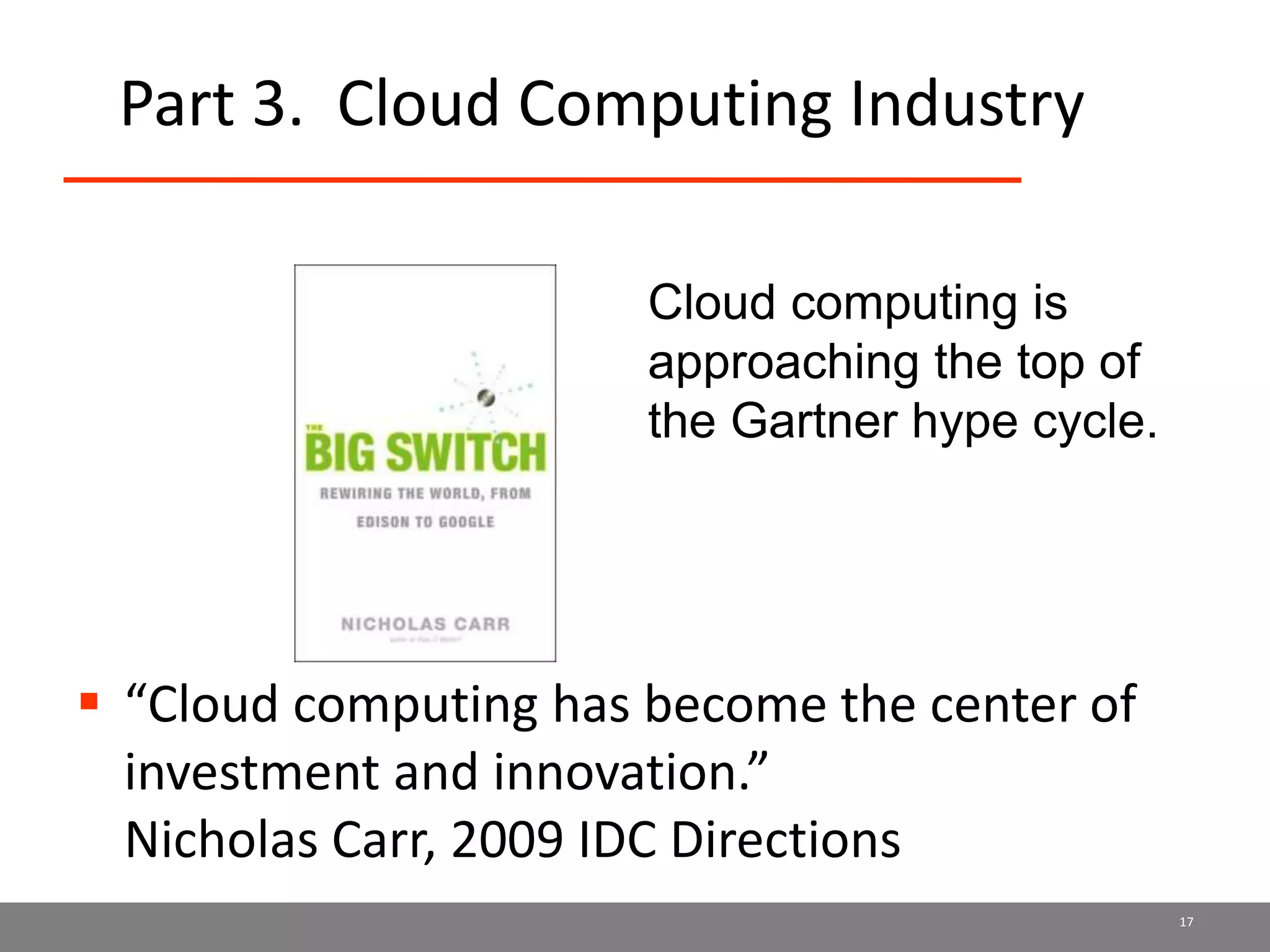
Part 3. Cloud Computing Industry
 “Cloud computing has become the center of
investment and innovation.”
Nicholas Carr, 2009 IDC Directions
17
Cloud computing is
approaching the top of
the Gartner hype cycle.
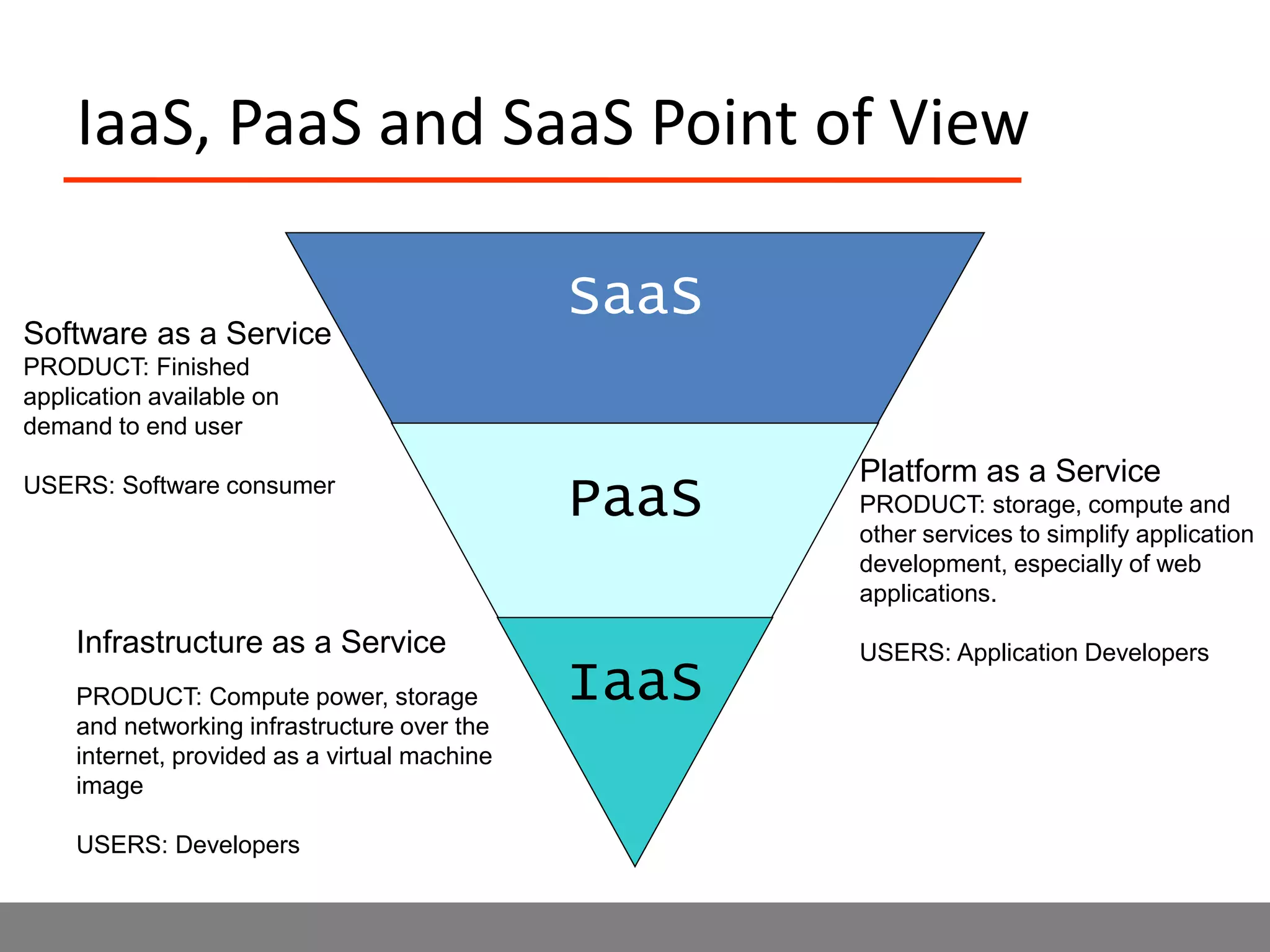
IaaS, PaaS and SaaS Point of View
SaaS
PaaS
IaaS
Infrastructure as a Service
PRODUCT: Compute power, storage
and networking infrastructure over the
internet, provided as a virtual machine
image
USERS: Developers
Platform as a Service
PRODUCT: storage, compute and
other services to simplify application
development, especially of web
applications.
USERS: Application Developers
Software as a Service
PRODUCT: Finished
application available on
demand to end user
USERS: Software consumer
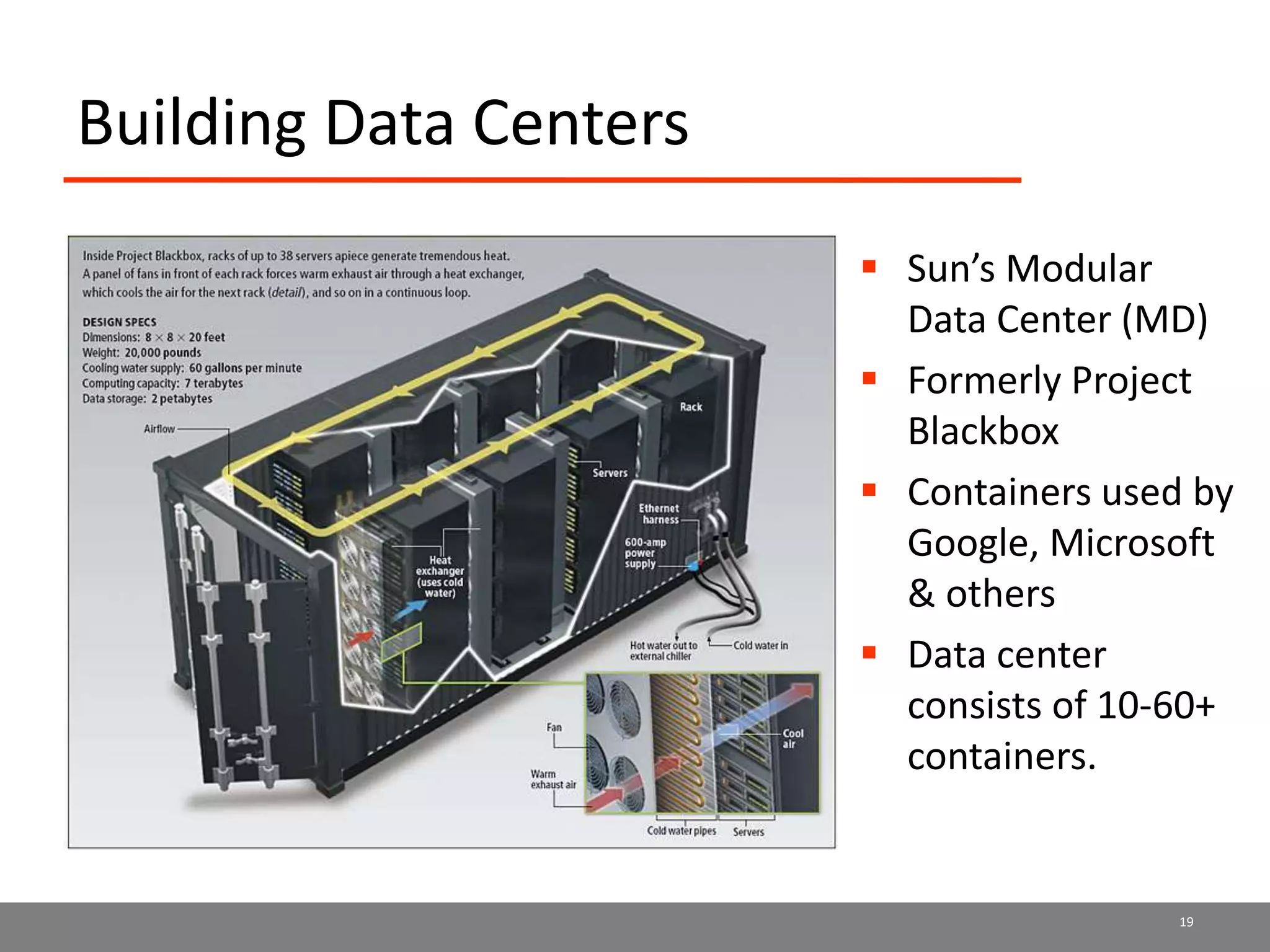
Building Data Centers
 Sun’s Modular
Data Center (MD)
 Formerly Project
Blackbox
 Containers used by
Google, Microsoft
& others
 Data center
consists of 10-60+
containers.
19
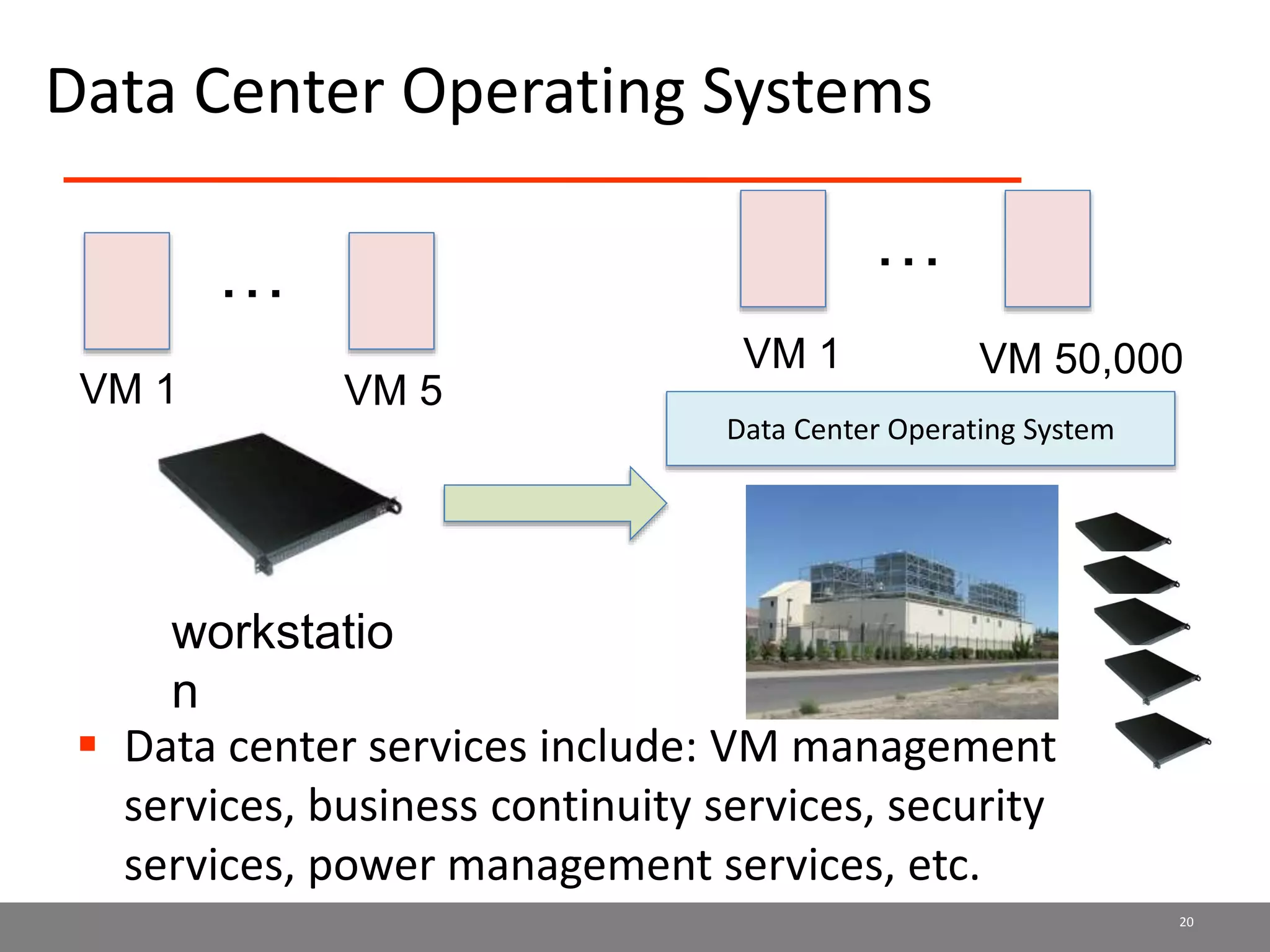
Data Center Operating Systems
 Data center services include: VM management
services, business continuity services, security
services, power management services, etc.
20
workstatio
n
VM 1 VM 5
…
VM 1 VM 50,000
…
Data Center Operating System
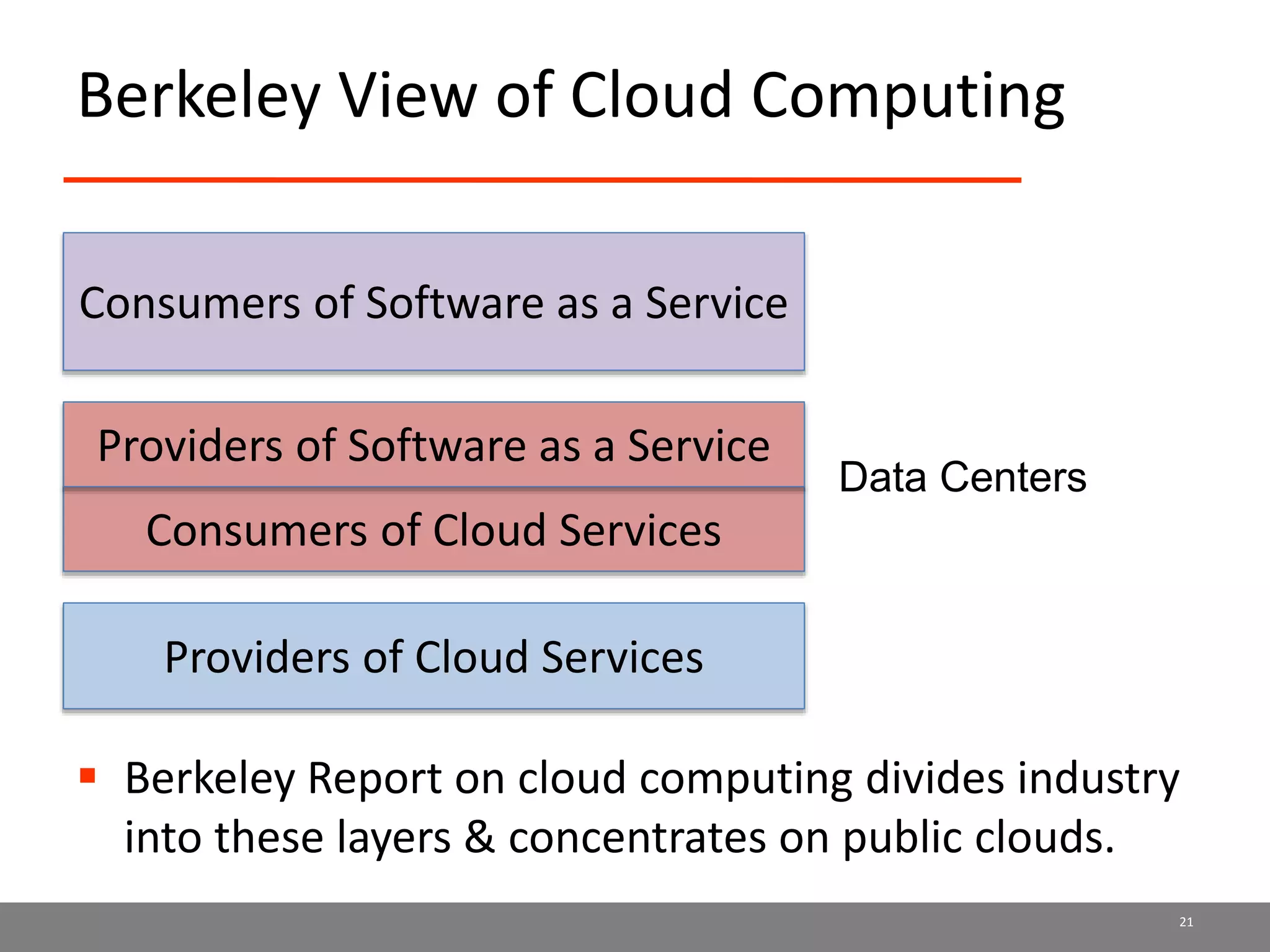
Berkeley View of Cloud Computing
21
Providers of Cloud Services
Consumers of Cloud Services
Providers of Software as a Service
Consumers of Software as a Service
 Berkeley Report on cloud computing divides industry
into these layers & concentrates on public clouds.
Data Centers
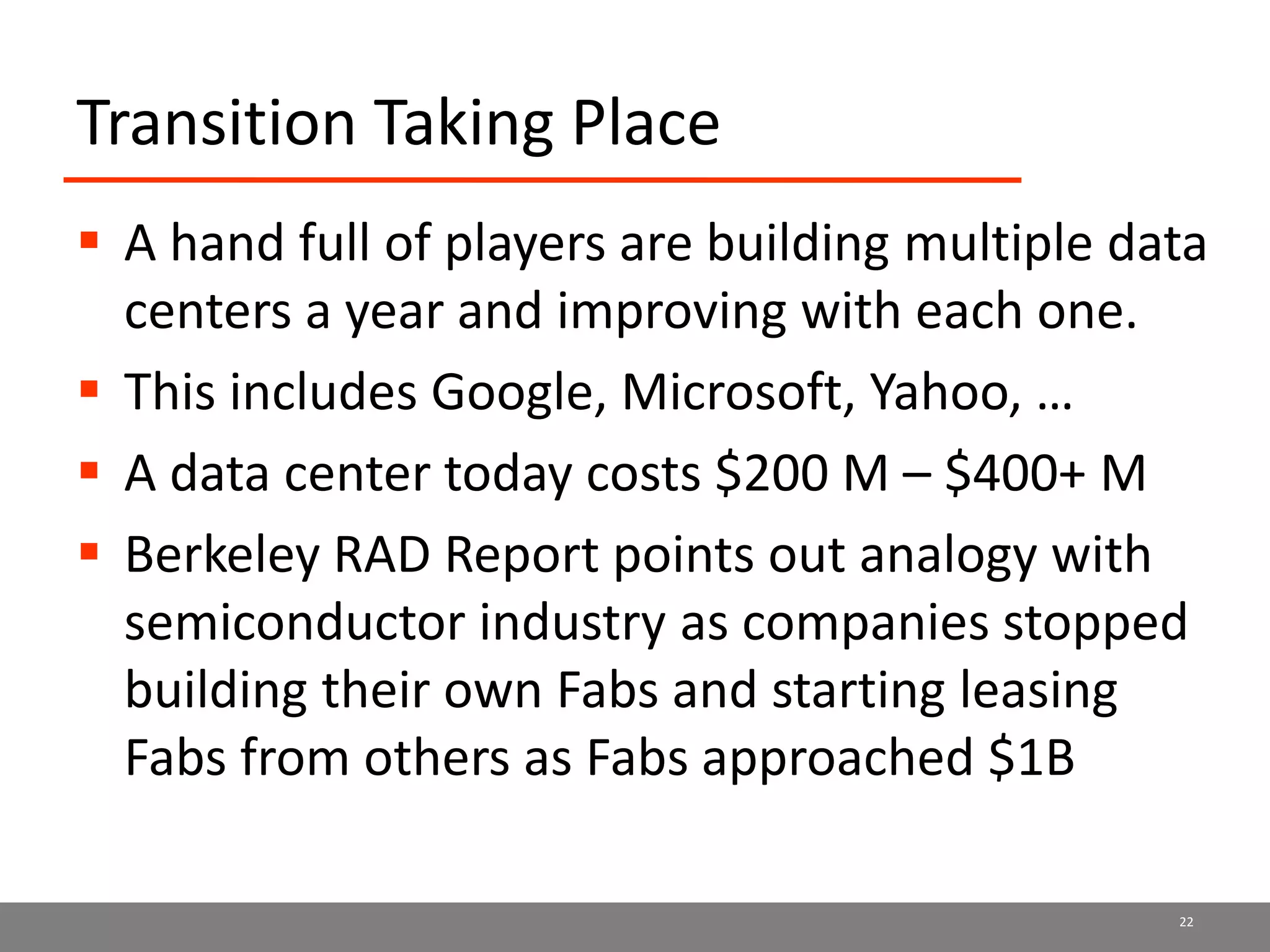
Transition Taking Place
 A hand full of players are building multiple data
centers a year and improving with each one.
 This includes Google, Microsoft, Yahoo, …
 A data center today costs $200 M – $400+ M
 Berkeley RAD Report points out analogy with
semiconductor industry as companies stopped
building their own Fabs and starting leasing
Fabs from others as Fabs approached $1B
22
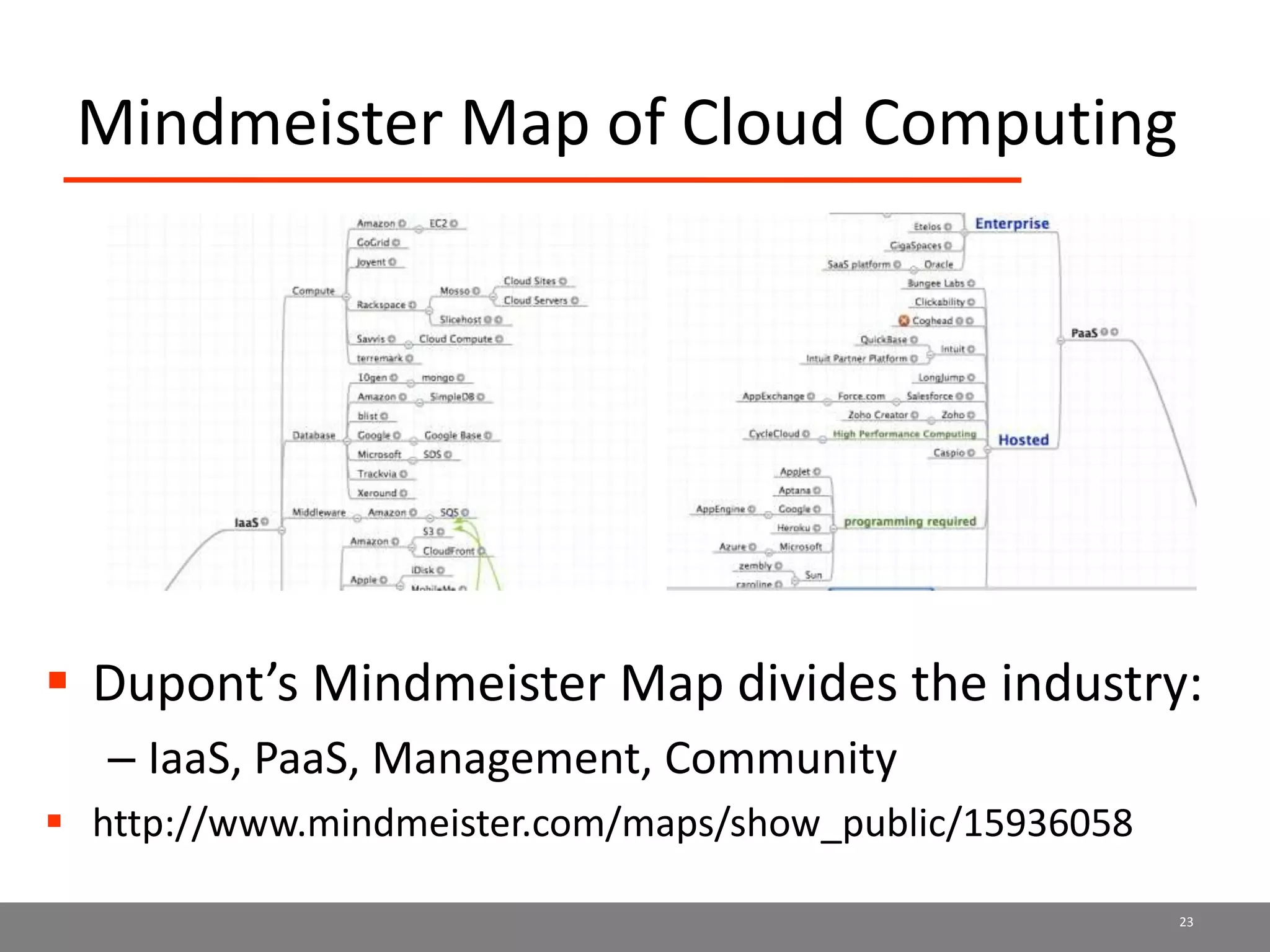
Mindmeister Map of Cloud Computing
 Dupont’s Mindmeister Map divides the industry:
– IaaS, PaaS, Management, Community
 http://www.mindmeister.com/maps/show_public/15936058
23
Part 4
Virtualization
24
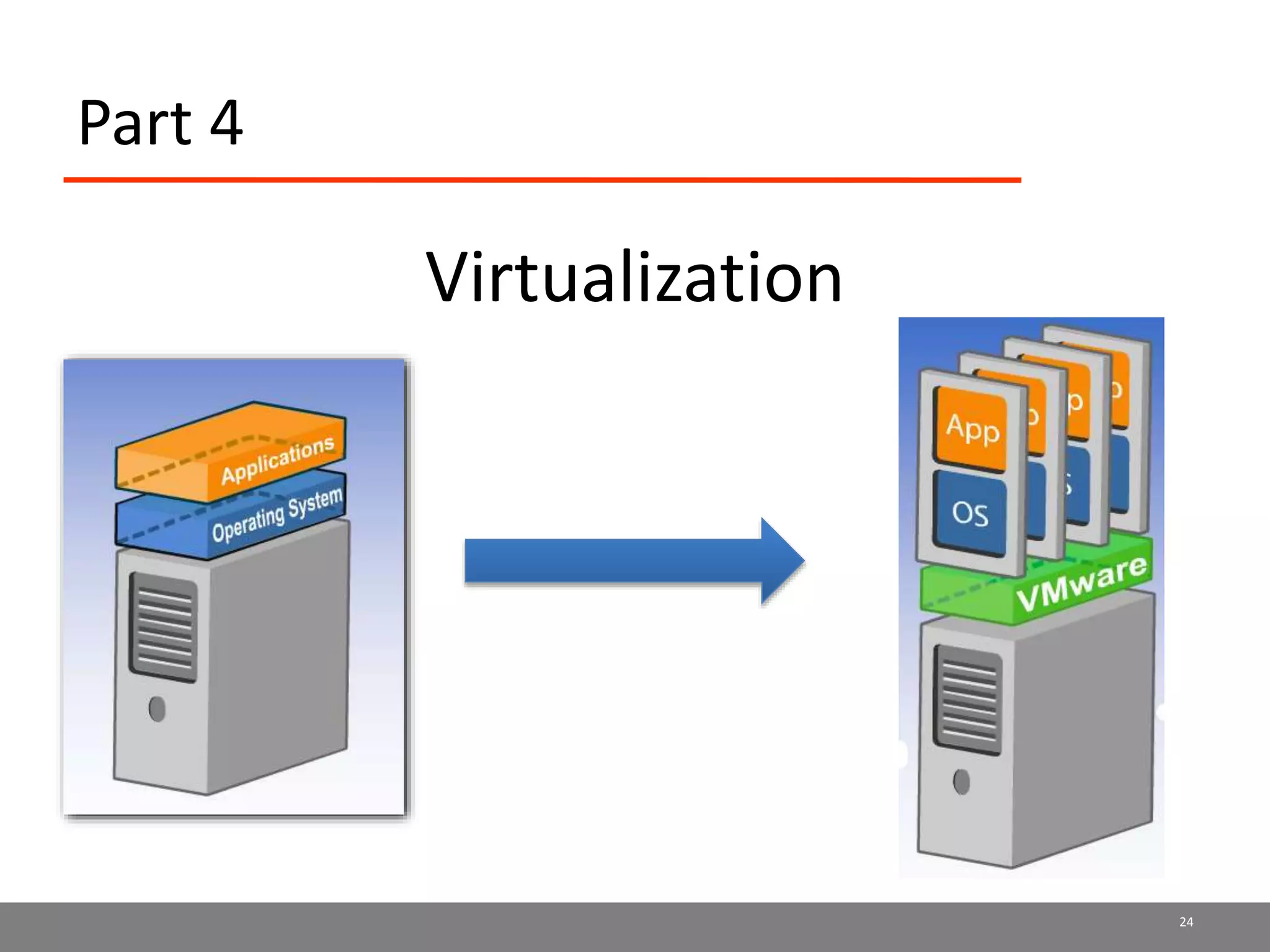
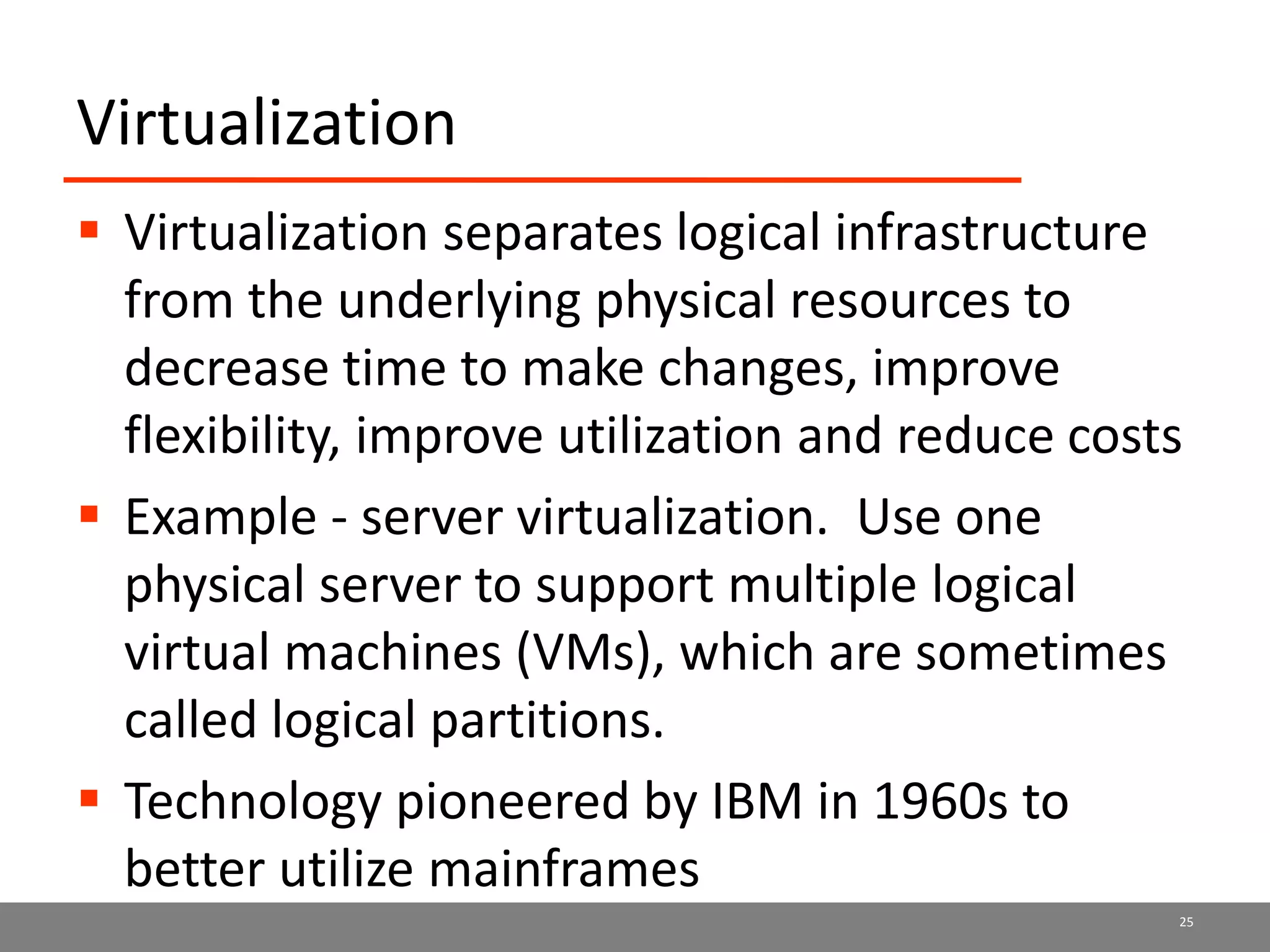
Virtualization
 Virtualization separates logical infrastructure
from the underlying physical resources to
decrease time to make changes, improve
flexibility, improve utilization and reduce costs
 Example - server virtualization. Use one
physical server to support multiple logical
virtual machines (VMs), which are sometimes
called logical partitions.
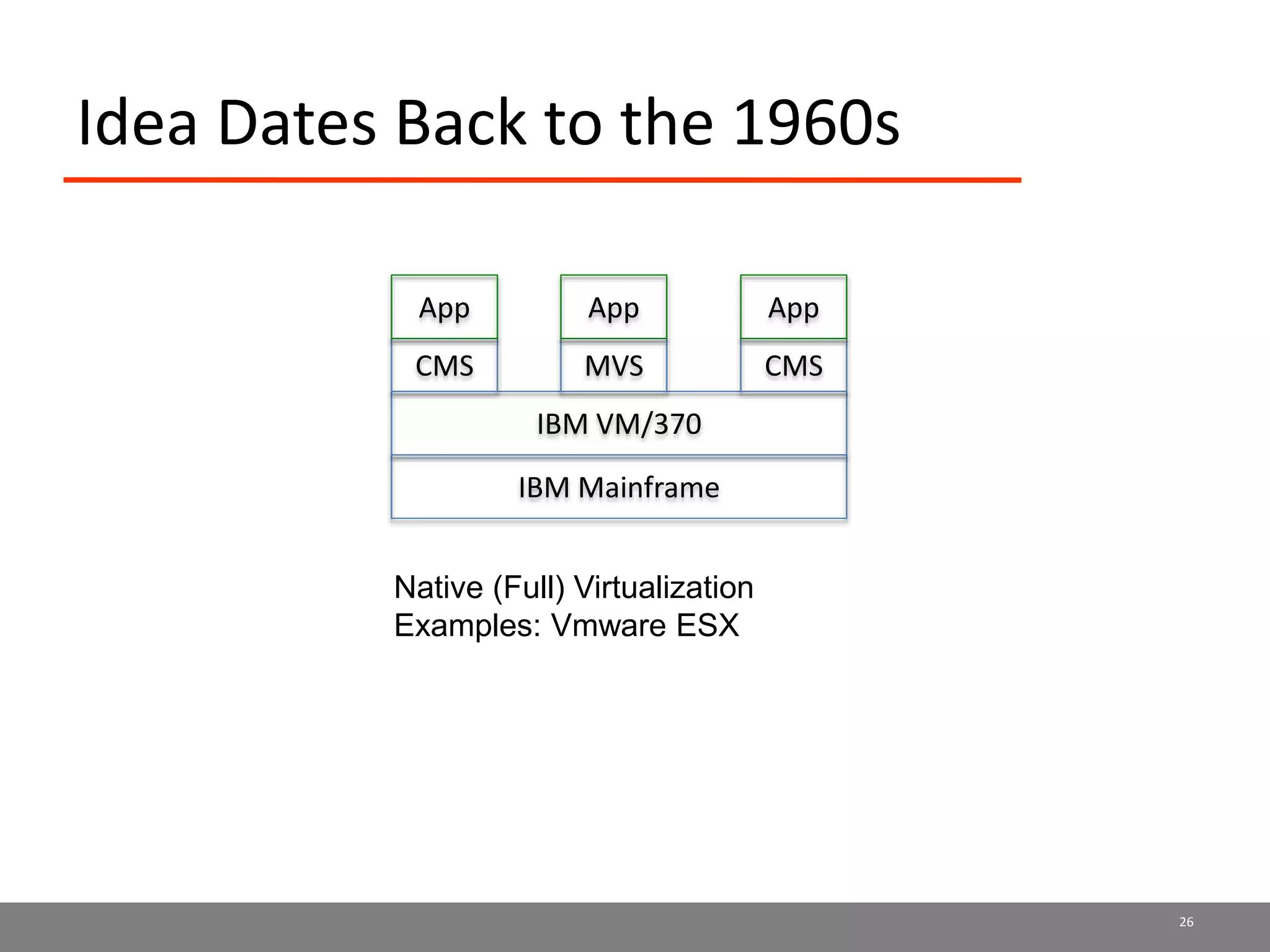
 Technology pioneered by IBM in 1960s to
better utilize mainframes
25
Idea Dates Back to the 1960s
26
IBM Mainframe
IBM VM/370
CMS
App
Native (Full) Virtualization
Examples: Vmware ESX
MVS
App
CMS
App
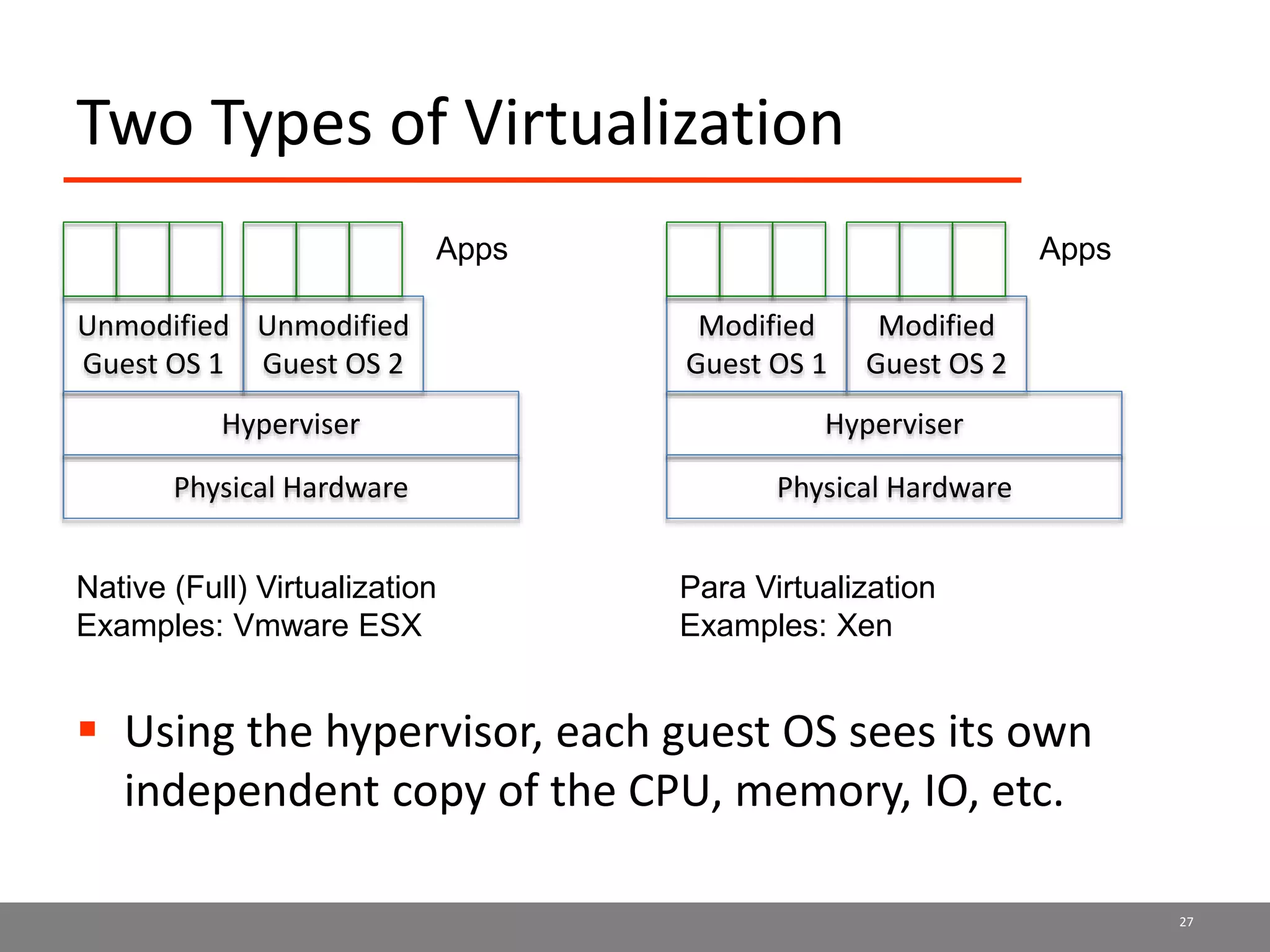
Two Types of Virtualization
 Using the hypervisor, each guest OS sees its own
independent copy of the CPU, memory, IO, etc.
27
Physical Hardware
Hyperviser
Unmodified
Guest OS 1
Unmodified
Guest OS 2
Native (Full) Virtualization
Examples: Vmware ESX
Apps
Physical Hardware
Hyperviser
Modified
Guest OS 1
Modified
Guest OS 2
Para Virtualization
Examples: Xen
Apps
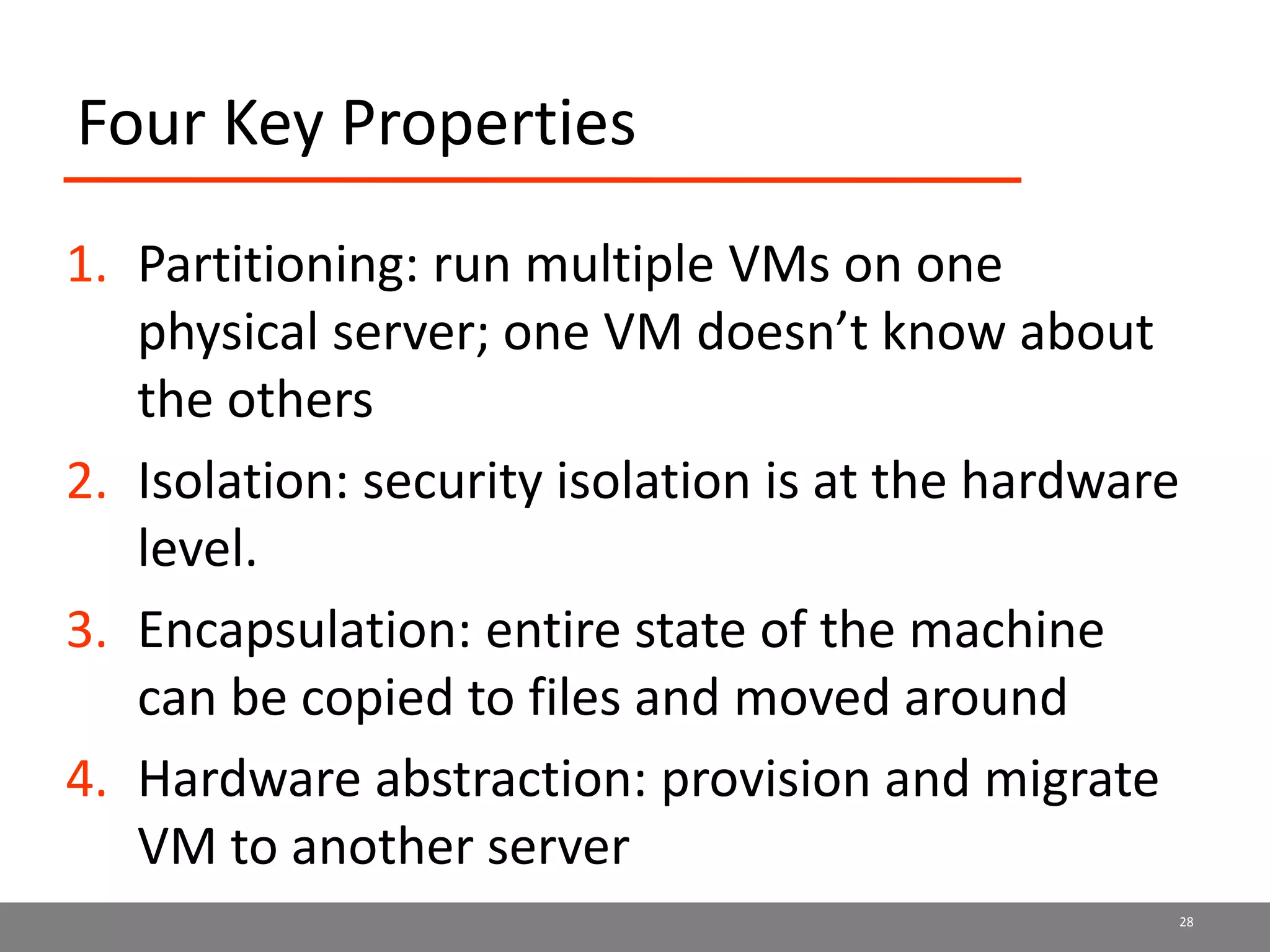
Four Key Properties
1. Partitioning: run multiple VMs on one
physical server; one VM doesn’t know about
the others
2. Isolation: security isolation is at the hardware
level.
3. Encapsulation: entire state of the machine
can be copied to files and moved around
4. Hardware abstraction: provision and migrate
VM to another server
28
Managing Virtual Machines
 Provision VM
 Schedule VM
 Monitor VM
 Self-service portal for VM
29
Large Data Clouds
30
Part 5
The Google Data Stack
 The Google File System (2003)
 MapReduce: Simplified Data Processing… (2004)
 BigTable: A Distributed Storage System… (2006)
31
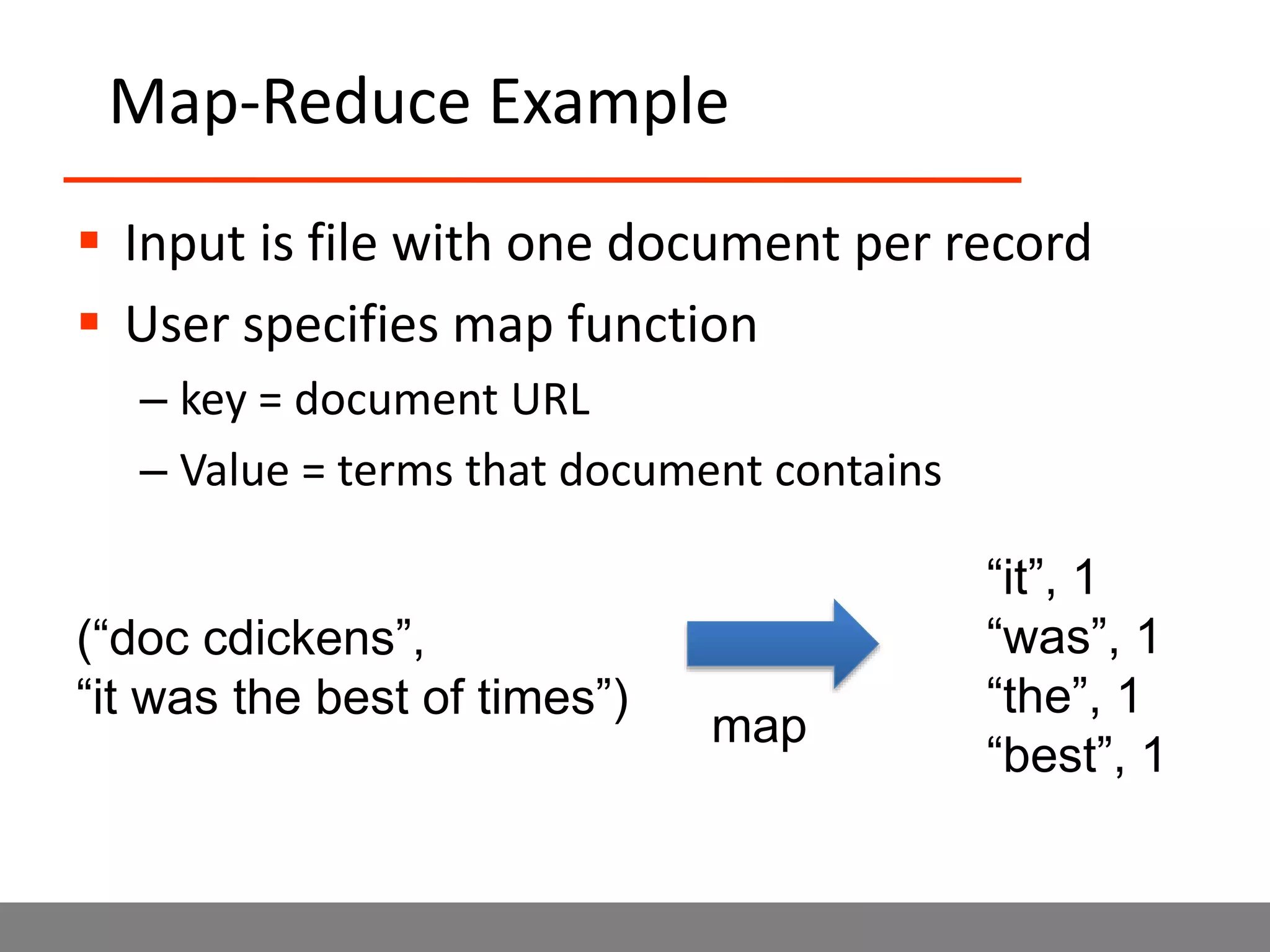
Map-Reduce Example
 Input is file with one document per record
 User specifies map function
– key = document URL
– Value = terms that document contains
(“doc cdickens”,
“it was the best of times”)
“it”, 1
“was”, 1
“the”, 1
“best”, 1
map
Example (cont’d)
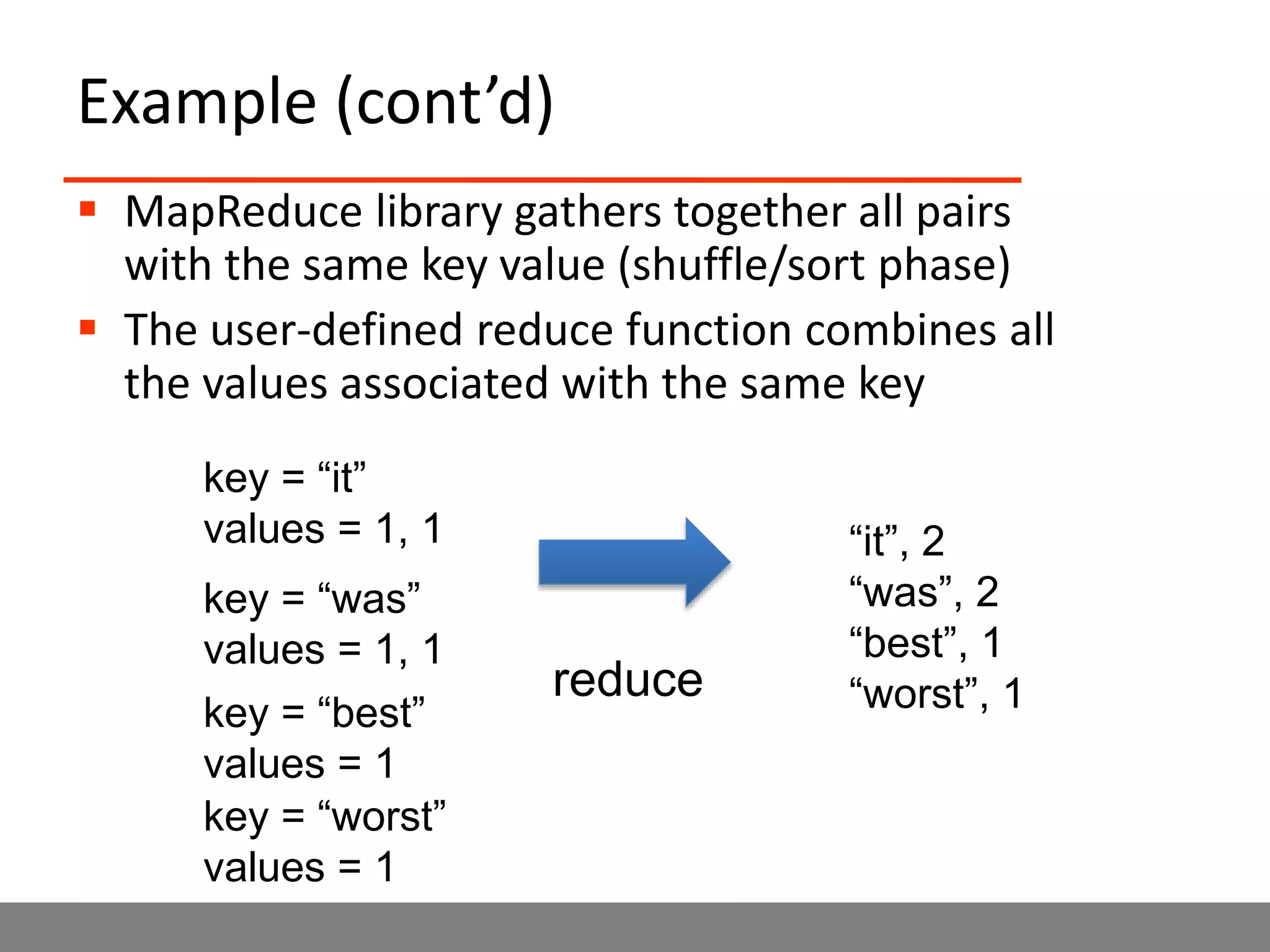
 MapReduce library gathers together all pairs
with the same key value (shuffle/sort phase)
 The user-defined reduce function combines all
the values associated with the same key
key = “it”
values = 1, 1
key = “was”
values = 1, 1
key = “best”
values = 1
key = “worst”
values = 1
“it”, 2
“was”, 2
“best”, 1
“worst”, 1reduce
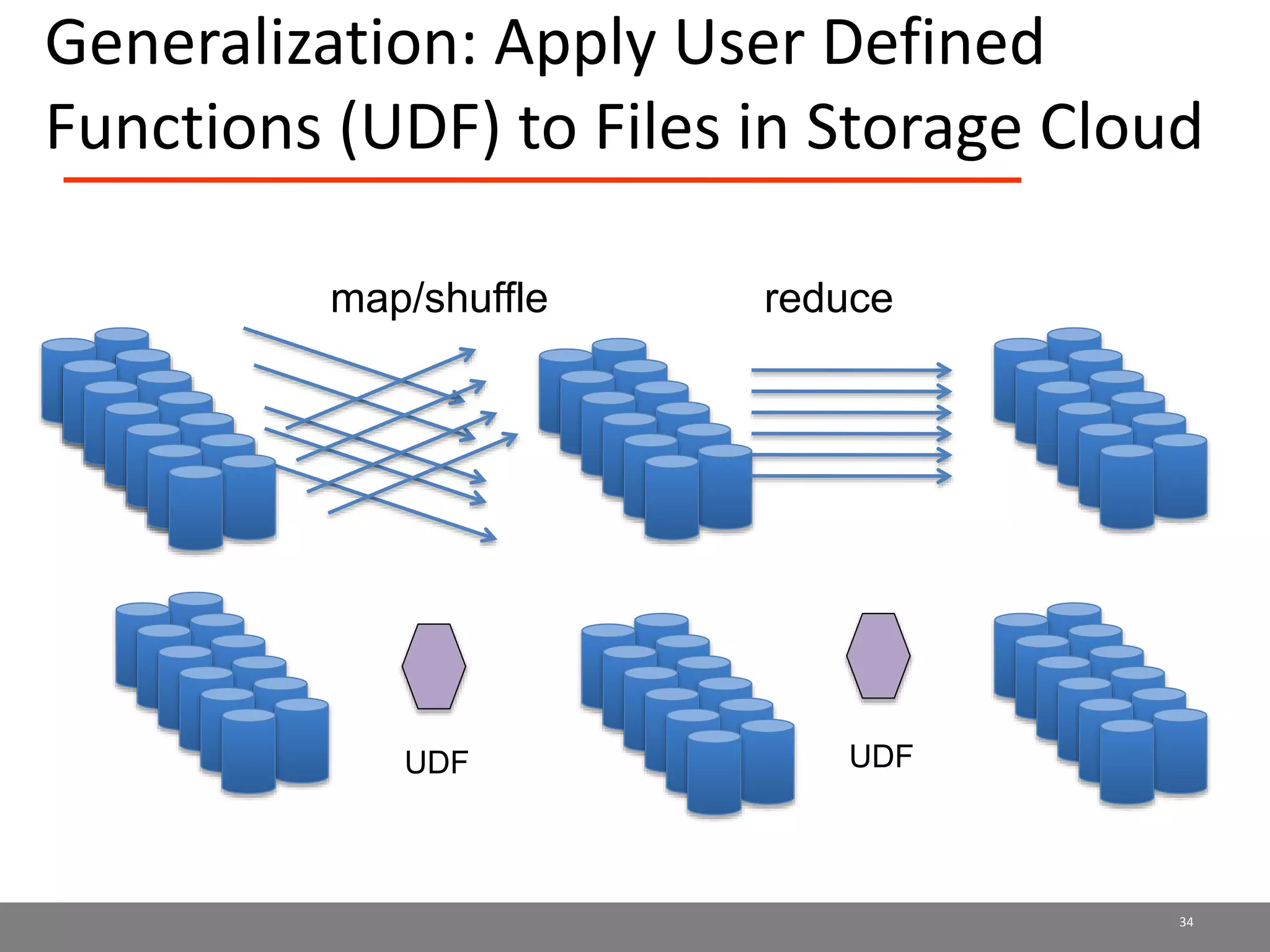
Generalization: Apply User Defined
Functions (UDF) to Files in Storage Cloud
34
map/shuffle reduce
UDFUDF
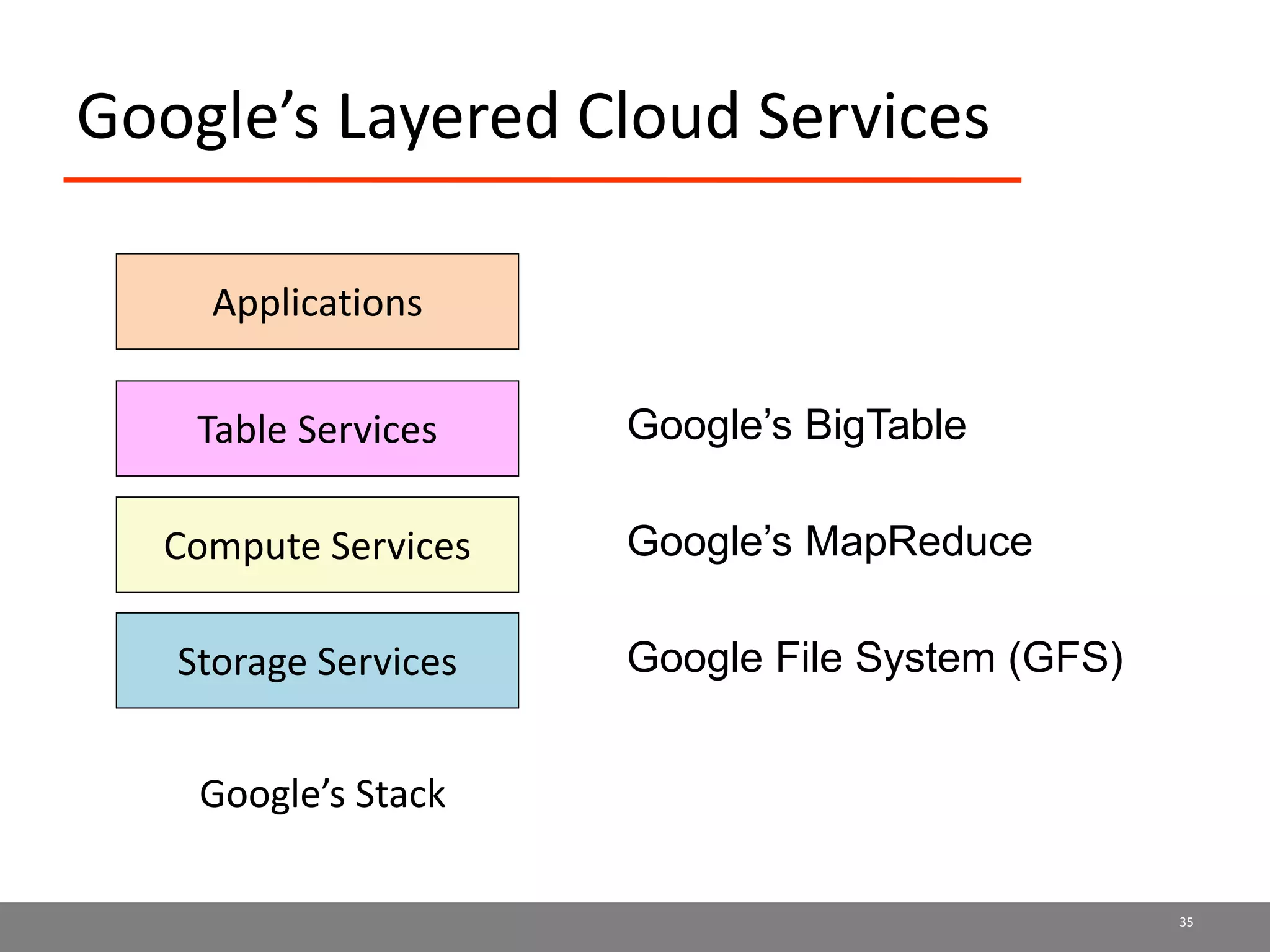
Google’s Layered Cloud Services
Storage Services
Table Services
Compute Services
35
Google’s Stack
Applications
Google File System (GFS)
Google’s MapReduce
Google’s BigTable
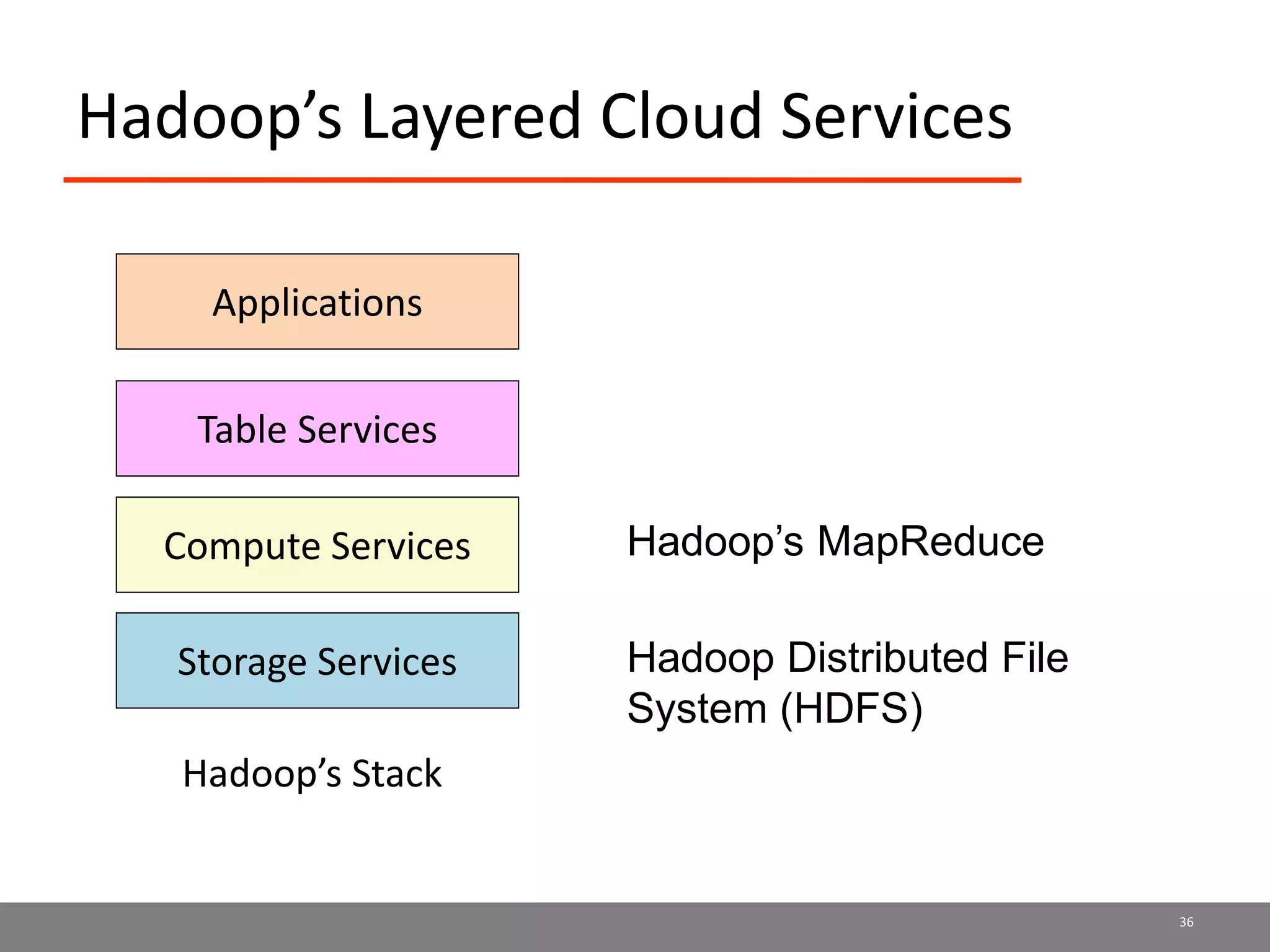
Hadoop’s Layered Cloud Services
Storage Services
Table Services
Compute Services
36
Hadoop’s Stack
Applications
Hadoop Distributed File
System (HDFS)
Hadoop’s MapReduce
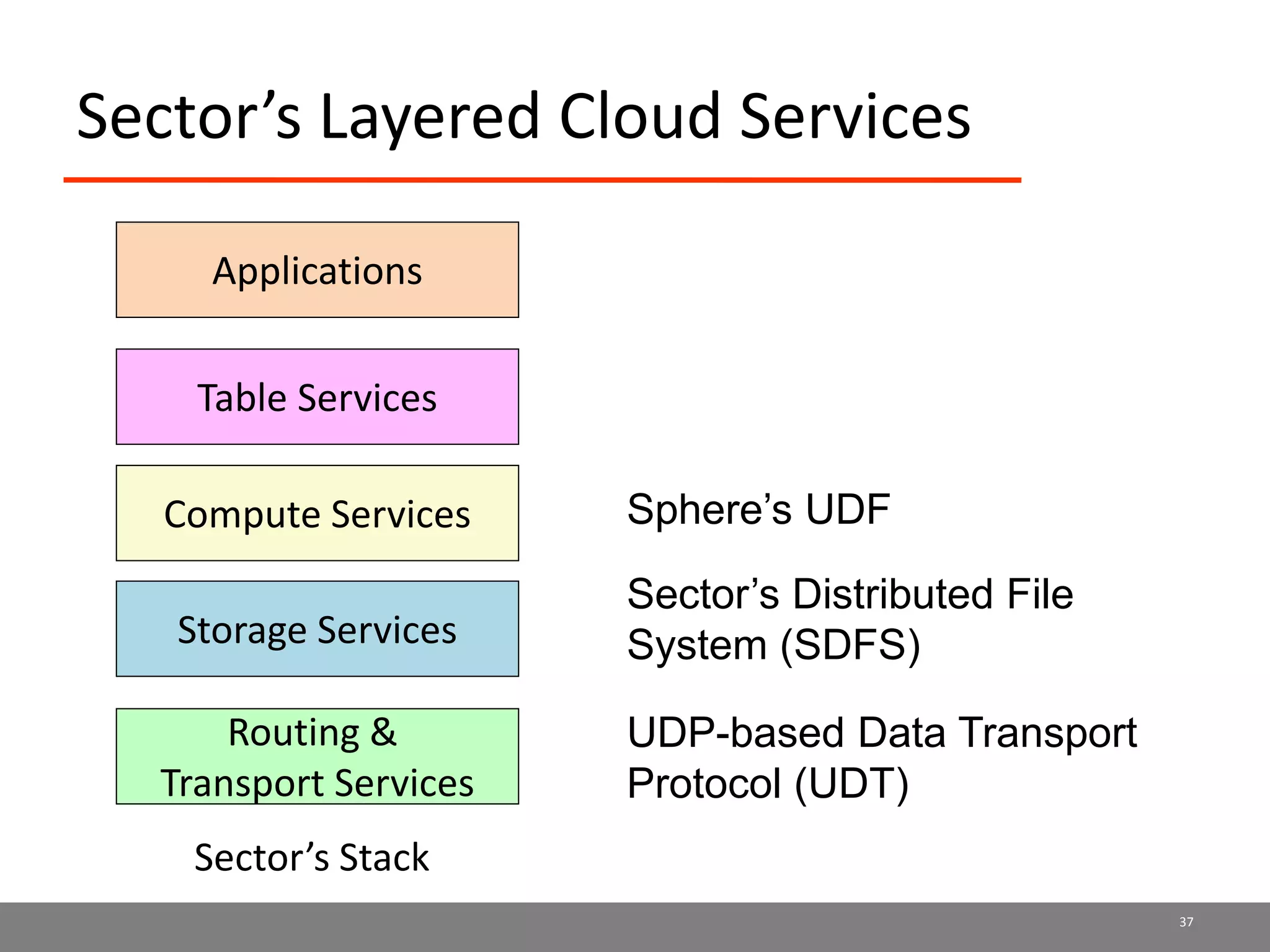
Sector’s Layered Cloud Services
Storage Services
Table Services
Compute Services
37
Sector’s Stack
Applications
Sector’s Distributed File
System (SDFS)
Sphere’s UDF
Routing &
Transport Services
UDP-based Data Transport
Protocol (UDT)
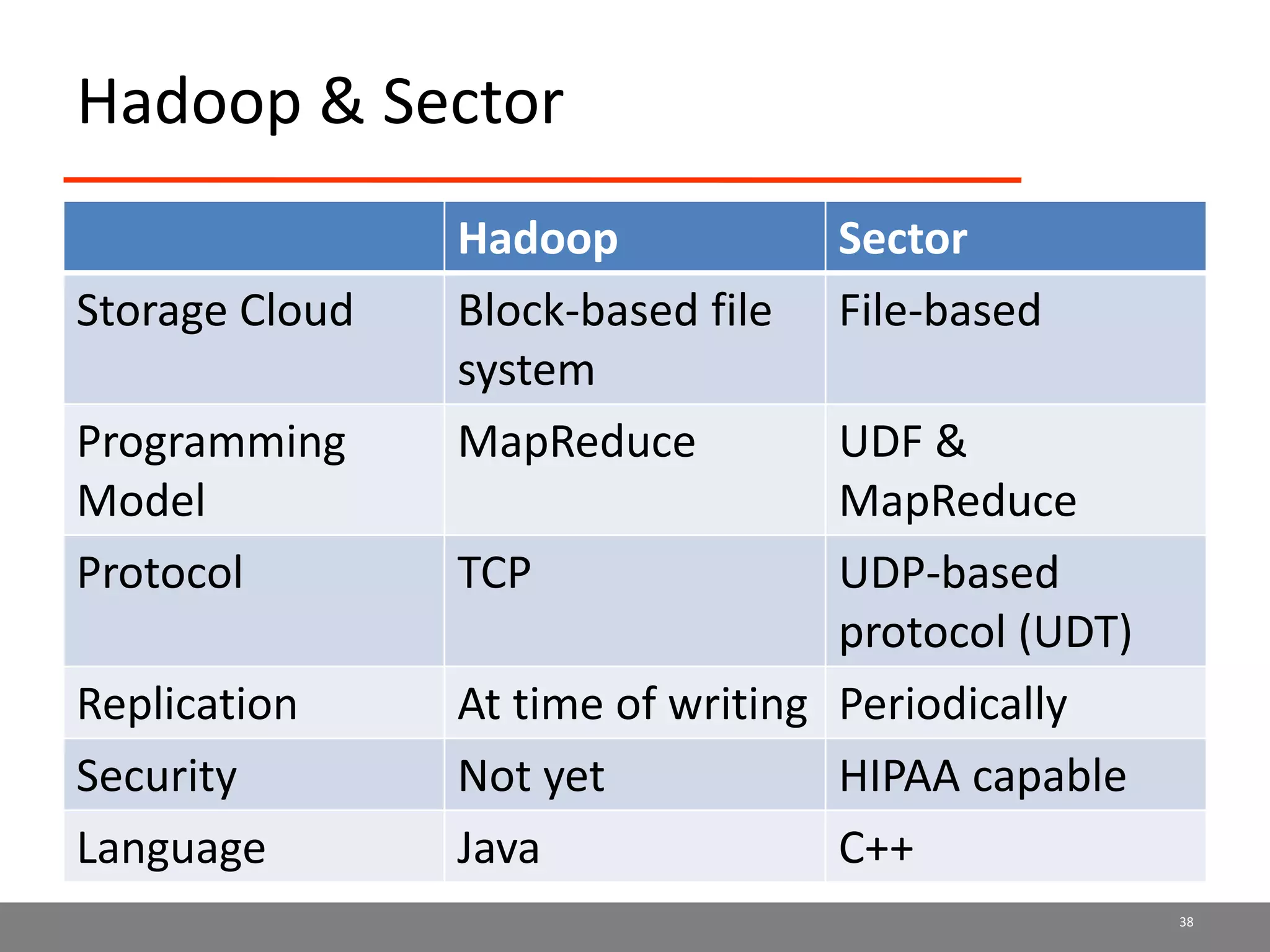
Hadoop & Sector
Hadoop Sector
Storage Cloud Block-based file
system
File-based
Programming
Model
MapReduce UDF &
MapReduce
Protocol TCP UDP-based
protocol (UDT)
Replication At time of writing Periodically
Security Not yet HIPAA capable
Language Java C++
38
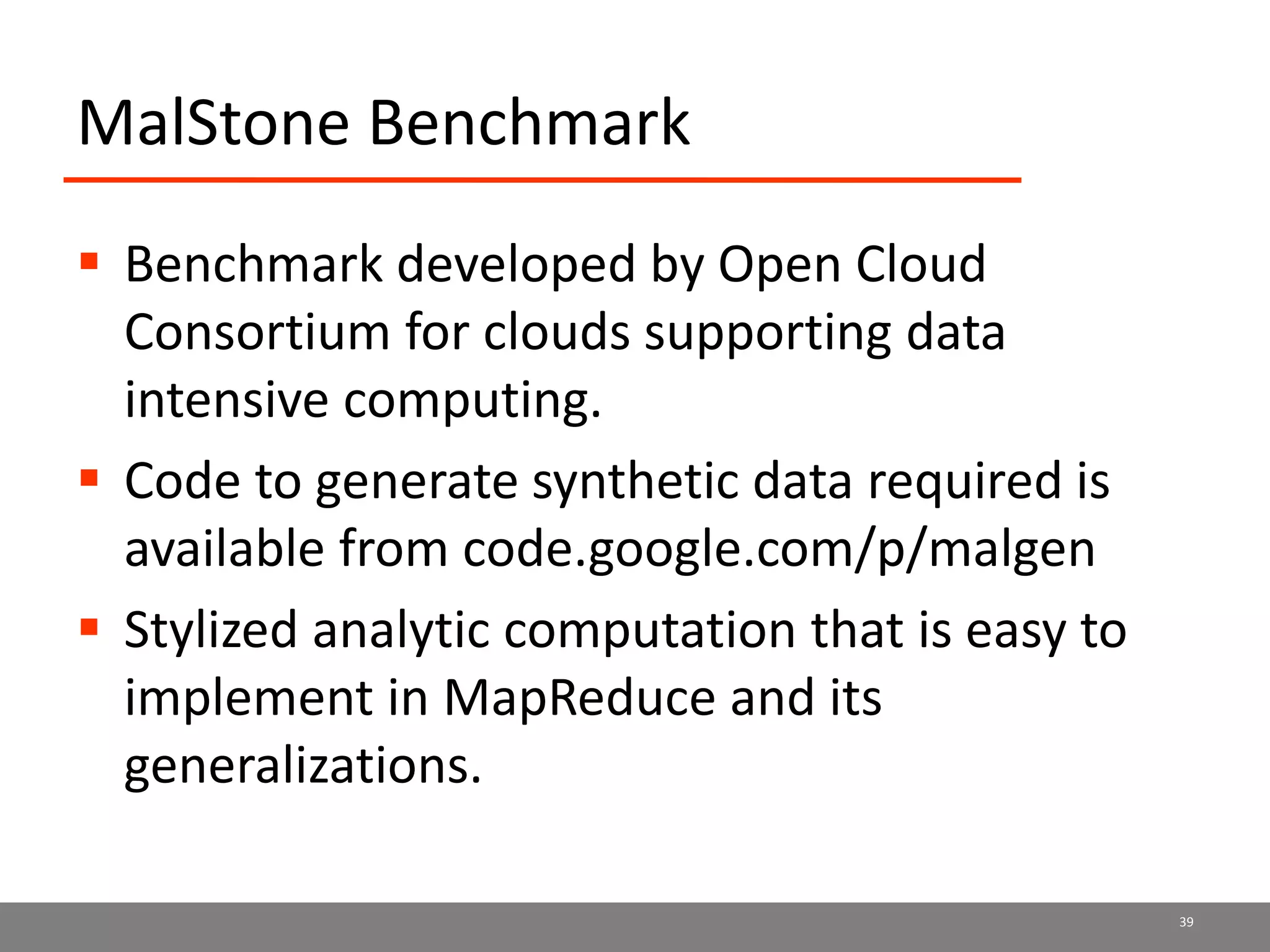
MalStone Benchmark
 Benchmark developed by Open Cloud
Consortium for clouds supporting data
intensive computing.
 Code to generate synthetic data required is
available from code.google.com/p/malgen
 Stylized analytic computation that is easy to
implement in MapReduce and its
generalizations.
39
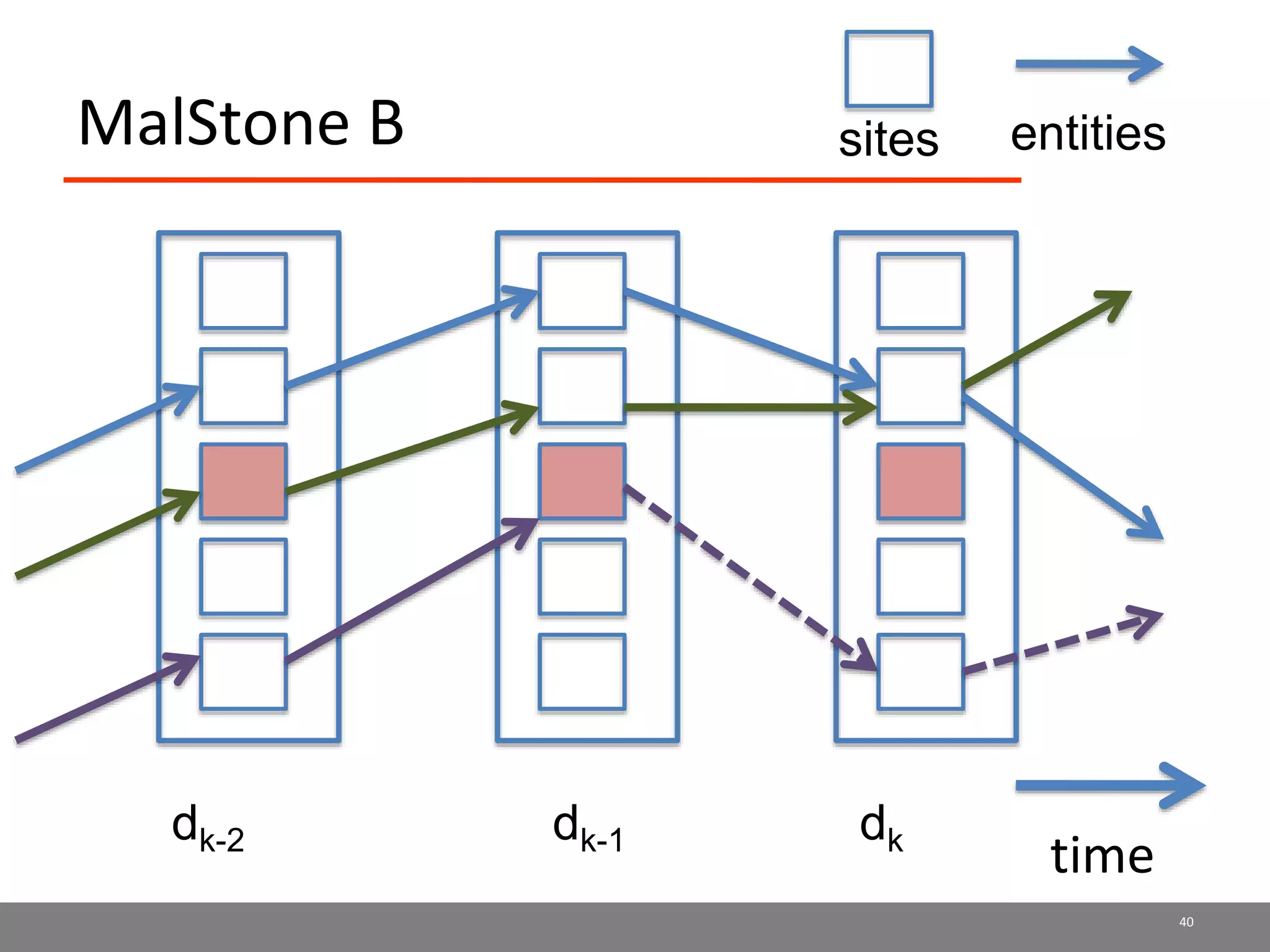
MalStone B
time
40
dk-2 dk-1 dk
sites entities
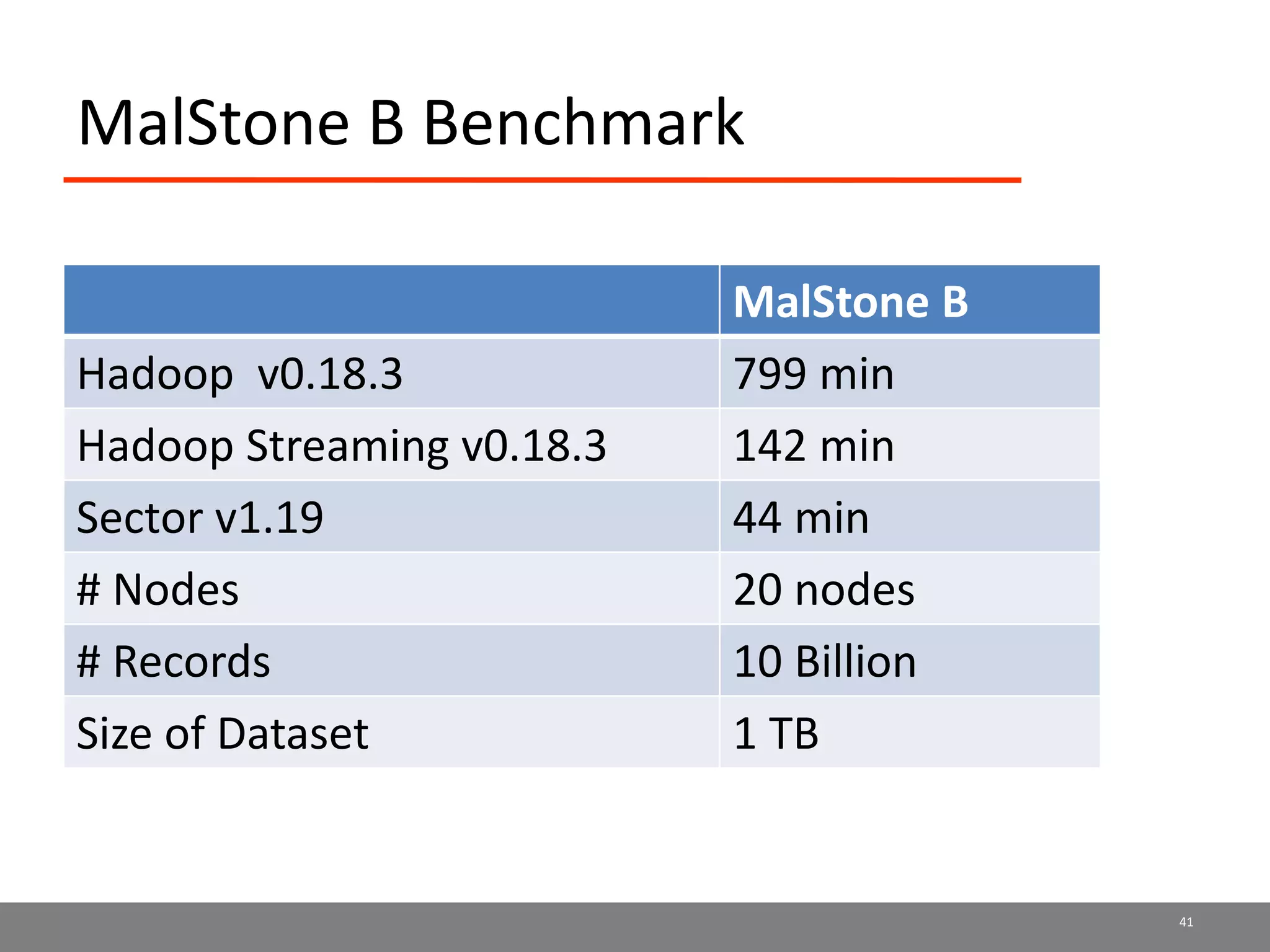
MalStone B Benchmark
41
MalStone B
Hadoop v0.18.3 799 min
Hadoop Streaming v0.18.3 142 min
Sector v1.19 44 min
# Nodes 20 nodes
# Records 10 Billion
Size of Dataset 1 TB
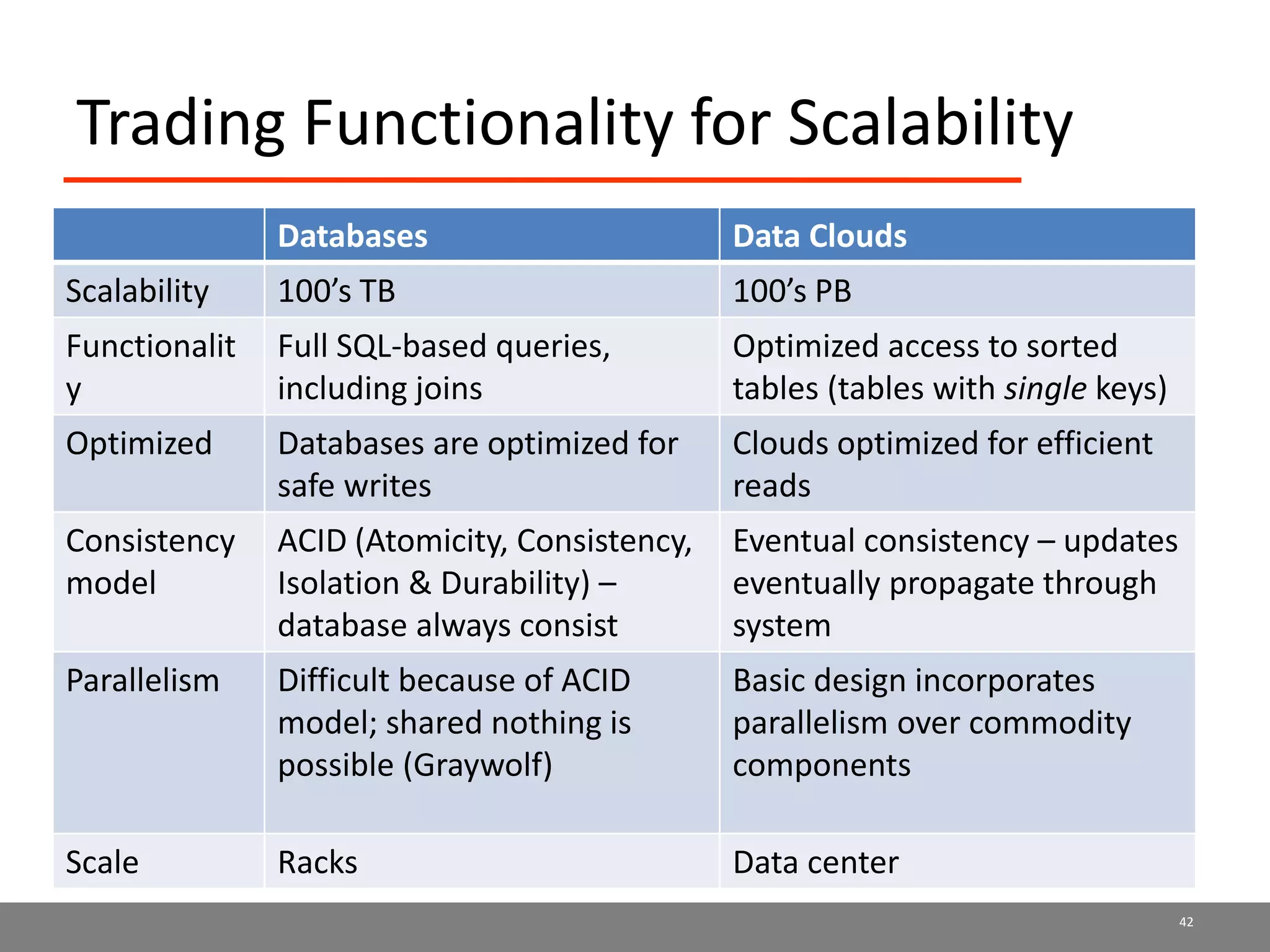
Trading Functionality for Scalability
Databases Data Clouds
Scalability 100’s TB 100’s PB
Functionalit
y
Full SQL-based queries,
including joins
Optimized access to sorted
tables (tables with single keys)
Optimized Databases are optimized for
safe writes
Clouds optimized for efficient
reads
Consistency
model
ACID (Atomicity, Consistency,
Isolation & Durability) –
database always consist
Eventual consistency – updates
eventually propagate through
system
Parallelism Difficult because of ACID
model; shared nothing is
possible (Graywolf)
Basic design incorporates
parallelism over commodity
components
Scale Racks Data center
42
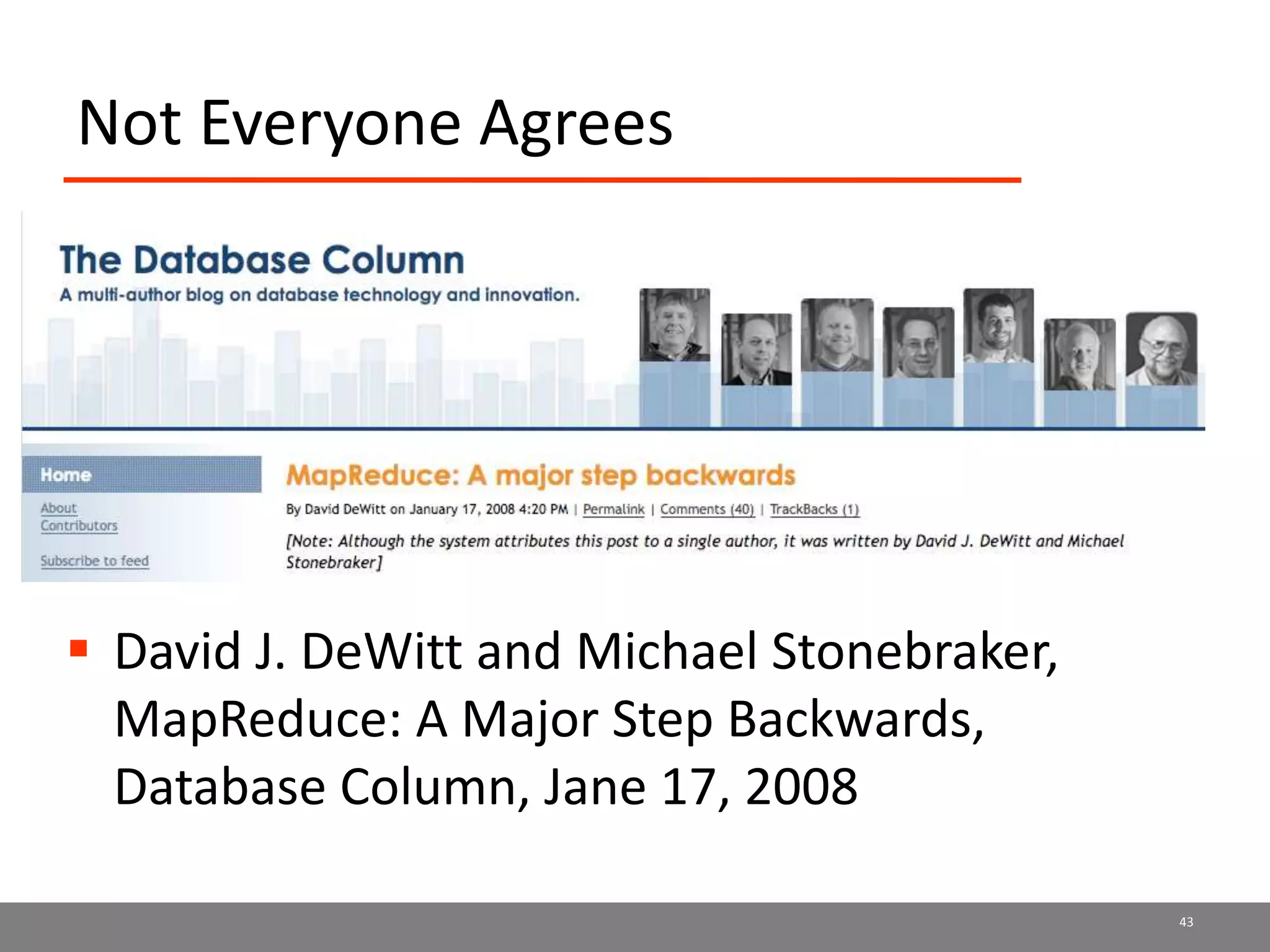
Not Everyone Agrees
 David J. DeWitt and Michael Stonebraker,
MapReduce: A Major Step Backwards,
Database Column, Jane 17, 2008
43
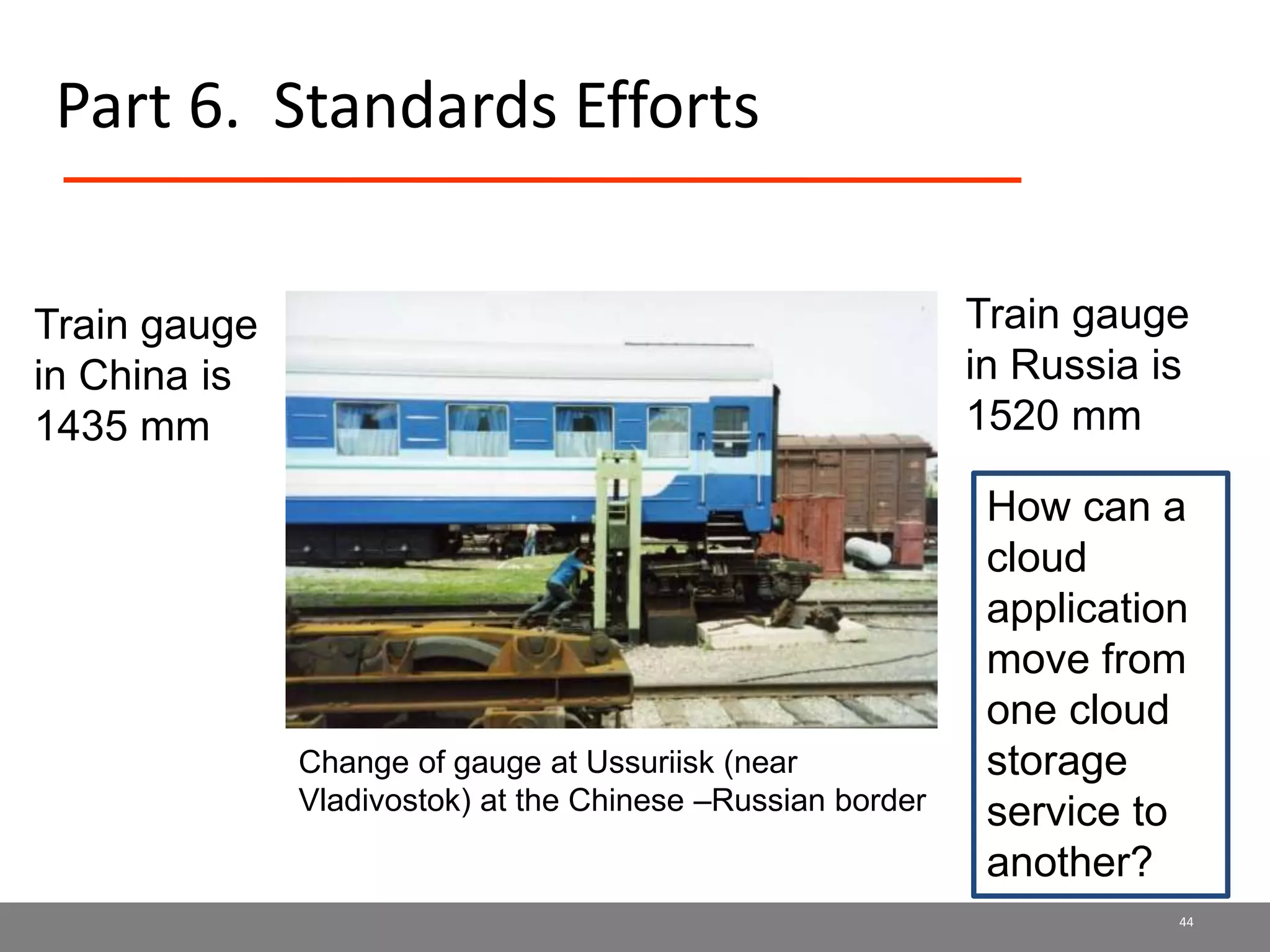
Part 6. Standards Efforts
44
Change of gauge at Ussuriisk (near
Vladivostok) at the Chinese –Russian border
Train gauge
in China is
1435 mm
Train gauge
in Russia is
1520 mm
How can a
cloud
application
move from
one cloud
storage
service to
another?
Standards Efforts for Clouds
 Cloud Computing Interoperability Forum (CCIF)
 Open Cloud Consortium (OCC)
 Open Grid Forum (OGF)
 Distributed Management Task Force (DMTF)
 Storage Network Industrial Association (SNIA)
 Plus several others…
45
www.opencloudconsortium.org
1. Supports the development of standards.
2. Supports reference implementations for
cloud computing, preferably open source.
3. Manages a testbed for cloud computing
called the Open Cloud Testbed.
4. Supports the development of benchmarks.
5. Sponsors workshops and other events related
to cloud computing.
46
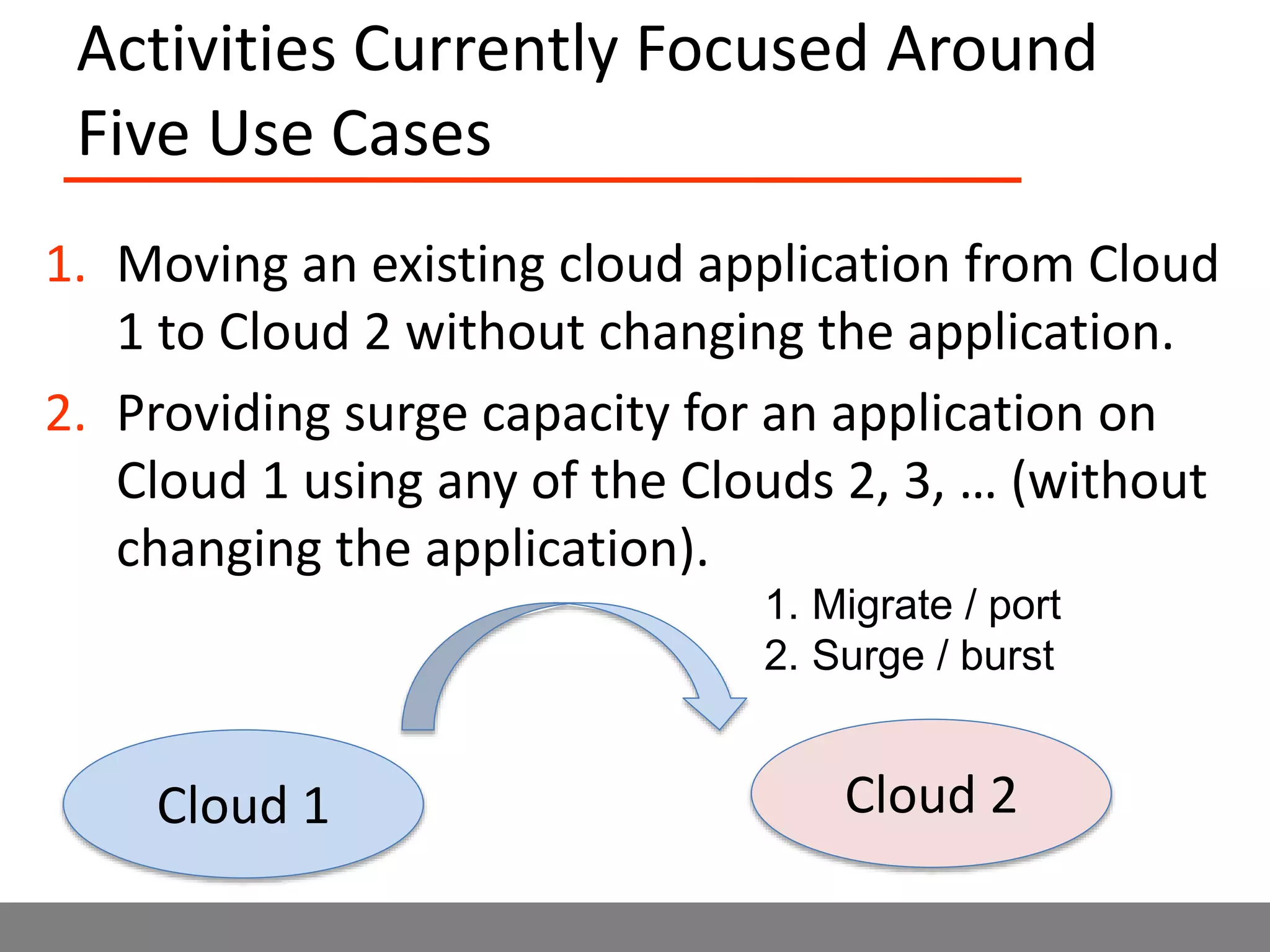
Activities Currently Focused Around
Five Use Cases
1. Moving an existing cloud application from Cloud
1 to Cloud 2 without changing the application.
2. Providing surge capacity for an application on
Cloud 1 using any of the Clouds 2, 3, … (without
changing the application).
Cloud 1 Cloud 2
1. Migrate / port
2. Surge / burst
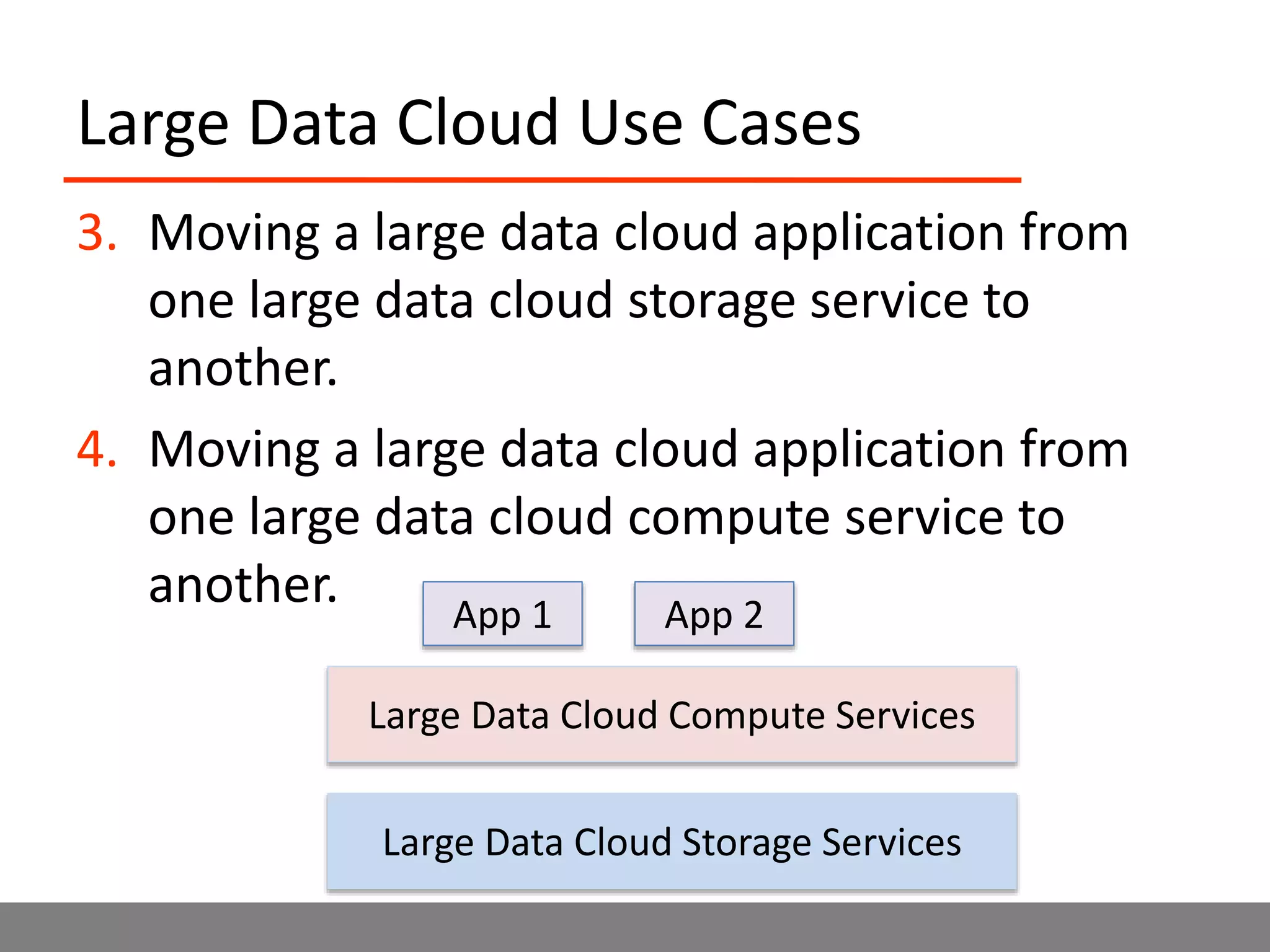
Large Data Cloud Use Cases
3. Moving a large data cloud application from
one large data cloud storage service to
another.
4. Moving a large data cloud application from
one large data cloud compute service to
another.
Large Data Cloud Storage Services
Large Data Cloud Compute Services
App 1 App 2
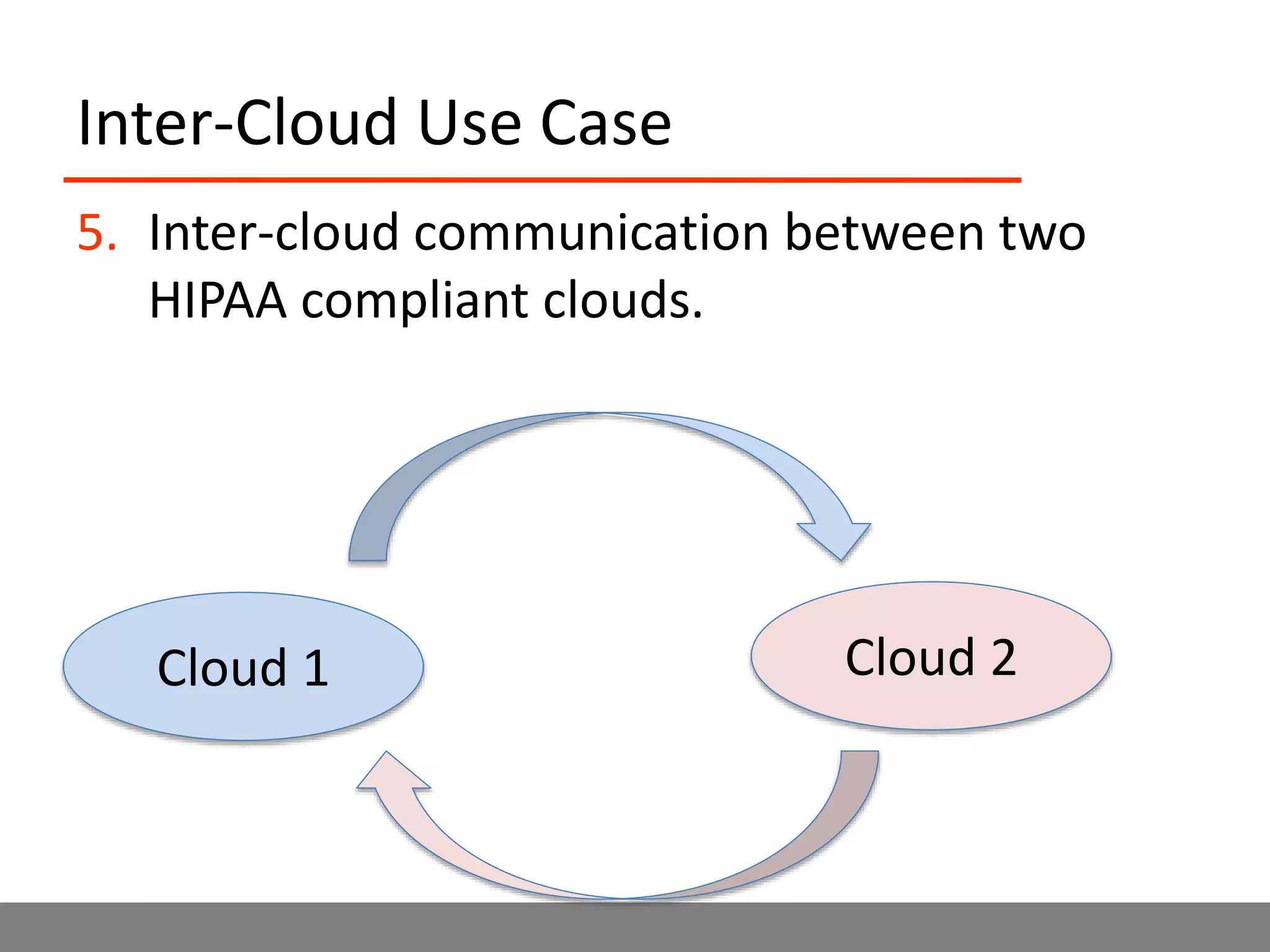
Inter-Cloud Use Case
5. Inter-cloud communication between two
HIPAA compliant clouds.
Cloud 1 Cloud 2
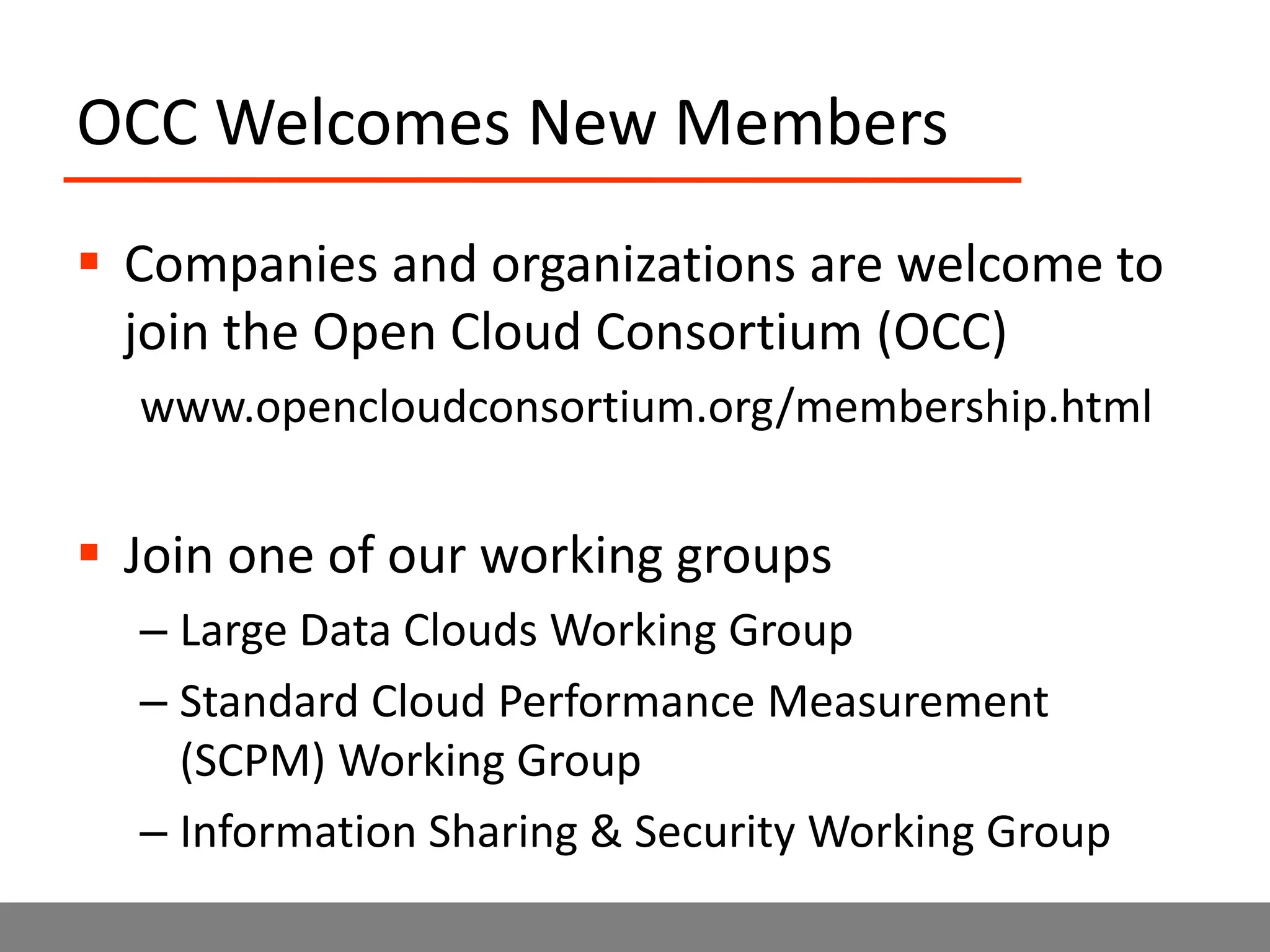
OCC Welcomes New Members
 Companies and organizations are welcome to
join the Open Cloud Consortium (OCC)
www.opencloudconsortium.org/membership.html
 Join one of our working groups
– Large Data Clouds Working Group
– Standard Cloud Performance Measurement
(SCPM) Working Group
– Information Sharing & Security Working Group
For More Information
 Contact information:
Robert Grossman
rlg@opendatagroup.com
blog.rgrossman.com
 Web sites
– www.opendatagroup.com
– www.ncdm.uic.edu
– www.opencloudconsortium.org
51

An Introduction to Cloud Computing by Robert Grossman 08-06-09 (v19)

  • 1.
    An Overview ofCloud Computing: My Other Computer is a Data Center Robert Grossman Open Data Group & University of Illinois at Chicago IEEE New Technologies Conference August 6, 2009
  • 2.
    Part 1 What isa Cloud? 2
  • 3.
    What is aCloud? 3 Software as a Service
  • 4.
    What Else isa Cloud? 4 Platform as a Service
  • 5.
    Is Anything Elsea Cloud? 5 Infrastructure as a Service
  • 6.
    Are There OtherTypes of Clouds? 6 Large Data Cloud Services ad targeting
  • 7.
    One Definition  Cloudsprovide on-demand resources or services over a network, often the Internet, with the scale and reliability of a data center.  No standard definition.  Cloud architectures are not new.  What is new: – Scale – Ease of use – Pricing model. 7
  • 8.
  • 9.
    Elastic, Usage BasedPricing Is New 9 1 computer in a rack for 120 hours 120 computers in three racks for 1 hour costs the same as  Elastic, usage based pricing turns capex into opex.  Clouds can be used to manage surges in computing needs.
  • 10.
    Simplicity Offered Bythe Cloud is New 10 + .. and you have a computer ready to work. A new programmer can develop a program to process a container full of data with less than day of training using MapReduce.
  • 11.
  • 12.
    Varieties of Clouds Architectural Model – On-demand computing instances vs large data cloud services  Payment Model – Elastic, usage based pricing, lease/own, …  Management Model – Private vs Public; Single vs Multiple Tenant; …  Programming Model – Queue Service, MPI, MapReduce, Distributed UDF 12 Computing instances vs large data cloud services Private internal vs public external Elastic, usage- based pricing or not All combinations occur.
  • 13.
    Architectural Models: How DoYou Fill a Data Center? Cloud Storage Services Cloud Compute Services (MapReduce & Generalizations) Cloud Data Services (BigTable, etc.) Quasi-relational Data Services App App App App App App App App App large data cloud services App App App … on-demand computing instances
  • 14.
    Payment Models  Buyingracks, containers and data centers  Leasing racks containers and data centers  Utility based computing (pay as you go) – Moves cap ex to op ex – Handle surge requirements (use 1000 servers for 1 hour vs 1 server for 1000 hours) 14
  • 15.
    Management Models  Public,private and hybrid models  Single tenant vs multiple tenant (shared vs non-shared hardware)  Owned vs leased  Manage yourself vs outsource management  All combinations are possible 15
  • 16.
    Programming Models  Amazon’sSimple Queue Service  MPI, sockets, FIFO 16  MapReduce  Distributed UDF on-demand computing instances large data cloud services  DryadLINQ  Azure services
  • 17.
    Part 3. CloudComputing Industry  “Cloud computing has become the center of investment and innovation.” Nicholas Carr, 2009 IDC Directions 17 Cloud computing is approaching the top of the Gartner hype cycle.
  • 18.
    IaaS, PaaS andSaaS Point of View SaaS PaaS IaaS Infrastructure as a Service PRODUCT: Compute power, storage and networking infrastructure over the internet, provided as a virtual machine image USERS: Developers Platform as a Service PRODUCT: storage, compute and other services to simplify application development, especially of web applications. USERS: Application Developers Software as a Service PRODUCT: Finished application available on demand to end user USERS: Software consumer
  • 19.
    Building Data Centers Sun’s Modular Data Center (MD)  Formerly Project Blackbox  Containers used by Google, Microsoft & others  Data center consists of 10-60+ containers. 19
  • 20.
    Data Center OperatingSystems  Data center services include: VM management services, business continuity services, security services, power management services, etc. 20 workstatio n VM 1 VM 5 … VM 1 VM 50,000 … Data Center Operating System
  • 21.
    Berkeley View ofCloud Computing 21 Providers of Cloud Services Consumers of Cloud Services Providers of Software as a Service Consumers of Software as a Service  Berkeley Report on cloud computing divides industry into these layers & concentrates on public clouds. Data Centers
  • 22.
    Transition Taking Place A hand full of players are building multiple data centers a year and improving with each one.  This includes Google, Microsoft, Yahoo, …  A data center today costs $200 M – $400+ M  Berkeley RAD Report points out analogy with semiconductor industry as companies stopped building their own Fabs and starting leasing Fabs from others as Fabs approached $1B 22
  • 23.
    Mindmeister Map ofCloud Computing  Dupont’s Mindmeister Map divides the industry: – IaaS, PaaS, Management, Community  http://www.mindmeister.com/maps/show_public/15936058 23
  • 24.
  • 25.
    Virtualization  Virtualization separateslogical infrastructure from the underlying physical resources to decrease time to make changes, improve flexibility, improve utilization and reduce costs  Example - server virtualization. Use one physical server to support multiple logical virtual machines (VMs), which are sometimes called logical partitions.  Technology pioneered by IBM in 1960s to better utilize mainframes 25
  • 26.
    Idea Dates Backto the 1960s 26 IBM Mainframe IBM VM/370 CMS App Native (Full) Virtualization Examples: Vmware ESX MVS App CMS App
  • 27.
    Two Types ofVirtualization  Using the hypervisor, each guest OS sees its own independent copy of the CPU, memory, IO, etc. 27 Physical Hardware Hyperviser Unmodified Guest OS 1 Unmodified Guest OS 2 Native (Full) Virtualization Examples: Vmware ESX Apps Physical Hardware Hyperviser Modified Guest OS 1 Modified Guest OS 2 Para Virtualization Examples: Xen Apps
  • 28.
    Four Key Properties 1.Partitioning: run multiple VMs on one physical server; one VM doesn’t know about the others 2. Isolation: security isolation is at the hardware level. 3. Encapsulation: entire state of the machine can be copied to files and moved around 4. Hardware abstraction: provision and migrate VM to another server 28
  • 29.
    Managing Virtual Machines Provision VM  Schedule VM  Monitor VM  Self-service portal for VM 29
  • 30.
  • 31.
    The Google DataStack  The Google File System (2003)  MapReduce: Simplified Data Processing… (2004)  BigTable: A Distributed Storage System… (2006) 31
  • 32.
    Map-Reduce Example  Inputis file with one document per record  User specifies map function – key = document URL – Value = terms that document contains (“doc cdickens”, “it was the best of times”) “it”, 1 “was”, 1 “the”, 1 “best”, 1 map
  • 33.
    Example (cont’d)  MapReducelibrary gathers together all pairs with the same key value (shuffle/sort phase)  The user-defined reduce function combines all the values associated with the same key key = “it” values = 1, 1 key = “was” values = 1, 1 key = “best” values = 1 key = “worst” values = 1 “it”, 2 “was”, 2 “best”, 1 “worst”, 1reduce
  • 34.
    Generalization: Apply UserDefined Functions (UDF) to Files in Storage Cloud 34 map/shuffle reduce UDFUDF
  • 35.
    Google’s Layered CloudServices Storage Services Table Services Compute Services 35 Google’s Stack Applications Google File System (GFS) Google’s MapReduce Google’s BigTable
  • 36.
    Hadoop’s Layered CloudServices Storage Services Table Services Compute Services 36 Hadoop’s Stack Applications Hadoop Distributed File System (HDFS) Hadoop’s MapReduce
  • 37.
    Sector’s Layered CloudServices Storage Services Table Services Compute Services 37 Sector’s Stack Applications Sector’s Distributed File System (SDFS) Sphere’s UDF Routing & Transport Services UDP-based Data Transport Protocol (UDT)
  • 38.
    Hadoop & Sector HadoopSector Storage Cloud Block-based file system File-based Programming Model MapReduce UDF & MapReduce Protocol TCP UDP-based protocol (UDT) Replication At time of writing Periodically Security Not yet HIPAA capable Language Java C++ 38
  • 39.
    MalStone Benchmark  Benchmarkdeveloped by Open Cloud Consortium for clouds supporting data intensive computing.  Code to generate synthetic data required is available from code.google.com/p/malgen  Stylized analytic computation that is easy to implement in MapReduce and its generalizations. 39
  • 40.
  • 41.
    MalStone B Benchmark 41 MalStoneB Hadoop v0.18.3 799 min Hadoop Streaming v0.18.3 142 min Sector v1.19 44 min # Nodes 20 nodes # Records 10 Billion Size of Dataset 1 TB
  • 42.
    Trading Functionality forScalability Databases Data Clouds Scalability 100’s TB 100’s PB Functionalit y Full SQL-based queries, including joins Optimized access to sorted tables (tables with single keys) Optimized Databases are optimized for safe writes Clouds optimized for efficient reads Consistency model ACID (Atomicity, Consistency, Isolation & Durability) – database always consist Eventual consistency – updates eventually propagate through system Parallelism Difficult because of ACID model; shared nothing is possible (Graywolf) Basic design incorporates parallelism over commodity components Scale Racks Data center 42
  • 43.
    Not Everyone Agrees David J. DeWitt and Michael Stonebraker, MapReduce: A Major Step Backwards, Database Column, Jane 17, 2008 43
  • 44.
    Part 6. StandardsEfforts 44 Change of gauge at Ussuriisk (near Vladivostok) at the Chinese –Russian border Train gauge in China is 1435 mm Train gauge in Russia is 1520 mm How can a cloud application move from one cloud storage service to another?
  • 45.
    Standards Efforts forClouds  Cloud Computing Interoperability Forum (CCIF)  Open Cloud Consortium (OCC)  Open Grid Forum (OGF)  Distributed Management Task Force (DMTF)  Storage Network Industrial Association (SNIA)  Plus several others… 45
  • 46.
    www.opencloudconsortium.org 1. Supports thedevelopment of standards. 2. Supports reference implementations for cloud computing, preferably open source. 3. Manages a testbed for cloud computing called the Open Cloud Testbed. 4. Supports the development of benchmarks. 5. Sponsors workshops and other events related to cloud computing. 46
  • 47.
    Activities Currently FocusedAround Five Use Cases 1. Moving an existing cloud application from Cloud 1 to Cloud 2 without changing the application. 2. Providing surge capacity for an application on Cloud 1 using any of the Clouds 2, 3, … (without changing the application). Cloud 1 Cloud 2 1. Migrate / port 2. Surge / burst
  • 48.
    Large Data CloudUse Cases 3. Moving a large data cloud application from one large data cloud storage service to another. 4. Moving a large data cloud application from one large data cloud compute service to another. Large Data Cloud Storage Services Large Data Cloud Compute Services App 1 App 2
  • 49.
    Inter-Cloud Use Case 5.Inter-cloud communication between two HIPAA compliant clouds. Cloud 1 Cloud 2
  • 50.
    OCC Welcomes NewMembers  Companies and organizations are welcome to join the Open Cloud Consortium (OCC) www.opencloudconsortium.org/membership.html  Join one of our working groups – Large Data Clouds Working Group – Standard Cloud Performance Measurement (SCPM) Working Group – Information Sharing & Security Working Group
  • 51.
    For More Information Contact information: Robert Grossman rlg@opendatagroup.com blog.rgrossman.com  Web sites – www.opendatagroup.com – www.ncdm.uic.edu – www.opencloudconsortium.org 51