




What's the
Difference and
Why Does it
Matter?
Hall Web Services
Who We Are
Hall Web Services
www.hallme.com
• 11+ Years in Business
• Over 80 Search Marketing Clients
• 98% of Customers "Very Satisfied"
Who We Are
Kasi Gajtkowski
Organic Search Specialist
kasi@hallme.com
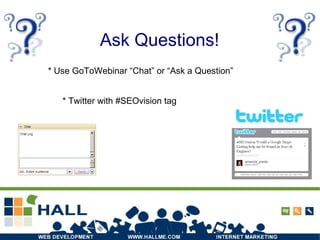
Ask Questions!
* Use GoToWebinar “Chat” or “Ask a Question”
* Twitter with #SEOvision tag
What You'll Learn
•Some stats and demos of Google,
Yahoo, and Bing users
•The details of the Microsoft-Yahoo
search deal
•The differences in Google and Bing's
search technology, some things that make
them unique, and SEO tips for each.
Search Engines: Quick Overview
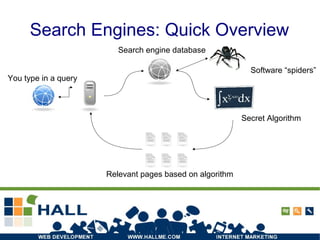
You type in a query
Search engine database
Software “spiders”
Secret Algorithm
Relevant pages based on algorithm
Let's talk stats...
Facts & Figures
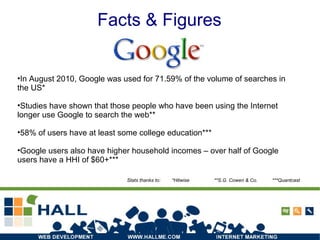
•In August 2010, Google was used for 71.59% of the volume of searches in
the US*
•Studies have shown that those people who have been using the Internet
longer use Google to search the web**
•58% of users have at least some college education***
•Google users also have higher household incomes – over half of Google
users have a HHI of $60+***
Stats thanks to: *Hitwise **S.G. Cowen & Co. ***Quantcast
Facts & Figures
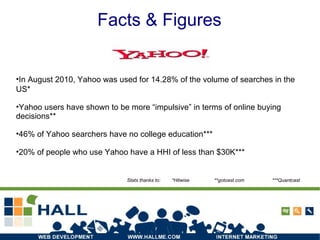
•In August 2010, Yahoo was used for 14.28% of the volume of searches in the
US*
•Yahoo users have shown to be more “impulsive” in terms of online buying
decisions**
•46% of Yahoo searchers have no college education***
•20% of people who use Yahoo have a HHI of less than $30K***
Stats thanks to: *Hitwise **gotoast.com ***Quantcast
Facts & Figures
•In August 2010, Bing was used for 9.87% of the volume of searches in the
US*
•Bing's users click on more ads than Google's (relative to impressions)**
•25% of Bing searchers are over the age of 50.***
•44% of people who use Bing are not college-educated.***
Stats thanks to: *Hitwise **TechCrunch. ***Quantcast
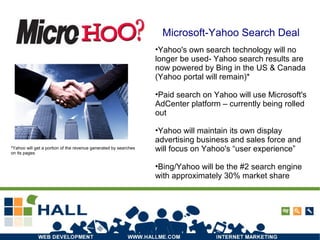
Microsoft-Yahoo Search Deal
•Yahoo's own search technology will no
longer be used- Yahoo search results are
now powered by Bing in the US & Canada
(Yahoo portal will remain)*
•Paid search on Yahoo will use Microsoft's
AdCenter platform – currently being rolled
out
•Yahoo will maintain its own display
advertising business and sales force and
will focus on Yahoo's “user experience”
•Bing/Yahoo will be the #2 search engine
with approximately 30% market share
*Yahoo will get a portion of the revenue generated by searches
on its pages
So...
We're going to leave Yahoo out and just look at Google and
Bing's search technologies
Let's talk technology...
Search Technology
•Google's Googlebot is more effective at crawling the web than
competing engines
•More sophisticated at filtering out web pages for targeted phrases
related to search query
•Good at differentiating between real text patterns and spammy text
•Better than other search engines at determining the true intent of a
query and trying to match that versus doing direct text matching.
Thanks to SEObook: http://www.seobook.com/relevancy
Since 1996
Search Technology
•Bing's MSNbot (soon to be called “Bingbot”) has gotten better over time
at crawling but still not as good as Google at crawling deeply through
large sites (such as eBay).
•Does try to process queries for meaning instead of direct text matching –
not on par with Google yet.
•Since Microsoft started doing search later in the game, it has a harder
time determining natural links from spammy/bought links.
•Still takes longer than Google to get new websites in their index.
Thanks to SEObook: http://www.seobook.com/relevancy
Since 2005
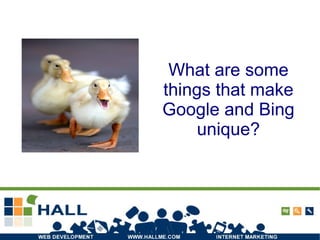
What are some
things that make
Google and Bing
unique?
Photo courtesy of hongkiat.com
•
Brand new! Google Instant
•
Google Real Time Search
•
Tries to give you an answer without needing to
leave Google
Photo courtesy of hongkiat.com
•
Tries to focus on user experience
•
Bing Social Search – partnership with Facebook
•
Uses categories – no more “10 blue links”
Let's talk SEO...
SEO Tips for
•Accurate and unique titles for each web page consisting of your keywords for that
page.
•Use H1 as Google considers the text within this tag as important (only one H1 per
page)
•Use unique description tags for each page that are 200 words or less.
•Write natural, quality content for your site.
•Engage in link building to have quality inbound links to your website with keyword
anchor text.
SEO Tips for
•Follow the same guidelines as Google (title tags, description tags, header tags,
quality links, etc).
•Bing seems to put more weight on keyword-rich domains (i.e., maine-social-
media-marketing.com).
•Websites that have been around longer seem to score some extra points.
•More favor has been shown upon pages with more than 300 words of text.
•Since Bing is about breaking things into easy categories, look at the categories
that appear for your keywords and emphasize that (i.e., cell phone accessories).
SEO Tips for
Re-cap
Photo: http://www.flickr.com/photos/5-0_og/1304841776/
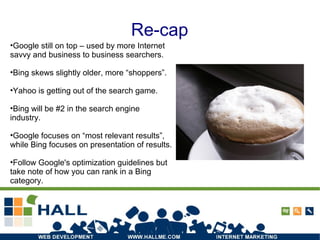
•Google still on top – used by more Internet
savvy and business to business searchers.
•Bing skews slightly older, more “shoppers”.
•Yahoo is getting out of the search game.
•Bing will be #2 in the search engine
industry.
•Google focuses on “most relevant results”,
while Bing focuses on presentation of results.
•Follow Google's optimization guidelines but
take note of how you can rank in a Bing
category.
Photo: http://www.flickr.com/photos/5-0_og/1304841776/
Weekly Webinars
Next week:
Amanda – Social Media for Non Believers
Two Weeks:
Alayna – Improve User Conversion with Your CMS
Learn More!
• Web Vision Blog - http://www.hallme.com/blog
• Webinars – http://www.hallme.com/webinars
• Follow Hall on Twitter - @Hall_Web
• Follow Kasi on Twitter - @kasi_marie
• Email me: kasi@hallme.com

Google, Bing, Yahoo - What's the Difference and Why Does it Matter?

  • 1.
    What's the Difference and WhyDoes it Matter? Hall Web Services
  • 2.
    Who We Are HallWeb Services www.hallme.com • 11+ Years in Business • Over 80 Search Marketing Clients • 98% of Customers "Very Satisfied" Who We Are Kasi Gajtkowski Organic Search Specialist kasi@hallme.com
  • 3.
    Ask Questions! * UseGoToWebinar “Chat” or “Ask a Question” * Twitter with #SEOvision tag
  • 4.
    What You'll Learn •Somestats and demos of Google, Yahoo, and Bing users •The details of the Microsoft-Yahoo search deal •The differences in Google and Bing's search technology, some things that make them unique, and SEO tips for each.
  • 5.
    Search Engines: QuickOverview You type in a query Search engine database Software “spiders” Secret Algorithm Relevant pages based on algorithm
  • 6.
  • 7.
    Facts & Figures •InAugust 2010, Google was used for 71.59% of the volume of searches in the US* •Studies have shown that those people who have been using the Internet longer use Google to search the web** •58% of users have at least some college education*** •Google users also have higher household incomes – over half of Google users have a HHI of $60+*** Stats thanks to: *Hitwise **S.G. Cowen & Co. ***Quantcast
  • 8.
    Facts & Figures •InAugust 2010, Yahoo was used for 14.28% of the volume of searches in the US* •Yahoo users have shown to be more “impulsive” in terms of online buying decisions** •46% of Yahoo searchers have no college education*** •20% of people who use Yahoo have a HHI of less than $30K*** Stats thanks to: *Hitwise **gotoast.com ***Quantcast
  • 9.
    Facts & Figures •InAugust 2010, Bing was used for 9.87% of the volume of searches in the US* •Bing's users click on more ads than Google's (relative to impressions)** •25% of Bing searchers are over the age of 50.*** •44% of people who use Bing are not college-educated.*** Stats thanks to: *Hitwise **TechCrunch. ***Quantcast
  • 10.
    Microsoft-Yahoo Search Deal •Yahoo'sown search technology will no longer be used- Yahoo search results are now powered by Bing in the US & Canada (Yahoo portal will remain)* •Paid search on Yahoo will use Microsoft's AdCenter platform – currently being rolled out •Yahoo will maintain its own display advertising business and sales force and will focus on Yahoo's “user experience” •Bing/Yahoo will be the #2 search engine with approximately 30% market share *Yahoo will get a portion of the revenue generated by searches on its pages
  • 11.
    So... We're going toleave Yahoo out and just look at Google and Bing's search technologies
  • 12.
  • 13.
    Search Technology •Google's Googlebotis more effective at crawling the web than competing engines •More sophisticated at filtering out web pages for targeted phrases related to search query •Good at differentiating between real text patterns and spammy text •Better than other search engines at determining the true intent of a query and trying to match that versus doing direct text matching. Thanks to SEObook: http://www.seobook.com/relevancy Since 1996
  • 14.
    Search Technology •Bing's MSNbot(soon to be called “Bingbot”) has gotten better over time at crawling but still not as good as Google at crawling deeply through large sites (such as eBay). •Does try to process queries for meaning instead of direct text matching – not on par with Google yet. •Since Microsoft started doing search later in the game, it has a harder time determining natural links from spammy/bought links. •Still takes longer than Google to get new websites in their index. Thanks to SEObook: http://www.seobook.com/relevancy Since 2005
  • 15.
    What are some thingsthat make Google and Bing unique?
  • 16.
    Photo courtesy ofhongkiat.com • Brand new! Google Instant • Google Real Time Search • Tries to give you an answer without needing to leave Google
  • 17.
    Photo courtesy ofhongkiat.com • Tries to focus on user experience • Bing Social Search – partnership with Facebook • Uses categories – no more “10 blue links”
  • 18.
  • 19.
    SEO Tips for •Accurateand unique titles for each web page consisting of your keywords for that page. •Use H1 as Google considers the text within this tag as important (only one H1 per page) •Use unique description tags for each page that are 200 words or less. •Write natural, quality content for your site. •Engage in link building to have quality inbound links to your website with keyword anchor text.
  • 20.
    SEO Tips for •Followthe same guidelines as Google (title tags, description tags, header tags, quality links, etc). •Bing seems to put more weight on keyword-rich domains (i.e., maine-social- media-marketing.com). •Websites that have been around longer seem to score some extra points. •More favor has been shown upon pages with more than 300 words of text. •Since Bing is about breaking things into easy categories, look at the categories that appear for your keywords and emphasize that (i.e., cell phone accessories). SEO Tips for
  • 21.
    Re-cap Photo: http://www.flickr.com/photos/5-0_og/1304841776/ •Google stillon top – used by more Internet savvy and business to business searchers. •Bing skews slightly older, more “shoppers”. •Yahoo is getting out of the search game. •Bing will be #2 in the search engine industry. •Google focuses on “most relevant results”, while Bing focuses on presentation of results. •Follow Google's optimization guidelines but take note of how you can rank in a Bing category.
  • 22.
    Photo: http://www.flickr.com/photos/5-0_og/1304841776/ Weekly Webinars Nextweek: Amanda – Social Media for Non Believers Two Weeks: Alayna – Improve User Conversion with Your CMS
  • 23.
    Learn More! • WebVision Blog - http://www.hallme.com/blog • Webinars – http://www.hallme.com/webinars • Follow Hall on Twitter - @Hall_Web • Follow Kasi on Twitter - @kasi_marie • Email me: kasi@hallme.com