1. WHAT IS SEO
2. HISTORY OF SEO
3. SEO MARKETING MODELS
4. SEO’S PLACE IN MARKETING COMMUNICATION
5. SEO’S PLACE IN INTERNATIONAL MARKETING
6. SEO’S PLACE IN TURKEY
7. CASE STUDY: SUCCESS STORIES
8. CONCLUSION
WHAT IS SEO
I KNOW YOU WERE: EASILY DEFINE YOUR
TARGET GROUP
YOU WERE GONNA COME TO ME: GOOGLE’S
LARGE SHARE ON THE SEARCH ENGINE
MARKET
BETTER CHOOSE CAREFULLY:
CHOOSING WORDS CAREFULLY
ā€˜CAUSE I, I’M CAPABLE OF ANYTHING OF
ANYTHING AND EVERYTHING:
CAN REACH MILLIONS OF CUSTOMERS PER
DAY
If You Had to Define SEO
in Under 100 Words, What
Would You Say?
• Search engine optimization (SEO)
• is the practice of improving the ranking
• and visibility of your website's pages in search
engines like Google.
• The easier it is for people to find you via a search
engine, the more likely you'll get people visiting
your site to learn more about your business.
So, how do people
optimize their pages for
search?
• The specifics change based on how the ranking
algorithms work.
• And the way they work is always changing.
• But usually, the best way to ensure you're SEO-
friendly is to solve for the reader with helpful
content and a good user experience.
There is two different results.
Organic vs. paid results.
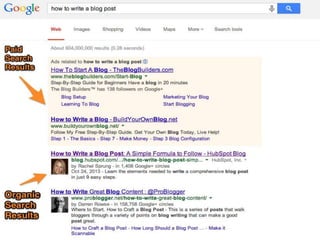
• Organic results are the results that appear in
search engines, for free, based on an algorithm.
• Paid -- or inorganic -- search results appear at the
top or side of a page. These are the links that
advertisers pay to appear on different search
engines.
If You Had to Define SEO in Under 100
Words, What Would You Say?
2) What's the difference between organic vs. paid results?
Organic results are the results that appear in search engines, for free, based on an
algorithm. Paid -- or inorganic -- search results appear at the top or side of a page.
These are the links that advertisers pay to appear on different search engines.
Meta descriptions and do they still
matter?
Meta descriptions and do they still matter?
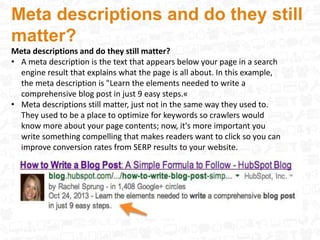
• A meta description is the text that appears below your page in a search
engine result that explains what the page is all about. In this example,
the meta description is "Learn the elements needed to write a
comprehensive blog post in just 9 easy steps.Ā«
• Meta descriptions still matter, just not in the same way they used to.
They used to be a place to optimize for keywords so crawlers would
know more about your page contents; now, it's more important you
write something compelling that makes readers want to click so you can
improve conversion rates from SERP results to your website.
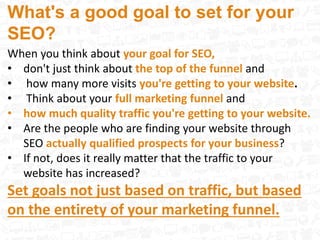
What's a good goal to set for your
SEO?
When you think about your goal for SEO,
• don't just think about the top of the funnel and
• how many more visits you're getting to your website.
• Think about your full marketing funnel and
• how much quality traffic you're getting to your website.
• Are the people who are finding your website through
SEO actually qualified prospects for your business?
• If not, does it really matter that the traffic to your
website has increased?
Set goals not just based on traffic, but based
on the entirety of your marketing funnel.
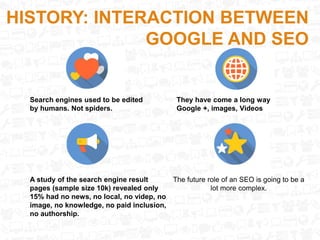
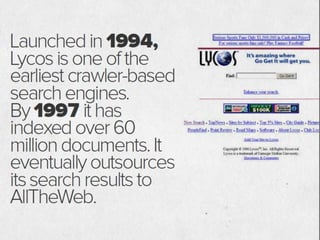
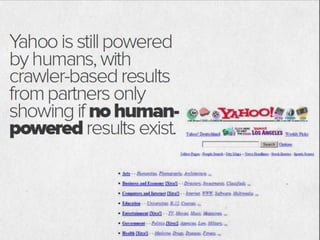
Search engines used to be edited
by humans. Not spiders.
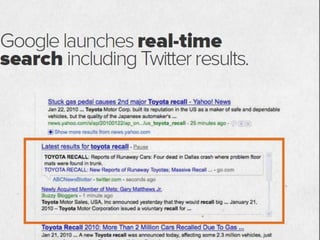
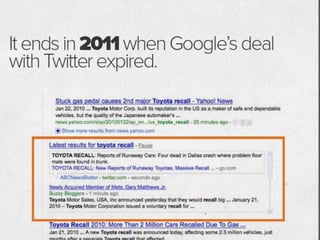
They have come a long way
Google +, images, Videos
The future role of an SEO is going to be a
lot more complex.
A study of the search engine result
pages (sample size 10k) revealed only
15% had no news, no local, no videp, no
image, no knowledge, no paid inclusion,
no authorship.
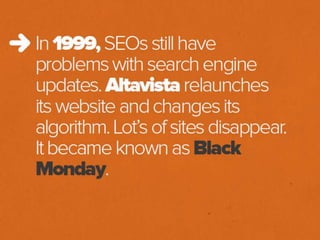
HISTORY: INTERACTION BETWEEN
GOOGLE AND SEO
HISTORY: INTERACTION BETWEEN GOOGLE AND SEO
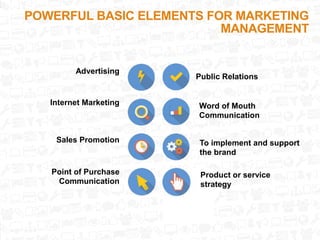
Advertising
Word of Mouth
Communication
Internet Marketing
Sales Promotion
Point of Purchase
Communication
To implement and support
the brand
Product or service
strategy
Public Relations
POWERFUL BASIC ELEMENTS FOR MARKETING
MANAGEMENT
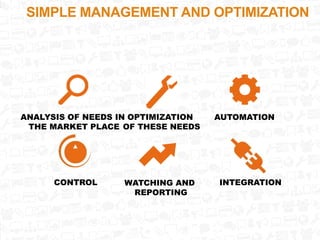
ANALYSIS OF NEEDS IN
THE MARKET PLACE
OPTIMIZATION
OF THESE NEEDS
AUTOMATION
INTEGRATIONCONTROL WATCHING AND
REPORTING
SIMPLE MANAGEMENT AND OPTIMIZATION
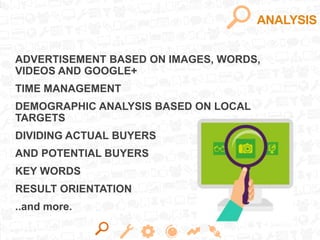
ANALYSIS
ADVERTISEMENT BASED ON IMAGES, WORDS,
VIDEOS AND GOOGLE+
TIME MANAGEMENT
DEMOGRAPHIC ANALYSIS BASED ON LOCAL
TARGETS
DIVIDING ACTUAL BUYERS
AND POTENTIAL BUYERS
KEY WORDS
RESULT ORIENTATION
..and more.
OPTIMIZATION
Cost Per Action
Cost Per Action or CPA (sometimes known as Pay Per
Action or PPA; also Cost Per Conversion) is an online
advertising pricing model, where the advertiser pays for each
specified action - for example, an impression, click, form submit
(e.g., contact request, newsletter sign up, registration etc.),
double opt-in or sale.
Cost Per Click
Pay per click (PPC) (also called cost per click) is an internet
advertising model used to direct traffic to websites, in which
advertisers pay the publisher (typically a website owner) when
the ad is clicked. It is defined simply as ā€œthe amount spent to get
an advertisement clicked.
OPTIMIZATION
Search analytics is the analysis and aggregation of search
engine statistics for use in search engine marketing (SEM)
and search engine optimization(SEO). In other words, search
analytics helps website owners understand and improve their
performance on search engines.
Services: It could be undeniable part of
Your marketing strategy
Data Collection: Market Segmentation
Distinct needs, charachteristics, behavior
Could be easily determined.
OPTIMIZATION
Return of Investment
Actual ROI is the one which eventually decides the fate of our
future engagement with a client.
Actual ROI = (Total E-Commerce Revenue through SEO + Total
Goal Value through SEO)- cost of running the SEO campaign/
cost of running the SEO campaign
Market Conditions: Target marketing could be
Done according to needs
A COMPANY WITH LIMITED RESOURCES MIGHT DECIDE TO SERVE ONLY ONE
OR FEW SPECIAL SEGMENTS OR MARKET NICHES .
NICHERS SPECIALIZE IN SERVING MARKET SEGMENTS THAT MAJOR
COMPETITORS OVERLOOK OR IGNORE
AUTOMATION
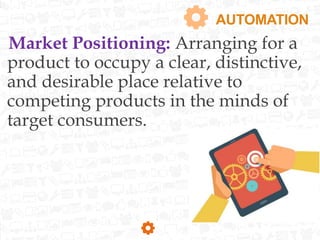
Market Positioning: Arranging for a
product to occupy a clear, distinctive,
and desirable place relative to
competing products in the minds of
target consumers.
CONTROL
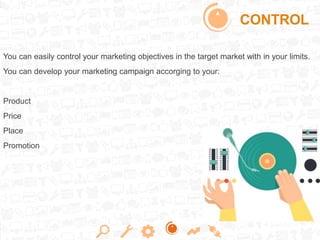
You can easily control your marketing objectives in the target market with in your limits.
You can develop your marketing campaign accorging to your:
Product
Price
Place
Promotion
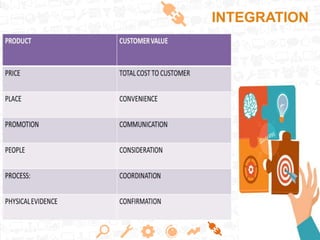
Digital technologies are radically changing marketing in several
sectors
The new needs:
product, with the introduction of co-design with customers;
price, with higher levels of transparency;
place, with the creation of new ways to reach customers; and
promotion, thanks to the new interactive capabilities .
WATCHING & REPORT
INTEGRATION
LET’S MOVE ON TO THE CASE
STUDIES..

SEO: New Generation Instrument of International Marketing

  • 2.
    1. WHAT ISSEO 2. HISTORY OF SEO 3. SEO MARKETING MODELS 4. SEO’S PLACE IN MARKETING COMMUNICATION 5. SEO’S PLACE IN INTERNATIONAL MARKETING 6. SEO’S PLACE IN TURKEY 7. CASE STUDY: SUCCESS STORIES 8. CONCLUSION
  • 3.
    WHAT IS SEO IKNOW YOU WERE: EASILY DEFINE YOUR TARGET GROUP YOU WERE GONNA COME TO ME: GOOGLE’S LARGE SHARE ON THE SEARCH ENGINE MARKET BETTER CHOOSE CAREFULLY: CHOOSING WORDS CAREFULLY ā€˜CAUSE I, I’M CAPABLE OF ANYTHING OF ANYTHING AND EVERYTHING: CAN REACH MILLIONS OF CUSTOMERS PER DAY
  • 4.
    If You Hadto Define SEO in Under 100 Words, What Would You Say? • Search engine optimization (SEO) • is the practice of improving the ranking • and visibility of your website's pages in search engines like Google. • The easier it is for people to find you via a search engine, the more likely you'll get people visiting your site to learn more about your business.
  • 5.
    So, how dopeople optimize their pages for search? • The specifics change based on how the ranking algorithms work. • And the way they work is always changing. • But usually, the best way to ensure you're SEO- friendly is to solve for the reader with helpful content and a good user experience.
  • 6.
    There is twodifferent results. Organic vs. paid results. • Organic results are the results that appear in search engines, for free, based on an algorithm. • Paid -- or inorganic -- search results appear at the top or side of a page. These are the links that advertisers pay to appear on different search engines.
  • 7.
    If You Hadto Define SEO in Under 100 Words, What Would You Say? 2) What's the difference between organic vs. paid results? Organic results are the results that appear in search engines, for free, based on an algorithm. Paid -- or inorganic -- search results appear at the top or side of a page. These are the links that advertisers pay to appear on different search engines.
  • 8.
    Meta descriptions anddo they still matter? Meta descriptions and do they still matter? • A meta description is the text that appears below your page in a search engine result that explains what the page is all about. In this example, the meta description is "Learn the elements needed to write a comprehensive blog post in just 9 easy steps.Ā« • Meta descriptions still matter, just not in the same way they used to. They used to be a place to optimize for keywords so crawlers would know more about your page contents; now, it's more important you write something compelling that makes readers want to click so you can improve conversion rates from SERP results to your website.
  • 9.
    What's a goodgoal to set for your SEO? When you think about your goal for SEO, • don't just think about the top of the funnel and • how many more visits you're getting to your website. • Think about your full marketing funnel and • how much quality traffic you're getting to your website. • Are the people who are finding your website through SEO actually qualified prospects for your business? • If not, does it really matter that the traffic to your website has increased? Set goals not just based on traffic, but based on the entirety of your marketing funnel.
  • 10.
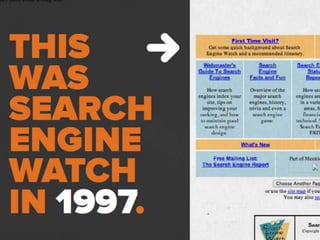
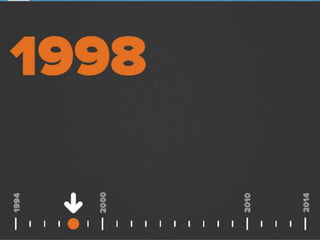
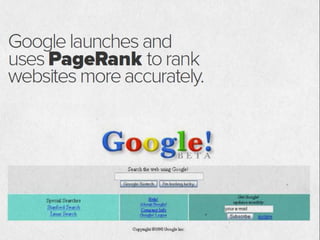
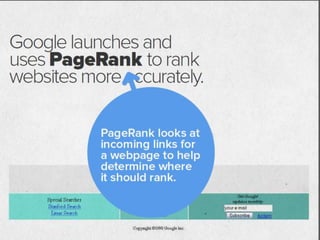
    Search engines usedto be edited by humans. Not spiders. They have come a long way Google +, images, Videos The future role of an SEO is going to be a lot more complex. A study of the search engine result pages (sample size 10k) revealed only 15% had no news, no local, no videp, no image, no knowledge, no paid inclusion, no authorship. HISTORY: INTERACTION BETWEEN GOOGLE AND SEO
  • 11.
  • 12.
  • 13.
  • 14.
  • 15.
  • 16.
  • 17.
  • 18.
  • 19.
  • 20.
  • 21.
  • 22.
  • 23.
  • 24.
  • 25.
  • 26.
  • 100.
    Advertising Word of Mouth Communication InternetMarketing Sales Promotion Point of Purchase Communication To implement and support the brand Product or service strategy Public Relations POWERFUL BASIC ELEMENTS FOR MARKETING MANAGEMENT
  • 101.
    ANALYSIS OF NEEDSIN THE MARKET PLACE OPTIMIZATION OF THESE NEEDS AUTOMATION INTEGRATIONCONTROL WATCHING AND REPORTING SIMPLE MANAGEMENT AND OPTIMIZATION
  • 102.
    ANALYSIS ADVERTISEMENT BASED ONIMAGES, WORDS, VIDEOS AND GOOGLE+ TIME MANAGEMENT DEMOGRAPHIC ANALYSIS BASED ON LOCAL TARGETS DIVIDING ACTUAL BUYERS AND POTENTIAL BUYERS KEY WORDS RESULT ORIENTATION ..and more.
  • 103.
    OPTIMIZATION Cost Per Action CostPer Action or CPA (sometimes known as Pay Per Action or PPA; also Cost Per Conversion) is an online advertising pricing model, where the advertiser pays for each specified action - for example, an impression, click, form submit (e.g., contact request, newsletter sign up, registration etc.), double opt-in or sale. Cost Per Click Pay per click (PPC) (also called cost per click) is an internet advertising model used to direct traffic to websites, in which advertisers pay the publisher (typically a website owner) when the ad is clicked. It is defined simply as ā€œthe amount spent to get an advertisement clicked.
  • 104.
    OPTIMIZATION Search analytics isthe analysis and aggregation of search engine statistics for use in search engine marketing (SEM) and search engine optimization(SEO). In other words, search analytics helps website owners understand and improve their performance on search engines. Services: It could be undeniable part of Your marketing strategy Data Collection: Market Segmentation Distinct needs, charachteristics, behavior Could be easily determined.

  • 105.
    OPTIMIZATION Return of Investment ActualROI is the one which eventually decides the fate of our future engagement with a client. Actual ROI = (Total E-Commerce Revenue through SEO + Total Goal Value through SEO)- cost of running the SEO campaign/ cost of running the SEO campaign Market Conditions: Target marketing could be Done according to needs A COMPANY WITH LIMITED RESOURCES MIGHT DECIDE TO SERVE ONLY ONE OR FEW SPECIAL SEGMENTS OR MARKET NICHES . NICHERS SPECIALIZE IN SERVING MARKET SEGMENTS THAT MAJOR COMPETITORS OVERLOOK OR IGNORE
  • 106.
    AUTOMATION Market Positioning: Arrangingfor a product to occupy a clear, distinctive, and desirable place relative to competing products in the minds of target consumers.
  • 107.
    CONTROL You can easilycontrol your marketing objectives in the target market with in your limits. You can develop your marketing campaign accorging to your: Product Price Place Promotion
  • 108.
    Digital technologies areradically changing marketing in several sectors The new needs: product, with the introduction of co-design with customers; price, with higher levels of transparency; place, with the creation of new ways to reach customers; and promotion, thanks to the new interactive capabilities . WATCHING & REPORT
  • 109.
  • 110.
    LET’S MOVE ONTO THE CASE STUDIES..