a 30 min short walk
Robert Saxby - Big Data Product Specialist
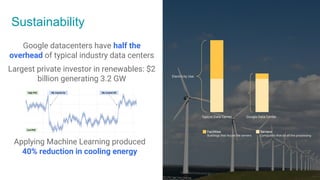
Sustainability
Google datacenters have half the
overhead of typical industry data centers
Largest private investor in renewables: $2
billion generating 3.2 GW
Applying Machine Learning produced
40% reduction in cooling energy
Large Datasets Cutting Edge Models Compute at Scale
Drivers of Success in AI/ML Projects
App DeveloperData Scientist
Build custom modelsUse/extend OSS SDK Use pre-built models
ML researcher
Cloud MLE ML Perception services
End to End: Google Cloud AI Spectrum
App DeveloperData Scientist
Build custom modelsUse/extend OSS SDK Use pre-built models
ML researcher
Cloud MLE ML Perception services
End to End: Google Cloud AI Spectrum
Proprietary + Confidential
What is TensorFlow?
● A system for distributed, parallel machine learning
● It’s based on general-purpose dataflow graphs
● It targets heterogeneous devices
○ A single PC with CPU
○ A single PC with GPU(s)
○ A mobile device
○ Clusters of 100s or 1000s of CPUs, GPUs and TPUs
Proprietary + Confidential
Another data flow system
MatMul
Add Relu
biases
weights
examples
labels
Xent
Graph of Nodes, also called Operations or ops
Proprietary + Confidential
With tensors
MatMul
Add Relu
biases
weights
examples
labels
Xent
Edges are N-dimensional arrays: Tensors
Proprietary + Confidential
What’s in a name?
0 Scalar (magnitude only) s = 483
1 Vector (magnitude and direction) v = [1.1, 2.2, 3.3]
2 Matrix (table of numbers) m = [[1, 2, 3], [4, 5, 6], [7, 8, 9]]
3 3-Tensor (cube of numbers) t = [[[2], [4], [6]], [[8], [10], [12]], [[14], [16], [18]]]
4 n-Tensor (you get the idea) ....
Proprietary + Confidential
Convolutional layer
W1
[4, 4, 3]
W2
[4, 4, 3]
+padding
W[4, 4, 3, 2]
filter
size
input
channels
output
channels
stride
convolutional
subsampling
convolutional
subsampling
convolutional
subsampling
Proprietary + Confidential
With state
Add Mul
biases
...
learning
rate
−=...
'Biases' is a variable −= updates biasesSome ops compute gradients
Proprietary + Confidential
And distributed
Add Mul
biases
...
learning
rate
−=...
Device BDevice A
TensorFlow Distributed Execution Engine
CPU GPU Android iOS ...
C++ FrontendPython Frontend ...
Layers
Estimator
Models in a box
Train and evaluate
models
Build models
Keras
Model
Canned Estimators
Proprietary + Confidential
Artificial Intelligence
The science of making things smart
Neural Network
A type of algorithm in machine learning
Machine Learning
Building machines that can learn
Proprietary + Confidential
The popular imagination of what ML is
Lots of data Magical resultsComplex mathematics in multidimensional spaces
Proprietary + Confidential
In reality, ML is
Collect
data
Create the
model
Refine the
model
Understand
and prepare
the data
Serve the
model
Define
objectives
Proprietary + Confidential
In reality, ML is
Collect
data
Create the
model
Refine the
model
Understand
and prepare
the data
Serve the
model
Define
objectives
Proprietary + Confidential
Neural Network is a function that can learn
Proprietary + Confidential
How about this?
Proprietary + Confidential
Neural Network can extract hidden features from data
Proprietary + Confidential
28x28
pixels
softmax
...
...
0 1 2 9
weighted sum of all
pixels + bias
neuron outputs
784 pixels
A very simple model
L0,0
w0,0
w0,1
w0,2
w0,3
… w0,9
w1,0
w1,1
w1,2
w1,3
… w1,9
w2,0
w2,1
w2,2
w2,3
… w2,9
w3,0
w3,1
w3,2
w3,3
… w3,9
w4,0
w4,1
w4,2
w4,3
… w4,9
w5,0
w5,1
w5,2
w5,3
… w5,9
w6,0
w6,1
w6,2
w6,3
… w6,9
w7,0
w7,1
w7,2
w7,3
… w7,9
w8,0
w8,1
w8,2
w8,3
… w8,9
…
w783,0
w783,1
w783,2
… w783,9
x
x
x
x
x
x
x
x
L1,0
L1,1
L1,2
L1,3
… L1,9
L2,0
L2,1
L2,2
L2,3
… L2,9
L3,0
L3,1
L3,2
L3,3
… L3,9
L4,0
L4,1
L4,2
L4,3
… L4,9
…
L99,0
L99,1
L99,2
… L99,9
L0,0
L0,1
L0,2
L0,3
… L0,9
… + b0
b1
b2
b3
… b9
+ Same 10 biases
on all lines
X : 100 images,
one per line,
flattened
784 pixels
784lines
broadcast
100 images at a time
Proprietary + Confidential
9...0 1 2
sigmoid function
softmax
200
100
60
10
30
784
overkill
;-)
Going Deep, 5 Layers Deep
Proprietary + Confidential
TanhSigmoidBinary StepIdentity Relu
Softmax
1 1 1
-1
weighted sum of all
pixels + bias
2.0
1.0
0.1
Scores
→ Logits
0.7
0.2
0.1
Probabilities
Activation Functions
Proprietary + Confidential
Predictions Images Weights Biases
Y[100, 10] X[100, 784] W[784,10] b[10]
matrix multiply
broadcast
on all lines
applied line
by line
tensor shapes in [ ]
Softmax on a batch of images
Demo
Proprietary + Confidential
Cross entropy:
computed probabilities
actual probabilities, “one-hot” encoded
0 0 0 0 0 0 1 0 0 0
this is a “6”
0.1 0.2 0.1 0.3 0.2 0.1 0.9 0.2 0.1 0.1
0 1 2 3 4 5 6 7 8 9
0 1 2 3 4 5 6 7 8 9
Success?
Proprietary + Confidential
Gradient Descent
Proprietary + Confidential
import tensorflow as tf
X = tf.placeholder(tf.float32, [None, 28, 28, 1])
W = tf.Variable(tf.zeros([784, 10]))
b = tf.Variable(tf.zeros([10]))
init = tf.initialize_all_variables()
# model
Y=tf.nn.softmax(tf.matmul(tf.reshape(X,[-1, 784]), W) + b)
# placeholder for correct answers
Y_ = tf.placeholder(tf.float32, [None, 10])
# loss function
cross_entropy = -tf.reduce_sum(Y_ * tf.log(Y))
# % of correct answers found in batch
is_correct = tf.equal(tf.argmax(Y,1), tf.argmax(Y_,1))
accuracy = tf.reduce_mean(tf.cast(is_correct,tf.float32))
optimizer = tf.train.GradientDescentOptimizer(0.003)
train_step = optimizer.minimize(cross_entropy)
sess = tf.Session()
sess.run(init)
for i in range(10000):
# load batch of images and correct answers
batch_X, batch_Y = mnist.train.next_batch(100)
train_data={X: batch_X, Y_: batch_Y}
# train
sess.run(train_step, feed_dict=train_data)
# success ? add code to print it
a,c = sess.run([accuracy, cross_entropy], feed=train_data)
# success on test data ?
test_data={X:mnist.test.images, Y_:mnist.test.labels}
a,c = sess.run([accuracy, cross_entropy], feed=test_data)
initialisation
model
success metrics
training step
Run
The whole code
Workshop
Self-paced code lab (summary below ↓): goo.gl/mVZloU
Code: github.com/martin-gorner/tensorflow-mnist-tutorial
1-5. Theory (install then sit back and listen or read)
Neural networks 101: softmax, cross-entropy,
mini-batching, gradient descent, hidden layers, sigmoids,
and how to implement them in Tensorflow
6. Practice (full instructions for this step)
Open file: mnist_1.0_softmax.py
Run it, play with the visualisations (keyboard shortcuts
on previous slide), read and understand the code as well
as the basic structure of a Tensorflow program.
7. Practice (full instructions for this step)
Start from the file mnist_1.0_softmax.py and add one
or two hidden layers.
Solution in: mnist_2.0_five_layers_sigmoid.py
8. Practice (full instructions for this step)
Special care for deep neural networks: use RELU
activation functions, use a better optimiser, initialise
weights with random values and beware of the log(0)
9-10. Practice (full instructions for this step)
Use a decaying learning rate and then add dropout
Solution in: mnist_2.2_five_layers_relu_lrdecay_dropout.py
11. Theory (sit back and listen or read)
Convolutional networks
12. Practice (full instructions for this step)
Replace your model with a convolutional network,
without dropout.
Solution in: mnist_3.0_convolutional.py
13. Challenge (full instructions for this step)
Try a bigger neural network (good hyperparameters on
slide 43) and add dropout on the last layer to get >99%
Solution in: mnist_3.0_convolutional_bigger_dropout.py
?
?
Proprietary + Confidential
https://cloud.google.com/solutions/running-distributed-tensorflow-on-compute-engine
Distributed TensorFlow on Compute Engine
Proprietary + Confidential
Machine Learning on any data, of any size
Cloud ML Engine
Portable models with TensorFlow
Services are designed to work together
Managed distributed training infrastructure
that supports CPUs and GPUs
Automatic hyperparameter tuning
Custom Estimators: The Model
https://github.com/GoogleCloudPlatform/cloudml-samples/tree/master/census
...
def _model_fn(mode, features, labels):
...
if mode == Modes.PREDICT:
...
return tf.estimator.EstimatorSpec(mode, predictions=predictions, export_outputs=export_outputs)
...
if mode == Modes.TRAIN:
...
return tf.estimator.EstimatorSpec(mode, loss=loss, train_op=train_op)
...
https://github.com/GoogleCloudPlatform/cloudml-samples/tree/master/census
Custom Estimators: The Task
...
train_input = lambda: model.generate_input_fn(hparams.train_files, num_epochs=hparams.num_epochs,
batch_size=hparams.train_batch_size)
...
"""This function is used by learn_runner to create an Experiment which executes model code
provided in the form of an Estimator and input functions."""
def _experiment_fn(run_config, hparams):
tf.estimator.Estimator(
model.generate_model_fn(
...
),
train_input_fn=train_input,
eval_input_fn=eval_input,
**experiment_args
)
...
Proprietary + Confidential
Running locally
gcloud ml-engine local train 
--module-name trainer.task --package-path trainer/ 
-- 
--train-files $TRAIN_DATA --eval-files $EVAL_DATA --train-steps 1000 --job-dir $MODEL_DIR
training
data
evaluation
data
output
directory
train locally
Proprietary + Confidential
Single trainer running in the cloud
gcloud ml-engine jobs submit training $JOB_NAME --job-dir $OUTPUT_PATH 
--runtime-version 1.0 --module-name trainer.task --package-path trainer/ --region $REGION 
-- 
--train-files $TRAIN_DATA --eval-files $EVAL_DATA --train-steps 1000 --verbosity DEBUG
train in the cloud
region
Google cloud storage
location
Proprietary + Confidential
Distributed training in the cloud
gcloud ml-engine jobs submit training $JOB_NAME --job-dir $OUTPUT_PATH 
--runtime-version 1.0 --module-name trainer.task --package-path trainer/ --region $REGION 
--scale-tier STANDARD_1
-- 
--train-files $TRAIN_DATA --eval-files $EVAL_DATA --train-steps 1000 --verbosity DEBUG
distributed
Proprietary + Confidential
In reality, ML is
Collect
data
Create the
model
Refine the
model
Understand
and prepare
the data
Serve the
model
Define
objectives
Proprietary + Confidential
Refine the model
Feature engineering
Better algorithms
More examples, more data
Hyperparameter tuning
Proprietary + Confidential
Hyperparameter tuning
● Automatic hyperparameter tuning service
● Build better performing models faster and save
many hours of manual tuning
● Google-developed search (Bayesian Optimisation)
algorithm efficiently finds better hyperparameters
for your model/dataset
HyperParam #1
Objective
We want to find this
Not these
https://cloud.google.com/blog/big-data/2017/08/hyperparameter-tuning-in-cloud-machine-learning-engine-using-bayesian-optimization
Proprietary + Confidential
Hyperparameter tuning
gcloud ml-engine jobs submit training $JOB_NAME --job-dir $OUTPUT_PATH 
--runtime-version 1.0 --module-name trainer.task --package-path trainer/ --region $REGION 
--scale-tier STANDARD_1 --config $HPTUNING_CONFIG
-- 
--train-files $TRAIN_DATA --eval-files $EVAL_DATA --train-steps 1000 --verbosity DEBUG
hypertuning
Proprietary + Confidential
Hyperparameter tuning
trainingInput:
hyperparameters:
goal: MAXIMIZE
hyperparameterMetricTag: accuracy
maxTrials: 4
maxParallelTrials: 2
params:
- parameterName: first-layer-size
type: INTEGER
minValue: 50
maxValue: 500
scaleType: UNIT_LINEAR_SCALE
...
...
# Construct layers sizes with exponetial decay
hidden_units=[
max(2, int(hparams.first_layer_size *
hparams.scale_factor**i))
for i in range(hparams.num_layers)
],
...
parser.add_argument(
'--first-layer-size',
help='Number of nodes in the 1st layer of the DNN',
default=100,
type=int
)
...
hptuning_config.yaml task.py
Proprietary + Confidential
In reality, ML is
Collect
data
Create the
model
Refine the
model
Understand
and prepare
the data
Serve the
model
Define
objectives
Proprietary + Confidential
Deploying the model
Creating model
gcloud ml-engine models create $MODEL_NAME --regions=$REGION
Creating versions
gcloud ml-engine versions create v1 --model $MODEL_NAME --origin $MODEL_BINARIES 
--runtime-version 1.0
gcloud ml-engine models list
Proprietary + Confidential
Predicting
gcloud ml-engine predict --model $MODEL_NAME --version v1 --json-instances ../test.json
Using REST:
POST https://ml.googleapis.com/v1/{name=projects/**}:predict
JSON format (in this case):
{"age": 25, "workclass": "private", "education": "11th", "education_num": 7, "marital_status":
"Never-married", "occupation": "machine-op-inspector", "relationship": "own-child", "gender": "
male", "capital_gain": 0, "capital_loss": 0, "hours_per_week": 40, "native_country": "
United-States"}
Google Big Data Expo

Google Big Data Expo

  • 1.
    a 30 minshort walk Robert Saxby - Big Data Product Specialist
  • 3.
    Sustainability Google datacenters havehalf the overhead of typical industry data centers Largest private investor in renewables: $2 billion generating 3.2 GW Applying Machine Learning produced 40% reduction in cooling energy
  • 4.
    Large Datasets CuttingEdge Models Compute at Scale Drivers of Success in AI/ML Projects
  • 5.
    App DeveloperData Scientist Buildcustom modelsUse/extend OSS SDK Use pre-built models ML researcher Cloud MLE ML Perception services End to End: Google Cloud AI Spectrum
  • 6.
    App DeveloperData Scientist Buildcustom modelsUse/extend OSS SDK Use pre-built models ML researcher Cloud MLE ML Perception services End to End: Google Cloud AI Spectrum
  • 7.
    Proprietary + Confidential Whatis TensorFlow? ● A system for distributed, parallel machine learning ● It’s based on general-purpose dataflow graphs ● It targets heterogeneous devices ○ A single PC with CPU ○ A single PC with GPU(s) ○ A mobile device ○ Clusters of 100s or 1000s of CPUs, GPUs and TPUs
  • 8.
    Proprietary + Confidential Anotherdata flow system MatMul Add Relu biases weights examples labels Xent Graph of Nodes, also called Operations or ops
  • 9.
    Proprietary + Confidential Withtensors MatMul Add Relu biases weights examples labels Xent Edges are N-dimensional arrays: Tensors
  • 10.
    Proprietary + Confidential What’sin a name? 0 Scalar (magnitude only) s = 483 1 Vector (magnitude and direction) v = [1.1, 2.2, 3.3] 2 Matrix (table of numbers) m = [[1, 2, 3], [4, 5, 6], [7, 8, 9]] 3 3-Tensor (cube of numbers) t = [[[2], [4], [6]], [[8], [10], [12]], [[14], [16], [18]]] 4 n-Tensor (you get the idea) ....
  • 11.
    Proprietary + Confidential Convolutionallayer W1 [4, 4, 3] W2 [4, 4, 3] +padding W[4, 4, 3, 2] filter size input channels output channels stride convolutional subsampling convolutional subsampling convolutional subsampling
  • 12.
    Proprietary + Confidential Withstate Add Mul biases ... learning rate −=... 'Biases' is a variable −= updates biasesSome ops compute gradients
  • 13.
    Proprietary + Confidential Anddistributed Add Mul biases ... learning rate −=... Device BDevice A
  • 14.
    TensorFlow Distributed ExecutionEngine CPU GPU Android iOS ... C++ FrontendPython Frontend ... Layers Estimator Models in a box Train and evaluate models Build models Keras Model Canned Estimators
  • 15.
    Proprietary + Confidential ArtificialIntelligence The science of making things smart Neural Network A type of algorithm in machine learning Machine Learning Building machines that can learn
  • 16.
    Proprietary + Confidential Thepopular imagination of what ML is Lots of data Magical resultsComplex mathematics in multidimensional spaces
  • 17.
    Proprietary + Confidential Inreality, ML is Collect data Create the model Refine the model Understand and prepare the data Serve the model Define objectives
  • 18.
    Proprietary + Confidential Inreality, ML is Collect data Create the model Refine the model Understand and prepare the data Serve the model Define objectives
  • 19.
    Proprietary + Confidential NeuralNetwork is a function that can learn
  • 20.
  • 21.
    Proprietary + Confidential NeuralNetwork can extract hidden features from data
  • 22.
    Proprietary + Confidential 28x28 pixels softmax ... ... 01 2 9 weighted sum of all pixels + bias neuron outputs 784 pixels A very simple model
  • 23.
    L0,0 w0,0 w0,1 w0,2 w0,3 … w0,9 w1,0 w1,1 w1,2 w1,3 … w1,9 w2,0 w2,1 w2,2 w2,3 …w2,9 w3,0 w3,1 w3,2 w3,3 … w3,9 w4,0 w4,1 w4,2 w4,3 … w4,9 w5,0 w5,1 w5,2 w5,3 … w5,9 w6,0 w6,1 w6,2 w6,3 … w6,9 w7,0 w7,1 w7,2 w7,3 … w7,9 w8,0 w8,1 w8,2 w8,3 … w8,9 … w783,0 w783,1 w783,2 … w783,9 x x x x x x x x L1,0 L1,1 L1,2 L1,3 … L1,9 L2,0 L2,1 L2,2 L2,3 … L2,9 L3,0 L3,1 L3,2 L3,3 … L3,9 L4,0 L4,1 L4,2 L4,3 … L4,9 … L99,0 L99,1 L99,2 … L99,9 L0,0 L0,1 L0,2 L0,3 … L0,9 … + b0 b1 b2 b3 … b9 + Same 10 biases on all lines X : 100 images, one per line, flattened 784 pixels 784lines broadcast 100 images at a time
  • 24.
    Proprietary + Confidential 9...01 2 sigmoid function softmax 200 100 60 10 30 784 overkill ;-) Going Deep, 5 Layers Deep
  • 25.
    Proprietary + Confidential TanhSigmoidBinaryStepIdentity Relu Softmax 1 1 1 -1 weighted sum of all pixels + bias 2.0 1.0 0.1 Scores → Logits 0.7 0.2 0.1 Probabilities Activation Functions
  • 26.
    Proprietary + Confidential PredictionsImages Weights Biases Y[100, 10] X[100, 784] W[784,10] b[10] matrix multiply broadcast on all lines applied line by line tensor shapes in [ ] Softmax on a batch of images
  • 27.
  • 28.
    Proprietary + Confidential Crossentropy: computed probabilities actual probabilities, “one-hot” encoded 0 0 0 0 0 0 1 0 0 0 this is a “6” 0.1 0.2 0.1 0.3 0.2 0.1 0.9 0.2 0.1 0.1 0 1 2 3 4 5 6 7 8 9 0 1 2 3 4 5 6 7 8 9 Success?
  • 29.
  • 30.
    Proprietary + Confidential importtensorflow as tf X = tf.placeholder(tf.float32, [None, 28, 28, 1]) W = tf.Variable(tf.zeros([784, 10])) b = tf.Variable(tf.zeros([10])) init = tf.initialize_all_variables() # model Y=tf.nn.softmax(tf.matmul(tf.reshape(X,[-1, 784]), W) + b) # placeholder for correct answers Y_ = tf.placeholder(tf.float32, [None, 10]) # loss function cross_entropy = -tf.reduce_sum(Y_ * tf.log(Y)) # % of correct answers found in batch is_correct = tf.equal(tf.argmax(Y,1), tf.argmax(Y_,1)) accuracy = tf.reduce_mean(tf.cast(is_correct,tf.float32)) optimizer = tf.train.GradientDescentOptimizer(0.003) train_step = optimizer.minimize(cross_entropy) sess = tf.Session() sess.run(init) for i in range(10000): # load batch of images and correct answers batch_X, batch_Y = mnist.train.next_batch(100) train_data={X: batch_X, Y_: batch_Y} # train sess.run(train_step, feed_dict=train_data) # success ? add code to print it a,c = sess.run([accuracy, cross_entropy], feed=train_data) # success on test data ? test_data={X:mnist.test.images, Y_:mnist.test.labels} a,c = sess.run([accuracy, cross_entropy], feed=test_data) initialisation model success metrics training step Run The whole code
  • 31.
    Workshop Self-paced code lab(summary below ↓): goo.gl/mVZloU Code: github.com/martin-gorner/tensorflow-mnist-tutorial 1-5. Theory (install then sit back and listen or read) Neural networks 101: softmax, cross-entropy, mini-batching, gradient descent, hidden layers, sigmoids, and how to implement them in Tensorflow 6. Practice (full instructions for this step) Open file: mnist_1.0_softmax.py Run it, play with the visualisations (keyboard shortcuts on previous slide), read and understand the code as well as the basic structure of a Tensorflow program. 7. Practice (full instructions for this step) Start from the file mnist_1.0_softmax.py and add one or two hidden layers. Solution in: mnist_2.0_five_layers_sigmoid.py 8. Practice (full instructions for this step) Special care for deep neural networks: use RELU activation functions, use a better optimiser, initialise weights with random values and beware of the log(0) 9-10. Practice (full instructions for this step) Use a decaying learning rate and then add dropout Solution in: mnist_2.2_five_layers_relu_lrdecay_dropout.py 11. Theory (sit back and listen or read) Convolutional networks 12. Practice (full instructions for this step) Replace your model with a convolutional network, without dropout. Solution in: mnist_3.0_convolutional.py 13. Challenge (full instructions for this step) Try a bigger neural network (good hyperparameters on slide 43) and add dropout on the last layer to get >99% Solution in: mnist_3.0_convolutional_bigger_dropout.py ? ?
  • 32.
  • 33.
    Proprietary + Confidential MachineLearning on any data, of any size Cloud ML Engine Portable models with TensorFlow Services are designed to work together Managed distributed training infrastructure that supports CPUs and GPUs Automatic hyperparameter tuning
  • 34.
    Custom Estimators: TheModel https://github.com/GoogleCloudPlatform/cloudml-samples/tree/master/census ... def _model_fn(mode, features, labels): ... if mode == Modes.PREDICT: ... return tf.estimator.EstimatorSpec(mode, predictions=predictions, export_outputs=export_outputs) ... if mode == Modes.TRAIN: ... return tf.estimator.EstimatorSpec(mode, loss=loss, train_op=train_op) ...
  • 35.
    https://github.com/GoogleCloudPlatform/cloudml-samples/tree/master/census Custom Estimators: TheTask ... train_input = lambda: model.generate_input_fn(hparams.train_files, num_epochs=hparams.num_epochs, batch_size=hparams.train_batch_size) ... """This function is used by learn_runner to create an Experiment which executes model code provided in the form of an Estimator and input functions.""" def _experiment_fn(run_config, hparams): tf.estimator.Estimator( model.generate_model_fn( ... ), train_input_fn=train_input, eval_input_fn=eval_input, **experiment_args ) ...
  • 36.
    Proprietary + Confidential Runninglocally gcloud ml-engine local train --module-name trainer.task --package-path trainer/ -- --train-files $TRAIN_DATA --eval-files $EVAL_DATA --train-steps 1000 --job-dir $MODEL_DIR training data evaluation data output directory train locally
  • 37.
    Proprietary + Confidential Singletrainer running in the cloud gcloud ml-engine jobs submit training $JOB_NAME --job-dir $OUTPUT_PATH --runtime-version 1.0 --module-name trainer.task --package-path trainer/ --region $REGION -- --train-files $TRAIN_DATA --eval-files $EVAL_DATA --train-steps 1000 --verbosity DEBUG train in the cloud region Google cloud storage location
  • 38.
    Proprietary + Confidential Distributedtraining in the cloud gcloud ml-engine jobs submit training $JOB_NAME --job-dir $OUTPUT_PATH --runtime-version 1.0 --module-name trainer.task --package-path trainer/ --region $REGION --scale-tier STANDARD_1 -- --train-files $TRAIN_DATA --eval-files $EVAL_DATA --train-steps 1000 --verbosity DEBUG distributed
  • 39.
    Proprietary + Confidential Inreality, ML is Collect data Create the model Refine the model Understand and prepare the data Serve the model Define objectives
  • 40.
    Proprietary + Confidential Refinethe model Feature engineering Better algorithms More examples, more data Hyperparameter tuning
  • 41.
    Proprietary + Confidential Hyperparametertuning ● Automatic hyperparameter tuning service ● Build better performing models faster and save many hours of manual tuning ● Google-developed search (Bayesian Optimisation) algorithm efficiently finds better hyperparameters for your model/dataset HyperParam #1 Objective We want to find this Not these https://cloud.google.com/blog/big-data/2017/08/hyperparameter-tuning-in-cloud-machine-learning-engine-using-bayesian-optimization
  • 42.
    Proprietary + Confidential Hyperparametertuning gcloud ml-engine jobs submit training $JOB_NAME --job-dir $OUTPUT_PATH --runtime-version 1.0 --module-name trainer.task --package-path trainer/ --region $REGION --scale-tier STANDARD_1 --config $HPTUNING_CONFIG -- --train-files $TRAIN_DATA --eval-files $EVAL_DATA --train-steps 1000 --verbosity DEBUG hypertuning
  • 43.
    Proprietary + Confidential Hyperparametertuning trainingInput: hyperparameters: goal: MAXIMIZE hyperparameterMetricTag: accuracy maxTrials: 4 maxParallelTrials: 2 params: - parameterName: first-layer-size type: INTEGER minValue: 50 maxValue: 500 scaleType: UNIT_LINEAR_SCALE ... ... # Construct layers sizes with exponetial decay hidden_units=[ max(2, int(hparams.first_layer_size * hparams.scale_factor**i)) for i in range(hparams.num_layers) ], ... parser.add_argument( '--first-layer-size', help='Number of nodes in the 1st layer of the DNN', default=100, type=int ) ... hptuning_config.yaml task.py
  • 44.
    Proprietary + Confidential Inreality, ML is Collect data Create the model Refine the model Understand and prepare the data Serve the model Define objectives
  • 45.
    Proprietary + Confidential Deployingthe model Creating model gcloud ml-engine models create $MODEL_NAME --regions=$REGION Creating versions gcloud ml-engine versions create v1 --model $MODEL_NAME --origin $MODEL_BINARIES --runtime-version 1.0 gcloud ml-engine models list
  • 46.
    Proprietary + Confidential Predicting gcloudml-engine predict --model $MODEL_NAME --version v1 --json-instances ../test.json Using REST: POST https://ml.googleapis.com/v1/{name=projects/**}:predict JSON format (in this case): {"age": 25, "workclass": "private", "education": "11th", "education_num": 7, "marital_status": "Never-married", "occupation": "machine-op-inspector", "relationship": "own-child", "gender": " male", "capital_gain": 0, "capital_loss": 0, "hours_per_week": 40, "native_country": " United-States"}