AdWords
Emily Chin, Dabin Ha, Mikaela James, Peter Marin, Samreen Mohammed, Victoria Studer
AdWords: What is it?
● Advertising Service
○ A business pays for their
website to be displayed
on the Search Engine
Results Page (SERP)
when certain keywords
are entered.
AdWords: When did it begin?
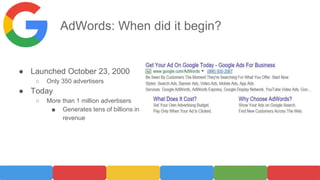
● Launched October 23, 2000
○ Only 350 advertisers
● Today
○ More than 1 million advertisers
■ Generates tens of billions in
revenue
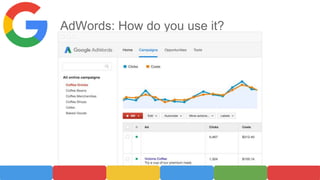
AdWords: How do you use it?
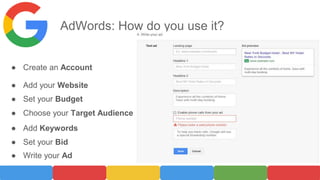
● Create an Account
● Add your Website
● Set your Budget
● Choose your Target Audience
● Add Keywords
● Set your Bid
● Write your Ad
AdWords: How do you use it?
AdWords: Ad Auction
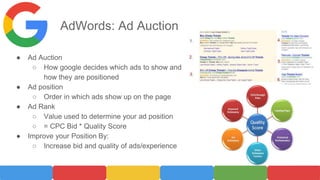
● Ad Auction
○ How google decides which ads to show and
how they are positioned
● Ad position
○ Order in which ads show up on the page
● Ad Rank
○ Value used to determine your ad position
○ = CPC Bid * Quality Score
● Improve your Position By:
○ Increase bid and quality of ads/experience
AdWords: User profile
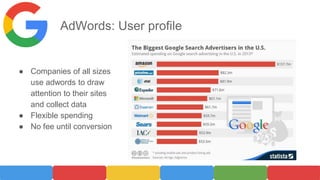
● Companies of all sizes
use adwords to draw
attention to their sites
and collect data
● Flexible spending
● No fee until conversion
AdWords: Industries Using AdWords Most
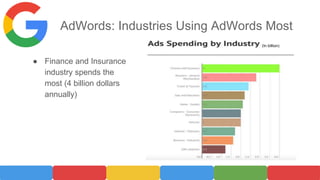
● Finance and Insurance
industry spends the
most (4 billion dollars
annually)
(In billion)
AdWords: How does it work?
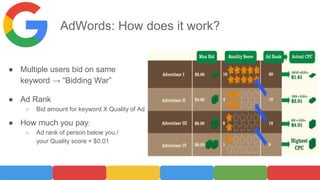
● Multiple users bid on same
keyword → “Bidding War”
● Ad Rank
○ Bid amount for keyword X Quality of Ad
● How much you pay:
○ Ad rank of person below you /
your Quality score + $0.01
AdWords: How does Google make money?
● The bulk of Google’s $89.6 billion
revenue in 2016 came from AdWords
● Advertisers pay Google each time a
visitor clicks on an advertisement
○ A click can be worth anywhere from a
few cents to over $50
● Google’s algorithm attempts to provide
the most relevant results for your queries
○ Related suggested pages can be
from AdWords advertisers
AdWords: Benefits
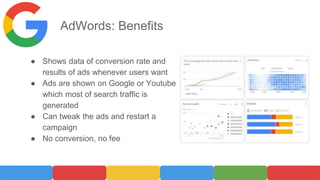
● Shows data of conversion rate and
results of ads whenever users want
● Ads are shown on Google or Youtube
which most of search traffic is
generated
● Can tweak the ads and restart a
campaign
● No conversion, no fee
AdWords: How Useful Is the Tool for
Marketing?
● Ads are shown by customers’ needs
● Target range is customizable
● Reach customers through any devices
○ Desktop, laptop, tablet and mobile
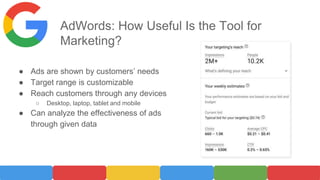
● Can analyze the effectiveness of ads
through given data
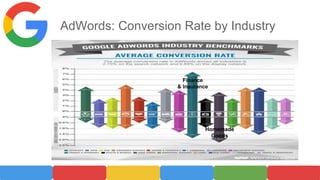
AdWords: Conversion Rate by Industry
Finance
& Insurance
Homemade
Goods
AdWords: Common Mistakes Companies Make
1. Targeting keywords that are too broad
a. It’s pointless for a company to attempt to bid their way to the top spot for such broad keywords as it
is extremely costly and unlikely that the generated revenues will justify the costs.
2. Putting too many keywords in an adgroup
a. Having too many keywords in the same adgroup forces a lot of unrelated words and phrases to use
the same ads and landing pages. Instead, companies should stick to just 5-10 keywords to start.
3. Sending traffic directly to your homepage
a. Every visitor that a company secures via PPC should be directed to a landing page that is designed
to be as appealing and engaging as possible based on their interests. If visitors are simply sent
straight to the homepage, they have to put in extra work navigating their desired information, which
leads to higher bounce rates and missed conversion opportunities.
AdWords: Common Mistakes Companies Make
4. Not including negative keywords
a. Failing to include negative keywords can result in your ad popping up for searches irrelevant
to your product. Since every click costs money, adding a negative keyword to your adgroup
can prevent your campaign from being seen by the wrong audience.
5. Not measuring ROI
a. Running an adwords campaign without any way to measure which paid clicks are converting
into customers is a waste of money. Companies should track conversions that enter the
sales funnel from an adwords click and become purchases. This will show you where to
focus future ad spend and which campaigns/ad groups should be increased or dialed down.
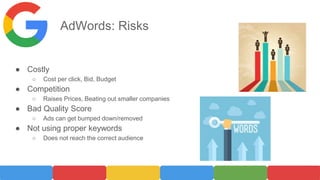
AdWords: Risks
● Costly
○ Cost per click, Bid, Budget
● Competition
○ Raises Prices, Beating out smaller companies
● Bad Quality Score
○ Ads can get bumped down/removed
● Not using proper keywords
○ Does not reach the correct audience
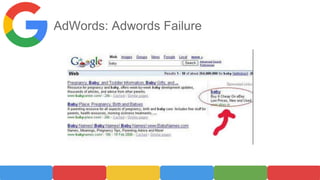
AdWords: Adwords Failure
QUESTIONS?

Google AdWords

  • 1.
    AdWords Emily Chin, DabinHa, Mikaela James, Peter Marin, Samreen Mohammed, Victoria Studer
  • 2.
    AdWords: What isit? ● Advertising Service ○ A business pays for their website to be displayed on the Search Engine Results Page (SERP) when certain keywords are entered.
  • 3.
    AdWords: When didit begin? ● Launched October 23, 2000 ○ Only 350 advertisers ● Today ○ More than 1 million advertisers ■ Generates tens of billions in revenue
  • 4.
    AdWords: How doyou use it? ● Create an Account ● Add your Website ● Set your Budget ● Choose your Target Audience ● Add Keywords ● Set your Bid ● Write your Ad
  • 5.
    AdWords: How doyou use it?
  • 6.
    AdWords: Ad Auction ●Ad Auction ○ How google decides which ads to show and how they are positioned ● Ad position ○ Order in which ads show up on the page ● Ad Rank ○ Value used to determine your ad position ○ = CPC Bid * Quality Score ● Improve your Position By: ○ Increase bid and quality of ads/experience
  • 7.
    AdWords: User profile ●Companies of all sizes use adwords to draw attention to their sites and collect data ● Flexible spending ● No fee until conversion
  • 8.
    AdWords: Industries UsingAdWords Most ● Finance and Insurance industry spends the most (4 billion dollars annually) (In billion)
  • 9.
    AdWords: How doesit work? ● Multiple users bid on same keyword → “Bidding War” ● Ad Rank ○ Bid amount for keyword X Quality of Ad ● How much you pay: ○ Ad rank of person below you / your Quality score + $0.01
  • 10.
    AdWords: How doesGoogle make money? ● The bulk of Google’s $89.6 billion revenue in 2016 came from AdWords ● Advertisers pay Google each time a visitor clicks on an advertisement ○ A click can be worth anywhere from a few cents to over $50 ● Google’s algorithm attempts to provide the most relevant results for your queries ○ Related suggested pages can be from AdWords advertisers
  • 11.
    AdWords: Benefits ● Showsdata of conversion rate and results of ads whenever users want ● Ads are shown on Google or Youtube which most of search traffic is generated ● Can tweak the ads and restart a campaign ● No conversion, no fee
  • 12.
    AdWords: How UsefulIs the Tool for Marketing? ● Ads are shown by customers’ needs ● Target range is customizable ● Reach customers through any devices ○ Desktop, laptop, tablet and mobile ● Can analyze the effectiveness of ads through given data
  • 13.
    AdWords: Conversion Rateby Industry Finance & Insurance Homemade Goods
  • 14.
    AdWords: Common MistakesCompanies Make 1. Targeting keywords that are too broad a. It’s pointless for a company to attempt to bid their way to the top spot for such broad keywords as it is extremely costly and unlikely that the generated revenues will justify the costs. 2. Putting too many keywords in an adgroup a. Having too many keywords in the same adgroup forces a lot of unrelated words and phrases to use the same ads and landing pages. Instead, companies should stick to just 5-10 keywords to start. 3. Sending traffic directly to your homepage a. Every visitor that a company secures via PPC should be directed to a landing page that is designed to be as appealing and engaging as possible based on their interests. If visitors are simply sent straight to the homepage, they have to put in extra work navigating their desired information, which leads to higher bounce rates and missed conversion opportunities.
  • 15.
    AdWords: Common MistakesCompanies Make 4. Not including negative keywords a. Failing to include negative keywords can result in your ad popping up for searches irrelevant to your product. Since every click costs money, adding a negative keyword to your adgroup can prevent your campaign from being seen by the wrong audience. 5. Not measuring ROI a. Running an adwords campaign without any way to measure which paid clicks are converting into customers is a waste of money. Companies should track conversions that enter the sales funnel from an adwords click and become purchases. This will show you where to focus future ad spend and which campaigns/ad groups should be increased or dialed down.
  • 16.
    AdWords: Risks ● Costly ○Cost per click, Bid, Budget ● Competition ○ Raises Prices, Beating out smaller companies ● Bad Quality Score ○ Ads can get bumped down/removed ● Not using proper keywords ○ Does not reach the correct audience
  • 17.
  • 18.

Editor's Notes

  • #3 Tori
  • #4 Tori
  • #5 Tori -Budget: how much you’re willing to spend per day -Bid: most you’re willing to pay for a click on your ad → your bid determines the amount of traffic your ads receive as well as ROI
  • #6 Tori
  • #7 Samreen Basically how google decided which ads go where on the page Ad position of 1 means your ad shows up first on the page which is good because more people will see your ad You can still beat out a competitor who has a higher bid if you have a better quality score To improve your ad position, you can: increase your bid improve the quality of your ads Improve the quality of your computer and mobile landing page experience
  • #8 Mikaela User profile: Who primarily uses this social media site? Demographics? Why do users/subscribers use this tool? What do they expect from it?
  • #9 Peter
  • #10 Tori/Peter
  • #11 Peter
  • #12 Dabin
  • #13 Dabin
  • #14 Dabin Google AdWords is split into two networks, search network and display network.
  • #15 Dabin Google AdWords is split into two networks, search network and display network.
  • #16 Emily
  • #17 Emily
  • #18 Samreen -you have to pay for clicks and your bid which results in Risking spending more than your budget -your competition beating you out and raising prices which makes it harder for smaller companies -if you don't use the right keywords, the right people won't see it -if the quality of your landing page is bad and if you don't monitor your ads and keep them up to date then they can get bumped down/removed 5. Marketing risks: What are the risks involved? Could the examples of failures you provided have been avoided? How? What do you think we can learn from them?