•GCP
GOOD CATERING PRACTICE
What is Good Catering Practice?
• GCP
• Recommend best practice for catering industry
Objectives?
• To ensure food products are prepared to meet
certain quality and safety requirement.(temperature,
cross contamination)
• Check method, equipments, facilities and controls for
all prepared food products from raw to table.
• Prerequisite program for food quality & safety plans.
Eg – HACCP, ISO9000
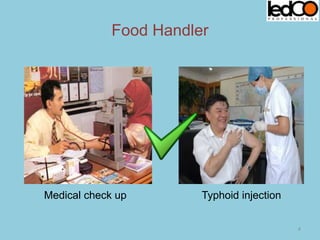
Food Handler
Medical check up Typhoid injection
4
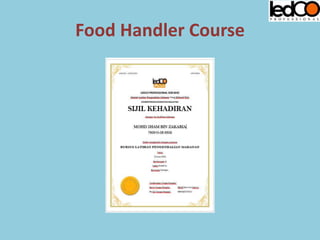
Food Handler Course
Proper attire for team members.
1. Head cover- cap, hair net
2. Uniform & apron – clean
3. Gloves when handling food- change gloves
4. Protective shoes- Non slip, clean, covered
5. No accessories- watch, jewelleries,brooch
with stones
Personal Hygiene
1. Hair restraints-long hair tied up neatly
2. Proper hand washing
3. Cuts and wounds are well covered
4. Regular changes of gloves
5. BOH team not involved in assembling
finished products without proper attire
6. No unhygienic behaviour
HAND WASHING
Before start work
After going to toilet
After absence from work station
After handling non-food & raw material
When hands soiled or contaminated
7 LANGKAH BETUL MENCUCI TANGAN
9
7 STEPS TO PROPER WASHING OF HANDS
Design & Structure
• Floor, wall and ceiling (clean & in good condition)
• Restaurant fixtures (clean & well maintained)
• Exhaust hood (filter, drip container, corner of hood clean)
• Dining area (clean & well maintained)
• Kitchen door (close & clean)
• Water supply is safe for use (water filter should be
changed every 2 weeks or when necessary with expiry code
date)
Receiving & Storage
• ‘10 minutes rule’- checking & receiving should
be done within 10 minutes to avoid
temperature abuse. (meat & frozen products)
• Temperature checked upon receipt.(receiving
report/checklist)
• Transferring equipment- clean,no food debris
or residue
• Receiving date
Receiving & Storage
• Temperature for storing (chilled,frozen)
• Storing equipment- freezer,chiller,dry storage
• Labelling
• Arrangement- FIFO, gap from wall
Food Preparation & Handling
• Cleanliness of workplace,equipment &
utensils
• Labelling & date marking- coding on finished
products, storage
• Temperature monitoring- checklist, production
chart
• Thermometer – functioning, calibrated
Temperature Control
• Check temperature for hot and cold products
• Food kept at the temperature danger zone
(5’C – 60’C)
• Food to be kept out of the temperature
danger zone.
Cross Contamination
• Towel usage
• Cutting board
• Equipment
• Handling food
• Gloves
• Utensils
• Behaviour
Sanitary Facilities
• Water supply (sufficient,from a sanitary source)
• Plumbing (adequate floor drainage, non-rust material
,overhead system)
• Toilet facilities (easily accessible,good repair at all
time,self closing doors,clear and proper signs)
• Hand washing facilities (essential location,hand
cleaning&sanitatizing agents provided,paper towels or drying
devices,warm running water, proper refuse bin {foot
operated}, foot or knee/elbow operated or sensor type taps))
Sanitary Facilities
• Sewage disposal (adequate and proper)
• Rubbish & offal disposal (stored & disposed properly,
easy cleaning , avoid accumulation of waste)
Sanitary Operations
• Written instructions
• A planned cleaning schedule
• Cleaning method (manual, soak, pressure, cleaning in
place(CIP) )
• Set cleaning standards
• How clean is clean :
1)Organoleptic test(ujian deria,rupabentuk am)
2)Microbiological test(swab & contact test)
5 S system
• Sort (susun)
• Systematic (atur)
• Sweep (Bersih)
• Standardize (Mengemaskini)
• Self-Discipline (disiplin)
PEST CONTROL
• Presence,infestation- check for any presence of
pest(cockroaches,flies,rodents)
• Harborage- check for any sign of
dnawing,biting,droppings,secretion/urine
• Pest control treatment- record available and on
schedule.
• Layout –bait or trap station
The Sign of Infestation
• Smell (bau)
• Droppings (najis)
• Smears (kesan)
• Path (laluan)
• Body parts (bahagian badan)
• Damage (kerosakan)
• Maggots (ulat)
• Visual (visual)
How Pests Get Into The Premise??
• Deliveries (penghantaran stok)
• Attracted by smell of food (bau makanan)
• Encouraged by employees (tidak jaga kebersihan diri)
• Cracks, gaps, holes (retakan,celah,lubang)
• Drainage system (sistem penyaliran)
• Window , doors, ventilation (tingkap,pintu,sistem
pengudaraan)
SUPPLIES
Inspect, segregate , clean and store
Receiving area away from preparation area
Inspection upon receipt, storage and before
use
Store under proper condition
Wash and clean-contaminant & minimize
deterioration (mengurangkan kerosakan)
Requirement (level of microorganism, temperature,
packaging, other hazards , physical specifications)
SUPPLIER QUALITY ASSURANCE
(SQA)
Compliance with requirements verified by a
planned and managed Supplier Quality
Assurance(SQA) Programed
SQA :
- agreed specifications
- audits (twice a year)
- Certificates of Analysis (CoA)
Certificates of Analysis (CoA)
Confirm raw materials have been sampled
Meet all criteria
Prepared by competent/approved labotories
PROCESS CONTROL
 All operation conducted in accordance with
adequate sanitation principles
 Quality control operations
 Overall sanitation
 Preparation method – don’t contribute
contamination from any source
 Raw material and food items : inspected, stored,
washed or cleaned, not contaminated, holding
identification
INSPECTION
Elements to consider :
• Freshness
• Temperature
• Color
• Odor
• Contamination
• Infestation
• Packaging
• labelling
Preparation
 Prevent growth of undesirable microorganisms
 Heat blanching
 Mechanical preparation steps
 Butters, breading, sauces,gravies,dressings etc
 Adulterated food (makanan tercemar)
 ice – to be safe
 Control physical factors & preparation
Assembling, packaging and other operations
 Effective measures to protect finished food
STORAGE AND DISTRIBUTION
All raw material, food items and other
supplies inspected upon receipt & unloading
Food items inspected prior serving
Storage area designed and constructed to
protect against contamination
STORAGE RAW MATERIALS &
FOOD ITEMS
 Proper conditions/temperature
 Appropriate stock rotation
 Sufficient space
 Well ventilated
 Cleaning and sanitizing programs
 Labelled
 Adequate lighting
 Stock rotation
Transport
Inspected (damaged , infestation etc)
Cleaned and sanitized
Properly loaded, arranged and unloaded
Constructed with suitable material
Temperature control
Security precautions
PRODUCT COMPLAINT &
PRODUCT RECALL PROCEDURES
Written & tested recall procedures
* person responsible – recall team
* step by step procedures described
* product traceability – product coding
Obtain information from the complaint (forms
and procedures)
Evaluate the complaint (involved regulators &
outside advisors)
Thorough investigation
PRODUCT RECALL PROCEDURES
Regulatory agency may :
 Take samples
 Prevent the sale of product
 Require medical & lab exam of employees
 Exclude suspect employees from food handling duties
Deal with media
Take proper preventative measures(avoid
recurrence)
CORRECTIVE ACTIONS
Recalled product may be :
Disposed (dibuangkan)
Reworked (diproses semula)
Quarantined (dikuarantin)
DOCUMENTATION
Define materials, operations and food items
Record and communication information
Reduce risk of errors arising from oral
communication
Defect product traceability
Permit investigation
DOCUMENTATION STRUCTURES
Quality
Manual
Operating
Procedures
Supporting Documents
DOCUMENTATION
Quality Manual
 policy statements on the way a company intends to
carry out its business
Operating Procedures
 what a company does and how it achieves the stated
policies
Supporting Documents
 how a company carries out what it says it does (in
detail)
Standard Operating Procedures
(SOP)
What to do, who does it and when
Not static; continuously adjusted
Simple
Training aid
Prevent the ‘subject-to-change-without-
notice’ situation
Provide written standard for audits
Effective, detail, simple and practical
Supporting Documents
Working Instruction
Codes of Practice
User Manuals
Technical Documentation
Job Description & Specification
Forms
Checklists
THANK YOU

Good Catering Practise (GCP)

  • 1.
  • 2.
    What is GoodCatering Practice? • GCP • Recommend best practice for catering industry
  • 3.
    Objectives? • To ensurefood products are prepared to meet certain quality and safety requirement.(temperature, cross contamination) • Check method, equipments, facilities and controls for all prepared food products from raw to table. • Prerequisite program for food quality & safety plans. Eg – HACCP, ISO9000
  • 4.
    Food Handler Medical checkup Typhoid injection 4
  • 5.
  • 6.
    Proper attire forteam members. 1. Head cover- cap, hair net 2. Uniform & apron – clean 3. Gloves when handling food- change gloves 4. Protective shoes- Non slip, clean, covered 5. No accessories- watch, jewelleries,brooch with stones
  • 7.
    Personal Hygiene 1. Hairrestraints-long hair tied up neatly 2. Proper hand washing 3. Cuts and wounds are well covered 4. Regular changes of gloves 5. BOH team not involved in assembling finished products without proper attire 6. No unhygienic behaviour
  • 8.
    HAND WASHING Before startwork After going to toilet After absence from work station After handling non-food & raw material When hands soiled or contaminated
  • 9.
    7 LANGKAH BETULMENCUCI TANGAN 9
  • 10.
    7 STEPS TOPROPER WASHING OF HANDS
  • 11.
    Design & Structure •Floor, wall and ceiling (clean & in good condition) • Restaurant fixtures (clean & well maintained) • Exhaust hood (filter, drip container, corner of hood clean) • Dining area (clean & well maintained) • Kitchen door (close & clean) • Water supply is safe for use (water filter should be changed every 2 weeks or when necessary with expiry code date)
  • 12.
    Receiving & Storage •‘10 minutes rule’- checking & receiving should be done within 10 minutes to avoid temperature abuse. (meat & frozen products) • Temperature checked upon receipt.(receiving report/checklist) • Transferring equipment- clean,no food debris or residue • Receiving date
  • 13.
    Receiving & Storage •Temperature for storing (chilled,frozen) • Storing equipment- freezer,chiller,dry storage • Labelling • Arrangement- FIFO, gap from wall
  • 14.
    Food Preparation &Handling • Cleanliness of workplace,equipment & utensils • Labelling & date marking- coding on finished products, storage • Temperature monitoring- checklist, production chart • Thermometer – functioning, calibrated
  • 15.
    Temperature Control • Checktemperature for hot and cold products • Food kept at the temperature danger zone (5’C – 60’C) • Food to be kept out of the temperature danger zone.
  • 16.
    Cross Contamination • Towelusage • Cutting board • Equipment • Handling food • Gloves • Utensils • Behaviour
  • 17.
    Sanitary Facilities • Watersupply (sufficient,from a sanitary source) • Plumbing (adequate floor drainage, non-rust material ,overhead system) • Toilet facilities (easily accessible,good repair at all time,self closing doors,clear and proper signs) • Hand washing facilities (essential location,hand cleaning&sanitatizing agents provided,paper towels or drying devices,warm running water, proper refuse bin {foot operated}, foot or knee/elbow operated or sensor type taps))
  • 18.
    Sanitary Facilities • Sewagedisposal (adequate and proper) • Rubbish & offal disposal (stored & disposed properly, easy cleaning , avoid accumulation of waste)
  • 19.
    Sanitary Operations • Writteninstructions • A planned cleaning schedule • Cleaning method (manual, soak, pressure, cleaning in place(CIP) ) • Set cleaning standards • How clean is clean : 1)Organoleptic test(ujian deria,rupabentuk am) 2)Microbiological test(swab & contact test)
  • 20.
    5 S system •Sort (susun) • Systematic (atur) • Sweep (Bersih) • Standardize (Mengemaskini) • Self-Discipline (disiplin)
  • 21.
    PEST CONTROL • Presence,infestation-check for any presence of pest(cockroaches,flies,rodents) • Harborage- check for any sign of dnawing,biting,droppings,secretion/urine • Pest control treatment- record available and on schedule. • Layout –bait or trap station
  • 22.
    The Sign ofInfestation • Smell (bau) • Droppings (najis) • Smears (kesan) • Path (laluan) • Body parts (bahagian badan) • Damage (kerosakan) • Maggots (ulat) • Visual (visual)
  • 23.
    How Pests GetInto The Premise?? • Deliveries (penghantaran stok) • Attracted by smell of food (bau makanan) • Encouraged by employees (tidak jaga kebersihan diri) • Cracks, gaps, holes (retakan,celah,lubang) • Drainage system (sistem penyaliran) • Window , doors, ventilation (tingkap,pintu,sistem pengudaraan)
  • 24.
    SUPPLIES Inspect, segregate ,clean and store Receiving area away from preparation area Inspection upon receipt, storage and before use Store under proper condition Wash and clean-contaminant & minimize deterioration (mengurangkan kerosakan) Requirement (level of microorganism, temperature, packaging, other hazards , physical specifications)
  • 25.
    SUPPLIER QUALITY ASSURANCE (SQA) Compliancewith requirements verified by a planned and managed Supplier Quality Assurance(SQA) Programed SQA : - agreed specifications - audits (twice a year) - Certificates of Analysis (CoA)
  • 26.
    Certificates of Analysis(CoA) Confirm raw materials have been sampled Meet all criteria Prepared by competent/approved labotories
  • 27.
    PROCESS CONTROL  Alloperation conducted in accordance with adequate sanitation principles  Quality control operations  Overall sanitation  Preparation method – don’t contribute contamination from any source  Raw material and food items : inspected, stored, washed or cleaned, not contaminated, holding identification
  • 28.
    INSPECTION Elements to consider: • Freshness • Temperature • Color • Odor • Contamination • Infestation • Packaging • labelling
  • 29.
    Preparation  Prevent growthof undesirable microorganisms  Heat blanching  Mechanical preparation steps  Butters, breading, sauces,gravies,dressings etc  Adulterated food (makanan tercemar)  ice – to be safe  Control physical factors & preparation Assembling, packaging and other operations  Effective measures to protect finished food
  • 30.
    STORAGE AND DISTRIBUTION Allraw material, food items and other supplies inspected upon receipt & unloading Food items inspected prior serving Storage area designed and constructed to protect against contamination
  • 31.
    STORAGE RAW MATERIALS& FOOD ITEMS  Proper conditions/temperature  Appropriate stock rotation  Sufficient space  Well ventilated  Cleaning and sanitizing programs  Labelled  Adequate lighting  Stock rotation
  • 32.
    Transport Inspected (damaged ,infestation etc) Cleaned and sanitized Properly loaded, arranged and unloaded Constructed with suitable material Temperature control Security precautions
  • 33.
    PRODUCT COMPLAINT & PRODUCTRECALL PROCEDURES Written & tested recall procedures * person responsible – recall team * step by step procedures described * product traceability – product coding Obtain information from the complaint (forms and procedures) Evaluate the complaint (involved regulators & outside advisors) Thorough investigation
  • 34.
    PRODUCT RECALL PROCEDURES Regulatoryagency may :  Take samples  Prevent the sale of product  Require medical & lab exam of employees  Exclude suspect employees from food handling duties Deal with media Take proper preventative measures(avoid recurrence)
  • 35.
    CORRECTIVE ACTIONS Recalled productmay be : Disposed (dibuangkan) Reworked (diproses semula) Quarantined (dikuarantin)
  • 36.
    DOCUMENTATION Define materials, operationsand food items Record and communication information Reduce risk of errors arising from oral communication Defect product traceability Permit investigation
  • 37.
  • 38.
    DOCUMENTATION Quality Manual  policystatements on the way a company intends to carry out its business Operating Procedures  what a company does and how it achieves the stated policies Supporting Documents  how a company carries out what it says it does (in detail)
  • 39.
    Standard Operating Procedures (SOP) Whatto do, who does it and when Not static; continuously adjusted Simple Training aid Prevent the ‘subject-to-change-without- notice’ situation Provide written standard for audits Effective, detail, simple and practical
  • 40.
    Supporting Documents Working Instruction Codesof Practice User Manuals Technical Documentation Job Description & Specification Forms Checklists
  • 41.