FOOD FLOW:
PURCHASING &
STORING
D A R L A M A L A S M A S
I A N P I C O N D O
HACCP AND FOOD
SAFETY
• Is the Hazard Analysis Critical
Control Points system that was
developed to ensure the safety of
food for United States astronauts
nearly 30 years ago. This system is
now being used in our restaurants
because these guidelines make
good sense.
ANALYZE
HAZARDS
• Potential hazards associated with a food and
measures to control those hazards are identified.
The hazard could be biological, such as microbe or
chemical, such as a toxin; or physical, such as
ground glass or metal fragments.
IDENTIFY
CRITICAL
CONTROL
POINTS
These are points in a food production
from its raw state through processing and
shipping, to consumption by the
consumer, at which the potential hazard
can be controlled or eliminated.
Example are cooking, cooling, packaging
and metal detection.
ESTABLISH
PREVENTIVE
MEASURES WITH
CRITICAL LIMITS
FOR EACH
CONTROL POINT
• For a cooked food, for example, this might include setting the
minimum cooking temperature and time required to ensure the
elimination of any harmful microbes.
ESTABLISH
PROCEDURES TO
MONITOR THE
CRITICAL
CONTROL POINTS
• Such procedures might include
determining how and by whom
cooking time and temperature should
be monitored.
E S T A B L I S H
C O R R E C T I V E
A C T I O N S T O B E
T A K E N W H E N
M O N I T O R I N G S H O W S
T H A T A C R I T I C A L
L I M I T H A S N O T B E E N
M E T
F O R E X A M P L E , R E P R O C E S S I N G O R
D I S P O S I N G O F F O O D I F T H E M I N I M U M
C O O K I N G T E M P E R AT U R E I S N O T M E T.
ESTABLISH
PROCEDURE
TO VERIFY
THAT THE
SYSTEM IS
WORKING
PROPERLY
• For example, testing time and temperature
recording devices to verify that a cooking unit is
working properly.
ESTABLISH
EFFECTIVE RECORD
KEEPING TO
DOCUMENT THE
HACCP SYSTEM
• This would include records of hazards and their control methods,
the monitoring of safety requirements and action taken to correct
potential problems. Each of these principles must be backed by
sound scientific knowledge. For example, published microbiological
studied on time and temperature factors for controlling food borne
pathogens.
HACCP LOOKS AT THE
FLOW OF FOOD THROUGH
YOUR RESTAURANT,
FROM THE TIME IT IS
DELIVERED TO THE TIME
IT IS SERVED TO YOUR
CUSTOMERS. LET US
TAKE A LOOK AT HOW
THIS MIGHT PERTAIN TO
YOUR RESTAURANT
1. THE
DELIVERY
When you receive a delivery make sure the food is in good condition. Frozen foods must be received frozen.
You will need to open the carton and take the temperature of the item, which should be 0 degrees F or -18
degrees C. look at the bottom of the box and make sure there are no puddles or indication that the
products has started to thaw.
Produce should read 40 degrees goods to make sure they are intact.
The canned goods should not have bulges, dents, leaks or rust.
Also check the dates the product expires. Refuse any products that do not meet these standards.
2. THE
STORAGE OF
PRODUCTS
ROTATE! REMEMBER FIFO (first in first out!)
This is extremely critical when the product involved is
highly perishable, such as pre-sliced meats or
produce. When you put your products away, always
date the boxes. Make sure that your refrigerator and
freezer are at the correct temperatures.
Refrigerated products must be stored below 40
degrees F. or 4.4 degrees C. and frozen food must be
stored at 0 degrees F. or -18 degrees C. Also, there
should be enough room for circulation around and
under the stored product.
Never store boxes on the floor of the refrigerator or
freezer. No canned or dry goods can be stored on the
floor because they can contaminate when you mop.
It should be away from the cleaning chemicals.
3. FOOD PREPARATION
Remember to use only clean and sanitized
equipment and utensils. Thaw all frozen food in
the refrigerator.
Keep refrigerated products cold until you work
with them. Make sure all hot foods are prepared
quickly and that they reach the right temperature
(165 degrees F./73.9 degrees C) and that they are
held 140-145 degrees F./60-60.0 degrees C.
Never mix old products with new.
Proper hygiene habits are must for all staff with
proper hand washing.
4. SERVING CUSTOMERS
Because employees can transmit illness, they must have high personal
hygiene habits. They must have clean hands, hair in place, clean
clothes or uniforms and each must be thoroughly trained in proper
hand washing techniques.
(Before starting work, returning from the restroom, touching food or
serving customers, after cleaning assignments, handling money or
non-food items, touching hair-face or skin and in between preparing
different food products.)
5. STORING
PRODUCTS WHEN
CLOSING
• Store hot products in large shallow pans as this will enable the
product to cool quickly. Never store open canned products in their
cans. Make sure leftover food is covered and labeled.
WHEN YOU
BUY FOOD AT
THE GROCERY
STORE
REMEMBER TO:
Purchase
• Purchase meat, poultry and dairy products last.
Keep
• Keep packages of raw meat and poultry separate from other foods, especially produce items.
Use
• Use plastic bags to enclose individual packages of raw meat and poultry. Grab a few extra while in the produce section and
put these on the bottom of the cart.
Make
• Make sure meat, poultry and dairy products are refrigerated as soon as possible after purchase.
Place
• Place refrigerated foods in a cooler, especially in hot weather, for the trip home.
Purchase
• Purchase canned goods that are free of dents, cracks or bulging lids.
Check
• Check that all food packages are intact. No broken seams or tears.
Select
• Select produce that is fresh! Watch the sighs of aging and decay, such as mold or brown leaves and stems. Look for glossy
skin and green leaves.
Select
• Select food packages with longest period of the time until expiration.
CHARACTERISTICS OF A SAFE FOOD
SUPPLIER
Obtain food from approved and safe sources. Food should be purchased from commercial suppliers that are under
proper regulatory control. Food cannot be prepared in home kitchen
that is not under proper regulatory control and then served in a food
establishment.
GUIDELINES FOR SPECIFIC FOODS
• Food in a Hermetically Sealed Container. Processing food at proper
temperature for the appropriate time is essential to kill bacterial spores.
Of special concern is Clostridium botulinum, a microorganism whose
spores are found throughout the environment. Even slight under
processing of low acid food can be dangerous because the spoilage
microorganisms are killed and there are no signs to warm consumers
that botulinum spores might have germinated into vegetative cells and
produced their toxin. This is one reason that home canned foods
be served in a food establishment because the processing method has
not necessarily been tested and is often not properly monitored.
FLUID MILK AND MILK PRODUCTS
These are susceptible to contamination by a variety of microbial
pathogens, such as Shiga toxin-producing Escherichia coli,
Salmonella, and Listeria monocytogenes.
They also provide rich medium for their growth. Pasteurization is
required to eliminate pathogen contamination in milk and milk
products.
FISH
• All processors of fish must have
conducted a hazard analysis of
their operation, identified each
hazard that is reasonably likely to
occur, and implemented a HACCP
plan to control each identified
hazard. Fish must be purchased
from seafood suppliers who have
complied with this requirement.
MOLLUSCAN
SHELLFISH
Include oysters, clams, mussels, and scallops. Molluscan
shellfish are a potential problem because:
1) the environment is which they grow are commonly
subject to contamination from sewage that might contain
pathogens and to naturally occurring pathogenic bacteria;
2) they filter and concentrate pathogens that might be
present in surrounding waters; and
3) they are often consumed whole, either raw or partially
cooked.
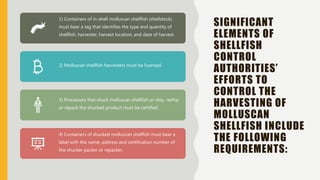
SIGNIFICANT
ELEMENTS OF
SHELLFISH
CONTROL
AUTHORITIES’
EFFORTS TO
CONTROL THE
HARVESTING OF
MOLLUSCAN
SHELLFISH INCLUDE
THE FOLLOWING
REQUIREMENTS:
1) Containers of in-shell molluscan shellfish (shellstock)
must bear a tag that identifies the type and quantity of
shellfish, harvester, harvest location, and date of harvest.
2) Molluscan shellfish harvesters must be licensed.
3) Processors that shuck molluscan shellfish or ship, reship,
or repack the shucked product must be certified.
4) Containers of shucked molluscan shellfish must bear a
label with the name, address and certification number of
the shucker packer or repacker.
• Pathogens such as Vibrio vulnificus, Vibrio parahaemolyticus, Vibrio
cholerae, and Listeria monocytogenes that may be present in low
numbers at the time that molluscan shellfish are harvested, may
increase to more hazardous levels if they are time-temperature
abused. To minimize the risk of pathogen growth, Shellfish Control
Authorities also place limits on the time between harvest and
refrigeration.
WILD MUSHROOMS
Over 5000 species of mushrooms grow
naturally. Most have never been tested to
determine their toxicity. It is known that
about 15 species are deadly and another 60
are toxic to humans whether they are
consumed raw or cooked.
Some wild mushrooms that are extremely
poisonous may be difficult to distinguish
from edible species. In most parts of the
country there is at least one organization
that includes individuals who can provide
assistance with both identification and
program design.
FOOD FLOW: STORING
Proper storage maintains
quality and prevents
contamination from
unintentional and intentional
sources.
Wash your hands as soon as
you return home.
Refrigerate or freeze meat,
fish and poultry immediately.
Freezers should be 0 degree
F.
Refrigerate dairy products
immediately. Refrigerator
temperature should be
below 41 degrees F.
Store meat, fish and poultry
in plastic bags or on a plate,
and place on lowest shelf of
refrigerator to prevent raw
juices from dripping onto
other foods.
Wash hands with soap and
water for 15 seconds before
and after handling raw meat,
poultry or seafood products.
Store canned goods in a
cool, clean, dry place. Put
recent purchases in the back
of older items.
Store fresh produce
appropriately. Most should
be refrigerated and not
washed until time to use.
Washing with running water
is sufficient.
CLEANING AND
CHEMICAL
STORAGE
Cleaning supplies and chemicals
should be stored away from food.
Keep supplies and chemicals in their
original containers.
If supplies and chemicals are not in
their original containers, clearly label.
DRY STORAGE
Storerooms should be cool, dry, clean, well
lighted and well ventilated
Food items must be kept off the floor. Food items should be kept in containers that
cannot be damaged by water or a possible
pest infestation.
FROZEN STORAGE
Freezers keep food at 0 degree
F or below.
Freezers are never intended to
cool food.
Freezers should not be
overloaded.
REFRIGERATED
STORAGE
Refrigerators are use for short-term
holding at 41 degrees F or below.
Food must be stored correctly to
minimize the possibility of foodborne
illness and cross-contamination.
Refrigerated storage temperatures
vary from product to product.
RELATIONSHIP
OF DATES AND
FOOD SAFETY
Food labels and packaging are excellent sources of
information about food and guides for food safety. The
primary source of food safety information is the shelf-life
of the package, which can be presented in many
different ways.
• Examples include:
• The “sell by” date. This is the last day the product can
be sold. It allows time for the product to be stored and
used at home.
• The use by or “best if used by” date. This is the
freshness date; product may be safe after this date but
will probably not be at peak quality.
• The “do not use after” or expiration date. This is the
last date the product should be used.
COLD STORAGE
Refrigeration temperatures are often used to
control the growth of most pathogens.
Some pathogens, like Listeria and Yersinia,
will grow almost to the freezing point.
Refrigeration can also slow biological and
chemical processes that result in spoilage,
oxidative rancidity, and other quality defects.
Control of temperature during storage can be
accomplished using ice, chemical coolants
such as gel packs, and mechanical dry
refrigeration.
For dry refrigerated storage, the control can
be assured by checking product
temperatures.
FREEZING
• Some microorganisms remain visible for long
periods of time during frozen storage. Most viruses,
bacteria spores, and some bacteria vegetative cells
survive freezing unchanged. Other microorganisms
are sensitive to one or more steps associated with
the freezing process- freezing, frozen storage, or
thawing. Because multi-celled organisms are
generally more sensitive to low temperatures than
are bacteria- freezing and frozen storage are good
methods to destroy microorganisms, such as
parasitic protozoa, nematodes, and trematodes in
various foods.
THANK YOU!

Purchasing storing (Ryuna Robles)

  • 1.
    FOOD FLOW: PURCHASING & STORING DA R L A M A L A S M A S I A N P I C O N D O
  • 2.
    HACCP AND FOOD SAFETY •Is the Hazard Analysis Critical Control Points system that was developed to ensure the safety of food for United States astronauts nearly 30 years ago. This system is now being used in our restaurants because these guidelines make good sense.
  • 3.
    ANALYZE HAZARDS • Potential hazardsassociated with a food and measures to control those hazards are identified. The hazard could be biological, such as microbe or chemical, such as a toxin; or physical, such as ground glass or metal fragments.
  • 4.
    IDENTIFY CRITICAL CONTROL POINTS These are pointsin a food production from its raw state through processing and shipping, to consumption by the consumer, at which the potential hazard can be controlled or eliminated. Example are cooking, cooling, packaging and metal detection.
  • 5.
    ESTABLISH PREVENTIVE MEASURES WITH CRITICAL LIMITS FOREACH CONTROL POINT • For a cooked food, for example, this might include setting the minimum cooking temperature and time required to ensure the elimination of any harmful microbes.
  • 6.
    ESTABLISH PROCEDURES TO MONITOR THE CRITICAL CONTROLPOINTS • Such procedures might include determining how and by whom cooking time and temperature should be monitored.
  • 7.
    E S TA B L I S H C O R R E C T I V E A C T I O N S T O B E T A K E N W H E N M O N I T O R I N G S H O W S T H A T A C R I T I C A L L I M I T H A S N O T B E E N M E T F O R E X A M P L E , R E P R O C E S S I N G O R D I S P O S I N G O F F O O D I F T H E M I N I M U M C O O K I N G T E M P E R AT U R E I S N O T M E T.
  • 8.
    ESTABLISH PROCEDURE TO VERIFY THAT THE SYSTEMIS WORKING PROPERLY • For example, testing time and temperature recording devices to verify that a cooking unit is working properly.
  • 9.
    ESTABLISH EFFECTIVE RECORD KEEPING TO DOCUMENTTHE HACCP SYSTEM • This would include records of hazards and their control methods, the monitoring of safety requirements and action taken to correct potential problems. Each of these principles must be backed by sound scientific knowledge. For example, published microbiological studied on time and temperature factors for controlling food borne pathogens.
  • 10.
    HACCP LOOKS ATTHE FLOW OF FOOD THROUGH YOUR RESTAURANT, FROM THE TIME IT IS DELIVERED TO THE TIME IT IS SERVED TO YOUR CUSTOMERS. LET US TAKE A LOOK AT HOW THIS MIGHT PERTAIN TO YOUR RESTAURANT
  • 11.
    1. THE DELIVERY When youreceive a delivery make sure the food is in good condition. Frozen foods must be received frozen. You will need to open the carton and take the temperature of the item, which should be 0 degrees F or -18 degrees C. look at the bottom of the box and make sure there are no puddles or indication that the products has started to thaw. Produce should read 40 degrees goods to make sure they are intact. The canned goods should not have bulges, dents, leaks or rust. Also check the dates the product expires. Refuse any products that do not meet these standards.
  • 12.
    2. THE STORAGE OF PRODUCTS ROTATE!REMEMBER FIFO (first in first out!) This is extremely critical when the product involved is highly perishable, such as pre-sliced meats or produce. When you put your products away, always date the boxes. Make sure that your refrigerator and freezer are at the correct temperatures. Refrigerated products must be stored below 40 degrees F. or 4.4 degrees C. and frozen food must be stored at 0 degrees F. or -18 degrees C. Also, there should be enough room for circulation around and under the stored product. Never store boxes on the floor of the refrigerator or freezer. No canned or dry goods can be stored on the floor because they can contaminate when you mop. It should be away from the cleaning chemicals.
  • 13.
    3. FOOD PREPARATION Rememberto use only clean and sanitized equipment and utensils. Thaw all frozen food in the refrigerator. Keep refrigerated products cold until you work with them. Make sure all hot foods are prepared quickly and that they reach the right temperature (165 degrees F./73.9 degrees C) and that they are held 140-145 degrees F./60-60.0 degrees C. Never mix old products with new. Proper hygiene habits are must for all staff with proper hand washing.
  • 14.
    4. SERVING CUSTOMERS Becauseemployees can transmit illness, they must have high personal hygiene habits. They must have clean hands, hair in place, clean clothes or uniforms and each must be thoroughly trained in proper hand washing techniques. (Before starting work, returning from the restroom, touching food or serving customers, after cleaning assignments, handling money or non-food items, touching hair-face or skin and in between preparing different food products.)
  • 15.
    5. STORING PRODUCTS WHEN CLOSING •Store hot products in large shallow pans as this will enable the product to cool quickly. Never store open canned products in their cans. Make sure leftover food is covered and labeled.
  • 16.
    WHEN YOU BUY FOODAT THE GROCERY STORE REMEMBER TO: Purchase • Purchase meat, poultry and dairy products last. Keep • Keep packages of raw meat and poultry separate from other foods, especially produce items. Use • Use plastic bags to enclose individual packages of raw meat and poultry. Grab a few extra while in the produce section and put these on the bottom of the cart. Make • Make sure meat, poultry and dairy products are refrigerated as soon as possible after purchase. Place • Place refrigerated foods in a cooler, especially in hot weather, for the trip home. Purchase • Purchase canned goods that are free of dents, cracks or bulging lids. Check • Check that all food packages are intact. No broken seams or tears. Select • Select produce that is fresh! Watch the sighs of aging and decay, such as mold or brown leaves and stems. Look for glossy skin and green leaves. Select • Select food packages with longest period of the time until expiration.
  • 17.
    CHARACTERISTICS OF ASAFE FOOD SUPPLIER Obtain food from approved and safe sources. Food should be purchased from commercial suppliers that are under proper regulatory control. Food cannot be prepared in home kitchen that is not under proper regulatory control and then served in a food establishment.
  • 18.
    GUIDELINES FOR SPECIFICFOODS • Food in a Hermetically Sealed Container. Processing food at proper temperature for the appropriate time is essential to kill bacterial spores. Of special concern is Clostridium botulinum, a microorganism whose spores are found throughout the environment. Even slight under processing of low acid food can be dangerous because the spoilage microorganisms are killed and there are no signs to warm consumers that botulinum spores might have germinated into vegetative cells and produced their toxin. This is one reason that home canned foods be served in a food establishment because the processing method has not necessarily been tested and is often not properly monitored.
  • 19.
    FLUID MILK ANDMILK PRODUCTS These are susceptible to contamination by a variety of microbial pathogens, such as Shiga toxin-producing Escherichia coli, Salmonella, and Listeria monocytogenes. They also provide rich medium for their growth. Pasteurization is required to eliminate pathogen contamination in milk and milk products.
  • 20.
    FISH • All processorsof fish must have conducted a hazard analysis of their operation, identified each hazard that is reasonably likely to occur, and implemented a HACCP plan to control each identified hazard. Fish must be purchased from seafood suppliers who have complied with this requirement.
  • 21.
    MOLLUSCAN SHELLFISH Include oysters, clams,mussels, and scallops. Molluscan shellfish are a potential problem because: 1) the environment is which they grow are commonly subject to contamination from sewage that might contain pathogens and to naturally occurring pathogenic bacteria; 2) they filter and concentrate pathogens that might be present in surrounding waters; and 3) they are often consumed whole, either raw or partially cooked.
  • 22.
    SIGNIFICANT ELEMENTS OF SHELLFISH CONTROL AUTHORITIES’ EFFORTS TO CONTROLTHE HARVESTING OF MOLLUSCAN SHELLFISH INCLUDE THE FOLLOWING REQUIREMENTS: 1) Containers of in-shell molluscan shellfish (shellstock) must bear a tag that identifies the type and quantity of shellfish, harvester, harvest location, and date of harvest. 2) Molluscan shellfish harvesters must be licensed. 3) Processors that shuck molluscan shellfish or ship, reship, or repack the shucked product must be certified. 4) Containers of shucked molluscan shellfish must bear a label with the name, address and certification number of the shucker packer or repacker.
  • 23.
    • Pathogens suchas Vibrio vulnificus, Vibrio parahaemolyticus, Vibrio cholerae, and Listeria monocytogenes that may be present in low numbers at the time that molluscan shellfish are harvested, may increase to more hazardous levels if they are time-temperature abused. To minimize the risk of pathogen growth, Shellfish Control Authorities also place limits on the time between harvest and refrigeration.
  • 24.
    WILD MUSHROOMS Over 5000species of mushrooms grow naturally. Most have never been tested to determine their toxicity. It is known that about 15 species are deadly and another 60 are toxic to humans whether they are consumed raw or cooked. Some wild mushrooms that are extremely poisonous may be difficult to distinguish from edible species. In most parts of the country there is at least one organization that includes individuals who can provide assistance with both identification and program design.
  • 25.
    FOOD FLOW: STORING Properstorage maintains quality and prevents contamination from unintentional and intentional sources. Wash your hands as soon as you return home. Refrigerate or freeze meat, fish and poultry immediately. Freezers should be 0 degree F. Refrigerate dairy products immediately. Refrigerator temperature should be below 41 degrees F. Store meat, fish and poultry in plastic bags or on a plate, and place on lowest shelf of refrigerator to prevent raw juices from dripping onto other foods. Wash hands with soap and water for 15 seconds before and after handling raw meat, poultry or seafood products. Store canned goods in a cool, clean, dry place. Put recent purchases in the back of older items. Store fresh produce appropriately. Most should be refrigerated and not washed until time to use. Washing with running water is sufficient.
  • 26.
    CLEANING AND CHEMICAL STORAGE Cleaning suppliesand chemicals should be stored away from food. Keep supplies and chemicals in their original containers. If supplies and chemicals are not in their original containers, clearly label.
  • 27.
    DRY STORAGE Storerooms shouldbe cool, dry, clean, well lighted and well ventilated Food items must be kept off the floor. Food items should be kept in containers that cannot be damaged by water or a possible pest infestation.
  • 28.
    FROZEN STORAGE Freezers keepfood at 0 degree F or below. Freezers are never intended to cool food. Freezers should not be overloaded.
  • 29.
    REFRIGERATED STORAGE Refrigerators are usefor short-term holding at 41 degrees F or below. Food must be stored correctly to minimize the possibility of foodborne illness and cross-contamination. Refrigerated storage temperatures vary from product to product.
  • 30.
    RELATIONSHIP OF DATES AND FOODSAFETY Food labels and packaging are excellent sources of information about food and guides for food safety. The primary source of food safety information is the shelf-life of the package, which can be presented in many different ways. • Examples include: • The “sell by” date. This is the last day the product can be sold. It allows time for the product to be stored and used at home. • The use by or “best if used by” date. This is the freshness date; product may be safe after this date but will probably not be at peak quality. • The “do not use after” or expiration date. This is the last date the product should be used.
  • 31.
    COLD STORAGE Refrigeration temperaturesare often used to control the growth of most pathogens. Some pathogens, like Listeria and Yersinia, will grow almost to the freezing point. Refrigeration can also slow biological and chemical processes that result in spoilage, oxidative rancidity, and other quality defects. Control of temperature during storage can be accomplished using ice, chemical coolants such as gel packs, and mechanical dry refrigeration. For dry refrigerated storage, the control can be assured by checking product temperatures.
  • 32.
    FREEZING • Some microorganismsremain visible for long periods of time during frozen storage. Most viruses, bacteria spores, and some bacteria vegetative cells survive freezing unchanged. Other microorganisms are sensitive to one or more steps associated with the freezing process- freezing, frozen storage, or thawing. Because multi-celled organisms are generally more sensitive to low temperatures than are bacteria- freezing and frozen storage are good methods to destroy microorganisms, such as parasitic protozoa, nematodes, and trematodes in various foods.
  • 33.