Gonadil- f Endocrinology Male Reproductive System & Sexual Disorders Female Reproductive System & Sexual Disorders Product
Endocrinology Human Beings are multi-cellular organisms. Numerous cells make up the many tissues and organs of the body. In biological processes, such as growth and development, reproduction, defense and behavior, individual tissues and organs have to perform a variety of specialized tasks. In the body there are actually two systems taking care of this communication: The Endocrine System The Nervous System
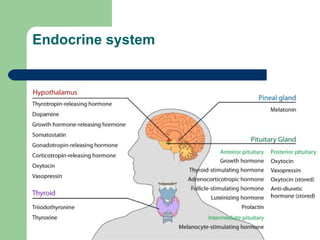
Endocrine system In  physiology , the endocrine system is a system of glands, each of which secretes a type of hormone directly into the bloodstream to regulate the body. The endocrine system is in contrast to the  exocrine system , which secretes its chemicals using  ducts . It derives from the Greek words endow meaning inside, within, and crinis for secrete. The endocrine system is an information signal system like the nervous system, yet its effects and mechanism are classifiably different. The endocrine system's effects are slow to initiate, and prolonged in their response, lasting for hours to weeks. The nervous system sends information very quickly, and responses are generally short lived. Hormones are substances (chemical mediators) released from endocrine tissue into the bloodstream where they travel to target tissue and generate a response. Hormones regulate various human functions, including  Metabolism ,  growth and development ,  tissue  function, and  mood . The field of study dealing with the endocrine system and its disorders is  endocrinology , a branch of  internal medicine . Features of endocrine glands are, in general, their ductless nature, their vascularity, and usually the presence of intracellular vacuoles or granules storing their hormones. In contrast,  exocrine glands , such as  salivary glands ,  sweat glands , and  glands  within the  gastrointestinal tract , tend to be much less vascular and have ducts or a hollow  lumen . In addition to the specialised endocrine organs mentioned above, many other organs that are part of other body systems, such as the  kidney ,  liver ,  heart  and  gonads , have secondary endocrine functions. For example the kidney secretes endocrine hormones such as  erythropoietin  and  renin . The endocrine system is made of a series of glands that produce chemicals called  hormones . A number of glands that signal each other in sequence is usually referred to as an axis, for example, the  hypothalamic-pituitary-adrenal axis .
Endocrine system
 

Gonadil f prestatation final

  • 1.
    Gonadil- f EndocrinologyMale Reproductive System & Sexual Disorders Female Reproductive System & Sexual Disorders Product
  • 2.
    Endocrinology Human Beingsare multi-cellular organisms. Numerous cells make up the many tissues and organs of the body. In biological processes, such as growth and development, reproduction, defense and behavior, individual tissues and organs have to perform a variety of specialized tasks. In the body there are actually two systems taking care of this communication: The Endocrine System The Nervous System
  • 3.
    Endocrine system In physiology , the endocrine system is a system of glands, each of which secretes a type of hormone directly into the bloodstream to regulate the body. The endocrine system is in contrast to the exocrine system , which secretes its chemicals using ducts . It derives from the Greek words endow meaning inside, within, and crinis for secrete. The endocrine system is an information signal system like the nervous system, yet its effects and mechanism are classifiably different. The endocrine system's effects are slow to initiate, and prolonged in their response, lasting for hours to weeks. The nervous system sends information very quickly, and responses are generally short lived. Hormones are substances (chemical mediators) released from endocrine tissue into the bloodstream where they travel to target tissue and generate a response. Hormones regulate various human functions, including Metabolism , growth and development , tissue function, and mood . The field of study dealing with the endocrine system and its disorders is endocrinology , a branch of internal medicine . Features of endocrine glands are, in general, their ductless nature, their vascularity, and usually the presence of intracellular vacuoles or granules storing their hormones. In contrast, exocrine glands , such as salivary glands , sweat glands , and glands within the gastrointestinal tract , tend to be much less vascular and have ducts or a hollow lumen . In addition to the specialised endocrine organs mentioned above, many other organs that are part of other body systems, such as the kidney , liver , heart and gonads , have secondary endocrine functions. For example the kidney secretes endocrine hormones such as erythropoietin and renin . The endocrine system is made of a series of glands that produce chemicals called hormones . A number of glands that signal each other in sequence is usually referred to as an axis, for example, the hypothalamic-pituitary-adrenal axis .
  • 4.
  • 5.