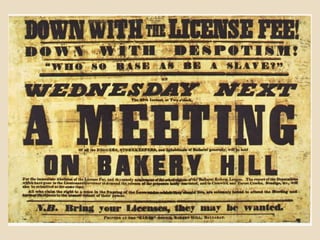
Gold Changed Everything
Year 9 Depth Study 1: Making a Better World?


                Marion Littlejohn
                Education Officer
             Sovereign Hill Museums
      HTAV Middle Years Conference, October 2012
Depth studies

There are three depth studies for this historical period.

1 Making a Better World?

2 Australia and Asia

3 World War I

For each depth study, there are up to three electives
that focus on a particular society, event, movement or
development.
It is expected that ONE elective will be studied in detail.

http://ausvels.vcaa.vic.edu.au/Level9
Depth Study 1

Making a Better World?

Students investigate how life changed in the period in
depth through the study of ONE of these major
developments:

   1. The Industrial Revolution (1750 – 1914)

   2. Movement of peoples (1750 – 1901)
   3. Progressive ideas and movements (1750 – 1918)

The study includes the causes and effects of the
development, and the Australian experience.

http://ausvels.vcaa.vic.edu.au/Level9
Progressive ideas and movements (1750 – 1918)
   • The emergence and nature of key ideas in the period, with a particular focus
     on ONE of the following: capitalism, socialism, egalitarianism, nationalism,
     imperialism, Darwinism, Chartism

   • The reasons why ONE key idea emerged and/or developed a following, such
     as the influence of the Industrial Revolution on socialism

   • The role of an individual or group in the promotion of ONE of these key ideas,
     and the responses to it from, for example, workers, entrepreneurs, land
     owners, religious groups

   • The short and long-term impacts of ONE of these ideas on Australia and the
     world


   http://ausvels.vcaa.vic.edu.au/Level9
Key inquiry questions (same for all Depth Studies)

• What were the changing features of the movements of
  people from 1750 to 1918?
• How did new ideas and technological developments
  contribute to change in this period?
• What was the origin, development, significance and long-
  term impact of imperialism in this period?


• What was the significance of World War I?
Inquiry question

•   How did new ideas and
    technological developments
    contribute to change in this
    period?


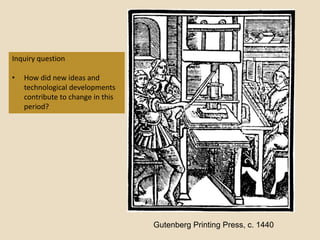
                                   Gutenberg Printing Press, c. 1440
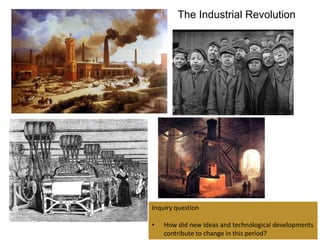
The Industrial Revolution


Inquiry question

•   How did new ideas and technological developments
    contribute to change in this period?
Inquiry Question

What was the origin,                                   Queen Victoria
development,                                           [ 1819-1901 ]
significance and                                       By
long-term impact of                                    Franz Xaver
imperialism in this                                    Winterhalter
period?


          1837 Victoria crowned Queen of Great Britain and Ireland
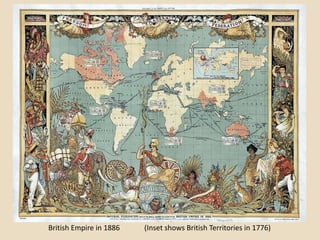
British Empire in 1886   (Inset shows British Territories in 1776)
Inquiry question
•   How did new ideas and technological
    developments contribute to change in this
    period?


                                                    From the "Bertoloni Album," 1839
[The Oriel Window, South
Gallery, Lacock Abbey], 1835 or 1839                William Henry Fox Talbot
William Henry Fox Talbot                            Photogenic drawing
(British, 1800–1877)                                Album of 36 photogenic drawings

Metropolitan Museum of Art, New York.
http://www.metmuseum.org/toah/hd/tlbt/hd_tlbt.htm
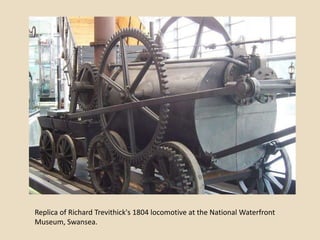
Replica of Richard Trevithick's 1804 locomotive at the National Waterfront
Museum, Swansea.
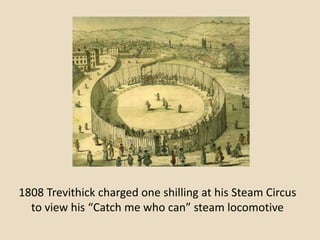
1808 Trevithick charged one shilling at his Steam Circus
  to view his “Catch me who can” steam locomotive
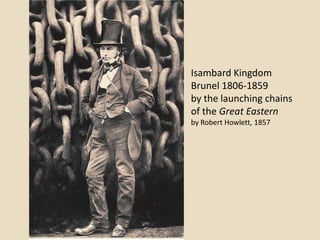
Isambard Kingdom
Brunel 1806-1859
by the launching chains
of the Great Eastern
by Robert Howlett, 1857
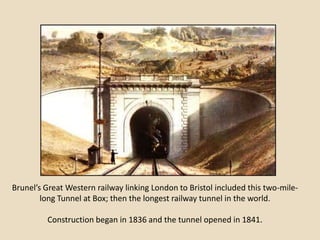
Brunel’s Great Western railway linking London to Bristol included this two-mile-
        long Tunnel at Box; then the longest railway tunnel in the world.

         Construction began in 1836 and the tunnel opened in 1841.
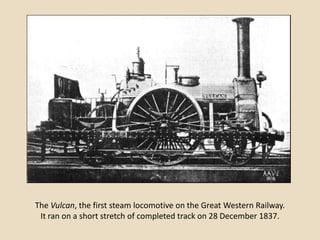
The Vulcan, the first steam locomotive on the Great Western Railway.
 It ran on a short stretch of completed track on 28 December 1837.
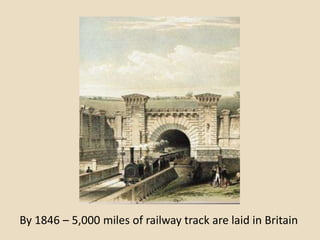
By 1846 – 5,000 miles of railway track are laid in Britain
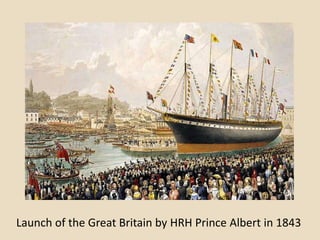
Launch of Great Britain at Bristol, July 1843. Painting by Joseph Walter


Launch of the Great Britain by HRH Prince Albert in 1843
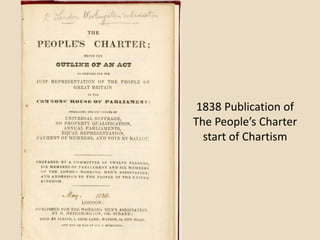
1838 Publication of
The People’s Charter
  start of Chartism
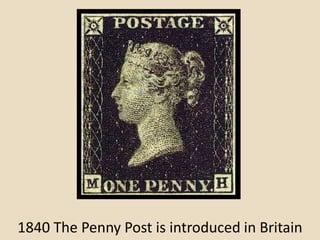
1840 The Penny Post is introduced in Britain
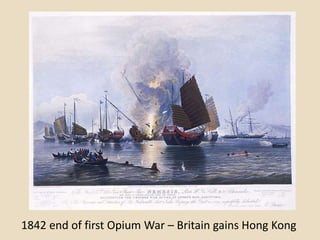
1842 end of first Opium War – Britain gains Hong Kong
Inquiry Question

 How did new ideas
 and technological
 developments
 contribute to change
 in this period?


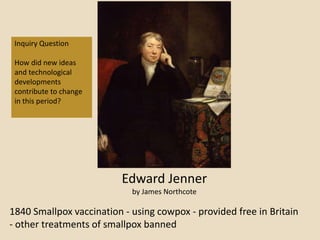
                          Edward Jenner
                            by James Northcote

1840 Smallpox vaccination - using cowpox - provided free in Britain
- other treatments of smallpox banned
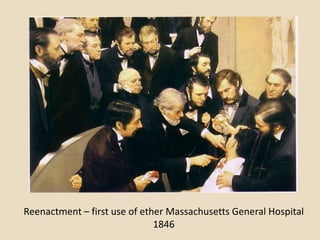
Reenactment – first use of ether Massachusetts General Hospital
                              1846
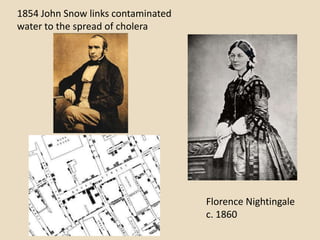
1854 John Snow links contaminated
water to the spread of cholera


                                    Florence Nightingale
                                    c. 1860
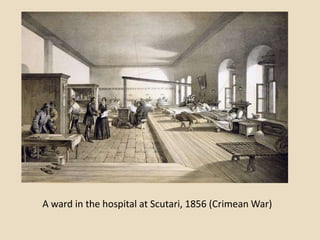
A ward in the hospital at Scutari, 1856 (Crimean War)
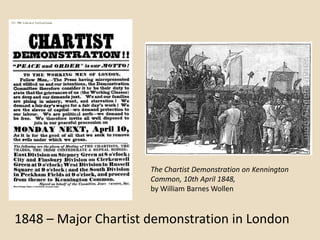
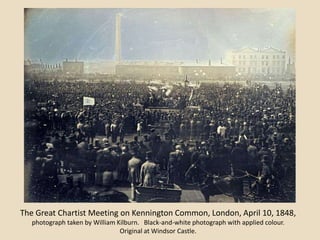
The Chartist Demonstration on Kennington
                      Common, 10th April 1848,
                      by William Barnes Wollen


1848 – Major Chartist demonstration in London
The Great Chartist Meeting on Kennington Common, London, April 10, 1848,
   photograph taken by William Kilburn. Black-and-white photograph with applied colour.
                                Original at Windsor Castle.
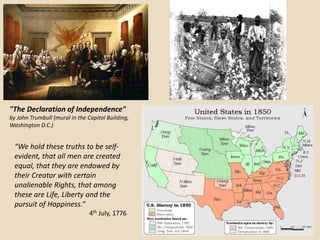
"The Declaration of Independence"
by John Trumbull (mural in the Capitol Building,
Washington D.C.)


  “We hold these truths to be self-
  evident, that all men are created
  equal, that they are endowed by
  their Creator with certain
  unalienable Rights, that among
  these are Life, Liberty and the
  pursuit of Happiness.”
                                4th July, 1776
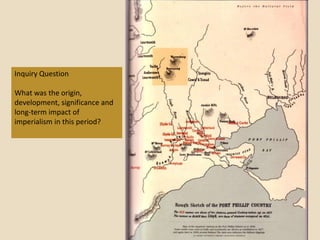
Inquiry Question

What was the origin,
development, significance and
long-term impact of
imperialism in this period?
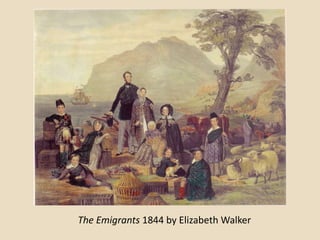
The Emigrants 1844 by Elizabeth Walker
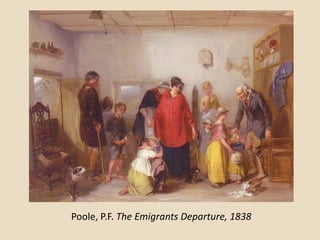
Poole, P.F. The Emigrants Departure, 1838
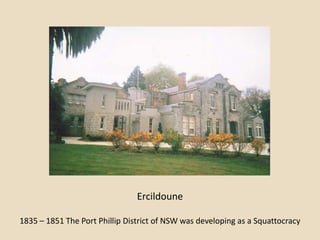
Ercildoune

1835 – 1851 The Port Phillip District of NSW was developing as a Squattocracy
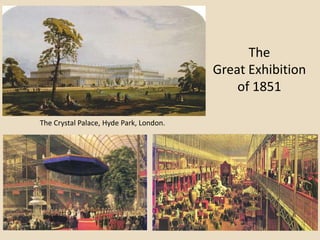
The
                                         Great Exhibition
                                             of 1851

The Crystal Palace, Hyde Park, London.
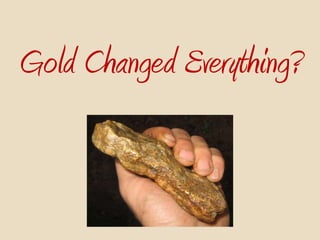
Gold Changed Everything?
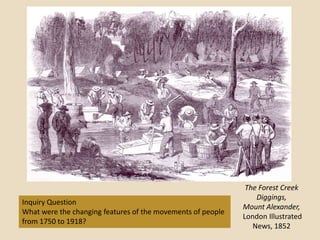
The Forest Creek
                                                                 Diggings,
Inquiry Question
                                                             Mount Alexander,
What were the changing features of the movements of people
                                                             London Illustrated
from 1750 to 1918?
                                                                News, 1852
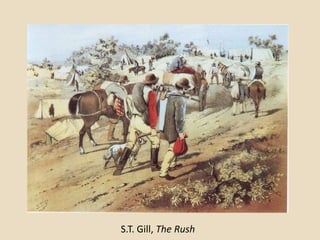
S.T. Gill, The Rush
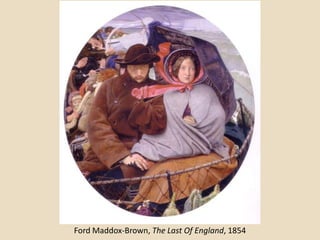
Ford Maddox-Brown, The Last Of England, 1854
Inquiry Question
                                   What were the changing features of the
                                   movements of people from 1750 to
                                   1918?


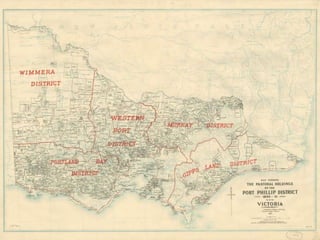
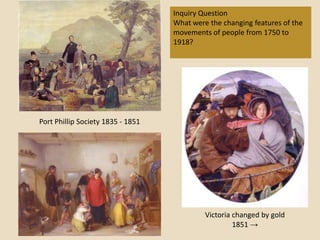
Port Phillip Society 1835 - 1851


                                            Victoria changed by gold
                                                     1851 →
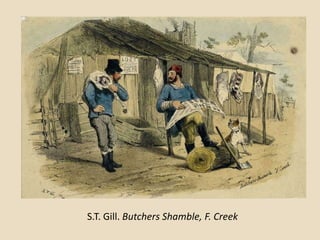
S.T. Gill. Butchers Shamble, F. Creek
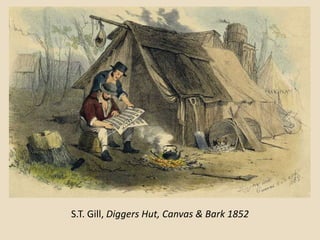
S.T. Gill, Diggers Hut, Canvas & Bark 1852
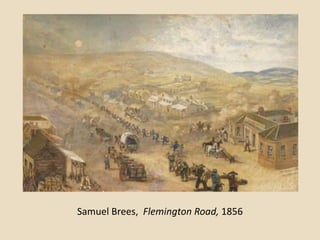
Samuel Brees, Flemington Road, 1856
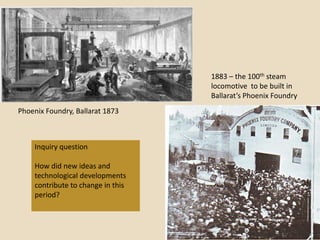
1883 – the 100th steam
                                   locomotive to be built in
                                   Ballarat’s Phoenix Foundry
Phoenix Foundry, Ballarat 1873


    Inquiry question

    How did new ideas and
    technological developments
    contribute to change in this
    period?
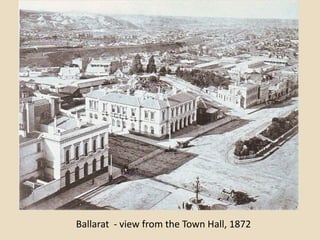
Ballarat - view from the Town Hall, 1872
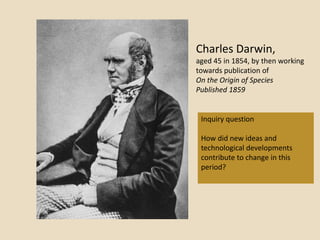
Charles Darwin,
aged 45 in 1854, by then working
towards publication of
On the Origin of Species
Published 1859


 Inquiry question

 How did new ideas and
 technological developments
 contribute to change in this
 period?
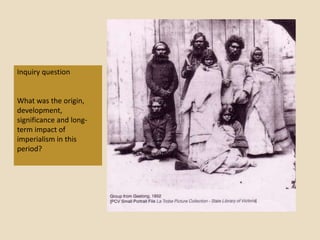
Inquiry question


What was the origin,
development,
significance and long-
term impact of
imperialism in this
period?
The Industrial Revolution
Wikipedia has an excellent overview
         http://en.wikipedia.org/wiki/Industrial_Revolution

Spartacus Educational website
British online encyclopaedia created to provide free education materials for teachers
and students in the UK. Has an excellent section on the Industrial Revolution divided
into easily searchable topics
http://www.spartacus.schoolnet.co.uk/IndustrialRevolution.htm

History of the Great Western Railway
A good site for train enthusiasts
          http://mikes.railhistory.railfan.net/r010.html

ss Great Britain Museum web page         http://www.ssgreatbritain.org/

History of Photography         http://www.metmuseum.org/toah/hd/tlbt/hd_tlbt.htm

Trove
A quick link to all digitised resources held in Australian museums, libraries and cultural
institutions.
Includes books, images, historic newspapers, maps, music, archives and more
http://trove.nla.gov.au/
Gold changed everything

Gold changed everything

  • 1.
    Gold Changed Everything Year9 Depth Study 1: Making a Better World? Marion Littlejohn Education Officer Sovereign Hill Museums HTAV Middle Years Conference, October 2012
  • 2.
    Depth studies There arethree depth studies for this historical period. 1 Making a Better World? 2 Australia and Asia 3 World War I For each depth study, there are up to three electives that focus on a particular society, event, movement or development. It is expected that ONE elective will be studied in detail. http://ausvels.vcaa.vic.edu.au/Level9
  • 3.
    Depth Study 1 Makinga Better World? Students investigate how life changed in the period in depth through the study of ONE of these major developments: 1. The Industrial Revolution (1750 – 1914) 2. Movement of peoples (1750 – 1901) 3. Progressive ideas and movements (1750 – 1918) The study includes the causes and effects of the development, and the Australian experience. http://ausvels.vcaa.vic.edu.au/Level9
  • 4.
    Progressive ideas andmovements (1750 – 1918) • The emergence and nature of key ideas in the period, with a particular focus on ONE of the following: capitalism, socialism, egalitarianism, nationalism, imperialism, Darwinism, Chartism • The reasons why ONE key idea emerged and/or developed a following, such as the influence of the Industrial Revolution on socialism • The role of an individual or group in the promotion of ONE of these key ideas, and the responses to it from, for example, workers, entrepreneurs, land owners, religious groups • The short and long-term impacts of ONE of these ideas on Australia and the world http://ausvels.vcaa.vic.edu.au/Level9
  • 5.
    Key inquiry questions(same for all Depth Studies) • What were the changing features of the movements of people from 1750 to 1918? • How did new ideas and technological developments contribute to change in this period? • What was the origin, development, significance and long- term impact of imperialism in this period? • What was the significance of World War I?
  • 6.
    Inquiry question • How did new ideas and technological developments contribute to change in this period? Gutenberg Printing Press, c. 1440
  • 7.
    The Industrial Revolution Inquiryquestion • How did new ideas and technological developments contribute to change in this period?
  • 8.
    Inquiry Question What wasthe origin, Queen Victoria development, [ 1819-1901 ] significance and By long-term impact of Franz Xaver imperialism in this Winterhalter period? 1837 Victoria crowned Queen of Great Britain and Ireland
  • 9.
    British Empire in1886 (Inset shows British Territories in 1776)
  • 10.
    Inquiry question • How did new ideas and technological developments contribute to change in this period? From the "Bertoloni Album," 1839 [The Oriel Window, South Gallery, Lacock Abbey], 1835 or 1839 William Henry Fox Talbot William Henry Fox Talbot Photogenic drawing (British, 1800–1877) Album of 36 photogenic drawings Metropolitan Museum of Art, New York. http://www.metmuseum.org/toah/hd/tlbt/hd_tlbt.htm
  • 11.
    Replica of RichardTrevithick's 1804 locomotive at the National Waterfront Museum, Swansea.
  • 12.
    1808 Trevithick chargedone shilling at his Steam Circus to view his “Catch me who can” steam locomotive
  • 13.
    Isambard Kingdom Brunel 1806-1859 bythe launching chains of the Great Eastern by Robert Howlett, 1857
  • 14.
    Brunel’s Great Westernrailway linking London to Bristol included this two-mile- long Tunnel at Box; then the longest railway tunnel in the world. Construction began in 1836 and the tunnel opened in 1841.
  • 15.
    The Vulcan, thefirst steam locomotive on the Great Western Railway. It ran on a short stretch of completed track on 28 December 1837.
  • 16.
    By 1846 –5,000 miles of railway track are laid in Britain
  • 17.
    Launch of GreatBritain at Bristol, July 1843. Painting by Joseph Walter Launch of the Great Britain by HRH Prince Albert in 1843
  • 18.
    1838 Publication of ThePeople’s Charter start of Chartism
  • 19.
    1840 The PennyPost is introduced in Britain
  • 20.
    1842 end offirst Opium War – Britain gains Hong Kong
  • 21.
    Inquiry Question Howdid new ideas and technological developments contribute to change in this period? Edward Jenner by James Northcote 1840 Smallpox vaccination - using cowpox - provided free in Britain - other treatments of smallpox banned
  • 22.
    Reenactment – firstuse of ether Massachusetts General Hospital 1846
  • 23.
    1854 John Snowlinks contaminated water to the spread of cholera Florence Nightingale c. 1860
  • 24.
    A ward inthe hospital at Scutari, 1856 (Crimean War)
  • 25.
    The Chartist Demonstrationon Kennington Common, 10th April 1848, by William Barnes Wollen 1848 – Major Chartist demonstration in London
  • 26.
    The Great ChartistMeeting on Kennington Common, London, April 10, 1848, photograph taken by William Kilburn. Black-and-white photograph with applied colour. Original at Windsor Castle.
  • 27.
    "The Declaration ofIndependence" by John Trumbull (mural in the Capitol Building, Washington D.C.) “We hold these truths to be self- evident, that all men are created equal, that they are endowed by their Creator with certain unalienable Rights, that among these are Life, Liberty and the pursuit of Happiness.” 4th July, 1776
  • 28.
    Inquiry Question What wasthe origin, development, significance and long-term impact of imperialism in this period?
  • 29.
    The Emigrants 1844by Elizabeth Walker
  • 30.
    Poole, P.F. TheEmigrants Departure, 1838
  • 32.
    Ercildoune 1835 – 1851The Port Phillip District of NSW was developing as a Squattocracy
  • 33.
    The Great Exhibition of 1851 The Crystal Palace, Hyde Park, London.
  • 35.
  • 36.
    The Forest Creek Diggings, Inquiry Question Mount Alexander, What were the changing features of the movements of people London Illustrated from 1750 to 1918? News, 1852
  • 37.
  • 38.
    Ford Maddox-Brown, TheLast Of England, 1854
  • 39.
    Inquiry Question What were the changing features of the movements of people from 1750 to 1918? Port Phillip Society 1835 - 1851 Victoria changed by gold 1851 →
  • 40.
    S.T. Gill. ButchersShamble, F. Creek
  • 41.
    S.T. Gill, DiggersHut, Canvas & Bark 1852
  • 43.
  • 44.
    1883 – the100th steam locomotive to be built in Ballarat’s Phoenix Foundry Phoenix Foundry, Ballarat 1873 Inquiry question How did new ideas and technological developments contribute to change in this period?
  • 45.
    Ballarat - viewfrom the Town Hall, 1872
  • 46.
    Charles Darwin, aged 45in 1854, by then working towards publication of On the Origin of Species Published 1859 Inquiry question How did new ideas and technological developments contribute to change in this period?
  • 47.
    Inquiry question What wasthe origin, development, significance and long- term impact of imperialism in this period?
  • 48.
    The Industrial Revolution Wikipediahas an excellent overview http://en.wikipedia.org/wiki/Industrial_Revolution Spartacus Educational website British online encyclopaedia created to provide free education materials for teachers and students in the UK. Has an excellent section on the Industrial Revolution divided into easily searchable topics http://www.spartacus.schoolnet.co.uk/IndustrialRevolution.htm History of the Great Western Railway A good site for train enthusiasts http://mikes.railhistory.railfan.net/r010.html ss Great Britain Museum web page http://www.ssgreatbritain.org/ History of Photography http://www.metmuseum.org/toah/hd/tlbt/hd_tlbt.htm Trove A quick link to all digitised resources held in Australian museums, libraries and cultural institutions. Includes books, images, historic newspapers, maps, music, archives and more http://trove.nla.gov.au/

Editor's Notes

  • #7 In spite of Gutenberg's efforts to keep his technique a secret, the printing press spread rapidly. Before 1500 some 2500 European cities had acquired presses. German masters held an early leadership, but the Italians soon challenged their pre-eminence. The Venetian printer Aldus Manutius published works, notably editions of the classics.The immediate effect of the printing press was to multiply the output and cut the costs of books. It thus made information available to a much larger segment of the population who were, of course, eager for information of any variety. Libraries could now store greater quantities of information at much lower cost. Printing also facilitated the dissemination and preservation of knowledge in standardized form -- this was most important in the advance of science, technology and scholarship. The printing press certainly initiated an "information revolution" on par with the Internet today. Printing could and did spread new ideas quickly and with greater impact.Printing stimulated the literacy of lay people and eventually came to have a deep and lasting impact on their private lives. Although most of the earliest books dealt with religious subjects, students, businessmen, and upper and middle class people bought books on all subjects. Printers responded with moralizing, medical, practical and travel manuals. Printing provided a superior basis for scholarship and prevented the further corruption of texts through hand copying. By giving all scholars the same text to work from, it made progress in critical scholarship and science faster and more reliable.http://www.historyguide.org/intellect/press.html
  • #13 In 1808, Trevithick publicised his steam railway locomotive expertise by building a new locomotive called “Catch me who can” The configuration differed from the previous locomotives in that the cylinder was mounted vertically and drove a pair of wheels directly with the connecting rods, without flywheel or gearing. This was probably Trevithick's fourth locomotive, after those used at Coalbrookdale, Pen-y-darren ironworks and the Wylam colliery. He ran it on a circular track just south of the present day Euston Square tube stationin London.Admission to the "steam circus" was one shilling including a ride and it was intended to show that rail travel was faster than by horse. This venture also suffered from weak tracks and public interest was limited.Trevithick was disappointed by the response and designed no more railway locomotives. It was not until 1812 that twin cylinder steam locomotives, built by Matthew Murray in Holbeck, successfully started replacing horses for hauling coal wagons on the edge railed, rack and pinionMiddleton Railway from Middleton colliery to Leeds, West Yorkshire.
  • #15 The most difficult engineering problem that Isambard Brunel had to solve when building the London to Bristol line was the Box Tunnel. Positioned between Bath and Swindon,Box Hill consists mainly of limestone. Box Tunnel was originally built for the Great Western Railway under the direction of the GWR's engineer Isambard Kingdom Brunel. This tunnel, dug through Box Hill, is one of the most significant structures on the Great Western Main Line.The tunnel is just under two miles (1.83 miles/3,212 yards/2,937 m) in length, straight, and descends a 1 in 100 gradient from the east. Construction started in 1836, and the tunnel opened in 1841. The lives of about 100 navvies (railway construction workers) were lost during construction. At the time of opening it was the longest railway tunnel in the world, though the Standedge Tunnel and several other canal tunnels were longer. The dramatic western portal, near Box is designed in a grand classical style, while the eastern portal, at Corsham, has a more modest brick face with rusticated stone. When the two ends of the tunnel were joined underground there was found to be less than 2 inches (51 mm) error in their alignment.
  • #18 Worlds first all metal shipPainting by Joseph WalterThe launch of the Great Britain on 19 July 1843 by HRH Prince Albert, who is standing on the podium just forward of the bows. Launch at the Great Western Dockyard, Bristol
  • #20 Although a number of people laid a claim to the concept of the postage stamp, postage stamps were first introduced in the United Kingdom of Great Britain and Ireland on 1 May 1840, as part of postal reforms promoted by Sir Rowland Hill. With its introduction the postage fee was to be paid by the sender and not the recipient, though sending mail prepaid was not a requirement. The first stamp, the penny black, put on sale on 1 May, was valid from 6 May 1840; two days later came the two pence blue. Both show an engraving of the young Queen Victoria and were a success though refinements like perforations were instituted later. At the time, there was no reason to include the United Kingdom's name on the stamp, and the UK remains the only country not to identify itself by name on the stamps (the monarch's head is used as identification).Following the introduction of the stamp in the UK the number of letters increased from 82 million in 1839 to 170 million in 1841.http://en.wikipedia.org/wiki/Postage_stamp
  • #22 Edward JennerIn 1796, he carried out his now famous experiment on eight-year-old James Phipps. Jenner obtained pus taken from a cowpox pustule and inserted it into an incision on the boy's arm. He was testing his theory, drawn from the folklore of the countryside, that milkmaids who suffered the mild disease of cowpox never contracted smallpox, one of the greatest killers of the period, particularly among children. Jenner subsequently proved that having been inoculated with cowpox Phipps was immune to smallpox. He submitted a paper to the Royal Society in 1797 describing his experiment, but was told that his ideas were too revolutionary and that he needed more proof. Undaunted, Jenner experimented on several other children, including his own 11-month-old son. In 1798, the results were finally published and Jenner coined the word vaccine from the Latin 'vacca' for cow.http://www.bbc.co.uk/history/historic_figures/jenner_edward.shtml
  • #26 On 10 April 1848 crowds marched with their banners from various points in London to a huge Chartist demonstration organised by the National Charter Association on Kennington Common.Poster advertising the Chartists' Demonstration, 1848
  • #45 New processes were developed to produce stronger iron. In the mid-1800s, Henry Bessemer developed a process to improve the production of steel, a mixture of iron and other materials. Steel triggered the growth of still other industries. The Phoenix Foundry in Ballarat was one of many which developed to cater for the needs of the mines.Established in 1854, by 1861 it employed 96 men, in 1884 it employed 350.